Dog Park Etiquette for Poodles: 12 Safety Rules
Good dog park etiquette for poodles is less about forcing social play and more about choosing the right park, entering calmly, reading body language, protecting a mat-prone coat, and leaving before excitement becomes stress. A successful visit may involve playful running—or simply relaxed sniffing near compatible dogs.
Quick Answer: What Is Good Dog Park Etiquette for Poodles?
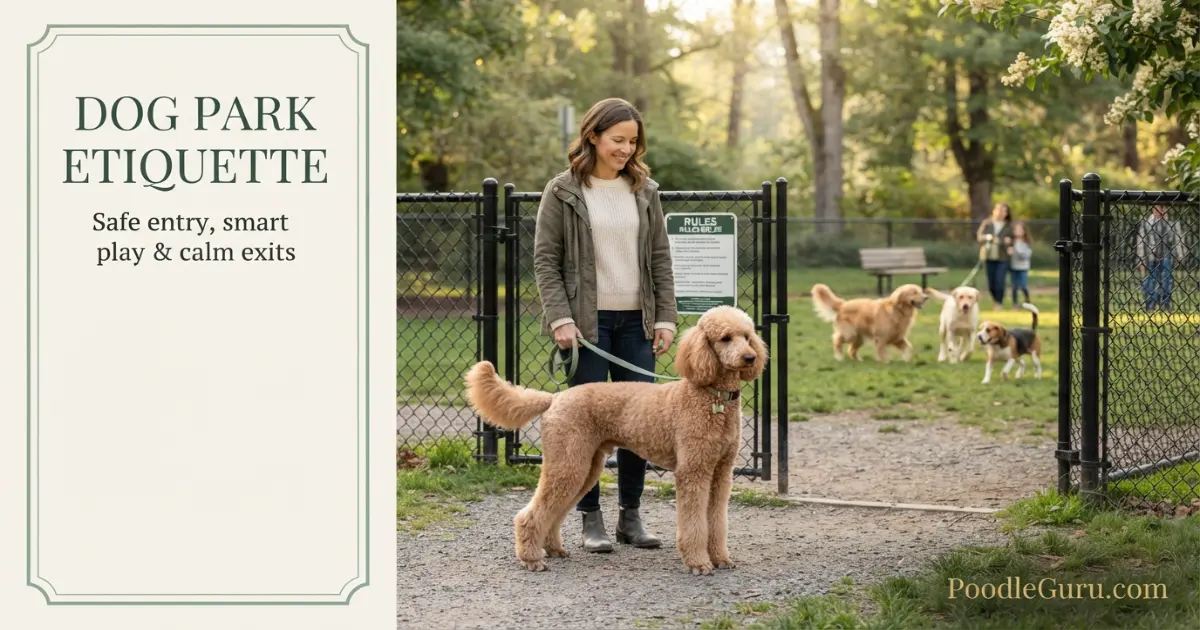
Check the park’s rules, confirm your poodle is healthy and appropriately vaccinated, and observe the dogs already inside before entering. Use the correct size section, avoid food and snag-prone equipment, stay close enough to intervene early, and watch for loose, reciprocal play rather than relentless chasing or pinning. Remove the leash only inside the secure entry area and only as local rules direct. Leave when your dog asks for space, play stops being balanced, the park becomes crowded, or owners are not supervising.
Is a Dog Park Right for Your Poodle?
Not every friendly dog enjoys a public off-leash park. Dog parks place unfamiliar dogs with different play styles, training histories, health status, and owner supervision in one shared space. Some confident, socially skilled poodles enjoy that environment. Others do better with a known play partner, a fenced rental field, a training class, a sniff walk, or parallel walking with another dog.
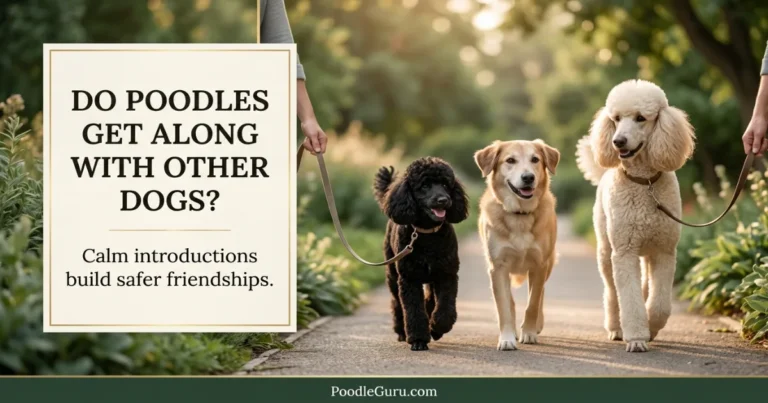
Your poodle does not need public dog-park visits to be “properly socialized.” Good socialization means being able to move through the world with manageable stress—not greeting or wrestling with every dog. Our guide to introducing a poodle to another dog explains a lower-pressure parallel-walk approach.
A Better Candidate
Your poodle enjoys unfamiliar dogs, disengages when called, shares space without guarding, recovers quickly from excitement, and can move away instead of escalating.
Use a Quieter Alternative
Your poodle is shy, easily overwhelmed, still learning recall, physically fragile, recently adopted, recovering from illness, or uncomfortable with unpredictable greetings.
Skip the Public Park
Your dog has a recent bite or fight history, guards toys or people, is ill, has contagious symptoms, is in heat, or becomes highly reactive around unfamiliar dogs.
Before You Go: Health, Rules, and Gear
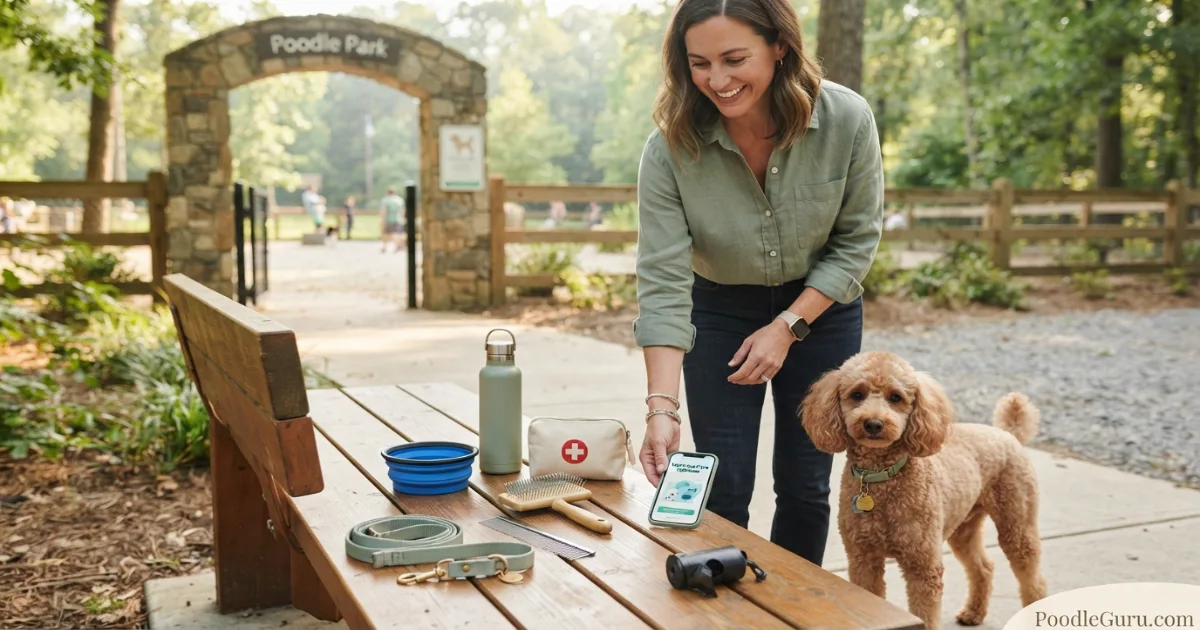
The safest dog-park visit begins before you leave home. Read the park’s posted rules because age limits, vaccination requirements, intact-dog policies, opening hours, and small-dog weight limits vary. Do not assume one park’s rules apply everywhere.
| Check | Practical Rule | Why It Matters |
|---|---|---|
| Veterinary clearance | Ask your veterinarian when your puppy or newly adopted dog is ready for shared dog spaces. | Public parks can expose dogs to respiratory and gastrointestinal disease and contaminated soil or water. |
| Vaccination plan | Keep core and legally required vaccines current. Discuss lifestyle vaccines such as Bordetella, canine influenza, and leptospirosis based on local exposure risk. | AAHA and AVMA guidance emphasizes individualized vaccination based on lifestyle, geography, and contact with other dogs. |
| Current health | Stay home for coughing, vomiting, diarrhea, fever, eye or nose discharge, unexplained lethargy, parasites, open wounds, or recent contagious illness exposure. | A dog may spread disease before a diagnosis is confirmed. |
| Identification | Use a secure flat collar or park-approved harness with current identification and a registered microchip. | Gates fail and dogs can escape during crowding. |
| Leash | Bring a standard leash. Avoid retractable leads in crowded gate areas. | Retractable cord can tangle dogs and reduce close control. |
| Water and cleanup | Bring fresh water, a clean bowl, and waste bags. | Shared bowls may be dirty or unavailable; prompt cleanup is basic etiquette. |
| Coat and body | Remove existing tangles, check nails and paw pads, and use a practical coat length for frequent outdoor play. | Moisture, friction, burrs, collars, and repeated mouthing can tighten tangles. |
About Puppies and Vaccines
Avoid using a fixed age such as “exactly 16 weeks” as the only rule. Vaccine schedules and local disease risk differ. AVMA advises caution in places where dogs gather until the initial vaccination series is complete, and your veterinarian should decide when your puppy is ready for a public dog park.
The PoodleGuru 4-Step Safe Park Entry
Gate congestion is one of the most stressful moments at a dog park. The goal is to avoid walking a restrained dog directly into a crowd of loose dogs. The following method should always be adjusted to the park’s posted rules and physical layout.
Observe From Outside
Stand far enough from the entrance that your poodle can remain calm. Watch for several minutes. Look for reciprocal play, adequate space, attentive owners, and dogs that can pause or disengage. Wait or leave if dogs are mobbing the gate, one dog is relentlessly chasing others, or the space is too crowded for safe movement.
Use the Airlock One Household at a Time
Let the previous user clear the double-gate before entering. Close the outer gate fully. Do not allow unfamiliar dogs to rush into the airlock. Follow posted instructions about where to remove the leash; never unclip your poodle outside an unsecured fence.
Move Away From the Entrance
Once safely inside, move calmly away from the gate rather than standing in the traffic zone. Let your poodle sniff and orient. Do not force immediate face-to-face greetings. If your dog freezes, tries to climb you, repeatedly heads for the exit, or cannot recover, leave without treating it as a failure.
Supervise Active Play
Stay mobile and watch your dog rather than your phone. Call your poodle away periodically for a brief reset. Good play resumes by mutual choice; a dog that repeatedly tries to escape, hide, or stay beside its owner should not be pushed back into the group.
Size Matters: Toy, Miniature, and Standard Park Strategies
Use the park’s posted weight threshold rather than guessing from breed name alone. Poodles vary within each size, and physical confidence matters as much as height. A small-dog section reduces—but does not eliminate—risk.
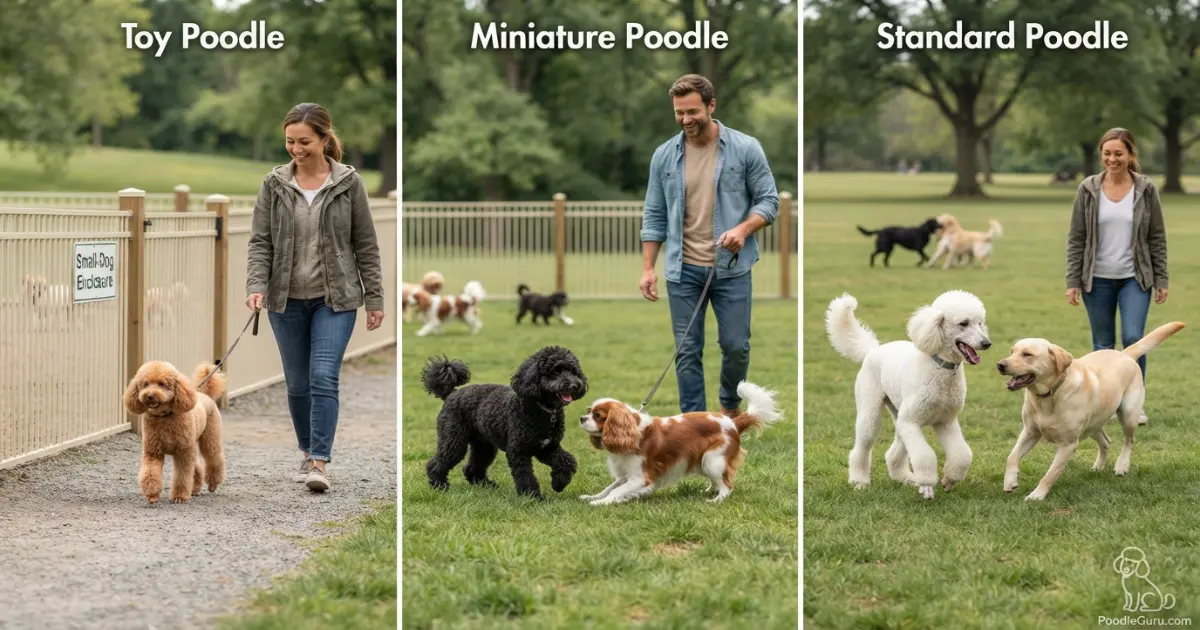
| Poodle Size | Safer Strategy | Main Risk to Watch | Better Alternative When Needed |
|---|---|---|---|
| Toy Poodle | Use a quiet small-dog enclosure with strict size limits, or choose known one-to-one play. | Accidental impact, trampling, crowding at the gate, and defensive behavior when overwhelmed. | Private fenced field, indoor training games, sniff walks, or a calm size-matched playdate. See the Toy Poodle guide. |
| Miniature Poodle | Choose the section that matches the park’s weight rule and your dog’s actual play style. | Being chased without relief, getting rolled by heavier dogs, or becoming over-aroused in a crowded group. | Parallel walks or small planned groups. Our poodle-with-small-dogs guide covers size mismatch in more detail. |
| Standard Poodle | Use the large-dog area only when play partners are socially appropriate and the park has room to disengage. | High-speed collisions, repeated body slams, joint strain, over-arousal, or conflicts around toys and gates. | Structured off-leash sessions with known dogs, hiking, retrieving, scent work, or a secure private field. |
Do Not Scoop Up a Small Poodle in the Middle of a Chaotic Group
Picking up a small dog while other dogs are jumping or fixating can increase chase behavior and place your hands and face near aroused dogs. Call your dog toward an exit, use distance and a barrier where possible, and leave through the gate. Pick up your poodle only when you have created enough space to do so safely.
Reading the Park: Play, Pressure, and Stress
No single tail position or sound tells the whole story. Read the entire body and the pattern of interaction. Healthy play is usually loose, curved, interrupted by pauses, and reciprocal. Stress or conflict is more likely when movement becomes stiff, one-sided, inescapable, or increasingly intense.
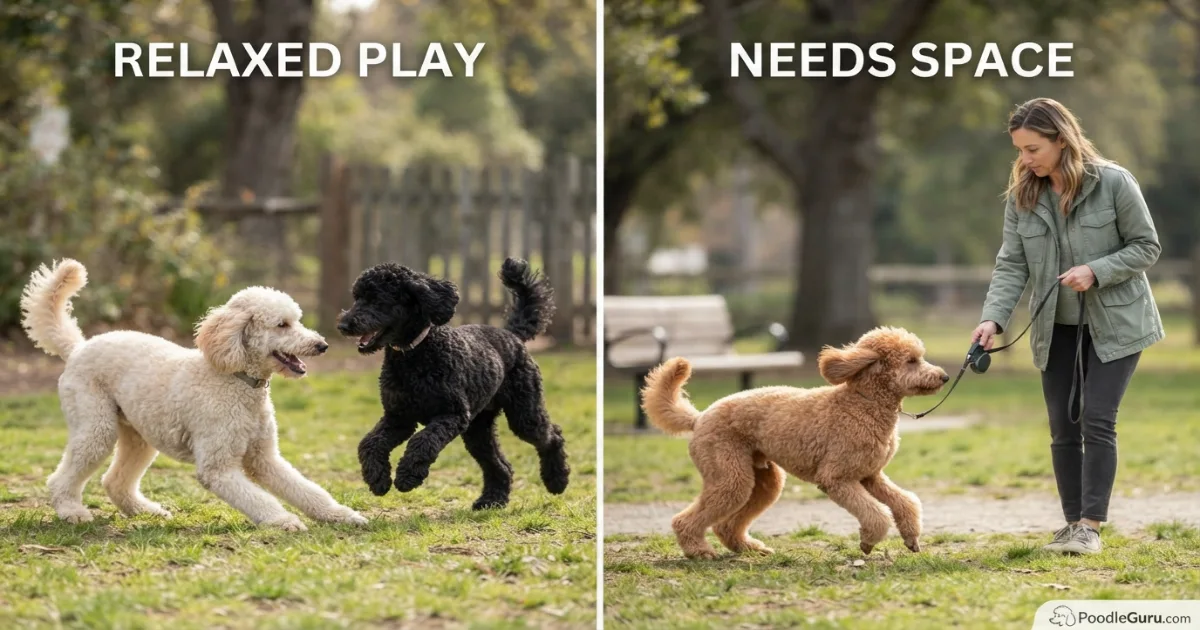
| What You See | Likely Meaning | Owner Response |
|---|---|---|
| Curved bodies, open mouths, play bows, brief pauses, roles switching | Relaxed, reciprocal play | Continue supervising and offer occasional recall breaks. |
| One dog chases continuously while the other repeatedly flees or hides | Play is no longer balanced | Call your poodle away, create distance, and end the interaction if the pursuer returns. |
| Freezing, hard stare, closed mouth, forward weight, stiff high tail | Rising tension or threat assessment | Increase distance immediately; do not wait for a growl or snap. |
| Tucked tail, pinned ears, crouching, repeated yawning, lip licking, hiding behind owner | Discomfort or need for space | Move toward the exit and allow recovery away from the group. |
| Repeated mounting, pinning, neck grabbing, body slamming, or ignoring another dog’s attempts to stop | Over-arousal, bullying, or unsafe mismatch | Interrupt early with recall and separation. Leave if it repeats. |
| Brief shake-off, sniffing, or pause followed by loose re-engagement | Self-regulation and reset | Allow play if both dogs voluntarily return and remain loose. |
Managing Play Without Micromanaging
You do not need to stop every chase or vocalization. Your job is to protect choice. Both dogs should be able to pause, move away, and return voluntarily. Call your poodle away every few minutes, reward attention outside the main play cluster if park rules permit food only beyond the fence, and then decide whether to re-enter play.
Protecting a Poodle Coat at the Park
Poodle curls can tighten where moisture and friction meet—especially behind the ears, under the collar, in the armpits, around the tail base, and between the legs. Prolonged coat mouthing, wet grass, mud, harness rubbing, and burrs can turn small tangles into mats. The coat does not “mat in seconds,” but delaying a post-park check makes tangles harder to remove.
- Start with a combed, dry coat rather than spraying heavy product before play.
- Use a practical clip if your poodle regularly runs outdoors.
- Interrupt repeated grabbing of ears, topknot, tail, or long body coat.
- After the visit, inspect the collar line, ears, armpits, groin, feet, and tail base.
- Brush only after removing burrs and checking for skin pain, punctures, or swelling.
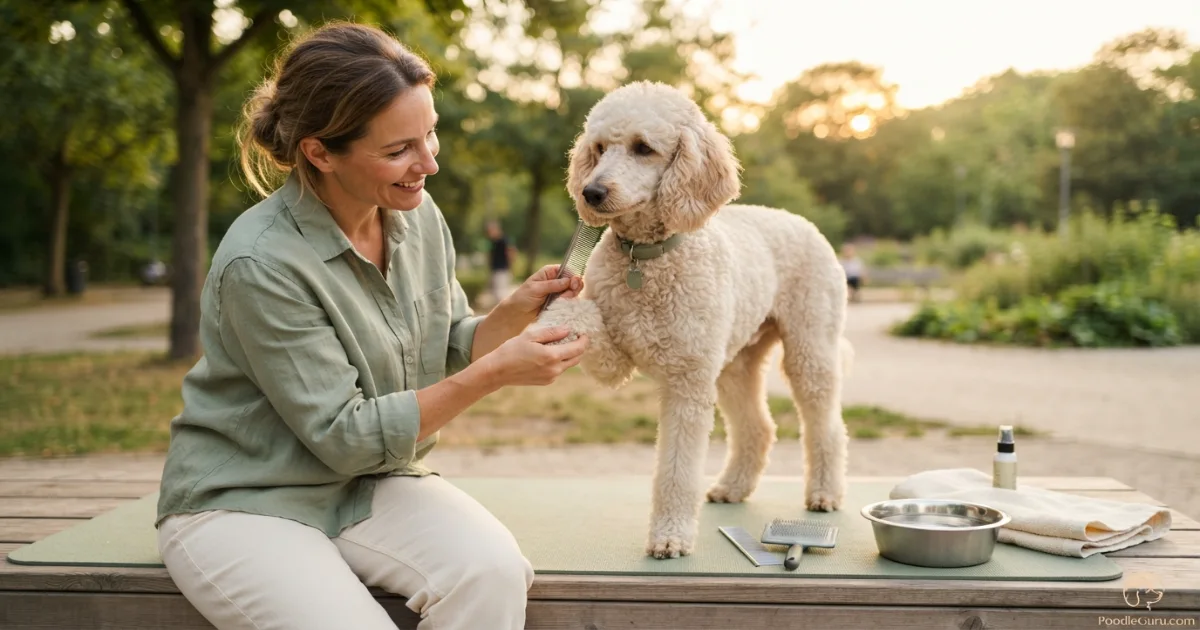
Use the Poodle grooming schedule to build a regular mat-prevention routine, and review how much exercise a poodle needs for safer alternatives to crowded parks.
When to Leave the Dog Park Immediately
Leaving early is responsible ownership. Do not wait for an injury to prove that the visit was going badly.
- Your poodle repeatedly asks to leave, hides, freezes, tucks the tail, or cannot disengage from you.
- Another dog repeatedly pursues, mounts, pins, corners, or guards access to people, gates, toys, or water.
- Play becomes stiff, silent, and one-sided—or intensity continues rising after a reset.
- The gate area is crowded and owners cannot control entries and exits.
- An owner is absent, distracted, dismissive, or unwilling to call off an incompatible dog.
- Your dog starts limping, overheats, coughs, vomits, develops diarrhea, or appears suddenly tired or disoriented.
- A fight occurs anywhere nearby and the group remains highly aroused.
- You cannot clearly see or reach your poodle because the park is too crowded.
What to Do if a Dog Fight Starts
Never Reach Between Fighting Dogs or Grab Their Collars
Aroused dogs can redirect a bite toward a person. Do not put your hands, face, or body between them. Call for the other owner, use an available solid barrier, water hose, blanket, or other remote interruption only if it can be done without moving into bite range, and follow the park’s emergency procedure. AKC safety guidance similarly warns against using your body or grabbing collars to separate fighting dogs.
Once the dogs are separated, move them out of sight of each other and do not restart play. Check for bleeding, punctures, pain, swelling, limping, breathing difficulty, eye injury, or shock. Small punctures can hide deeper damage, so contact a veterinarian after any bite or significant collision. Exchange contact information and report the incident according to local park rules.
12 Common Dog Park Etiquette Mistakes
| Mistake | Why It Is Risky | Better Choice |
|---|---|---|
| Entering while dogs crowd the gate | A restrained newcomer can feel trapped. | Wait until the entrance clears. |
| Staring at a phone | Early stress signals and escalating play are missed. | Move with your dog and supervise continuously. |
| Bringing food into a busy shared area | Food can create competition or resource guarding. | Keep treats outside the enclosure unless the park explicitly permits controlled use. |
| Leaving toys scattered | Balls and toys may trigger guarding or frantic competition. | Follow park rules and remove toys when conflict develops. |
| Using a retractable leash at the gate | Cords tangle and limit close control. | Use a standard leash. |
| Keeping a leash attached in the main off-leash area | The restrained dog cannot move naturally away from loose dogs. | Follow the park’s secure airlock procedure and posted rules. |
| Forcing a nervous dog to “socialize” | Flooding can intensify fear and reactivity. | Choose distance, parallel walking, or private play. |
| Assuming all barking is play | Vocalization must be read with posture, movement, and reciprocity. | Watch the entire interaction. |
| Waiting for a fight before interrupting | Stiffness and one-sided pressure usually appear first. | Recall and reset at the earliest tension. |
| Picking up a small dog inside a jumping group | Can attract jumping and place the owner in bite range. | Create space and exit first. |
| Bringing a sick dog or female in heat | Raises disease exposure and conflict risk. | Stay home and follow park rules for intact dogs. |
| Staying too long | Fatigue can reduce tolerance and self-control. | End while your poodle is still relaxed and responsive. |
Your Simple Park-Day Action Plan
Before Leaving
Check health, local rules, weather, identification, water, waste bags, leash, recall response, coat, paws, and nails.
At the Gate
Observe first, wait for a clear airlock, follow posted leash procedure, and leave if the existing group is incompatible.
During Play
Stay mobile, watch body language, protect choice, interrupt one-sided pressure, and use short resets.
After Leaving
Offer clean water, cool down calmly, check the whole body, remove debris, brush tangles, and monitor for illness or injury.
Dog Park Alternatives That Still Build Confidence
A public off-leash enclosure is only one option. Many poodles thrive with lower-pressure activities that offer more predictability:
- Parallel walks with one calm dog.
- Private fenced-field rentals.
- Small trainer-supervised social groups.
- Sniff walks, hiking, retrieving, swimming, and scent games.
- Known playdates with compatible dogs.
- Agility foundations, obedience, trick training, or structured enrichment.
The best activity is the one that leaves your poodle relaxed, physically safe, and willing to participate again—not the one that looks most social to other people.
Frequently Asked Questions
Can Toy Poodles safely go to dog parks?
Some confident Toy Poodles can use a quiet, well-managed small-dog enclosure with strict size limits. However, their small body size makes accidental impact more serious. Private playdates, fenced rentals, and parallel walks are often safer and equally valuable alternatives.
When can a Poodle puppy go to a dog park?
Use your veterinarian’s clearance rather than a fixed age alone. AVMA advises caution in places where dogs gather until the puppy’s initial vaccination series is complete. Local disease risk, vaccine schedule, park rules, and the puppy’s confidence all matter.
Should I bring treats or toys into a dog park?
Food and high-value toys can create competition among unfamiliar dogs. In a busy shared enclosure, it is usually safer to keep them outside the fence unless the park explicitly allows controlled use and no other dogs are crowding you.
How do I know whether my Poodle is enjoying the dog park?
Look for a loose body, curved movement, soft expression, easy pauses, voluntary re-engagement, and the ability to respond to you. Hiding, repeated escape attempts, tucked tail, freezing, frantic panting, or staying glued to you suggest the dog needs space or should leave.
How can I prevent my Poodle’s coat from matting after park play?
Begin with a tangle-free practical coat, stop repeated coat grabbing, and inspect the ears, collar line, armpits, groin, feet, and tail base after play. Remove burrs carefully and brush small tangles before they tighten. Do not brush over a painful area or suspected bite.
What should I do if another dog attacks my Poodle?
Do not reach between the dogs or grab collars. Call for the other owner and use a remote interruption or solid barrier only if you can stay outside bite range. Once separated, leave, exchange details, follow local reporting rules, and contact a veterinarian because punctures can hide deeper injury.
Is it okay if my Poodle does not like dog parks?
Yes. A Poodle can be well-socialized without enjoying crowded off-leash play. Parallel walks, calm playdates, training classes, scent work, retrieving, hiking, and private fenced exercise can provide safer physical and social enrichment.
Sources and Review Method
This guide was reviewed against current owner-safety and veterinary guidance from the American Kennel Club’s dog-park etiquette guidance, the American Veterinary Medical Association’s disease-risk guidance for canine social settings, the AVMA vaccination overview, the AAHA canine vaccination guidelines, and AKC guidance on play, fighting, and safe separation. Local park rules and veterinary advice take priority over general online guidance.
Summary: Dog Park Etiquette for Poodles
The best dog-park visit is not the longest or busiest one. It is a controlled experience in which your poodle remains loose, responsive, physically safe, and free to disengage.
- Confirm health, vaccination readiness, identification, and local park rules before visiting.
- Observe before entering and avoid a gate crowded by loose dogs.
- Use the section that matches the park’s posted size rule and your poodle’s actual play style.
- Healthy play includes pauses, turn-taking, and voluntary re-engagement.
- Leave at the first repeated stress signal, one-sided pressure, illness sign, injury, or loss of supervision.
- Never reach between fighting dogs or grab collars during a fight.
- Check paws, skin, ears, and high-friction coat zones after every visit.
- Skipping the dog park is completely valid when another activity suits your poodle better.