True Cost of Owning a Poodle: Year One Breakdown
The purchase price is just the beginning. The real cost of owning a poodle in the first year includes grooming, vet care, and the hidden expenses that catch new owners off guard. Here’s the honest breakdown — no surprises, just numbers.
Quick Answer
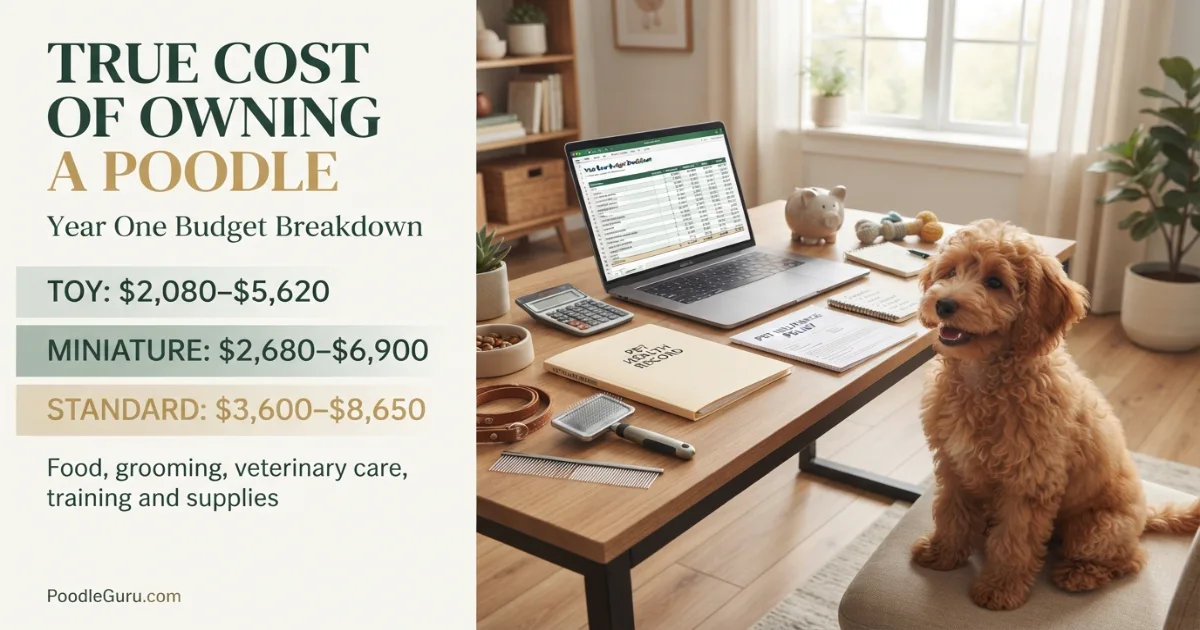
The first-year cost of owning a poodle typically ranges from about $2,080 to $8,650+ depending on the poodle’s size, acquisition route, location, and care choices. This includes the acquisition price (adoption or breeder), essential supplies, veterinary care, high-quality food, professional grooming, and training. Grooming alone often surprises new owners — poodles require consistent professional grooming every 4–8 weeks, and that’s a recurring cost that starts immediately. The most important thing to understand is that the upfront cost of the dog itself is rarely the largest expense. Planning your budget around the recurring costs — not just the purchase — is what separates a smooth first year from a stressful one.
🐩 Size Multiplies Costs
A Standard Poodle eats more, needs larger crates and beds, and incurs higher medication doses. Size directly scales recurring expenses.
✂️ Grooming Never Stops
Expect to spend $360–$900+ on professional grooming in year one alone. Learning to groom at home requires an initial tool investment but saves money long-term.
🩺 Vet Costs Peak Early
Puppy vaccinations, spay/neuter, and microchipping make the first vet year the most expensive. Budget $400–$900 for routine care.
📦 Supplies Add Up Fast
Crate, bed, bowls, collar, harness, leash, toys, and potty-training supplies can easily hit $300–$600 in the first month.
🧠 Training Isn’t Optional
Poodles need mental stimulation. Group classes or private sessions range from $150–$500. Skipping training often leads to behavioral costs later.
💡 Emergency Fund Rule
Set aside $1,000–$3,000 for unexpected vet visits. Poodles can have emergencies regardless of how careful you are.
Why First-Year Poodle Costs Surprise Even Prepared Owners
The cost of owning a poodle is the total financial commitment required to acquire, feed, groom, train, and provide medical care for a poodle during its first year. For poodle owners, this means understanding that the sticker price of the puppy is only about 20–40% of the total first-year expense. The most important thing to understand is that poodles, unlike many breeds, have a mandatory recurring grooming cost that never goes away — and that single factor reshapes the entire budget.
General dog ownership cost estimates often miss what poodles need. A breed with a continuously growing coat can’t skip the groomer. A breed this intelligent can’t skip training and enrichment. And a breed with size variation from 4 pounds to 70 pounds can’t be budgeted with a single number. The AKC poodle breed page describes three distinct sizes, and as you’ll see, the costs scale accordingly.
The PoodleGuru First-Year Budget Framework
At PoodleGuru, we evaluate the cost of owning a poodle not by a single bottom-line number but by five categories that interact. This framework helps you see where your money goes — and where you can adjust without shortchanging your dog. Use it as a planning tool, not a judgment.
One-Time Acquisition & Setup
This is the purchase price or adoption fee, plus the crate, bed, bowls, collar, leash, harness, and initial potty-training supplies. It’s the largest upfront hit. Expect roughly $150–$5,000+ across the wider market, although the companion-puppy ranges used in the table below are narrower. Adoption, breeder standards, pedigree, health testing, location, and placement terms all affect the price.
Recurring Care: Food, Grooming & Prevention
Monthly expenses you can’t pause. Quality food (roughly $25–$115 per month), professional grooming (commonly $60–$180+ per session depending on size and location), and parasite prevention prescribed for your dog’s needs. These numbers vary by poodle size but are non-negotiable for health and coat maintenance.
Veterinary: Routine & Unexpected
Puppy vaccination series, spay/neuter, microchipping, and at least one wellness check. Then there’s the emergency buffer: a poodle who eats a sock or breaks a tooth can generate a $500–$3,000 bill. Pet insurance or a dedicated savings account protects against this.
Training & Socialization
Poodles thrive on structure. Puppy kindergarten, basic obedience, or a few private sessions provide the foundation. Budget $150–$500. An untrained poodle often develops anxiety or destructive behaviors that cost far more to fix later.
Enrichment & Miscellany
Toys, puzzle feeders, treats, poop bags, a car restraint, a raincoat or sweater, maybe a DNA test. This category is small but persistent — $200–$400 over the year. Rotate toys to keep costs reasonable; poodles love novelty.
Budget Tip: The “Pretend It’s a Car Payment” Rule
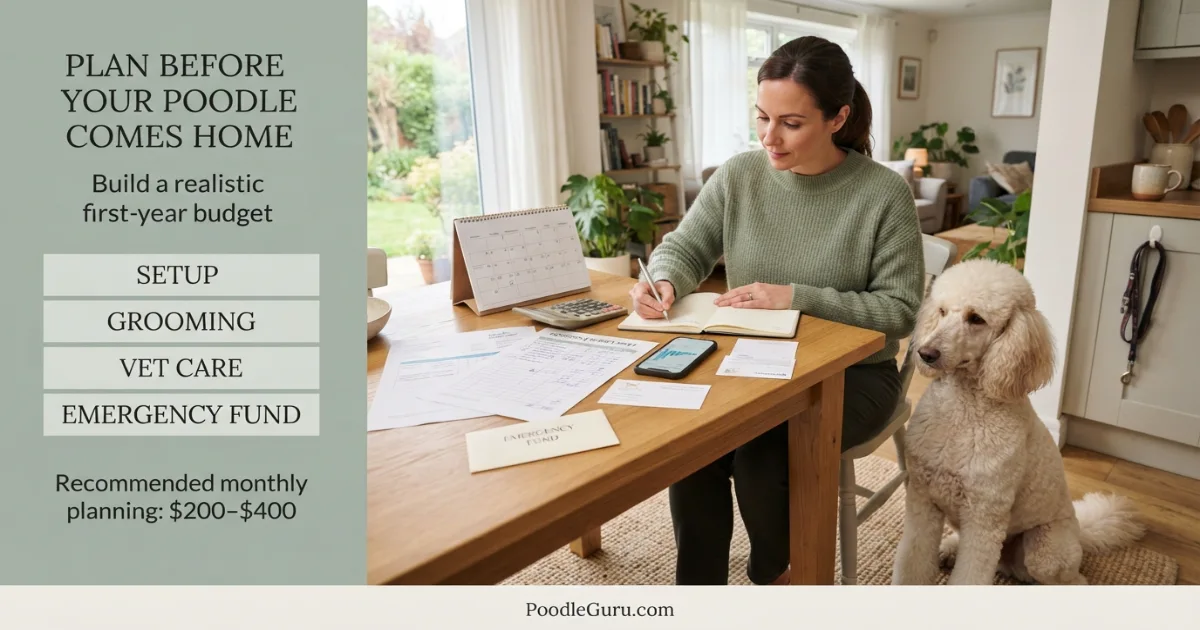
If you can comfortably set aside $200–$400 per month for your poodle (after the initial purchase), you’re in good shape. That covers food, grooming, prevention, and builds an emergency fund. If that number feels tight, consider adopting an adult poodle or choosing a smaller size.
Year One Cost Breakdown: Toy, Miniature & Standard
This table uses 2026 realistic price ranges. “Low” reflects careful spending (adoption, home grooming, minimal paid training). “High” reflects a typical companion puppy from a health-focused breeder, professional grooming, and full puppy training classes. Show, breeding-rights, imported, or unusually high-demand placements can exceed these acquisition ranges. All figures are rounded.
| Expense Category | Toy Poodle (Low–High) | Miniature Poodle (Low–High) | Standard Poodle (Low–High) |
|---|---|---|---|
| Typical acquisition (adoption or companion breeder) | $300–$2,000 | $400–$2,500 | $500–$3,000 |
| One-time supplies (crate, bed, bowls, leash, harness, etc.) | $200–$400 | $250–$450 | $350–$600 |
| Food (high-quality kibble/wet, year) | $200–$400 | $350–$600 | $600–$900 |
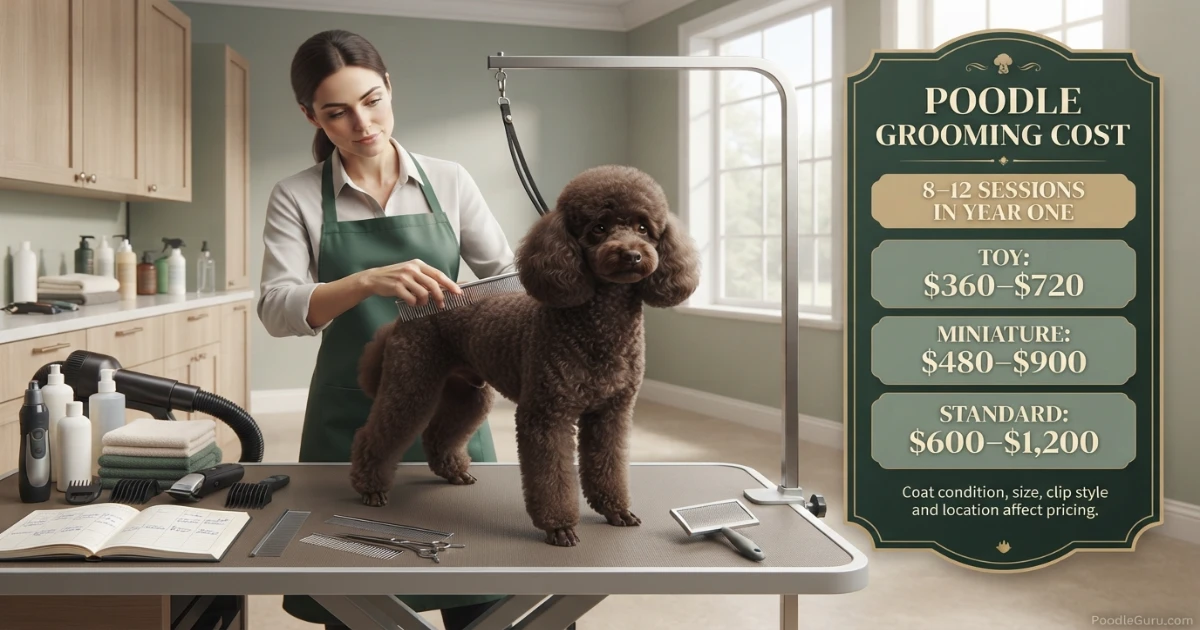
| Professional grooming (8–12 sessions) | $360–$720 | $480–$900 | $600–$1,200 |
| Routine vet care (vaccines, spay/neuter, microchip, wellness) | $400–$700 | $450–$800 | $500–$900 |
| Flea/tick/heartworm prevention (year) | $120–$200 | $150–$250 | $200–$350 |
| Training (group classes or private sessions) | $150–$400 | $150–$450 | $200–$500 |
| Pet insurance or emergency fund (year) | $200–$500 | $250–$600 | $400–$800 |
| Toys, treats, poop bags, misc. | $150–$300 | $200–$350 | $250–$400 |
| TOTAL FIRST YEAR (approximate) | $2,080–$5,620 | $2,680–$6,900 | $3,600–$8,650 |
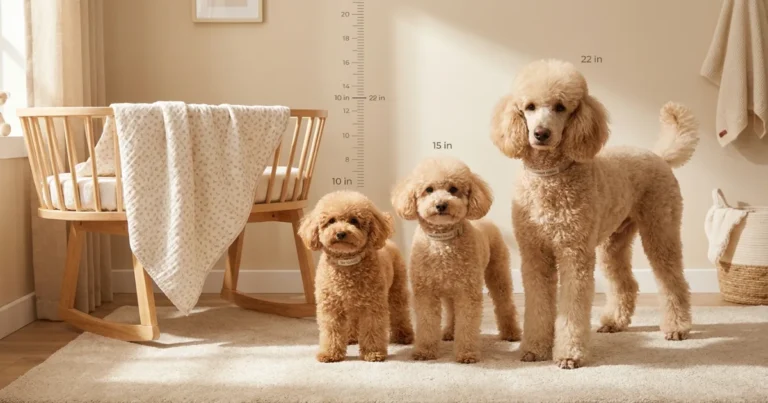
Notice the pattern: the gap between sizes widens as the year progresses. A Toy Poodle’s annual food bill is a fraction of a Standard’s. Grooming a Standard takes longer and costs more. Medications are dosed by weight. If you’re on the fence about size, the long-term cost difference is significant. For help choosing, see our poodle size chart.
Where the Money Really Goes: The Three Biggest Line Items
1. Grooming: The Non-Negotiable Recurring Cost
Poodle coats grow continuously. Without regular clipping, they mat painfully against the skin. Professional grooming every 4–8 weeks is the standard. Home grooming is possible — and many owners learn — but requires a quality clipper ($150–$300), shears, a high-velocity dryer, and a commitment to learning. Even if you groom at home, your first-year tool investment nearly matches the cost of professional sessions. There’s no free lunch on poodle grooming.
2. Veterinary Care: The Front-Loaded Year
Puppies need a series of vaccinations (DHPP, rabies, bordetella), deworming, and at least two to three vet visits before their first birthday. Spay or neuter pricing varies by location, clinic, dog size, and procedure timing; discuss the appropriate timing with your veterinarian, particularly for a Standard Poodle. Pet insurance may reimburse eligible expenses after the deductible, co-insurance, limits, and exclusions are applied. Compare policies carefully, especially their treatment of pre-existing conditions. Some clinics also offer wellness plans, but these are not the same as accident-and-illness insurance.
3. Training: The Investment That Prevents Destruction
A bored, untrained poodle can destroy furniture, bark excessively, or develop anxiety that requires a behaviorist — which costs far more than puppy classes. Group obedience classes run $100–$250 for a 6-week session. Private training is $75–$150 per hour. Think of training as insurance against behavioral problems. A poodle’s intelligence needs direction; without it, that brainpower turns toward mischief. Our guide to Poodle trainability and effective methods explains what to expect.
The Purchase Price Trap: What Buyers Misunderstand
Many buyers fixate on the puppy’s price tag and think the rest will be cheap. This leads to dangerous corner-cutting. The ASPCA pet-care cost guide separates recurring expenses from initial setup costs, reinforcing why the purchase price is only one part of the ownership budget. A low purchase price can become expensive when the seller provides no verifiable health testing, veterinary records, early socialization details, or written contract. A responsible breeder cannot guarantee that a dog will never become ill, but transparent health practices reduce avoidable uncertainty.
Buyer Tip: The Real Cost of a “Bargain” Puppy
A suspiciously cheap puppy may come without verifiable health results, individual veterinary records, early socialization, or a meaningful return policy. Price alone cannot prove quality, and even carefully bred dogs can develop health problems. Compare evidence, transparency, temperament, and buyer support—not just the deposit.
Buyer Red Flags That Inflate Year-One Costs
Certain selling tactics predict higher hidden costs. Watch for these warning signs when buying a poodle puppy.
| Red Flag | Why It Matters | Possible Consequence |
|---|---|---|
| “Teacup” or “micro” Toy Poodle marketing | These are marketing terms, not separate AKC-recognized Poodle varieties. Extreme size-focused breeding deserves careful scrutiny. | Greater uncertainty about mature size, structure, health, and breeder priorities. |
| No verifiable health-test results for both parents | Recommended tests differ among Toy, Miniature, and Standard Poodles. A vague claim such as “DNA clear” is not a complete health program. | Less information about inherited-risk management and potentially avoidable veterinary uncertainty. |
| Heavy “rare color” markup | Color demand does not replace health testing or temperament. Merle is not a recognized Poodle color, and merle-to-merle breeding carries additional welfare concerns. | You may pay a premium without receiving stronger health, structure, or buyer support. |
| Puppy offered before eight weeks | Very early separation can interrupt important learning with the mother and littermates. Ask why the placement is being rushed. | Greater socialization and behavior-management challenges for the new owner. |
| No written contract or return policy | Verbal promises are difficult to verify. The contract should explain health terms, registration, deposits, placement conditions, and what happens if you cannot keep the dog. | Unexpected financial responsibility and little support when a dispute or placement problem occurs. |
Can You Reduce Costs Without Cutting Corners?
Yes — but only in areas that don’t compromise your poodle’s health or well-being. Here’s where smart owners save.
✂️ Learn Home Grooming
After the initial tool investment, home grooming pays for itself within a year. Even doing every other groom at home cuts costs in half.
📦 Buy Supplies Strategically
Get a crate that adjusts with growth panels. Buy high-quality toys that last. Avoid fashion items that serve no function.
🐾 Adopt an Adult Poodle
Adoption fees are $100–$400. Many adult poodles come already spayed/neutered, vaccinated, and sometimes even groomed. The savings are immediate.
📋 Puppy Wellness Plans
Many vet clinics offer bundled packages that spread the cost of vaccinations, exams, and spay/neuter over monthly payments.
🧾 Pet Insurance Early
Compare policies while your Poodle is young and healthy, because pre-existing conditions are commonly excluded. Review the deductible, reimbursement percentage, annual limit, waiting periods, and exclusions before buying.
📚 DIY Training Foundations
Use positive-reinforcement books and free online resources for basic commands. Then take a group class for socialization and proofing.
Never cut corners on food quality, preventive vet care, or essential safety gear. For more tips on keeping your poodle healthy without overspending, see our guide to poodle lifespan and care.
Owner Action Plan: Budget Before You Bring a Poodle Home
Use this checklist before committing. It turns vague worry into a real plan.
Choose Your Poodle Size Based on Real Costs
Look at the table above. Can you comfortably afford the high-end estimate for the size you want? If the high end feels tight, consider a smaller poodle or adoption. Don’t talk yourself into a Standard if a Toy fits your budget better.
Research a Responsible Breeder or Rescue
A responsible breeder should provide verifiable health results appropriate to the Poodle variety, individual puppy records, a written contract, and clear return support. These practices cannot guarantee perfect health, but they show that inherited risks are being managed responsibly.
Create a Separate Savings Account
Open a dedicated “poodle fund.” Automatically transfer $200–$300 per month. This covers regular expenses and builds an emergency buffer. When the vet says your poodle needs a surprise dental extraction, you’ll be ready — not panicked.
Schedule the First Groomer and Vet Visit Now
Before the puppy arrives, arrange the first veterinary examination within the timeframe required by the breeder or rescue contract. Ask the breeder, veterinarian, and groomer when a low-stress introductory grooming visit is appropriate based on vaccination status and local disease risk.
Frequently Asked Questions
Is it cheaper to own a Toy Poodle than a Standard Poodle?
Usually, yes. Toy Poodles generally eat less and need smaller equipment and lower weight-based medication doses. However, breeder price, insurance, location, health needs, and grooming frequency can narrow or widen the difference.
How much does poodle grooming cost per month?
A practical planning range is about $60–$110 per Toy session, $75–$130 for a Miniature, and $90–$180+ for a Standard. Coat condition, clip complexity, location, and appointment frequency can move prices higher. Home grooming still requires equipment, maintenance supplies, time, and training.
Do poodles need pet insurance?
Pet insurance is optional, but it is worth comparing with a dedicated emergency fund. Policies differ in deductibles, reimbursement, annual limits, waiting periods, and exclusions, and they generally do not cover pre-existing conditions. Read the policy before relying on it for a future bill.
What’s the most expensive part of owning a poodle?
Grooming is usually one of the largest predictable recurring expenses. In the first year, the acquisition price and setup can be larger, while an unexpected medical problem can exceed every routine category. Budget for both predictable care and emergencies.
Can I cut costs by grooming my poodle at home?
Yes, but savings are not immediate or guaranteed. A safe setup may include clippers, blades, combs, shears, a table or restraint system, and a dryer. Many owners begin with brushing, bathing, and face/feet maintenance while using a professional for full clips.
Are poodles more expensive to own than other breeds?
Poodles often cost more to maintain than breeds with low-maintenance coats because clipping is a lifelong requirement. Total ownership cost still depends on size, health, insurance, food, training, boarding, location, and individual medical needs.
How much should I save before getting a poodle?
Before bringing a Poodle home, cover the acquisition fee and essential setup, then keep enough for several months of routine care plus a separate emergency reserve. For many households, a $2,000–$5,000 reserve beyond the purchase price is a useful goal, but the right amount depends on Poodle size, insurance, location, and access to credit or veterinary payment options.
Sources and Cost Methodology
The figures in this guide are planning ranges, not guaranteed quotes. They were reconciled with PoodleGuru’s current Poodle price guide and adjusted by Poodle size, equipment needs, grooming frequency, and common first-year care categories.
Breed-size context is checked against the American Kennel Club. Breeder-screening guidance follows current AKC health-testing guidance and the Poodle Club of America. General cost categories are compared with the ASPCA pet-care cost guide. For insurance decisions, review the AVMA pet-insurance questions and obtain policy-specific quotes.
Last reviewed: 2026. Actual costs vary by location, clinic, groomer, breeder or rescue, Poodle size, coat condition, insurance terms, and individual medical needs.
Key Takeaways: The Real Cost of Owning a Poodle in Year One
A poodle is a long-term financial commitment, not an impulse purchase. But when you budget honestly, the joy far outweighs the expense. Here’s what to remember:
- The detailed table in this guide places the typical first-year cost of owning a Poodle at approximately $2,080 to $8,650+, with Toy Poodles generally at the lower end and Standards at the higher end.
- Professional grooming is the single largest recurring expense that surprises new owners. Budget $360–$1,200 annually, or invest in home grooming tools and skills to reduce long-term costs.
- The lowest puppy price is not automatically the lowest ownership cost. Compare verifiable health testing, puppy records, temperament work, contract terms, and breeder support instead of choosing by price alone.
- Routine veterinary costs are often front-loaded in year one, while a separate emergency fund or carefully selected insurance policy can improve preparedness for unpredictable bills.
- Training and enrichment are not optional extras for a poodle — they prevent destructive behaviors that cost far more to correct. Budget $150–$500 for professional guidance.
- Using the PoodleGuru First-Year Budget Framework, create a monthly savings plan of $200–$400 after the initial purchase to cover food, grooming, prevention, and emergencies without stress.
Your next step: Write down the high-end estimate for your preferred poodle size. Open a savings account and set up an automatic transfer today. The future you — and your poodle — will thank you.