
How Much Exercise Does a Poodle Need Per Day? 7 Essential Rules
Poodles are not lapdogs who thrive on one slow stroll around the block. They are athletic, intelligent retrievers built for movement, problem-solving, and daily engagement. This guide answers how much exercise does a Poodle need by size, age, activity type, and energy level — because a Toy Poodle, Miniature Poodle, and Standard Poodle should never be exercised with the same routine.

How Much Exercise Does a Poodle Need? Quick Answer
Toy Poodles need 30–45 minutes of daily exercise. Miniature Poodles need 45–60 minutes. Standard Poodles need 60–90 minutes. But raw minutes miss the point — how you exercise a poodle matters at least as much as how long. A Standard Poodle walked on a slack leash for an hour is still under-stimulated. A Toy Poodle who gets 20 minutes of focused fetch plus a puzzle feeder may be perfectly content. The real goal is combining physical movement with mental engagement, and the ratios shift by size, age, and individual temperament.
Quick Facts: Poodle Exercise at a Glance
📏 Toy Poodle
30–45 min/day
Short walks, indoor fetch, puzzle toys. Easily satisfied with compact activity bursts. Over-exercise risk is real — watch those small joints.
🐾 Miniature Poodle
45–60 min/day
Brisk walks, off-leash play, agility foundations. The middle child often needs more mental work than owners expect.
🐶 Standard Poodle
60–90 min/day
Running, swimming, retrieving, structured training. A tired Standard is a well-behaved Standard. Under-exercise here causes real behavior problems.
Why Poodle Exercise Needs Are Different From Other Dogs
Poodles occupy an unusual space in the dog world. They look refined — almost delicate — but their working history tells a completely different story. The breed descends from water retrievers. These were dogs who plunged into cold lakes, swam against current, and retrieved waterfowl for hours. That genetic blueprint didn’t disappear when poodles moved from marsh to living room.
According to the AKC breed standard, poodles are described as “active, intelligent, and elegant” — with “active” listed first for a reason. Beneath the iconic coat is a muscular, athletic frame built for endurance. This isn’t a breed that tires out after a single loop around the park.
What makes poodles uniquely demanding, though, isn’t just their physical engine. It’s the combination of that engine with exceptional intelligence. A dog who is tired only in body but mentally restless will still dig, bark, chew, pace, and problem-solve in ways you won’t enjoy. Poodles need both tanks drained — physical and mental — and owners who underestimate either one usually pay for it in destroyed cushions and complaint calls from neighbors.
The three size varieties complicate things further. A Toy Poodle’s exercise ceiling is dramatically lower than a Standard’s, but his mental needs are nearly identical. That mismatch — a big brain in a small body — creates unique management challenges that generic dog-exercise advice simply doesn’t address.

Daily Exercise Requirements by Poodle Size
Here’s where most generic articles go wrong: they give a single number and move on. But a Toy Poodle puppy and a senior Standard aren’t even in the same universe. The table below maps what each size actually needs across the dimensions that matter — total time, ideal session structure, intensity level, and the non-negotiable mental component.
| Dimension | Toy Poodle (usually 4–10 lb / under 10 inches) | Miniature Poodle (usually 10–15 lb / 10–15 inches) | Standard Poodle (usually 40–70 lb / over 15 inches) |
|---|---|---|---|
| Total Daily Exercise | 30–45 minutes | 45–60 minutes | 60–90 minutes |
| Ideal Session Count | 2–3 short sessions | 2 sessions (1 longer, 1 shorter) | 2 sessions (both substantial) |
| Best Walk Length | 10–15 minutes each | 20–30 minutes each | 30–45 minutes each |
| Intensity Sweet Spot | Moderate — brisk walking, indoor fetch | Moderate-to-high — jogging intervals, off-leash play | High — running, swimming, sustained cardio |
| Mental Exercise Needed | 15–20 min (puzzles, scent games, short training) | 20–30 min (advanced puzzles, agility foundations) | 20–30 min (complex training, retrieve drills, nose work) |
| Over-Exercise Risk | High — small joints, luxating patella risk | Moderate — watch for lameness | Lower — but still monitor hips and growth plates in puppies |
| Under-Exercise Signals | Restlessness, barking, indoor zoomies | Demand barking, pacing, destructive chewing | Leash pulling, counter-surfing, digging, hyper-vigilance |
| Best Activity Match | Indoor fetch, short sniff walks, puzzle feeders | Agility, rally, brisk hikes, flirt pole | Swimming, running, dock diving, long retrieve sessions |
The takeaway here isn’t subtle: the gap between a Toy Poodle and a Standard Poodle is the gap between a neighborhood stroll and a genuine workout. But notice that mental exercise minutes barely change across sizes. A Toy Poodle’s brain is every bit as capable as a Standard’s — and that brain needs a job regardless of how short the legs carrying it are.
What Type of Exercise Actually Works for a Poodle?
Not all movement is equal. A poodle walked on a loose six-foot leash while you scroll through your phone is getting about as much enrichment as a hamster on a wheel. The breed needs activities that engage their retrieving instinct, their problem-solving drive, and their social attachment to you.
Structured Walks With Purpose
Walks should include sniffing latitude — poodles gather enormous mental stimulation from scent — but they also need moments of focused heeling, direction changes, and short obedience bursts. A good poodle walk alternates between free-sniff decompression and engaged teamwork. Think of it as a conversation, not a commute.
Retrieve Games and Water Work
If your poodle shows any retrieving interest — and most do — lean into it. Fetch on land is solid. Fetch in water is gold. Swimming engages muscles that walking doesn’t touch, and the retrieving sequence (chase, grab, return, deliver) lights up every circuit in a poodle’s working brain. Even a kiddie pool and a floating toy can transform a Standard Poodle’s afternoon.
Off-Leash Freedom (Safely)
Poodles, especially Standards, benefit enormously from off-leash running in secure areas. The difference between a leashed jog and an unleashed sprint is the difference between a treadmill and a soccer field. If you don’t have a fenced yard, seek out sniff spots, private dog parks, or early-morning empty fields. Just make sure recall is rock-solid first — poodles can be selectively deaf when something interesting moves.
📝 Expert Insight: Exercise vs. Arousal
One distinction owners often miss: exercise lowers physical energy, but certain activities raise arousal. Chasing squirrels, intense flirt-pole sessions, and uncontrolled dog-park chaos can leave a poodle physically tired but mentally wired. If your dog collapses for 20 minutes and then bounces back vibrating with restlessness, the activity burned calories but didn’t meet the need for calm, focused engagement. Balance high-arousal exercise with calming mental work — like a post-walk sniff session or a slow treat-release puzzle.

Mental Exercise: The Half Most Owners Skip
Here’s a truth that separates experienced poodle owners from frustrated ones: a physically exhausted poodle with an unstimulated brain is still a problem. The breed’s intelligence isn’t a party trick — it’s a working requirement. Poodles were bred to make independent decisions at a distance from their handler. That cognitive capacity doesn’t shut off just because you walked them for 45 minutes.
What Mental Exercise Actually Looks Like
Mental exercise is any activity that requires your poodle to think, problem-solve, or exercise impulse control. Common forms include:
- Scent work: Hiding treats or a specific scent article and letting your poodle hunt for it. Fifteen minutes of nose work can tire a dog as effectively as a 30-minute walk.
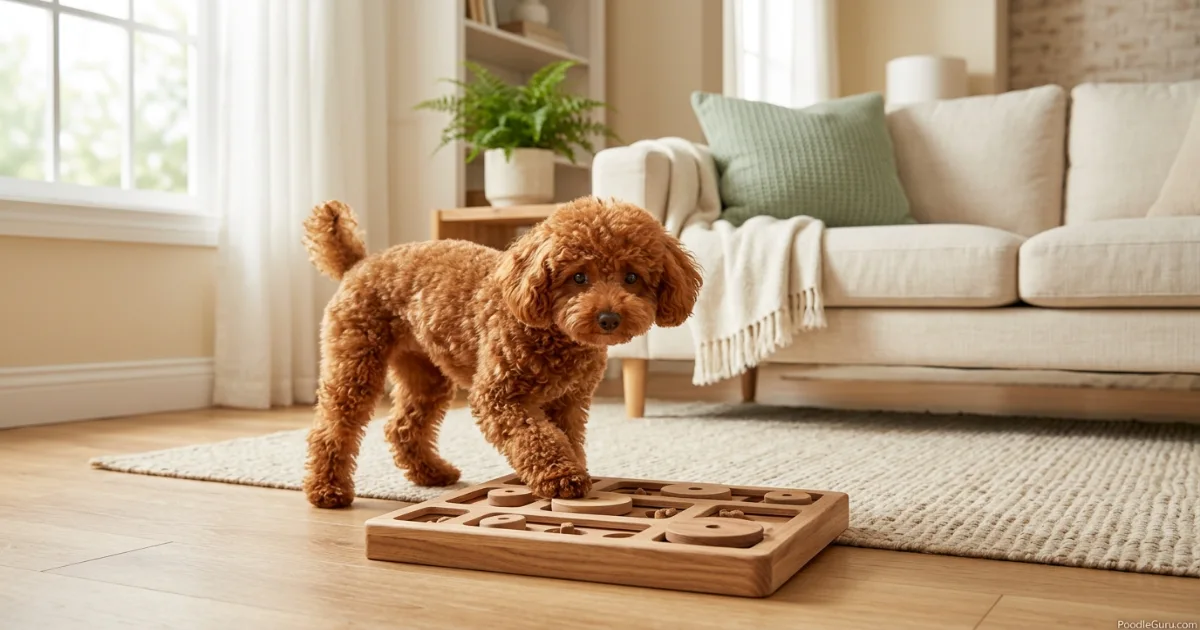
- Puzzle feeders and food-dispensing toys: Replace the food bowl. Every meal becomes a cognitive task.
- Short training sessions: Five minutes of focused obedience, trick training, or shaping a new behavior burns mental energy fast.
- Impulse-control games: “Leave it,” “wait,” and “settle” exercises teach a poodle to regulate their own arousal — a skill that pays dividends for life.
The most important thing to understand is that mental exercise isn’t a bonus add-on. For a poodle, it’s as essential as the walk itself. At PoodleGuru, we evaluate a daily routine not by minutes clocked but by whether both physical and mental needs were addressed. A 45-minute walk with zero cognitive engagement is half a plan.
Signs Your Poodle Is Under-Exercised (or Over-Exercised)
Poodles are expressive dogs. They’ll tell you when something’s off — but the signals aren’t always obvious, especially to first-time owners. Learning to read the difference between “I need more” and “I’ve had too much” prevents both behavioral problems and injuries.
| Sign | What It Usually Means | What to Adjust |
|---|---|---|
| Destructive chewing, digging, shredding | Under-exercised — the dog is creating its own enrichment | Increase total daily activity; add mental work before leaving the dog alone |
| Demand barking, pawing, nudging | Boredom or unmet social-exercise need | Add interactive play sessions; teach a “settle” cue |
| Nighttime restlessness, pacing | Pent-up energy without an evening outlet | Add a short evening walk or calming mental exercise after dinner |
| Leash pulling that won’t improve | Walk is the day’s only excitement — arousal is too high | Exercise before the walk; use the walk for training, not just energy release |
| Limping, stiffness after exercise | Over-exercise or joint stress | Reduce duration or intensity; add rest days; consult a veterinarian |
| Reluctance to move, lagging on walks | Fatigue, pain, or overheating | Stop immediately; check paw pads, hydration, and temperature; see a vet if persistent |
| Excessive panting, drooling, disorientation | Heat stress or over-exertion | Move to shade, offer water, cool gradually; seek emergency vet care if severe |
One nuance worth emphasizing: a poodle who collapses after exercise and sleeps for an hour isn’t necessarily “properly tired.” That pattern — extreme exertion followed by crash — can indicate the dog is being over-faced rather than appropriately challenged. The goal is a calm, content demeanor that lasts through the evening, not a dog who swings between mania and collapse.
How Exercise Needs Change With Age
A poodle’s exercise requirements shift significantly across three life stages. Applying adult guidelines to a puppy or a senior is one of the most common — and most damaging — mistakes an owner can make.
Puppies (8 weeks – 18 months)
Poodle puppies need frequent, short, low-impact activity. The old rule of five minutes of structured exercise per month of age (twice daily) is a reasonable starting point — so a four-month-old puppy gets roughly 20 minutes of structured walking twice per day. But unstructured play — zoomies, gentle wrestling, exploring — should happen freely throughout the day. Growth plates in puppies remain open until 12–18 months depending on size (later for Standards), and high-impact activities like jumping, long runs, or stair-climbing marathons should wait until skeletal maturity. For more on developmental stages, see our poodle puppy growth guide.
Adults (18 months – 7 years)
This is the window where you can push intensity safely. Adult poodles with healthy joints can run, swim, hike, and train at full capacity. The size-based guidelines in the table above apply here. This is also the stage where establishing a consistent routine matters most — adult poodles thrive on predictability and will remind you when it’s walk time with impressive accuracy.
Seniors (7+ years)
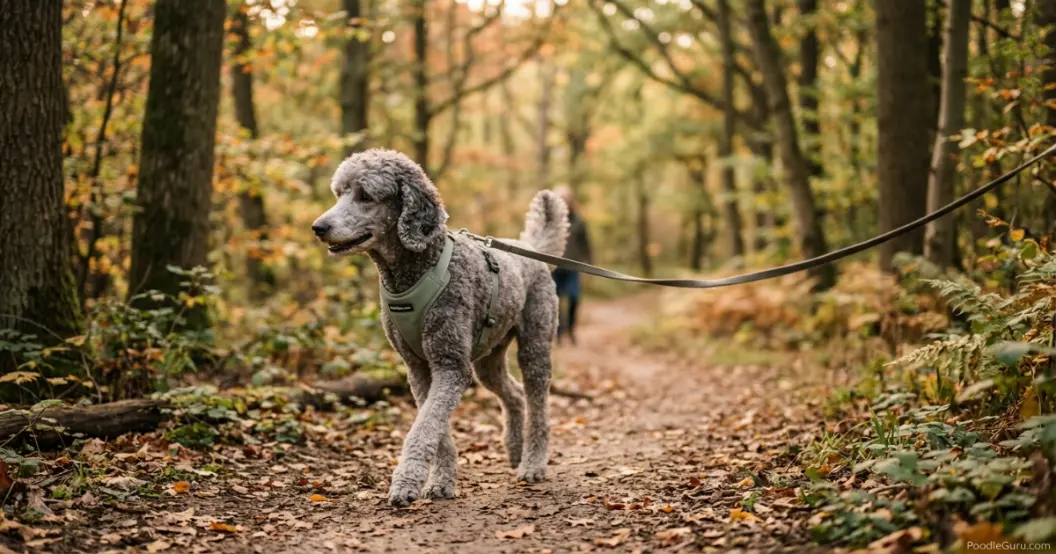
Senior poodles still need daily exercise — movement keeps joints lubricated and minds sharp — but intensity should dial back. Swap running for swimming, long walks for shorter sniff-rich strolls, and high-impact fetch for gentle retrieve games. Watch for stiffness after rest, reluctance to jump, or changes in gait. These can signal arthritis or other age-related conditions that a veterinarian should evaluate. The goal shifts from “tire them out” to “keep them comfortable and engaged.”
The PoodleGuru Daily Exercise Framework
At PoodleGuru, we approach poodle exercise planning through a simple four-part structure. It’s designed to be flexible across sizes, ages, and lifestyles while ensuring nothing critical gets skipped. Use this as a daily checklist rather than a rigid schedule.
The 4-Part Daily Exercise Framework
Physical Foundation (50–60% of daily exercise time)
Tool: Leash, secure outdoor space, or water access.
One or two focused sessions of walking, running, swimming, or fetch. This is the aerobic core. For Toys, it might be a brisk walk and indoor fetch. For Standards, it’s a run or a swim. The goal is elevated heart rate and full-body movement.
Outcome: Calm resting respiration within 10–15 minutes of session end. Not panting excessively or crashing.
Mental Enrichment (20–25% of daily engagement time)
Tool: Puzzle toys, scent articles, training treats, snuffle mat.
At least one dedicated session of brain work: nose games, trick training, puzzle feeders, or impulse-control practice. This doesn’t need to happen in one block — five minutes here and there adds up fast. Replace the food bowl with a food-dispensing toy to make this automatic.
Outcome: Dog settles willingly after the session, not seeking more stimulation.
Social Connection (10–15% of daily interaction time)
Tool: You. Treats, toys, calm presence.
Poodles are handler-focused dogs. They need interaction with you, not just activity near you. This can be a short training game, a grooming session, or quiet couch time with physical contact. The key is shared attention — the dog knows you’re present and engaged together.
Outcome: Dog seeks proximity calmly, not demand-barking or nudging for attention.
Recovery Check (end of day assessment)
Tool: Observation — gait, breathing, demeanor, appetite.
Before bed, run a quick mental checklist: Is the dog moving normally? Settling easily? Breathing relaxed? Eating and drinking normally? Any stiffness, limping, or unusual restlessness? This isn’t a formal exam — just a habit that catches problems early.
Outcome: Either peace of mind or an early signal to adjust tomorrow’s plan or call the vet.
This framework works because it’s size-agnostic and age-flexible. A Toy Poodle’s Physical Foundation might be 20 minutes of indoor fetch while a Standard’s is a 45-minute trail run — but both dogs need all four parts addressed every day. Skip Mental Enrichment for three days, and even a well-walked poodle will start finding their own “projects.” Skip Social Connection, and you’ll see attention-seeking behaviors escalate.
Common Exercise Mistakes Poodle Owners Make
Most of these aren’t obvious until you’ve lived with a poodle for a while. They’re the kind of mistakes that feel reasonable in theory but backfire in practice.
| Mistake | Why It Backfires | Better Approach |
|---|---|---|
| Treating all three sizes the same | A Toy Poodle’s joints can’t handle Standard-level intensity; a Standard can’t thrive on Toy-level walks | Match activity type and duration to size, not just breed |
| Skipping mental work entirely | Physical exercise alone doesn’t satisfy a poodle’s cognitive drive | Add at least one daily brain game or training session |
| Only exercising on weekends | Poodles don’t “bank” exercise. Two intense weekend days don’t compensate for five sedentary weekdays | Shorter daily sessions beat sporadic marathons |
| Dog park as primary exercise | Unstructured chaos raises arousal, risks injury, and teaches bad social habits | Use controlled playdates or solo exercise as the foundation; dog parks as occasional variety |
| Pushing through stiffness or reluctance | Pain signals are easy to miss in stoic dogs. “Pushing through” can worsen joint issues | Stop and assess; consult a vet if lameness or stiffness persists beyond 24 hours |
| No rest days ever | Muscles and joints need recovery. Constant high output increases injury risk | Build in one light day per week — gentle walk, mental games, no intense cardio |
🚨 When to Consult a Veterinarian
Exercise intolerance, persistent limping, stiffness that lasts more than 24 hours, labored breathing during mild activity, or sudden reluctance to exercise are all valid reasons to schedule a vet visit. Joint conditions like hip dysplasia (more common in Standards) and luxating patella (more common in Toys) benefit enormously from early detection. Don’t assume a poodle is “just being lazy” — pain often shows up as quiet withdrawal before it shows up as obvious limping.
Building a Daily Routine That Actually Works
A good poodle exercise routine isn’t about heroic effort. It’s about consistency and rhythm. Most poodles thrive on predictability — they learn when to expect activity and when to settle, and that internal clock reduces anxiety and demand behaviors.
Sample Daily Rhythm: Standard Poodle (Adult)
- Morning (30 min): Brisk walk or jog with sniff breaks, followed by 5 minutes of obedience drills
- Midday (10 min): Puzzle feeder or frozen Kong for mental engagement
- Late afternoon (30–40 min): Off-leash fetch, swimming, or long-line exploring — the day’s main physical outlet
- Evening (10–15 min): Calm sniff walk or indoor scent game, then settle time with a chew
Sample Daily Rhythm: Toy Poodle (Adult)
- Morning (15 min): Brisk neighborhood walk with plenty of sniffing
- Midday (10 min): Indoor fetch or tug session, puzzle toy with part of lunch
- Late afternoon (15 min): Second walk or active indoor play
- Evening (10 min): Snuffle mat, trick training, or calm interaction
These are templates, not prescriptions. The right routine for your poodle depends on their individual energy level, your schedule, and your environment. The non-negotiable elements are daily consistency, a mix of physical and mental work, and enough observation to notice when something needs adjustment.
For more detailed routine planning, see our complete poodle care guide, which covers daily schedules across all life stages.

When Weather or Health Interrupts the Routine
Extreme heat, ice, heavy rain, or post-surgery recovery will occasionally derail your plan. The key is having indoor alternatives ready before you need them. Indoor fetch down a hallway, hide-and-seek with treats, stair-climbing games (for healthy adults), and extended puzzle-toy sessions can substitute for outdoor exercise temporarily. What matters isn’t perfect adherence to the plan — it’s that the dog’s combined physical and mental needs are met most days. One or two off days won’t unravel a well-exercised poodle. A chronic pattern of under-stimulation will.
For guidance on exercising safely in hot weather, the AKC’s guidelines on canine exercise needs provide a helpful baseline for adjusting activity to conditions and life stages.
Frequently Asked Questions
How much exercise does a Toy Poodle need per day?
A Toy Poodle needs 30–45 minutes of daily exercise, ideally split into two or three short sessions. Because of their small joints, intensity should stay moderate — brisk walks, indoor fetch, and puzzle toys are ideal. Mental exercise matters just as much as physical movement for this size.
How much exercise does a Standard Poodle need per day?
A Standard Poodle needs 60–90 minutes of daily exercise, typically split into two substantial sessions. This should include aerobic activity like running, swimming, or sustained fetch, plus mental work. Standards are high-energy athletes — a single short walk won’t meet their needs.
Can you over-exercise a Poodle?
Yes. Toy Poodles are especially vulnerable to over-exercise due to their small joints and risk of luxating patella. Standards can also be overworked, particularly puppies whose growth plates haven’t closed. Signs include limping, stiffness, reluctance to move, and excessive panting. Always include rest days and watch for post-activity soreness.
What happens if a Poodle doesn’t get enough exercise?
Under-exercised poodles commonly develop behavioral problems: destructive chewing, demand barking, pacing, digging, leash pulling, and hyper-vigilance. These aren’t personality flaws — they’re a smart, athletic dog creating their own stimulation when none is provided. Consistent under-exercise can also contribute to weight gain and related health issues.
Do Poodles need exercise every single day?
Yes. Poodles don’t bank exercise from one day to the next, and skipping multiple days in a row reliably triggers restlessness and behavior issues. That said, one light day per week — a gentle walk with extra mental enrichment instead of intense cardio — is healthy and gives joints recovery time.
What’s the best type of exercise for a Poodle?
The best exercise combines physical movement with mental engagement. Swimming and retrieve games are ideal because they satisfy the breed’s retrieving heritage while being low-impact on joints. Structured walks with training interludes, scent work, and agility foundations are also excellent. Pure repetitive walking without engagement is the least efficient option.
How much exercise does a senior Poodle need?
Senior poodles (typically 7+ years) still need daily exercise, but intensity should decrease. Aim for 20–40 minutes of gentle walking, swimming, or calm sniff walks, depending on size and health. Joint-friendly activities become essential. Watch for stiffness after rest and adjust duration downward if recovery takes longer than it used to.
Can Poodles be left alone if they get enough exercise?
A well-exercised poodle with solid mental enrichment is far more likely to settle calmly when left alone. However, poodles are highly social dogs, and even a perfectly exercised one may struggle with long isolation. Exercise makes alone time manageable — it doesn’t eliminate the breed’s need for companionship. Separation anxiety is separate from exercise needs and may require professional training support.
Key Takeaways: Poodle Exercise Made Simple
Daily exercise for a poodle isn’t about hitting an arbitrary minute count. It’s about consistently meeting both the body and the brain where they are — and understanding that those needs shift by size, age, and individual temperament.
If you are still asking how much exercise does a Poodle need, start with the size-based daily range, then adjust based on age, recovery, behavior, and how calmly your dog settles after activity.
- Toy Poodles need 30–45 minutes of daily exercise; Miniatures need 45–60 minutes; Standards need 60–90 minutes — but quality of engagement matters as much as duration.
- Mental exercise is not optional for poodles. Puzzle toys, scent work, and short training sessions are as essential as the daily walk, and skipping them reliably produces behavior problems.
- The PoodleGuru 4-Part Daily Exercise Framework (Physical Foundation, Mental Enrichment, Social Connection, Recovery Check) ensures no critical need gets overlooked — regardless of size or age.
- Under-exercise signs include destructive chewing, demand barking, pacing, and nighttime restlessness. Over-exercise signs include limping, stiffness, reluctance to move, and excessive panting — both require immediate adjustment.
- Poodle puppies need frequent short sessions with low impact until growth plates close (12–18 months). Seniors need consistent gentle movement to maintain joint health and mental sharpness.
- One rest day per week with light activity and extra mental enrichment is healthy. Weekend-only exercise doesn’t work — poodles need daily consistency, not sporadic intensity.





One Comment