Poodle With Small Dogs: The Complete Safe Coexistence Guide
Quick Answer: A well-socialized poodle can live safely and peacefully with small dogs, but success depends on structured introductions, size-aware supervision, separate feeding, calm play rules, and respect for each dog’s personality. Toy and Miniature Poodles usually have easier size parity with small breeds, while Standard Poodles need more management around very tiny companions. The strongest success factor is not breed alone — it is early, positive, controlled exposure plus consistent daily routines.
You have a poodle. Or you are about to bring one home. And somewhere in your life — already curled on the couch or waiting at the rescue — is a small dog. Maybe a Chihuahua, a Papillon, a Yorkshire Terrier, a Dachshund, or a feisty little rescue mix. The question is practical: Can my poodle and my small dog actually live together safely? Will there be tension? Will my larger poodle accidentally hurt the little one? Am I setting myself up for constant management?
These are the right questions. They are the mark of a thoughtful owner. The answer is usually encouraging, but it is not a lazy yes. A poodle with small dogs can be a beautiful household combination when introductions are calm, resources are managed, and play is supervised until both dogs have earned trust through repeated safe patterns.
Quick Facts: Poodle With Small Dogs at a Glance
Publication safety note: This guide is educational and does not replace a qualified force-free trainer, certified behavior consultant, or veterinary behaviorist. If either dog shows repeated resource guarding, stiff body language, escalating fear, or any bite that breaks skin, get professional help early.
Understanding Poodle Temperament Around Smaller Breeds
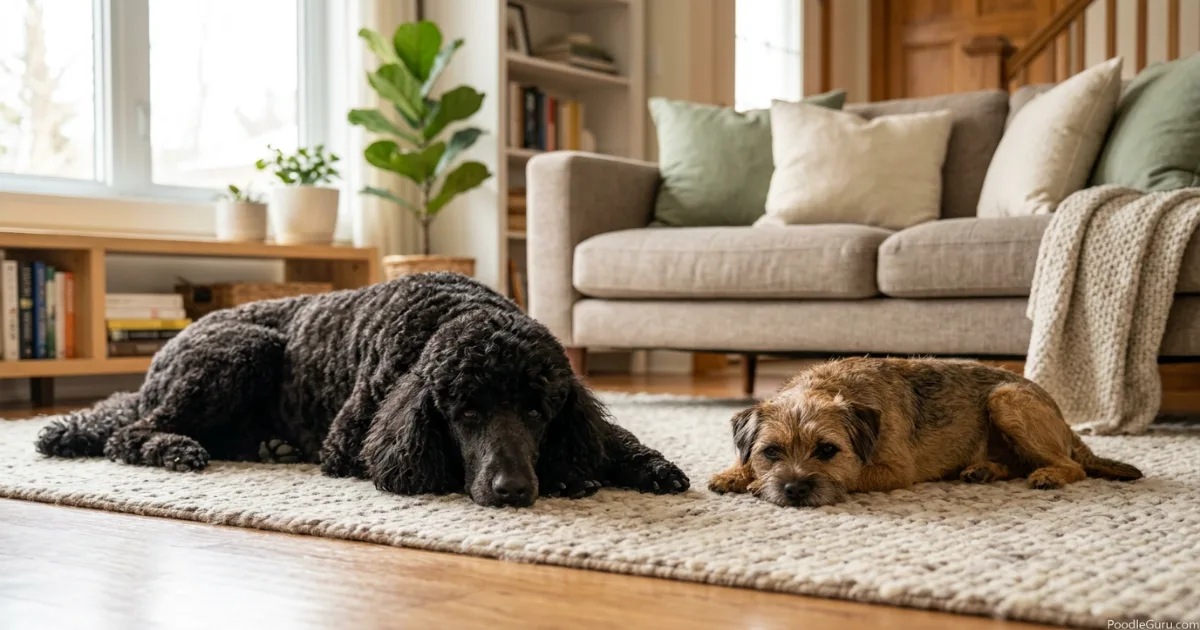
Poodles are intelligent, trainable, athletic, and strongly people-oriented. They were developed as working water retrievers and companions, not as terriers bred to grab small animals. That background helps explain why many poodles can learn calm, cooperative behavior around smaller dogs. It does not mean every poodle will automatically be gentle, but it gives owners a good foundation to build on.
Temperament is never a flat line. A nervous poodle from poor early socialization, a rescue with unknown dog history, or an adolescent Standard with too much energy and too little impulse control may need more structure than a calm, mature, dog-social poodle. Even a well-bred poodle can struggle if it missed safe exposure to different dogs during the early socialization period in the first few months of life.
The core truth is simple: a well-socialized poodle often has strong potential for peaceful coexistence with small dogs, but that potential becomes reality only when the owner manages introductions, resources, and play with intention.
💡 Expert Insight: Many owners report that Standard Poodles soften their play around tiny household dogs over time. Some even become nurturing, checking on the smaller dog and lowering their body during interaction. That is not guaranteed, but it is common enough to be worth noting — and it usually develops through calm repetition, not wishful thinking.
Why Size Difference Creates Unique Dynamics
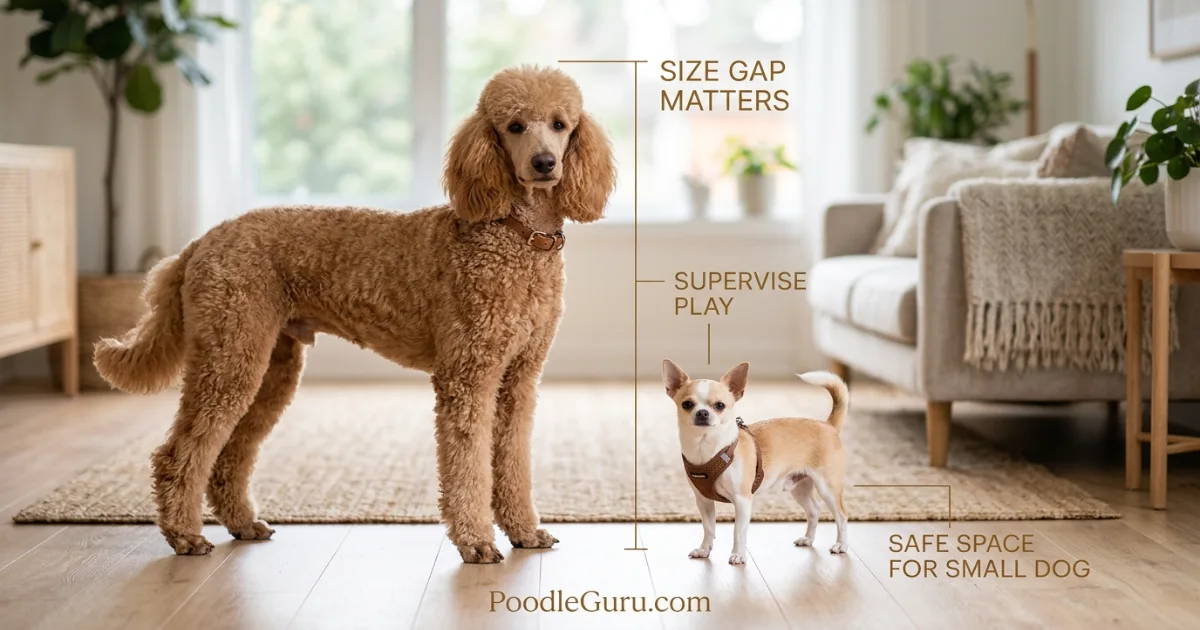
When people search for information about a poodle with small dogs, the unspoken worry is usually size. That worry is valid. A Standard Poodle can be many times heavier than a Chihuahua or Yorkie. Even when the poodle means no harm, a hard paw swipe, fast turn, or excited zoomie can injure a fragile small dog.
Size disparity creates three main risks:
1. Accidental injury during play. A Standard Poodle’s enthusiastic bounce or poorly aimed pounce can hurt a small dog. The poodle may be playful, not aggressive, but the outcome still matters.
2. Resource-guarding escalation. Food, chews, toys, beds, and human attention can create tension. A small dog may snap defensively if it feels crowded, and a larger poodle’s response can become dangerous simply because of size.
3. Missed social signals. Small dogs may freeze, lip-curl, hide, or suddenly bolt when uncomfortable. A poodle that is excited or inexperienced may miss those cues and keep pushing for play.
What Most Owners Get Wrong About Poodles and Small Dogs
The most common mistake is assuming, “My poodle is gentle with people, so he will be gentle with a small dog.” Human-directed gentleness and dog-directed social skill are not the same thing. A poodle can be affectionate with children and still be too physical, too excited, or too pushy with a tiny dog.
- Assuming the poodle knows its own strength. Poodles are athletic and quick. Standards especially do not automatically calibrate force for a 5-pound companion.
- Rushing introductions. Dropping a small dog into the poodle’s home without neutral territory and gradual exposure can create avoidable tension.
- Leaving them unsupervised too soon. Even dogs that seem fine for a few days need a longer trust-building period.
- Ignoring the small dog’s stress signals. Owners often watch the bigger dog while missing the smaller dog’s fear, stiffness, or avoidance.
- Treating all small dogs as the same. A bold Papillon, a fragile senior Yorkie, and a defensive rescue Chihuahua all need different management.
The Prey Drive Question: Separating Fact From Fiction
One worry in owner forums is that a poodle may see a tiny dog as prey. The more balanced answer is this: poodles are retrievers rather than terriers or sighthounds, so true predatory behavior toward another household dog is not typical. But individual dogs still vary. Some poodles will chase squirrels, birds, cats, or very fast-moving small dogs when arousal gets high.
The safer framing is not “poodles have no prey drive.” The safer framing is: do not assume your poodle is predatory, but do not ignore fixation, stalking, hard chasing, or inability to disengage. What owners often call prey drive is unmanaged play arousal, but play arousal can still injure a tiny dog if the owner lets it escalate.
🧪 Breed Reality Check: Poodles are recognized for intelligence, trainability, and an active working background. Those traits are helpful for coexistence training. Still, any repeated stalking, hard chasing, or stiff focus toward a small dog should be treated as a safety issue and addressed with management and professional guidance if it persists.
Poodle Varieties and Small Dog Compatibility
| Poodle Size | Common Size Reality | Compatibility With Very Small Dogs | Key Risk Factor | Management Level |
|---|---|---|---|---|
| Toy Poodle | Smallest poodle variety | High because size parity reduces physical risk | Same-size rivalry, resource guarding, fragile body size | Low to moderate |
| Miniature Poodle | Small-to-medium companion size | Good with many small breeds | Play style mismatch; may be too physical for frail seniors | Moderate |
| Moyen / Medium Poodle | Between Miniature and Standard | Moderate; noticeable gap with toy breeds | Accidental stepping, body-slamming, fast turns | Moderate to high |
| Standard Poodle | Largest poodle variety | Variable; depends heavily on temperament and training | Accidental injury, intimidation, resource imbalance | High initially; moderate after trust is proven |
Setting Up First Introductions the Right Way
The first meeting between a poodle and a small dog sets the emotional tone for the relationship. A rushed introduction can create tension that takes weeks to undo. A calm, structured introduction builds neutrality before closeness.
Step 1: Meet on neutral territory. Do not bring a new small dog straight into your poodle’s home. Use a quiet park corner, a friend’s fenced yard, or another calm place that does not feel like either dog’s territory.
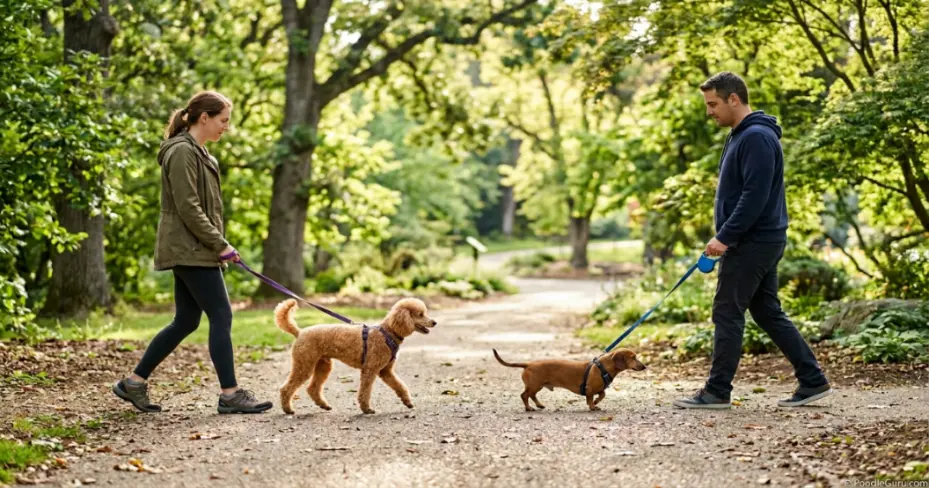
Step 2: Start with parallel walking. Walk both dogs in the same direction with enough distance that both stay relaxed. Gradually close the distance only if body language remains loose.
Step 3: Use brief greetings. Allow a 3–5 second sniff, then call both dogs away and reward. Short, repeated greetings are safer than one long, intense greeting.
Step 4: Keep leashes loose. Tight leashes create tension and can make dogs feel trapped. If either dog stiffens, increase distance rather than pulling them closer.
Step 5: Separate spaces at home. For the first several days, use separate resting areas, separate feeding zones, and supervised shared time. Coexistence does not require constant togetherness.
Daily Coexistence: Feeding, Playing, and Resting Together
Once introductions succeed, the real work begins: building a daily rhythm where your poodle with small dogs feels normal, not constantly tense. The best multi-dog households do not rely on luck. They rely on predictable routines.
Feeding Time
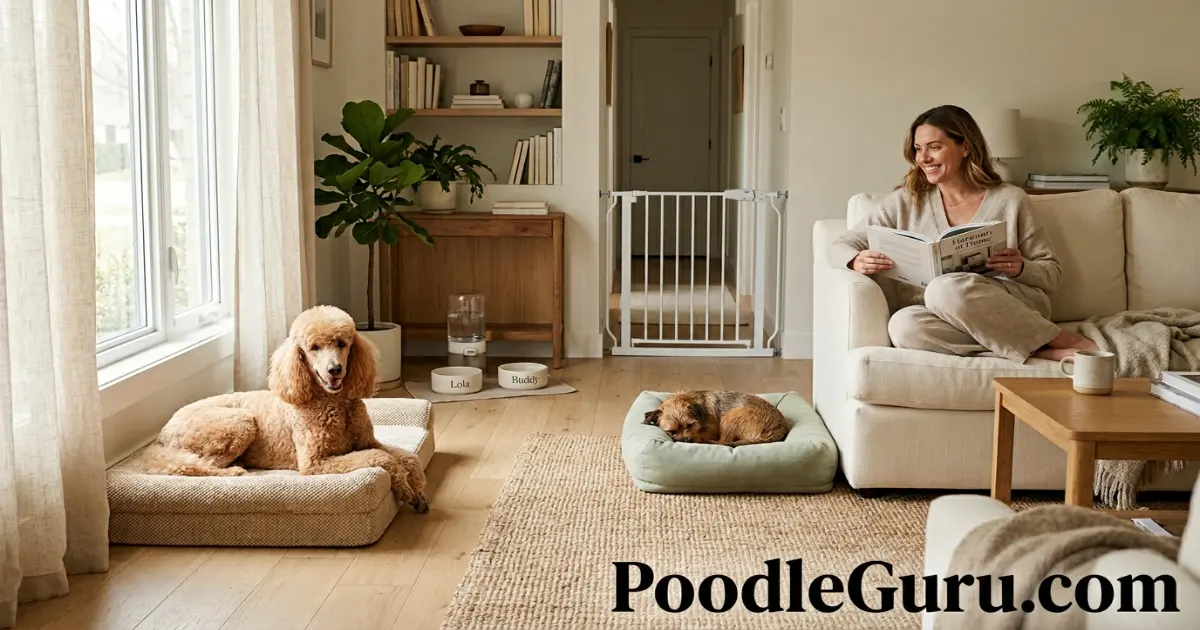
Feed dogs separately. Always. Use baby gates, crates, or separate rooms so each dog can eat without watching the other. This one habit prevents more household conflict than almost anything else.
Play Supervision
Good play includes role reversal: the chaser becomes the chased, the dog on top backs off, and both dogs re-engage willingly. If the small dog is always retreating, hiding, stiffening, or getting pinned, interrupt calmly and redirect the poodle to a toy or short training cue.
Resting Arrangements
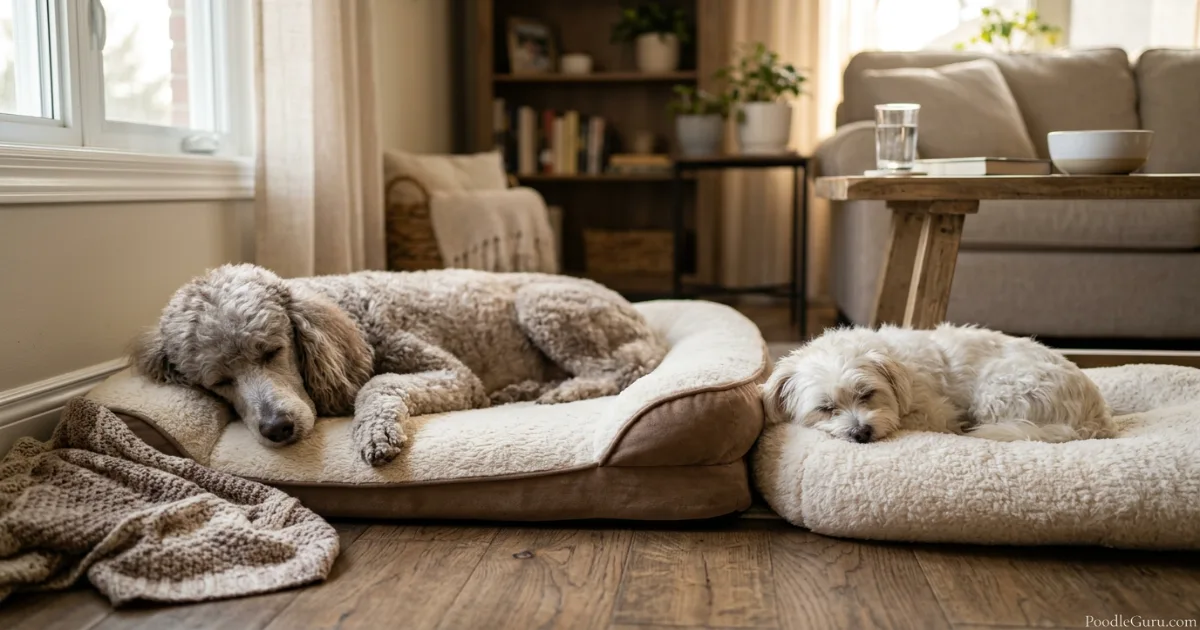
Do not force cuddling. Some dogs become best friends. Some simply coexist peacefully. Provide several beds and safe resting zones so the small dog does not have to share space before it feels ready.
📍 Pro Tips for Daily Management
- Use consent tests during play: Briefly pause the poodle. If the small dog moves away, play is done. If the small dog re-engages, play is mutual.
- Remove high-value chews: Do not leave bully sticks, bones, or food puzzles down when both dogs are loose together.
- Create safe escape routes: Use gated zones, stable raised beds, covered crates, or a small-dog-only room the poodle cannot access.
- Reward calm coexistence: Notice and reward both dogs when they relax near each other. Calm behavior should not go invisible.
Warning Signs and Body Language You Should Never Ignore
Dogs usually whisper before they shout. In a poodle with small dogs household, catching early signals matters because size imbalance can turn a small conflict into a serious injury.
From the poodle: hard staring, freezing over a resource, standing stiffly over the small dog, whale eye, repeated lip licking outside food contexts, blocking doorways, or a slow, tense tail wag.
From the small dog: hiding, cowering, sudden stillness, avoiding rooms where the poodle is present, lip-curling, snapping the air, rigid belly-up posture, or refusing to eat when the poodle is nearby.
None of these signs automatically means the dogs cannot live together. They mean the owner needs to reduce pressure, increase distance, remove resources, and slow the process down.
How Age Affects the Dynamic
Poodle puppy + adult small dog: Often manageable because the small dog can teach boundaries early. The risk is that a clumsy puppy may overwhelm a fragile or senior small dog.
Adult poodle + small dog puppy: Watch size and strength. An adult Standard’s playful paw swipe can hurt a tiny puppy even if the intent is friendly.
Senior poodle + senior small dog: Often peaceful, but pain can change behavior. Arthritis, dental pain, vision loss, or hearing loss may make either dog less tolerant of bumps and surprises.
Adolescent poodle + any small dog: This is the highest-management phase. Between roughly 6 and 18 months, many poodles have more energy, weaker impulse control, and bigger feelings. Supervision that worked at 5 months may not be enough at 10 months.
Common Myths About Poodles and Small Dogs
Myth 1: “Standards are too big to live with tiny dogs safely.” False as a blanket rule. Size creates risk, not inevitability. Many Standard Poodles live safely with Chihuahuas, Yorkies, Papillons, and small mixes when management is sensible.
Myth 2: “If they grow up together, they will always be fine.” Familiarity helps, but it does not prevent resource guarding, adolescent boundary testing, or accidental play injuries.
Myth 3: “My poodle never growls, so I do not need to worry.” Many poodle-small dog injuries are not aggression-driven. They are caused by size disparity and excitement.
Myth 4: “Small dogs are always the victims.” Small dogs can guard resources, snap first, chase attention, or provoke tension. Because the poodle is bigger, the owner must manage both sides fairly.
Training Essentials That Make Coexistence Work
Training is not about showing control. It is about giving both dogs a predictable language. For a poodle with small dogs setup, prioritize these skills:
1. Leave it. This cue should mean “disengage and return attention to me.” It interrupts fixation before it escalates.
2. Settle or place. Each dog should have a bed or mat where they can relax on cue. This lets you separate dogs without grabbing collars or creating tension.
3. Reliable recall. If play intensity rises, you need to call one or both dogs away immediately.
4. Calm handling. Teach both dogs that being gently moved, guided, or briefly held is not scary. This makes interventions safer.
When Professional Help Is the Right Call
Seek a qualified force-free trainer, certified behavior consultant, or veterinary behaviorist if you see repeated fights, any bite that breaks skin, resource guarding that escalates despite separation, persistent fear from the small dog, stiff stalking from the poodle, or play that repeatedly becomes too intense to interrupt. Early help is cheaper and kinder than waiting for a crisis.
🔎 Buyer & Owner Awareness: If you are adding a poodle to a home with a small dog — or adding a small dog to a poodle home — ask the breeder, rescue, or foster about the dog’s history with smaller animals. A dog that has already lived calmly in a multi-dog home gives you a stronger starting point.
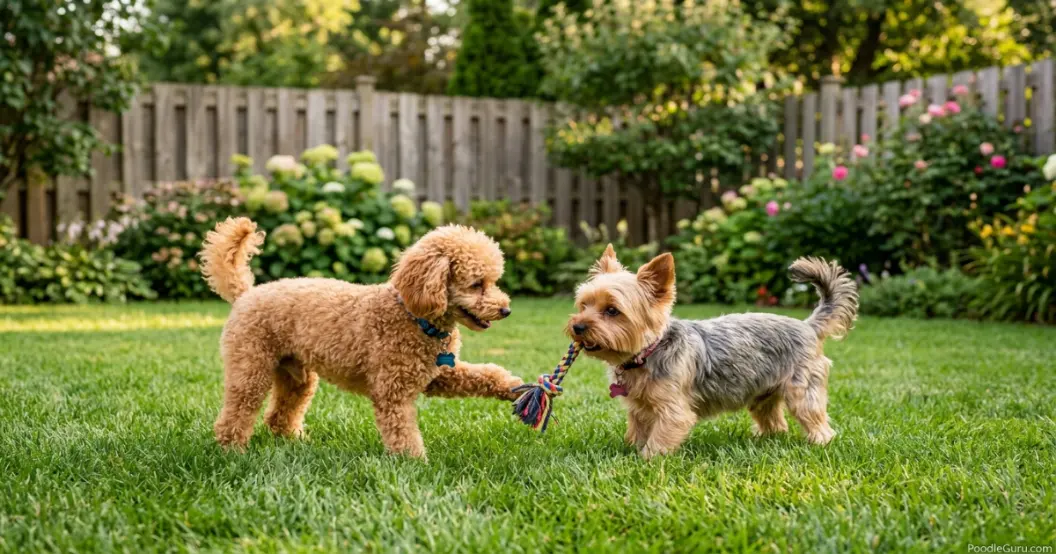
Practical Owner Insight: What Daily Life Actually Looks Like
It is not constant vigilance forever. The first few weeks require closer attention, but patterns solidify. Feeding separately becomes normal. Baby gates become part of the house. The poodle learns which play style is allowed. The small dog learns where it can retreat. That is what success usually looks like: not perfection, but predictable peace.
It is also not always a best-friend story. Some poodle-small dog pairs cuddle daily. Others simply share space and ignore each other. Peaceful coexistence is still a win. Your goal is not a viral video; it is a household where both dogs feel safe.
Price and Investment Considerations
💰 Cost Awareness for Multi-Dog Poodle Households
Plan for practical safety tools: quality baby gates or barriers, separate feeding stations, crates or rest zones, extra beds, and one or two professional trainer sessions if the introduction is tense. Pet insurance or an emergency fund is also wise when a large dog and tiny dog live together, because accidental injuries can become expensive quickly.
Frequently Asked Questions
Can a Standard Poodle live safely with a Chihuahua?
Yes, many Standard Poodles live safely with Chihuahuas, but the size difference requires careful introductions, supervised play, separate feeding, and escape routes for the Chihuahua. The risk is usually accidental injury, not intentional harm.
Will my poodle hurt my small dog during play?
It is possible if play becomes too rough, especially with a Standard or Moyen Poodle. Watch for pinning, chasing without role reversal, stiff body language, or the small dog trying to escape. Interrupt early and calmly.
Are Toy Poodles better with small dogs than Standards?
In physical safety terms, Toy Poodles usually have an advantage because their size is closer to other small breeds. However, Toy Poodles can still guard resources, become pushy, or clash with another small dog, so management still matters.
How long does it take for a poodle and a small dog to get along?
Basic tolerance may develop within a few days, but relaxed coexistence often takes several weeks. Deep bonding, if it happens, may take months. Rushing is the biggest mistake.
Should I get a male or female poodle if I already have a small dog?
Opposite-sex pairings can sometimes reduce same-sex rivalry, but temperament matters far more than sex. Choose the calmer, better-socialized dog over the “right” sex on paper.
What is the biggest mistake owners make when introducing a poodle to a small dog?
Rushing. Many owners move from first greeting to unsupervised time too quickly. A slow, multi-phase introduction builds safer long-term trust.
Do poodles have high prey drive toward small dogs?
Usually not in a true predatory sense, but individual dogs vary. Poodles are retrievers rather than terriers or sighthounds, so what owners call prey drive is often play enthusiasm or over-arousal. Repeated stalking, fixation, or hard chasing should still be managed seriously.
✓ The Safe Coexistence Summary
Bringing a poodle with small dogs into one household is not automatically risky, but it is intentional. The poodle’s intelligence and trainability provide a strong foundation. What protects both dogs is structured introduction, separate feeding, supervised play, safe escape routes, and respect for each dog’s signals. With the right approach, many poodles and small dogs do not just tolerate each other — they build peaceful, stable routines that make the home calmer for everyone.