How to Introduce a Poodle to Another Dog Safely
Poodles notice everything. The slight tension on a leash. The pause in your breath. The other dog’s ear position across the street. That intelligence makes them wonderful companions — and it also makes introductions higher-stakes than most owners expect. Done well, introducing a poodle to a new dog builds a calm, trusting multi-dog household. Done poorly, it can create reactivity that takes months to undo.
Quick Answer
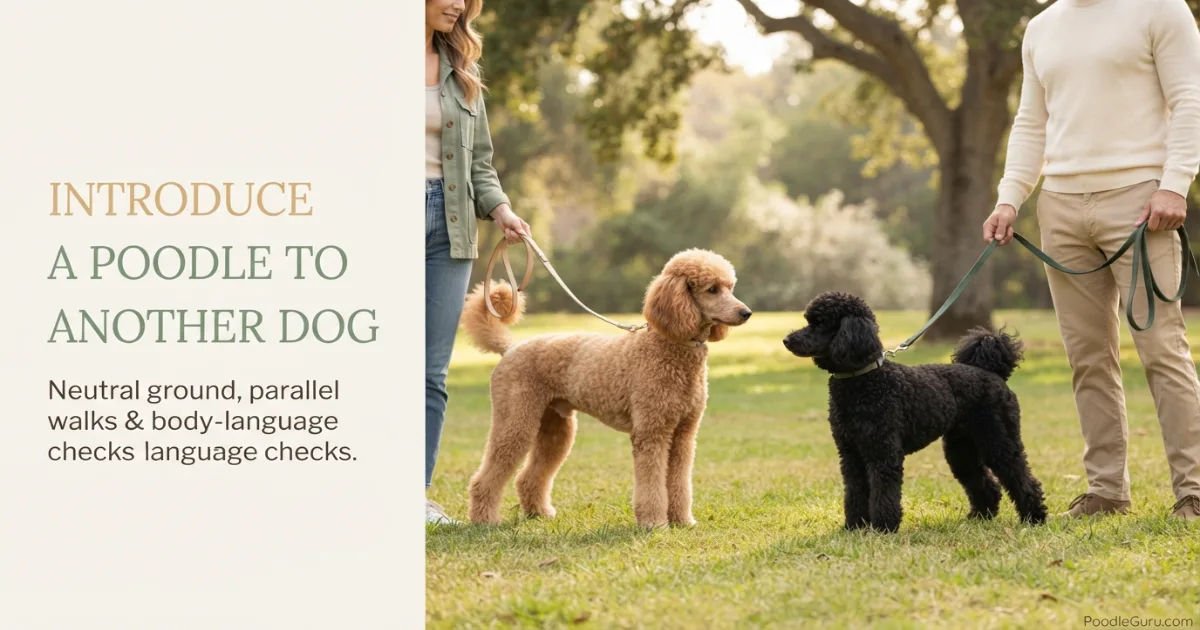
To introduce a poodle to another dog safely, start on neutral territory with a controlled parallel walk, both dogs on loose 6-foot leashes, and enough distance that neither dog is staring, barking, freezing, or pulling hard. Let the dogs walk near each other before any direct greeting. Keep the first sniff short — 5 to 10 seconds — then separate and keep moving. Poodles read human tension quickly, so your calm breathing, relaxed leash hand, and willingness to increase distance matter as much as the dogs’ behavior. Most failed introductions happen because owners rush the face-to-face moment.
Why Poodles Aren’t “Just Another Dog” in Introductions
Introducing a poodle to a new dog is not the same as introducing a retriever or a laid-back mixed breed. Poodles were developed as working retrievers with exceptional situational awareness — they read environments, handlers, and other animals with an intensity that most breeds don’t match. That’s a feature, not a bug. But it means introductions require more precision.
Where a Labrador might bounce through a clumsy greeting and recover instantly, a poodle often remembers. A tense first encounter can imprint. The dog may carry that wariness into future interactions, not because it’s “dramatic,” but because its brain is wired to learn from single exposures. This is especially true for Toys and Miniatures, who can develop leash reactivity after one bad experience that a larger, more resilient dog might shrug off.
The most important thing to understand is that your poodle is watching you as well as the other dog. If you’re gripping the leash, holding your breath, or staring, your poodle may register that tension and become more cautious. Your job is to create enough distance that both you and your dog can stay loose and calm.
What Owners Usually Misunderstand
The biggest mistake isn’t letting the dogs meet too early. It’s expecting a poodle to greet another dog the way a confident, goofy retriever would. Poodles tend to be polite but reserved with unfamiliar dogs. A quiet standoff with some sniffing is often a successful introduction. Owners misinterpret that reserve as “they don’t like each other” and intervene nervously, which actually creates the tension they feared.
Poodle Introduction Quick Facts
Best Location
Neutral territory — a quiet park, a friend’s yard, or a street neither dog considers home.
Ideal Distance
Start 20–30 feet apart. Close distance only when both dogs show relaxed body language.
Leash Setup
6-foot standard leashes, held loosely. No retractable leashes — they create tension and reduce control.
First Interaction
Keep it to 5–10 seconds of sniffing, then separate and walk. Short reps beat long greetings.
Warning Signs
Stiff body, closed mouth, hard stare, raised hackles. Increase distance immediately if you see these.
Success Timeline
Most smooth introductions span days, not hours. A single perfect meeting is rare.
Before the Introduction: What to Arrange First
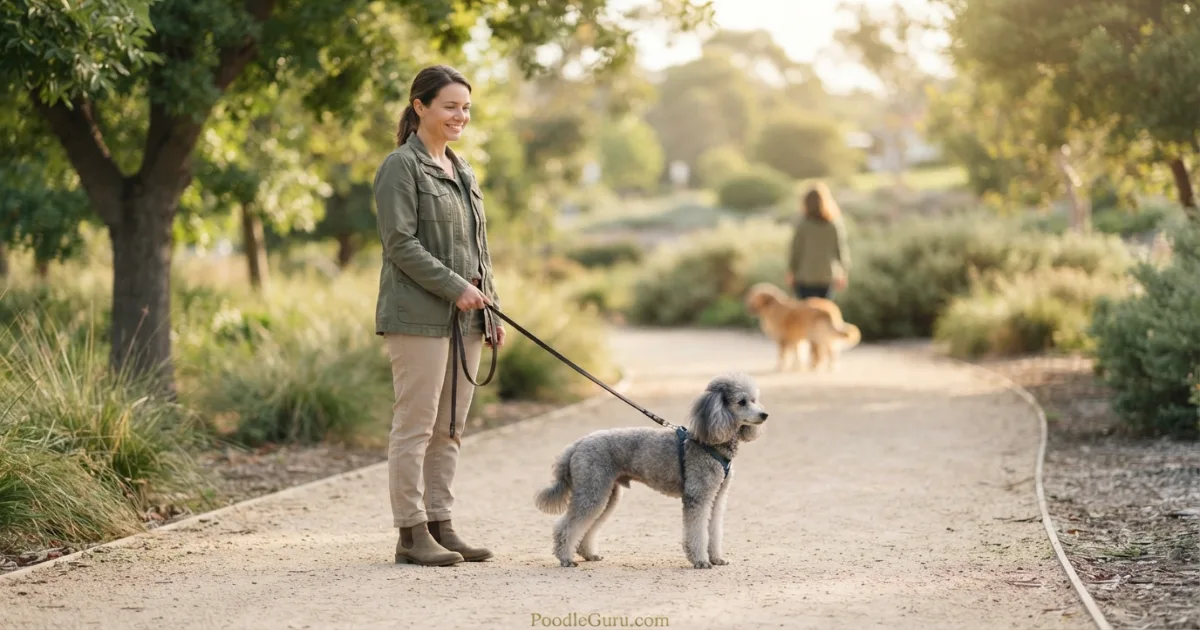
Most introduction guides skip straight to the dogs meeting. That’s a mistake with poodles. What you do before the dogs see each other shapes how the introduction unfolds. A few hours of preparation prevent weeks of behavior work later.
Exercise Both Dogs Separately First
A tired dog is not automatically a calm dog — but a dog who has had a good walk, some mental work, and a chance to eliminate is far less likely to be on edge. Take your resident poodle on a full walk before the introduction. Ask the new dog’s owner or foster to do the same. Two dogs meeting with pent-up energy is a recipe for over-arousal. Your poodle doesn’t need to be exhausted. Just settled.
Use Scent Before Sight
Poodles have excellent noses, and scent is a low-pressure introduction. Swap blankets or a towel that each dog has slept on for a day before the meeting. Let them investigate the scent at home, in their own time, with no other dog present. This is especially useful for poodles who are cautious by nature — it gives them information before any face-to-face pressure. Owners often notice their poodle is calmer at the visual meeting when scent has been exchanged first.
The PoodleGuru Parallel Walk Method
At PoodleGuru, we teach one method above all others for introducing a poodle to another dog. It’s not flashy. It’s not fast. It works because it respects how poodles process information — gradually, at a distance, with their handler as a safety anchor. This is the Parallel Walk Method.
Why Parallel Walking Works for Poodles
Direct face-to-face greetings are confrontational in dog body language. Many dogs find them inherently stressful. Poodles, with their heightened awareness, often find them very stressful. Parallel walking removes the confrontation. Both dogs move in the same direction, doing something normal — walking — while gradually learning that the other dog’s presence predicts nothing bad. Movement diffuses tension. The shared activity builds neutrality, which is the foundation of any good dog-dog relationship.
The Step-by-Step Protocol
Set Up Neutral Ground with Distance
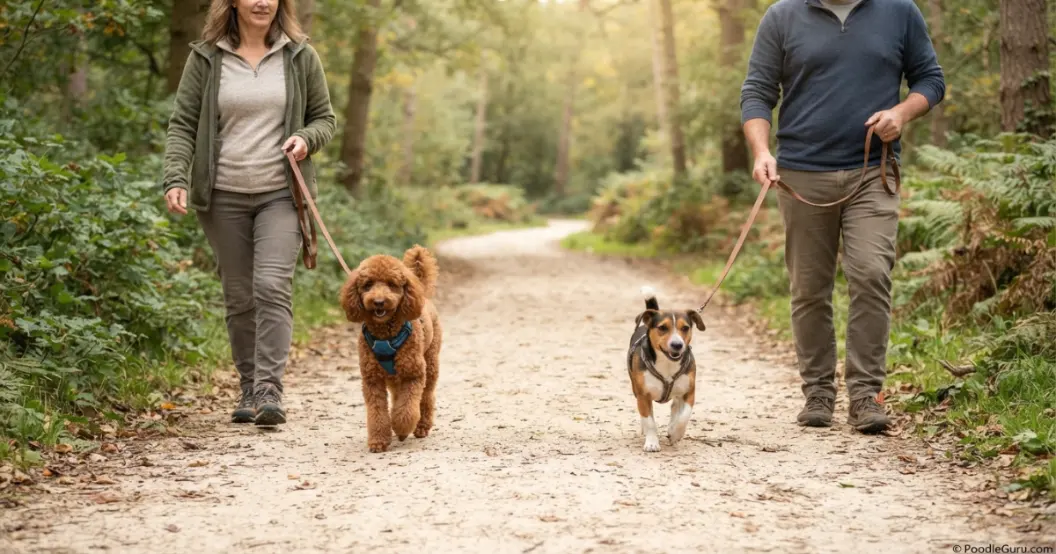
Choose a quiet outdoor space neither dog has claimed. Start 20–30 feet apart, both dogs on standard 6-foot leashes held loosely. Walk in the same direction — parallel paths or the same path with generous distance. No eye contact between dogs yet. Outcome: Both dogs notice each other without stiffening, barking, or fixating.
Walk for 5–10 Minutes Without Closing Distance
Keep moving. Don’t stop and stare. Don’t let the leashes tighten. If either dog pulls, freezes, or hard-stares, increase distance. The goal here is neutrality — both dogs accept the other’s presence as unremarkable. Outcome: Dogs walk with loose bodies, occasionally glancing at the other dog then looking away.
Gradually Narrow the Gap
Over the next 10–15 minutes, allow the parallel paths to come closer — 15 feet, then 10, then 6. Watch body language at every reduction. If tension returns, widen the gap again and spend more time there. This isn’t a failure — it’s information. Outcome: Both dogs walk comfortably within 6 feet of each other, relaxed and attentive to handlers.
Allow a Brief Rear Sniff While Moving
When both dogs have been calm at close distance for several minutes, allow a quick sniff — ideally rear-first, not nose-to-nose. Keep both dogs moving. This should last 5–10 seconds maximum. Then separate and keep walking. Outcome: Brief, polite investigation followed by easy disengagement.
Repeat Short Greetings Over Multiple Sessions
Don’t expect friendship in one walk. Repeat the parallel-walk-and-brief-sniff pattern over 2–3 sessions before attempting any off-leash or home interaction. Each successful session builds a history of calm co-presence. Outcome: Both dogs associate each other with relaxed walking, not pressure or conflict.
Trainer-Recommended Tools
Use a standard 6-foot nylon or leather leash — never a retractable. A well-fitted flat collar or front-clip harness works best for poodles. Avoid choke chains or prong collars during introductions; pain or discomfort during a greeting creates a negative association that’s hard to undo. Bring high-value treats (small, soft, smelly) and reward calm behavior throughout the walk, not just during the sniff.
Reading Poodle Body Language During Introductions
Poodles communicate clearly if you know what to watch. During introductions, you’re looking for two things: signs of relaxation (keep going) and signs of stress (increase distance). The table below breaks down what you’ll see and what to do about it.
| Signal | What It Looks Like | What It Means | What to Do |
|---|---|---|---|
| Loose, sweeping tail wag | Tail at mid-height, wide wags, body soft | Relaxed, friendly interest | Continue at current distance |
| Play bow | Front legs down, rear up, bouncy movement | Invitation to play — very positive | Allow brief interaction if both dogs reciprocate |
| High, stiff tail with small movements | Tail raised high, vibrating slightly, body tense | Arousal — could tip either way | Increase distance, let dog settle |
| Hard stare with closed mouth | Eyes fixed, mouth shut tight, body frozen | Threat assessment — high tension | Immediately increase distance, redirect with treats |
| Lip lick or yawn (out of context) | Tongue flick, exaggerated yawn when not tired | Stress or appeasement signal | Give more space, slow the introduction |
| Raised hackles (piloerection) | Hair standing up along the back or shoulders | Arousal — can be excitement or fear | Check other signals. If combined with stiffness, increase distance |

Mistakes That Make Poodle Introductions Worse
Good intentions don’t always produce good outcomes. Here are the most common errors owners make when introducing a poodle to another dog — and what to do instead.
| Mistake | Why It Backfires | What to Do Instead |
|---|---|---|
| Forcing a nose-to-nose greeting immediately | Direct face-to-face is confrontational in dog language. Poodles often find it threatening. | Use parallel walking first. Allow rear sniffing before any face contact. |
| Introducing on home territory | Your resident poodle may feel the need to defend its space, toys, or people. | Always start on neutral ground. Bring the new dog home only after positive off-site meetings. |
| Tightening the leash when nervous | Leash tension telegraphs your anxiety and physically restricts the dog, increasing frustration. | Breathe. Keep the leash loose. If you can’t relax, increase distance until you can. |
| Letting the first greeting go too long | Long greetings can tip from polite to over-aroused or irritated without warning. | Cap first sniffs at 5–10 seconds. Separate and walk. Short reps build comfort faster. |
| Punishing growls or warnings | A growl is communication. Punishing it removes the warning without removing the discomfort. | Respect the growl. Increase distance. A dog that’s corrected for warning may skip to biting next time. |
When to Get Professional Help
If your poodle has a history of leash reactivity, has been in a fight, or shows intense fear (cowering, screaming, trying to flee) at the sight of another dog, don’t attempt introductions on your own. A qualified force-free professional dog trainer, certified behavior consultant, or veterinary behaviorist can set up a safe, structured introduction protocol. The ASPCA’s guidance on dog behavior issues is a useful starting point for understanding when professional support is warranted. This isn’t failure — it’s responsible ownership.
Bringing the New Dog Home: The First 72 Hours
You’ve had successful neutral-ground meetings. Now the new dog is coming into your poodle’s territory. This is where careful management replaces the parallel-walk structure. The goal in the first three days is peaceful co-existence — not friendship, not shared toys, not instant pack harmony.
Separate Spaces First
Set up the new dog in a separate room or gated area with its own bed, water, and toys. Your resident poodle keeps access to its familiar spaces. The dogs can hear and smell each other through the barrier without any risk of conflict. Feed them on opposite sides of a closed door or baby gate so they associate each other’s presence with something positive — food.
This separation period typically lasts 24–72 hours, depending on how the dogs respond. Rushing it is the single most common cause of household tension in the first week.
Supervised Shared Time Only
When both dogs seem relaxed with the gate between them, allow short supervised periods together in a neutral room of the house — not near food bowls or favorite sleeping spots. Keep these sessions to 15–20 minutes. End on a positive note, separate again, and gradually increase the duration over the following days. Pick up all high-value toys and chews before shared time. Resource guarding between newly introduced dogs is common and preventable with simple management.
Owner Action Plan: First Week Checklist
- Day 1–2: Separate spaces, scent exchange through barriers, no direct contact inside the home.
- Day 3–4: Short supervised meetings indoors (15–20 min), no toys or food present.
- Day 5–7: Longer supervised periods, parallel walks outside, begin feeding in same room at distance.
- Week 2: Gradual normalization with continued management around high-value resources.
Special Case: Introducing a Poodle to Another Poodle
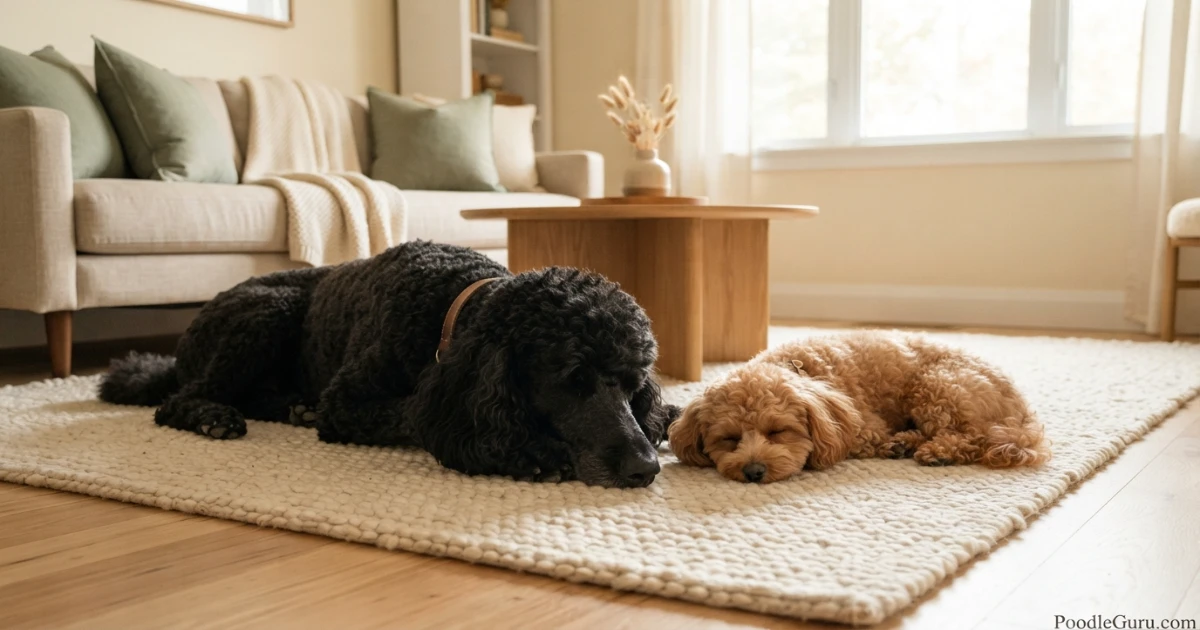
Multi-poodle households are wonderful. They’re also, occasionally, complicated. Two poodles under one roof means double the intelligence, double the sensitivity, and sometimes double the drama. The good news: poodles often recognize and appreciate each other’s communication style. A Toy Poodle and a Standard Poodle may settle into a rhythm faster than either would with a rougher, less socially precise breed.
The watchpoint is resource competition. Poodles bond intensely with their people, and a new poodle in the house can trigger jealousy that looks like guarding — of you, your lap, your attention. Counter this deliberately. Give the resident poodle attention first when you enter a room. Don’t let the new dog crowd you while the resident is nearby. These small signals tell the resident poodle that its position is secure, which reduces the impulse to compete. For more on how poodle temperament shapes daily life, our poodle temperament guide covers what to expect across all sizes.
Frequently Asked Questions
How long does it take for a poodle to accept a new dog?
Most poodles show acceptance within 1–3 weeks with proper introductions. Full comfort — relaxed sharing of space, toys, and attention — can take 2–3 months. Every dog is different. Some poodles adjust in days; sensitive or previously reactive dogs may need longer.
Should I introduce my poodle to a new dog on or off leash?
Start on leash, always. Loose 6-foot leashes on neutral ground give you control without creating tension. Off-leash introductions should only happen in a securely fenced area after multiple successful leashed sessions. Rushing to off-leash is a common cause of fights.
Why does my poodle growl at the new dog?
A growl is communication, not necessarily aggression. It usually means your poodle is uncomfortable — with the proximity, the speed of the introduction, or the other dog’s behavior. Respect the growl. Increase distance. Never punish a growl, which removes the warning without fixing the discomfort.
What if my poodle and the new dog fight during the introduction?
Separate them calmly and immediately. Do not reach between fighting dogs. Use a barrier if one is available, call them apart if they can disengage, or have handlers move away in opposite directions while keeping hands away from mouths. End the session, give both dogs at least 24 hours to decompress, and restart only with more distance and professional guidance if needed.
Can I introduce my poodle to a new puppy in the same way?
The same principles apply, with one adjustment: adult poodles may correct a rude puppy with a growl or snap. This can be normal canine communication when the puppy is too intense, but it still needs close supervision. Interrupt calmly if the adult dog looks trapped, if the puppy keeps returning, or if the correction escalates beyond a brief warning.
Are male or female poodles easier to introduce to another dog?
Individual temperament matters far more than sex. That said, opposite-sex pairings (male-female) tend to have lower tension long-term than same-sex pairings. Spaying and neutering may reduce some hormonally driven tension, but it is not a guarantee of compatibility. Temperament, history, size, age, and resource management matter more.
My poodle seems jealous. Will that go away?
Poodles are people-oriented and can show jealousy when a new dog receives attention. This usually improves with time and deliberate management — greet the resident poodle first, maintain its routines, and ensure one-on-one time. If jealousy escalates to guarding behavior, consult a professional trainer.
Key Takeaways
Introducing a poodle to another dog succeeds when you slow down, read body language carefully, and let neutrality build before friendship. Here’s what to remember:
- Poodles are highly observant and sensitive — introductions require more precision than with many other breeds, and a rushed greeting can create lasting reactivity.
- Start on neutral ground with the Parallel Walk Method, keeping dogs 20–30 feet apart before gradually closing distance over multiple short sessions.
- Keep first sniffs to 5–10 seconds, separate, and repeat. Short, positive repetitions build trust faster than one long, overstimulating greeting.
- Read body language continuously — loose body, soft eyes, and sweeping tail wags mean continue. Stiff posture, hard stares, and closed mouths mean increase distance.
- Bring the new dog home only after successful off-site meetings. Use separate spaces for the first 24–72 hours and supervise all interactions around resources.
- Respect growls. Punishing warning signals teaches a dog to skip the warning. If introductions consistently go poorly, consult a certified professional trainer.
Your poodle doesn’t need to love every dog it meets. Peaceful co-existence is a perfectly successful outcome. Take your time, trust what you see, and let the dogs set the pace.