Poodle Overweight Signs: Health Risks & Weight Management
A few extra pounds on a poodle isn’t just a cosmetic issue. It shortens lifespan, stresses joints, and fuels chronic disease. The challenge? Poodle overweight signs are easy to miss under all that curly fur. This guide shows you exactly what to look for, what’s at stake, and how to get your poodle back to a healthy weight — safely.
Quick Answer
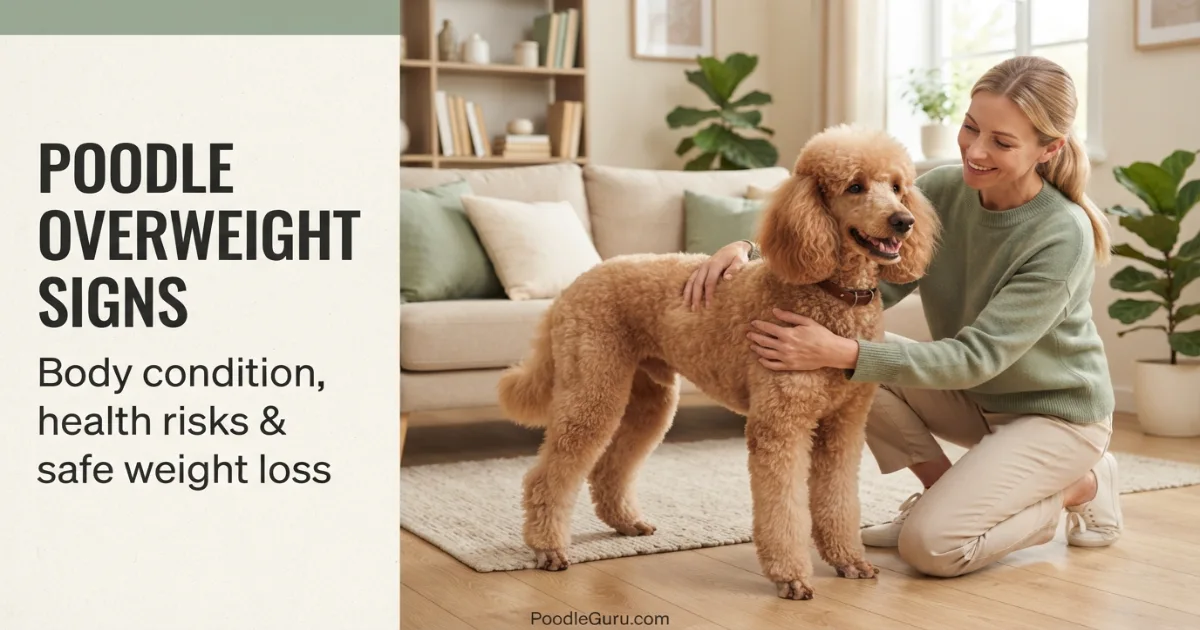
Poodle overweight signs include a loss of a visible waist when viewed from above, a belly that hangs down instead of tucking up, and ribs you can’t easily feel under a thin layer of fat. Other clues: waddling gait, reluctance to exercise, and heavy panting. A body condition score (BCS) above 6 out of 9 is considered overweight. For most poodles, simply adjusting food portions and adding daily low-impact movement starts reversing the trend within weeks.
Prevalence
Veterinary surveys commonly find that more than half of pet dogs carry excess weight. Poodles are not exempt — especially smaller varieties that live mostly indoors or receive frequent treats.
Lifespan Impact
A landmark lifelong feeding study in Labrador Retrievers found that dogs kept lean lived longer and had better healthspan. The exact effect varies by dog, but excess weight clearly reduces comfort and mobility.
Fastest Fix
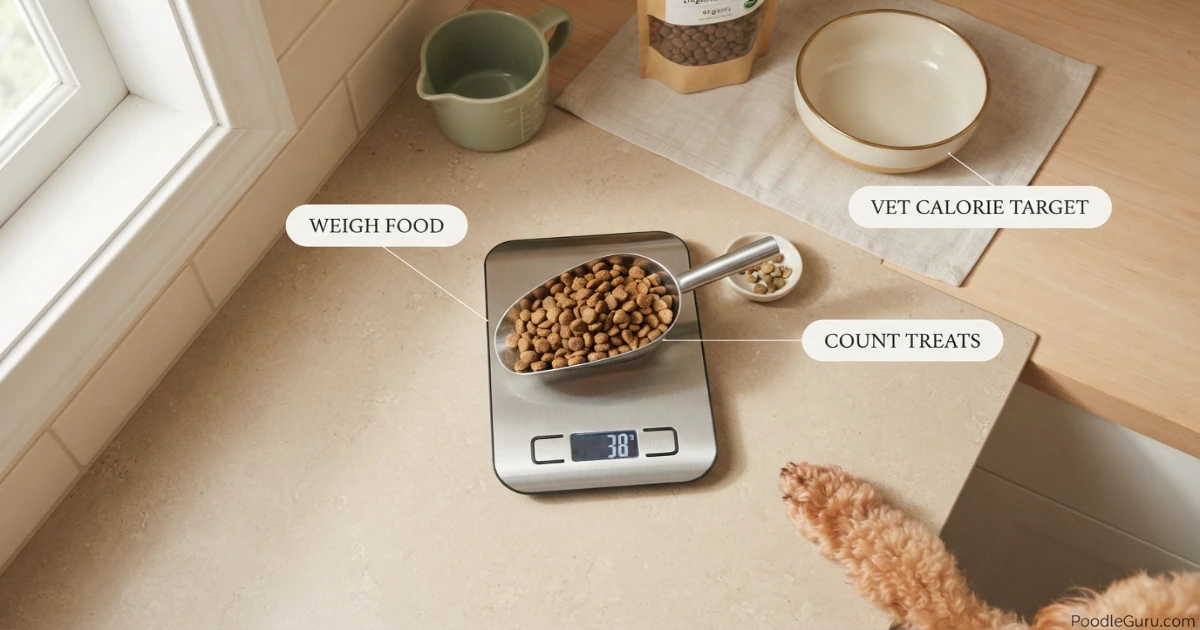
Accurate portion control — using a gram scale to measure food — is one of the most effective changes owners can make. It prevents the hidden overfeeding that measuring cups often create.
Poodle Overweight Signs You Can’t Ignore
Poodle overweight signs are often subtle because a thick curly coat hides the body’s true outline. You might only notice a problem when your dog suddenly seems reluctant to jump on the couch. The key is to evaluate your poodle’s body — not just look at the number on a scale.
The Visual Check
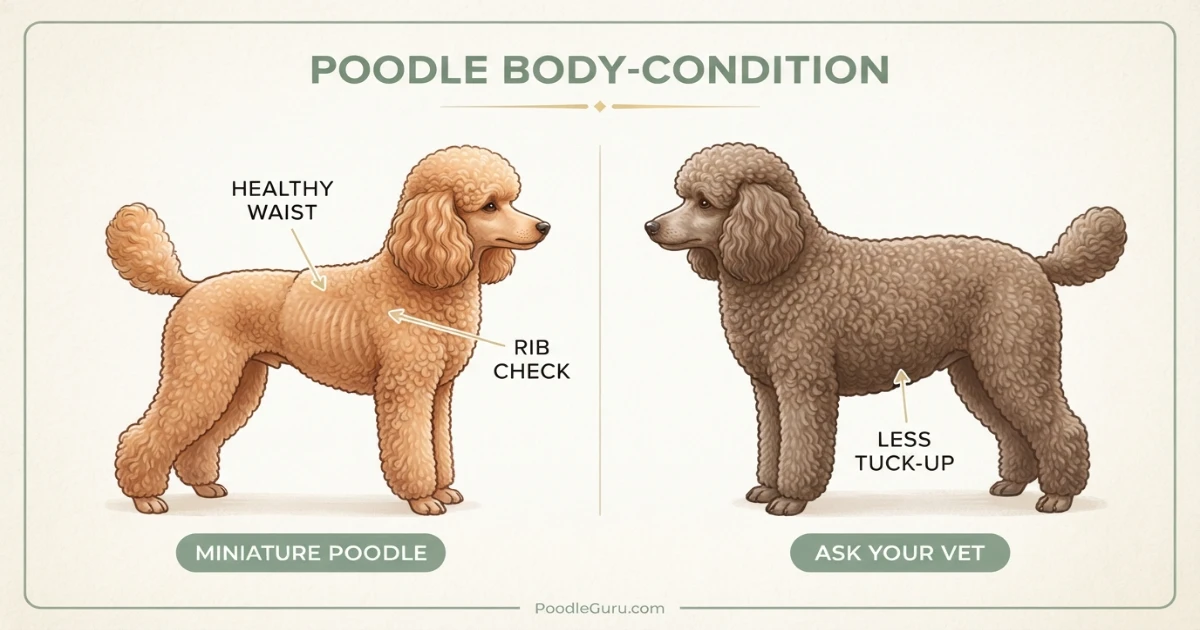
Stand over your poodle and look down. You should see a visible waist — an indentation behind the ribs. Viewed from the side, the belly should tuck up clearly behind the ribcage. If your poodle’s body looks like a straight tube with no narrowing, that’s a classic poodle overweight sign. The silhouette test works best on freshly groomed or short-clipped dogs; if your poodle is in a full coat, you’ll need to rely more on touch.
The Rib Test
Place your thumbs on your poodle’s spine and spread your fingers over the ribs. You should feel the ribs easily under a thin, soft layer of tissue — similar to the back of your hand. If you have to press firmly to find them, there’s too much covering. If you can’t feel them at all, the poodle is well into obesity territory.
Behavioral Red Flags
- Reluctance to walk: A poodle that used to bound to the door now lags behind or stops frequently.
- Heavy panting: Even mild activity leaves an overweight poodle winded. Excess fat insulates the body and makes it harder to cool down.
- Waddling gait: Fat pads around the hips and chest alter the natural stride, sometimes producing a rolling motion.
- Difficulty grooming: A poodle that can’t reach its hindquarters to groom is carrying too much bulk.
According to VCA Animal Hospitals’ overview of obesity in dogs, obesity can increase the risk of diabetes, heart disease, respiratory problems, arthritis, and reduced quality of life. For a Toy Poodle, even one extra pound can be clinically meaningful.
The Hidden Health Risks of Poodle Obesity
Excess weight isn’t a cosmetic problem that can wait. It can worsen mobility, breathing comfort, heat tolerance, and long-term disease risk. A landmark lifelong Labrador Retriever feeding study found that dogs maintained in lean body condition lived longer and had delayed onset of chronic disease compared with control-fed littermates. The risk profile is especially concerning for a breed already predisposed to certain orthopedic and metabolic conditions.
| Health Condition | How Obesity Makes It Worse | Poodle-Specific Note |
|---|---|---|
| Arthritis & Joint Disease | Extra pounds multiply the load on hips, knees, and elbows. Fat tissue also releases inflammatory compounds that worsen joint pain. | Poodles are already at risk for luxating patella (especially Toys) and hip dysplasia (Standards). Obesity accelerates joint degeneration. |
| Diabetes Mellitus | Excess body fat causes insulin resistance, forcing the pancreas to work harder until it eventually fails. | Miniature and Toy Poodles have a genetic predisposition to diabetes. Obesity dramatically increases that risk. |
| Tracheal Collapse | Fat deposits around the neck and chest put pressure on the trachea, worsening breathing. | Toy Poodles are highly prone to tracheal collapse. Extra neck fat compounds the problem and makes episodes more severe. |
| Heart Disease | Obesity increases blood pressure and forces the heart to pump harder to supply excess tissue. | Poodles can develop mitral valve disease; added cardiac strain from obesity is especially dangerous. |
| Shortened Lifespan | Chronic inflammation from obesity accelerates cellular aging and organ decline. | Poodles are long-lived dogs; excess weight can reduce healthspan and may shorten lifespan, especially when it worsens joint, heart, or endocrine disease. |
Why Poodles Gain Weight: Beyond “Too Much Food”
Most weight gain boils down to more calories in than out — but that simple equation hides several poodle-specific factors. Understanding these helps you target the right fix.
Portion Distortion
Many owners follow the feeding guidelines on kibble bags, which often overestimate needs for less active pets. Poodles are clever and persuasive — a few extra treats add up fast. A single extra dog biscuit per day over a year can translate to a pound of weight gain in a small poodle.
Spaying and Neutering
After spay or neuter, many dogs need fewer calories because activity level, appetite, and hormone patterns can change. If portions are not adjusted, weight gain may follow within months. This is not a reason to avoid the procedure — it is a reason to monitor body condition and ask your vet whether portions should change.
Age and Activity Shifts
A puppy’s frantic energy gives way to adult calm. A seven-year-old Standard Poodle may need 25% fewer calories than at age two. Unless the food bowl shrinks, the poodle expands.
Hidden Calories in Treats and Toppers
Training treats, dental chews, table scraps, and “just a little something” add up silently. A poodle getting 20% of daily calories from treats is effectively overfed by 20% — even if the measured meals seem correct.
The PoodleGuru Body Condition Assessment Framework
At PoodleGuru, we teach owners to rely on hands and eyes — not just the scale. This three-step assessment takes under a minute and gives you a reliable body condition score (BCS) on the standard 9-point scale used by veterinarians.
Rib Check — The 1-Minute Palpation
Run your fingertips across the ribcage with gentle pressure. You should feel individual ribs with a thin, supple covering — like the skin over your knuckles. If ribs are buried under noticeable padding, your poodle is above ideal weight. If you can see ribs from a distance, that’s a sign of being underweight.
Waist and Tuck — The Overhead and Side View
Stand directly above your poodle. A visible waist should indent behind the ribs. Then crouch to the side. The belly should slope upward from the ribs to the hind legs. No indentation and a straight or sagging belly line both point to excess body fat.
Spine and Hips — The Structural Check
Palpate the spine and the top of the hip bones. You should feel them under a thin layer of muscle and skin, not protruding, but not padded with thick fat deposits. Overweight poodles often carry excess fat over the hips and at the tail base.
Assign a BCS from 1 (emaciated) to 9 (severely obese). A score of 4 or 5 is ideal — ribs easily felt, visible waist, and minimal fat cover. A score of 6 means “overweight,” and 7–9 means “obese.” For most poodles, a 1.5-point drop in BCS represents a 10–15% weight reduction. Share your BCS assessment with your vet to get an accurate target weight.
Healthy Weight Ranges by Poodle Size
Poodles vary dramatically in size, so healthy weight depends on variety. These ranges reflect breed standards and clinical norms. Always aim for the ideal body condition, not just the number.
| Poodle Variety | Healthy Weight Range (lbs) | When Overweight Is Likely (lbs) |
|---|---|---|
| Toy Poodle | 4–6 | 6.5+ |
| Miniature Poodle | 10–15 | 16+ |
| Moyen / Medium Poodle | 20–30 | 32+ |
| Standard Poodle | 40–70 (females lighter, males heavier) | Varies; >10% over ideal frame |
These are guidelines only. A petite 38-pound Standard female may be healthy, while a 72-pound male might be obese if his frame is small. Use the body condition framework first, weight second. The AKC poodle breed page provides official size categories but does not define obesity thresholds; those are determined by individual build.
Safe Weight Management Strategies That Actually Stick
Crash diets aren’t safe for dogs. Weight loss should be gradual — commonly around 1–2% of body weight per week when supervised appropriately. For a 15-pound Miniature Poodle, that’s roughly 2.5–5 ounces per week. The AAHA weight management guidelines use this 1–2% weekly range for dogs, with veterinary adjustment when needed. Here’s a multi-layered approach that works without leaving your poodle hungry.
Calculate Calories, Don’t Guess
Ask your vet for a daily caloric target for weight loss. As a rough starting point, veterinarians often calculate resting energy requirement as 70 × body weight in kg^0.75, then adjust for activity, age, neuter status, and weight-loss goals. Do not use the formula alone as your final target. Ask your vet for a safe daily calorie range, especially for Toy Poodles, seniors, or dogs with diabetes, heart disease, arthritis, Cushing’s disease, or hypothyroidism.
Measure Food by Weight, Not Volume
A “cup” of kibble can vary significantly depending on kibble size, density, and how the scoop is filled. Use a digital kitchen scale. Weigh each meal in grams. This is the single most reliable way to control portions. If you switch brands, re-weigh because kibble density differs.
Swap to a Weight Management or High-Protein Diet
Diets formulated for weight control tend to be lower in fat, higher in fiber, and rich in protein to preserve lean muscle. A prescription weight-loss diet from your vet offers guaranteed nutrient balance at lower calories. Over-the-counter “light” foods can work, but always verify calories per cup or per gram — some are only marginally lower than maintenance formulas.
Increase Low-Impact Movement
For an overweight poodle, long runs risk joint injury. Start with two 15-minute walks daily and gradually extend to 30 minutes. Add mental enrichment — puzzle toys, hide-and-seek, or gentle fetch indoors. Movement stimulates metabolism without stressing joints. Swimming is excellent for poodles comfortable in water; it burns calories with zero joint impact.
Keep a weekly weight log. Use a baby scale for small poodles or a reliable bathroom scale (weigh yourself holding the dog, subtract your weight). Track progress every Saturday. No change after two weeks? Reduce daily food by another 5–10 calories — small adjustments add up.
Feeding an Overweight Poodle Without the Guilt
Many owners equate food with love. But a poodle doesn’t feel loved through volume — it feels loved through attention, play, and comfort. Reframing how you offer food can transform weight loss.
Treats: The Hidden Villain
Treats should make up no more than 10% of daily calories. For a Toy Poodle on a weight-loss plan, that might mean 15–20 calories from treats — roughly two small training treats or a single blueberry. Bulk up reward value by using tiny pieces (pea-sized) and offering low-calorie options: green beans, cucumber slices, or plain air-popped popcorn.
Feeding Frequency
Split the daily allotment into two or three small meals rather than one large one. Smaller meals help regulate blood sugar and reduce begging behavior. A poodle that knows food is coming later is less frantic.
Stop Free-Feeding
Leaving a bowl of kibble out all day makes calorie control almost impossible. Some poodles nibble throughout the day and quietly exceed their needs. Timed meals make intake measurable and give owners a clearer picture of appetite changes.
Weight Loss Mistakes That Backfire
Even well-intentioned efforts can stall progress or cause harm. These are the most common traps and how to avoid them.
| Mistake | Why It Fails | What to Do Instead |
|---|---|---|
| Cutting food too drastically | Overly aggressive calorie reduction can cause excessive hunger, nutrient imbalance, and muscle loss. | Reduce daily calories by 10–20% from maintenance. Aim for slow, steady loss of 1–2% body weight per week. |
| Using “diet” food but still overfeeding | Light formulas are lower in calories, but feeding the same volume still delivers excess energy. | Weigh the new food. Follow calorie-based feeding guidelines, not cup-based, for the target weight. |
| Forgetting to count treats | A few dental chews, a bully stick, and table scraps can add 100+ calories — negating the meal reduction. | Include all treats in the daily calorie count. Use a treat limit of 10% of total intake. |
| Neglecting muscle maintenance | Weight loss without adequate protein or exercise leads to muscle loss, which lowers metabolism further. | Choose a high-protein weight-loss diet and include gentle exercise to preserve lean mass. |
| Expecting fast results | Visible change takes weeks. Owners often give up after a few days and revert to old habits. | Commit to a 12-week plan. Reassess monthly with your vet. Progress photos help more than daily weigh-ins. |
If your poodle is severely obese (BCS 8–9), do not crash diet. Rapid or poorly balanced weight loss can cause weakness, nutrient deficiencies, muscle loss, and other medical problems. Any weight-loss plan for a significantly overweight poodle should be designed and supervised by a veterinarian. Also, if your poodle suddenly gains weight without a change in food or exercise, see a vet to rule out hypothyroidism or Cushing’s disease — both are poodle-relevant endocrine disorders.

Frequently Asked Questions
How do I know if my poodle is overweight if I can’t see its body under the fur?
Use your hands. The rib test and the waist palpation are more reliable than visual assessment for a curly-coated poodle. After a bath or grooming session, when the coat is wet and flat, you can also visually check for a waist. Your vet can provide an accurate body condition score.
My poodle is only 2 pounds overweight — does it really matter?
Yes. For a Toy Poodle, 2 extra pounds can represent a very large percentage of ideal body weight. Even a small excess strains joints, makes breathing harder, and increases the risk of diabetes and tracheal collapse. Every ounce counts.
Can spaying or neutering cause weight gain in poodles?
Spay/neuter does not automatically cause obesity, but many dogs need fewer calories afterward. If food intake is not adjusted to match changing energy needs, weight gain can follow. Adjust portions with your vet’s guidance and monitor weight monthly.
What’s the best diet for an overweight poodle?
A high-protein, moderate-fiber, low-fat diet is ideal. Prescription weight-management formulas offer precise calorie control and muscle-sparing protein levels. Over-the-counter light foods can work if you carefully measure portions and ensure your poodle isn’t losing muscle.
How fast should my poodle lose weight?
Aim for 1–2% of body weight per week. For a 15-pound Miniature Poodle, that’s 2.5–5 ounces weekly. Faster loss can risk muscle loss, excessive hunger, and poor nutrient intake. A 12-week plan is often more realistic than a quick crash diet.
My poodle begs constantly during dieting — what can I do?
Bulk up meals with low-calorie vegetables like steamed green beans or zucchini. Split daily food into three smaller meals. Offer attention, play, or a chew toy instead of a treat. Begging usually decreases as the dog adjusts to the new routine over two to three weeks.
Should I exercise an overweight poodle more intensely?
No. Overweight poodles are at risk for joint injury and overheating. Start with low-impact activities — short walks, swimming, gentle play. Increase duration before intensity. Avoid high-impact jumping or running until weight has noticeably decreased.
Key Takeaways
Poodle overweight signs are subtle but discoverable. Here’s what to remember:
- An overweight poodle loses the visible waist and palpable ribs that signal ideal body condition; rely on hands-on checks, not just visual inspection through thick coat.
- Even a small amount of excess weight — a pound on a Toy Poodle, a few on a Standard — raises the risk for arthritis, diabetes, tracheal collapse, and shortened lifespan.
- The PoodleGuru Body Condition Assessment Framework (rib palpation, waist/tuck check, spine/hip check) gives owners a reliable at-home method to monitor weight status.
- Safe weight loss means 1–2% body weight per week, achieved through precise calorie measurement (gram scale), a high-protein weight-loss diet, and consistent low-impact exercise.
- Portion control trumps special “diet” food; weighing meals eliminates the inaccuracy of measuring cups and hidden treat calories.
- Involve your veterinarian for severely overweight poodles, sudden unexplained weight gain, or if weight loss stalls despite consistent effort — underlying endocrine disorders may be present.