Poodle vs Maltese: Coat, Size & Care Compared
Two small, elegant, low-shedding companion breeds — but the daily reality of living with each one is surprisingly different. Here’s what most guides skip.
Quick Answer
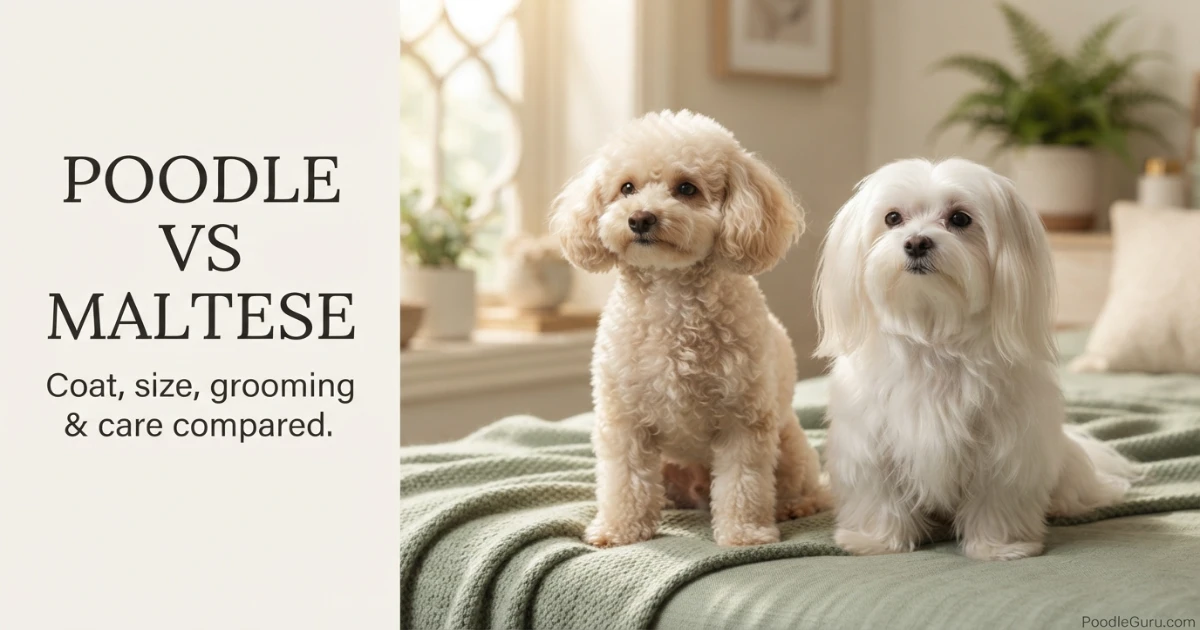
Both the Toy Poodle and the Maltese are small, low-shedding companion dogs, but their coats, grooming demands, and personalities diverge in ways that matter every single day. Poodles have dense, curly coats that need regular clipping every 4–6 weeks. Maltese have long, silky, straight coats that tangle fast without daily brushing. Toy Poodles tend to be more athletic and quick to learn. Maltese are famously attached to their people — cuddly, alert, and prone to separation anxiety if left alone too long. Your choice comes down to grooming tolerance, activity expectations, and how much independence you want in a small dog.
In This Guide
- Quick Facts: Toy Poodle vs Maltese
- Coat Comparison: The Biggest Daily Difference
- Size & Build: Nearly Identical, Subtly Different
- Temperament & Personality
- Grooming Requirements & Daily Care
- Health Considerations & Lifespan
- The PoodleGuru Coat & Care Decision Framework
- Common Buyer Mistakes & Misidentification
- How to Evaluate Which Breed Fits Your Lifestyle
- Frequently Asked Questions
Quick Facts: Toy Poodle vs Maltese
Toy Poodle
Weight: 4–6 lbs
Height: Up to 10 inches
Coat: Dense, curly, single coat
Shedding: Very minimal
Lifespan: 12–15 years
Trainability: Exceptionally high
Energy: Moderate to high for size
Maltese
Weight: 4–7 lbs
Height: 7–9 inches
Coat: Long, silky, straight, single coat
Shedding: Very minimal
Lifespan: 12–15 years
Trainability: Moderate (stubborn streak)
Energy: Moderate, bursts of play
Key Difference
Coat type drives roughly 80% of the practical care differences between these two breeds. The Poodle’s curly coat traps loose hair and needs clipping. The Maltese coat grows continuously and mats without daily attention. Training style and separation tolerance create the remaining divide.
On paper, the Toy Poodle and Maltese look nearly interchangeable. Both are toy-sized, both are often marketed as allergy-friendly because they shed very little, both turn heads with elegant coats, and both fit neatly into apartment living. But anyone who has lived with both breeds will tell you: the daily rhythm of care, the grooming commitment, and the emotional dynamic with your dog differ more than you’d expect.
The AKC recognizes three official poodle sizes — Toy, Miniature, and Standard — and for this comparison we focus on the Toy Poodle, since it matches the Maltese in weight class. The Maltese is consistently one small size with no official size variants, making the Toy-to-Maltese matchup the most practical head-to-head for buyers deciding between them.
This guide isn’t a surface-level breed summary. It’s built for someone who has already done the basic reading and now needs the sharper, real-ownership distinctions that actually shape daily life with a small dog.
Coat Comparison: The Biggest Daily Difference
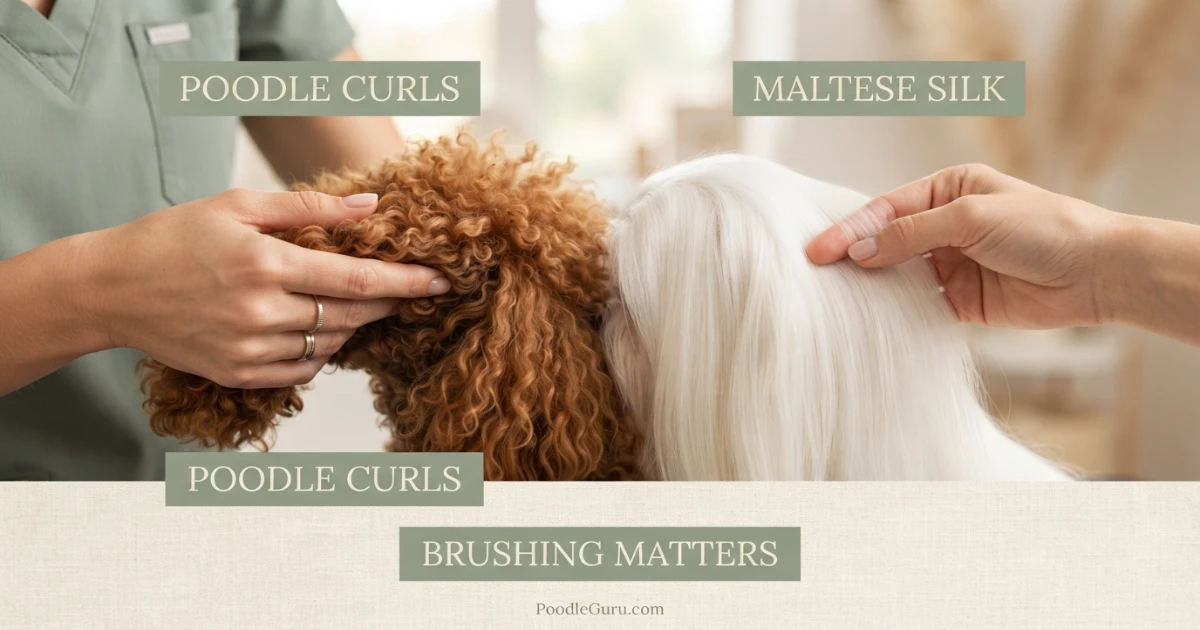
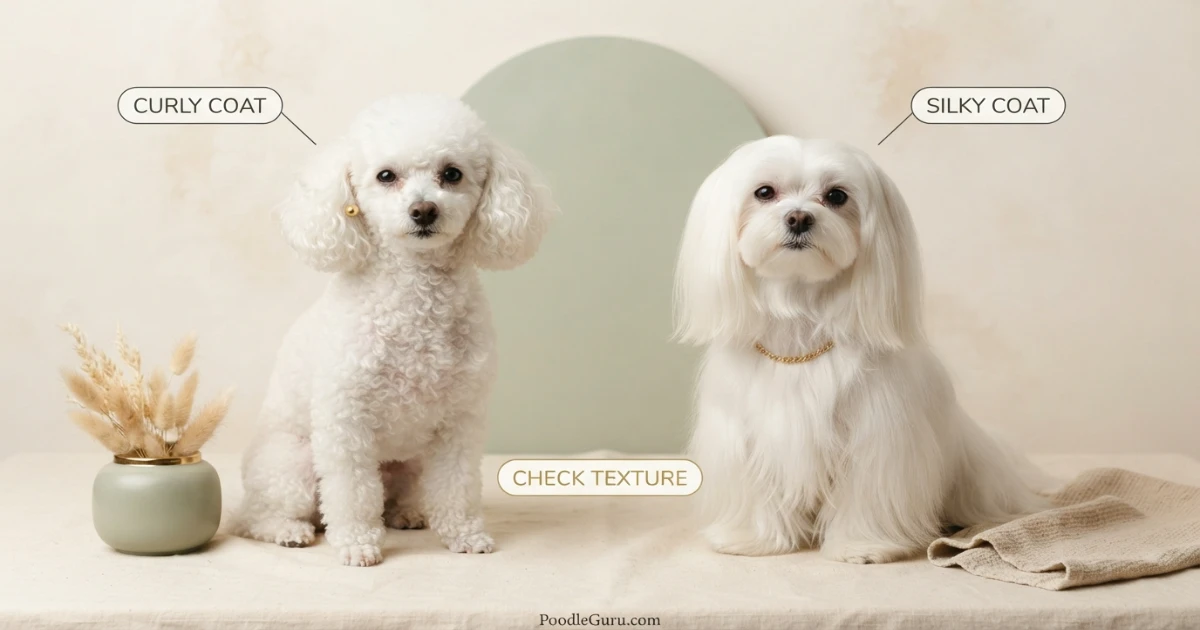
A Toy Poodle’s coat is a dense, curly, single-layer coat — often described as woolly or corded in texture. It grows continuously and, crucially, it traps shed hair within the curls rather than releasing it onto your furniture. That’s the mechanism behind the “hypoallergenic” reputation. The trade-off: that trapped hair must be removed through brushing and clipping. Without it, mats form against the skin.
A Maltese coat is something else entirely. It’s a long, straight, silky single coat that also grows continuously — but because the strands are smooth and fine, they slide against each other and tangle into knots with startling speed. The coat doesn’t trap hair the way a Poodle’s does. Instead, loose strands slip out gradually, and the real maintenance battle is preventing tangles from turning into painful mats, especially behind the ears, under the legs, and along the belly.
What “Hypoallergenic” Actually Means Here
Neither breed is truly allergen-free. Dog allergens come from dander, saliva, and skin proteins, not just visible shedding. Because both breeds shed very little, they may spread fewer loose hairs around the home than heavy-shedding dogs, but individual allergy reactions still vary. The safest approach is to spend time with adult Toy Poodles and Maltese before choosing, then commit to regular bathing, brushing, laundry, and home cleaning if allergies are a concern.
| Coat Attribute | Toy Poodle | Maltese |
|---|---|---|
| Coat type | Dense, curly, single coat | Long, silky, straight, single coat |
| Shedding level | Very minimal (hair trapped in curls) | Very minimal (loose strands slip out gradually) |
| Brushing frequency | 2–3 times per week minimum | Daily, sometimes twice daily in full coat |
| Professional grooming | Every 4–6 weeks (clipping required) | Every 4–6 weeks if kept in trim; weekly baths if in full coat |
| Matting risk | High if brushing is skipped; mats tighten close to skin | Very high; tangles form rapidly, especially behind ears and on belly |
| Coat grows continuously? | Yes | Yes |
| Common owner complaint | “I didn’t realize clipping was non-negotiable” | “I underestimated the daily brushing commitment” |
Size & Build: Nearly Identical, Subtly Different
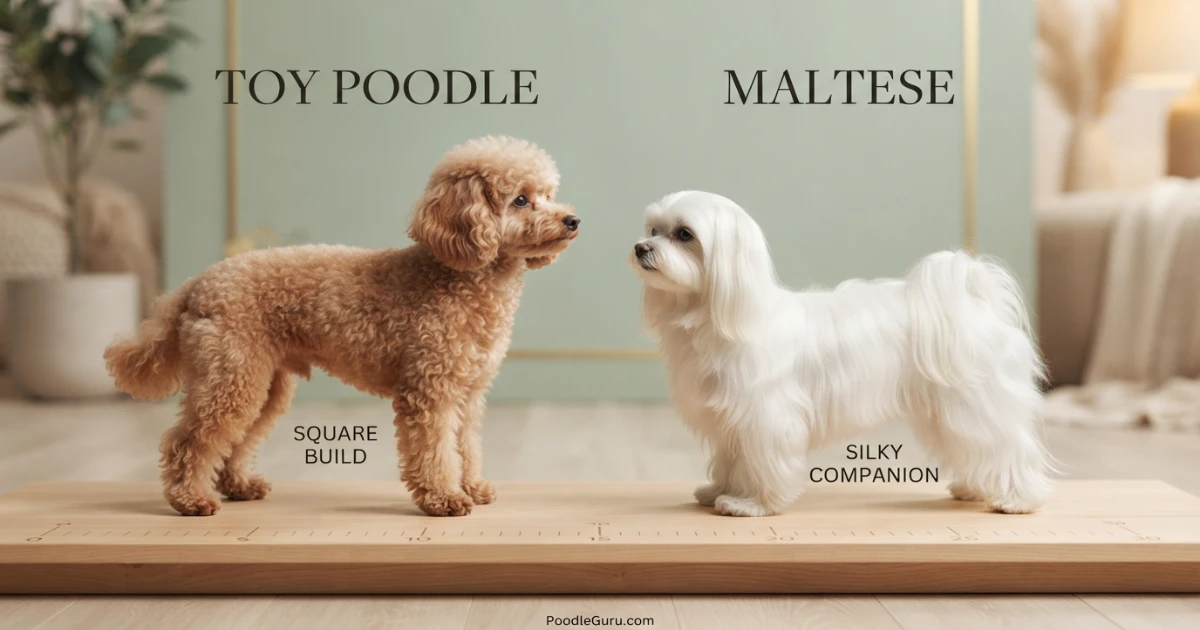
At a glance, a Toy Poodle and a Maltese occupy the same physical space. Both weigh between 4 and 7 pounds. Both stand under 10 inches at the shoulder. But the build tells a different story.
The Toy Poodle has a squarely proportioned, athletic frame — a scaled-down version of the Standard Poodle’s balanced structure. It moves with a light, springy gait that surprises people who expect a delicate lap ornament. The Maltese, by contrast, has a slightly more compact, longer-bodied silhouette with a level topline and a plumy tail carried over the back. It’s sturdy but less overtly athletic in build.
In practical terms, the Toy Poodle is more likely to enjoy jumping onto furniture, navigating agility equipment, or keeping up on longer walks. The Maltese is more likely to request being picked up and carried. Neither is fragile in the sense of being glass-like, but the Maltese’s finer bone structure means owners should be especially mindful around larger dogs and young children.
Temperament & Personality
Here’s where the two breeds genuinely diverge, and where buyer expectations most often go wrong.
The Toy Poodle is, at its core, a working dog compressed into a small package. Poodles were originally water retrievers, and that intelligence and drive persist even in the tiniest Toy. They’re quick studies — often too quick. A Toy Poodle that isn’t mentally stimulated will invent its own entertainment, and you won’t always like the result. They tend to be alert, responsive, and sometimes reserved with strangers before warming up. They bond deeply but aren’t typically clingy.
The Maltese was bred for one purpose: companionship. That’s not a downgrade — it’s a specialization. A Maltese wants to be where you are, preferably touching you. The breed is known for a cheerful, lively disposition mixed with a stubborn streak that surprises first-time owners. Maltese are affectionate, often described as “velcro dogs,” and they can develop significant separation anxiety if not gradually conditioned to alone time from puppyhood.
Owner Insight: The Independence Gap
If you work from home and want a dog that stays close, the Maltese fits that picture perfectly — maybe too perfectly. If you want a small dog that can entertain itself for reasonable stretches, the Toy Poodle’s greater independence is an asset. Neither breed does well with long daily absences, but the Maltese tends to struggle more visibly when left alone.
Grooming Requirements & Daily Care
Grooming is where the poodle vs maltese decision hits your calendar and your wallet hardest.
For a Toy Poodle, professional clipping every 4–6 weeks isn’t optional — it’s structural. The curly coat doesn’t stop growing, and when it outgrows the clipping cycle, mats form at the skin level where they’re painful to remove. Between appointments, you’ll brush 2–3 times per week with a slicker brush and metal comb, working in sections to reach the skin. Many owners learn a basic maintenance clip at home, which cuts long-term costs but demands practice and the right tools. For a deeper dive on poodle-specific coat care, see our Complete Poodle Grooming Guide.
For a Maltese, the grooming commitment scales with coat length. If you keep the coat in a short “puppy cut,” you’ll still need brushing 3–4 times per week and a grooming appointment every 4–6 weeks. If you maintain the long, flowing show-style coat, daily brushing is mandatory — often twice daily — plus weekly baths and conditioning treatments to prevent breakage. Most pet owners opt for the shorter trim, and it dramatically reduces the daily workload.
When to Call a Professional Groomer
For either breed, if you feel mats forming close to the skin, stop brushing. Brushing over mats tightens them and causes pain. A professional groomer can safely remove mats — sometimes with clippers — without injuring the dog. This is especially important behind the ears, in the armpits, and around the sanitary area for both breeds.
Health Considerations & Lifespan
Both breeds share a similar lifespan range of 12–15 years, and both benefit from responsible breeding practices that screen for common inherited conditions.
Toy Poodles have breed-relevant health considerations that include patellar luxation (slipping kneecaps), progressive retinal atrophy (PRA), and Legg-Calvé-Perthes disease affecting the hip joint. Small size doesn’t equal zero health risk. Reputable breeders screen for these conditions, and veterinary guidance generally recommends annual eye exams and orthopedic evaluations for aging Toys.
Maltese are predisposed to patellar luxation, portosystemic shunt (a liver condition), and dental disease due to their small jaws crowding teeth. They’re also prone to white shaker syndrome — a tremor condition more common in small white breeds. Professional veterinary organizations like VCA Animal Hospitals provide detailed breed health overviews that can help owners recognize early warning signs.
Dental care deserves special emphasis for both breeds. Small mouths mean crowded teeth, and crowded teeth mean plaque buildup accelerates. Daily tooth brushing and annual veterinary dental cleanings aren’t bonus items — they’re baseline care for toy breeds.
The PoodleGuru Coat & Care Decision Framework
At PoodleGuru, we evaluate breed-fit decisions through a practical lens: what does this dog ask of you every single day? The Coat & Care Decision Framework helps you weigh the poodle vs maltese choice across three dimensions that actually shape ownership.
1. Grooming Tolerance
High tolerance: You don’t mind daily brushing — go Maltese, even in a longer trim.
Moderate tolerance: You’ll brush a few times weekly and pay for regular clipping — Toy Poodle fits better.
Low tolerance: Be honest with yourself. Both breeds need more grooming than a short-haired dog. If you’re unwilling to brush at all, neither breed is the right match.
2. Emotional Attachment Style
You want a shadow: The Maltese will follow you room to room and want contact constantly. That’s the breed working as designed.
You want closeness with some breathing room: The Toy Poodle bonds warmly but keeps a bit of independence. It’s less likely to panic when you leave the room.
3. Activity & Mental Engagement
You enjoy training and mental games: Toy Poodles thrive on puzzle toys, trick training, and learning new commands. They need brain work.
You prefer cuddling and gentle play: Maltese are playful but less driven by mental challenges. Short play sessions and lap time satisfy them.
This framework isn’t about ranking one breed above the other. It’s about alignment. The best breed is the one whose daily needs match what you’re actually willing to provide — not what you imagine providing in an ideal week.
Common Buyer Mistakes & Misidentification
These two breeds are frequently confused by casual buyers, and that confusion leads to preventable problems.
Mistake 1: Assuming “hypoallergenic” means zero grooming. Both breeds require consistent coat care. The Poodle’s curls hide mats; the Maltese’s silk shows tangles immediately. Neither coat maintains itself.
Mistake 2: Thinking all small white dogs are Maltese. A white Toy Poodle and a Maltese can look similar in quick photos, but the coat texture gives them away instantly. Poodle coats feel springy and dense. Maltese coats feel smooth and fine. If you’re buying from a breeder and the coat doesn’t match the breed description, ask questions.
Mistake 3: Overlooking the separation anxiety gap. A Maltese left alone for 8+ hours daily will often develop distress behaviors — barking, destructive chewing, house soiling. This isn’t a training failure; it’s a breed tendency. The Toy Poodle handles alone time better, but neither breed thrives in a 10-hour empty house.
Mistake 4: Buying based on appearance alone. It’s easy to fall for the Maltese’s flowing white coat or the Poodle’s sculpted clip. But those looks are maintained, not inherited. The question isn’t “Do I like how this breed looks?” It’s “Am I willing to do what it takes to keep this breed looking and feeling healthy?”
How to Evaluate Which Breed Fits Your Lifestyle
Use this step-by-step evaluation to move past impulse and into a clear, honest decision.
Track Your Grooming Reality
For one week, note how much time you actually spend on pet care each day. Not how much you’d like to spend — what you do. If 10–15 minutes of daily brushing feels like a burden, the Maltese in full coat isn’t for you. A Toy Poodle in a short trim may fit better.
Assess Your Household’s Alone-Time Patterns
Count the hours your home is empty on a typical weekday. If it’s more than 6 hours regularly, factor in a dog walker or sitter for either breed — but especially for a Maltese. Be realistic, not optimistic.
Visit Both Breeds in Person
Photos don’t communicate coat texture, energy level, or how a breed’s personality feels in a room. Visit a responsible breeder, a breed-specific rescue, or a dog show. Touch the coat. Watch the dog move. Ask about daily care from someone who lives it.
Project First-Year Costs
Grooming for either breed runs roughly $50–$90 per session every 4–6 weeks, depending on your area. That’s $400–$1,000+ annually before you add tools, shampoos, dental care, and veterinary expenses. A Maltese kept in full coat will cost more in grooming time or professional fees. Budget honestly.
Check Your Trainer Network
Toy Poodles benefit from early training to channel their intelligence productively. Maltese benefit from early socialization to prevent timidity. Either way, have a positive-reinforcement trainer or class lined up before the puppy arrives. Waiting until problems appear costs more time and stress.
Frequently Asked Questions
Which is better for allergies: Poodle or Maltese?
Both are low-shedding, single-coated breeds that produce fewer airborne allergens than double-coated dogs. The Poodle’s curly coat traps dander closer to the skin, requiring regular bathing to wash allergens away. The Maltese’s straight coat releases dander more freely. Neither breed is allergen-free, and individual reactions vary. Spend time with both before deciding.
Do Poodles or Maltese shed more?
Both shed minimally. The difference is where the shed hair goes. Poodle curls trap loose hair inside the coat, so it stays until brushed out. Maltese hair slips out gradually and may appear on clothing or furniture in small amounts. Neither breed leaves the visible drifts of fur associated with heavy shedders.
Which breed is easier to train?
Toy Poodles are generally easier to train for owners who enjoy structured reward-based sessions. They are quick learners and tend to respond strongly to positive reinforcement. Maltese can learn well too, but they have a stubborn streak and may require more patience and consistency. Short, reward-heavy sessions work best for both.
Are Maltese more affectionate than Poodles?
Maltese tend to be more physically affectionate and clingy — they were bred specifically as companion dogs and often want constant contact. Toy Poodles are loving and bonded to their people but generally retain more independence. Neither breed is aloof, but the style of affection differs.
Which breed lives longer?
Both breeds share a similar expected lifespan of 12–15 years. Individual health, genetics, diet, dental care, and preventive veterinary attention matter far more than breed averages. Well-cared-for individuals of either breed can reach their mid-teens.
Do Toy Poodles and Maltese get along with other dogs?
Generally, yes — both are companionable with other dogs when properly socialized from puppyhood. Toy Poodles may be slightly more selective about dog friends. Maltese can be fearless to the point of poor judgment around much larger dogs, so supervision matters. Early socialization is key for both breeds.
Which is more expensive to own: Poodle or Maltese?
Annual costs are comparable. Professional grooming runs $400–$1,000+ yearly for either breed. A Maltese kept in full show coat will cost more in grooming time and professional care. Toy Poodles may have slightly higher initial purchase prices from reputable breeders. Budget $1,500–$3,000+ annually for quality care with either breed.
Can you tell a Poodle-Maltese mix apart from purebreds?
Sometimes, but not reliably. A Maltipoo (Poodle-Maltese cross) may inherit the Poodle’s curl, the Maltese’s silk, or something in between. Coat texture is unpredictable in mixed breeds. If coat predictability matters to you — for allergy reasons or grooming planning — a purebred from a responsible breeder offers more consistency.
Poodle vs Maltese: The Bottom Line
Both breeds make wonderful companions for the right owner — but “right” depends entirely on what you’re genuinely willing to provide, day after day, for the next 12 to 15 years.
- Toy Poodles weigh 4–6 lbs; Maltese weigh 4–7 lbs — nearly identical in size, but the Poodle has a squarer, more athletic build.
- The Poodle’s dense curly coat needs clipping every 4–6 weeks and brushing 2–3 times weekly; the Maltese coat needs daily brushing if kept long, or similar clipping frequency in a short trim.
- Toy Poodles are highly trainable, quick-learning dogs that need mental engagement; Maltese are affectionate companion specialists that can be stubborn but deeply devoted.
- Maltese are more prone to separation anxiety and do best in homes where someone is present most of the day; Toy Poodles tolerate alone time more comfortably.
- Professional grooming costs $400–$1,000+ annually for either breed — factor this into your budget before buying, not after.
- Neither breed is truly hypoallergenic, but both shed minimally and may work well for allergy-sensitive owners who maintain consistent grooming and bathing routines.
Best next step: Visit both breeds in person. Touch the coats. Watch how each dog moves and interacts. Then run your decision through the PoodleGuru Coat & Care Decision Framework above — and be honest about what your real week looks like, not your ideal one.