Poodle vs Kerry Blue Terrier: Hypoallergenic Comparison (2026)
If allergies have you searching for a dog that won’t leave a trail of fur, both the Poodle and the Kerry Blue Terrier land on your shortlist. But “hypoallergenic” doesn’t mean no-maintenance. This poodle vs Kerry Blue terrier comparison unpacks coat reality, grooming commitment, temperament differences, and lifetime costs — so you can choose the right fit without falling for myths.
Quick Answer: Poodle vs Kerry Blue Terrier — Key Differences
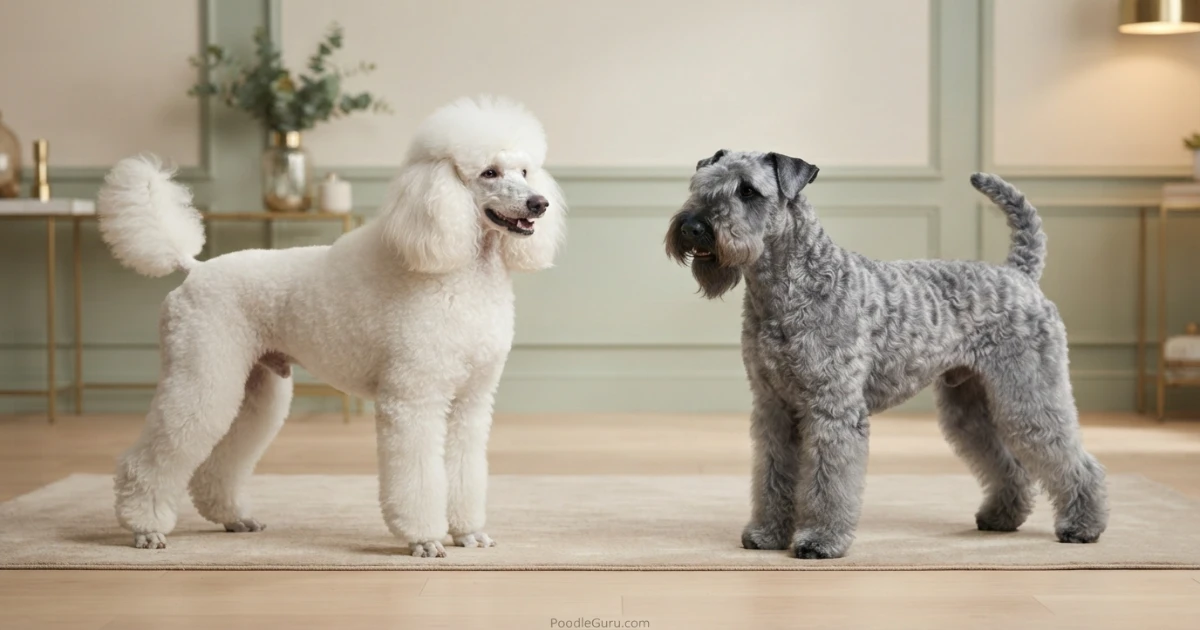
The Poodle comes in Toy, Miniature, and Standard sizes, giving you a wider size range than the single-sized Kerry Blue Terrier (around 33–40 lbs). Both breeds are low-shedding options that many allergy-sensitive owners consider, but neither is allergy-proof.
The Poodle’s coat usually needs professional clipping every 4–8 weeks depending on style, while the Kerry Blue needs regular clipping or traditional hand-stripping plus structured brushing to prevent matting. Temperamentally, Poodles lean elegant and sensitive; Kerry Blues are playful, terrier-tenacious, and sometimes stubborn.
Expect to pay $1,500–$4,000 for a well-bred puppy of either breed in 2026.
What Does Hypoallergenic Really Mean?
A hypoallergenic dog is one that may trigger fewer reactions for some people — not a dog that produces zero allergens. For poodle owners considering a Kerry Blue Terrier, this means both breeds shed minimally, so less dander-laden hair floats around your home.
The most important thing to understand is that allergens can come from dander, saliva, and skin oils, not just fur; VCA notes that no canine breed is 100% hypoallergenic, so individual reactions vary even within these breeds.
Veterinary dermatologists often note that regular bathing and grooming can significantly reduce allergen load. So, whichever breed you lean toward, grooming diligence is your real allergy-management tool. No dog is 100% allergy-proof, but both the Poodle and the Kerry Blue sit near the top of the compatibility list for sensitive owners.
At-a-Glance: Poodle vs Kerry Blue Terrier Comparison
| Trait | Poodle (Toy, Miniature, Standard) | Kerry Blue Terrier |
|---|---|---|
| Size & Weight | Toy: 4–6 lbs, 10 in; Mini: 10–15 lbs, 11–15 in; Standard: 40–70 lbs, 15+ in | 33–40 lbs, 17.5–19.5 in |
| Coat Type | Curly or corded, single coat, continuously growing | Soft, dense, wavy single coat, continuously growing |
| Shedding Level | Very low; hair often gets caught in curls | Very low; little loose hair |
| Grooming Frequency | Professional clipping every 4–8 weeks; brushing several times weekly, daily for longer clips | Clipping or hand-stripping every 6–8 weeks; brushing 2–3 times per week minimum |
| Temperament | Intelligent, eager, sensitive, affectionate | Confident, playful, sometimes stubborn, terrier spunk |
| Trainability | High; excels in obedience and advanced training | High but may require more patience; independent streak |
| Exercise Needs | Moderate to high (varies by size); mental stimulation critical | Moderate to high; enjoys games and purposeful activity |
| Common Health Issues | Hip dysplasia, eye disorders, bloat (Standard), patellar luxation (Toy/Mini) | Hip dysplasia, eye issues, skin cysts, hypothyroidism |
| Lifespan | 12–15+ years (Toy often longer) | 12–15 years |
| 2026 Puppy Price Range | $1,500–$4,000+ (varies by size, color, pedigree) | $1,800–$3,500 |
| Best For | Owners wanting size variety, advanced training, and a close companion bond | Active households wanting a sturdy, playful, single-size dog with terrier charm |
Size & Appearance: Variety vs. Uniformity
The Poodle’s biggest advantage in this comparison is size flexibility. You can choose a Toy that fits in a purse, a Miniature for apartment living, or a Standard that joins you on long hikes. The AKC Poodle breed standard describes a squarely built, elegant dog with a proud carriage.
In contrast, the Kerry Blue Terrier offers one size — a medium, athletic build with a distinctive soft blue-gray coat and a bearded face that gives it a unique profile.
For poodle buyers, the decision often starts with size. Are you prepared for a Standard’s food intake, exercise needs, and potential bloat risk? Or does a Toy’s fragility around young children give you pause? The Kerry Blue removes that question: you get a medium dog, no smaller, no larger. This makes the choice simpler but less customizable.
Coat, Shedding & Grooming: The Real Commitment
Both breeds have continuously growing, low-shedding coats rather than a seasonal double coat. That is why they are often recommended for allergy-conscious homes. But don’t mistake low shedding for low maintenance.
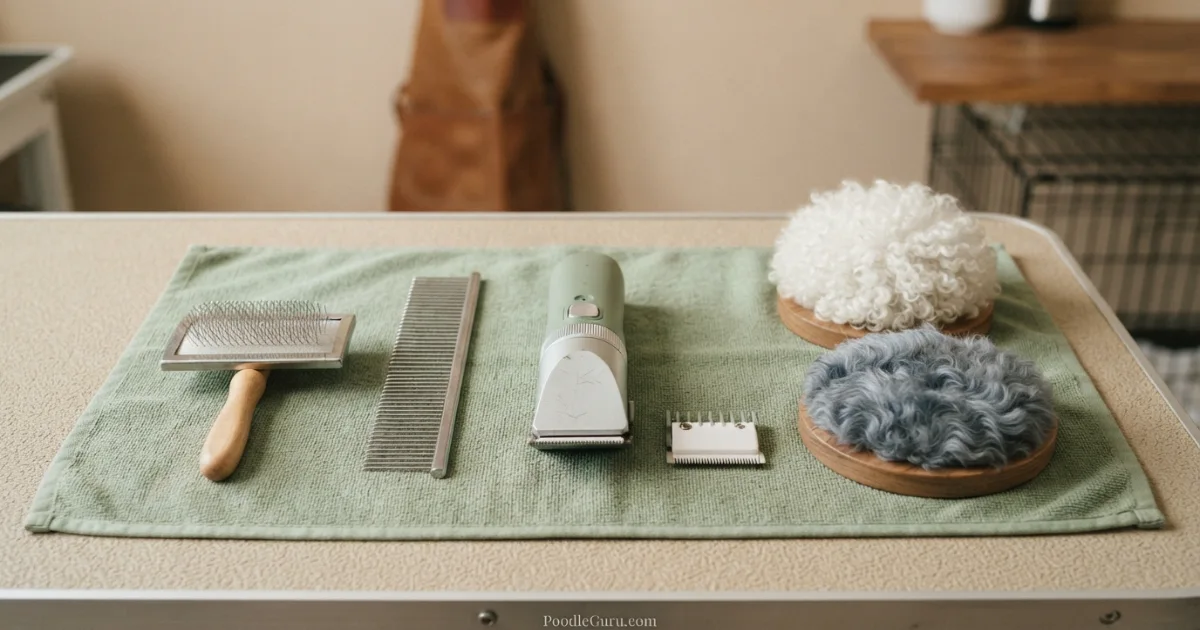
A Poodle’s curly coat usually requires professional clipping every 4 to 8 weeks to keep it manageable, depending on the clip length. Between appointments, brushing several times per week — and daily for longer styles — helps prevent painful mats. Poodle owners who neglect brushing end up with shave-downs and skin irritation.
The AKC Kerry Blue Terrier breed page describes a soft, dense, wavy coat that needs brushing two to three times a week, and either regular clipping or traditional hand-stripping to maintain texture. Kerry Blues mat just as easily, especially behind the ears and under the legs, where the hair is finer.
The bottom line: if you’re choosing based on allergies, budget for a professional groomer every month or two, regardless of breed. Factor in $60–$120 per session for either dog. And plan on at-home brushing as a non-negotiable.
Temperament & Family Compatibility
The Poodle is a thinking breed. They’re highly intelligent, attuned to their owner’s emotions, and typically eager to please. That sensitivity means they don’t respond well to harsh corrections or chaotic households. Standards especially need mental engagement — puzzle toys, training games, and a job to do. A bored Poodle can develop anxiety, destructive chewing, or excessive barking.
The Kerry Blue Terrier brings terrier tenacity wrapped in a playful, affectionate package. Breed standards often use the word “game” — they have a spirited, sometimes mischievous personality. They’re generally good with older children and can adapt to multi-dog homes, but they may show assertiveness toward same-sex dogs.
The Kerry Blue’s independent streak means training requires consistency, but they’re certainly not unintelligent. Expect a dog that loves water, digging, and games with a competitive edge.
If you want a dog that mirrors your emotional state and thrives on complex training, the Poodle may edge ahead. If you love a dog with a bit of devil-may-care attitude that still bonds deeply, the Kerry Blue deserves a serious look.
The PoodleGuru Hypoallergenic Breed Match Framework
At PoodleGuru, we evaluate hypoallergenic breed compatibility across four factors. This isn’t a diagnostic tool — it’s a decision lens for thoughtful owners.
1. Grooming Investment Factor
Both breeds rank high. If your budget or schedule can’t sustain monthly professional grooming plus weekly brushing, reconsider. Factor in emergency “shave-down” costs for neglected coats.
2. Size Flexibility Factor
Poodle wins outright. Three distinct sizes mean you can match a dog to your living space and exercise capacity. The Kerry Blue’s medium size is less adaptable but also less prone to size-related health extremes.
3. Temperament Tolerance Factor
Poodle for sensitivity; Kerry Blue for spunk. If you prefer a biddable, emotionally intuitive dog, lean Poodle. If you enjoy a terrier’s independent humor and don’t mind occasional stubbornness, the Kerry Blue delivers.
How to Decide: Poodle vs Kerry Blue Terrier
Use this step-by-step process to move from “both seem great” to a confident choice.
Assess Your Living Space and Size Preference
If you need a dog under 20 lbs, the Poodle is your only option (Toy or Mini). If you want a sturdy, medium-sized dog that won’t knock over toddlers but also won’t fit in a carrier, the Kerry Blue hits that sweet spot.
Evaluate Your Grooming Commitment Honestly
Map out a realistic monthly grooming budget ($70–$120 per session) and daily/weekly brushing time. Both dogs demand consistency. Are you more likely to maintain a 6-week clipping schedule (Poodle) or a 6–8 week clipping/stripping routine (Kerry Blue)?
Match Temperament to Household Energy
A home that values quiet sensitivity and advanced training will adore a Poodle. A home that enjoys playful mischief, outdoor adventure, and can laugh at terrier antics will find a soulmate in the Kerry Blue.
Research Breeder Health Clearances
Insist on OFA or PennHIP certifications for hips, plus eye clearances for both breeds. Ask about von Willebrand’s disease (Poodles) and skin cyst history (Kerry Blues). Never buy from a breeder who can’t produce documentation.
Calculate Lifetime Costs
Add up puppy price, annual grooming ($800–$1,400), premium food, routine vet care, and potential health issues. Toy Poodles may incur higher dental costs; Standards may have bloat surgery risk. Kerry Blues may need cyst removal. Plan for the long game.
Health & Lifespan: What to Watch For
Both breeds enjoy similar lifespans of 12–15 years, though Toy Poodles often reach 17 or beyond. Health-wise, no breed is completely risk-free.
Standard Poodles are prone to bloat (gastric dilatation-volvulus), a life-threatening emergency. Owners often opt for prophylactic gastropexy surgery. Toy and Miniature Poodles frequently face patellar luxation and dental crowding. Progressive retinal atrophy (PRA) and Addison’s disease also appear in the breed. For a deeper look at overall poodle health, see our comprehensive guide.
Kerry Blue Terriers, meanwhile, can inherit hip dysplasia, eye conditions like cataracts, and a higher-than-average tendency for skin cysts and ear infections. Their floppy ears need regular cleaning to prevent yeast and bacteria buildup — a task that also applies to Poodles with hairy ear canals.
In both breeds, responsible breeding with proper health testing dramatically reduces these risks. Never skip the paperwork.
Price & Lifetime Value (2026)
A well-bred Poodle puppy in 2026 typically costs between $1,500 and $4,000, with rare colors and show-quality pedigrees commanding the higher end. Kerry Blue Terrier puppies from health-tested parents usually range from $1,800 to $3,500. Adoption fees through breed-specific rescues can be $300–$600 but come with unknown health histories.
💰 What Inflates the Price
- Poodles: Phantom, parti, or rare solid colors; champion bloodlines; proven health clearances on both parents; early neurological stimulation programs.
- Kerry Blues: Limited breeder availability in some regions; champion titles; comprehensive health testing; show-quality coat texture.
What’s actually worth paying for: documented health clearances and a breeder who stays in touch for the dog’s lifetime. That’s your best value protection against future vet bills.
Buyer Red Flags for Both Breeds
| Red Flag | What It Hides |
|---|---|
| “Teacup” or “Micro” Poodle listings | Unethical breeding for extreme size, often with severe health problems |
| Kerry Blues without health certificates | Untested parents, possible hip or eye disease hidden in lines |
| Breeder refuses to show living conditions | Possible puppy mill; poor socialization |
| Puppies offered before 8 weeks old | Skipping critical social development; often linked to mass breeding |
| Poodle puppies with matted coats or sores | Neglect; may indicate poor overall care |
| Kerry Blue puppies with dull, harsh coat | Possible malnutrition or incorrect breeding for coat quality |

Frequently Asked Questions
Is a Poodle more hypoallergenic than a Kerry Blue Terrier?
Both breeds are low-shedding and often tolerated by people with allergies, but no dog is 100% hypoallergenic. Individual reactions vary. Spending time with adult dogs of each breed before committing is the best way to test your personal sensitivity.
Does a Kerry Blue Terrier shed more than a Poodle?
Both shed very little. The Poodle’s curly coat tends to trap loose hairs, so you’ll see less around the house, while the Kerry Blue’s wavy coat may release a few more loose strands. Neither breed leaves visible fur on furniture the way a double-coated dog would.
Which breed is easier to groom: Poodle or Kerry Blue Terrier?
Grooming difficulty is similar overall. Poodles usually need clipping every 4–8 weeks depending on coat length and style; Kerry Blues often need clipping or hand-stripping every 6–8 weeks. However, Poodles are often styled in clips that require regular maintenance, while Kerry Blues can be kept in a simpler trim. Both need regular brushing at home.
Can a Kerry Blue Terrier live in an apartment like a Toy Poodle?
Yes, provided it gets sufficient daily exercise. A Toy Poodle is naturally suited to apartment life due to size. A Kerry Blue can adapt well if walked and mentally stimulated, but its larger size and energy mean a tiny apartment with no outdoor access isn’t ideal.
Are Poodles and Kerry Blue Terriers good with children?
Both can be excellent family dogs when properly socialized. Standard Poodles are sturdy and gentle; Toy Poodles are more fragile and may not suit homes with very young, rough children. Kerry Blues are playful and tolerant but may chase or herd small kids if not trained.
How much does a Poodle cost vs a Kerry Blue Terrier in 2026?
Poodle prices range from $1,500 to over $4,000 depending on size, color, and pedigree. Kerry Blue Terriers from health-tested breeders typically cost $1,800–$3,500. Both require a similar ongoing investment in grooming and quality food.
Which breed is more trainable?
Poodles are among the most trainable breeds in the world, excelling in obedience, agility, and service work. Kerry Blue Terriers are intelligent but have an independent, sometimes stubborn streak that requires patience and creative motivation. Both respond beautifully to positive reinforcement.
Key Takeaways: Poodle vs Kerry Blue Terrier
You’re comparing two outstanding, low-shedding breeds. Here’s how the differences break down:
- Poodles offer three distinct sizes (Toy, Miniature, Standard), while the Kerry Blue Terrier comes in one medium size, making the Poodle more adaptable to different living situations.
- Both breeds have high grooming needs — budget $800–$1,400 per year for professional grooming and commit to regular at-home brushing to prevent painful matting.
- The Poodle is intensely sensitive, people-oriented, and highly trainable; the Kerry Blue is playful, confident, and more independent — perfect for owners who appreciate terrier spirit.
- Healthy puppies from reputable breeders cost $1,500–$4,000 (Poodle) or $1,800–$3,500 (Kerry Blue) in 2026, with health clearances being the single most important price factor.
- Neither breed is 100% allergy-proof, but both produce far less dander and loose hair than typical shedding dogs, making them top contenders for allergy-conscious homes.
Best next step: Visit a Poodle and a Kerry Blue Terrier in person. Spend time with adult dogs of each breed. Talk to ethical breeders about temperament and health testing. Then use the PoodleGuru framework above to match your real lifestyle — not an idealized one. For a deeper dive into poodle sizes, check our complete size chart.