Educational veterinary information only. Megaesophagus can lead to aspiration pneumonia and other urgent complications. Always work with your veterinarian before changing feeding position, food texture, water delivery, medication, or emergency care for your poodle.
Poodle Megaesophagus: Symptoms & Feeding Adjustments
Poodle megaesophagus can look like sudden, effortless food coming back up after meals — but it is not ordinary vomiting or picky eating. It is an esophageal motility problem that needs prompt veterinary diagnosis, careful upright feeding, and close monitoring for aspiration pneumonia.
Quick Answer: What Is Poodle Megaesophagus?
Poodle megaesophagus is a condition where the esophagus — the tube connecting the mouth to the stomach — becomes enlarged and loses normal motility. For poodle owners, this often means passive regurgitation of undigested food or water shortly after eating, without the heaving seen with vomiting. The most important thing to understand is that this is not a stomach problem; it is a swallowing and motility issue that needs veterinary diagnosis, upright feeding, careful food-texture adjustments, and monitoring for aspiration pneumonia.
In This Guide
- What Exactly Is Megaesophagus?
- Causes of Megaesophagus in Poodles
- Recognizing the Symptoms: Regurgitation vs. Vomiting
- How Is Megaesophagus Diagnosed?
- The PoodleGuru Megaesophagus Feeding Protocol
- Complications: Aspiration Pneumonia
- Living With a Poodle With Megaesophagus
- When to Call the Vet Immediately
- Common Myths About Poodle Megaesophagus
- FAQs
Not Vomiting, But Regurgitation
The hallmark is passive expulsion of undigested food — no heaving, no bile. It can happen minutes to hours after eating, often catching owners off guard.
Breathing Trouble Follows
Food or water entering the lungs can cause aspiration pneumonia, the most dangerous complication. Coughing, fever, lethargy, or labored breathing means your poodle needs urgent veterinary care.
Upright Feeding Is Everything
Gravity becomes the esophagus’s ally. Many affected dogs are fed upright and kept upright afterward; your veterinarian may recommend a specific angle and time based on your poodle’s size, response, and aspiration risk.
What Exactly Is Megaesophagus?
Megaesophagus is a disorder in which the esophagus becomes dilated and does not move food normally toward the stomach. Instead of coordinated contractions, the weakened tube can allow food, liquid, or air to pool above the stomach. For poodle owners, this means meals may come back up passively, and pooled material can be inhaled into the airway. VCA Animal Hospitals explains megaesophagus as a condition that can be congenital or acquired, with careful feeding management forming a major part of care.
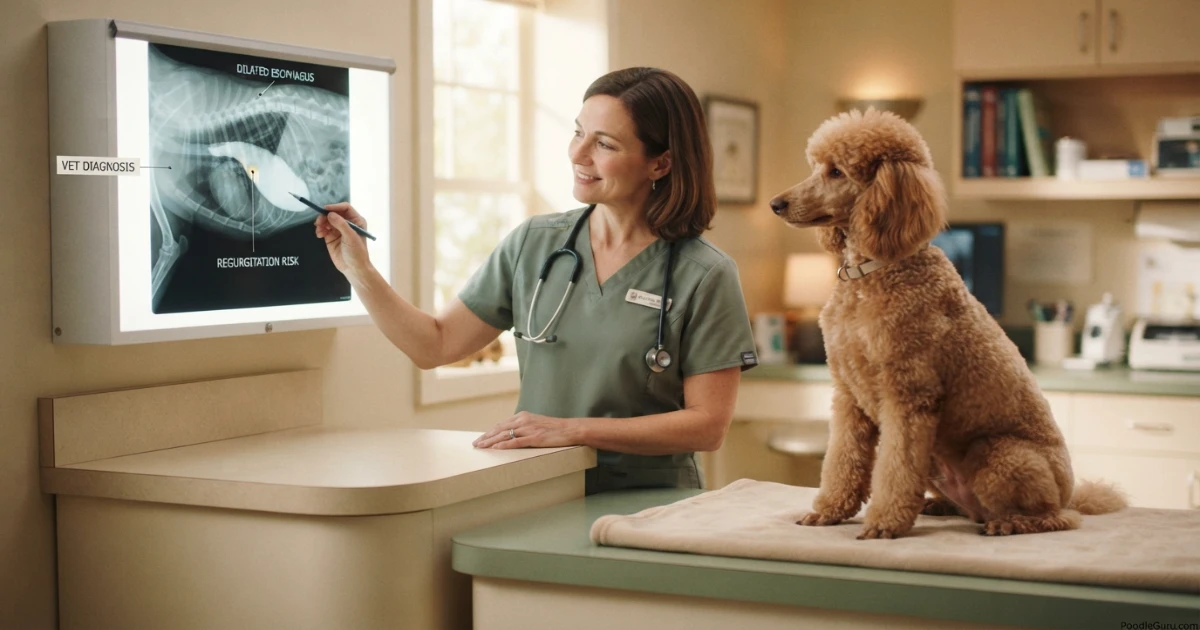
The term “megaesophagus” literally means enlarged esophagus. It’s visible on X-rays as a wide, floppy tube filled with air or food. In poodles, it’s often discovered in young adults, sometimes secondary to an underlying condition like myasthenia gravis, a disease that disrupts nerve-muscle communication.
Causes of Megaesophagus in Poodles
Veterinary specialists divide megaesophagus into two broad categories. Congenital megaesophagus appears in puppies shortly after weaning, often due to incomplete nerve development in the esophagus. Acquired megaesophagus develops later and can stem from several conditions:
- Myasthenia gravis: An autoimmune attack on the junction between nerves and muscles. It’s one of the most treatable causes — if caught.
- Hypothyroidism: Low thyroid hormone can weaken esophageal muscles, though this link is rarer.
- Addison’s disease: Cortisol deficiency sometimes causes esophageal motility problems.
- Vascular ring anomalies: A congenital band of tissue constricts the esophagus, more often seen in large breeds but occasionally in Standard Poodles.
- Idiopathic: No cause can be found. Many adult-onset cases fall here.
Standard Poodles are among the breeds reported with acquired myasthenia gravis, and megaesophagus can be one of its serious complications. Any poodle with repeated regurgitation should be evaluated by a veterinarian, who may recommend acetylcholine receptor antibody testing and other screening based on the history and exam.
Recognizing the Symptoms: Regurgitation vs. Vomiting
This distinction is the single most important concept for poodle owners. Vomiting is an active process — your dog heaves, retches, and brings up partially digested food mixed with bile. Regurgitation is passive: undigested food simply slides back out, often in a tubular shape, without warning. Poodle megaesophagus causes regurgitation, not vomiting.
| Sign | Regurgitation (Megaesophagus) | Vomiting (Stomach Issue) |
|---|---|---|
| Warning signs | None — food appears suddenly, often while the dog is walking or after a drink | Lip licking, drooling, retching, abdominal contractions |
| Appearance | Undigested, sometimes tubular-shaped, no bile | Partially digested, may contain yellow bile |
| Timing | Minutes to hours after eating or drinking | Any time, often on an empty stomach |
| Smell | Mild, if any — food hasn’t been processed | Sour, acidic |
| Dog’s demeanor | Usually normal, may try to eat the regurgitated food | May seem nauseous, depressed, or uncomfortable before |
Other poodle megaesophagus symptoms include weight loss despite a good appetite, excessive drooling, bad breath from food sitting in the esophagus, and a gurgling sound when breathing if aspiration has occurred. Puppies with the congenital form often look stunted and have a wet cough after nursing.
How Is Megaesophagus Diagnosed?
Your veterinarian will start with a thorough history and physical exam. If megaesophagus is suspected, the first test is usually a chest X-ray — often without sedation to avoid aspiration risk. A dilated, air- or food-filled esophagus is the classic sign. To better visualize the esophagus, a barium swallow study may be performed: your poodle swallows a liquid that shows up bright on X-rays, highlighting the flaccid tube and any narrowing.
Because acquired megaesophagus can have underlying causes, blood tests for myasthenia gravis (acetylcholine receptor antibody test), thyroid function, and adrenal hormones may be recommended. Identifying a treatable trigger can improve the treatment plan, though response varies and some dogs still require lifelong feeding management.
The PoodleGuru Megaesophagus Feeding Protocol
At PoodleGuru, we prioritize a structured, gravity-assisted feeding routine that protects the airway. This protocol is built on the universal principle: keep the esophagus vertical so food falls into the stomach. Here’s how to implement it safely.
Set Up an Upright Feeding Station
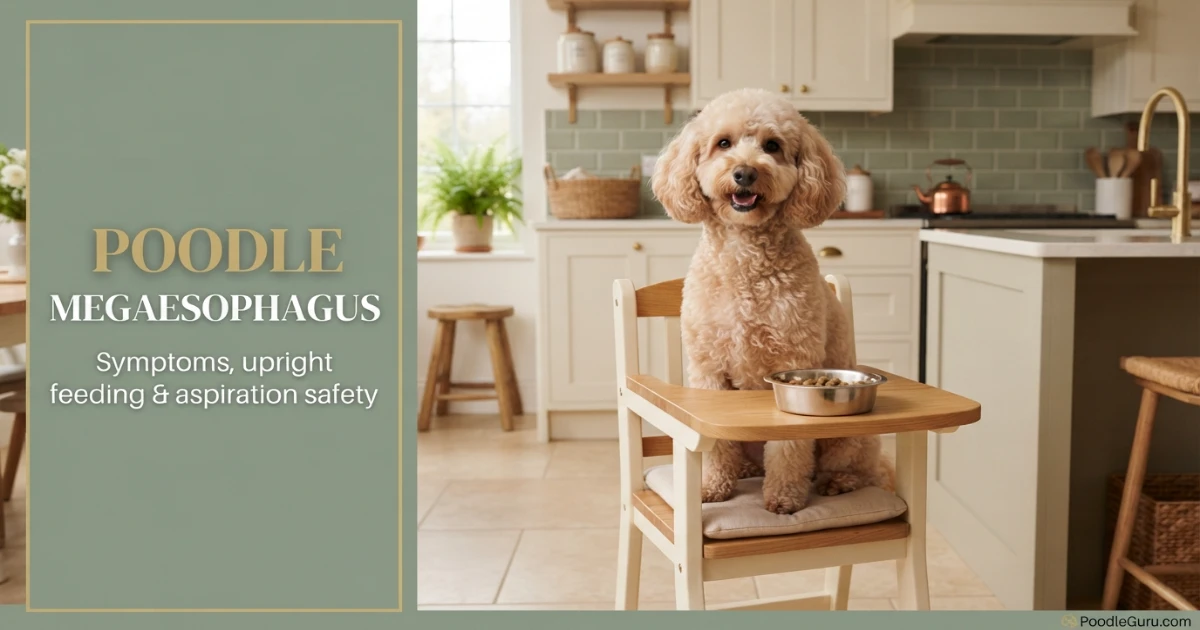
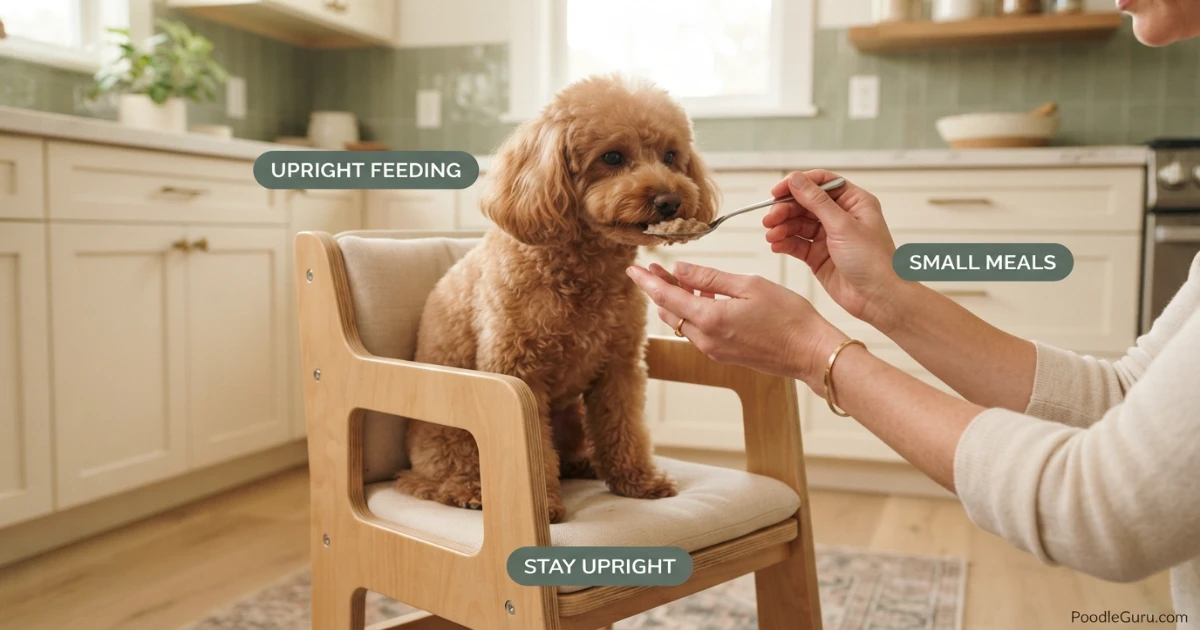
Position your poodle in a seated, vertical posture with the front paws elevated. A Bailey chair — a specially designed upright feeding chair — is commonly used. For Toy and Miniature Poodles, use a secure, veterinarian-approved upright setup that supports the body safely; avoid improvised positions that allow slipping, twisting, or panic. Your veterinarian can help you choose a safe target angle, often within the 45–90 degree range depending on the dog.
Tool: Bailey chair or homemade upright feeding stand with secure support.
Prepare the Right Food Consistency
Food consistency is individual. Some poodles do best on a slurry or gruel; others tolerate canned-food meatballs better. Dry kibble and hard treats may be difficult or unsafe for many affected dogs. Work with your veterinarian to test one texture at a time and choose the consistency that reduces regurgitation for your dog.
Outcome: A texture that flows easily, reducing the risk of getting stuck.
Feed Slowly and in Small Portions
Offer food in small, frequent meals — often 3 to 4 times daily instead of two large ones, depending on your veterinarian’s plan. Use a spoon, slow feeder tray, or feeding syringe only as directed, keeping the poodle calm and upright without forcing food. Do not push food deep into the mouth, because force-feeding can increase choking or aspiration risk.
Watch for: Any coughing, gulping, or food backing out — pause and let gravity work before continuing.
Maintain Upright Position After Eating
Keep your poodle upright after meals and water according to your veterinarian’s instructions. Many dogs need at least 10–15 minutes, and some need longer. Use a Bailey chair, supportive lap position, or other safe setup that keeps your poodle calm and vertical until food has time to move into the stomach.
Tip: Water can also be regurgitated or aspirated; some dogs need upright water delivery, thickened liquids, gelatin cubes, or water mixed into meals under veterinary guidance.
Complications: Aspiration Pneumonia
This is the emergency every megaesophagus owner dreads. When food, water, or saliva enters the lungs, it can trigger aspiration pneumonia — a serious complication that needs prompt veterinary care. Merck Veterinary Manual notes that aspiration pneumonia must be treated immediately and aggressively. Signs can include coughing, fever, lethargy, rapid breathing, and increased effort to breathe. In a poodle with megaesophagus, any new cough or breathing change should be treated as urgent.
Prevention is the best defense: strict upright feeding, never allowing the dog to eat off the floor, and monitoring water intake. Some owners keep a simple daily log of breathing rate, cough episodes, appetite, weight, and regurgitation events so they can recognize changes early and share clear information with their veterinarian.
Living With a Poodle With Megaesophagus
The routine is demanding, but many owners find a rhythm. Morning and evening meals become quiet rituals — the dog in the chair, the spoon or syringe, the gentle encouragement. While travel and boarding become more complicated, devoted owners adapt. The reward is a poodle who, despite a faulty esophagus, can still enjoy food, cuddles, and a loving home.
Weight and hydration must be tracked closely. Weekly weigh-ins on a home scale alert you to silent calorie loss. Water intake may be managed through upright drinking, water mixed into food, or gelatin cubes if your veterinarian approves that method. Be vigilant with dental care, too — regurgitation and retained food can contribute to bad breath, dental issues, and oral irritation.
Explore our comprehensive guide to Poodle Health Issues for more on managing chronic conditions, from allergies to endocrine disorders.
When to Call the Vet Immediately
Red Flags Requiring Urgent Care
- Any cough, especially moist or productive, or increased breathing effort.
- Fever (rectal temperature over 102.5°F) combined with lethargy.
- Sudden refusal to eat or drink, which can rapidly lead to dehydration in small poodles.
- Regurgitation followed by coughing, choking, distress, or noisy breathing, which may suggest airway involvement.
- Blue-tinged gums or tongue — a sign of oxygen deprivation.
Keep an emergency kit with your vet’s number, the nearest 24-hour clinic address, and a transport plan for your poodle that keeps them upright if possible.
Common Myths About Poodle Megaesophagus
Myth: A poodle with megaesophagus can just eat smaller meals from a bowl.
Reality: The problem isn’t meal size but gravity. Without an upright posture, any food or water can pool in the esophagus and be aspirated.
Myth: It only happens in giant breeds.
Reality: While large dogs are commonly affected, megaesophagus occurs in all sizes, including Toy and Miniature Poodles. Congenital forms can appear in puppies of any breed.
Myth: There’s a simple surgery to fix it.
Reality: With rare exceptions like a vascular ring anomaly, megaesophagus has no surgical cure. Management is the mainstay, though treating underlying diseases like myasthenia gravis can sometimes improve function.
Myth: If my dog regurgitates, I should restrict water.
Reality: Hydration is critical. Restrict how water is offered — upright, in gelatin cubes, or as a slurry — but never restrict total water intake without veterinary guidance.
Frequently Asked Questions
What is megaesophagus in poodles?
Megaesophagus is a condition where the esophagus loses muscle tone and becomes enlarged, preventing food from moving to the stomach. It causes passive regurgitation, not active vomiting, and requires upright feeding to manage.
Can poodle megaesophagus be cured?
There is no direct cure for the esophageal dilation itself unless it’s caused by a treatable underlying condition like myasthenia gravis. Many dogs can be managed with lifelong feeding adjustments, and some cases improve when an underlying cause is found and treated. Prognosis depends on cause, aspiration history, and response to management.
How do you feed a poodle with megaesophagus?
Feed only in the upright position recommended by your veterinarian, often using a Bailey chair or other secure setup. Your vet may recommend slurry, canned-food meatballs, or another texture, then keeping your poodle upright after meals. Water delivery also needs a safe plan.
What is the life expectancy of a poodle with megaesophagus?
With dedicated upright feeding and pneumonia prevention, many poodles live years with good quality of life. The biggest threat is aspiration pneumonia, which can be fatal if not treated promptly. Regular veterinary check-ups, weight tracking, and fast response to coughing or breathing changes are essential.
Is megaesophagus more common in poodles than other breeds?
Poodles are not the classic top-risk breed for all forms of megaesophagus, but Standard Poodles can appear in myasthenia gravis-associated cases. Any poodle with repeated regurgitation should be evaluated regardless of size.
What’s the difference between regurgitation and vomiting?
Regurgitation is passive: undigested food comes up without retching, often minutes to hours after eating. Vomiting is active, with heaving and bile. Megaesophagus causes regurgitation; stomach problems cause vomiting. This distinction guides diagnosis.
Can a poodle with megaesophagus eat dry kibble?
Many affected dogs do not tolerate dry kibble because it can lodge or regurgitate, but the safest texture varies by individual. Follow your veterinarian’s recommendation after observing which consistency your poodle handles best.
Key Takeaways: Poodle Megaesophagus Management
Megaesophagus changes how you feed, not how you love. These core facts will guide you.
- Megaesophagus is an enlarged, flaccid esophagus that prevents food from reaching the stomach and causes passive regurgitation.
- The primary symptom is regurgitation of undigested food without warning; vomiting is different and involves active heaving.
- Upright feeding — using a Bailey chair to keep the poodle vertical during and after meals — is the cornerstone of management.
- Aspiration pneumonia is the most dangerous complication; any cough, fever, or breathing change warrants immediate veterinary attention.
- Underlying causes like myasthenia gravis should be tested for, as treatment may improve esophageal function.
- With a strict routine and owner commitment, poodles with megaesophagus can enjoy comfortable, happy lives.
If your poodle has started regurgitating food or water, document the episodes and contact your veterinarian promptly. Chest imaging and screening for underlying causes can clarify the safest path forward.