Merle Poodle: Is It a Real Poodle? The Controversy Explained
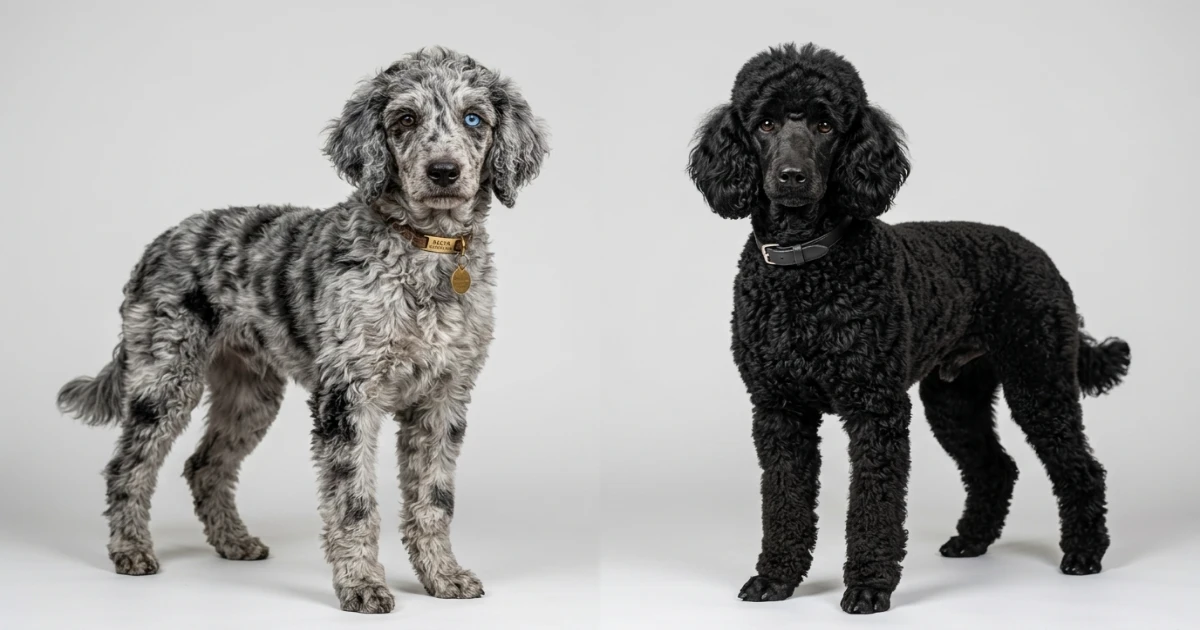
A merle poodle is a poodle carrying the SILV (merle) gene mutation, which creates a mottled, dappled coat pattern not found in purebred poodle genetics. The controversy centers on whether a dog marketed as a “merle poodle” is truly purebred. Merle does not occur naturally in poodles — it requires either an undocumented crossbreeding event or an introduced genetic mutation. The AKC does not recognize merle as an accepted poodle color, and many breed purists argue these dogs are not genuine poodles at all. Whether you see it as an interesting designer variation or a compromise of breed integrity depends on what you value — but every buyer deserves to understand exactly what they’re purchasing.
If you’ve been browsing poodle listings lately, you’ve probably encountered them: poodles with coats that swirl and dapple in silver, gray, blue, and cream — a marbled pattern unlike anything you’d see at a traditional dog show. Sellers call them merle poodles, price them at a premium, and sometimes claim they’re rare, exotic purebreds. The reality is more complicated, and understanding it matters far more than most breeders will tell you upfront.
The merle poodle debate is one of the most heated in the poodle world. It sits at the crossroads of genetics, breed standards, canine health, and ethical breeding — and it has very real consequences for unsuspecting buyers. This guide cuts through the marketing noise to give you the full picture.
What Exactly Is a Merle Poodle?
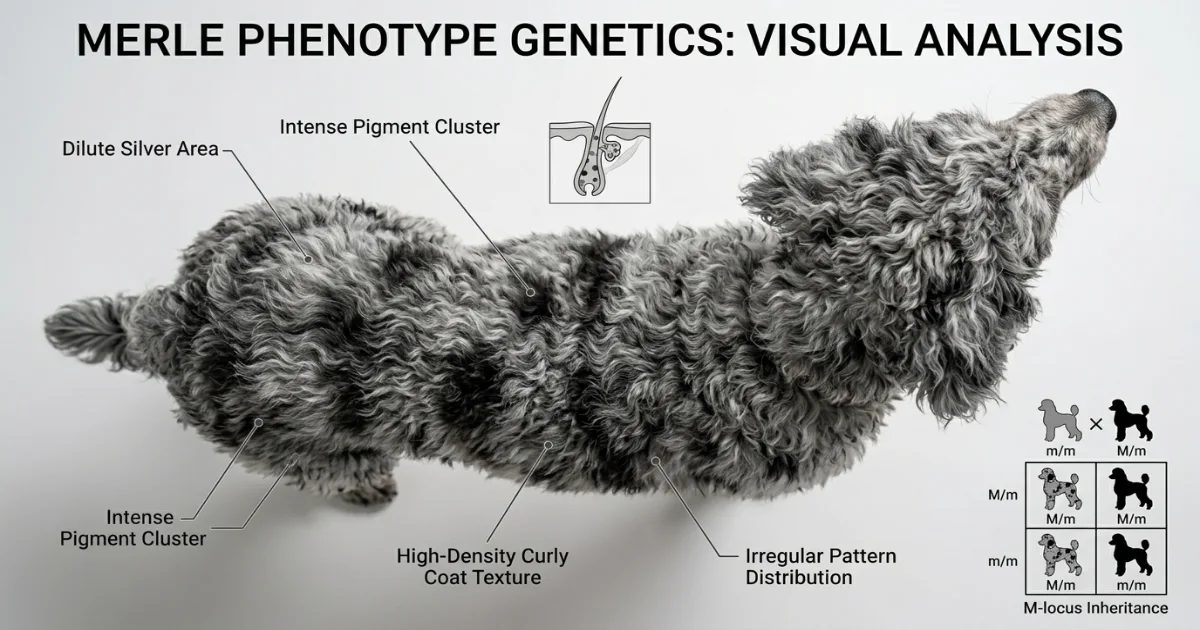
A merle poodle is a dog that presents with the merle coat pattern and is either sold as or believed to be a poodle. The merle pattern itself is caused by the SILV gene (sometimes written M locus), which randomly dilutes patches of pigment across the coat, eyes, and sometimes the skin. The result is that swirling, irregular patchwork of lighter and darker shades that looks simultaneously gorgeous and unusual.
Here’s the key problem: the merle gene does not occur naturally in purebred poodle genetics. Poodles have an extraordinarily well-documented genetic history. Their standard coat colors — black, white, apricot, cream, chocolate, silver, blue, red, and café-au-lait — are all accounted for in breed genetics. Merle is not among them.
For a “merle poodle” to exist, one of two things must be true: the dog has undocumented mixed ancestry somewhere in its lineage (most commonly with breeds like the Catahoula, Dachshund, Collie, or Australian Shepherd that carry the merle gene), or a very rare spontaneous genetic mutation occurred — an event so uncommon it’s generally considered implausible as an ongoing breeding explanation.
The Genetics Behind the Pattern
To understand the controversy, you need a working understanding of what the merle gene actually does. The SILV gene mutation functions as a pattern modifier, not a color gene in the traditional sense. When a single copy is inherited (Mm), it creates the classic merle pattern — random patches of diluted pigment scattered across the base coat color. A dog with two copies (MM) is a “double merle,” which comes with serious consequences.
The merle allele (M) acts by disrupting melanocyte function in patches, causing irregular pigment dilution. Single-copy merle (Mm) is generally considered safe. Double merle (MM) — produced when two merle-patterned dogs are bred together — causes significant developmental abnormalities including microphthalmia (abnormally small eyes), blindness, deafness, and other sensory deficits. This is the primary reason responsible breed organizations oppose merle-to-merle breeding. The risks are not theoretical; they are well-documented across multiple breeds.
In breeds where merle is native — Australian Shepherds, Border Collies, Great Danes, Dachshunds — responsible breeders have decades of accumulated knowledge about managing the gene safely. Merle poodle breeders, by contrast, are working with a gene introduced into a population where it has no natural history, no breed-specific safety data, and no official oversight.
Why the Poodle Community Is Divided
The backlash from established poodle breeders is significant — and it isn’t just snobbery about breed standards. Their concern operates on several levels.
The Breed Integrity Argument
Poodles are one of the oldest recognized dog breeds in the world, with centuries of selective breeding producing a specific set of traits — physical, temperamental, and genetic. To introduce a foreign gene through crossbreeding and then market the result as a purebred poodle is, to traditionalists, a form of misrepresentation. The argument isn’t that these are bad dogs. It’s that calling them purebred poodles is factually inaccurate.
The Health Responsibility Argument
Breed clubs exist partly to maintain health standards. When breeders operate outside those clubs — as most merle poodle producers do — there is no formal oversight. The risk of double merle pairings is real, and without community accountability, the incentive to avoid them is purely financial, not ethical.
The Counter-Argument From Merle Advocates
Supporters of merle poodles point out that if a dog tests genetically as a poodle, looks like a poodle, and behaves like a poodle, the aesthetic origin of one coat gene shouldn’t be disqualifying. They argue that breed purists are gatekeeping aesthetics rather than protecting function. Some also note that all breeds were created through crossbreeding at some point in history.
It’s a fair philosophical point — but it doesn’t resolve the practical questions about transparency, health testing, and buyer disclosure.
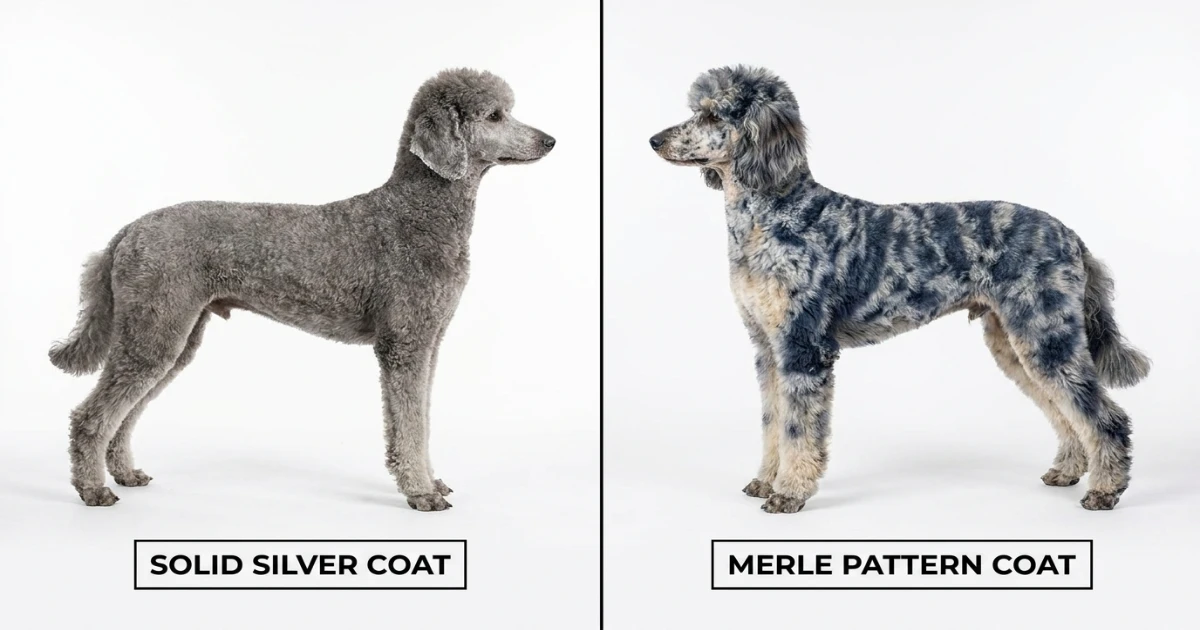
Merle Poodle vs. Standard Poodle: How They Actually Compare
| Feature | Merle Poodle | Standard Purebred Poodle |
|---|---|---|
| Coat Pattern | Mottled, dappled, marbled | Solid or parti — never merle |
| AKC Registration | Not eligible as purebred merle | Eligible for full registration |
| Genetic Origin | SILV gene (introduced, not native) | Recognized breed genetics only |
| Eye Color Risk | Blue eyes, heterochromia common; double merle risk of microphthalmia | Standard dark eyes; no merle risks |
| Health Testing Culture | Variable; often minimal oversight | Strong club-driven testing standards |
| Breed Standard Compliance | Non-compliant | Fully compliant |
| Typical Price (2026) | $2,500–$8,000+ (marketed as rare) | $1,500–$4,000 from reputable breeders |
| Show Eligibility | Disqualified from AKC conformation | Fully eligible |
What Buyers Usually Get Wrong
This is where the real consumer harm lives — and it’s worth naming directly.
Many buyers encounter the phrase “rare merle poodle” and interpret “rare” as a mark of quality or exclusivity. In reality, rarity here means the pattern isn’t supposed to exist in this breed. Marketers have turned a genetic anomaly into a selling point, and many buyers have no idea they’re paying a premium for something that breed purists consider a disqualification.
Sellers who claim their merle poodles are “100% purebred AKC registered” without disclosing the source of the merle gene are at minimum being misleading. Ask directly: has DNA ancestry testing been performed? Where does the merle gene originate? Has the sire or dam been tested to confirm they are not double merle carriers? If a breeder can’t answer these questions clearly, walk away.
The second common mistake is confusing phantom or parti poodles with merle. Parti poodles have patches of white alongside another color, which can look vaguely similar in puppy photos. Phantom poodles have a distinctive two-tone pattern. Neither is merle, and a reputable poodle breeder will always clarify the distinction. If a listing uses “merle” and “parti” interchangeably, that’s a red flag.
Third: buyers often underestimate the double merle health risk. Two merle-patterned parents — even if both appear healthy — can produce double merle offspring with serious disabilities. This isn’t a worst-case scenario. It’s a statistical certainty in any Mm × Mm pairing.
How Merle Poodles Are Actually Produced
The most common pathway is deliberate crossbreeding, typically using a Catahoula Leopard Dog — a breed that carries merle naturally and has some physical similarity to poodles in terms of athleticism and build. Others have used merle Dachshunds or merle Australian Shepherds. The crosses are then repeatedly bred back to poodles in an attempt to minimize non-poodle traits over successive generations.
By F3 or F4 generation, a dog can look overwhelmingly poodle-like in structure, coat texture, and temperament — while still carrying the introduced merle gene. DNA breed testing at this stage may show 90%+ poodle ancestry. This is precisely what makes the “real poodle” debate complicated rather than simple.
A few breeders claim to have developed what they call “multi-generational merle lines” and insist their dogs are effectively purebred poodles. The broader poodle community remains largely unconvinced, and no major kennel club has moved to recognize merle as an accepted poodle color or pattern.
Health Considerations for Merle Poodles
The merle gene itself, in single-copy form, doesn’t automatically make a dog unhealthy. Many Australian Shepherds, Border Collies, and other breeds carry merle and live full, healthy lives. The issue is context and breeding practice, not the gene in isolation.
For merle poodles specifically, the risk factors stack in ways that require careful attention:
- Hearing abnormalities: The BAER (Brainstem Auditory Evoked Response) test should be performed on all merle-patterned dogs to screen for deafness, which is more common in merle individuals across all breeds.
- Eye abnormalities: Ocular assessments should be standard, particularly for any puppy produced in a merle × merle pairing.
- Double merle risk: This is non-negotiable. A responsible merle poodle breeder must never breed two merle-patterned dogs together. If a breeder cannot confirm this, no health guarantee is meaningful.
- Standard poodle health testing: Hip evaluations, progressive retinal atrophy (PRA) screening, and thyroid testing remain just as relevant for merle poodles as for any other.
The compounding problem is that merle poodle breeders are largely outside the established poodle health registry system. The Poodle Health Registry, OFA data, and breed club health initiatives don’t typically include dogs that aren’t accepted as purebred poodles by the registering bodies. This creates a data gap that makes long-term health tracking genuinely difficult.
Merle Poodle Prices in 2026: What’s Really Driving the Numbers
2026 Merle Poodle Price Guide
- Toy or Miniature Merle Poodle: $2,500 – $6,500 depending on coat pattern intensity and breeder reputation
- Standard Merle Poodle: $3,000 – $8,000+ — “rare” coloring commands highest premiums at standard size
- Double-blue-eyed Merle: Often marketed at $7,000–$10,000 — the highest aesthetic premium, but carries the most health scrutiny
- What inflates prices: Perceived rarity, social media virality, intense blue or heterochromic eyes, unusual merle pattern intensity
- What you’re actually paying for: Aesthetic novelty and marketing — not superior breed quality, health certifications, or lineage documentation
- Red flag pricing: Any seller charging a “rarity premium” but offering no DNA testing, BAER results, or OFA health clearances
Pro Tips for Anyone Considering a Merle Poodle
What to Do Before You Commit
- Request full DNA ancestry testing results for both parents — not just the puppy. Understand what percentage poodle the dog actually is.
- Ask specifically: are both parents merle-patterned? If yes, walk away. If the answer is unclear, walk away.
- Request BAER (hearing) test results for any merle puppy. This is non-negotiable.
- Ask for OFA health clearances on both parents — hips, eyes (including PRA testing), and cardiac screening where appropriate for the size.
- Be honest with yourself about what you want. If you want a poodle for showing, competing in AKC events, or maintaining verifiable purebred lineage, a merle poodle is not the right choice. If you want a companion animal with poodle-like traits and you’ve done your health homework, the decision is more personal.
- Do not pay a premium for blue eyes without understanding the double merle risk. Intense blue eyes in a merle dog can be beautiful — they can also be a symptom of problematic breeding, not a feature to celebrate.

So Is a Merle Poodle a “Real” Poodle?
The honest answer is: it depends what you mean by “real.”
By AKC standards and traditional breed definitions, no. Merle is not a recognized poodle color. A dog carrying the merle gene almost certainly has non-poodle ancestry somewhere in its lineage. No major kennel club accepts merle as a valid poodle pattern, and these dogs cannot be shown in conformation classes as purebred poodles.
By function, temperament, and appearance at a multi-generational level? In many cases, yes — a high-generation merle poodle may be indistinguishable from a purebred poodle in every practical sense except coat pattern. They can be just as intelligent, just as trainable, just as hypoallergenic in terms of coat texture, and just as devoted as any other poodle.
The “real poodle” debate ultimately comes down to documentation, transparency, and intent. A breeder who produces these dogs honestly — acknowledging the crossbreeding history, performing appropriate health tests, and never claiming AKC purebred status they can’t support — is operating differently from one who markets them as exotic rarities with fabricated provenance. Buyers deserve to know which kind they’re dealing with.
Frequently Asked Questions
Can a merle poodle be AKC registered?
Not as a recognized purebred poodle with full registration in the traditional sense. The AKC does not list merle as an accepted poodle color, and dogs with that pattern are disqualified from conformation showing. Some merle poodles may be registered in alternative registries that have less stringent standards, but these are not equivalent to AKC registration and should not be treated as verification of purebred status.
Are merle poodles more expensive than regular poodles?
Yes, typically by a significant margin. In 2026, merle poodle puppies frequently sell for $2,500 to $8,000 or more, often exceeding the price of well-bred purebred poodles from established health-tested lines. The premium is driven almost entirely by the aesthetic novelty of the coat pattern and the marketing around rarity — not by superior health, lineage, or breed quality.
What breeds are crossed to produce merle poodles?
The most commonly used merle-carrying breeds in the production of merle poodles include Catahoula Leopard Dogs, Dachshunds, Australian Shepherds, and Collies. The initial cross is then typically bred back to purebred poodles over multiple generations to reduce visible non-poodle characteristics while retaining the merle gene.
Is a merle poodle healthy?
A single-copy merle (Mm) poodle produced through responsible breeding — with BAER hearing tests, ocular assessments, and standard poodle health clearances — can be a healthy dog. The serious health risks arise specifically with double merle (MM) individuals, who may suffer from blindness, deafness, and developmental eye abnormalities. The overall health picture also depends heavily on the quality of the breeder’s program, which varies enormously in the merle poodle market.
How do I tell if a poodle is merle or parti?
Merle produces a mottled, marbled, irregular dilution pattern — patches that fade and swirl rather than creating hard color boundaries. Parti poodles have distinct, clearly defined patches of white and another solid color, typically with hard edges. Phantom poodles have a structured two-tone pattern with specific color placement points. If you’re uncertain, ask the breeder for a genetic color panel, which will identify the merle allele directly.
Can two merle poodles be bred together?
This is strongly inadvisable and considered irresponsible by virtually all canine genetics experts. Breeding two merle-patterned dogs together carries a 25% statistical chance of producing double merle offspring in each litter. Double merle puppies suffer from serious and often irreversible developmental disabilities including blindness and deafness. No aesthetic goal justifies this risk.
Do merle poodles have blue eyes naturally?
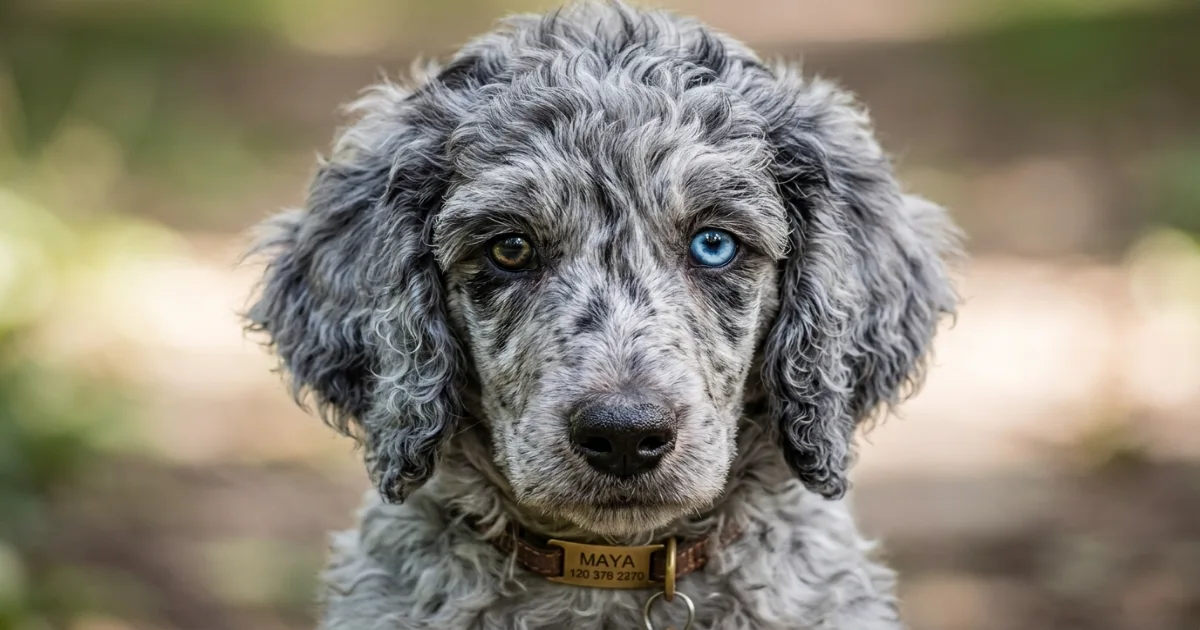
Blue or odd-colored eyes (heterochromia) are common in merle-patterned dogs of any breed. They result from reduced pigmentation in the iris caused by the same merle gene. While visually striking, blue eyes in a merle dog are not a separate desirable trait — they’re a byproduct of the pigmentation-diluting effect that creates the coat pattern. In double merle dogs, eye abnormalities extend beyond color to include structural malformations.
The Bottom Line on Merle Poodles
Merle poodles are visually striking, often expensive, and genuinely controversial within the poodle community. Here’s what every prospective buyer should carry away from this:
- The merle pattern does not occur naturally in purebred poodles — it requires introduced genetics, typically through crossbreeding.
- No major kennel club recognizes merle as a valid poodle color; these dogs cannot be shown as purebred poodles in AKC conformation.
- The health risks associated with the merle gene are real and require specific testing — especially BAER hearing assessment and ocular evaluation.
- Double merle pairings (merle × merle) carry a serious risk of producing disabled offspring. This is non-negotiable and should disqualify any breeder who practices it.
- The premium price attached to merle poodles is driven by aesthetics and marketing, not by superior breed quality or health standards.
- A merle poodle can still be a wonderful companion — but only when purchased from a breeder who is honest about the dog’s origins, thorough with health testing, and transparent about what “merle poodle” actually means.
Know what you’re buying. Ask the hard questions. And don’t let a beautiful coat pattern substitute for the documentation and integrity that any reputable breeder should be proud to provide.