Are Poodles Good Off-Leash? What Owners Should Know
The fantasy of a poodle trotting beside you through a field, completely free, is lovely. The reality? It depends on your dog, your training, and the environment. Here’s how to honestly assess your poodle’s off-leash reliability before you risk that unclip.
Quick Answer
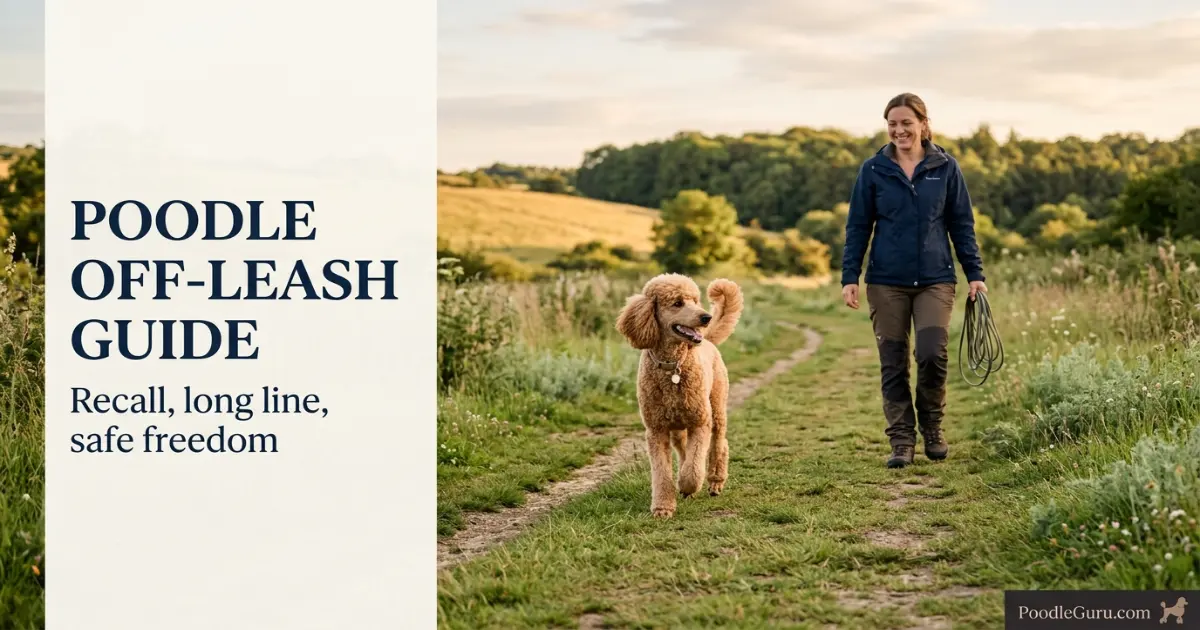
Poodle off-leash reliability can be excellent, but poodles are not universally reliable. Their high intelligence is a double-edged sword: they learn commands quickly, but they also learn when you can’t enforce them. Toy and Miniature Poodles often have strong prey drives that make them dash after squirrels without thinking. Standard Poodles can be more steady, but still need proofed recall training. Real off-leash reliability requires months of consistent work, not just a few successful calls in the backyard.
Publication Note
For SEO and safety clarity, this guide treats off-leash freedom as a privilege earned through recall proofing, long-line training, environment management, and honest risk assessment — not as a breed guarantee.
What Is Poodle Off-Leash Reliability?
Poodle off-leash reliability is a measure of how consistently your poodle returns to you immediately when called, regardless of distractions. For poodle owners, this means your dog will stop mid-chase after a squirrel, ignore a barking dog across the street, or leave a dropped piece of food — all because you gave the recall cue. The most important thing to understand is that reliability isn’t a personality trait; it’s a trained skill that must be maintained. A poodle that comes 9 out of 10 times is not reliable. That one failure could be catastrophic.
Many owners confuse “my poodle stays near me in a quiet park” with true reliability. But the real test comes when something exciting or scary appears. A passing cyclist, a rabbit, another dog — that’s when your training gets challenged. Poodles are bred as retrievers, which means they have a genetic impulse to chase moving objects. Combined with their smarts, they can be selective listeners. Reliability means overcoming that selective hearing.
Quick Facts About Poodles and Off-Leash Behavior
Not a Guarantee
No poodle is 100% off-leash reliable in all situations. Even well-trained dogs can have a bad day or a moment of instinct.
Size Doesn’t Dictate Reliability
A Toy Poodle can have bombproof recall, while a Standard might bolt. It’s about training and temperament, not just stature.
Prey Drive Is the Biggest Wildcard
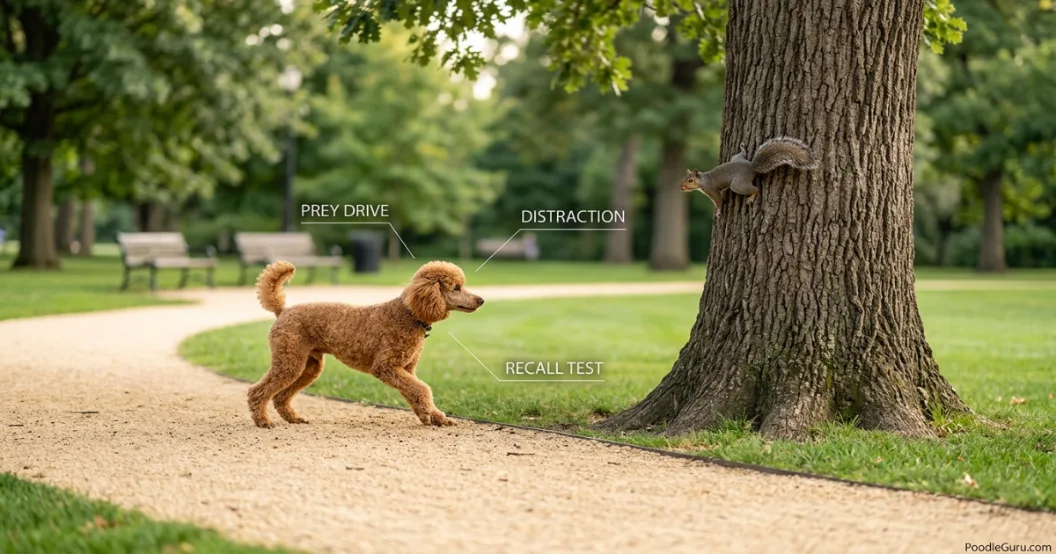
Many poodles have strong chase instincts. A moving squirrel can override months of training in a heartbeat.
What Affects Poodle Off-Leash Reliability?
Six core factors interact to determine how well your poodle will do off leash. You can’t change genetics, but you can work with the rest. These factors are what separate casual obedience from true poodle off-leash reliability.
1. Genetic Prey Drive and Retrieving Instinct
Poodles were originally water retrievers. That means they’re hardwired to notice and pursue movement. Some lines have been bred down for show or companionship, but many still carry a strong chase drive. If your poodle fixates on birds or squirrels, that’s not disobedience — it’s genetics showing up. Acknowledging this helps you set realistic expectations.
2. Training Consistency and Proofing
A recall practiced only in the kitchen isn’t a real recall. Effective poodle training requires proofing in gradually more distracting environments. Poodles are quick learners, so they often master the cue at home within days. But real-world proofing takes months.
3. Individual Temperament
Some poodles are naturally velcro dogs, glued to your side. Others are independent explorers. This temperament, shaped by early socialization and genetics, heavily influences off-leash potential. A timid poodle might bolt from a loud noise; a bold one might chase a deer. According to the AKC breed standard, poodles are alert and active, but individual variation is huge.
4. Age and Maturity
Puppies and adolescents (6–18 months) are the least reliable. They’re impulsive, easily distracted, and still learning impulse control. Many owners make the mistake of trusting their “perfect” 5-month-old off leash, only to have the dog blow them off at 10 months. Adulthood (2+ years) brings more steadiness.
5. Environment and Distractions
The same poodle that’s reliable in a fenced yard might be completely unreliable near a road or in a crowded park. The more novel the environment, the harder recall becomes. This is true for all dogs, but poodles’ sensitivity to new stimuli can amplify it.
6. Relationship and Engagement
Poodles thrive on partnership. If you’re the most interesting thing in their world, they’ll stick closer. Building that bond through play, training, and shared adventures is a massive reliability booster. Disengaged poodles have less reason to return.
Poodle Off-Leash Reliability Factors: Low vs. High Probability of Success
Use this table to honestly assess where your poodle sits today. It’s not about judgement — it’s about safety.
| Factor | Low Reliability Indicator | High Reliability Indicator |
|---|---|---|
| Recall Response Latency | Hesitates, sniffs, finishes what they were doing before slowly returning | Immediately whips around and sprints back, even mid-chase |
| Prey Drive Expression | Cannot break focus from squirrels, birds, cats; screams in excitement | Notices movement but can easily reorient to you when called |
| Distraction Tolerance | Ignores you completely when another dog or person appears | Glances at distraction but returns attention to you quickly |
| Distance Comfort | Wanders far, disappears from sight frequently, checks out | Maintains a loose radius, regularly checks in with eye contact |
| Emotional Regulation | Panics or becomes hyperaroused easily, difficult to calm down | Recovers quickly from surprises, stays level-headed in new settings |
| Owner Engagement | Rarely checks in, prefers environment over owner interaction | Seeks interaction, brings toys, responds to voice tone changes |
The PoodleGuru Off-Leash Readiness Checklist
At PoodleGuru, we evaluate off-leash readiness through a five-point checklist that looks beyond “he usually comes when called.” You need all five before trusting your poodle off leash in an unfenced area.
1. Rocket Recall in Low Distraction
When called in your backyard or a quiet indoor space, your poodle turns instantly and returns at speed, not a meandering walk.
2. Proofed Around High-Value Temptations
You’ve practiced with food dropped on the floor, a favorite toy, or a friend holding a treat, and your poodle still chooses you.
3. Check-In Habit
Even off leash in a safe area, your poodle spontaneously glances back at you every 10–20 seconds without being prompted.
4. Emergency Stop Cue
You have a separate “stop” or “down” cue that works at a distance, especially useful if recall isn’t possible (like near a road).
5. No History of Bolting
Your poodle has never taken off and ignored you for more than a few seconds in a scenario you’d consider dangerous.
How to Build Poodle Off-Leash Reliability Step by Step
If your poodle isn’t ready yet, that’s okay. Follow these six steps to build a recall you can trust. Plan for months, not weeks.
Start With a Unique Recall Word
Pick a crisp, uncommon word like “here” or “pronto” — not “come” which may be poisoned. Use it only for recall, and always reward with high-value treats (chicken, cheese).
Load the Cue Indoors with Zero Distractions
Say the word, then immediately toss a treat at your feet. The poodle learns that the word means “run to me because awesome things happen right here.” Practice 20x a day.
Add Distance Indoors, Then Move to a Fenced Yard
Practice from 5 feet, then 10 feet. Still no distractions. Once reliable, move to a fenced outdoor area. Never chase your poodle if they don’t come — run away from them instead to trigger chase instinct toward you.
Introduce Controlled Distractions Gradually
Use a long 20–30 foot training leash in a park. Have a friend walk by, then recall. Work up to squirrels, other dogs, and bikes — always on the long line until your poodle nails it every time.
Never Poison the Cue
Don’t call your poodle to do something they dislike (bath, nail trim, leaving the park). If you need to end fun, go get them instead. According to the ASPCA’s recall training guidance, every recall that ends in punishment or removal from fun weakens the cue.
Test in New Locations with a Long Line First
Before going completely off leash in a new area, use the long line. Poodles are context-specific learners. A recall in your usual park doesn’t guarantee a recall at the beach. Re-proof everywhere.
Owner Mistakes That Destroy Off-Leash Reliability
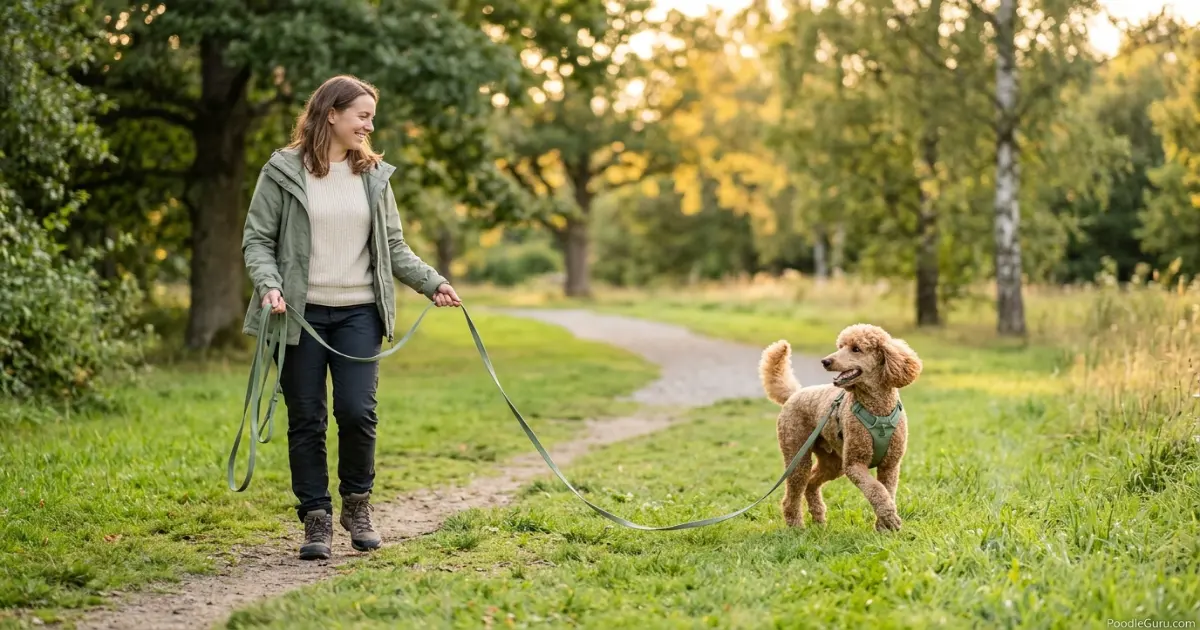
Even skilled owners accidentally undermine their poodle’s recall. Here are the biggest pitfalls — and how to avoid them.
Repeating the Cue
Saying “come, come, come, COME!” teaches your poodle the cue is optional. Say it once, then help them succeed (jog backward, squeak a toy) if they don’t respond immediately.
Only Recalling to End Freedom
If every recall means the leash goes on and the fun stops, your poodle learns that coming when called predicts punishment. Practice “surprise recalls” where you let them go again.
Trusting “Mostly Reliable”
“He comes 90% of the time” is a dangerous gamble. That 10% might be the time a car is coming. Off-leash freedom should only happen when you’d bet your poodle’s life on that recall.
When to Keep the Leash On — No Exceptions
Safety Scenarios Where Leashes Are Non-Negotiable
Even the most reliable poodle should be leashed in these situations, regardless of training level:
- Near roads, parking lots, or any vehicle traffic
- Areas with known wildlife — deer, coyotes, porcupines, snakes
- Unfamiliar hiking trails with sudden drop-offs or cliffs
- Locations where leash laws apply (it’s the law, and it protects everyone)
- When your gut says no — your intuition about a situation is often right
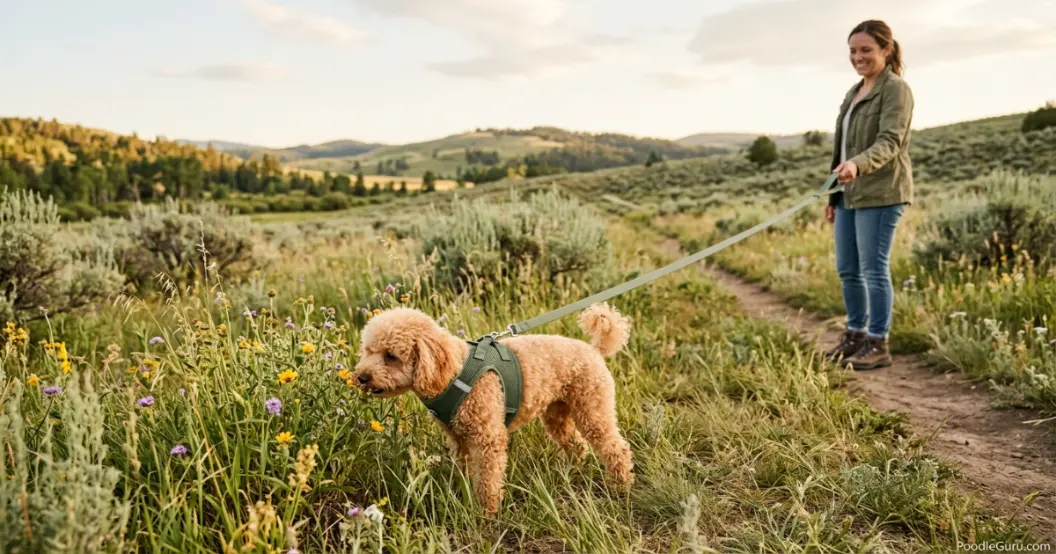
A long leash (biothane, 20+ feet) gives your poodle freedom to explore while you maintain a literal safety line.
What Experienced Poodle Owners Know
Off-leash reliability isn’t a finish line you cross once. It’s a daily maintenance skill. Poodles that have been solid for years can have a random “deaf day.” Owners who stay humble about this keep their dogs safest. Celebrate when your poodle nails a recall around a huge distraction — and always pay generously. That reinforcement never stops.
Frequently Asked Questions
Can poodles be trusted off leash?
Some can, with extensive training and under the right conditions. But no poodle should be trusted 100% off leash in every environment. Reliable recall takes months of proofing and constant maintenance.
Are standard poodles better off leash than toy or miniature poodles?
Not necessarily. Standard Poodles may be less physically prone to bolting due to larger stride, but all sizes can have high prey drive or independence. Temperament and training matter more than size.
What age should I start off-leash training?
Start recall foundations as early as 8 weeks, but only use a long line or fenced area for off-leash practice until the dog is mature enough (around 18–24 months) and proofed against heavy distractions.
My poodle bolts after squirrels. Can this be trained out?
You can’t erase prey drive, but you can redirect it. Use a long line and gradually practice recall near squirrels, rewarding heavily when your poodle chooses you. It takes time and patience, but improvement is possible.
Is a GPS collar a good backup for off-leash poodles?
Yes. A GPS collar (like Fi or Tractive) provides peace of mind, but it doesn’t replace recall training. It’s a safety net, not a training tool. Ensure the collar fits well and the battery is always charged.
What should I do if my poodle ignores a recall and runs toward danger?
Don’t chase — it becomes a game. Instead, run away from the danger, make exciting noises, or drop to the ground. Many dogs will turn to see what you’re doing. Carry an emergency squeaker or high-value treat pouch at all times.
Can I ever fully trust my poodle off leash near roads?
No. Even world-class obedience dogs can spook or make a mistake. Near traffic, always use a leash. The risk is too great. Save true off-leash freedom for enclosed spaces or vast, traffic-free nature areas.
Key Takeaways: Poodle Off-Leash Reliability
Your poodle’s off-leash future depends on honest assessment and consistent training. Here’s what to remember:
- Poodle off-leash reliability is a trained skill, not a breed guarantee — high intelligence alone won’t keep your dog safe.
- Use the PoodleGuru Off-Leash Readiness Checklist (rocket recall, proofing, check-in habit, emergency stop, no bolting history) to evaluate your dog before dropping the leash.
- Prey drive is the biggest wildcard; recognize your poodle’s genetic chase impulse and manage it with long-line proofing around wildlife.
- Build recall step by step, never poison the cue by calling for unpleasant things, and reward generously every single time.
- True reliability takes months of consistent work; a “mostly reliable” poodle is still a risk — one mistake could be tragic.
- Even a highly reliable poodle must stay leashed near roads, cliffs, or unknown terrain; a long line is the safest compromise for exploration.