Are Poodles Velcro Dogs? Understanding Clingy Behavior
If your poodle follows you from room to room, leans against your leg while you work, or whines when you close the bathroom door, you’ve probably wondered: is this normal? The short answer is yes — poodles are famously attached to their people. But there’s a difference between devoted companionship and emotional dependence. Here’s how to tell the difference, and what to do when clinginess crosses the line.
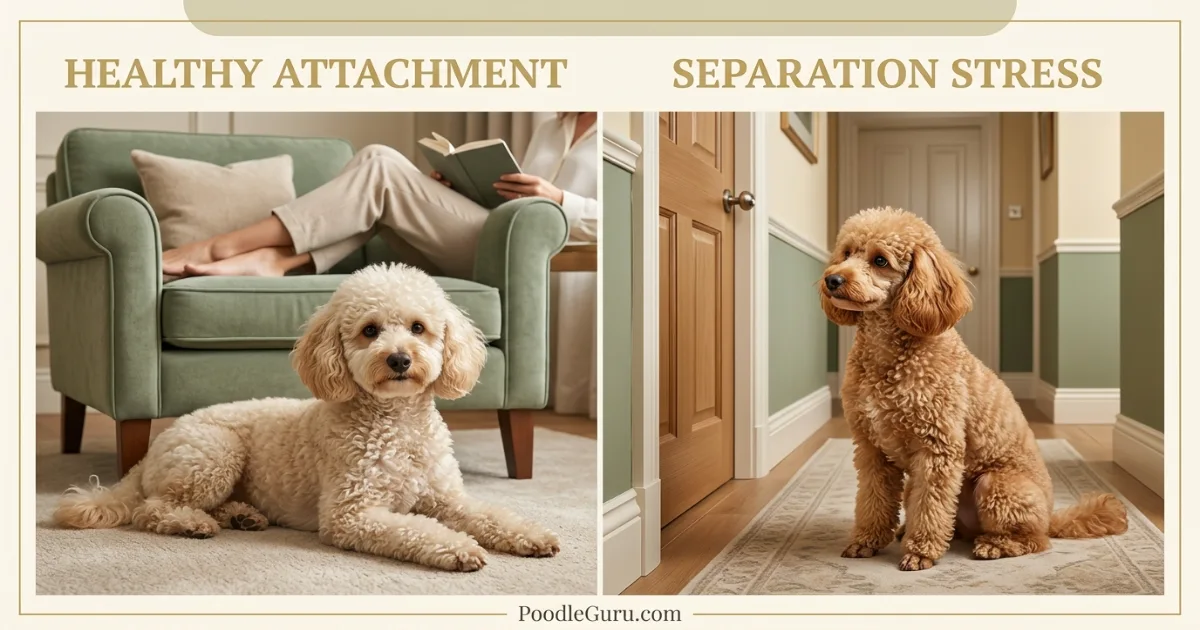
Quick Answer: Are Poodles Velcro Dogs?
Yes, poodles are widely considered velcro dogs — they form intense bonds and have a strong natural desire to stay near their owners. The breed was developed for close human partnership, and that instinct hasn’t faded. In most cases, this closeness is a healthy sign of trust and breed-typical temperament. However, when a poodle can’t tolerate even brief separation without panic, the behavior shifts from attachment into separation anxiety — and that needs a different response. Understanding where your poodle falls on the clinginess spectrum is the key to appreciating the devotion without letting it become a problem.
🧬 In Their DNA
Poodles were originally water retrievers who worked alongside hunters all day. That partnership bred a need for constant human connection.
💡 Smart & Sensitive
High intelligence means poodles notice everything — including when you might leave. Sensitivity makes them deeply attuned to their owner’s presence.
⚖️ It’s a Spectrum
Healthy velcro behavior is calm and flexible. Unhealthy clinginess involves panic, destruction, or vocalization the moment you’re out of sight.
What Is a Velcro Dog?
A velcro dog is a term that describes canines who shadow their owners persistently — following from room to room, lying as close as physically possible, and seeking frequent physical contact. For poodle owners, this means a dog who’d choose your lap over a plush bed, who waits outside the shower, and who considers a closed door a personal offense. The most important thing to understand is that velcro behavior isn’t inherently a problem; it’s a reflection of the deep social bonding dogs have evolved to feel toward their humans.
In poodles, this trait is particularly pronounced. It’s not unusual for a poodle to learn the sound of your car engine, anticipate your arrival at the window, and refuse to eat until you’re home. This isn’t manipulation — it’s attachment. And when the attachment stays relaxed and flexible, it’s one of the most rewarding parts of owning a poodle.
But when the following becomes frantic, when your poodle can’t settle unless touching you, and when short separations trigger distress, the label shifts from “velcro” to “separation distress.” That’s the line this guide helps you find.
Why Are Poodles So Clingy?
Poodles weren’t designed to be independent. They were designed to work closely with a human partner, reading cues and responding instantly. That history still lives in every poodle, whether they’re retrieving a ball or watching you cook dinner.
A Retriever’s Mindset
The AKC classifies poodles in the non-sporting group, but their original purpose was water retrieval. A good retriever stays near the hunter, watches for direction, and springs into action on command. That means poodles are genetically inclined to stay close, pay attention, and feel unsettled when separated from their handler.
High Emotional Intelligence
Poodles read human facial expressions, tone of voice, and body language with startling accuracy. They know when you’re about to stand up before you’ve moved. This sensitivity fuels the velcro tendency — they’re always scanning you for information, and closeness gives them more data. It also means they pick up on your stress. An anxious owner can unintentionally signal that the world is unsafe, which makes a poodle cling even harder.
Boredom Magnifies Clinginess
An under-stimulated poodle has nowhere to direct their mental energy except toward you. If you’re the most interesting thing in the room, they’ll attach themselves to you like static. This is one reason why well-exercised, mentally enriched poodles often show a calmer, more balanced version of velcro behavior.
The AKC poodle breed page notes the breed’s “active, proud, very smart” nature — traits that, when unmet, can spiral into attention-seeking clinginess.
Healthy Attachment vs. Problem Clinginess
Not all following is unhealthy. In fact, a poodle who checks in on you in different rooms is displaying a secure attachment. The difference lies in what happens when you walk out the door.
| Indicator | Healthy Velcro Behavior | Separation Anxiety / Problem Clinginess |
|---|---|---|
| Following you around | Follows casually, settles nearby, may stay in another room if comfortable | Follows frantically, can’t settle out of sight, paces |
| Reaction to closed door | May wait a moment then lie down; minimal vocalization | Barking, scratching, whining, panting within seconds |
| When you return | Happy greeting, quickly returns to normal activity | Over-the-top, frantic greeting that takes a long time to settle |
| Appetite when alone | Eats treats or meals normally even when alone | Refuses food until owner returns |
| Sleep | Can sleep in another room or crate without distress | Needs physical contact to sleep; restless and wakes frequently |
| Overall mood | Content, playful, curious | Anxious, hypervigilant, often watches owner intensely |
If your poodle shows multiple signs from the right column, it’s time to address the underlying anxiety rather than simply labeling them as “clingy.” The ASPCA’s guide to separation anxiety offers valuable starting points, and a consultation with a certified separation anxiety trainer can be transformative.
The PoodleGuru Clinginess Spectrum
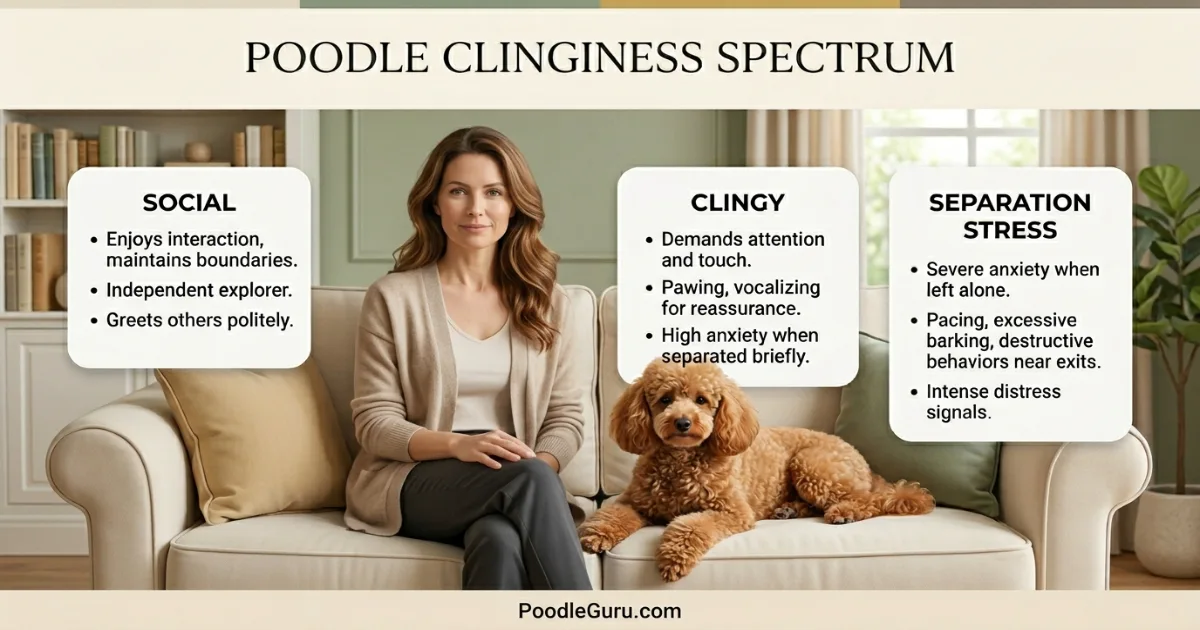
At PoodleGuru, we assess clinginess not as a yes-or-no label but as a spectrum. This model helps owners understand where their dog sits and what kind of support, if any, is needed.
The PoodleGuru Clinginess Spectrum
Use this framework to evaluate your poodle’s attachment style and decide on the best approach.
🟢 Socially Connected
Characteristics: Enjoys being near you, follows you at a relaxed pace, can settle in another room without distress. Seeks affection without urgency.
Owner Action: Enjoy it. This is the sweet spot of poodle companionship. No intervention needed.
🟡 Velcro-Adjacent
Characteristics: Prefers to be in the same room, occasionally scratches at a closed door but settles within a few minutes. Some mild vocalizing when left alone that stops quickly.
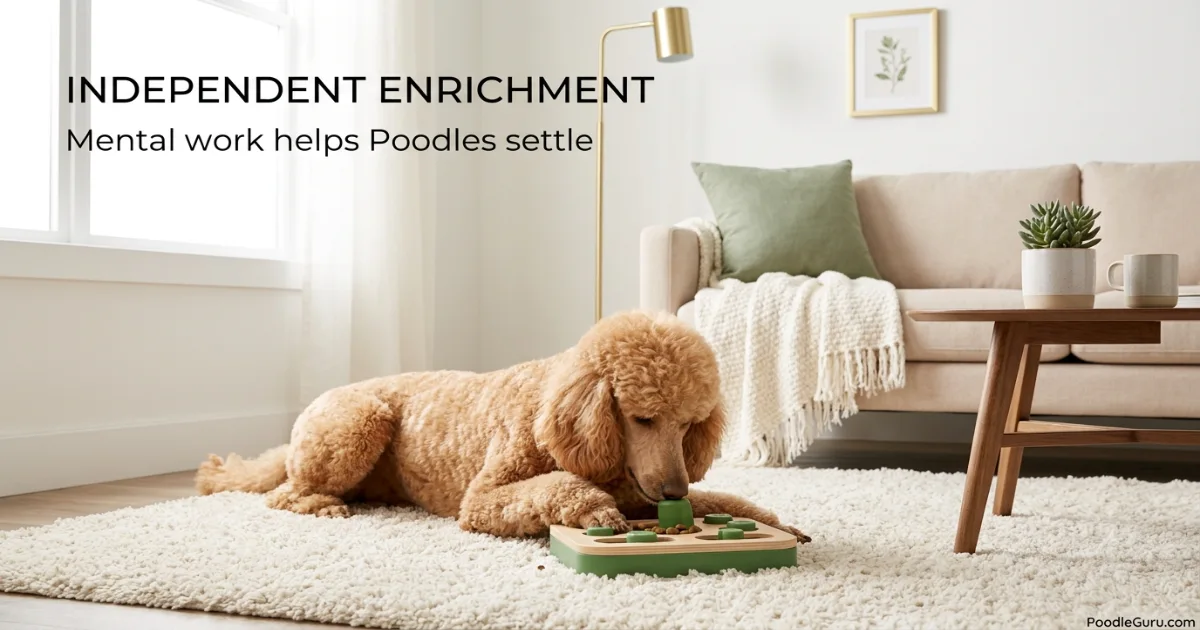
Owner Action: Provide occasional independent enrichment (snuffle mat, stuffed kong in another room). Practice short separations with rewards for calmness.
🟠 Clingy but Coping
Characteristics: Strong desire to be with owner, some restlessness when apart, may refuse treats when alone. Recovers within 10–15 minutes but shows clear preference for constant contact.
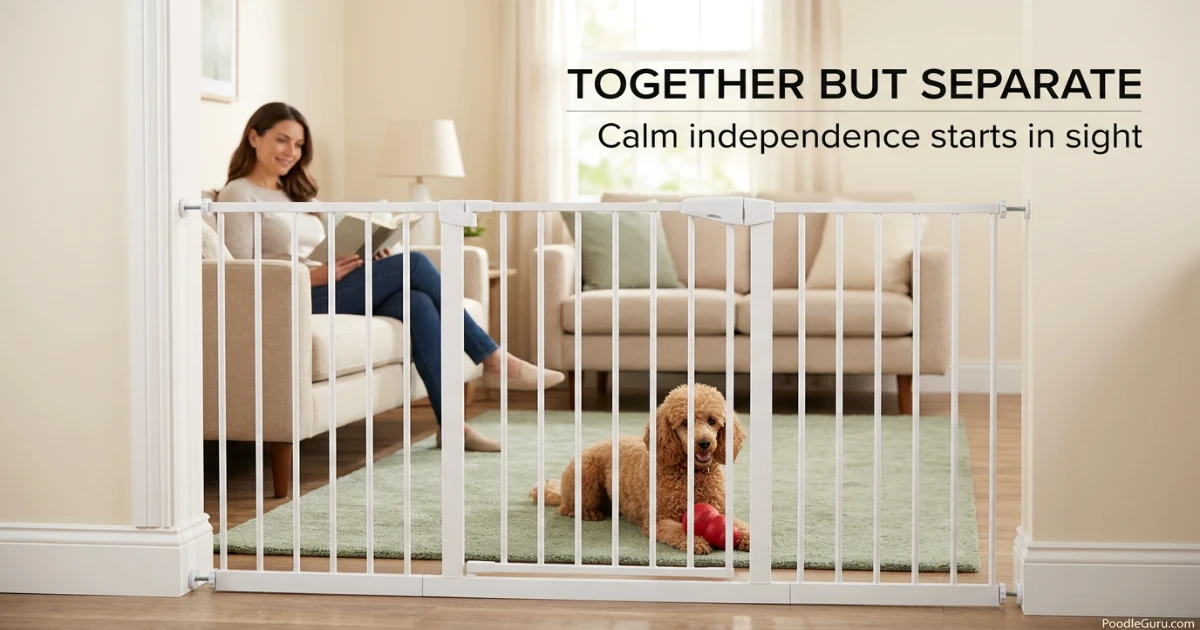
Owner Action: Increase structured alone time. Use baby gates to create “together but separate” time. Consult a trainer if the behavior escalates.
🔴 Separation Distress
Characteristics: Panic when owner leaves — destructive behavior, house soiling, self-injury, prolonged vocalization. Cannot settle even after owner returns.
Owner Action: This is a clinical issue. Seek help from a veterinary behaviorist or certified separation anxiety trainer. Avoid punishment; it makes the anxiety worse.
This spectrum helps remove the guilt many owners feel. Being a velcro dog isn’t a failure — it’s an expression of breed temperament. The goal is to keep your poodle in the green or yellow zone, where attachment enhances life without limiting it.
Clinginess Across Poodle Sizes
Is a Standard more independent than a Toy? Owners often ask whether size predicts velcro intensity. The honest answer is that individual temperament matters more than size, but there are subtle trends worth noting.
| Poodle Size | Typical Velcro Tendency | Reason |
|---|---|---|
| Toy Poodle | Highest likelihood of intense clinginess | Bred purely as lap companions; small size makes them easy to carry, which reinforces proximity |
| Miniature Poodle | Moderate to high clinginess | Retains working drive but also strong companion history; adaptable but often deeply bonded |
| Standard Poodle | Devoted but often more emotionally balanced | Larger size and stronger working heritage give more confidence; still highly attached, but usually less panicky about distance |
This doesn’t mean your Standard won’t shadow you — many do. But they may be more content to lie across the room than curled in your lap. Toy poodles, by contrast, often feel safest when physically touching their person. These aren’t rules, just patterns.
Mistakes That Make Clinginess Worse
Even experienced owners can accidentally reinforce clingy behavior. Poodles are master observers and learn which actions bring you closer.
❌ Punishing clinginess
Scolding a poodle for following you or pushing them away forcefully creates anxiety, not independence. The dog becomes more insecure and clings harder.
❌ Over-comforting departures
Long, emotional goodbyes or dramatic reunions signal to your poodle that separation is a big deal. Calm exits and entrances teach neutrality.
❌ Carrying your poodle everywhere
Especially with toys, constant carrying removes the opportunity to learn confident ground-level navigation and independent choice-making.
❌ Ignoring early stress signals
Subtle lip licking, yawning, or whale eye before you leave can escalate into full panic if dismissed. Early intervention is always easier.
How to Foster Independence Without Breaking the Bond
You don’t need to make your poodle stop loving you. You need to teach them they’re safe even when you’re not in the same room. That’s a confidence skill, not a betrayal.
Start With “Together but Separate”
Use baby gates or exercise pens to create a boundary between you and your poodle while you’re both still in sight. Give them a high-value chew or puzzle toy on their side. You’re physically present but not interacting. This builds the muscle of independent settling.
Practice Micro-Absences
Step out of the room for two seconds. Return before your poodle has time to panic. Reward calmness. Gradually stretch the duration. The key is staying under threshold — if your poodle whines or paces, you’ve gone too long. Back up and rebuild.
Quiet Departures and Arrivals
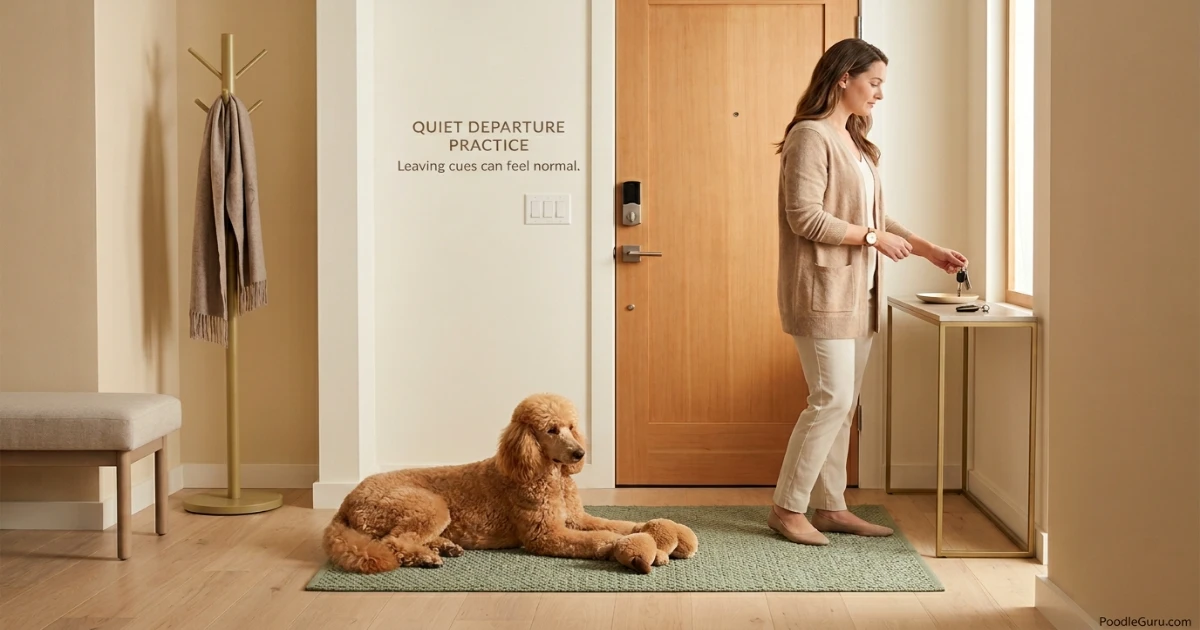
Pick up your keys and put on your coat without leaving. Do this randomly until those cues lose their emotional charge. When you do leave, walk out without a word. When you return, wait for your poodle to settle even slightly before greeting them. This breaks the cycle of dramatic anticipation.
Enrichment First, Then Alone Time
A poodle who’s had a sniff walk, some training, and a food puzzle is far more likely to rest when alone. Physical tiredness isn’t enough — mental satisfaction is what settles the poodle brain.
If clinginess persists despite consistent training, a vet check can rule out pain or cognitive issues — especially in senior poodles, who may become more dependent as their senses decline.
Frequently Asked Questions
Are all poodles velcro dogs?
Not every poodle is a velcro dog, but the breed’s strong human orientation means most form close attachments. A poodle’s individual personality, early socialization, and daily routine all influence how intensely they shadow you. Some are content with nearness; others demand touch.
Why does my poodle follow me to the bathroom?
Bathroom following is classic velcro dog behavior. To your poodle, you’re the center of the social group. If you disappear behind a door, their instinct is to stay close. In a relaxed poodle, this is harmless. If it comes with frantic pawing or crying, it may signal anxiety.
Can a poodle be too attached to its owner?
Yes. When the attachment prevents the dog from eating, sleeping, or relaxing without the owner’s presence, it has crossed into separation anxiety territory. That requires professional guidance, not just management. Early intervention yields the best outcomes.
Do male or female poodles tend to be more velcro?
There’s no consistent difference between male and female poodles in clinginess. Temperament varies more by individual and upbringing than by sex. Spaying or neutering doesn’t reliably change velcro behavior either — the drive is social, not hormonal.
Is it okay to let my poodle sleep in my bed if they’re clingy?
Yes, if they can sleep independently when needed. The potential issue isn’t the bed-sharing itself — it’s whether your poodle panics if they ever sleep elsewhere. Practice occasional separate sleeping spaces (like a cozy crate near the bed) to maintain flexibility.
Will getting a second poodle reduce clinginess?
Sometimes, but not reliably. A second dog can provide companionship, but if the clinginess is rooted in anxiety about the owner specifically, another dog may not help. In some cases, both dogs become anxious when the owner leaves. Assess the root cause before adding another animal.
How do I know if my poodle’s clinginess is a health issue?
Sudden increases in clinginess — especially in a previously independent adult poodle — can signal pain, vision loss, hearing loss, or cognitive decline. A vet check is the right first step before assuming it’s behavioral.
Key Takeaways: Poodles and Velcro Behavior
A velcro poodle isn’t broken — they’re doing exactly what their breed was designed to do. The art is knowing when attachment is healthy and when it’s crossing into anxiety. Here’s what to carry forward:
- Poodles are natural velcro dogs due to their working-retriever heritage and high emotional intelligence — following you is a sign of a strong bond, not a flaw.
- Healthy attachment involves relaxed following and easy recovery after separation; problem clinginess involves panic, destruction, or refusal to settle when alone.
- The PoodleGuru Clinginess Spectrum (connected, velcro-adjacent, clingy-but-coping, separation distress) helps owners quickly identify where their dog sits and what action fits.
- Common owner mistakes — like punishing clinging or over-dramatizing departures — often intensify the behavior instead of soothing it.
- Building independence is about teaching your poodle that alone time is safe and rewarding, not about pushing them away or breaking the bond.
- Sudden changes in clinginess, especially in older dogs, should prompt a veterinary check to rule out pain, sensory decline, or cognitive issues.