How Smart Are Poodles Compared to Other Dogs?
Poodles are famously bright. They consistently rank second in working intelligence, but raw obedience scores barely scratch the surface of what makes a poodle’s mind remarkable. To understand how they truly compare to Border Collies, German Shepherds, and other top breeds, you have to look beyond commands per repetition — and into the adaptive, emotional intelligence that defines daily life with a poodle.
Quick Answer
Poodles are the second most intelligent dog breed by traditional working and obedience standards, surpassed only by the Border Collie. But that ranking alone is incomplete. Poodles often outperform Border Collies in adaptive problem-solving and emotional attunement, making them more versatile in real-world settings. The honest answer: poodles aren’t just “second place” — they excel in different dimensions of intelligence, and for many owners, they’re the smarter choice for daily life.
Obedience Rank
Poodles rank #2 in working/obedience intelligence, behind Border Collies. They typically learn a new command in fewer than five repetitions.
Command Reliability
A well-trained poodle obeys a known command on the first attempt with a 95% success rate — among the highest for any breed.
Adaptive Edge
In unstructured problem-solving tests, poodles frequently outperform breeds ranked higher in pure obedience, showing stronger independent reasoning.
The Intelligence Ranking: Where Poodles Sit
When people ask how smart poodles are compared to other dogs, they’re usually referencing psychologist Stanley Coren’s well-known ranking of 138 breeds by working and obedience intelligence. In that framework, poodles hold the #2 spot, behind only the Border Collie. German Shepherds, Golden Retrievers, and Dobermans round out the top five.
That ranking is based on two measurable criteria: how many repetitions it takes for a breed to learn a new command, and how often the dog obeys a known command on the first try. Poodles excel at both. They grasp new cues quickly and retain them with near-perfect reliability — traits that have made them stars in obedience trials, agility, and circus performance for centuries.
But Coren himself acknowledged that this is only one slice of canine intelligence. A ranking of “brightest dogs” tells you which breeds are most biddable — most willing to follow human instructions. It doesn’t measure independent thinking, emotional perception, or the kind of cleverness that solves problems without being told. That’s where the poodle story gets more interesting.
The Three Dimensions of Canine Intelligence
Canine intelligence is a framework that describes three distinct but overlapping types of mental ability. For poodle owners, understanding these categories transforms how you see your dog’s behavior — and why they sometimes seem smarter than any ranking suggests.
Working and obedience intelligence is the capacity to learn from humans — how fast a dog picks up commands, how reliably it performs them, and how well it retains training over time. This is what standardized rankings measure. Poodles score near the top, but they’re not quite the fastest learners in every study. Border Collies hold a narrow edge in pure obedience speed.
Adaptive intelligence is the ability to solve problems independently — figuring out latches, navigating obstacles, or learning from past experiences without a human cue. This is where poodles often leap ahead. Owners regularly describe poodles opening doors, unzipping bags, and inventing games. That’s not obedience. That’s autonomous reasoning, and it’s a different kind of smart.
Instinctive intelligence is breed-specific skill hardwired by generations of selective breeding. Poodles were originally water retrievers. That heritage still shows in their strong retrieving drive, their comfort with water, and their natural soft mouth. It’s not something they learn — it’s something they’re born knowing how to do. When you compare poodles to herding breeds like Border Collies, this is where the paths diverge most sharply. Each breed is brilliant at the job it was designed for.
Expert Insight: Why a Single Ranking Falls Short
Coren’s research is valuable, but modern canine cognition experts emphasize that intelligence is multidimensional. A breed that excels at following commands may not be the breed that excels at reading human emotions or adapting to new environments. Poodles sit at a rare intersection: high in obedience, high in adaptive reasoning, and exceptionally high in social cognition. That combination is harder to find than any single score suggests.
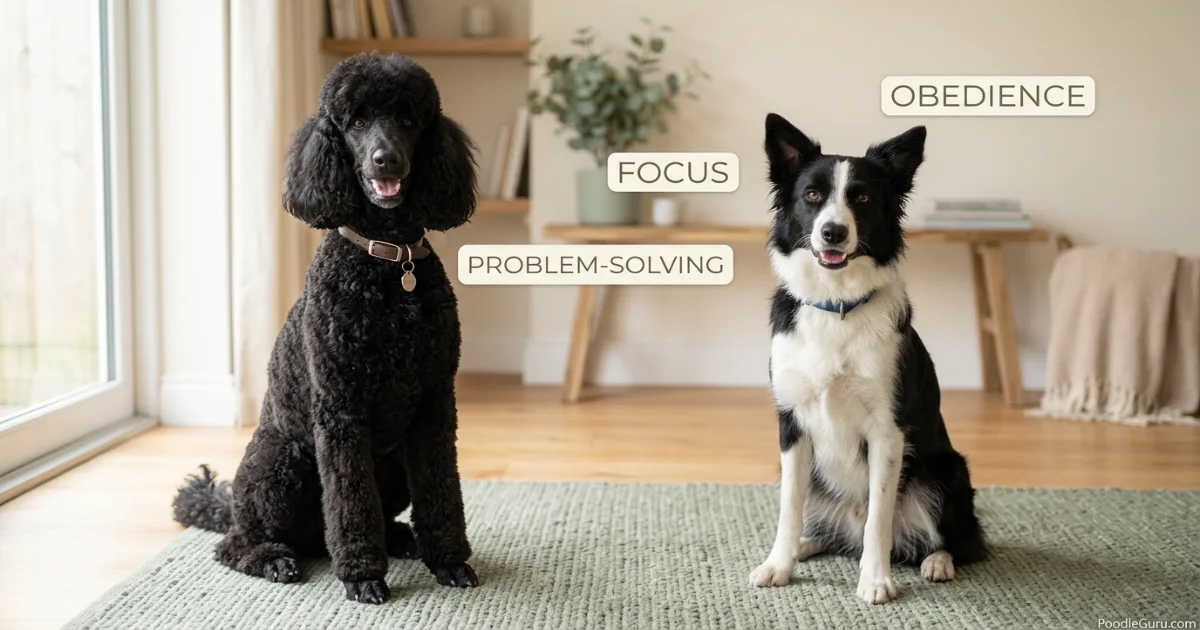
Poodles vs. Other Top Breeds: A Multi-Factor Comparison
Traditional intelligence rankings only tell part of the story. The table below compares poodles to four other famously smart breeds across dimensions that matter in real ownership — not just in obedience trials.
| Intelligence Factor | Poodle (All Sizes) | Border Collie | German Shepherd | Golden Retriever | Labrador Retriever |
|---|---|---|---|---|---|
| Working/Obedience Rank | #2 | #1 | #3 | #4 | #7 |
| Adaptive Problem-Solving | Excellent — inventive, persistent | Excellent — but often needs a job | Very Good — methodical | Good — but less independent | Good — persistent, food-motivated |
| Emotional Attunement | Exceptional — reads human states quickly | High — but intense focus can override | High — especially with bonded handlers | Very High — gentle, responsive | High — eager to please, forgiving |
| Novice Owner Suitability | Good — trainable but needs engagement | Challenging — requires advanced handling | Moderate — needs structure and leadership | Excellent — forgiving and adaptable | Excellent — among the easiest to train |
| Off-Switch / Settling Ability | Good — when mental needs are met | Poor — often struggles to settle | Moderate — settles after work | Very Good — naturally calm indoors | Good — but can be boisterous |
| Best Suited For | Owners wanting a versatile, emotionally-aware companion | Active handlers who can provide constant mental work | Experienced handlers needing a protective, trainable partner | Families wanting a forgiving, gentle, trainable dog | Active families wanting an enthusiastic, social companion |
This broader view clarifies something important: poodles don’t lose to Border Collies in meaningful, everyday intelligence. They simply express their smarts differently — with more emotional nuance, more independent creativity, and a better off-switch when their needs are met. For many owners, that makes them the superior breed in practice, even if they take one extra repetition to learn a new trick.
Adaptive Intelligence: Poodles’ Real-World Problem-Solving
Obedience is about following rules. Adaptive intelligence is about breaking them — creatively, intentionally, and often successfully. This is where poodles surprise even experienced dog owners.
Poodles are notorious for figuring out latches, opening cabinets, and manipulating objects to get what they want. They remember where you keep the treats. They learn which behaviors earn attention and which get ignored — and they adjust accordingly. This isn’t mischief. It’s a working mind applying past experience to new situations without being prompted.
In one often-cited canine cognition framework, adaptive intelligence is measured by how quickly a dog solves a novel problem — say, navigating around a transparent barrier to reach food. Poodles consistently perform at the top tier of these tests. They don’t just persist; they switch strategies when something isn’t working. That cognitive flexibility is rare, and it’s one reason poodles adapt so well to different households, routines, and living situations.
The flip side is that adaptive intelligence needs an outlet. A poodle without mental stimulation will invent its own puzzles — often the kind you don’t want, like dismantling the garbage can or learning to open the back door. This is why structured training and enrichment matter so much with this breed. A bored poodle isn’t a bad dog. It’s an underutilized one.
Emotional Intelligence: The Poodle’s Hidden Advantage
Ask any long-time poodle owner what sets the breed apart, and they’ll rarely mention trick speed first. They’ll talk about the way their poodle seems to know when they’re sad. The quiet presence during a hard day. The uncanny ability to read a room and adjust energy levels accordingly. That’s emotional intelligence — and it’s where poodles may genuinely lead all breeds.
Scientific research into canine social cognition shows that some dogs are better than others at interpreting human facial expressions, vocal tones, and emotional states. Poodles consistently rank among the most emotionally perceptive breeds in observational studies. They don’t just recognize human emotion — they respond to it. They approach distressed owners. They moderate their play intensity with children. They give space when space is needed.
This has real implications for ownership. Poodles make exceptional emotional support dogs because their attunement creates genuine co-regulation. They can sense a panic attack building before the handler consciously registers it. They offer calm physical contact without demanding attention in return. That’s not trainable in the same way “sit” is trainable. It’s a deeper cognitive trait, and it’s part of what makes the breed so uniquely suited to therapeutic roles.

The PoodleGuru Intelligence Spectrum
At PoodleGuru, we evaluate poodle intelligence across four interconnected dimensions rather than a single rank. This framework helps owners understand their dog’s strengths, identify areas where enrichment is needed, and make more informed decisions about training and daily engagement.
Canine intelligence is a spectrum, not a score. The most satisfied poodle owners are the ones who work with their dog’s natural cognitive profile — not against it. Use this framework to see your poodle more clearly.
Working Intelligence — How They Learn From You
This is the classic measure: speed of command acquisition, retention, and reliability. Poodles rate “bright” to “excellent” here depending on the individual. Watch for how many repetitions it takes before your poodle anticipates what you want. Most poodles begin anticipating patterns within 3–5 exposures to a new routine. This fast pattern recognition is a training gift — but it also means inconsistency confuses them quickly. They notice when you change the rules.
Adaptive Intelligence — How They Solve Problems Alone
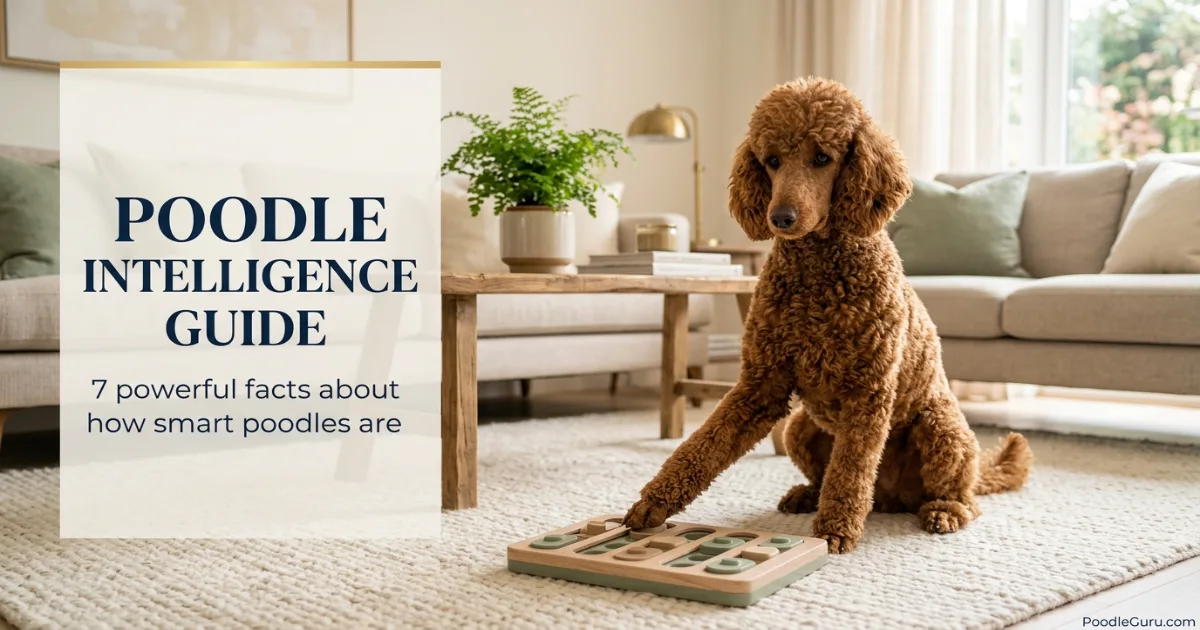
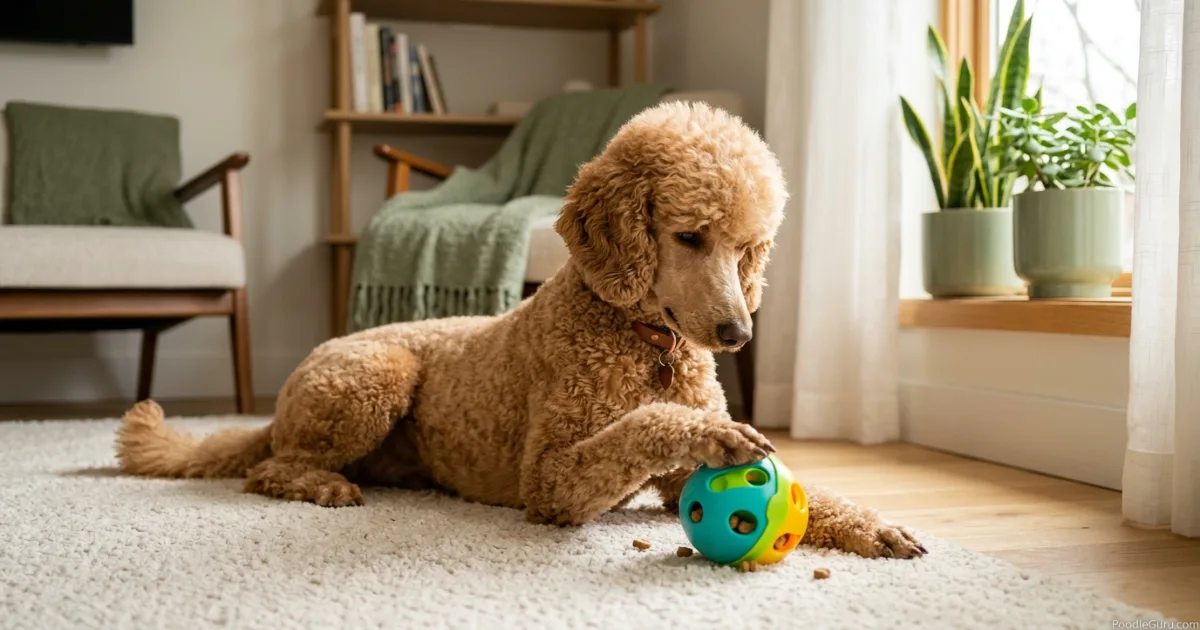
Present your poodle with a novel puzzle — a treat under an overturned bowl, a food toy with moving parts — and observe. Do they try one strategy repeatedly, or switch approaches? Poodles with high adaptive intelligence demonstrate flexibility. They’ll nudge, paw, circle, and if those fail, pause to observe before trying something new. This is the intelligence that keeps your dog mentally healthy. Give it weekly puzzles to engage.
Social-Emotional Intelligence — How They Read and Respond to Humans
Notice what your poodle does when your mood shifts. Do they approach, stay close, or bring a toy? The emotionally intelligent poodle modulates behavior based on your state — not just offering comfort, but calibrating it. They’ll be gentler on days you’re tired, more playful when you need energy, and quiet when you need stillness. This dimension is what makes poodles exceptional emotional support animals and deeply bonded companions.
Instinctive Intelligence — The Breed’s Built-In Wiring
Poodles were bred as water retrievers, and that heritage shows. Many poodles retrieve naturally without training. They’re drawn to water. They carry objects gently. This instinctive intelligence doesn’t need to be taught — but it can be shaped. Channel it into retrieving games, dock diving, or structured fetch. It satisfies a deep cognitive need and strengthens your bond. When a poodle’s instinctive drive is ignored, they often redirect it into less desirable outlets like stealing and hoarding objects.
Owner Tip: Track Your Poodle’s Cognitive Strengths
Keep a simple journal for a week. Note moments where your poodle surprised you with cleverness, emotional awareness, or independent problem-solving. Patterns will emerge. You might discover your poodle is strongest in adaptive intelligence but needs more support with impulse control, or vice versa. This awareness shapes better training, better enrichment, and a better relationship.
What Poodle Intelligence Means in Daily Life
Intelligence sounds impressive on paper. In daily life, it shows up in both delightful and demanding ways. Poodle owners quickly learn that a smart dog is a high-engagement dog — and that the breed’s mental needs are as real as its physical ones.
Training sessions with a poodle are fast and rewarding. They pick up cues quickly, which makes them ideal for first-time owners willing to put in the time. But they also bore easily. Repeating the same drill too many times can cause a poodle to check out or start offering alternative behaviors. Variety keeps them engaged. Rotate through trick training, scent work, agility foundations, and puzzle games.
Problem-solving can become a management issue if unaddressed. Poodles that open doors, raid cupboards, or outsmart baby gates aren’t being “bad” — they’re demonstrating exactly the intelligence that makes the breed remarkable. The solution is proactive enrichment, not punishment. Give them legal puzzles to solve, and they’ll be less inclined to invent illegal ones.
The emotional side of poodle intelligence means they don’t do well with harsh corrections. They’re sensitive. Yelling, yanking, or frustrated energy can damage trust, and once trust is damaged, the poodle’s responsiveness declines. Positive reinforcement is not just kinder — it’s strategically more effective with this breed. They want to work with you, not for you.
In multi-dog households, poodles often emerge as the “brains” of the operation — the one who figures out how things work while the others follow. They’re also more likely to train their owners, developing clever demand behaviors if those get rewarded. You haven’t truly experienced poodle intelligence until your dog has taught you a routine without you realizing you were the student.
Myths and Mistakes About Poodle Intelligence
Smart dogs attract smart misunderstandings. Here are the most common ones poodle owners encounter — and why they matter.
Myth: Intelligence Means Low Maintenance
A smart poodle is not a low-effort poodle. Intelligence creates needs: mental stimulation, novelty, and engagement. Without those, behavioral problems often follow. Poodles require more interactive time than many less intelligent breeds, not less.
Myth: All Poodles Are Equally Smart
There’s variation within every breed. Breeding lines matter. Some poodles are sharper than others. Additionally, a poodle’s intelligence can be masked by anxiety, lack of early socialization, or poor training. Don’t assume every poodle will show the same cognitive strengths.
Mistake: Skipping Enrichment Because “They’re Smart Enough”
Intelligence doesn’t plateau. It needs to be exercised. Poodles that are understimulated often develop anxious or destructive behaviors. Owners sometimes misinterpret these behaviors as “bad temperament” when the real issue is boredom. A puzzle toy a day, training sessions, and novel experiences make a significant difference.
Another critical mistake: comparing poodle intelligence to Border Collie intelligence in a vacuum. They were bred for entirely different jobs. The Border Collie’s obsessive work drive is inseparable from its herding instinct — it’s not “smarter” in a universal sense; it’s more single-mindedly focused. The poodle’s versatility, emotional range, and problem-solving flexibility represent a different kind of cognitive excellence. Neither is better. They’re just different.
Frequently Asked Questions
Are poodles smarter than German Shepherds?
By obedience ranking, poodles sit at #2 while German Shepherds sit at #3. Poodles typically learn commands in fewer repetitions, but German Shepherds excel at tasks requiring sustained focus and protective judgment. In adaptive problem-solving, poodles often have an edge. The difference is narrow, and individual temperament matters more than breed rank. Both breeds are exceptionally intelligent — they simply apply their intelligence in different ways.
Why are poodles considered one of the smartest dog breeds?
Poodles combine high working intelligence with exceptional adaptive and social-emotional cognition. They learn commands rapidly, retain training well, and demonstrate strong independent problem-solving. Their emotional attunement to humans is among the highest measured in any breed. This multidimensional intelligence — rather than any single score — places them consistently at the top of breed intelligence assessments.
Are Standard Poodles smarter than Toy or Miniature Poodles?
There’s no conclusive evidence that one poodle size is consistently smarter than another. All three sizes descend from the same gene pool and share the breed’s cognitive profile. Some owners anecdotally report that Standards display more independent problem-solving, while Toys excel at social manipulation — but these differences are likely individual rather than size-dependent. A well-bred Toy Poodle can be every bit as sharp as a Standard.
Do poodles get bored easily because they’re so smart?
Yes. Poodles need regular mental engagement. Without it, they’ll create their own activities — often destructive ones. The breed thrives on puzzle toys, training variety, scent work, and interactive play. A mentally stimulated poodle is calm and content. A bored poodle is a problem-solver looking for a project, and your trash can or pantry door may become that project.
How does poodle intelligence affect training?
Poodles are fast learners, which makes training rewarding and efficient. They can pick up basic commands in just a few repetitions. However, their intelligence also means they pick up bad habits quickly if those are inadvertently reinforced. Consistency is critical. Poodles notice when you change criteria, skip steps, or reward inconsistently — and they’ll adjust their behavior faster than you expect, sometimes in ways you didn’t intend.
Are poodles smarter than Labs?
Poodles rank #2 in working intelligence, while Labrador Retrievers rank #7. Poodles generally learn commands faster and demonstrate higher adaptive problem-solving ability. Labradors, however, are often more forgiving of training errors and more consistently eager to please, which can make them feel “easier” to train for some handlers. Both breeds are highly intelligent — the difference lies more in cognitive style than in raw capacity.

Key Takeaways: How Smart Are Poodles Compared to Other Dogs?
Poodles aren’t just smart — they’re smart across multiple dimensions. Their working intelligence places them second only to the Border Collie, but their adaptive problem-solving, emotional attunement, and cognitive flexibility often make them more versatile in real-world ownership. The question isn’t “are poodles smart?” — it’s “which type of intelligence matters most for the life you want with your dog?” For many owners, the poodle’s balanced cognitive profile is the best answer.
- Poodles rank #2 in working/obedience intelligence, learning new commands in fewer than 5 repetitions and obeying known commands with 95% reliability.
- Canine intelligence has three dimensions: working, adaptive, and instinctive. Poodles excel across all three, with a particular edge in adaptive reasoning and emotional perception.
- The PoodleGuru Intelligence Spectrum evaluates four domains — working intelligence, adaptive intelligence, social-emotional intelligence, and instinctive intelligence — to give a more complete picture than any single ranking.
- Compared to Border Collies, Poodles are more emotionally nuanced and adaptable to varied home environments, though slightly less obsessively driven in obedience tasks.
- Poodle intelligence requires management: mental stimulation is not optional. A bored poodle will invent its own problems to solve, often to the owner’s frustration.
- No single size is definitively smarter, and individual variation matters. Choose a poodle based on temperament fit, not an expectation of rank-based performance.