Poodle Pulling on Leash? How to Stop It Safely
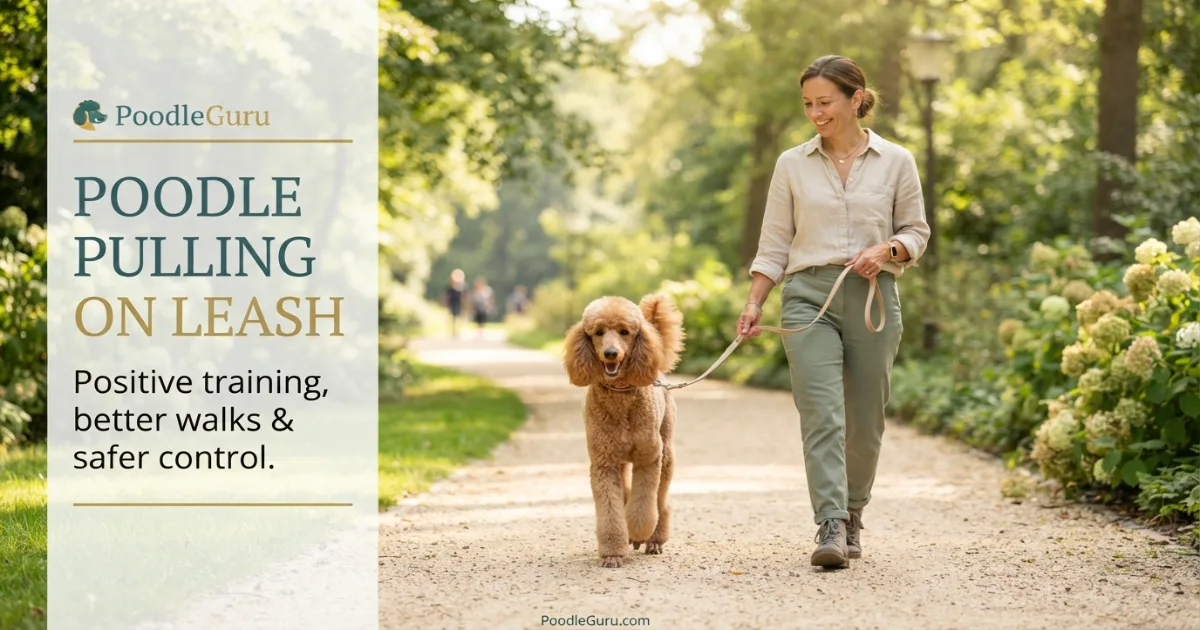
If your poodle is pulling on leash, she is not trying to dominate you — she is repeating a behaviour that has worked before. The good news: loose-leash walking can be retrained with clear rules, positive reinforcement, safer equipment, and short practice sessions that fit a poodle’s sensitive, intelligent nature.
Quick Answer: How to Stop Poodle Pulling on Leash
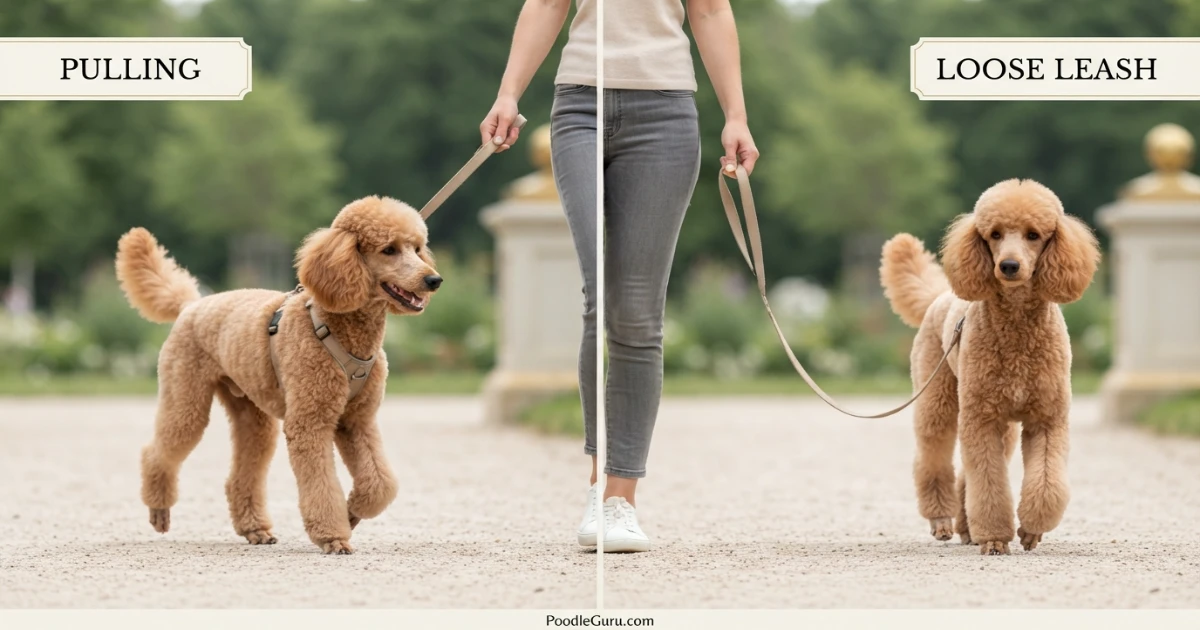
Poodle pulling on leash happens when a poodle learns that leash tension gets her closer to scents, dogs, people, or home. The behaviour is self-reinforcing: if pulling moves the walk forward, pulling becomes stronger. The fix is not a tighter grip or a harsher collar. The fix is a consistent reward pattern: loose leash means forward movement, tight leash means the walk pauses, and checking in with you earns praise, treats, and access to the environment.
Why Poodles Pull on the Leash
Poodles don’t pull because they’re stubborn or dominant. They pull because they’re smart, excited, and have learned that leaning into the harness gets them to the interesting smell faster. Poodles are a sensitive, high-energy breed. Their natural curiosity combines with a quick ability to spot patterns — unfortunately, the wrong pattern often sticks first.
Think about it from your poodle’s point of view. You clip on the leash, step outside, and she surges forward. You follow, even reluctantly. She reaches the bush she wanted to sniff. That’s a win. She pulled, and it worked. Repeat that a dozen times a week, and pulling becomes the default way to walk.
For poodles specifically, their athletic build and intelligence mean they don’t tire quickly and they problem-solve. If pulling has been rewarded in the past, a quick fix like jerking the leash can create anxiety, not understanding. The breed’s sensitivity means harsh methods often shut down learning entirely. A better route exists.
Quick Fact
Poodles were bred as water retrievers — they naturally want to move forward with purpose. That instinct can show up as pulling if not channelled.
Quick Fact
The average poodle learns that pulling works within the first three walks. Breaking that habit takes time, but it’s absolutely possible.
Quick Fact
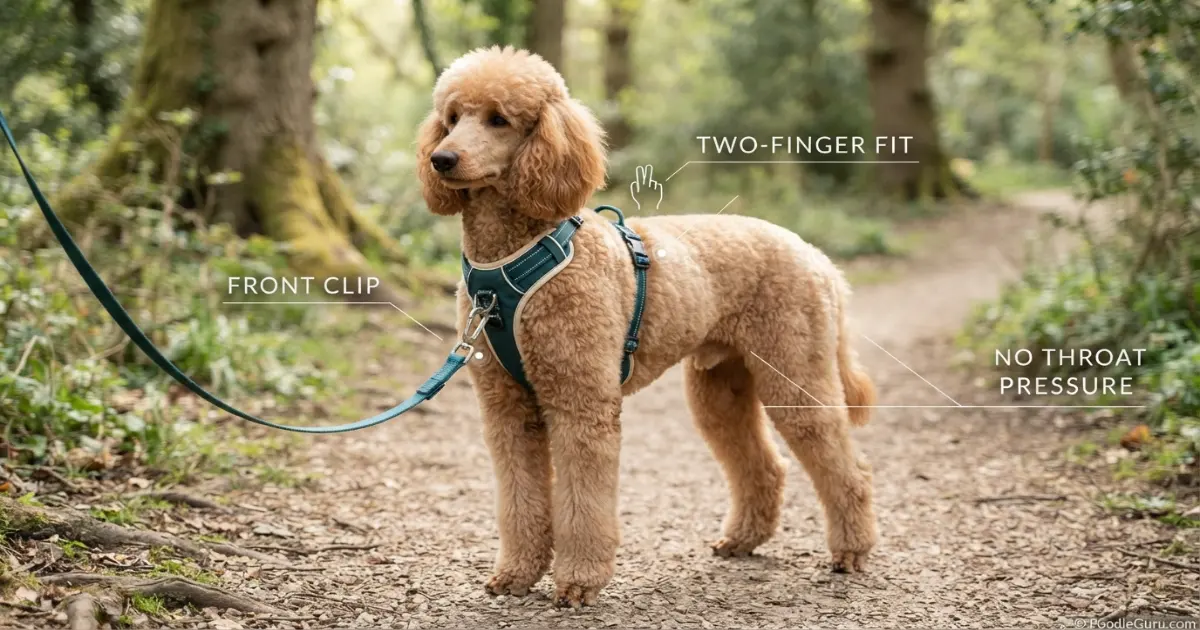
A well-fitted front-clip harness can make pulling easier to manage while you teach the loose-leash skill. It is a support tool, not a substitute for training.
Common Mistakes That Make Pulling Worse
Most owners accidentally reinforce pulling without realising it. Recognising these five patterns can transform your training overnight.
Mistake 1: Following the Pull
Every step you take while the leash is tight tells your poodle “this is how forward motion happens.” Stop moving the instant you feel tension.
Mistake 2: Using a Retractable Leash
Retractable leashes teach your poodle that pulling creates more freedom — the exact opposite of what you want. A standard 6-foot leash is essential.
Mistake 3: Jerking the Leash
Quick leash corrections can startle a sensitive poodle and damage trust. They may suppress pulling temporarily, but they do not teach the dog what to do instead.
Mistake 4: Training Only on Walks
Practising loose-leash walking first in a boring hallway or backyard removes distractions and lets your poodle learn the mechanics without excitement overload.
Mistake 5: Inconsistent Rules
If pulling is sometimes allowed (when you’re in a hurry, or a family member lets it slide), the behaviour persists. Everyone must follow the same plan.
Mistake 6: Skipping Pre-Walk Exercise
A poodle bursting with pent-up energy cannot learn. A quick game of fetch or a 5-minute training session before the walk reduces frantic pulling.
Equipment That Helps a Poodle Pulling on Leash
Your gear won’t train your poodle — but it can make training faster and safer. Here’s how to choose.
| Equipment | How It Works for Pulling | Good for Poodles? | PoodleGuru Recommendation |
|---|---|---|---|
| Flat Collar | No pulling control; pressure on trachea | Only for dogs who already walk nicely | Skip if pulling is a problem |
| Martingale Collar | Limited slip, prevents escape, little pulling deterrence | Good for poodles with narrow heads (Toy, Mini) | Acceptable for safety, not for training |
| Back-Clip Harness | Comfortable but makes pulling easier — dog can lean into it | Not ideal for pullers | Avoid until loose-leash walking is reliable |
| Front-Clip Harness | Redirects forward momentum gently; reduces pulling without pain | Excellent for poodles of all sizes | Our top pick for training |
| Head Halter | Controls head direction; must be introduced carefully | Can work but poodles often find it aversive without desensitisation | Only with professional guidance |
| Prong/Choke Collar | Relies on discomfort or pressure; can increase stress and does not teach loose-leash skills | Not appropriate for a sensitive breed | Avoid; choose reward-based training support instead |
Training equipment should support comfort and communication, not cause pain. A well-fitted front-clip harness can give you safer management while you teach the actual loose-leash skill. The American Veterinary Society of Animal Behavior supports reward-based training because it protects welfare and teaches the dog what behaviour earns reinforcement.
Pro Tip: Fit Matters
A harness that’s too loose lets your poodle slip out. One that’s too tight chafes under the armpits — a common complaint in poodles with dense coat. You should be able to fit two fingers between the harness and your dog’s body at every strap.
The PoodleGuru 4-Phase Leash Reset for Poodle Pulling on Leash
At PoodleGuru, we evaluate training methods by how well they work with poodle sensitivity and intelligence — not against it. This four-phase plan rebuilds loose-leash walking from the ground up, whether you’re starting with a puppy or retraining an adult.
Phase 1: Pre-Walk Energy Release
Before you clip the leash, burn off the edge. A 5-minute game of tug, a few rapid sits and downs for treats, or a quick backyard zoom session lowers frantic energy. A calm-ish poodle learns faster.
Phase 2: Indoor Leash Familiarity
Practice in a hallway with zero distractions. Hold the leash with some slack. The instant your poodle moves and keeps the leash loose, mark (say “yes” or click) and reward at your knee. Repeat until she stays within a 3-foot bubble reliably.
Phase 3: Stop-and-Go (Red Light, Green Light)
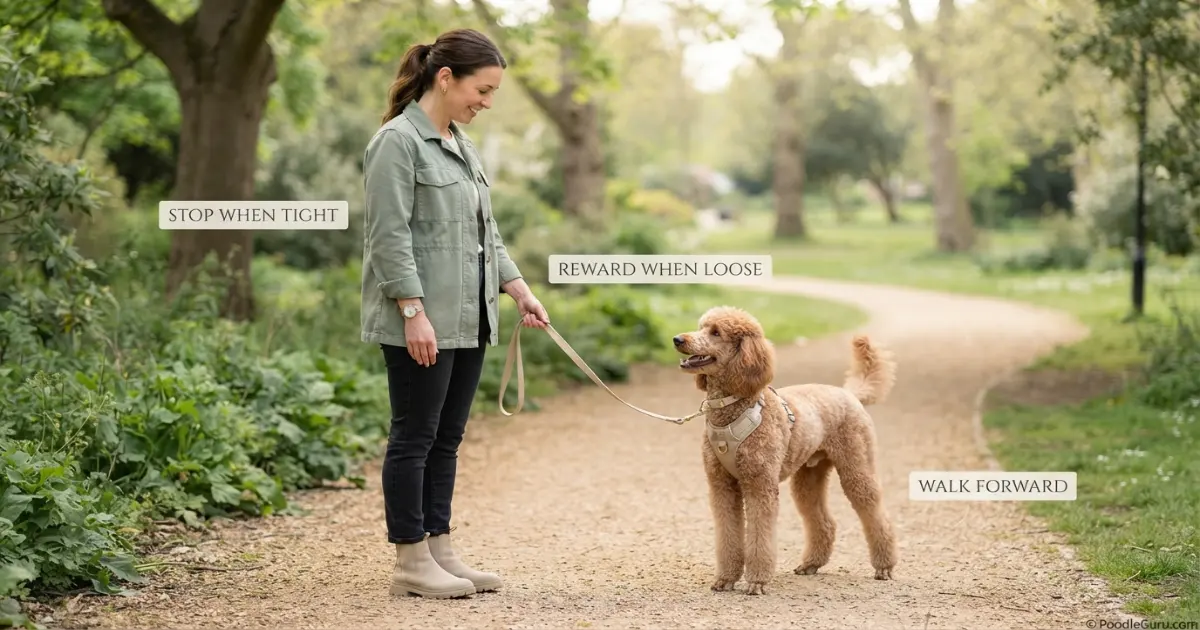
Move to a quiet outdoor space. The rule: if the leash goes tight, you stop completely — become a tree. Wait. The moment she looks back or shifts weight to loosen the leash, mark and reward, then walk forward. She learns that pulling stops the walk; a loose leash starts it again.
Phase 4: Graduated Distractions
Slowly increase the challenge: a street with one dog in the distance, then a park at quiet times. Keep sessions short (5-10 minutes) and end on a success. Never move to a harder level until she’s solid at the current one.
The PoodleGuru Leash Reset prioritises clarity over correction. Poodles thrive when they understand exactly what you’re asking and get paid well for it. Keep treats high-value — small bits of chicken or cheese work better than dry kibble when competing with squirrel smells.
Important
Never yank or pop the leash during the stop-and-go phase. Simply stop and wait. The poodle must figure out that her own choice (loosening the leash) earns the reward. If you force it, she’s learning to avoid punishment, not to walk politely.
What If Your Poodle Pulls Only When…
Many poodles walk beautifully at home but lose their minds in specific scenarios. That’s normal. Here’s how to handle the most common ones.
…Seeing Another Dog
This is often frustration or excitement, not aggression. Practice the “look at me” cue at a far distance where she can still focus. Reward heavily for checking in with you rather than staring. Gradually decrease the distance over many sessions. If she can’t focus, you’re too close — move back.
…A Squirrel or Prey Animal
Poodles have a prey drive. A sudden lunge can be dangerous. A front-clip harness keeps you in control. Teach a solid “leave it” cue separately, then practice on walks when a squirrel is at a distance. This takes patience but is trainable.
…When You’re Heading Home
Pulling often increases near the house — the dog is excited to get back. Make the return boring: stop frequently, change direction, or practice a few sits. The walk doesn’t end until the leash is loose at your front door.
When to Work With a Professional Trainer
If your poodle’s pulling is accompanied by growling, lunging with a stiff body, or snapping at people or dogs, it’s no longer just a walking issue. These can be signs of reactivity or fear, which need a qualified positive-reinforcement trainer or a veterinary behaviourist. A professional can assess the underlying emotion and build a custom desensitisation plan.
Similarly, if you’ve consistently applied the stop-and-go method for three weeks with zero improvement, an experienced trainer can watch your timing and help you spot what’s being missed. Sometimes a single adjustment — like rewarding a half-second earlier — unlocks everything.
The VCA’s leash-training guide notes that professional help is recommended when pulling becomes unmanageable or the dog’s safety is at risk. There’s no shame in getting that support.
7-Day Action Plan to Stop Poodle Pulling on Leash
Use this checklist to build momentum. The goal isn’t perfection in seven days — it’s to establish the foundation so walks start feeling better fast.
Day 1-2: Setup
Buy a front-clip harness and a 6-foot fixed leash. Ditch the retractable. Practice Phase 2 indoors for two 5-minute sessions each day.
Day 3-4: Quiet Outdoor Practice
Do Phase 3 in your backyard or a quiet alley. Keep sessions under 10 minutes. Reward every loose-leash check-in.
Day 5-6: Add Light Distractions
Walk in your neighbourhood at a calm time of day. Expect some pulling — stop each time. Celebrate even small wins.
Day 7: Review and Adjust
What improved? Where did you struggle? Adjust treat value or location difficulty. Build from here.
Frequently Asked Questions About Poodle Pulling on Leash
Why does my poodle pull on the leash even after exercise?
Exercise alone doesn’t teach leash manners. Your poodle may be physically tired but still excited by outdoor scents and sights. The pulling is a learned behaviour that needs specific training — not just tiring out. Pair exercise with the stop-and-go method for best results.
What is the best harness for a poodle that pulls?
A front-clip harness is the most effective and humane choice. It redirects your poodle’s forward momentum without putting pressure on the throat. Look for a Y-shaped chest design to avoid restricting shoulder movement. Back-clip harnesses can actually encourage pulling.
How long does it take to train a poodle to stop pulling on the leash?
You’ll see noticeable improvement within 1–2 weeks of consistent daily training using the stop-and-go method. For reliable loose-leash walking in all environments, expect 4–8 weeks of progressive practice. Poodles learn quickly but need time to generalise the skill to new places.
Should I use a prong collar on my poodle?
Prong collars are not recommended for poodles. This breed is sensitive and usually learns best through clear rewards, distance management, and positive reinforcement. A front-clip harness combined with consistent training is a safer long-term choice for most leash-pulling cases.
My poodle only pulls when seeing other dogs. What should I do?
This is likely frustration or over-excitement. Start at a distance where your poodle can see another dog but still respond to you. Reward heavily for looking at you instead of the dog. Gradually close the distance over many sessions. A “look at me” cue is your best tool.
Is it too late to train an older poodle not to pull?
No. Adult and senior poodles can learn new leash skills just as well as puppies — sometimes faster, because they have more impulse control. The same positive methods work regardless of age. If your older poodle has joint issues, choose low-impact practice areas and keep sessions short.
Should I stop walking my poodle until the pulling is fixed?
No, but you may need to change your approach. Instead of long walks that reinforce pulling, do short, focused training walks using the stop-and-go method, and provide exercise through fetch, tug, or indoor enrichment until loose-leash skills improve. This prevents pulling from being rehearsed.
Why does my poodle pull more when we turn toward home?
Your poodle has learned that pulling gets her to the destination faster — home is a strong reward. Counteract this by making the return boring: stop frequently, change direction randomly, and don’t let the walk end until the leash is loose at your doorstep. The excitement fades once pulling no longer speeds things up.
Key Takeaways
- Poodle leash pulling is a learned, self-reinforcing behaviour — not a sign of stubbornness or dominance.
- The most effective solution for poodle pulling is the PoodleGuru 4-Phase Leash Reset, using positive reinforcement and a front-clip harness.
- Avoid retractable leashes, prong collars, and leash jerking — these either encourage pulling or damage trust in a sensitive breed.
- Stop moving the instant the leash goes tight. Only walk forward when the leash is loose. Consistency across all family members is non-negotiable.
- Practice loose-leash walking first in boring environments, then gradually add distractions. Short, daily sessions beat occasional long ones.
- If pulling is accompanied by growling, lunging, or snapping, seek help from a qualified positive-reinforcement trainer or veterinary behaviourist.
Best next step: Start Phase 1 tomorrow morning — a 5-minute pre-walk play session and 5 minutes of indoor loose-leash practice. Then switch to a front-clip harness and commit to the stop-and-go rule on every walk this week. For more training foundations, read our Complete Poodle Training Guide.