
Are Poodles Hard to Train? What Experts Actually Say
They’re ranked among the smartest dogs on earth. Yet some owners struggle more than they ever expected. The disconnect isn’t the poodle — it’s the training approach most people reach for first.
Quick Answer
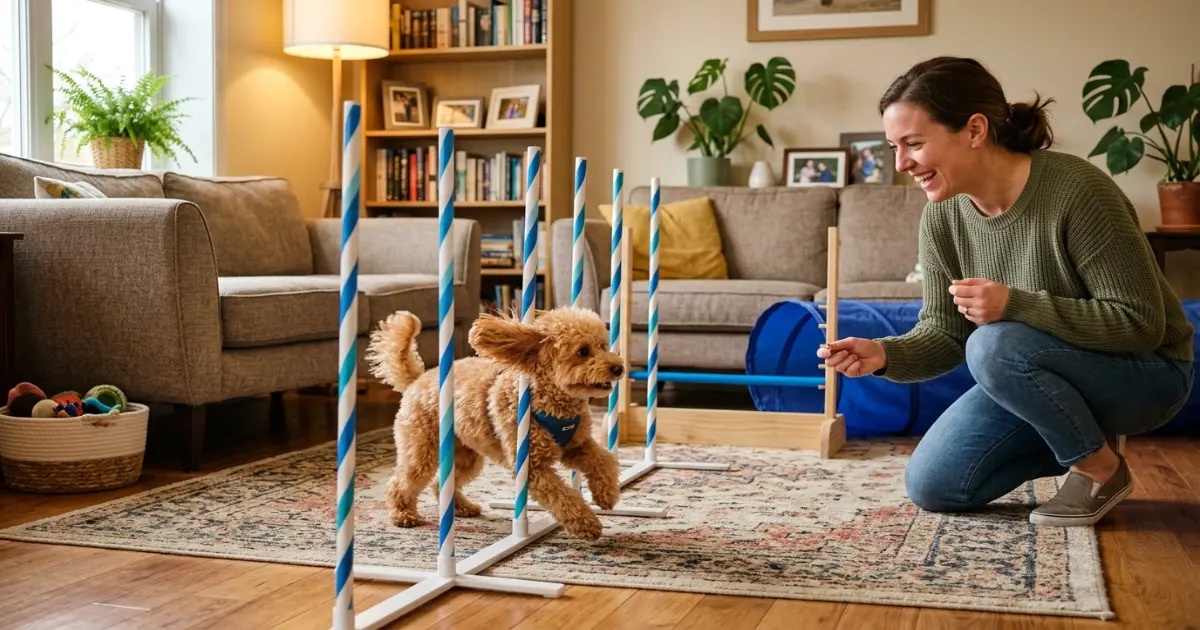
No, poodles are not hard to train — they’re among the most trainable breeds in the world. The AKC ranks poodles in the top tier of working intelligence, meaning new cues often stick in fewer than 5 repetitions. But trainability and ease are not the same thing. A poodle’s intelligence comes with sensitivity, pattern recognition, and a low tolerance for unfair handling. When training stalls, the method — not the dog — is usually the bottleneck.
Quick Facts at a Glance
🧠 Working Intelligence
Top 3 among all breeds. Most new cues learned in under 5 repetitions. Obedience command reliability among the highest measured.
⚡ Learning Speed
Exceptionally fast. A poodle can learn a new cue in a single short session — which means bad habits form just as quickly.
🎭 Sensitivity Level
High. Poodles read tone, body language, and consistency with precision. Harsh corrections erode trust faster than with more resilient breeds.
🔄 Boredom Threshold
Low. Repetitive drilling causes poodles to check out or invent their own variations. Short, varied sessions win every time.
🏆 Competitive Success
Poodles consistently place at top levels in obedience, agility, rally, and scent work trials — real-world proof of elite trainability.
❌ Common Failure Point
Inconsistency between family members. A poodle who gets mixed signals won’t guess — it’ll offer the behavior that benefits itself most.
Why People Ask “Are Poodles Hard to Train?”
On paper, the question shouldn’t exist. Poodles dominate intelligence rankings. They’re the breed professional trainers often recommend for first-time owners who want a dog that learns quickly. Yet forums and social media are full of frustrated owners describing poodles who outsmart them at every turn.
The gap between reputation and reality comes from a category error. People confuse trainable with compliant. A trainable dog learns fast. A compliant dog obeys without question. Poodles are wildly trainable. They are not, by nature, compliant. They think. They evaluate. They notice when your criteria shift by an inch. And they’ll exploit inconsistency with a precision that feels almost deliberate — because it is.
This isn’t stubbornness. It’s a working dog doing what working dogs were bred to do: make decisions. Your job isn’t to override that intelligence. It’s to channel it.
Where Poodles Actually Rank in Canine Intelligence
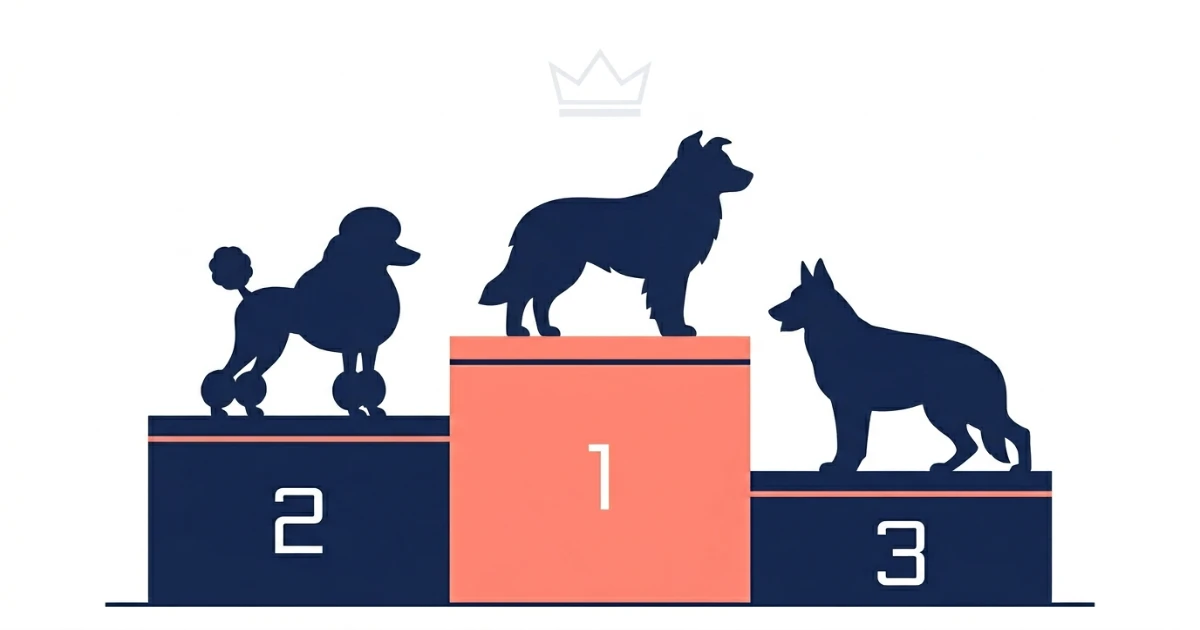
Poodle intelligence isn’t anecdotal — it’s measured. In the widely referenced canine intelligence framework developed by Dr. Stanley Coren, poodles rank second among all breeds for working and obedience intelligence, behind only the Border Collie. This ranking reflects two metrics: how many repetitions a breed needs to learn a new command, and how reliably the dog obeys a known command on the first cue.
For poodle owners, this means a dog who can learn “sit,” “down,” and “stay” in a single afternoon — and who will remember those cues tomorrow without a refresher. The most important thing to understand is that this learning speed applies to everything, not just the behaviors you want. A poodle who discovers that barking gets you to open the door has just learned a command you never meant to teach. You’re training your poodle every moment you interact with it, whether you realize it or not.
| Intelligence Dimension | Poodle Ranking | What It Means for Training |
|---|---|---|
| Working & Obedience | 2nd out of 138 breeds | New cues learned in under 5 repetitions; first-cue obedience above 95% |
| Instinctive Intelligence | High (retrieving heritage) | Natural retrieve drive — excellent foundation for fetch, scent work, and service tasks |
| Adaptive Intelligence | Exceptionally high | Solves problems independently, learns from observation, remembers solutions |
| Social Cognition | Very high | Reads human body language and emotional states — responsive to subtle cues |
| Memory Retention | Excellent | Retains trained behaviors long-term; also retains negative experiences |
The Double-Edged Sword: When Intelligence Meets Sensitivity
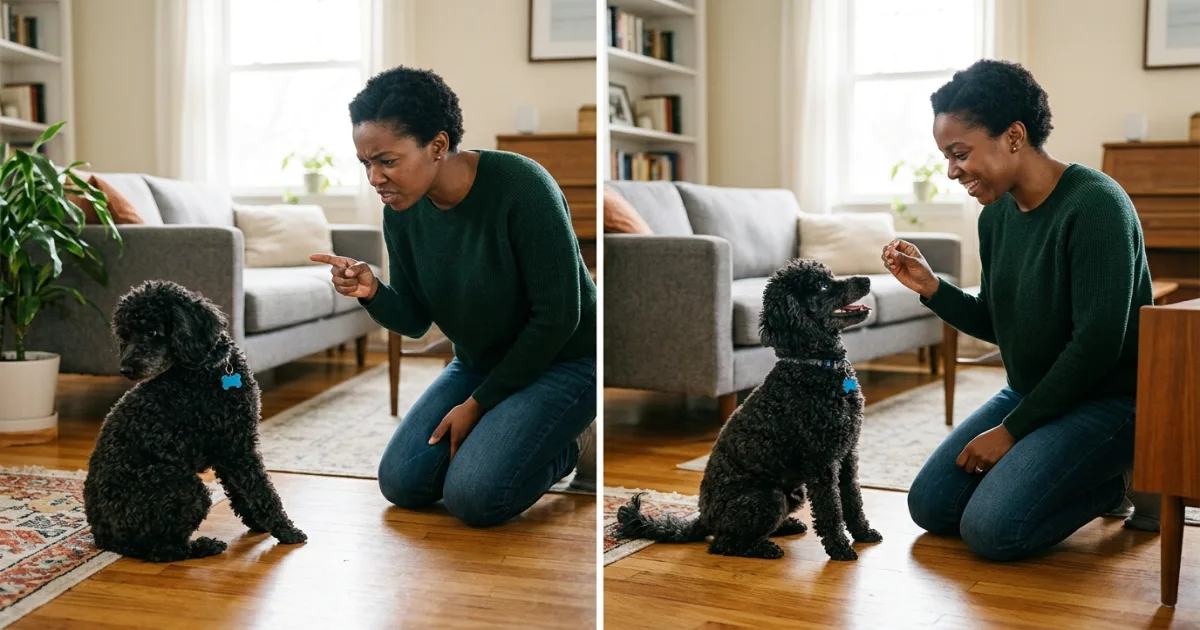
Here’s the part most training guides skip. A poodle doesn’t just learn what you’re teaching — it learns how you teach it. Your tone, your patience level, your consistency across sessions. A poodle who gets a frustrated sigh during a training mistake isn’t just processing the correction. It’s processing the relationship shift. And it files that information away.
This sensitivity is why punishment-based training methods fail so spectacularly with poodles. A more resilient breed might shake off a harsh leash correction and keep working. A poodle shuts down. It stops offering behaviors. It becomes “stubborn” — which is actually the dog deciding that trying isn’t safe anymore. Trainers who work extensively with poodles consistently recommend positive reinforcement as not just the kindest approach but the only approach that preserves the dog’s willingness to engage.
Does Size Change Trainability? Toy vs Miniature vs Standard
All three poodle sizes share the same intelligence baseline. A Toy Poodle’s brain is just as sharp as a Standard’s. But size shapes the training experience in ways that owners often overlook — and those differences explain why some people swear Toys are “harder” while others insist Standards are “more willful.”
| Training Factor | Toy Poodle (4–6 lbs) | Miniature Poodle (10–15 lbs) | Standard Poodle (40–70 lbs) |
|---|---|---|---|
| Common Owner Mistake | Skipping training — treated like an accessory, not a working dog | Inconsistent boundaries — “small enough to get away with it” | Underestimating physical power — pulling, jumping become safety issues |
| Housebreaking Speed | Can be slower — tiny bladder, more frequent trips needed | Moderate — consistent schedule produces reliable results | Generally fastest — larger bladder capacity helps |
| Training Motivation | Food- and attention-driven — short sessions essential | Balanced — responds well to food, play, and praise | Often toy- and task-motivated — needs mental challenge, not just treats |
| Consequence of Inconsistency | Develops “small dog syndrome” — demand barking, guarding | Becomes pushy — jumping, counter-surfing, leash reactivity | Becomes physically unmanageable — pulling, knocking people over |
| Ideal Training Approach | High-frequency micro-sessions, heavy on relationship-building | Structured daily sessions with clear boundaries | Task-oriented training with a job to do — advanced obedience, sport work |
The pattern is clear: size doesn’t change intelligence, but it absolutely changes what happens when training is neglected. A poorly trained Toy Poodle is annoying. A poorly trained Standard is dangerous — not because of aggression, but because 60 pounds of untrained enthusiasm can knock over a child or pull an owner into traffic. Train the dog in front of you, not the size category in your head.
5 Training Mistakes That Backfire Specifically With Poodles
Most training advice is written for dogs in general. Poodles aren’t general. They’re specific — and several common training practices backfire hard when applied to this breed. Here are the mistakes that turn a highly trainable poodle into a dog labeled “difficult.”
Repetitive Drilling
Asking for “sit” fifteen times in a row bores a poodle by the fourth repetition. They’ll either stop responding or start offering creative variations to entertain themselves. Three to five repetitions, then switch exercises. Short, varied sessions keep a poodle’s brain engaged.
Inconsistent Criteria Between Family Members
If one person lets the poodle on the couch and another doesn’t, the poodle doesn’t learn “couch sometimes.” It learns “humans are unpredictable — test every time.” A poodle’s pattern recognition makes inconsistency the single biggest training saboteur in multi-person households.
Punishing the Warning Signals
Correcting a growl doesn’t remove the discomfort that caused it — it removes the warning. Poodles who are punished for communicating discomfort may skip future warnings and go straight to a snap. This isn’t sudden aggression. It’s a dog whose early signals were trained away.
Neglecting Mental Exercise
A poodle who only gets physical exercise is a poodle with a fit body and a restless brain. That restless brain will find its own work — digging, counter-surfing, demand barking, obsessive licking. Puzzle toys, scent games, and trick training aren’t extras. They’re baseline requirements.
Waiting Too Long to Socialize
The critical socialization window closes around 16 weeks. A poodle who misses early exposure to different people, dogs, environments, and handling experiences doesn’t become “protective” or “aloof.” It becomes afraid — and fear in a highly intelligent dog produces avoidance behaviors that owners mistake for stubbornness.
The PoodleGuru Trainability Formula: Why Poodles Excel When the Setup Is Right
At PoodleGuru, we evaluate poodle trainability through a formula that captures what generic dog-training advice misses. Trainability isn’t just about the dog’s IQ. It’s the intersection of four variables — and when all four align, the poodle’s performance ceiling is extraordinary.
| Variable | What It Measures | Poodle Score | Owner Lever |
|---|---|---|---|
| Working Intelligence | Speed of learning new cues; reliability of known cues | Exceptional (top 3) | Teach in short sessions with high-value rewards |
| Biddability | Willingness to cooperate with human direction | High — but conditional on trust | Build relationship first; biddability follows trust |
| Emotional Resilience | Ability to recover from mistakes, corrections, or setbacks | Moderate — sensitivity limits bounce-back | Use errorless learning; minimize failure during training |
| Engagement Durability | How long focus holds before mental fatigue sets in | Moderate to high — varies by age and individual | End sessions before focus drops; always leave the dog wanting more |
Notice where the scores dip: emotional resilience and engagement durability. These aren’t intelligence problems. They’re handler-sensitivity problems. A poodle whose training sessions are short, positive, and consistent will outperform almost any breed. A poodle whose sessions are long, frustrating, or punitive will underperform a Golden Retriever. The variable isn’t the dog. It’s the human at the other end of the leash.
Owner Action Plan: Start Strong and Stay Consistent
Training a poodle isn’t about doing more. It’s about doing the right things in the right order — and not accidentally undoing your own work. This action plan covers the first 90 days and beyond, whether you’re starting with a puppy or resetting with an adult dog.
🏠 Week 1: Relationship First
No formal commands. Just hand-feeding, name recognition, and quiet time together. A poodle who trusts you will work for you. One who doesn’t, won’t — no matter how many treats you offer.
🎓 Weeks 2–4: Foundation Cues
Sit, down, come, and loose-leash walking in 5-minute sessions twice daily. Reward every correct response. Ignore mistakes. End every session on a win, even if it means asking for something easy.
🌍 Weeks 5–12: Socialization Blitz
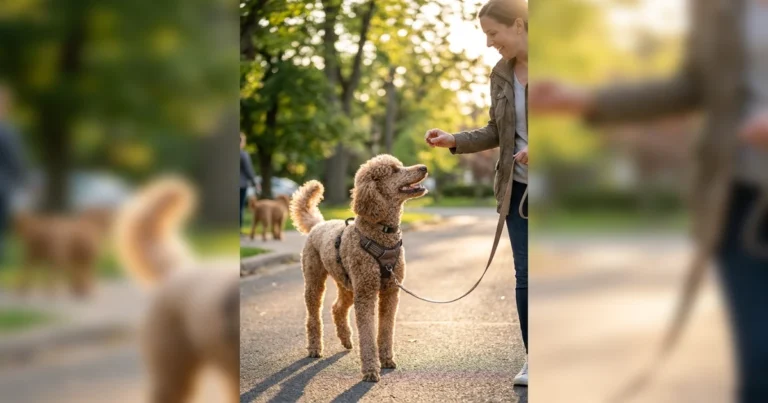
Expose your poodle to 100 new people, places, sounds, and surfaces — gently, with treats, never forced. This window closes. What’s missed now becomes the expensive training problem later.
🧩 Month 3+: Mental Workload Increase
Introduce puzzle feeders, scent games, trick chains, and impulse-control exercises. A poodle’s brain needs a job. Without one, it’ll invent its own — and you won’t like what it creates.
🔄 Ongoing: Household Consistency Check
Monthly family meeting: Is everyone using the same cues? Same rules? Same consequences? If not, fix it before the poodle exploits the gaps. Consistency isn’t strictness — it’s fairness in a language your dog understands.
🏅 Advanced: Give Them a Sport
Agility, rally, obedience, scent work, dock diving — poodles thrive in structured activities that channel their intelligence toward a goal. You don’t need to compete. You just need to give the brain somewhere to go.
Frequently Asked Questions
Are poodles easy to train for first-time owners?
Yes — with the right approach. Poodles learn faster than most breeds, which means a first-time owner who uses positive reinforcement, short sessions, and consistency will see rapid progress. The risk for novices is inconsistency: poodles notice mixed signals instantly and will exploit them. A first-timer who commits to clear rules gets an extraordinary first dog.
Why is my poodle so stubborn during training?
What looks like stubbornness is usually one of three things: the poodle is bored by repetition, confused by inconsistent criteria, or has shut down due to harsh handling. Poodles aren’t wired for blind compliance — they think through tasks. If your poodle stops responding, change the exercise, check your cues for clarity, or end the session and try again later.
How long should poodle training sessions be?
For puppies, 3–5 minutes. For adults, 5–10 minutes. Multiple short sessions per day dramatically outperform one long session. Poodles learn fast and fatigue mentally faster than their physical energy suggests. When focus wavers, stop — pushing past that point teaches the dog that training is exhausting, not rewarding.
Are Toy Poodles harder to housebreak than Standards?
Physically, yes — smaller bladder means more frequent trips. But the training principle is identical across sizes: consistent schedule, confinement when unsupervised, heavy reward for outdoor elimination. Toys need more management, not different training. Expect to take a Toy Poodle out every 1–2 hours during initial housebreaking versus every 2–3 for a Standard.
Do poodles respond well to clicker training?
Exceptionally well. The clicker’s precision matches a poodle’s pattern-recognition speed — the dog knows exactly which behavior earned the reward. Many professional trainers consider clicker training the ideal method for poodles because it removes the ambiguity of verbal praise timing. A poodle who understands what you want will offer that behavior eagerly.
At what age should I start training my poodle puppy?
Start the day the puppy comes home — typically 8 weeks. Name recognition, gentle handling, and positive exposure to new sights and sounds begin immediately. Formal cue training (sit, come, down) can start by 9–10 weeks in micro-sessions. The critical socialization window is already narrowing. Every gentle, positive experience before 16 weeks pays dividends for life.
Can an older poodle still be trained?
Absolutely. Poodles retain learning ability throughout life. Adult and senior poodles can learn new cues, overcome bad habits, and excel in sports they’ve never tried. The training principles are identical — positive reinforcement, short sessions, consistency. An older poodle may need more patience if previous training was harsh, but the intelligence doesn’t fade.
Final Summary: Brilliant Dogs, Fair Training
Are poodles hard to train? No — they’re among the most trainable dogs on the planet. But they’re also among the most sensitive, the most pattern-aware, and the least tolerant of unfair or inconsistent handling. A poodle won’t obediently endure bad training the way some breeds will. It’ll shut down, check out, or outsmart you — and people misinterpret all three as “difficult.”
The poodle training contract is simple: be clear, be consistent, be kind, and keep sessions short. In return, you get a dog who learns at lightning speed, remembers everything, and works with genuine joy. That’s not a hard dog. That’s an honest one — and it deserves an owner who meets it halfway.
Key Takeaways
- Poodles rank second among all breeds for working intelligence — most new cues are learned in under 5 repetitions with high first-cue reliability.
- Poodle trainability is elite, but sensitivity is high — punishment-based methods erode trust and cause shutdown faster than with resilient breeds.
- Toy, Miniature, and Standard Poodles share identical intelligence but face different training pitfalls based on how owners treat their size.
- Repetitive drilling, inconsistent household rules, and neglecting mental exercise are the top training mistakes that backfire with poodles.
- The PoodleGuru Trainability Formula identifies four variables — intelligence, biddability, emotional resilience, and engagement durability — that must all align for training success.
- Poodles trained with short positive sessions, clear criteria, and genuine consistency become some of the most impressive working partners in the dog world.
Best next step: Evaluate your current training routine against the PoodleGuru Trainability Formula. If sessions run longer than 10 minutes, if household rules vary between people, or if mental exercise isn’t daily — start there. For a deeper understanding of the sensitivity behind poodle behavior, read our complete Poodle Temperament guide next.


One Comment