How to Spot a Reputable Poodle Breeder (Red Flags You Can’t Afford to Miss)
Quick Answer: A reputable poodle breeder performs complete health testing on both parents (hips, eyes, genetic panels), proves their dogs in conformation or performance, raises puppies underfoot with early neurological stimulation, interviews you as thoroughly as you interview them, takes back any dog for life, and never sells through pet stores or to the first person with a deposit. Red flags include “rare” color marketing, missing health clearances, reluctance to let you meet the mother, pressure to pay quickly, and no written contract.
You are not just buying a puppy. You are choosing a family member who will shape your next twelve to fifteen years. And because poodles are intelligent, sensitive, and long-lived, the source of your puppy matters more than almost any other variable. Learning how to spot a reputable poodle breeder (red flags) is not optional knowledge—it is the single most important skill you can develop before you ever hand over a deposit.
The difference between an ethical poodle breeder and a questionable one is rarely a single obvious sign. It is a pattern of choices, a philosophy of breeding, and a trail of details that demand your attention. The heartbreak stories in poodle rescue—the Standard with crippling hip dysplasia at age two, the Toy with a congenital liver shunt, the Miniature with a temperament so nervous she cannot function in a normal home—almost always trace back to a breeder who should have been spotted and avoided. This guide gives you the pattern recognition to do exactly that.
Quick Facts: Reputable Poodle Breeder Essentials
Why Finding a Reputable Poodle Breeder Matters More Than You Think
The upfront cost difference between a thoughtfully bred poodle and a bargain puppy is a fraction of what poor breeding can cost you later. Hip dysplasia surgery runs $4,000–$7,000 per hip. Managing idiopathic epilepsy can mean years of medications, specialist visits, and emergency hospital stays. A poodle with Addison’s disease requires monthly injections and regular bloodwork for life. These conditions have genetic components, and breeders who skip health testing are gambling with your future—and your dog’s comfort.
Beyond physical health, temperament is deeply heritable. A poodle from lines selected for steady nerve and social confidence is a different animal from one bred purely for coat color or profit. The fear-biter at the vet clinic, the dog who cannot be left alone without destructive panic, the Standard who lunges at strangers despite months of training—these outcomes often trace back to breeders who never considered temperament in their breeding decisions.
And then there is the quiet erosion of the breed itself. Every purchase from a disreputable source funds the very practices that fill shelters and rescues with poodles whose owners were not prepared, not supported, and ultimately not able to keep them. Your choice of breeder is a vote for the kind of poodle world you want to live in.
🧪 Breeder Reality Check: The Poodle Club of America and its affiliate clubs maintain a strict Code of Ethics. Ethical breeders do not sell to pet stores, do not advertise on puppy broker websites, and do not produce “designer” crosses like doodles. They breed to preserve and improve the purebred poodle, and their commitment shows in every aspect of their program.
The Non-Negotiable Standards of an Ethical Poodle Breeder
Before we examine the red flags, you need a clear picture of what “good” actually looks like. These are not aspirational ideals; they are the baseline practices that every responsible poodle breeder follows. If a breeder checks all these boxes, you are on solid ground. If they miss several, keep looking.
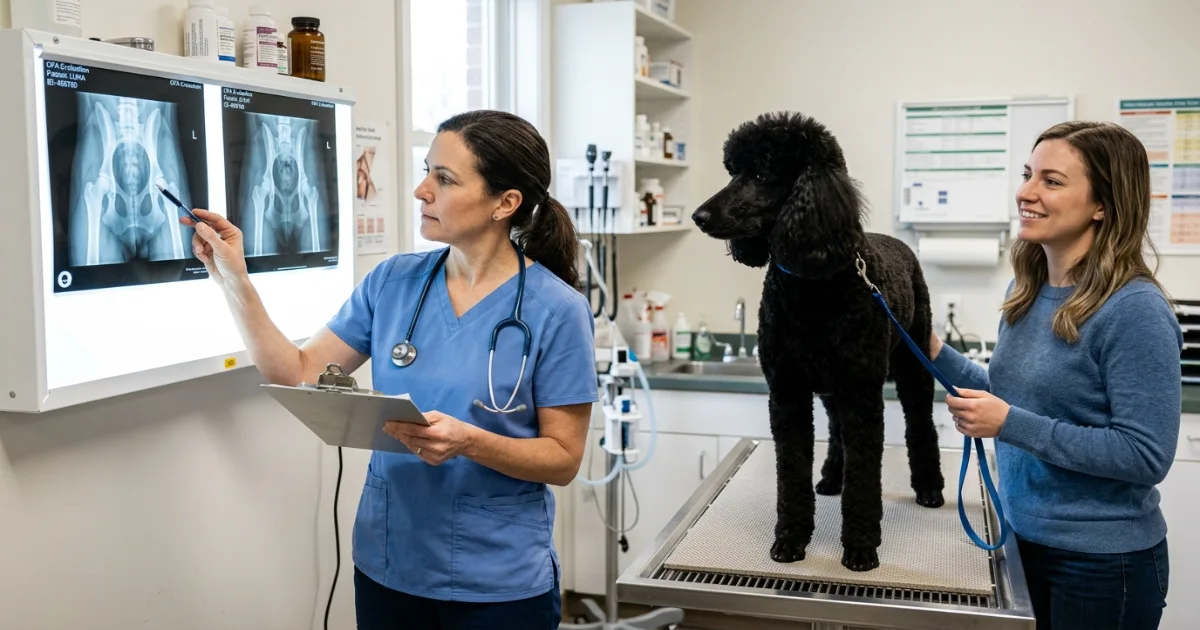
1. Complete, verifiable health testing. The breeder provides OFA (Orthopedic Foundation for Animals) or PennHIP results for hips, CAER eye exams within the last year, and genetic testing appropriate to the variety. For Standard Poodles, this includes hip dysplasia, von Willebrand’s disease, neonatal encephalopathy, and progressive retinal atrophy. Miniatures and Toys have their own panels, including patellar luxation screening and eye exams. Results must be publicly searchable in the OFA database—not a printout shown only to you.
2. Breeding dogs proven in some arena. Reputable breeders prove their dogs are worthy of passing on their genes. This usually means conformation titles, but performance titles in obedience, agility, or hunt tests also count. The point is that an objective third party has evaluated the dog against a standard, not just the breeder’s opinion.
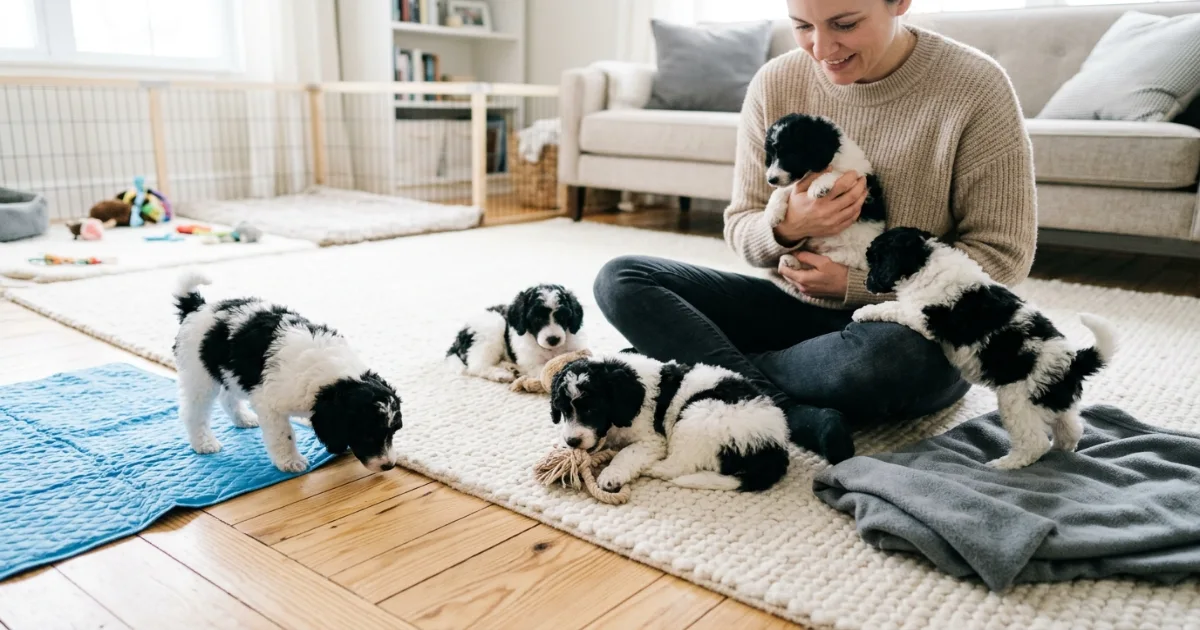
3. Puppies raised with deliberate socialization. From three to sixteen weeks, puppies undergo a structured enrichment program that introduces novel surfaces, sounds, gentle handling, and problem-solving challenges. The breeder can describe their protocol in detail and has documentation of each puppy’s progress.
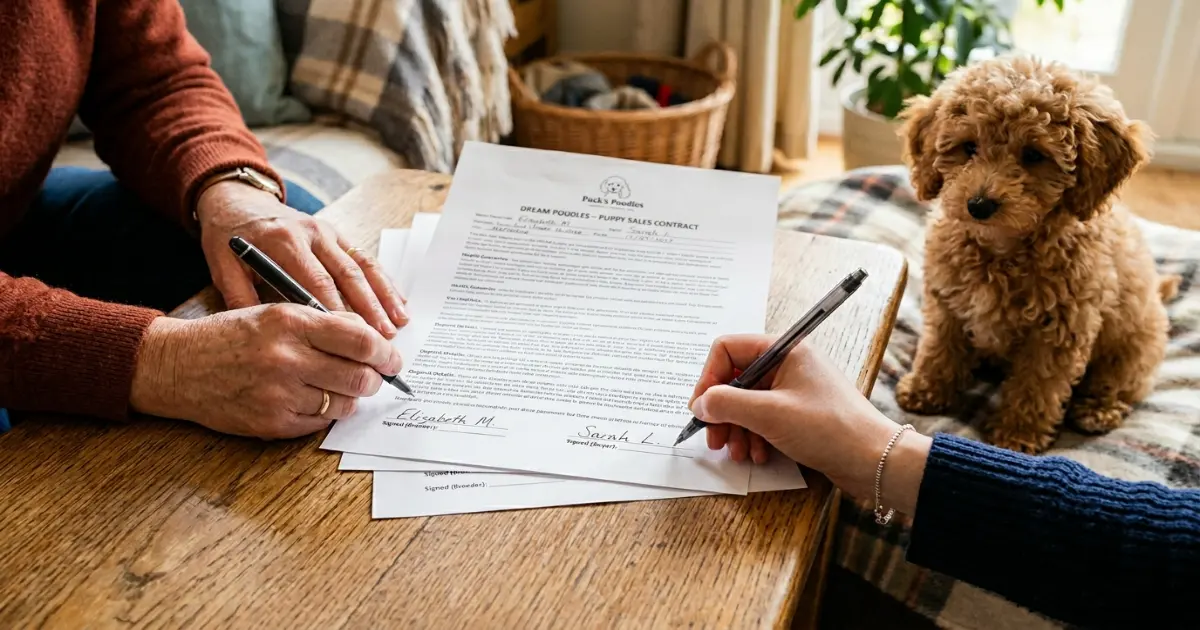
4. A written contract and health guarantee. The contract covers health guarantees beyond a cursory 72 hours, clearly states the spay/neuter expectation, and includes a clause that the breeder will take the dog back at any point in its life if you cannot keep it. No ethical breeder wants their dogs to end up in rescue.
5. A thorough application process. They ask about your lifestyle, experience with dogs, home environment, and plans for training. They are not desperate to sell. You wait for the right puppy, not pick from whatever is available on a website.
Red Flags That Scream “Stay Away” — A Detailed Breakdown
Now for the signals that should stop you cold. Some are obvious once you know what to look for. Others are subtle enough that well-meaning buyers walk right past them. Here is the landscape of warning signs in learning how to spot a reputable poodle breeder (red flags).
Red Flag: “Rare” color marketing. Language like “rare red,” “exotic phantom,” “unique merle” (merle does not naturally occur in poodles and indicates crossbreeding somewhere in the line), or “teacup” sizes is designed to inflate perceived value and price. Ethical breeders focus on health, structure, and temperament—not novelty colors.
Red Flag: Missing or unverifiable health clearances. “Vet checked” is not health testing. A general exam by a veterinarian cannot rule out hip dysplasia, inherited eye disease, or genetic disorders. If a breeder cannot point you to their dogs’ OFA records online, they either have not done the testing or are hiding the results.
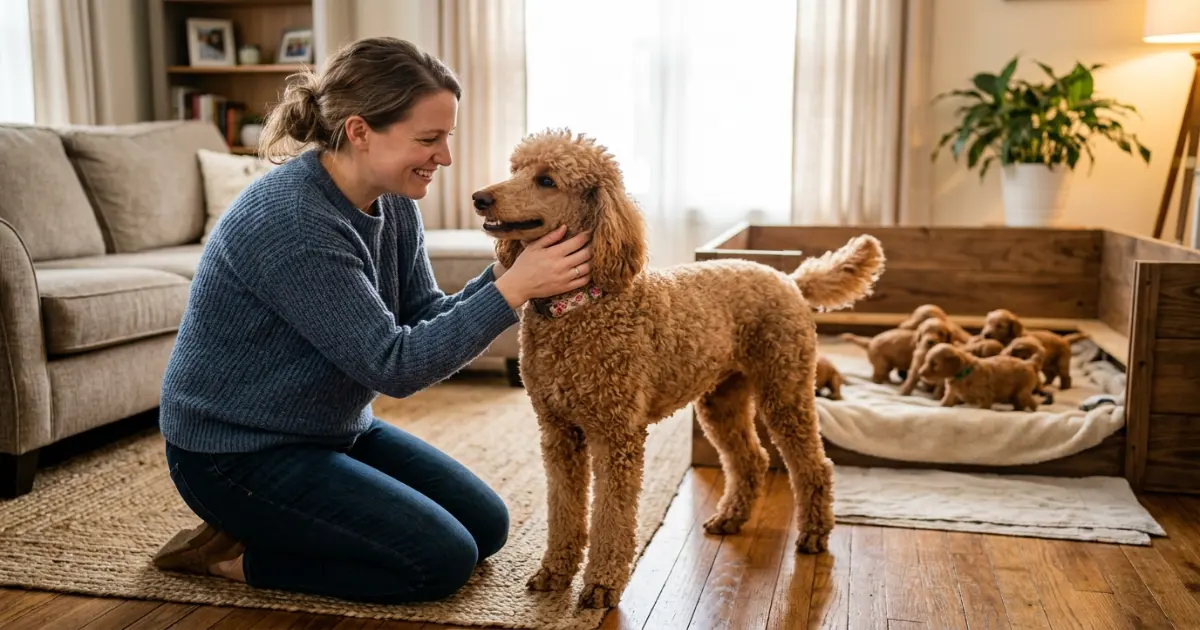
Red Flag: No meeting the mother dog. Breeders who will not let you see the dam, or who show you only the puppies in a neutral location, are often hiding poor living conditions or a dam who is in bad shape. The mother should be on the premises, and her temperament should be something you can observe firsthand.
Red Flag: Pressure to pay immediately. Reputable breeders have waitlists. If a breeder tells you a puppy is available right now and you must send a deposit within hours or it will go to someone else, that pressure is a sales tactic, not a sign of a responsible program.
Red Flag: Multiple litters on the ground at once. While a well-run program may occasionally have overlapping litters, a constant stream of puppies, especially from multiple different breeds, is the hallmark of a high-volume commercial operation, regardless of how pretty the website looks.
Red Flag: Selling through brokers or pet stores. No reputable poodle breeder sells through a third party. Period. Any puppy listed on a site that aggregates litters from multiple breeders should be considered suspect.
Reputable vs. Red-Flag Poodle Breeder: Side-by-Side Comparison
| Aspect | Reputable Breeder | Red-Flag Breeder |
|---|---|---|
| Health testing | OFA hips, CAER eyes, full genetic panel, publicly verifiable | “Vet checked,” no public database records, dismissive when asked |
| Parent dogs | Mother on-site, father often available to meet or with references, both with titles or proven work | Mother not shown, sire described vaguely, no proof of accomplishments |
| Puppy environment | Raised in the home, exposed to household activity, structured socialization protocol | Kennel-raised, isolated, minimal handling, puppies seem fearful or unresponsive |
| Sales approach | Application, interview, waitlist; asks you many questions | First come, first served; emphasizes immediate availability; pressures deposit |
| Contract | Detailed contract with health guarantee, spay/neuter clause, lifetime return policy | No contract, or minimal “as-is” bill of sale, no take-back clause |
| Color language | Uses standard color terms: black, white, apricot, brown, silver, etc. | Markets “rare,” “exotic,” “royal,” or “phantom” as premium traits; prices by color |
| Breed education | Educates you about grooming, temperament, training; stays in contact for life | Little guidance, no follow-up, seems uninterested once payment clears |
What Most Buyers Get Wrong About Poodle Breeder Research
Even savvy people fall into traps that lead them to the wrong breeder. Recognizing these patterns saves you from rationalizing a bad decision in the moment when puppy excitement takes over.
- Equating a beautiful website with a reputable breeder. Anyone can pay for a professional site. The prettiest web pages often belong to the highest-volume sellers. Look beyond the presentation to the substance of the breeding program.
- Believing AKC registration means quality. AKC papers confirm purebred status, not ethical breeding. Puppy mill puppies and backyard-bred litters can be AKC registered. Registration is the floor, not the ceiling.
- Assuming a “health guarantee” is enough. Many shady breeders offer guarantees that are impossible to claim—requiring you to return the dog, or only covering conditions diagnosed within 72 hours. Read the fine print. A guarantee that requires you to give up a beloved family member to get a refund is not a safety net; it is a loophole.
- Trusting social media photos. Instagram accounts showing adorable puppies in baskets tell you nothing about health testing or breeding ethics. Dig deeper than the aesthetic.
- Thinking price alone signals quality. High price does not equal reputable, and low price does not equal a bargain. There are expensive puppy mills and occasional ethical breeders who price modestly to ensure good homes. Evaluate the entire picture.
💡 Expert Insight: One of the most telling questions you can ask a breeder is, “What are the three biggest weaknesses in your breeding program, and what are you doing to improve them?” A reputable breeder will give you a thoughtful, specific answer. Someone who claims their dogs have no faults is either dishonest or lacks the knowledge to breed responsibly.
How to Vet a Poodle Breeder: A Step-by-Step Process
Vetting a breeder is not a single phone call. It is a deliberate sequence that protects you from emotional decisions. Here is the path to follow, adapted from the process that experienced poodle owners and breed mentors use.
Step 1: Start with the breed club referral list. The Poodle Club of America and its regional affiliates maintain breeder referral directories. These are not guarantees of quality, but they filter out the most egregious commercial operations because membership requires agreeing to a code of ethics.
Step 2: Verify health testing in OFA database. Ask for the registered names and/or OFA numbers of both parents. Go to ofa.org and search for them yourself. If the data is not there, walk away.
Step 3: Interview the breeder before visiting. Prepare a list of questions: What health issues have appeared in your lines? How do you socialize puppies? What titles do the parents hold? How do you match puppies to homes? Listen for detailed answers, not platitudes.
Step 4: Visit in person. See where the dogs live. Observe the mother’s condition and temperament. Notice how the breeder interacts with the dogs. A breeder whose dogs flinch or cower is telling you something they never would with words.
Step 5: Contact references. Ask for contact information from previous puppy buyers. Call them. Ask about health outcomes, temperament, and whether the breeder was supportive after the sale. A breeder who hesitates to provide references is hiding something.
Step 6: Trust your gut backed by evidence. If everything checks out on paper but something feels off in person, honor that. The right breeder will feel like a partner in your dog’s life, not a transactional vendor.
Realities of Poodle Pricing in 2026
Money is part of the breeder conversation, and understanding the numbers helps you calibrate expectations. Prices from reputable breeders reflect the real costs of responsible breeding—not profit margins.
💰 2026 Poodle Puppy Price Ranges (Reputable Breeder)
Toy Poodle: $2,500–$4,500
Miniature Poodle: $2,800–$4,800
Standard Poodle: $3,000–$5,500
Prices vary by region, litter size, titling, and health testing depth. A breeder charging significantly below these ranges is probably cutting corners. Prices far above, especially for color, are rarely justified by anything other than marketing. Expect to place a deposit and wait months—or more than a year—for a well-bred puppy.
Breeding ethically is not profitable in the way that high-volume production is. The cost of health testing, stud fees, reproductive veterinary care, puppy supplies, and the time spent raising a litter properly means that most reputable breeders barely break even across a dog’s breeding career. When you pay that $3,500 for a Standard Poodle puppy, you are not buying a product; you are compensating years of expertise, care, and investment in the breed’s future.
📍 Pro Tips for Buyers: Protecting Yourself Before the Deposit
- Never send a deposit without a signed contract. The contract should specify the puppy, the terms, the health guarantee, and what happens if something goes wrong on either side.
- Ask to see the pedigree. Look for linebreeding on dogs that lived long, healthy lives. Avoid pedigrees where the same dog appears repeatedly without health longevity data to support it.
- Verify the breeder’s involvement in the breed community. Are they members of a poodle club? Do they attend shows or trials? Breeders who participate in the wider breed world have reputations to protect.
- Be patient. The right puppy is worth the wait. If you feel rushed, you are being rushed. That is a red flag in itself.
- Consider an older puppy or adult. Reputable breeders sometimes place older pups or retired show dogs. This can be an excellent way to skip the intense puppy phase while still getting a health-tested, well-socialized poodle.
Frequently Asked Questions
What are the biggest red flags when choosing a poodle breeder?
The most serious red flags include unverifiable health testing, refusal to let you meet the mother dog, pressure to pay quickly, marketing based on “rare” colors or “teacup” sizes, selling through third-party websites, and having no written contract or health guarantee.
Why do some poodle breeders not allow visits?
Some reputable breeders limit visits to protect young puppies from disease before vaccinations, but they will still offer video calls, photos, and allow you to meet the mother outside the puppy area. A breeder who refuses to let you see the dam or uses “biosecurity” as a blanket excuse to hide conditions is a concern.
How much should a poodle puppy cost from a reputable breeder?
In 2026, expect $2,500–$5,500 depending on size and region. Pricing below $2,000 often signals skipped health testing or high-volume breeding. Pricing far above for color alone is a marketing tactic, not a quality indicator.
Does AKC registration mean a breeder is reputable?
No. AKC registration confirms purebred lineage but does not require health testing, good living conditions, or ethical practices. Many puppy mills produce AKC-registered dogs. Registration is one piece of the puzzle, not the whole picture.
Can a reputable poodle breeder sell puppies before they are born?
Reputable breeders often have waitlists before a litter is born, but they do not collect large non-refundable deposits before the puppies exist, and they match puppies to homes based on temperament and owner fit—not birth order or willingness to pay a premium.
What is the difference between a puppy mill and a backyard breeder?
Puppy mills are large-scale commercial operations prioritizing volume and profit, often with poor living conditions. Backyard breeders are smaller operations that may care about their dogs but skip health testing, breed without structural or temperament evaluation, and often breed the family pet “just once.” Both produce puppies with higher risks of health and temperament problems.
How can I find a reputable poodle breeder near me?
Start with the Poodle Club of America’s breeder referral list, then cross-check with regional poodle clubs. Verify health testing on ofa.org, interview breeders thoroughly, and visit in person before committing. A breeder directory is only a starting point; you must still do your own vetting.
✓ Choosing Wisely: The Bottom Line
Knowing how to spot a reputable poodle breeder (red flags) protects your future companion’s health, your finances, and your peace of mind. The signs are there if you look for them: verifiable health testing, transparency, thoughtful puppy raising, a detailed contract, and a breeder who truly cares where their puppies end up. When you find the right breeder, you gain more than a puppy—you gain a mentor, a resource, and a relationship that lasts the dog’s lifetime. Take your time. Ask hard questions. Walk away from anyone who makes you feel like you cannot.