How to Train a Poodle to Be Off-Leash Reliable
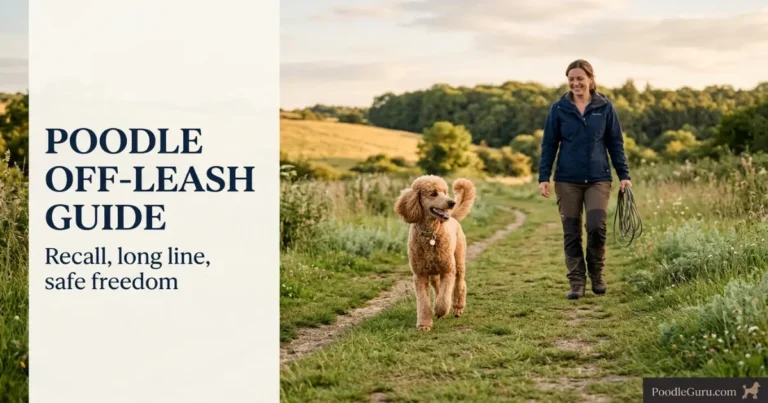
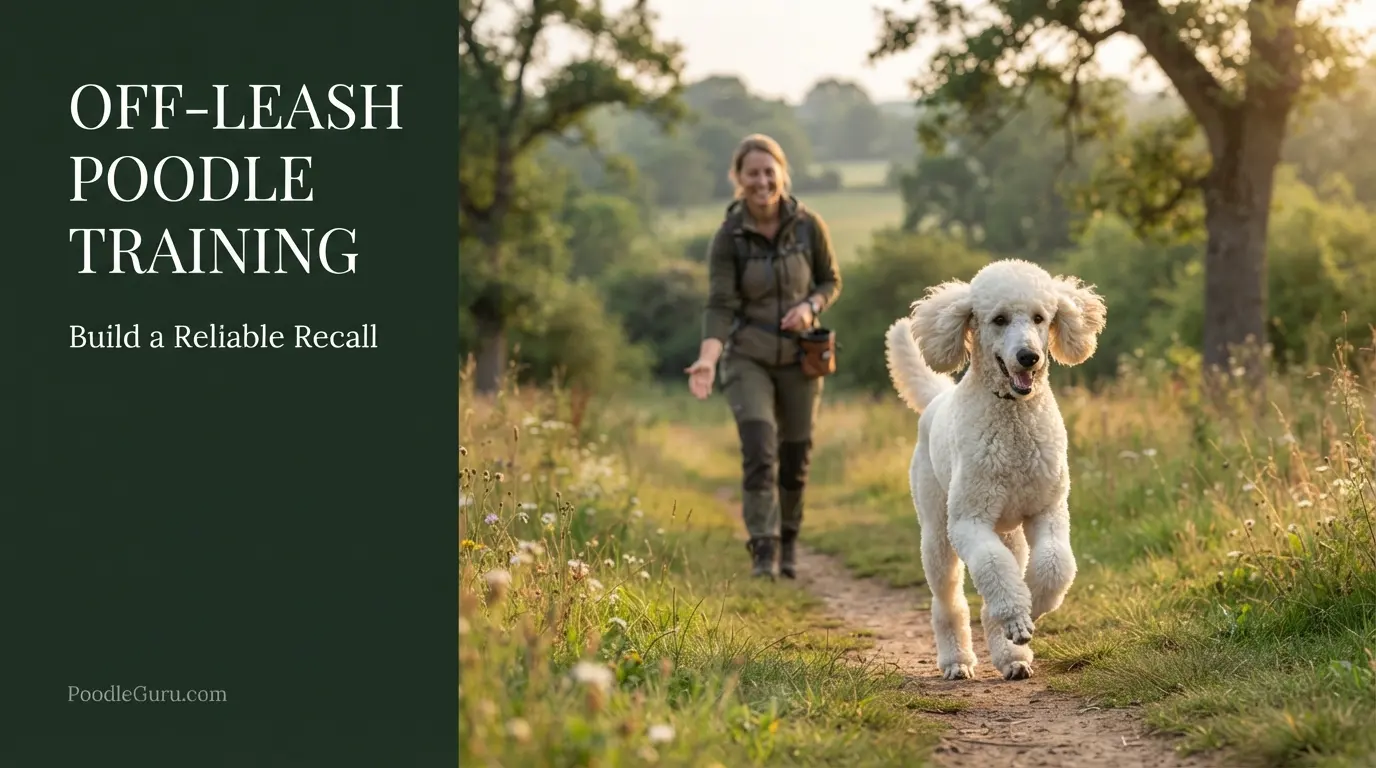
Off leash training a poodle is not about trusting intelligence alone. It is a gradual process of building a rewarding recall, practicing around controlled distractions, using a long line for safety, and knowing when an environment is simply too risky for off-leash freedom.
Quick Answer: How Do You Train a Poodle Off Leash?
Start with a recall cue in a quiet indoor space, reward every successful return generously, then add distance and distractions in small steps. Move outdoors on a standard leash before progressing to a long line attached to a well-fitted harness. Practice in multiple safe locations and use enclosed areas for early off-leash sessions. Do not rely on a fixed training timeline or a percentage score as proof of safety: even well-trained dogs can make mistakes, and off-leash activity should only happen where it is legal, appropriate, and low risk.
In This Guide
- Why Off-Leash Reliability Matters for Poodles
- Quick Facts
- The PoodleGuru Off-Leash Reliability Framework
- Pre-Training Prerequisites
- Core Training Phases
- Size-Specific Considerations
- Common Mistakes That Undo Your Progress
- Safety, Legal & When Not to Go Off-Leash
- Owner Readiness Checklist
- Frequently Asked Questions
- Key Takeaways
Why Off-Leash Reliability Matters for Poodles
Poodles were bred to work alongside handlers in the field, retrieving waterfowl and making independent decisions at a distance. That genetic blueprint means most poodles have a natural inclination to check in with their person — but also a strong prey drive and a curious mind that can override training if it isn’t layered deeply enough.
Off-leash freedom transforms a poodle’s quality of life. It lets them run at full speed, follow scent trails safely, swim, and explore with you as a trusted anchor. Without it, many poodles — especially Standards — end up under-exercised and mentally under-stimulated, which often shows up as restlessness, barking, or destructive chewing at home.
That said, off-leash reliability isn’t just about fun. It’s a safety net. A solid recall can stop your poodle from running into traffic, approaching an unfriendly dog, or disappearing into the woods. For Toy and Miniature Poodles, reliable recall can prevent interactions with larger predators or off-leash dogs that see a small poodle as prey.
The AKC’s recall training principles emphasize that recall is the single most important safety behavior a dog can learn. For poodles — intelligent but sometimes independently minded — this training requires a tailored approach.
Off Leash Training a Poodle: Quick Facts
There Is No Universal Timeline
Basic recall can improve within weeks, while dependable responses around real-world distractions often require months of progressive practice. Age, reinforcement history, prey interest, confidence, health, and environment all affect progress.
Essential Skill
Recall is the foundation. Recall is the foundation. Your poodle should respond promptly in multiple controlled environments before you consider off-leash freedom. One excellent session is not enough; repeatability matters.
Poodle-Specific Trait
Poodles often learn recall quickly indoors and struggle outside because the environment is harder. Treat that as a generalization gap: lower the difficulty, add distractions gradually, and keep reinforcement strong.
The PoodleGuru Off-Leash Reliability Framework
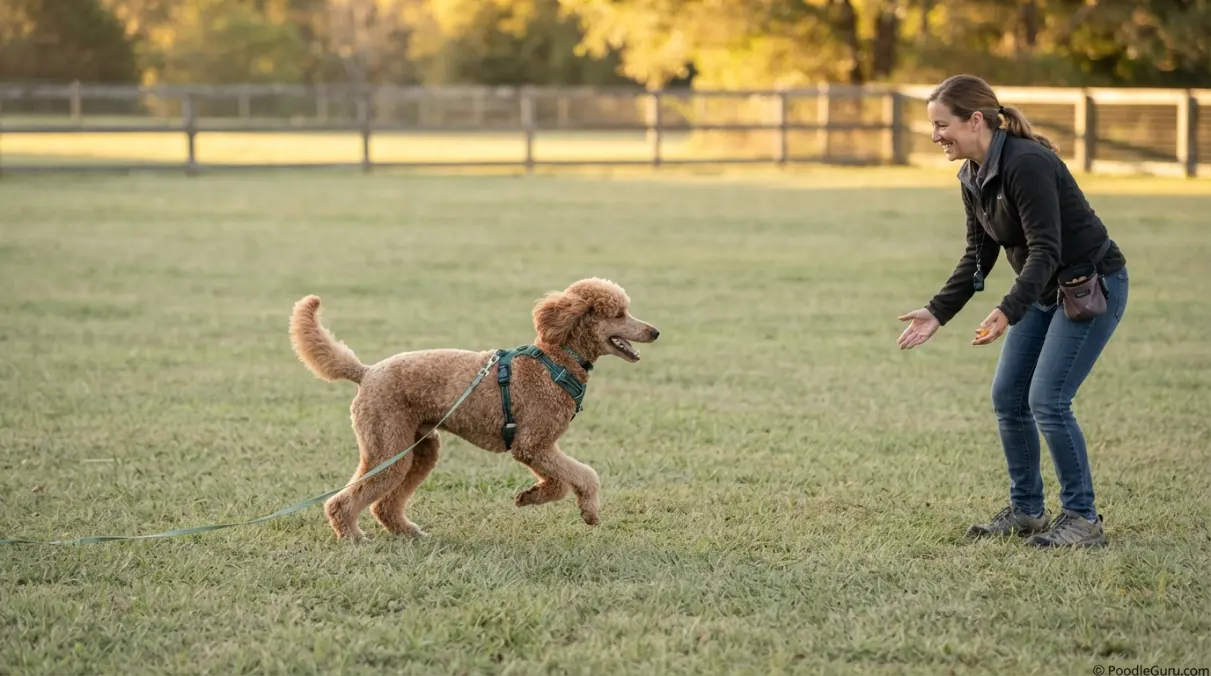
At PoodleGuru, we approach off-leash training through a four-phase method that respects the poodle’s learning style. Skip a phase or rush the sequence, and you’ll likely end up with a dog that recalls perfectly — until it matters most.
Foundation: Build the Bubble
Teach your poodle that staying near you is the most rewarding place in the world. Use spontaneous treats, play, and praise whenever your dog voluntarily checks in or walks close. This isn’t a formal command — it’s a value shift.
Recall: Engineer a Rock-Solid Cue
Choose a single recall word (“come,” “here,” or a whistle) and condition it as a guaranteed predictor of high-value rewards. Practice first indoors, then with distance, then with mild distractions. Never use the recall cue for something your poodle dislikes.
Proofing: Generalize Across the World
Systematically practice recall in new locations, around different distractions, and at increasing distances. Start in quiet environments and move to busier ones only after your poodle nails it each time. This phase is where most training stalls — and where patience pays off.
Maintenance: Never Let It Fade
Off-leash reliability degrades without ongoing reinforcement. Even a fully trained poodle needs occasional high-value recall rewards and practice sessions. A single incident of your dog ignoring the recall and getting rewarded for it (a squirrel chase, for example) can set progress back significantly.
Pre-Training Prerequisites
Before you drop the leash, your poodle needs these skills solidly in place:
| Skill | Why It’s Needed | Mastery Criterion |
|---|---|---|
| Name Recognition / Eye Contact | Without attention, you can’t give a cue. Your poodle must orient to you when you say their name. | Turns toward you readily in several familiar settings with mild distractions. |
| Hand Target (Touch) | A nose-to-palm touch becomes a portable “come closer” cue and a reset for distracted dogs. | Moves several steps to touch your open palm in multiple rooms and outdoors on leash. |
| Sit-Stay with Duration | Impulse control is the foundation for a recall that isn’t immediately followed by bolting. | Can settle briefly while you step away, first indoors and then in a quiet yard. |
| Leave It / Drop It | If your poodle picks up something dangerous off-leash, you need a reliable stopgap before the recall. | Responds in practiced situations without grabbing or guarding the item. |
| Loose-Leash Walking | A dog that constantly pulls on leash hasn’t learned to check in. Off-leash freedom builds on that check-in habit. | Can move with you on a relaxed leash and reconnect after mild distractions. |
There is no fixed number of weeks for these prerequisites. Build them until they are repeatable in several controlled settings. If a skill disappears when distractions increase, keep working with a leash or long line.
Off Leash Training a Poodle: From Long Line to Freedom
The actual off-leash transition follows a predictable path. Each phase should take at least a week of consistent success before moving on. If your poodle fails at any step, go back to the previous one and reinforce.
Phase 1: Recall Indoors with No Distractions
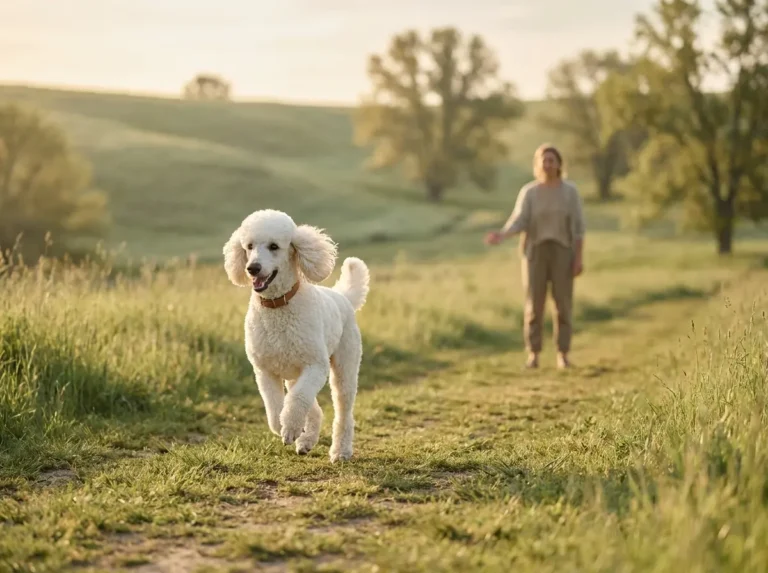
In a quiet room, say your recall cue once in a bright, happy voice. When your poodle comes, mark it (click or “yes!”) and reward with 3–5 small treats delivered one after another — a jackpot. Repeat 5–10 times per session. Gradually increase the distance you call from. Once the recall is instant indoors, move to the yard on a short leash.
Phase 2: Long-Line Training in Safe Open Spaces
Attach a 15–30 foot long line to a well-fitted harness and work in an open area where the line is unlikely to snag. Let your poodle explore, then give the recall cue once. If the dog does not respond, do not jerk the line, repeatedly shout the cue, or drag the dog back. Use the line to prevent access to hazards, move closer, regain attention, and reset at an easier level. Practice in legal low-distraction locations and securely fenced private spaces. The goal is to make returning rewarding while preventing failed recalls from turning into self-rewarding chases.
Phase 3: Off-Leash in Enclosed Areas
Use a securely fenced private yard, training field, or designated enclosed dog-exercise area whose rules allow training. Practice call-reward-release repetitions so coming to you does not always end the fun. If you use a lightweight drag line, do so only under close supervision in a clear space where it cannot snag. Move forward only after the behavior is repeatable across several sessions and locations.
Phase 4: Controlled Open Spaces
Do not treat an unfenced public park or trail as a final exam. Continue proofing on a long line in places where dogs are permitted and where the line can be used safely. Add distractions gradually — a person at distance, a stationary dog far away, or a toy — without letting the dog rehearse chasing. Off-leash practice should occur only where local rules allow it and the environment has an acceptable margin of safety. No recall is “bombproof.”
The Emergency Recall
Teach a separate, ultra-high-value recall word — something you’ll only use in true emergencies. Pair it with a unique, high-pitched whistle or a word like “now” delivered sharply. Reward with a small jackpot of an exceptionally valuable food or favorite toy every single time during conditioning. This cue must never be used casually or for anything the dog might want to avoid. Condition it so powerfully that your poodle reflexively spins and sprints toward you.
Size-Specific Considerations for Off-Leash Training
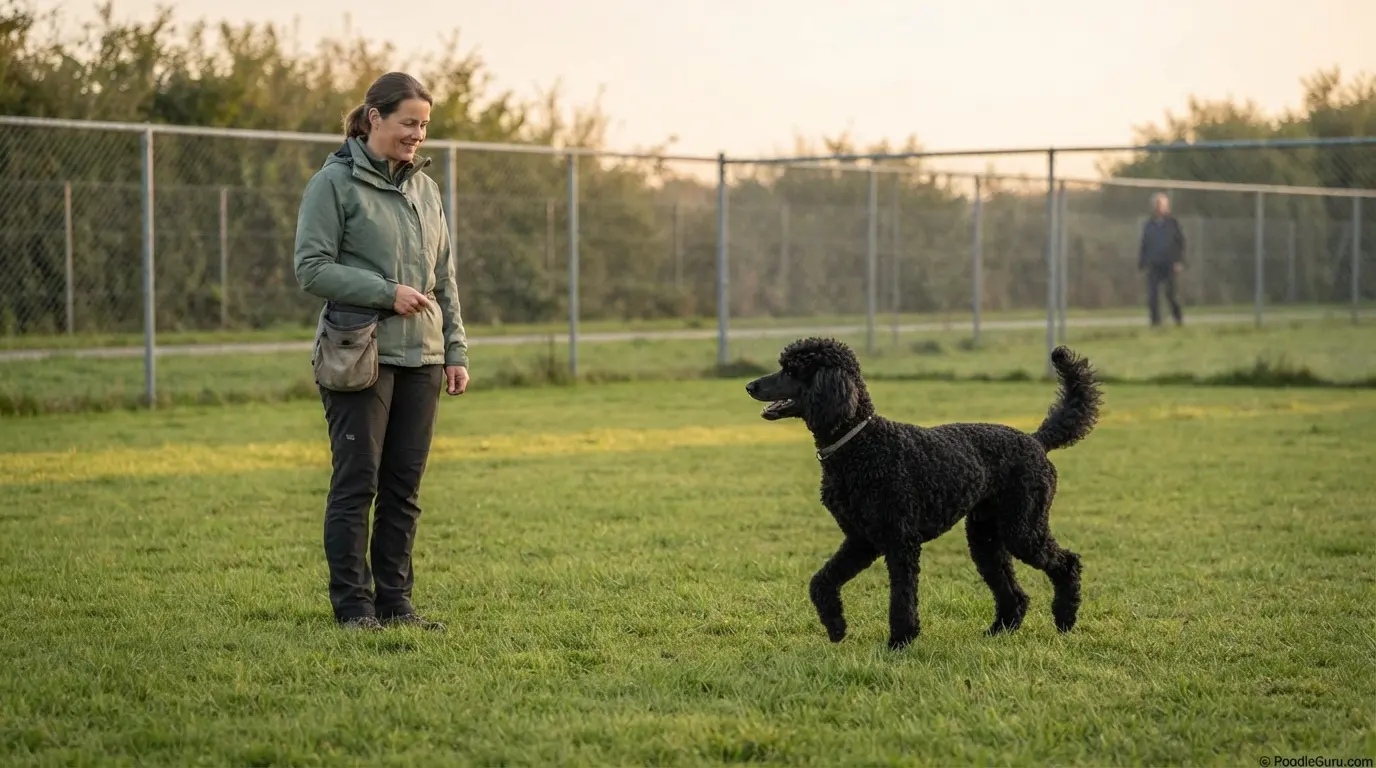
The learning principles are the same across poodle varieties, but size changes practical risk. Official poodle varieties are defined primarily by height, so avoid using a narrow weight range as a safety rule.
| Factor | Toy Poodle | Miniature Poodle | Standard Poodle |
|---|---|---|---|
| Visibility | Can disappear quickly behind vegetation, terrain, or crowds. | Easier to track than a Toy but still small in tall cover. | Usually easier to see at distance but capable of covering ground quickly. |
| Environmental Risk | Very small dogs may face greater risk from larger dogs or local wildlife in some regions. | Still requires careful management around large dogs, wildlife, traffic, and rough terrain. | Lower vulnerability to some predators, but greater speed and range can increase chase distance. |
| Exercise | Can get excellent exercise through walks, play, training, and fenced freedom; open off-leash running is not required. | Benefits from varied walking, games, sniffing, and secure running opportunities. | Often enjoys vigorous exercise, swimming, retrieving, and running, but off-leash access is still optional rather than essential. |
| Training Setup | Lightweight equipment and secure fencing are especially useful. | Long-line proofing works well when the line and harness are sized appropriately. | Use equipment strong enough for the dog and handle the line carefully to avoid burns or sudden impact. |
For a size-by-size overview, see the Poodle Size Chart.
Common Mistakes That Undo Your Progress
Even experienced poodle owners fall into patterns that poison the recall. Here are the big ones — and what to do instead.
| Mistake | Why It Hurts | Fix |
|---|---|---|
| Repeating the cue | “Come… come! COME!” teaches your poodle that the first cue is optional. The word loses meaning. | Say the cue once. If no response, move closer, use a happy voice, or gently reel in with a long line — then reward. |
| Calling your dog only to end fun | If recall always means the leash goes on and the walk ends, your poodle learns that coming to you is a bummer. | Call, reward, and release back to play 5–10 times for every time you actually leash up and leave. |
| Punishing a slow return | Scolding a dog when they finally come back — even if they took their time — teaches them that arriving at you is unsafe. | Always greet the returning dog with praise and treats, no matter how long it took. Deal with the delay by retraining, not by punishment. |
| Too much freedom too soon | Letting a dog off-leash in a high-distraction area before proofing is complete risks a failed recall that becomes a self-reinforcing habit. | Advance only when the previous phase is near-perfect. A single squirrel-chase that ends in joy for the dog sets training back weeks. |
| Using the recall for unpleasant things | Calling your poodle to trim nails, give medication, or end a playdate with a dog friend can taint the cue. | If you need to interrupt something fun, go get your dog instead of calling. Save the recall for positive outcomes. |
Safety, Legal, and When Not to Go Off-Leash
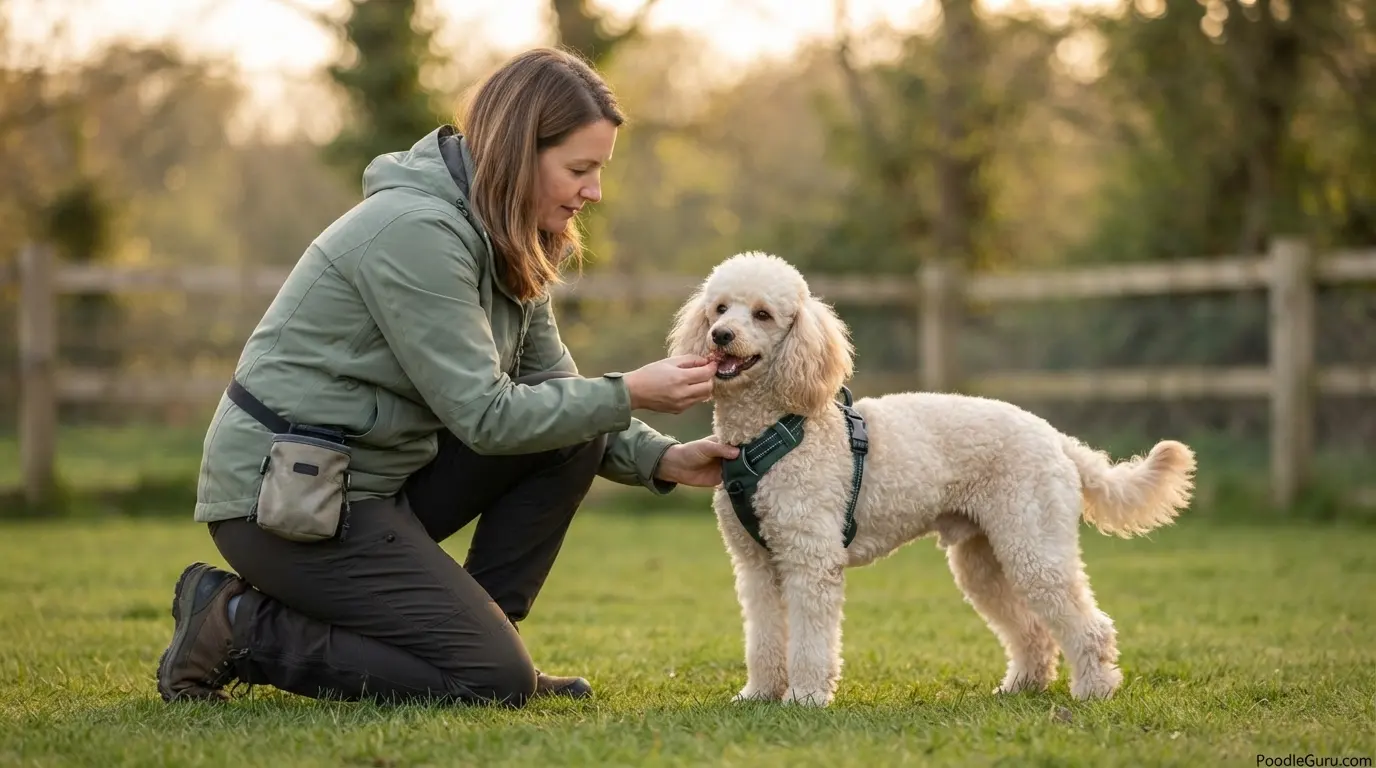
No recall is a guarantee. Even a well-trained poodle can make a mistake when a distraction is intense, the environment changes, or health and emotion affect responsiveness. Responsible off-leash ownership means combining training with management.
Legal Considerations
Leash requirements vary by municipality, park, trail, beach, conservation area, and season. Check current signs and the land manager’s rules before unclipping. Even where off-leash activity is permitted, prevent your poodle from approaching leashed dogs, wildlife, livestock, or people who have not invited contact.
When Off-Leash Isn’t Appropriate
Keep your poodle leashed or on a long line when:
- Traffic, parking areas, rail lines, cliffs, fast water, or other severe hazards are nearby.
- Wildlife is active or local rules protect nesting, grazing, or sensitive habitat.
- Your poodle shows intense prey interest, fear, over-arousal, or repeated failure to disengage.
- Other dogs, livestock, horses, cyclists, runners, or children cannot be given reliable space.
- Your poodle is in heat or reproductive behavior is affecting focus.
- Hearing, vision, pain, cognitive changes, or another health issue may reduce responsiveness.
- The area requires a leash, regardless of how reliable the recall seems.
When to Seek Professional Help
If your poodle consistently ignores recall in controlled training, bolts, freezes, becomes fearful, or cannot disengage from distractions, consult a qualified reward-based trainer or behavior professional before attempting more freedom. The IAABC consultant locator is one place to search for credentialed dog trainers and behavior consultants. The American Veterinary Society of Animal Behavior recommends reward-based training and advises against aversive tools, including electronic shock collars.
Owner Readiness Checklist: Before You Drop the Leash
Use this checklist to honestly assess whether your poodle — and you — are ready for off-leash freedom in a new environment.
- My poodle understands one clear recall cue and I do not routinely repeat it.
- My poodle returns promptly on a long line with mild, controlled distractions.
- I have practiced recall in several different safe locations and my poodle can respond in each.
- I carry high-value treats every time we train, and I reward recall consistently.
- I’ve never punished my poodle after a recall, even a slow one.
- I can read my poodle’s body language for signs of overstimulation or stress.
- I’ve taught a separate emergency recall and have proofed it with ultra-high-value rewards.
- My poodle wears a secure collar with ID tags and is microchipped with current info.
- The environment I’ve chosen for off-leash is legal, safe, and free of immediate hazards.
- I’m willing to return to a long line if my poodle shows any sign of recall slippage.
Frequently Asked Questions
How long does off-leash training take for a poodle?
There is no reliable universal timeline. Many poodles can learn the basic recall pattern fairly quickly, but dependable responses around outdoor distractions can take months of progressive practice. Judge readiness by repeatable behavior across controlled environments, not by a calendar.
Can Toy Poodles be trained off-leash safely?
Yes, but with strong caveats. Toy Poodles are highly trainable, but their small size makes them vulnerable to predators and they’re easily hidden in tall grass. Off-leash time for Toys is best limited to fully fenced, secure areas. In open spaces, a lightweight long line provides safety while still allowing freedom.
What’s the best recall cue for poodles?
Choose a distinct, single word like “come” or “here,” or a consistent whistle. The cue itself matters less than the conditioning behind it. Always pair the cue with high-value rewards and never use it for something your poodle might want to avoid, like nail trims or ending play. An emergency recall with a separate cue is also wise.
Why does my poodle ignore the recall command outside?
This is usually a generalization gap, not stubbornness. Indoors is predictable; outside is full of novel smells, sights, and distractions. The recall simply hasn’t been proofed in those environments yet. Go back to a long line, practice in gradually more distracting settings, and increase the reward value to compete with the environment.
Should I use a shock collar for off-leash training a poodle?
PoodleGuru recommends reward-based recall training. AVSAB’s current humane dog-training position recommends reward-based methods and advises against aversive tools, including electronic shock collars. If recall training is stalled or dangerous chasing is involved, seek qualified professional help rather than escalating punishment.
My poodle is an adult rescue. Can I still train off-leash reliability?
Absolutely. Adult and senior poodles learn new skills throughout life. The process may take longer, especially if the dog has a history of running off, but with patience and high-value reinforcement, reliable recall is achievable. Start from the foundation, don’t skip phases, and celebrate small wins.
What’s the most common mistake poodle owners make with off-leash training?
Calling the dog only to end fun is the most common poison. If every recall means the walk is over, the dog learns that coming when called leads to disappointment. Intersperse joyful recalls — call, reward heavily, and release back to play — so the cue remains positive.
Is a harness or collar better for off-leash recall training?
For long-line work, a well-fitted back-clip harness is safer because it distributes pressure if the line is stepped on or the dog suddenly bolts. A collar can cause neck injury during sudden stops. Once off-leash, a flat collar with ID tags is essential. Some handlers use a martingale collar for security.
Key Takeaways
- Off-leash reliability for poodles is built through a structured four-phase framework: foundation, recall conditioning, proofing across environments, and ongoing maintenance.
- Basic recall may improve quickly, but dependable responses around real-world distractions usually require progressive practice over time; readiness should be based on repeatable behavior, not a fixed number of weeks.
- Never use the recall cue for unpleasant outcomes; always reward with high-value treats, and separate an emergency recall cue for life-saving situations.
- Toy and Miniature Poodles need extra safety considerations — a securely fenced area or long line is often the wisest choice in open spaces due to predator risk and small size.
- Common mistakes like repeating the cue, punishing slow returns, or advancing too quickly can undo weeks of progress. If the recall fails, go back to the last successful phase.
- Off-leash freedom is a privilege that requires ongoing commitment. Use the readiness checklist honestly, and never hesitate to keep the long line on a little longer.
Start today with 5 minutes of indoor recall jackpots. Then, tomorrow, take it outside on a long line. Small steps built on trust get you further than any shortcut.