Poodle Nose Work Training: The Complete Scent Work Guide
Your poodle’s nose knows more than you think. Nose work training channels that brilliant scenting brain into a game both of you will love — no prior experience needed.
Quick Answer
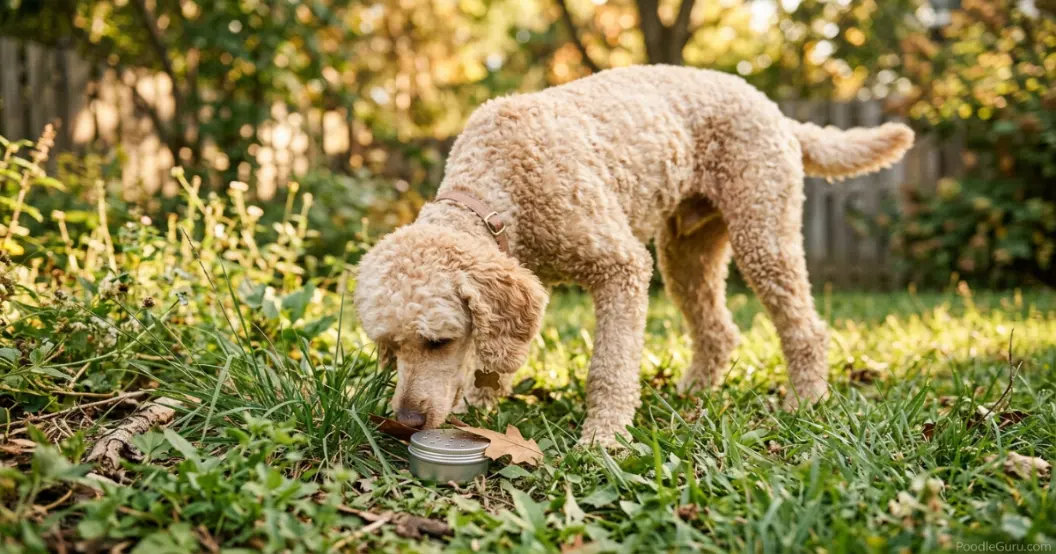
Poodle nose work training is a structured scent-detection activity where your dog learns to find and alert you to specific hidden odors. It taps into the poodle’s natural hunting instincts, sharpens mental focus, burns energy without physical strain, and deepens the handler-dog bond. You can start at home today with basic household items and high-value treats. No previous training or special equipment is required for beginner-level games.
🐩 Best For
All poodle sizes — Toy, Miniature, and Standard. Ideal for dogs of any age, from energetic adolescents to calmer seniors.
⏱ Time Commitment
10–15 minutes per session, 2–3 times per week. Short, focused sessions work better than long drilling.
🧠 Primary Benefit
Mental enrichment that tires a poodle faster than physical exercise alone. Reduces anxiety and boredom-driven behaviors.
🛠 Equipment Needed
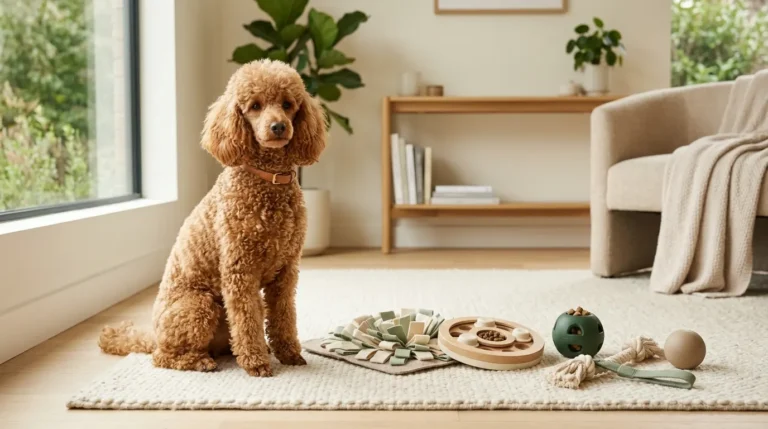
Start with cardboard boxes, high-value treats, and a quiet room. Upgrade to scent tins and target odors later.
🏆 Competition Ready?
Yes — AKC Scent Work, NACSW, and UKC nose work trials all welcome poodles. Many titles have been earned by the breed.
⚠️ Safety Note
Always supervise scent training. Use scent-work target odors only in a sealed or vented scent tin as directed. Never apply essential oils to your poodle’s skin, never allow ingestion, and never force a tired or stressed dog to continue.
What Is Nose Work for Poodles?
Nose work is a canine scent-detection sport and enrichment activity that teaches dogs to locate a specific target odor and communicate the find to their handler. For poodle owners, this means giving a brilliantly intelligent breed exactly what it craves: a problem to solve using its own senses. The most important thing to understand is that nose work isn’t about obedience commands or handler control — it’s about the dog leading, and the human learning to read the dog’s natural communication.
The activity originated from professional detection-dog training. Law enforcement and search-and-rescue handlers spent decades refining scent-work protocols. Those same principles now power a sport that any poodle can enjoy — no law-enforcement pedigree needed. Your poodle already has the hardware. Nose work simply gives it a job.
Poodles were originally bred as water retrievers. Their job was to mark downed birds, remember where multiple birds fell, and retrieve on command. That work demanded a sharp nose, strong memory, and independent problem-solving. Nose work reawakens those genetic instincts in a modern, accessible format. Unlike standard obedience training, scent work lets your poodle take the lead while you follow.
Expert Insight: Why “Following the Dog” Matters
In most training, the human gives cues and the dog responds. Nose work flips that script. The dog finds the scent, and the handler’s job is to observe, support, and reward. For poodles — a breed that can be sensitive to handler pressure — this reversal builds confidence and independence. Professional trainers often note that anxious or reactive poodles show remarkable calm during scent work because they’re finally allowed to process the world at their own pace.
Why Poodles Excel at Scent Work
Some breeds were built for scent work. Poodles belong on that list. Their original purpose — water retrieving — required sharp olfactory discrimination, spatial memory, and independent decision-making under distraction. Those traits transferred seamlessly into modern nose work. But there’s more to it than history.
A poodle’s intelligence works differently from a herding breed’s intelligence. Herding dogs read movement and respond to handler direction constantly. Poodles, as retrieving and hunting dogs, were bred to work at a distance from the handler — marking locations, remembering fall zones, and solving retrieval puzzles without micromanagement. That independent processing style is exactly what scent work rewards.
The AKC breed standard for poodles describes them as “active, intelligent, and elegant.” In practice, that intelligence needs an outlet. Without one, poodles invent their own jobs — and those self-assigned jobs often involve shredding pillows, barking at every passing squirrel, or reorganizing your trash can. Nose work channels the same mental energy into a structured, rewarding framework.
Poodles also possess a soft mouth and a naturally cooperative temperament. They want to work with you, not just for food. When a poodle makes a scent find and looks back at you — tail wagging, eyes bright — it’s not just asking for a treat. It’s inviting you into a shared success. That’s the difference between a breed that tolerates training and a breed that thrives on partnership.
The PoodleGuru Scent Success Framework
At PoodleGuru, we evaluate nose work training through a structured three-phase model. This isn’t a one-size-fits-all program pulled from generic dog-training manuals. It’s built around how poodles specifically learn, problem-solve, and communicate. Use this framework to guide your training — whether you’re playing at home or preparing for competition.
| Phase | Focus | What the Poodle Learns | Handler’s Role | Typical Duration |
|---|---|---|---|---|
| 1. Hunt Drive Activation | Building intrinsic motivation to search | “Searching pays off. I want to find the thing.” | Set up easy wins. Reward generously. Say very little. | 1–3 weeks |
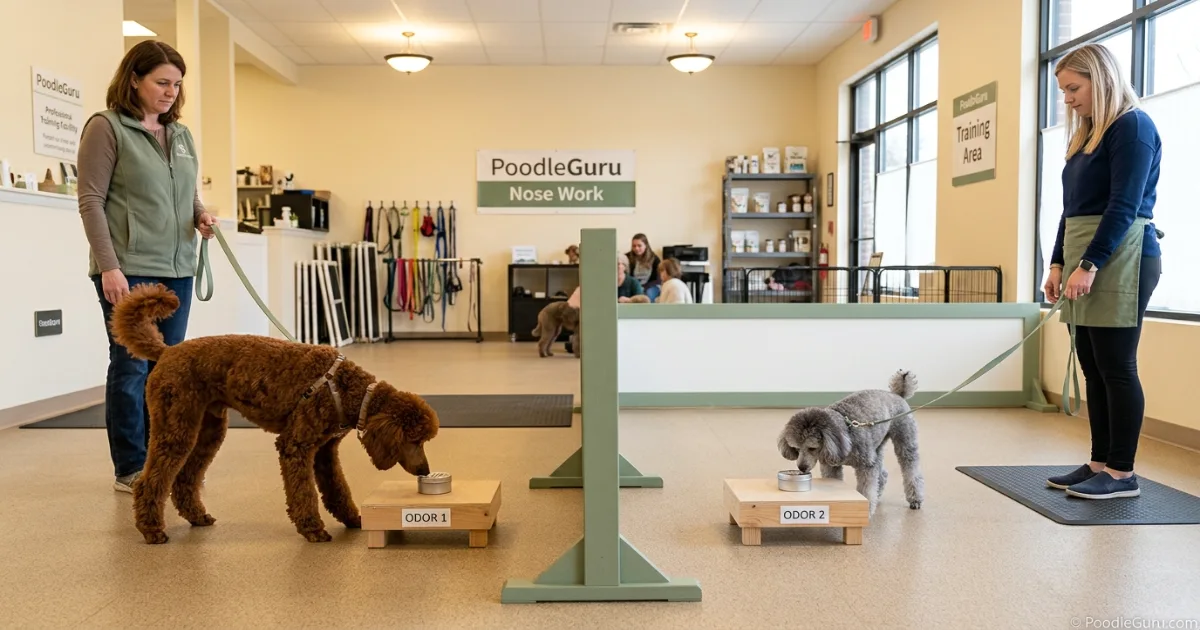
| 2. Odor Discrimination | Teaching the poodle to identify a specific target scent | “This smell matters. Other smells don’t.” | Introduce target odor paired with reward. Gradually remove food pairing. | 2–6 weeks |
| 3. Search Independence | Building duration, distance, and environmental complexity | “I can find this anywhere — indoors, outdoors, in containers, or on vehicles.” | Increase difficulty slowly. Trust the dog’s nose. Celebrate every find. | Ongoing |
Each phase builds on the last. Skipping Phase 1 — rushing straight to odor work before the poodle loves the search game itself — is the single most common reason owners stall out. A poodle that isn’t excited about hunting won’t magically become excited because you changed the target smell. Build the drive first. Everything else follows.
The PoodleGuru Nose Work Readiness Checklist
Before moving from one phase to the next, confirm these signals:
- Phase 1 complete: Your poodle runs to the search area voluntarily. Tail is up. Ears are forward. You’re not luring or coaxing.
- Phase 2 complete: Your poodle consistently identifies the target odor among distractions. False alerts are rare. The “alert” behavior (sit, paw, nose freeze) is distinct and reliable.
- Phase 3 in progress: Your poodle searches independently for 2+ minutes without handler help. You can change locations and the skills transfer.
Getting Started: Equipment & Setup
Nose work has one of the lowest barriers to entry of any dog sport. You don’t need a special facility, expensive gear, or prior training experience. What you do need: a quiet space, a hungry poodle, and the right mindset. Here’s what to gather before your first session.
What You’ll Need
| Item | Beginner | Intermediate | Notes |
|---|---|---|---|
| Search containers | Cardboard boxes (4–6) | Plastic bins, fabric pouches, PVC pipes | Start with open-top boxes. Graduate to closed containers with holes. |
| Reward | High-value treats (chicken, cheese, freeze-dried liver) | Treats + toy reward for some dogs | The reward must be better than anything else in the room. |
| Target odor | None (food search only) | Birch essential oil on a cotton swab in a vented tin | Birch is the standard starter odor for AKC Scent Work. |
| Harness & long line | Standard flat collar or harness | 6–10 ft lightweight long line | Poodles should not feel leash pressure while searching. |
| Treat pouch | Pocket or small bowl nearby | Hands-free treat pouch | Quick reward delivery is critical for timing. |
The most common setup mistake? Using treats that aren’t exciting enough. If your poodle would rather sniff the floor than work for your reward, upgrade the reward. Rotate between three or four high-value options to prevent boredom. Poodles are smart enough to get picky — stay ahead of them.
Step-by-Step Training Method
This section walks you through the first six sessions of poodle nose work training. These steps correspond to Phase 1 of the PoodleGuru Scent Success Framework: Hunt Drive Activation. Master these before introducing target odors or increasing difficulty.
Set the Stage
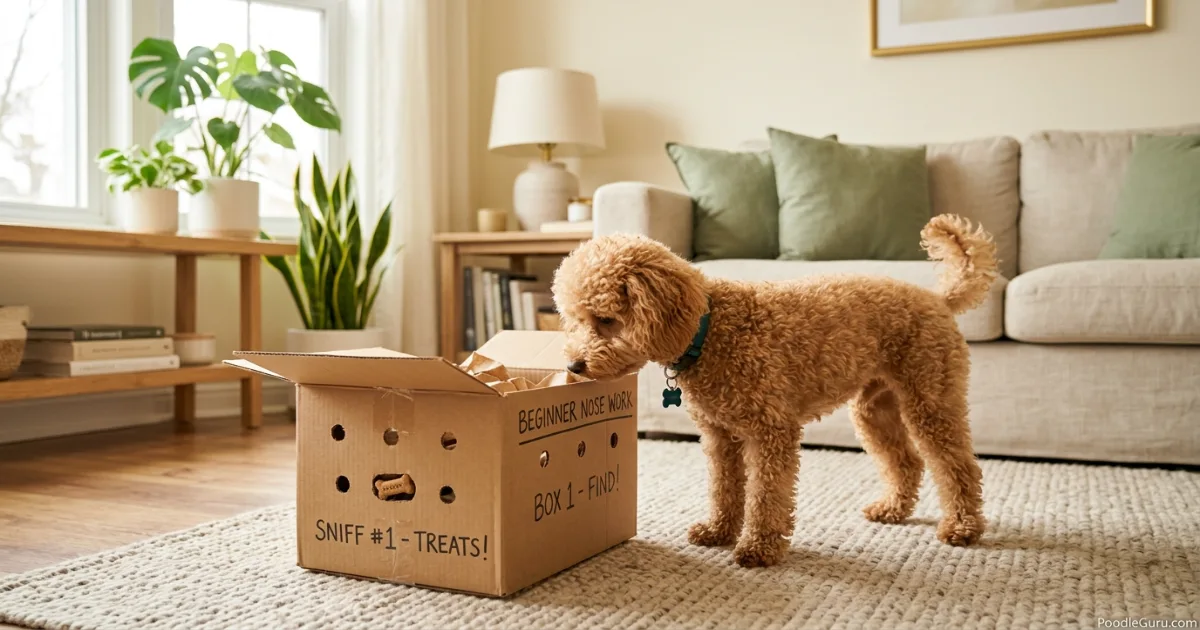
Choose a quiet room with minimal distractions. Place 3–4 open cardboard boxes on the floor. Let your poodle watch you drop a high-value treat into one box. Say nothing. Step back. Let the poodle investigate freely. When the treat is found, praise warmly and drop another treat into the same box while the poodle watches. Repeat 3–4 times, then end the session.
Goal: The poodle learns that boxes contain good things. No pressure. No cues. Pure discovery.
Add a Simple Choice
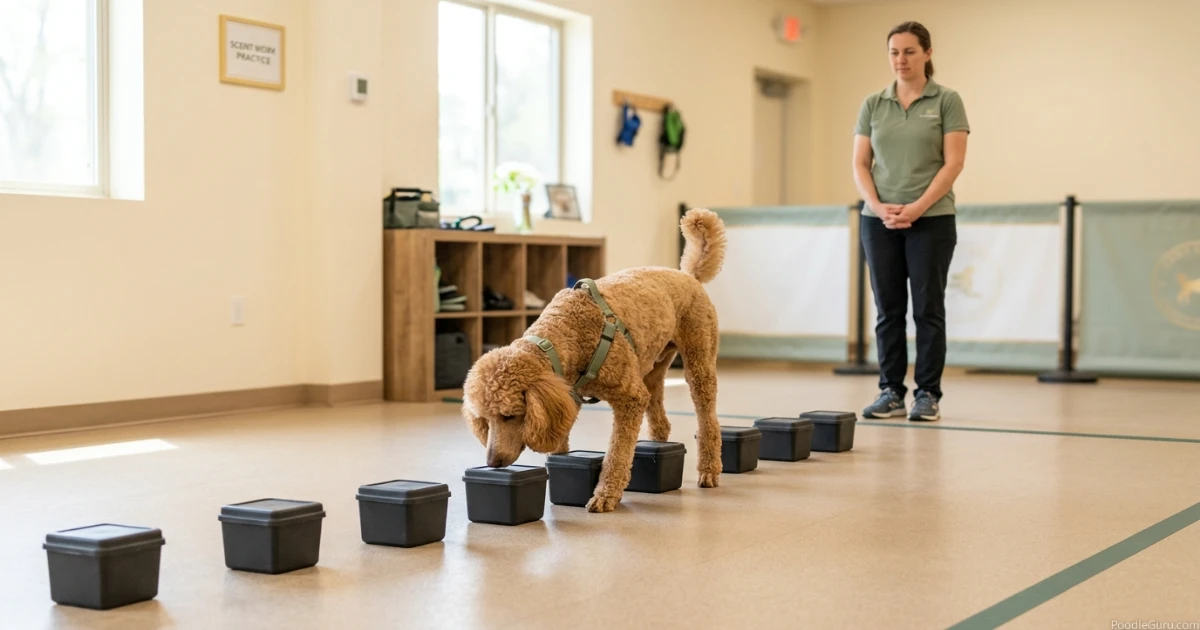
Now use 4–5 boxes. Place a treat in only one box — without the poodle watching. Bring the dog into the room on a loose leash or off-leash in a secure space. Gesture toward the boxes if needed, but don’t point to the correct one. Wait. The moment the poodle’s nose lingers at the correct box, mark with a calm “yes” and deliver a jackpot reward (3–4 treats in quick succession).
Goal: The poodle begins using its nose to discriminate between empty and baited boxes. The handler starts learning to read the dog’s body language.
Introduce a Search Cue
Choose a consistent cue — “find it” or “search” works well. Say the cue once as you release the poodle toward the boxes. Don’t repeat it. Don’t chatter. Your voice should be background noise, not a command loop. Let the dog work. Reward at the find, not before.
Goal: The poodle associates the cue with the start of a search window. The handler learns to stay quiet and trust the process.
Move the Boxes
Rearrange the box layout between rounds. Move them to different parts of the room. Add an unfamiliar object nearby — a chair, a broom, a laundry basket. Keep the search area small (8×8 feet max) but vary the visual landscape. The poodle should rely on scent, not spatial memory of where the box was last time.
Goal: The poodle learns that the target moves. Visual memory fades; nose work takes over.
Add a Second Room
Repeat the same process in a new location — a hallway, a different room, or a covered patio. Expect a slight performance dip. That’s normal. A poodle who searched brilliantly in the living room may look confused in the kitchen. Give them time. The nose will catch up. Reward any engagement with the search area.
Goal: The poodle generalizes the search game across environments. Confidence grows with each new space conquered.
Hide Without Watching
Have a second person hide the treat while you and the poodle wait in another room. Or set up the boxes before bringing the dog into the search space. This removes any chance of the poodle reading your body language instead of using its nose. It’s a crucial step toward true scent independence.
Goal: The poodle trusts its own nose completely. The handler becomes a silent partner, not a clue-giver.
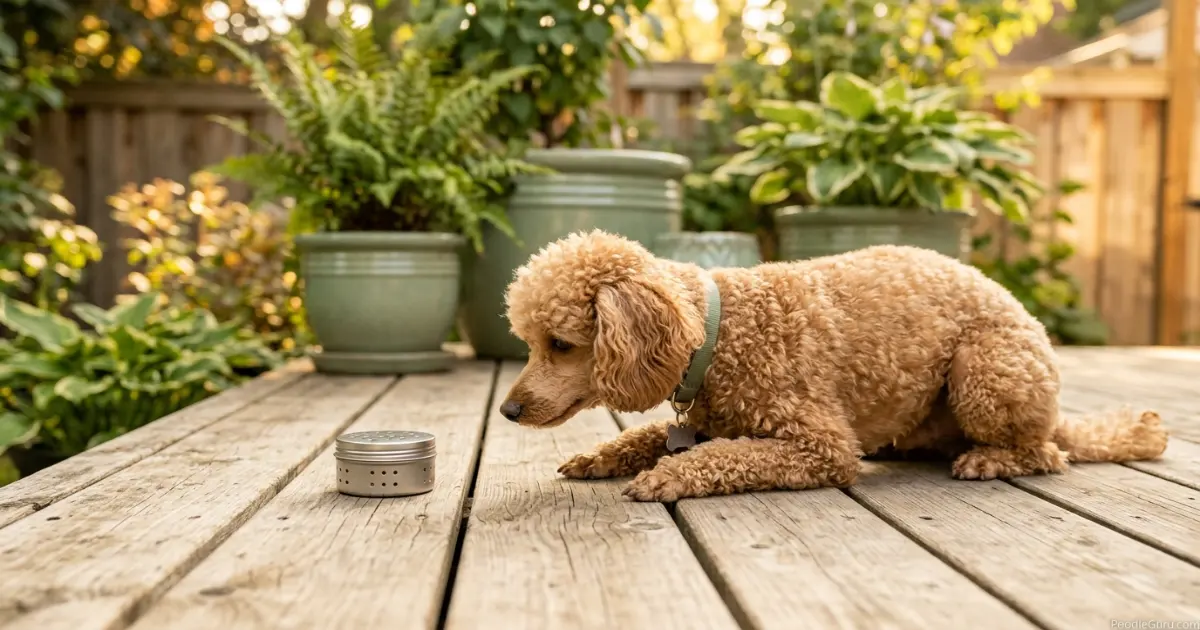
After these six sessions, many poodles are ready to transition into Phase 2 — introducing a target odor such as birch in a safe scent tin. That process deserves its own dedicated guide. But the foundation built here — the hunt drive, the search cue, the environmental confidence — is what carries everything that follows.
How Poodle Size Affects Nose Work Training
One question owners ask constantly: does my poodle’s size change how I should train? The answer is yes — but not in the ways most people expect. Scenting ability is similar across Toy, Miniature, and Standard poodles. What changes is search elevation, stamina, and environmental access. Here’s how to adapt.
| Factor | Toy Poodle (4–6 lbs) | Miniature Poodle (10–15 lbs) | Standard Poodle (40–70 lbs) |
|---|---|---|---|
| Search elevation | Keep hides at floor level or on low platforms. Avoid high surfaces — jumping down from height risks injury. | Low-to-medium hides work well. Can reach chair seats and low shelves with supervision. | Can search floor to above-head height. Vehicle searches and high hides are accessible. |
| Session duration | 5–8 minutes max. Small dogs tire faster when mentally engaged. Watch for overstimulation. | 8–12 minutes. Good stamina for multiple rounds with breaks. | 10–15 minutes. Can handle longer sessions and multiple search areas. |
| Container size | Small boxes (6×6 inches). The dog should be able to investigate without climbing inside. | Medium boxes (10×10 inches). Can navigate varied container types comfortably. | Any container size. Can search large bins, pallets, and outdoor structures. |
| Outdoor search | Supervised only. Predator risk is real. Use a secured yard or long line. | Fenced areas or long line. Good balance of portability and safety. | Can search open fields, wooded areas, and large outdoor venues with appropriate recall. |
| Competition class | Excellent for container and interior searches. Vehicle searches may require handler assistance to reach elevated hides. | Well-suited for all NACSW and AKC Scent Work elements with minor height accommodations. | No physical limitations. Can compete in all elements including exterior area and buried hides. |
None of these differences make one size “better” at nose work. They simply shape the training approach. A Toy Poodle searching a living room bookshelf (with hides placed on reachable lower shelves) is doing the same cognitive work as a Standard Poodle searching a full exterior area. Honor your dog’s physical reality while challenging their brain equally hard.
Common Mistakes Poodle Owners Make
Even experienced dog owners stumble with nose work. Poodles, in particular, can be sensitive to handler error — they read your frustration faster than most breeds. Here are the mistakes that undermine progress and how to fix each one.
| Mistake | What Happens | Fix It |
|---|---|---|
| Talking too much | The poodle tunes out constant chatter. The search cue loses meaning. The dog looks to the handler instead of using its nose. | Give the search cue once. Then be quiet. Count to 30 silently before saying anything else. Your silence is information. |
| Pointing at hides | The poodle learns to read your body, not scent. Progress stalls the moment you don’t know where the hide is. | Keep your hands at your sides. Avoid leaning toward the hide. Have a helper set up hides so you genuinely don’t know the location. |
| Overcorrecting false alerts | The poodle loses confidence and stops offering alerts altogether. Better to give a false alert than to stop trying. | If the poodle alerts incorrectly, stay neutral. Say “let’s keep looking” in a cheerful tone. Reward the next genuine find heavily. |
| Sessions that run too long | Mental fatigue sets in. Accuracy drops. The poodle associates nose work with exhaustion, not fun. | End on a success — even if that means placing an easy hide. 10 minutes of focused work beats 30 minutes of frustrated searching. |
| Skipping the foundation phase | Moving to target odors before hunt drive is solid. The poodle treats odor work like a chore, not a game. | Spend at least two weeks on pure food-search games. A poodle that runs to the search area is ready for odor. A poodle that needs coaxing is not. |
| Using low-value rewards | The poodle decides the environment is more interesting than the game. Sniffing the floor beats working for kibble. | Use real meat, cheese, or freeze-dried organ treats. The reward must beat every competing distraction in the room. |
When a Mistake Becomes a Pattern
One bad session won’t ruin your poodle’s nose work career. But if you notice consistent avoidance — your dog leaving the search area, sniffing exits, or lying down mid-search — stop and reassess. These are stress signals, not stubbornness. Shorten sessions. Increase reward value. Return to easier hides. A poodle that’s checked out needs less pressure, not more.
When to Consult a Professional Trainer
Nose work is remarkably accessible for DIY training. Most owners can reach a satisfying recreational level without hiring anyone. But there are moments when a qualified nose work instructor makes all the difference. Here’s when to seek one out.
Consider a certified nose work instructor if:
- Your poodle shows persistent stress signals during searches — lip licking, yawning, avoidance, or shutting down
- You’ve been training for 6+ weeks with no visible progress through Phase 1
- You want to compete in AKC Scent Work, NACSW, or UKC trials and need trial-specific preparation
- Your poodle has a history of reactivity or anxiety, and you’re unsure how scent work might interact with those behaviors
- You’re introducing a second target odor (anise or clove) and want to ensure clean discrimination between scents
Look for instructors certified through NACSW (National Association of Canine Scent Work) or who hold current AKC Scent Work judge credentials. A good nose work instructor says very little during your dog’s search. If a prospective instructor narrates constantly while the dog works, keep looking. The ASPCA’s enrichment guidelines reinforce that scent-based activities should be dog-led, not handler-directed — and the right instructor honors that principle.
Frequently Asked Questions
Can senior poodles do nose work?
Yes — and they often excel at it. Nose work is low-impact and mentally driven, making it ideal for older poodles with joint concerns or reduced stamina. Adjust hide heights to avoid jumping or climbing, keep sessions short (5–7 minutes), and watch for signs of fatigue. Many senior poodles find nose work deeply calming.
How long does it take to train a poodle for nose work?
Most poodles develop reliable hunt drive within 2–3 weeks of consistent short sessions. Transitioning to a target odor like birch typically takes an additional 4–6 weeks. Reaching competition-ready proficiency varies widely — plan on 4–8 months of regular practice before entering a novice trial.
What’s the best target odor to start with?
Birch is the standard starter odor for many AKC Scent Work beginners, while AKC odor work also uses birch, anise, clove, and cypress at different levels. It should be handled as a scent article only, not as something your dog touches or consumes. Use only a tiny amount on a cotton swab inside a sealed or vented scent tin, following your sport organization’s rules. Never apply essential oils directly to your poodle’s skin, never place them where the dog can lick them, and store all oils away from pets.
Can I do nose work if my poodle has reactivity issues?
Nose work can be especially beneficial for reactive poodles. The activity promotes calm, focused behavior and builds confidence. However, start in a completely controlled environment with no triggers present. Consult a certified nose work instructor who has experience with reactive dogs before joining group classes or trialing.
Do I need to use essential oils, or can I just hide treats forever?
You can absolutely stick with food hides for recreational nose work. Many owners never introduce target odors and their poodles love the game for life. Target odors become necessary if you want to compete in sanctioned trials (food is not allowed as a target in AKC or NACSW competition) or if you want to challenge your dog with odor-only discrimination work.
My poodle gets frustrated and barks during searches. Is that normal?
Frustration barking is common, especially in the early stages. It usually means the hide is too difficult or the poodle hasn’t built enough search confidence yet. Simplify the setup — make the hide more accessible, reduce the number of boxes, or return to a room where the dog has succeeded before. Frustration should decrease as skills build.
Can poodles compete in AKC Scent Work trials?
Yes. Poodles of all sizes compete successfully in AKC Scent Work. The sport is open to all breeds and mixed breeds registered through AKC Canine Partners. Poodles have earned titles at every level, from Novice to Elite. The breed’s intelligence, trainability, and natural scenting ability make them strong competitors across all search elements.
Key Takeaways: Your Poodle Nose Work Action Plan
Nose work is one of the most rewarding activities you can share with your poodle. It requires almost no equipment to start, adapts to any size or age, and builds a partnership based on trust — not commands. Here’s what to remember:
- Poodle nose work training activates your dog’s natural retrieving and scenting instincts through structured search games that build confidence, burn mental energy, and strengthen your bond.
- Start with Phase 1 — food searches in cardboard boxes — and spend at least two weeks building hunt drive before introducing target odors like birch essential oil.
- Keep sessions to 10–15 minutes, end on a success, and use rewards that genuinely excite your poodle. Short, joyful sessions beat long, frustrating ones every time.
- Your poodle’s size (Toy, Miniature, or Standard) affects hide placement and session duration but does not limit scenting ability — all poodles can excel at nose work.
- The handler’s most important job is to stay quiet, trust the dog’s nose, and resist the urge to help. Poodles learn faster when we stop talking and start watching.
- Nose work can reduce anxiety, reactivity, and boredom-driven behaviors by giving your poodle a mentally exhausting, deeply satisfying job to do — one that no puzzle toy can replicate.
Your next step: Grab four cardboard boxes and some chicken. Spend 10 minutes tomorrow playing the Session 1 game. Watch your poodle’s tail. That’s where everything begins.