Grain-Free Diet for Poodles: 7 Risks Owners Should Know in 2026
Quick Answer: A grain-free diet for poodles removes grains such as wheat, corn, rice, barley, and oats, usually replacing them with peas, lentils, chickpeas, potatoes, sweet potatoes, or tapioca. Grain-free food is not automatically dangerous, but legume-heavy formulas have been investigated for a possible connection with non-hereditary dilated cardiomyopathy (DCM), a serious heart condition in dogs. For most poodles, a complete, balanced, grain-inclusive food from a research-backed manufacturer is the safer everyday choice unless your veterinarian has a clear medical reason to recommend grain-free.
The grain-free movement swept through the dog food aisle like a nutritional revolution. Poodle owners were among its most loyal followers because poodles often deal with sensitive stomachs, itchy skin, ear issues, picky eating, and tear staining. A bag that promised “no corn, no wheat, no fillers” sounded cleaner, smarter, and more loving.
But the conversation has changed. The real question in 2026 is not whether every grain-free diet for poodles is bad. The better question is whether the formula is heavily built on pulses such as peas, lentils, and chickpeas, whether the manufacturer has strong nutrition expertise, and whether your poodle has any heart or digestive risk that should be monitored by a veterinarian.
What Grain-Free Means
No wheat, corn, rice, oats, barley, rye, or other cereal grains. Carbs usually come from legumes, potatoes, tapioca, or sweet potatoes.
Main Concern
The FDA has investigated reports of DCM in dogs eating diets with high levels of peas, lentils, other pulses, or potatoes.
Important Correction
The issue is not simply “grain-free.” The bigger concern is formula design, ingredient proportions, nutrient bioavailability, and dog-specific risk.
Best First Step
Do not panic-switch. Ask your veterinarian about diet history, body condition, heart symptoms, and whether taurine testing or echo screening is needed.
What exactly is a grain-free diet for poodles?
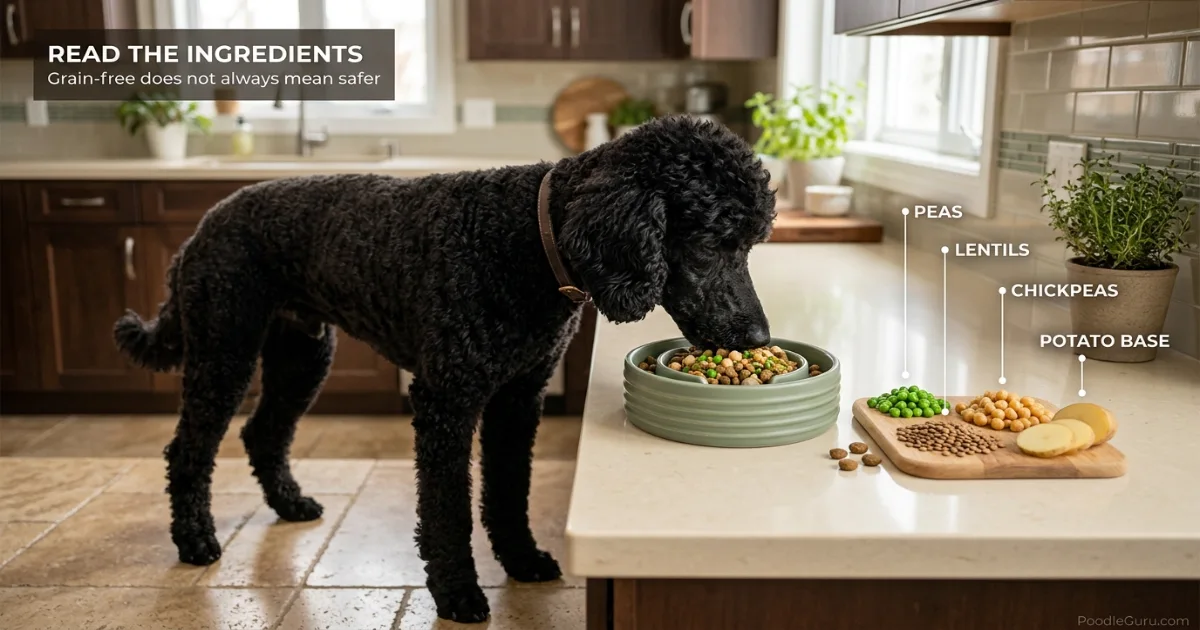
A grain-free dog food contains no cereal grains. Instead of rice, oats, corn, wheat, or barley, the food may use peas, lentils, chickpeas, potatoes, sweet potatoes, tapioca, or other starches. Many formulas also use “pea protein,” “lentil fiber,” or “chickpea flour,” which can appear separately on the ingredient list.
That matters because the ingredient panel can make a formula look meat-rich while plant ingredients are split into several smaller listings. For example, chicken may appear first, but peas, pea protein, pea starch, and lentil fiber together may represent a large part of the food. This does not automatically make the food unsafe, but it does mean poodle owners should read beyond the front of the bag.
Why grain-free became so popular with poodle families
Poodle owners tend to be careful observers. They notice when stools soften, when ears smell yeasty, when the coat looks dull, or when a poodle scratches after meals. When boutique brands framed grains as “fillers” and grain-free diets as more natural, the message landed quickly.
The problem is that “grain-free” became a shortcut for “better,” even though grains are not automatically unhealthy for dogs. Whole grains such as rice, oats, and barley can provide digestible energy, fiber, and useful nutrients. For many poodles, a well-formulated grain-inclusive food is easier to tolerate than a rich, legume-heavy grain-free food.
The DCM concern: what the FDA actually says
In 2018, the U.S. Food and Drug Administration began investigating reports of canine dilated cardiomyopathy in dogs eating certain diets, many of them labeled grain-free and containing high proportions of peas, lentils, other pulse ingredients, or potatoes among the main ingredients. Some reported dogs were from breeds not usually known for a genetic predisposition to DCM.
DCM is a disease of the heart muscle. The heart becomes enlarged and pumps less effectively, which can lead to weakness, coughing, exercise intolerance, collapse, fluid buildup, congestive heart failure, and in severe cases sudden death. It is not a casual “upset stomach” risk; it is a serious veterinary condition.
The important nuance: the FDA has not declared all grain-free diets unsafe, and it has not identified one simple cause. The agency describes non-hereditary DCM as a complex issue that may involve diet composition, ingredient sourcing, processing, nutrient bioavailability, genetics, underlying health, and feeding practices. That nuance makes this topic harder, but also more honest.
Publication correction: The earlier version of this post used very specific “2026 Tufts” and “poodle cohort” statistics that are not reliable enough to publish as fact. This corrected version keeps the 2026 owner guidance angle but removes unsupported study numbers and uses a safer evidence-based explanation.
Are poodles uniquely at risk from grain-free diets?
Poodles are not one of the classic breeds people think of first when discussing inherited DCM. That is exactly why diet-associated DCM discussions matter: reported cases have included dogs outside the traditional high-risk group. A Toy, Miniature, or Standard Poodle can still develop heart disease for many reasons, and diet is one possible factor your veterinarian may review if symptoms or screening results raise concern.
That does not mean every poodle on grain-free food is in danger. Many dogs eat grain-free formulas without obvious heart disease. The safer conclusion is this: poodles should not be kept on legume-heavy grain-free food for years simply because the label sounds premium. There should be a reason, a monitoring plan, and a manufacturer you can trust.

7 risks of a grain-free diet for poodles
1. Legume-heavy formulas may be harder to evaluate
The most concerning grain-free foods are often built around peas, lentils, chickpeas, or other pulses. These ingredients are not poisonous. The concern is proportion, processing, and how the full formula affects amino acids, bile acids, digestibility, and cardiac nutrition over time.
2. The food may look meat-rich but rely heavily on plant protein
Some formulas use multiple plant ingredients that make the recipe seem more animal-protein-based than it really is. Poodles need complete and balanced nutrition, not just a high protein percentage on the label.
3. Taurine status is not the whole story
Taurine is important for heart function, and some diet-associated DCM cases involve low taurine. But not every affected dog has low taurine, which means taurine supplements alone are not a guaranteed fix. Never add taurine or other supplements as a substitute for veterinary guidance.
4. Picky poodles may stay on one formula too long
Poodles can be selective eaters. When an owner finally finds a food the dog accepts, it is tempting to feed the same formula for years. Long-term feeding is exactly where formulation quality matters most.
5. Digestive improvements may be misread
If your poodle’s stool improved after switching grain-free, the improvement may have come from a different protein, fat level, fiber type, calorie density, or ingredient quality — not from removing grains specifically.
6. Premium price can create false confidence
Grain-free foods often cost more than grain-inclusive diets. But a higher price, boutique packaging, and emotional wording do not prove that a company has feeding trials, qualified nutritionists, strong quality control, or long-term safety data.
7. Abrupt switching can create new problems
Suddenly replacing a grain-free food with a grain-inclusive one can cause diarrhea, gas, vomiting, or appetite refusal. Then owners blame the grains and switch back too quickly. Most diet changes should be gradual unless your veterinarian advises otherwise.
Grain-free vs grain-inclusive diets for poodles
The safest choice depends on the individual poodle, but this comparison gives owners a practical framework.
| Diet Type | Common Carbohydrate Source | Risk Level to Discuss | Best Use Case for Poodles |
|---|---|---|---|
| Grain-free, high-legume | Peas, lentils, chickpeas, pea protein, lentil fiber | Higher concern if fed long-term without veterinary review | Only when there is a clear reason and your vet agrees with the formula |
| Grain-free, potato/tapioca based | Potato, sweet potato, tapioca | Still needs formula review; not automatically safer | Possible short-term option in selected food trials under guidance |
| Grain-inclusive premium | Rice, oats, barley, millet, corn, wheat depending on formula | Generally lower concern when complete, balanced, and well-formulated | Everyday maintenance for many healthy poodles |
| Veterinary therapeutic diet | Varies by medical need | Depends on diagnosis and monitoring | Allergies, gastrointestinal disease, kidney disease, obesity, or other diagnosed issues |
When a grain-free diet might make sense for a poodle
There are situations where a veterinarian may recommend a grain-free formula. A poodle may have a confirmed food allergy or a gastrointestinal condition that responds best to a specific diet. Some therapeutic diets may avoid certain grains while still being formulated by veterinary nutrition experts.
The key difference is medical purpose. Grain-free should not be chosen only because the bag says “ancestral,” “clean,” or “premium.” A true food allergy is usually diagnosed with a controlled elimination diet, not by guessing from tear stains or itchy ears. Many dogs with food allergies react to animal proteins more often than grains, so removing grain alone may miss the real trigger.
How to evaluate grain-free food for your poodle safely
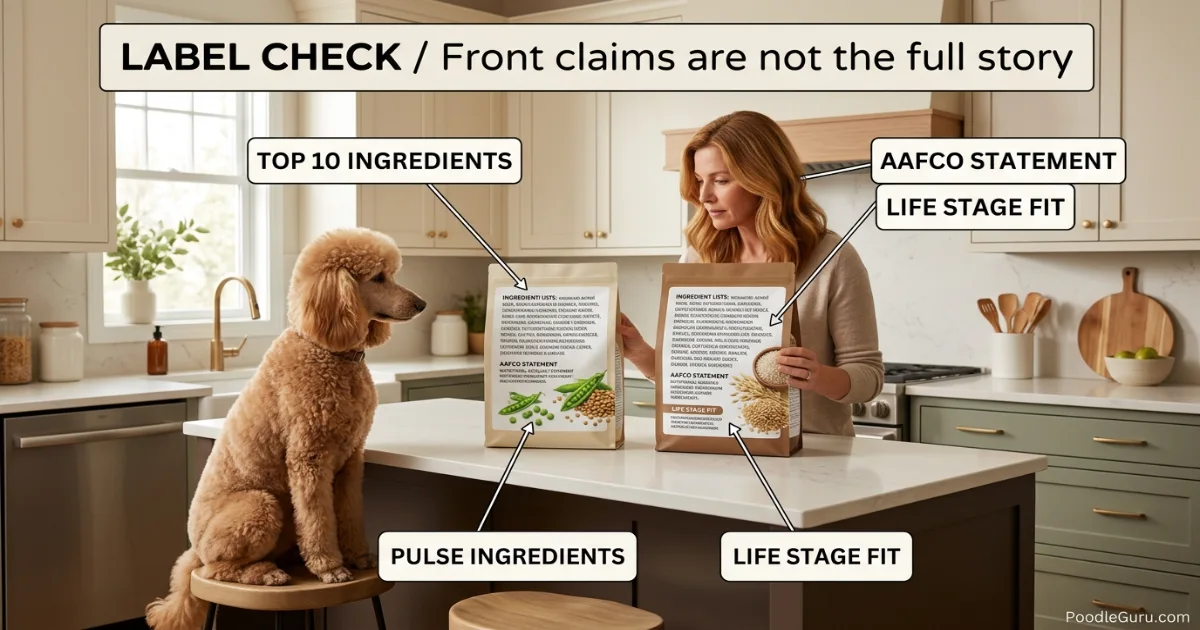
1. Read the top 10 ingredients
Look for peas, lentils, chickpeas, pea protein, pea starch, lentil fiber, potatoes, and sweet potatoes. One ingredient does not mean danger, but several pulse ingredients high on the list deserve a closer look.
2. Check the nutritional adequacy statement
The food should be complete and balanced for your poodle’s life stage. Puppies, adults, seniors, pregnant dogs, and dogs with disease do not all need the same formula.
3. Investigate the manufacturer
Look for companies that employ qualified nutrition experts, maintain strong quality control, can answer formulation questions, and ideally conduct feeding trials rather than relying only on computer nutrient calculations.
4. Bring the label to your veterinarian
Your vet can review diet history, body condition, symptoms, medications, and breed-specific risk. If your poodle has been on a legume-heavy grain-free diet for a long time, your vet may discuss bloodwork, taurine testing, or cardiac evaluation depending on the case.
5. Watch for heart warning signs
Call your veterinarian if your poodle develops unusual tiredness, coughing, fainting, rapid breathing, exercise intolerance, weakness, weight loss, or a sudden drop in enthusiasm for walks. These symptoms can have many causes, but they should not be ignored.
Practical dog food aisle checklist
- Choose complete and balanced food for your poodle’s life stage.
- Be cautious with foods where several pulse ingredients appear high on the label.
- Avoid choosing diet by trend words alone: “ancestral,” “wild,” “holistic,” or “premium” are not safety guarantees.
- Ask whether the brand uses qualified nutritionists, feeding trials, and transparent quality control.
- Do not add taurine, carnitine, or other supplements without your veterinarian’s direction.
How to transition a poodle from grain-free to grain-inclusive food
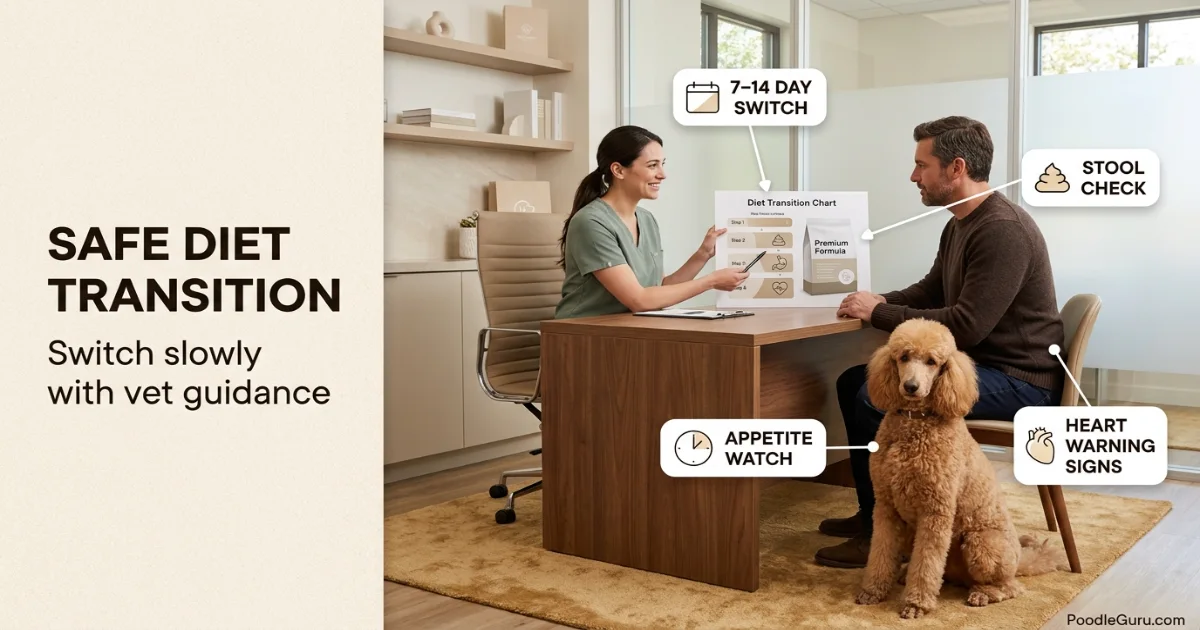
If your veterinarian agrees that switching is appropriate, transition slowly unless there is a medical reason for a faster change. Poodles can have sensitive digestion, so a gradual plan helps prevent loose stool and food refusal.
- Days 1–2: Feed about 75% old food and 25% new food.
- Days 3–4: Move to about 50% old food and 50% new food.
- Days 5–6: Feed about 25% old food and 75% new food.
- Day 7 onward: Move to 100% new food if stools, appetite, and energy look normal.
Some poodles need 10–14 days instead of one week. If your dog has vomiting, repeated diarrhea, blood in stool, lethargy, or refusal to eat, stop guessing and call your veterinarian.
Common myths about grains in poodle food
- Myth: Grains cause most poodle allergies. Many food reactions are linked to proteins such as beef, chicken, dairy, or egg. Grain allergy is possible, but it is not the default explanation for every itchy poodle.
- Myth: Grains are empty fillers. Properly used grains can provide digestible energy, fiber, vitamins, minerals, and texture. The question is formula quality, not whether a food contains one grain.
- Myth: Wolves did not eat grains, so poodles should not either. Domestic dogs are not wolves, and poodles are highly domesticated dogs with modern nutritional needs.
- Myth: Grain-free means higher quality. A grain-free recipe can be excellent, average, or poor. The absence of grain tells you little without looking at the full formulation and manufacturer.
Related reading on PoodleGuru
Sources checked for this 2026 update
This article is educational and should not replace veterinary advice. For accuracy, the main DCM section was aligned with FDA animal health updates, Tufts Petfoodology discussion of diet-associated DCM, WSAVA nutrition selection guidance, and AAFCO/FDA explanations of complete and balanced pet food.
Frequently Asked Questions About Grain-Free Diets for Poodles
Is grain-free food bad for all poodles?
No. Grain-free food is not automatically bad for every poodle. The concern is stronger with certain formulas that rely heavily on peas, lentils, chickpeas, or potatoes, especially when fed long-term without veterinary review.
Should I stop feeding grain-free food immediately?
Do not panic-switch unless your veterinarian tells you to. Abrupt diet changes can upset your poodle’s stomach. Call your vet, share the exact food label, and ask whether a gradual transition or screening is appropriate.
What ingredients are most concerning in grain-free poodle food?
Peas, lentils, chickpeas, pea protein, pea starch, lentil fiber, potatoes, and sweet potatoes deserve attention when they appear high on the ingredient list or appear in multiple split forms.
Can I feed grain-free if my poodle has allergies?
Possibly, but only after a proper elimination diet or veterinary diagnosis. Many food allergies are linked to animal proteins rather than grains, so removing grains may not solve the real issue.
Will taurine supplements make grain-free food safe?
Not reliably. Taurine may be part of the discussion in some cases, but diet-associated DCM is complex and not always explained by low taurine. Supplements should only be used with veterinary direction.
What is the safest daily diet for most poodles?
For many healthy poodles, the safest daily option is a complete and balanced food for the correct life stage from a manufacturer with strong nutrition expertise, quality control, and transparent formulation standards.
What symptoms should make me call a vet?
Call your veterinarian if your poodle has coughing, fainting, weakness, unusual tiredness, fast breathing, exercise intolerance, collapse, or sudden appetite and energy changes.
The bottom line for your poodle’s bowl
A grain-free diet for poodles should be treated as a specific nutrition choice, not a trend. Grain-free is not automatically harmful, and grain-inclusive is not automatically perfect. But in 2026, the safest everyday path for most poodle owners is to choose a complete, balanced, research-backed diet, avoid legume-heavy formulas unless there is a clear medical reason, and involve your veterinarian before making long-term feeding decisions.
Your poodle’s food should support the whole dog: heart, coat, gut, energy, weight, and long-term quality of life. The best label is not the prettiest one. It is the one that can stand up to real nutritional scrutiny.