Can Poodles Live Outside? The Honest Answer
A short coat doesn’t make them yard-proof. Here’s why outdoor living fails poodles in ways most new owners don’t expect — and what a fair alternative actually looks like.
Quick Answer
No, poodles cannot live outside as full-time outdoor dogs. Their single-layer coat provides almost no insulation against cold or wet weather. More importantly, poodles bond so intensely with their people that isolation outdoors routinely triggers anxiety, destructive behaviors, and stress-related health decline. A poodle left to live outside isn’t just uncomfortable — it’s a dog suffering in ways that aren’t always visible.
Quick Facts at a Glance
🧥 Coat Type
Single-layer, hair-like coat. Zero undercoat. Comparable to human hair in insulation value.
🌡️ Cold Tolerance
Poor. Prolonged exposure below 45°F (7°C) is risky, especially when wet. Frostbite risk is real.
🧠 Separation Sensitivity
High. Poodles are companion-bred dogs. Extended isolation causes measurable stress.
🏡 Indoor Preference
Strong. Poodles thrive inside with their families. They’re indoor dogs by breed design.
🕒 Supervised Outdoor Time
Healthy and encouraged — when weather-appropriate, fenced, and with owner nearby.
⚠️ Outdoor Living Verdict
Not appropriate. Full-time outdoor living contradicts core breed needs.
Why Owners Even Ask, “Can Poodles Live Outside?”
This question doesn’t come from neglect. It usually comes from two places: a backyard that feels wasted, or a previous dog who lived happily outdoors. If you grew up with a thick-coated farm dog who preferred the barn to the sofa, a poodle’s needs can feel foreign.
Some new owners also look at a poodle’s athletic build and assume active means outdoor-ready. They picture a Standard Poodle running alongside them on trails and think, “Surely this dog can handle a few hours outside.” A few hours, maybe. A life outside? That’s where the misunderstanding starts.
The honest disconnect sits in the coat. People see fur and assume insulation. But poodles don’t have fur — they have hair. And that single word changes everything about outdoor safety.
The Coat Truth Most People Miss
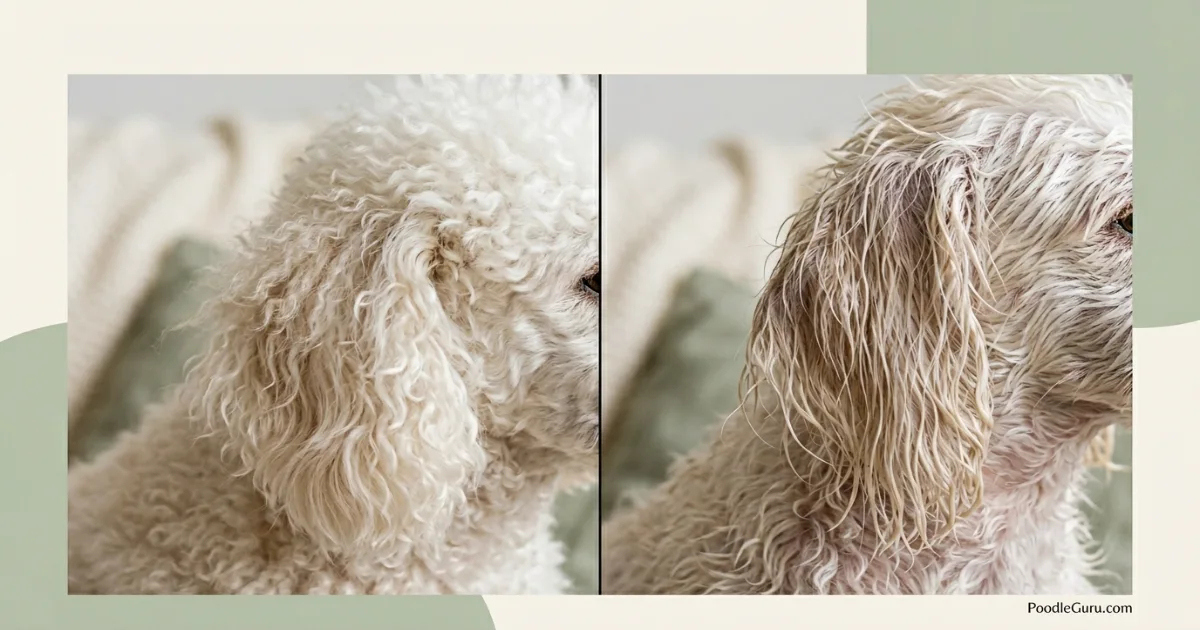
A poodle’s coat is an anomaly in the dog world. Most breeds have a double coat: a soft, dense undercoat for warmth, and a protective outer coat for weather resistance. Poodles have neither. Their coat is a single layer of tightly curled or corded hair that grows continuously — more like human hair than traditional dog fur.
For poodle owners, this means the coat provides almost no thermal barrier against cold, wind, or rain. The most important thing to understand is that when a poodle gets wet, the hair mats down against the skin, and the dog loses body heat rapidly. A soaked poodle in 50°F weather is in more danger than a double-coated breed in 30°F weather.
| Coat Feature | Poodle | Typical Outdoor Breed (e.g., Labrador, Husky) |
|---|---|---|
| Layers | Single-layer hair | Double-layer fur (undercoat + guard coat) |
| Shedding | Minimal (hair traps in coat) | Seasonal heavy shedding |
| Insulation When Dry | Low to moderate | High |
| Insulation When Wet | Very poor — mats flat, loses heat fast | Moderate — outer coat repels some water |
| Weather Protection | Minimal — not evolved for outdoor living | Strong — bred for working outdoors |
| Grooming Need | High — continuous growth requires regular clipping | Moderate — seasonal shedding management |
This isn’t a design flaw. Poodles were never bred to sleep in fields. Their original work as water retrievers involved short, active bursts in water followed by drying off in shelter. The coat works beautifully for that. It doesn’t work for overnight outdoor living. The AKC breed standard for poodles describes the coat texture in detail — notably, there’s no mention of an undercoat anywhere in the standard.
Temperament: Why “Outside” Quickly Means “Isolated”
Even if you could solve the coat problem with a heated, insulated dog house, you’d still face a bigger one. Poodles are companion dogs through and through. They were refined over centuries not just to work alongside humans, but to be with them. A poodle separated from its family for hours on end isn’t just bored — it’s distressed.
Owners often notice the first signs within days of an outdoor-living attempt: barking that won’t stop, digging at fence lines, pacing, loss of appetite. These aren’t training problems. They’re a dog telling you, in the only language it has, that isolation is unbearable.
What Isolation Does to a Poodle’s Behavior
📢 Excessive Vocalization
Poodles left outside often bark, whine, or howl for hours. This isn’t guarding — it’s distress calling.
🕳️ Destructive Escaping
Digging under fences, chewing through barriers. A poodle trying to get back to its people will find a way — or hurt itself trying.
😔 Withdrawal & Shutdown
Some poodles stop trying. They become lethargic, refuse food, and develop stress-related health issues that look like “calm” but are actually depression.
Toy vs Miniature vs Standard: Does Size Change the Answer?
It’s tempting to think a Standard Poodle — taller, heavier, more robust-looking — might handle outdoor living better than a Toy. The logic feels sound: bigger body, more heat retention, tougher constitution. But that logic collapses under scrutiny.
While body mass does affect heat retention slightly, it doesn’t change the fundamental problems. A Standard Poodle still has a single-layer coat. It still bonds fiercely with its family. It’s still vulnerable to cold, wet, and isolation. The size difference shifts the speed of risk, not the existence of it.
| Factor | Toy Poodle (4–6 lbs) | Miniature Poodle (10–15 lbs) | Standard Poodle (40–70 lbs) |
|---|---|---|---|
| Cold Tolerance | Very poor — loses heat rapidly | Poor — slightly more mass, still single coat | Poor to moderate — mass helps briefly, coat still fails when wet |
| Outdoor Risk Level | Extreme — even short exposure risky in cold | High — small size, same coat limits | High — size doesn’t overcome coat and temperament |
| Predator Vulnerability | Very high — hawks, coyotes, large dogs | High — still small enough for many predators | Moderate — size deters some, not all |
| Isolation Distress | Severe | Severe | Severe — size has zero effect on bonding need |
| Suitable for Outdoor Living? | No | No | No |
A Toy Poodle left outside in cold weather faces immediate danger. A Standard left outside faces the same danger, just on a slightly delayed timeline. Neither is acceptable.
Health Risks of Outdoor Living: Beyond the Obvious
Cold and loneliness aren’t the only threats. Outdoor living exposes poodles to a cascade of health risks that indoor dogs rarely face. Some are obvious — hypothermia, heatstroke — but others catch owners by surprise.
The Risk List Owners Don’t Expect
🦟 Parasite Overload
Constant outdoor exposure multiplies flea, tick, and mosquito contact. Poodle coats trap pests close to the skin where they’re harder to spot during grooming.
🩹 Coat Matting & Skin Infection
Outdoor dirt, moisture, and lack of daily brushing turn poodle hair into a matted shell. Mats pull at skin, trap bacteria, and hide wounds. What starts as a tangle becomes a veterinary skin emergency.
🦷 Ingesting Harmful Items
Unsupervised outdoor poodles eat things they shouldn’t: toxic plants, moldy food scraps, rodent poison, dead wildlife. Without someone watching, ingestion happens silently.
According to veterinary guidance, prolonged cold exposure in single-coated breeds can lead to hypothermia faster than owners realize. Wet conditions accelerate this dramatically — a risk that’s easy to underestimate when the dog looks healthy at a glance.
What Safe Outdoor Time Looks Like — And What It Doesn’t
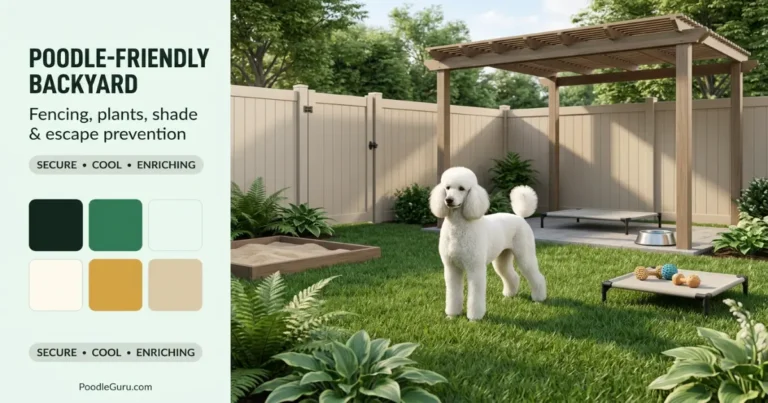
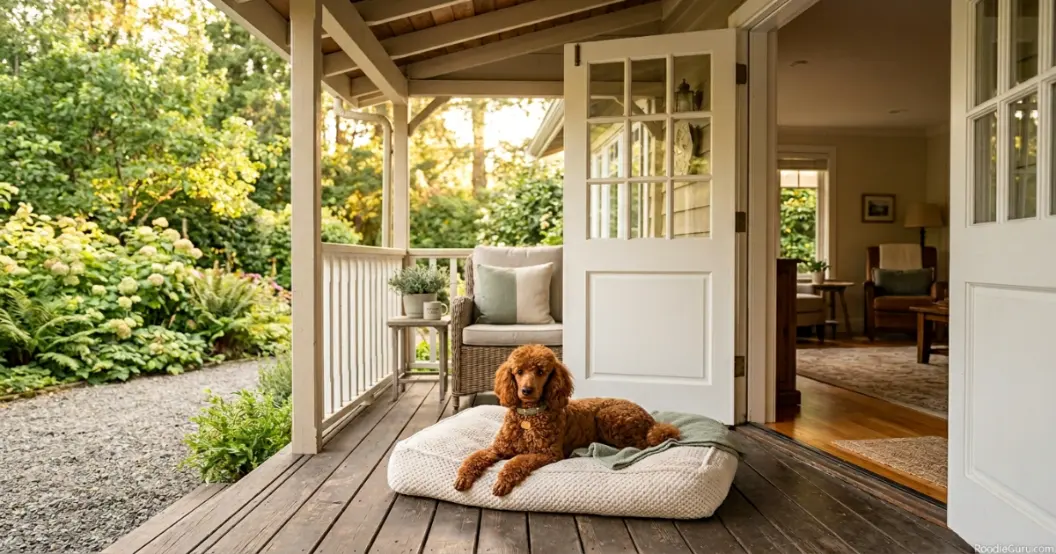
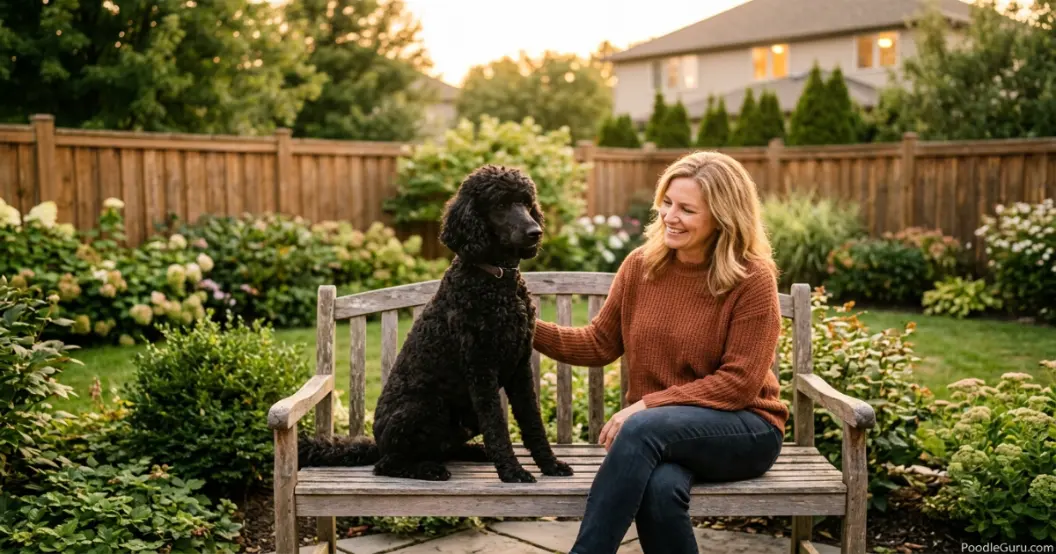
Rejecting outdoor living doesn’t mean rejecting outdoor time. Poodles love fresh air. They’ll sprint across a yard, sniff every corner, and sunbathe on a patio with visible contentment. The distinction is control: the poodle chooses to be outside, can come back inside freely, and isn’t left alone out there for hours.
Safe Outdoor Time Checklist
Weather Check First
If it’s below 45°F or above 85°F, keep outdoor sessions short — 15–20 minutes max — and watch your dog, not the clock. Wet, windy, or humid conditions shorten safe windows further.
Secure Fencing Is Non-Negotiable
A poodle who spots a squirrel or hears a neighbor doesn’t recall like a retriever. Physical barriers protect what training might not. Check fence lines regularly for digging gaps.
Supervision — Actually Present
“I can see the yard from the window” isn’t supervision. Be outside with your poodle, or at minimum check visually every 5–10 minutes. Predators, escapes, and ingestion happen in seconds.
Open Door Policy
Your poodle should always have the ability to come back inside on its own. A dog door, a propped-open screen, or you holding the door — whatever keeps the return path clear.
Post-Outdoor Coat Check
After every outdoor session, run your fingers through your poodle’s coat. Check for burrs, ticks, mats starting, moisture trapped near the skin, and any cuts or scrapes hiding under the hair.
The PoodleGuru Outdoor-Suitability Check
At PoodleGuru, we evaluate whether a dog can handle outdoor living using five criteria that go beyond coat type. Breed suitability isn’t one factor — it’s the intersection of coat, temperament, health vulnerability, bonding drive, and safety profile. Here’s how poodles measure up.
| Criterion | What Outdoor Living Requires | Poodle Reality | Pass? |
|---|---|---|---|
| Weather-Resistant Coat | Insulating undercoat, water-repellent guard hairs | Single-layer hair, zero undercoat, mats flat when wet | ❌ |
| Independent Temperament | Comfortable alone for extended periods | Companion-bonded, highly sensitive to isolation | ❌ |
| Low Health Vulnerability | Resilient to parasites, temperature swings, ingestion risks | Coat traps pests, skin prone to infection under mats, eats foreign objects | ❌ |
| Safety in Unsupervised Settings | Low escape drive, predator-resilient | High prey-chase instinct, vulnerable to predators (especially Toys/Minis) | ❌ |
| Breed History Supports It | Historically bred for outdoor or kennel living | Bred as close-companion water retriever, not an outdoor yard dog | ❌ |
Five criteria. Five failures. This isn’t a matter of opinion or owner preference — it’s a breed reality that no amount of wishful thinking can override. The PoodleGuru outdoor-suitability framework makes the answer unambiguous: poodles are indoor dogs who enjoy supervised outdoor privileges.
What If You Genuinely Have No Indoor Option?
Some owners face housing situations where full-time indoor living isn’t immediately possible — temporary relocations, rental restrictions, family transitions. If you’re in that position with a poodle, the solution isn’t to put the dog outside and hope for the best. It’s to build the safest temporary arrangement possible while working toward a better one.
Temporary Safety Measures (Short-Term Only)
🏠 Climate-Controlled Outbuilding
A properly insulated, heated, and cooled structure — not a plastic dog house. Think finished shed or garage conversion with temperature monitoring.
👥 Rotating Human Presence
If the poodle can’t be inside the main house, someone needs to be with it in the safe structure for significant portions of the day. This isn’t optional — it’s harm reduction.
📅 A Firm Exit Plan
Temporary means temporary. Set a deadline. If the situation can’t be resolved by that date, rehoming to an indoor-capable family is the responsible choice. The poodle’s welfare comes first.
The Better Alternative: Indoor Living With Outdoor Privileges
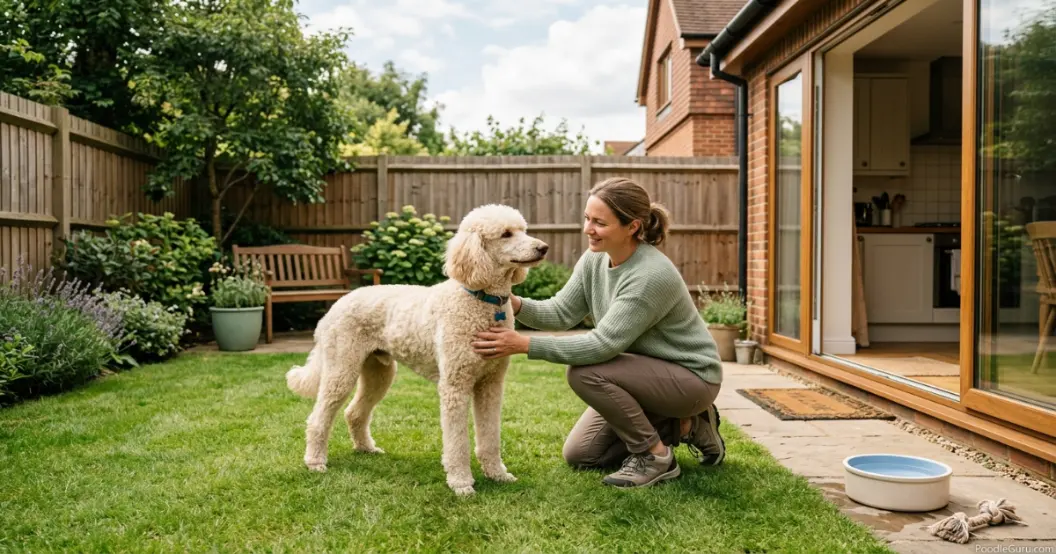
Here’s what a thriving poodle’s relationship with the outdoors actually looks like. Not deprivation — enrichment. The dog gets fresh air, exercise, and sensory stimulation without sacrificing safety or connection.
🌅 Morning Yard Time
20–30 minutes of supervised sniffing, running, and stretching while you have coffee nearby. Weather permitting.
🚶 Daily Walks
Structured walks provide exercise and mental stimulation far beyond what a yard alone offers. Poodles need the world, not just a patch of grass.
🪟 Open-Window Lounging
A screened window or secure porch lets a poodle watch birds, feel breezes, and sunbathe without exposure to danger or isolation.
🏕️ Supervised Adventures
Hikes, beach trips, park visits — all with you present. A poodle will hike for miles happily, then curl up on the couch next to you afterward. That’s the breed contract.
This is the pattern poodles were designed for: active engagement with the world alongside their people, followed by rest near their people. Break that pattern, and you break something essential in the dog.
Frequently Asked Questions
Can a poodle sleep outside in a heated kennel?
Even with heating, a kennel can’t solve the isolation problem. Poodles need proximity to their people, not just temperature control. A heated kennel reduces one risk but leaves the bigger one — social distress — completely unaddressed. Short-term emergency use only, never as a routine sleeping arrangement.
Do poodles need a yard to be happy?
No. A yard is a nice bonus, not a requirement. Poodles thrive in apartments and homes without yards as long as they get daily walks, playtime, and mental stimulation. What they need is engagement with you — not unsupervised access to grass. Many urban poodles live perfectly fulfilled lives without a yard at all.
Can a Standard Poodle handle cold weather better than a Toy?
Slightly, but not enough to change the outdoor-living verdict. A Standard’s larger body mass retains heat a bit longer, but the single-layer coat still fails in wet or prolonged cold. Size delays the onset of risk — it doesn’t eliminate it. Both sizes need indoor living.
What temperature is too cold for a poodle outside?
Below 45°F (7°C), outdoor time should be limited to short, supervised sessions. Below 32°F (0°C), even brief exposure requires a coat or sweater, and any sign of shivering means it’s time to go inside immediately. Wet conditions lower safe thresholds by 10–15 degrees.
Can a poodle be an outside dog in warm climates?
Heat doesn’t solve the isolation problem. A poodle in a warm climate is still a poodle — socially bonded, emotionally vulnerable to separation, and at risk from parasites, predators, and ingestion. Warm weather removes one danger while leaving all the others intact. Indoor living is still the standard.
Will my poodle’s coat grow thicker if it lives outside?
No. A poodle’s coat is genetically determined as a single-layer hair coat. It won’t develop an undercoat in response to cold exposure — it’s not capable of producing one. This is a common misconception that leads to dangerous decisions. The coat you see is the coat you get, regardless of environment.
Are there any poodle mixes that can live outside?
Coat inheritance in poodle mixes is unpredictable. Some doodles inherit a double coat from the non-poodle parent and may have better weather tolerance, but many still have primarily poodle-type coats. More importantly, temperament traits — including bonding intensity — often persist regardless of coat type. Evaluate each individual dog, not the mix label.
Final Summary: The Answer Is Clear
Can poodles live outside? The honest answer hasn’t changed through every section of this guide. A poodle’s coat can’t handle it. A poodle’s mind can’t handle it. A poodle’s health can’t handle it. This isn’t a preference or a luxury — it’s breed reality grounded in coat structure, temperament, and centuries of selective breeding for close human companionship.
Your poodle deserves an indoor home with supervised outdoor privileges. That’s the arrangement the breed was built for, and it’s the arrangement that produces a happy, healthy, behaviorally stable dog.
Key Takeaways
- Poodles have a single-layer hair coat with zero undercoat — they lack the insulation outdoor living requires.
- All three poodle sizes (Toy, Miniature, Standard) fail the outdoor-suitability test for the same core reasons.
- Isolation outdoors triggers distress behaviors in poodles: excessive barking, destructive escaping, and stress-related withdrawal.
- Safe outdoor time means supervised, weather-appropriate sessions with an open door back inside — not full-time yard living.
- A climate-controlled outbuilding with human presence can serve as a short-term bridge, but never as a permanent solution.
- The PoodleGuru Outdoor-Suitability Check confirms: poodles fail all five criteria needed for safe outdoor living.
Best next step: Evaluate your poodle’s current outdoor routine against the Safe Outdoor Time Checklist above. If your dog is spending hours outside unsupervised, today is the day to change that pattern — for their health, their happiness, and their bond with you. For more foundational care guidance, visit our Complete Poodle Grooming Guide.