Poodle Bloat (GDV): A Prevention Guide for Standard Poodles
Quick Answer: Poodle bloat (GDV) — gastric dilatation and volvulus — is a life-threatening emergency where the stomach fills with gas and twists on itself. Standard Poodles are a high-risk breed due to their deep, narrow chests. Prevention rests on three pillars: feeding management (smaller meals, no exercise right after eating), lifestyle adjustments, and prophylactic gastropexy surgery, which tacks the stomach to the body wall to prevent twisting. Recognizing early signs — a distended abdomen, unproductive retching, restlessness — and rushing to a vet within the first hour can save your dog’s life.
Few phrases strike more fear into a Standard Poodle owner than “bloat.” The word itself understates the horror: a healthy dog can be playing fetch at sunset and fighting for its life by midnight. Gastric dilatation-volvulus (GDV) kills swiftly, and Standard Poodles are among the breeds that veterinarians brace themselves to see. But knowledge and a few deliberate, evidence-based prevention steps tilt the odds back in your favor. This guide is written for the owner who refuses to face that midnight panic unprepared.
At PoodleGuru, we believe in clarity without sugarcoating. Poodle bloat (GDV) is not a mystery illness; its mechanisms are well understood, and while we can’t eliminate risk entirely, we can reduce it dramatically. We’ll walk you through the anatomy that makes Standards vulnerable, the feeding and exercise protocols that matter, the pros and cons of preventive surgery, and — critically — how to spot the earliest signs before the clock runs out.

What Exactly Happens During Bloat (GDV)?
GDV occurs in two stages: dilatation and volvulus. First, the stomach fills with gas, fluid, or food and expands painfully — this is dilatation, or “simple bloat.” If caught at this stage, a veterinarian can pass a stomach tube to relieve the pressure, and the crisis may pass. But far too often, the heavy, distended stomach then rotates on its long axis — volvulus. It may twist 180 to 360 degrees, snapping shut the entry and exit points like a twisted balloon. Gas continues to build with no escape, and blood supply to the stomach wall and spleen is choked off. Tissue begins to die within hours. Toxins flood the bloodstream. Heart rhythm destabilizes. Shock sets in. Without emergency surgery, death is almost certain.
That chain of events — from happy dog to irreversible shock — can take as little as two hours. Time is the enemy. Owners who know the signs and live within reasonable driving distance of a 24-hour emergency veterinary hospital give their dogs the best chance of surviving GDV.
🐩 Expert Insight: “I never want my Standard Poodle clients to panic after every meal, but I do want them to be uncomfortable enough with the thought of bloat that they take prevention seriously. One of the hardest calls I make is telling a family their dog died from GDV when prophylactic gastropexy could have prevented the volvulus.” — Dr. Samuel Kline, DVM, DACVS, board-certified veterinary surgeon
Why Are Standard Poodles at Such High Risk?
The single greatest risk factor for GDV is a deep, narrow thoracic cavity — the hallmark of the Standard Poodle’s conformation. The ratio of chest depth to width is a powerful predictor. In large, deep-chested breeds, the stomach is suspended in the abdomen like a pendulum, and when it is full and heavy, a sudden movement or gas accumulation can set it swinging into a twist. Add to this the Poodle’s thick, heavy stomach ligament (the gastrohepatic ligament) and possible genetic predisposition, and you have the perfect storm.
Recent studies also point to temperament: anxious, easily stressed dogs appear to have higher GDV rates. Poodles, for all their confidence, can be sensitive souls who internalize stress. Excitable, fast eaters are also at increased risk. These behavioral factors give us actionable prevention points beyond pure anatomy.

Prevention Strategy 1: Feeding and Watering Protocols
Decades of research point to several feeding practices that alter the mechanical environment in the stomach and reduce GDV risk. None are a guarantee, but together they form a strong defense.
- Feed two to three smaller meals daily, rather than one large one. A distended stomach from a single massive meal is a far higher torsion risk.
- Use a slow-feeder bowl or puzzle feeder. Bolting food adds air and stress; slowing ingestion decreases gas accumulation.
- Avoid raised food bowls. This is counterintuitive — raised feeders were long recommended based on a theory that floor-level eating increased air gulping. Large epidemiological studies have since found that elevated feeders actually increase GDV risk in large-breed dogs. Floor-level feeding is safer.
- Advocate for a calm feeding environment. Feed your Poodle in a quiet place, away from other pets and excitement.
- Restrict vigorous exercise for at least 60–90 minutes after meals. A brisk run or intense game of chase with a full stomach is a known trigger.
- Do not restrict water before or after meals. This is a pernicious myth. Water does not cause bloat. Restricting it can lead to dehydration and electrolyte issues. Always provide fresh water, even around mealtimes.
Prevention Strategy 2: Prophylactic Gastropexy — Tacking the Stomach
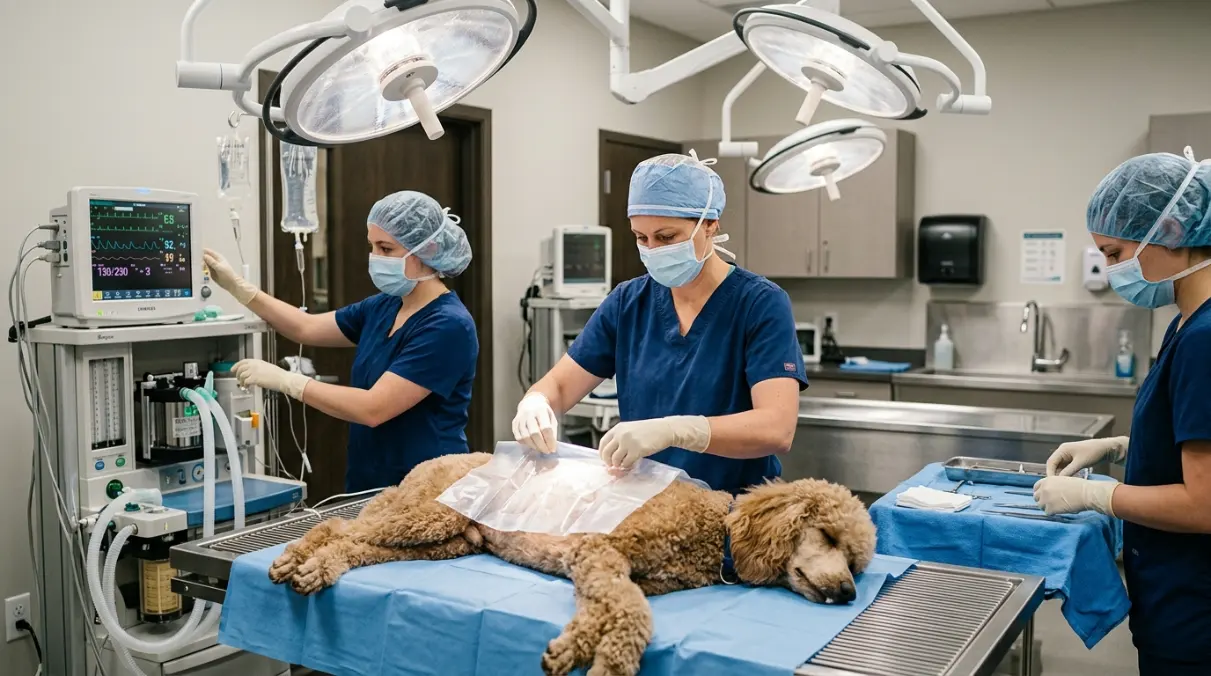
A prophylactic gastropexy is a surgical procedure in which the veterinarian sutures the outer wall of the stomach to the inside of the body wall. The stomach can still expand and contract normally, but it cannot twist. This does not prevent the “bloat” (dilatation) part of GDV, but it prevents the volvulus — and volvulus is what makes GDV fatal. A pexied dog might bloat, but it will not twist, which means the stomach can still be decompressed without emergency surgery.
Many Standard Poodle owners choose to have a gastropexy performed at the same time as spay or neuter, typically around 18–24 months for a Standard. Some breeders recommend it even earlier. The procedure can be done laparoscopically (minimally invasive) or via traditional open surgery, often adding little recovery time to the spay/neuter. For dogs who are already spayed or neutered, it can be done as a standalone laparoscopic procedure.
💰 Cost of Prophylactic Gastropexy (2026, U.S.)
Laparoscopic gastropexy alone: $800–$1,500 depending on location and hospital.
Combined with spay/neuter: Often an additional $300–$600 on top of the spay/neuter fee.
Cost of emergency GDV surgery without pexy: $3,500–$7,500, if the dog survives to surgery. The preventive procedure pays for itself many times over — emotionally and financially.
Lifestyle Modifications That Also Reduce Risk
Beyond feeding, several everyday habits make a meaningful difference:
- Avoid strenuous exercise one hour before and two hours after meals. Some owners feed their Standard after the morning walk, then provide a long, calm rest period before any strenuous play.
- Keep stress levels low around mealtimes. If your household is chaotic, feed your Poodle in a separate room.
- Do not bulk up a Poodle with overly rich, fatty foods that slow gastric emptying. Keep treats small and diet consistent.
- Know your dog’s “normal.” Some Standards are naturally gassier after certain foods. A food that causes visible bloat-like distension should be eliminated, even if not a true GDV episode.
- Maintain a healthy weight. Obesity has not been proven as a GDV risk factor, but lean, fit dogs undergo less abdominal stress.

Recognizing Acute Bloat: Signs That Can’t Wait
Early recognition saves lives. If your Standard Poodle exhibits any two of these signs, do not wait for a diagnosis at home — go directly to a veterinary emergency facility:
- Distended, firm abdomen — it may look visibly swollen and sound hollow when tapped.
- Unproductive retching or gagging — the dog looks like it needs to vomit but brings up only white foam or nothing at all.
- Restlessness, inability to get comfortable, pacing.
- Excessive drooling.
- Rapid breathing or panting.
- Pale gums and collapse — this is advanced shock; minutes matter.
Many owners mistake early GDV for an upset stomach and wait too long. The telltale difference: a dog with simple gastroenteritis usually vomits and then feels better. A dog with GDV tries to vomit and cannot, because the stomach is twisted shut.
What to Do If You Suspect GDV
- Call ahead. Let the emergency vet know you are coming with a suspected GDV case so they can prepare the surgical team.
- Transport calmly. Stress only worsens the situation. Have someone else drive so you can focus on your dog.
- Do not attempt home remedies. Do not give water, Gas-X, or attempt to tube the stomach yourself. You risk aspiration or perforation.
At the hospital, the vet will assess shock, attempt to decompress the stomach with a tube, stabilize the dog with IV fluids and medications, and then move to surgery to untwist the stomach, assess tissue viability, and perform a gastropexy if the dog survives.

What Buyers and Owners Often Get Wrong About Poodle Bloat
“My breeder said her dogs never bloat, so mine won’t.” GDV can strike any deep-chested dog, regardless of lineage. A breeder who dismisses the risk entirely is not giving you the full picture. Responsible breeders discuss prevention openly.
“I can just watch for symptoms and rush to the vet in time.” Yes, survival depends on speed. But even with the best care, some dogs are too advanced by the time symptoms are obvious. Proactive prevention is far wiser than a reactive sprint.
“Gastropexy is an unnecessary surgery.” It is a preventive elective procedure, but one that can prevent the volvulus component of GDV. If you are already spaying or neutering, the additional cost and recovery are modest. For a healthy young dog, the risk-benefit analysis strongly favors pexy.
“Wet food is safer than kibble.” There is no consistent evidence that one food form causes or prevents bloat. The mechanics of gas accumulation and stomach torsion are more about speed of eating, exercise timing, and anatomy.
🧬 Anatomy Meets Genetics: The exact genes that produce the deep chest also increase GDV risk. No commercial DNA test can screen for “bloat genes.” The best we have are conformation and pedigree awareness. Breeders committed to reducing the incidence of GDV may select for slightly broader chests while maintaining breed type, but it’s a slow process.
Day-to-Day Prevention: A Practical Owner’s Checklist
🐩 Daily Bloat Prevention Routine
- Morning meal: Half of daily allowance in a slow-feeder bowl, calm environment. Water available.
- No intense activity for 90 minutes after. A gentle leash walk is fine; free running is not.
- Afternoon or evening meal: Second half, same protocol.
- Late-night snack? Avoid heavy snacks right before bed. A small biscuit is okay.
- Know the nearest 24-hour emergency vet. Have the address and phone number saved in your phone.
- Consider monthly weigh-ins and body condition checks. Maintaining lean body mass reduces overall physiologic stress.
Frequently Asked Questions
What is the survival rate for GDV in Standard Poodles?
With prompt surgical intervention, survival rates range from 70% to 85%. The key variables are time from symptom onset to decompression, the degree of stomach wall necrosis, and whether the spleen was also damaged. Every hour that passes without treatment reduces the odds.
Can Toy or Miniature Poodles get bloat?
Yes, but it is far less common. Their chest conformation is not as deep or narrow. However, any dog can experience gastric dilatation. True volvulus is rare in small dogs, but when it occurs, it is equally deadly.
Does grain-free diet cause bloat in Standard Poodles?
There is no direct causal evidence linking grain-free diets to GDV. The major dietary factors appear to be meal size, speed of eating, and fat content. However, some grain-free formulations use legumes and pulses that may increase intestinal gas in sensitive dogs — which could theoretically contribute to dilatation, though research is inconclusive.
At what age should I consider a prophylactic gastropexy?
Most surgeons recommend performing the procedure at the time of spay or neuter, typically 18–24 months for Standard Poodles, when the dog is skeletally mature. It can also be done earlier if the dog is being anesthetized for another reason, but the timing should be discussed with your vet.
Can a dog bloat even after a gastropexy?
A dog with a gastropexy can still experience gastric dilatation (the stomach filling with gas), but it cannot twist. This means a pexied dog who bloats will need urgent decompression but can often avoid the life-threatening volvulus and its cascade of tissue death. This alone justifies the procedure.
Is there a test to predict which Poodles will bloat?
No predictive test exists. Chest conformation can be assessed via physical exam and radiographs, but it does not provide a definitive risk score. Vigilance and preventive measures are the best tools for every owner of a deep-chested breed.
What should I feed my Standard Poodle to lower bloat risk?
Choose a high-quality, easily digestible diet split into multiple smaller meals. Some owners add a small amount of canned food to the kibble to slow ingestion. Avoid excessively fatty meals, and never exercise within 90 minutes of eating. The specific brand matters less than these feeding mechanics.
📋 Summary: Poodle bloat (GDV) is a crisis you plan for, not one you merely react to. For Standard Poodle owners, the blueprint is simple and backed by years of clinical data: two to three small meals daily, floor-level slow-feed bowls, enforced quiet after eating, and serious consideration of a prophylactic gastropexy. Learn the early signs — especially the tight belly and the unproductive retch — and have your emergency plan rehearsed. Lives are saved not by luck, but by preparation. A Standard Poodle is a gift; protecting them from GDV is part of that stewardship.