Poodle-Friendly Backyard: Fencing, Plants, Shade & Escape Prevention
A safe backyard is not created by fence height alone. It combines secure boundaries, protected gates, safe landscaping, temperature control, supervised outdoor time and enough enrichment to prevent a clever Poodle from turning escape into a personal project.
Quick Answer
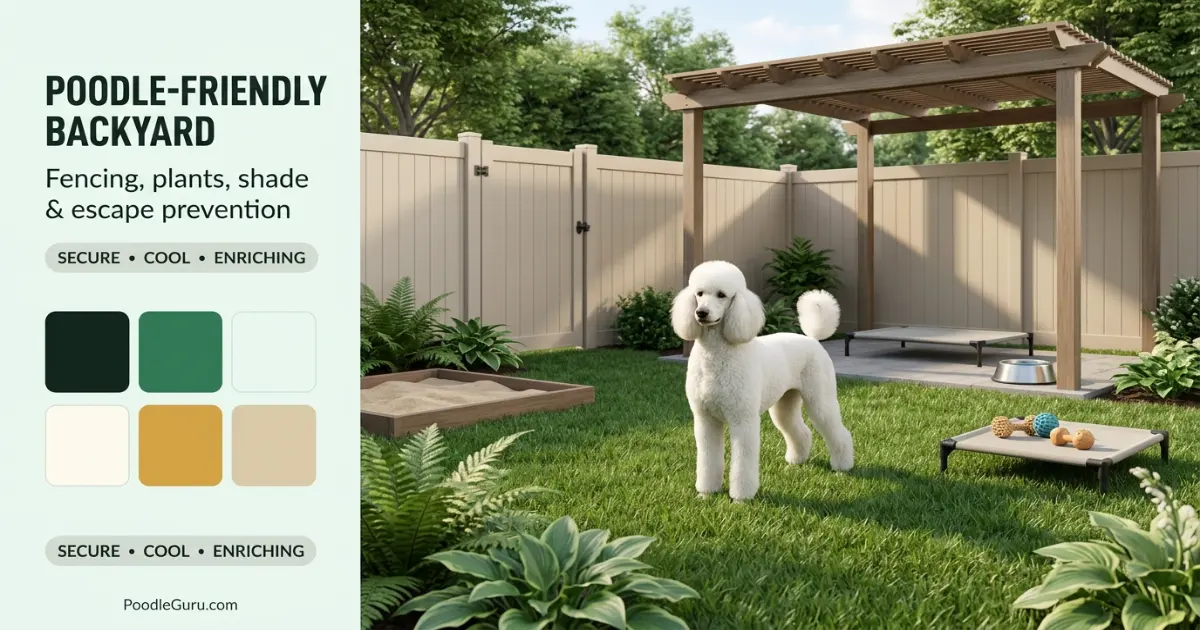
A Poodle-friendly backyard needs a physical fence selected for the individual dog’s jumping, climbing, digging and squeezing behavior—not a universal breed-size rule. Athletic or known escape-prone Poodles often benefit from a smooth 5–6-foot barrier, while smaller calm dogs may be safely contained by a shorter fence only when gaps, gates and ground-level escape routes are fully controlled. Add a secure self-closing gate, a professionally planned dig barrier where needed, verified non-toxic landscaping, shade, cool fresh water, safe footing and rotating enrichment. A fenced yard is not a substitute for supervision, walks, training or companionship.
Height, material and underground protection should match the individual dog’s real escape pattern.
Audit plants, mulch, compost, fertilizers, tools, standing water and hot surfaces.
Smart dogs still need human interaction, exercise, training and activities beyond the yard.
What a Poodle-Friendly Backyard Really Means
A dog-safe yard is a managed outdoor environment, not a place where a dog can be left indefinitely. Poodles are social, observant and highly trainable. Many will quickly notice a loose board, a gate that fails to latch, a gap created by erosion or a piece of furniture placed close enough to become a launch platform.
A useful yard supports several needs at once. It gives the dog secure space to toilet, sniff, play and rest. It limits access to toxic plants, garden chemicals, sharp tools and standing water. It provides shade that moves with the sun, water that stays clean, and footing that does not become dangerously hot or slippery. It also remains interesting enough to complement—but never replace—walks, training and shared activity.
Size matters, but behavior matters more. A Toy Poodle may squeeze through a narrow gate gap that a Standard cannot use. A Standard with strong jumping history may require a taller, smoother barrier than a quiet dog of the same breed variety. Start by understanding your own dog’s measurements and activity needs through the Poodle size chart and the Poodle exercise guide.
Assess Your Poodle’s Escape Risk Before Buying a Fence
Do not choose fencing from weight alone. Watch how your Poodle behaves around existing barriers and identify the likely escape route.
Jumper
Runs toward the fence, bounces vertically, clears baby gates or uses nearby objects to gain height. Prioritize barrier height, inward extensions where legal and a clear perimeter.
Climber
Uses chain link, horizontal rails, lattice or stacked materials as footholds. Prioritize a smooth inner face without climbable structure.
Digger
Targets corners, gates, soft soil or wildlife scent trails. Prioritize training, supervised redirection and a safely installed ground barrier.
Squeezer
Pushes through loose panels, gate hinges or gaps beneath fencing. Prioritize accurate gap measurement and a rigid, well-maintained lower edge.
Door-Dasher
Escapes when someone enters or exits. Prioritize self-closing hardware, high secure latches and a double-gate or entry airlock.
Trigger-Driven Runner
Chases wildlife, bikes, delivery workers or neighboring dogs. Prioritize visual screening, recall training and supervised yard access.
Record the trigger and location each time the dog tests the boundary. Repeated behavior deserves a qualified reward-based trainer or veterinary behavior consultation, particularly when anxiety, fear or separation distress is involved.
Choosing Fencing That Can Contain Your Poodle
No official Poodle standard dictates a universal backyard fence height. AKC yard-safety guidance recommends choosing a high fence with bottom barriers when a dog jumps or digs. For an athletic or previously escaping Poodle, many households choose a smooth 5–6-foot physical fence, subject to local rules. A shorter barrier may work for an individual small dog, but it should not be presented as automatically safe because of breed variety.
| Fence Type | Strengths | Main Risks | Best Safety Upgrade |
|---|---|---|---|
| Solid wood privacy | Blocks visual triggers and provides a mostly smooth inner face. | Loose boards, rot, splinters, ground gaps and horizontal support rails. | Inspect regularly, place rails outside where possible and seal every lower gap. |
| Vinyl or composite | Smooth, low-climb surface with fewer visual distractions. | Cracked panels, wind damage, warped sections and gaps at transitions. | Use reinforced posts and repair damaged panels immediately. |
| Chain link | Durable, visible and often lower cost. | Provides footholds for climbers and allows fence-running at visible triggers. | Add secure privacy screening and a professionally designed anti-climb top where legal. |
| Welded wire or livestock-style mesh | Useful for reinforcement and some rural settings. | Openings may be too large; cut edges, weak fastening or sagging can injure or permit escape. | Select appropriate aperture size, tension it correctly and cover every sharp edge. |
| Decorative metal | Strong, durable and visually attractive. | Wide picket spacing and spear-style tops can create entrapment or injury risk. | Measure gaps against the dog’s head and body; choose safe flat-top designs. |
Whatever material you choose, the completed fence should have no sharp wire, protruding fasteners, splintered wood or entrapment spaces. Check whether roots, slopes, retaining walls, sheds or neighboring structures reduce the effective height.
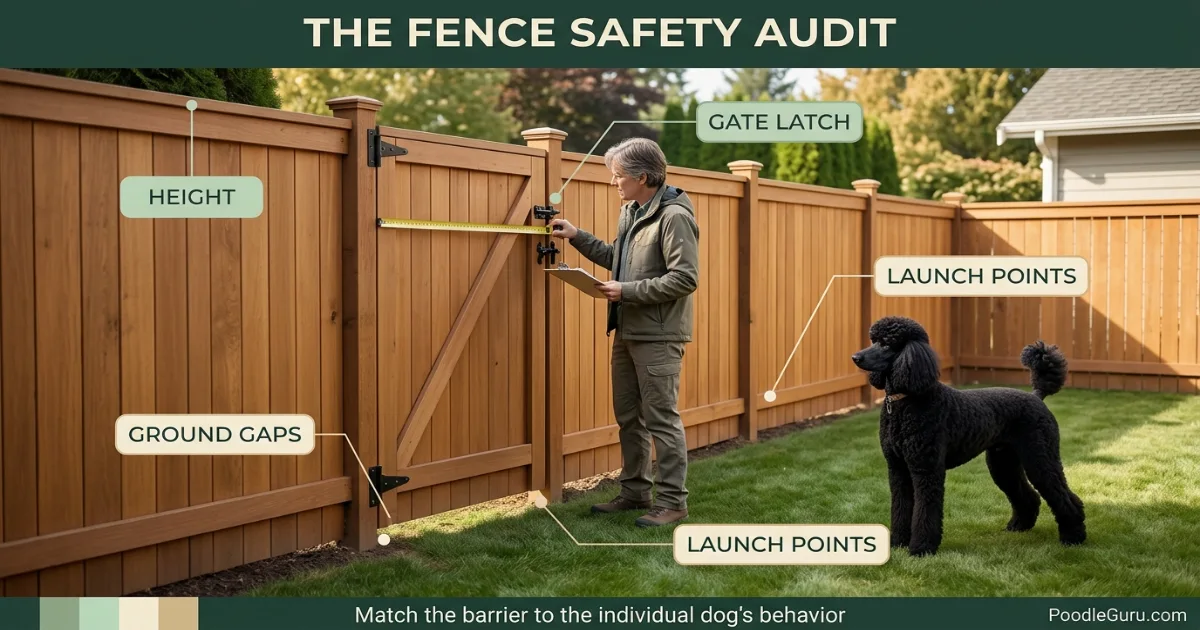
Gates, Gaps and Backyard Launch Points
The gate is often more vulnerable than the fence. Use self-closing hinges and a latch positioned where the dog cannot nose or paw it open. A carabiner or secondary lock can provide added security, but the gate must remain easy for adults to operate during an emergency.
Consider a double-gate or short entry pen when children, contractors, gardeners or delivery workers frequently enter the yard. This creates an airlock so one barrier remains closed while the other opens.
- Check the gap below the gate after rain, erosion, frost movement or landscaping work.
- Inspect hinge-side openings where a narrow Toy or Miniature might squeeze through.
- Move benches, bins, firewood, planters, play equipment and compost containers away from the fence.
- Trim climbable branches and prevent access from decks or retaining walls.
- Secure meter boxes and utility access without blocking required technician entry.
- Post a visible reminder so visitors close and relock the gate.
Do not use a tennis ball as a universal gap test. Dog head shape and body compression vary. Measure the actual dog’s head, chest and shoulders and choose a safety margin that prevents both escape and entrapment.
Digging Prevention and Underground Barriers
Digging may come from wildlife scent, boredom, temperature seeking, anxiety or a learned habit. Start by identifying the reason and redirecting the dog to an approved digging area. The Poodle digging guide explains how to separate natural digging from distress-driven escape behavior.
AKC recommends an L-footer as one option for dogs that dig under fences. A properly installed footer turns inward or outward along the ground so the dog meets a barrier while tunneling. The exact material, depth and direction should suit the soil, fence, drainage, frost line, utilities and local code.
Avoid loosely buried chicken wire with exposed cut edges. Use durable welded wire or hardware cloth selected and installed by someone who can secure every edge and prevent corrosion, entanglement and paw injury. Concrete curbs may work in some locations but can affect drainage and require permits.
Before any excavation, contact 811 in the United States and wait for utility marking. Check irrigation, low-voltage lighting, drainage and private lines that public locating services may not mark.
Why an Invisible Fence Is Not a Complete Safety System
Electronic boundary systems do not create a physical barrier. A highly motivated dog can cross the boundary, and the correction may discourage the dog from returning. The system also cannot keep roaming dogs, wildlife or people out of the yard.
For those reasons, a physical fence is generally the more reliable containment choice. When a physical fence is not possible, use a secure roofed exercise pen, a professionally designed dog run, supervised long-line activity or another setup that prevents escape without leaving the dog unattended.
Toxic Plants, Mulch and Garden Hazards
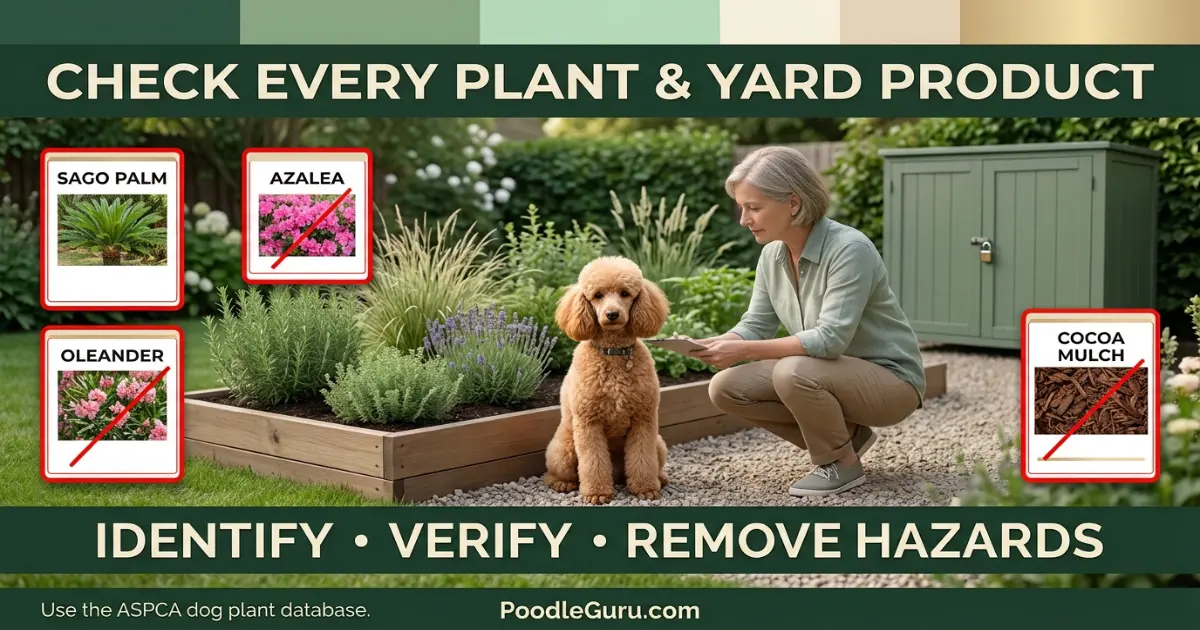
Plant toxicity cannot be judged by whether wildlife eats a plant or whether it is described as “natural.” Use the ASPCA dog plant database to identify every plant by scientific name before allowing access. Common toxic garden examples include sago palms, azaleas and rhododendrons, oleander, yew, autumn crocus, foxglove and castor bean.
| Hazard | Why It Matters | Safer Action |
|---|---|---|
| Sago palm | All parts are toxic, with seeds especially dangerous; exposure can cause severe gastrointestinal and liver injury. | Remove completely from areas accessible to pets and dispose of safely. |
| Azalea / rhododendron | Ingestion can cause drooling, vomiting, weakness and cardiovascular effects. | Replace with a plant verified as non-toxic in the ASPCA database. |
| Oleander and yew | These contain compounds that can affect the heart and may cause severe or sudden illness. | Do not rely on pruning or barriers; remove from pet-accessible spaces. |
| Cocoa-bean mulch | Its chocolate-like smell can attract dogs, and ingestion may cause gastrointestinal, cardiac or neurologic signs. | Choose a non-cocoa mulch and prevent chewing or swallowing of any ground cover. |
| Fertilizer, compost and pesticides | Products may irritate, obstruct, poison or cause severe gastrointestinal disease—even when marketed as organic. | Store behind a locked door, follow re-entry instructions and keep labels available. |
| Mushrooms and algae | Wild mushrooms are difficult to identify and some algae toxins can cause rapid, life-threatening illness. | Remove mushrooms promptly, prevent access to stagnant water and avoid unknown blooms. |
Shade, Fresh Water and Surface Temperature
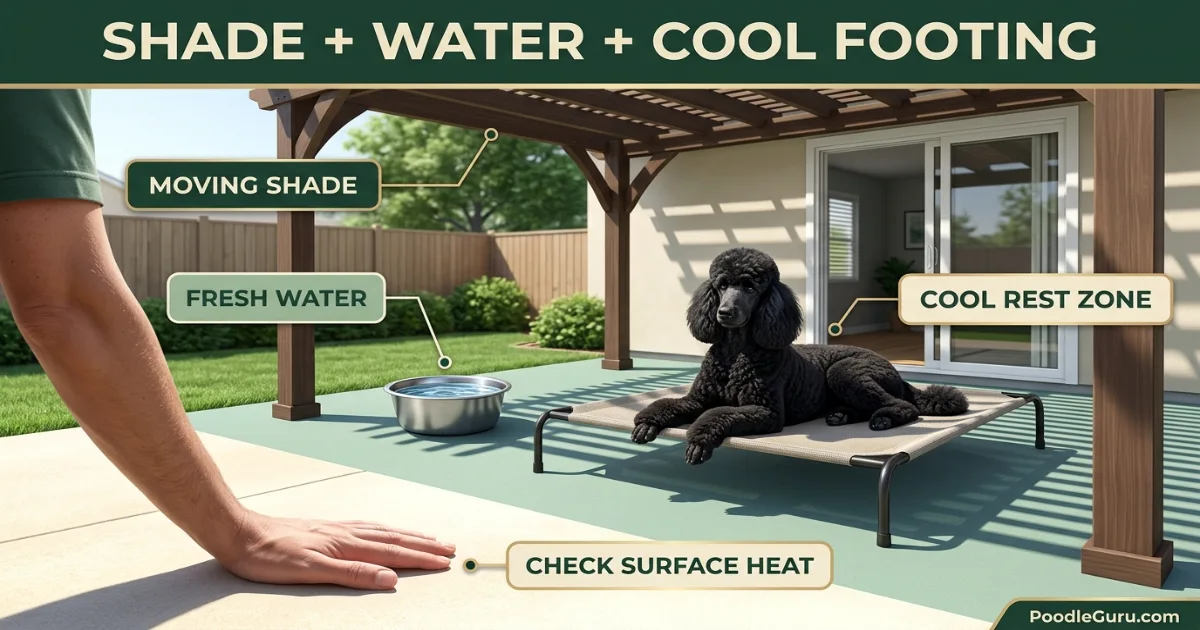
Every outdoor setup needs shade that remains available as the sun moves. A tree may shade the yard in the morning and leave it fully exposed by afternoon. Check the space at several times of day and create a second covered rest zone when needed.
AVMA warm-weather guidance recommends avoiding hot surfaces such as asphalt that can burn paws. Artificial turf, concrete, stone, decks and dark rubber surfaces can also become very hot. Test surfaces frequently, provide cooler routes and move the dog indoors before discomfort develops.
Provide clean water in a heavy bowl placed in shade. Refresh it often, especially after play or when debris, insects or algae appear. A fountain is useful only when it is cleaned and backed up by a normal bowl in case power or the pump fails.
Poodles should not be left outdoors during extreme heat, storms, wildfire smoke or dangerous cold. Signs such as heavy panting, excessive drooling, weakness, confusion, vomiting or collapse require immediate cooling and veterinary help.
Ground Cover, Drainage and Paw Safety
No ground material is perfect for every climate or dog. Choose from drainage, heat, maintenance, chemical use and whether your Poodle eats non-food items.
- Natural grass: Comfortable when healthy, but avoid unsafe herbicides, sharp seed heads and muddy drainage zones.
- Clover or mixed lawn: Can be soft and resilient, but confirm the exact plant mix and local treatment plan.
- Artificial turf: Easy to clean but may become extremely hot and requires drainage and odor control.
- Pea gravel: Useful in controlled paths or toilet zones for dogs that do not swallow stones; supervise closely.
- Wood mulch: Avoid cocoa mulch, splintering pieces and material treated with unknown chemicals.
- Concrete or pavers: Durable but can heat rapidly and become slick when wet.
Repair standing water, sharp edging, exposed irrigation parts, holes and unstable stepping stones. After storms, check for fallen branches, mushrooms, displaced chemicals, broken fence panels and wildlife debris.
Enrichment Makes the Yard Safer—but Does Not Replace Exercise
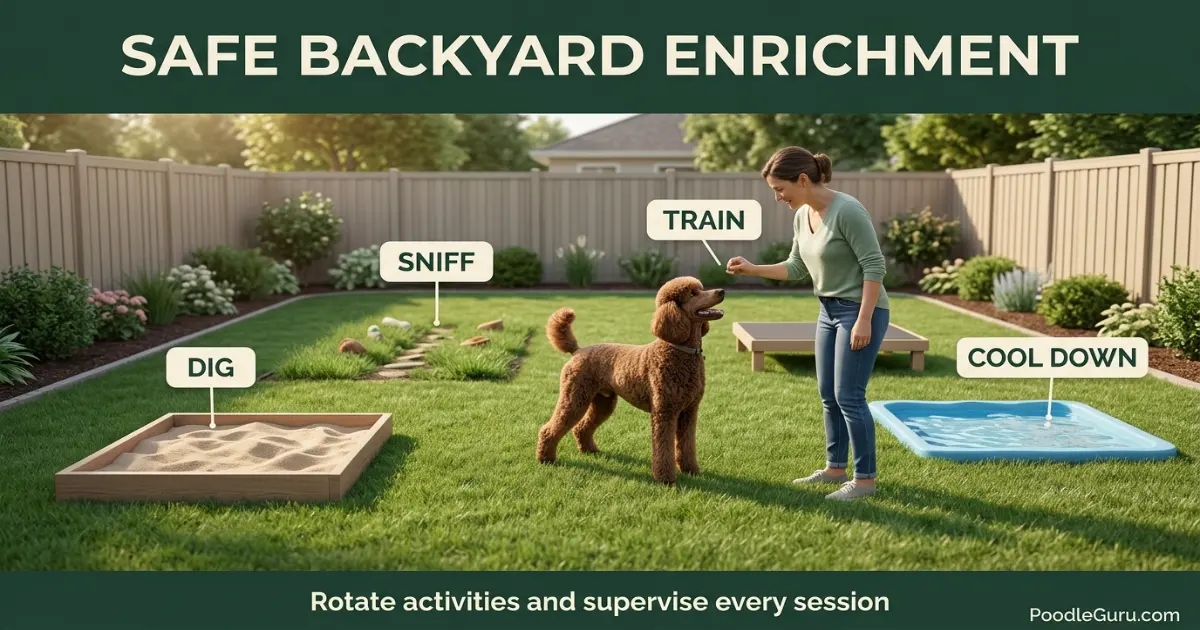
A bored Poodle may dig, bark, patrol the fence or invent escape games. Enrichment reduces boredom when it is rotated, supervised and suited to the dog’s health. It should supplement daily walks, sniffing opportunities, training and time with people.
Approved Dig Box
Use play sand or clean soil in a defined box. Hide safe toys shallowly and reward digging there instead of punishing natural behavior.
Scent Search
Scatter part of the measured meal in clean grass or create a short scent trail. Confirm the yard is free of chemicals and wildlife waste first.
Low Observation Platform
Use a stable, non-slip platform well away from the fence. Keep it low enough for the dog’s age and joints.
Water Play
A shallow splash mat may suit water-loving Poodles. Drain it after use and supervise every session.
Training Stations
Practice recall, touch, settle and “leave it” in short sessions. These skills improve yard safety more than toys alone.
Weekly Rotation
Store outdoor toys between sessions and rotate them. Remove damaged ropes, cracked balls and anything small enough to swallow.
Keep climbing platforms, agility equipment and storage boxes far from the perimeter. Puppies, seniors and dogs with orthopedic problems need lower-impact activities.
The PoodleGuru Seasonal Backyard Safety Audit
Run this audit at least every season, after severe weather and whenever contractors, landscapers or utility workers enter the yard.
Walk the Perimeter
Push gently on posts and panels. Check rot, rust, cracks, loose fasteners, erosion, animal burrows and gaps beneath gates.
Test Every Gate
Confirm self-closing action, latch engagement and secondary security. Remove soil or plants that prevent full closure.
Audit Plants and Products
Identify new plants and mushrooms, lock chemicals, inspect mulch and remove compost or fallen fruit that attracts eating.
Check Climate Comfort
Observe shade at different hours, clean water containers, test surfaces and inspect drainage after rain.
Review Enrichment Placement
Move platforms and furniture away from the fence, discard damaged toys and update activities for age, health and weather.
Practice Emergency Skills
Refresh recall, gate waiting, leave-it and calm re-entry. Confirm identification and microchip contact details remain current.
2026 Fence and Backyard Upgrade Costs
Fence cost depends on linear footage, height, material, labor, terrain, demolition, gates, permits and local wages. A flat total such as “$500–$3,000 for a safe yard” is misleading for many properties.
Current 2026 consumer estimates place general fence installation around $6–$50 per linear foot, with an average near $23 per linear foot. Dog-fence projects are often estimated around $15–$45 per linear foot, while wood privacy fencing may reach roughly $33–$53 per linear foot depending on conditions. Treat these as national planning benchmarks, not quotes.
Budget in Separate Layers
- Professional fence or run: Measure total linear feet and obtain at least three itemized local quotes.
- Gate hardware: Include self-closing hinges, secure latches, secondary locks and a double-gate where needed.
- Dig protection: Add utility locating, excavation, corrosion-resistant materials, labor and drainage repair.
- Comfort: Budget for permanent shade, a raised cot, water containers and safe surface improvements.
- Landscaping removal: Toxic shrubs, stumps, sharp edging and unsafe mulch may require professional disposal.
- Maintenance reserve: Set aside money for damaged panels, storm repairs, staining, hinge replacement and erosion.
Permits and HOA requirements can change both design and cost. Do not purchase materials until the approved height, setback, easement and appearance rules are confirmed.
Common Mistakes That Create False Security
| Mistake | Why It Fails | Safer Correction |
|---|---|---|
| Choosing fence height only from Poodle size | Dogs of the same variety differ in athleticism, fear, prey drive and learned escape behavior. | Choose from observed behavior, yard layout and professional assessment. |
| Relying on an electronic boundary | It does not physically contain the dog or exclude outside threats. | Use a physical fence, secure run or supervised long-line alternative. |
| Using exposed chicken wire | Sharp, loose or corroded edges can injure paws and entangle the dog. | Use correctly installed, durable materials with every edge covered. |
| Assuming “pet-safe” means harmless | Organic fertilizer, mulch, compost and pest products can still cause illness. | Read labels, follow re-entry times and lock all products away. |
| Leaving a Poodle outside for hours | Social isolation, weather, boredom and wildlife increase risk. | Use short supervised sessions and bring the dog indoors. |
| Placing enrichment beside the fence | Platforms, furniture and storage can become launch points. | Keep activity zones in the center of the yard with a clear perimeter. |
Frequently Asked Questions
How high should a fence be for a Standard Poodle?
There is no universal breed rule. For an athletic, climbing or previously escaping Standard, many owners choose a smooth 5–6-foot physical fence, subject to local codes. The safest height depends on the individual dog’s behavior, nearby launch points, terrain and fence design.
Is a 4-foot fence enough for a Toy or Miniature Poodle?
It may contain some calm small Poodles, but size alone does not guarantee safety. Check jumping history, climbable surfaces, gate gaps, ground erosion and outside triggers. A taller barrier may be needed for an athletic or escape-prone dog.
How do I stop a Poodle digging under the fence?
Identify the cause, supervise outside access, redirect digging to an approved box and repair the targeted area. An L-footer or professionally installed ground barrier may be appropriate, but utility location, drainage, sharp-edge control and local rules must be considered.
Can an invisible fence safely replace a physical fence?
An electronic boundary does not physically prevent escape and cannot keep other dogs, wildlife or people out. A physical fence, secure run or supervised long-line setup generally provides more reliable containment.
Can I leave my Poodle outside all day in a fenced yard?
No yard is risk-free, and Poodles need social contact, exercise and changing weather protection. Use supervised outdoor sessions and bring the dog indoors rather than treating the yard as long-term housing.
Which backyard plants are dangerous to dogs?
Examples include sago palm, azalea, rhododendron, oleander, yew, foxglove and castor bean. Plant names and varieties can be confusing, so verify every plant through the ASPCA dog plant database or a veterinary poison resource.
What should I do if my Poodle eats a toxic plant?
Contact your veterinarian, an emergency clinic or the ASPCA Animal Poison Control Center at (888) 426-4435 immediately. Photograph the plant when safe and do not induce vomiting unless a veterinary professional instructs you.
Is artificial turf safe for Poodles?
Artificial turf can work when it drains well and is cleaned appropriately, but it may become dangerously hot in direct sun. Test the surface, provide shaded alternatives and prevent access when temperatures rise.
How much does a Poodle-safe fence cost in 2026?
Current national estimates vary widely by material and location. General installation may run about $6–$50 per linear foot, while dog-fence projects are often estimated around $15–$45 per foot. Obtain local itemized quotes and include gates, permits, dig protection and repairs.
How often should I inspect the backyard?
Perform a complete audit at least each season and after storms, freezes, landscaping, utility work or any escape attempt. Check gates and visible hazards every time the dog goes outside.
Editorial Sources
These sources were used to correct the fencing, plant, temperature and cost claims in this guide.
- American Kennel Club: Types of Dog Fences
- American Kennel Club: Yard Safety
- American Kennel Club: Preventing Yard Escapes
- ASPCA: Toxic and Non-Toxic Plant List for Dogs
- ASPCA: Gardening With Pets
- AVMA: Warm Weather Pet Safety
- 811: Call Before You Dig
- Angi: 2026 Fence Installation Cost Data
- Homewyse: 2026 Wood Privacy Fence Cost
Key Takeaways: Building a Poodle-Friendly Backyard
- Choose fence height and construction from the individual Poodle’s jumping, climbing, digging and squeezing behavior—not breed size alone.
- Secure gates, ground-level gaps, surrounding launch points and underground escape routes as one complete system.
- Contact 811 and verify permits, HOA restrictions, easements and drainage before installing posts or buried barriers.
- Use the ASPCA dog plant database to verify every plant, and avoid cocoa mulch and unsecured garden products.
- Provide moving shade, fresh water, cool footing and indoor access; a fenced yard does not make extreme weather safe.
- Use rotating, supervised enrichment in the center of the yard and continue daily walks, training and social interaction.
- Inspect the complete yard seasonally, after severe weather and whenever workers or landscaping changes affect the space.
- Use local itemized fencing quotes because 2026 costs vary widely by material, height, terrain, permits and labor.
Next step: walk the perimeter with a tape measure and checklist. Photograph every gate, gap, plant and hot surface, then rank each issue by escape risk, poisoning risk and weather exposure before buying decorative upgrades.