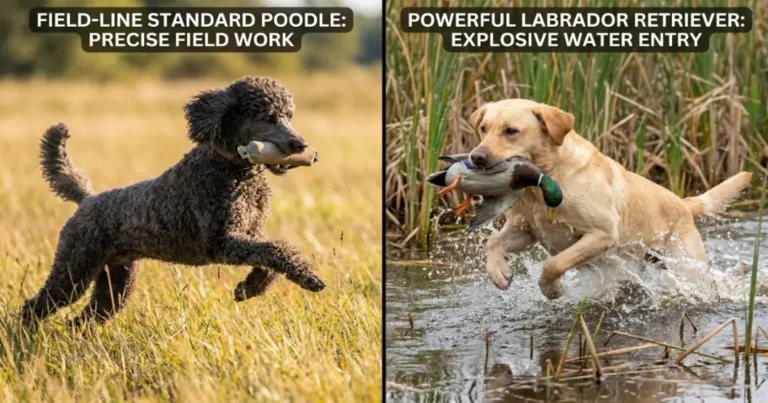
Poodle Service Dog Training: 6 Safe, Proven Steps
Poodle service dog training succeeds when a suitable individual dog learns measurable disability-related tasks, reliable public behavior and calm handler-focused work. Intelligence and a low-shedding coat help, but stable temperament, appropriate health, humane training and long-term welfare remain the true requirements.
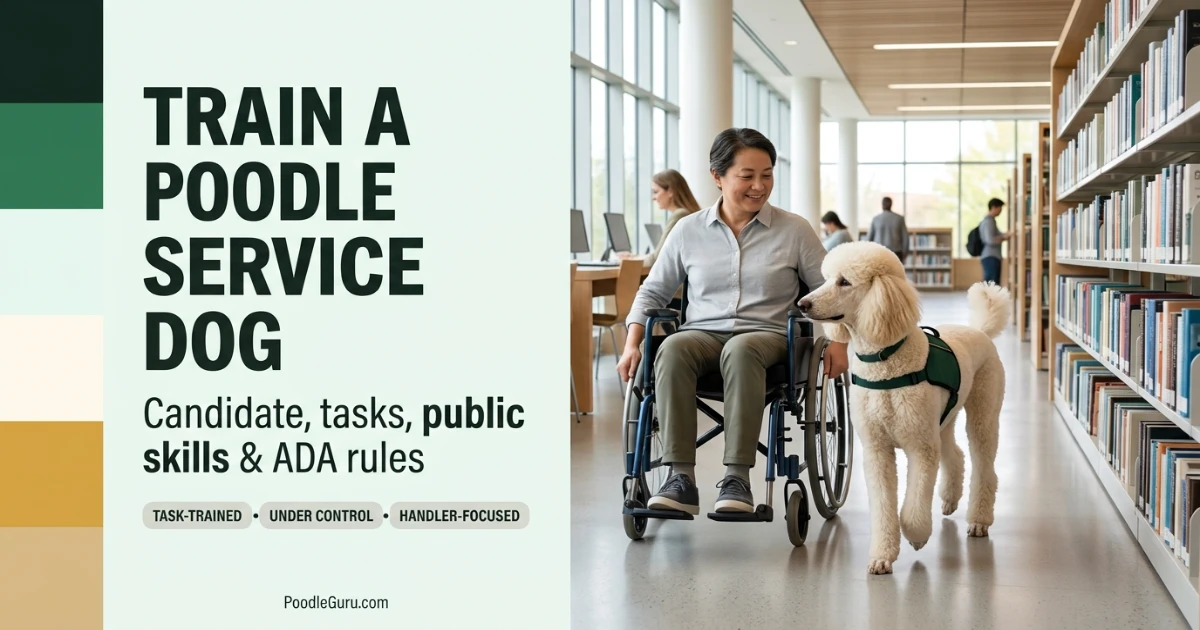
Quick Answer
Poodle service dog training begins by confirming that the handler has a disability-related need for trained work or tasks and that the individual dog has suitable health, temperament and recovery from stress. Build reward-based foundation skills, teach one clearly defined task that directly mitigates the disability, generalize that task safely, and develop reliable public behavior. Under the U.S. ADA, any breed and any size of dog can qualify; professional training, certification, registration, a vest and a doctor’s note are not required for public access. However, a service dog in training is not covered by the federal ADA until trained, although state or local law may provide broader access. The dog must remain under control and housebroken, and it can be removed if the handler does not regain control.
Comfort alone is not enough. The dog must be trained to take a specific action related to the handler’s disability.
A promising breed does not guarantee a suitable individual. Fear, pain, aggression or chronic stress can end the plan.
The dog should work quietly without soliciting attention, interfering with others or creating a safety risk.
Poodle Service Dog Training: What Legally Makes a Service Dog?
Under the U.S. Department of Justice ADA rules, Poodle service dog training must teach a dog to do work or perform tasks for a person with a disability. The work must be directly related to that disability. The ADA explicitly recognizes dogs of any breed and any size.
Examples include retrieving needed items, alerting a deaf handler to a sound, interrupting a disability-related behavior, reminding a handler to take medication, guiding, pulling a wheelchair or taking a trained action during a psychiatric or medical episode. The legal question is not whether the dog makes the person feel better; it is whether the dog has learned a specific action that mitigates the disability.
Emotional support, companionship and comfort through presence alone do not meet the ADA service-dog definition. A psychiatric service dog can qualify when trained to detect or respond to an episode with a specific action—for example, interrupting self-harm, leading a disoriented handler to an exit or retrieving medication.
Different Settings, Different Rules
The ADA covers many state/local government services and public accommodations. The Fair Housing Act and other housing rules may use the broader term assistance animal. Air travel follows the Air Carrier Access Act and U.S. Department of Transportation procedures. Employment accommodations are individualized. Do not assume one document or vest controls every setting.
Certification, Registration, Vests and Public Questions
The ADA does not require a professional training program, government certification, online registry, identification card, patch or special harness. A disabled handler may train their own dog. Buying an online certificate does not turn a pet into a service dog and does not create legal access.
When the service is not obvious, staff may ask only two questions: whether the dog is required because of a disability, and what work or task the dog has been trained to perform. Staff may not demand a diagnosis, medical documentation, certification, task demonstration or a service-dog ID as a condition of entry.
The handler remains responsible for the dog’s care and control. The dog generally must be harnessed, leashed or tethered unless that equipment interferes with the work or the disability prevents its use; in those cases, voice, signal or another effective method must maintain control.
| Common Claim | ADA-Correct Answer |
|---|---|
| “A service dog must be certified.” | No federal ADA certification or registration is required. |
| “The dog must wear a vest.” | No. A vest can communicate that the dog is working but does not create legal status. |
| “A doctor’s letter proves public-access rights.” | Public businesses cannot require medical documentation under the ADA. Other settings may use different accommodation processes. |
| “Any calm pet is a service dog.” | No. The dog must be individually trained for disability-related work or tasks. |
| “Passing CGC makes a service dog.” | No. CGC is a useful manners benchmark, not service-dog status or public-access certification. |
| “Any dog in training has federal access.” | No. The federal ADA does not cover service dogs in training; state or local law may. |
Poodle Service Dog Training Candidate Assessment
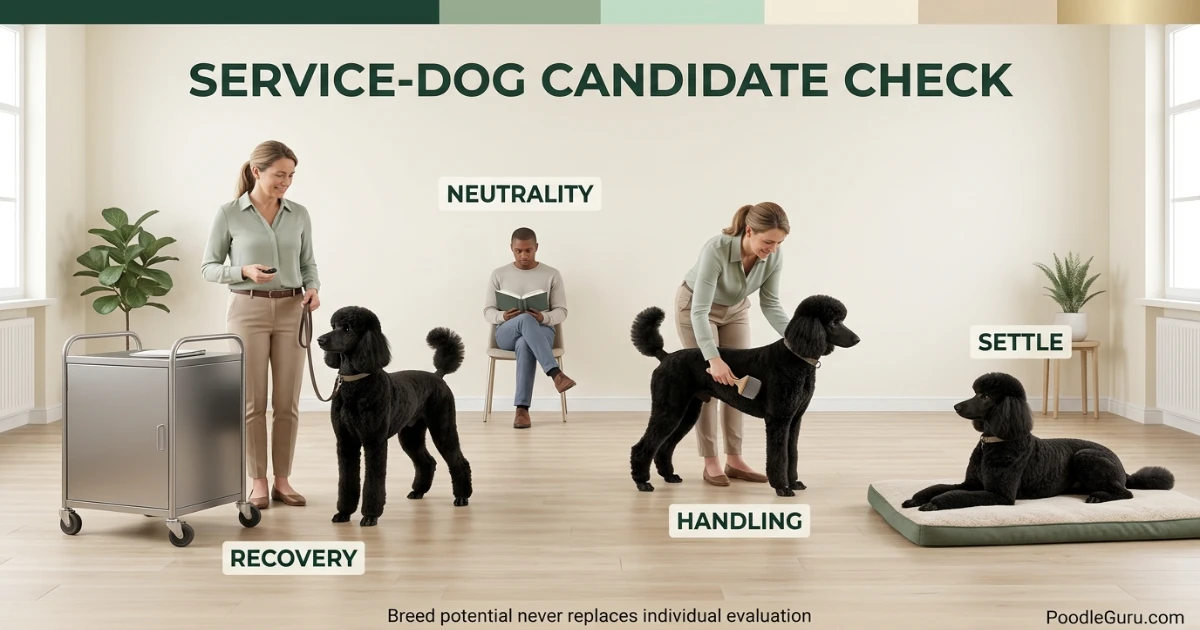
Poodle service dog training should begin only after candidate assessment. Poodles are intelligent, athletic and people-oriented, but those breed traits do not guarantee public-working suitability. Candidate selection should focus on emotional stability, health, resilience and the handler-dog match.
Fast Recovery
The dog may startle at a cart, alarm or dropped object but should recover quickly without prolonged fear or avoidance.
Environmental Neutrality
The dog can notice people, children, food, dogs and movement without lunging, hiding, barking or demanding interaction.
Cooperative Motivation
The dog enjoys working for food, play or social reward and can continue learning without coercion.
Comfort With Handling
The Poodle tolerates grooming, veterinary care, harnessing and ordinary body handling through trained cooperation.
Sound Physical Structure
The dog can perform the intended activity without pain, orthopedic overload or chronic medical limitation.
Ability to Settle
The dog can rest quietly for extended periods rather than remaining hypervigilant or constantly seeking activity.
Red flags include aggression, persistent dog reactivity, severe separation distress, noise phobia, guarding, inability to recover from stress, chronic pain or repeated shutdown. A young dog can mature, but service work should not become an experiment in forcing an unsuitable dog to tolerate public life.
Use a reward-based trainer with service-dog experience and involve a veterinary behavior professional when fear, panic or aggression appears. AVSAB recommends reward-based methods and advises against aversive tools such as shock collars, prong collars, choke chains and physical punishment.
Poodle Size and Task Matching
Legally, any Poodle size can qualify. Practically, body size affects which tasks are safe and useful. Match the task to reach, strength, durability, travel environment and the handler’s needs rather than assigning one role to every dog of a variety.
| Poodle Variety | Often Practical For | Important Limits |
|---|---|---|
| Toy Poodle | Sound alerts, medication retrieval of lightweight items, trained interruption, scent-based alert or response, at-home and public tasks when safely managed. | Greater risk of being stepped on or injured in crowds; unsuitable for weight-bearing mobility work. |
| Miniature Poodle | Hearing tasks, psychiatric response, scent work, retrieval of small objects, finding a person or exit and compact travel. | Limited reach and strength; not appropriate for bracing, pulling or body-weight support. |
| Standard Poodle | Retrieval, carrying light items, opening light accessible doors, pressing buttons, guiding to exits, psychiatric tasks and some professionally assessed mobility-related work. | Deep-chested build, orthopedic health and harness mechanics require caution; do not assume the dog should bear handler weight. |
A Toy Poodle is not legally disqualified from public service work. The handler should plan safe positioning, avoid floor-level crowd hazards and choose tasks the dog can perform without physical risk. For body-size context, use the Poodle size chart.
Health Screening Before Intensive Service Training
Begin with a complete veterinary examination and a detailed discussion of the intended tasks. The health standard for a sound-alert dog differs from the standard for a dog expected to retrieve throughout the day or assist with mobility.
The Poodle Club of America recommends variety-specific breeder health testing that can include eye examinations, DNA testing, patellar evaluation and hip evaluation depending on Toy, Miniature or Standard variety. For an individual working candidate, also consider body condition, pain, gait, cardiac and neurologic findings, skin and ear health, dental comfort and any family history.
- Confirm the dog is free from pain that could worsen with repetitive work.
- Discuss orthopedic imaging or specialist evaluation for physical-assistance tasks.
- Review vision and hearing when the task depends on accurate environmental information.
- Keep body condition lean enough to protect joints and stamina.
- Build a preventive-care and grooming schedule that supports frequent public activity.
- Repeat examinations when work, gait, willingness or task performance changes.
The 6-Step Poodle Service Dog Training Blueprint
This Poodle service dog training blueprint is not a rigid 12–18-month promise. Development, disability needs, previous experience, task complexity and setbacks change the timeline. Progress by demonstrated readiness rather than calendar age.
Define the Disability-Related Task
Write the exact problem the handler experiences, the observable action the dog will take and how that action reduces the impact of the disability. “Makes me feel safe” is not specific enough; “nudges my thigh repeatedly when cued by a trained anxiety signal, then leads me to an exit” is trainable and measurable.
Build Foundation and Cooperative Care
Teach name response, recall, loose-leash walking, settle, leave-it, position changes, house training, calm confinement and grooming cooperation through rewards. Practice in controlled places where the dog is legally permitted.
Teach the Task in Small Components
Use shaping, capturing, targeting and chaining. Reinforce one clear criterion at a time, then combine the pieces only when each part is fluent and comfortable.
Generalize Without Flooding
Practice across safe locations, surfaces, handler positions and distraction levels. Increase one difficulty at a time and leave before the dog becomes overwhelmed.
Develop Public Reliability
Build neutral behavior around food, people, animals, carts, elevators and waiting. Service dogs in training must follow state access law or receive business permission until federal ADA status applies.
Maintain, Reassess and Retire Responsibly
Refresh tasks, monitor stress and health, schedule breaks and plan for retirement. A dog should not lose welfare because the handler depends on its work.
How to Define a Trainable Service Task
A strong task plan contains a trigger, a dog behavior, a measurable completion point and a disability-related outcome.
| Task Element | Question to Answer | Example |
|---|---|---|
| Trigger | What event or cue starts the task? | A timer, a sound, a handler cue or a reliably trained physiological sample. |
| Dog action | What exactly will the Poodle do? | Nose nudge, retrieve pouch, press button, lead to exit or lie in a trained position. |
| Completion | How will you know the task is finished? | The item reaches the handler’s hand, the handler responds, or the dog arrives at the target. |
| Disability mitigation | How does the action reduce the disability’s impact? | Provides access to medication, interrupts a harmful behavior or alerts to an inaccessible sound. |
| Safety boundary | What must the dog never be asked to do? | Bear unsafe weight, enter traffic, ignore pain or replace emergency equipment. |
Poodle Service Task Examples
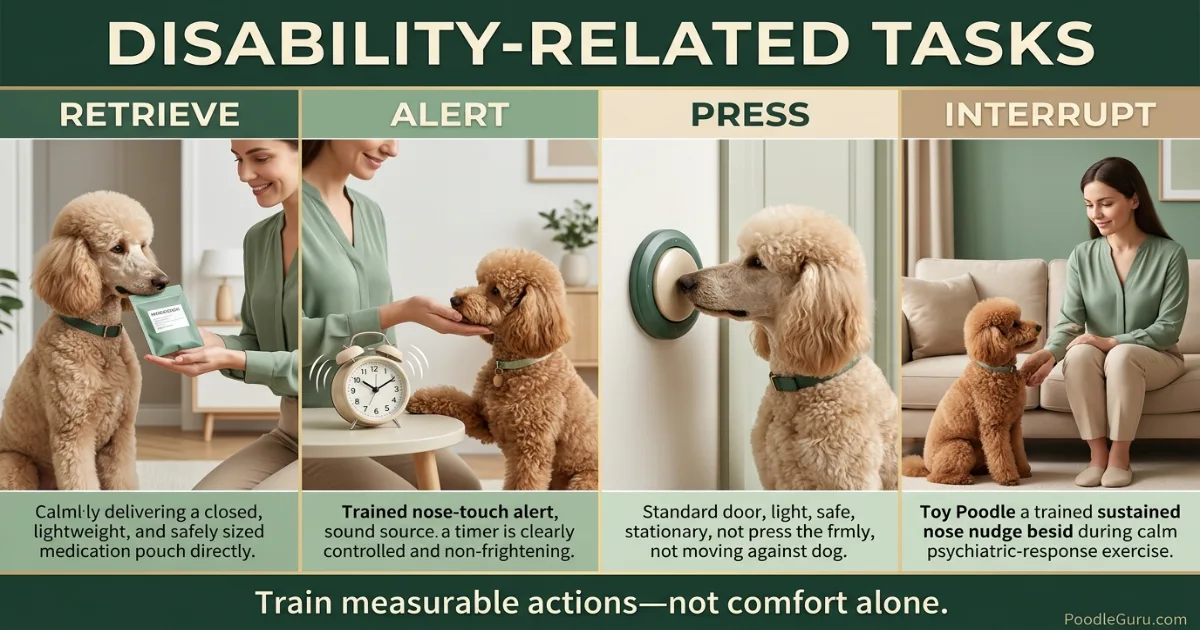
Retrieve a Lightweight Item
Teach a voluntary hold, pickup, delivery to hand and object discrimination. Begin with a soft safe item, reward gentle mouth use and gradually add objects such as a medication pouch, phone case or dropped keys. Do not force the jaw or use an object that can break, leak or injure the mouth.
Sound Alert
Pair a specific sound with a trained nose touch, then teach the dog to lead the handler to the source or another safe action. Practice only one sound initially and use controlled volume. Fire alarms and life-safety systems still require human backup planning.
Psychiatric Interruption or Response
Train a concrete action such as a sustained nose nudge, paw target, retrieval of a grounding kit, leading to an exit or waking the handler from a disability-related episode. Deep pressure positioning may be appropriate when comfortable for both dog and handler, but pressure, duration and body placement should not compromise breathing, pain or mobility.
Find an Exit or Another Person
Teach the Poodle to target a known person or a clearly defined exit cue in controlled environments. This is different from allowing the dog to drag the handler unpredictably through crowds.
Press an Accessible Button
Use nose or paw targeting to activate an automatic-door plate, alert button or household switch that is safe and permitted. Protect nails, joints and surrounding people.
Medication Reminder
Train a response to an alarm or schedule cue, such as nudging the handler and retrieving a labeled pouch. The dog is responding to a trained cue; it does not decide dosage or replace the handler’s medical plan.
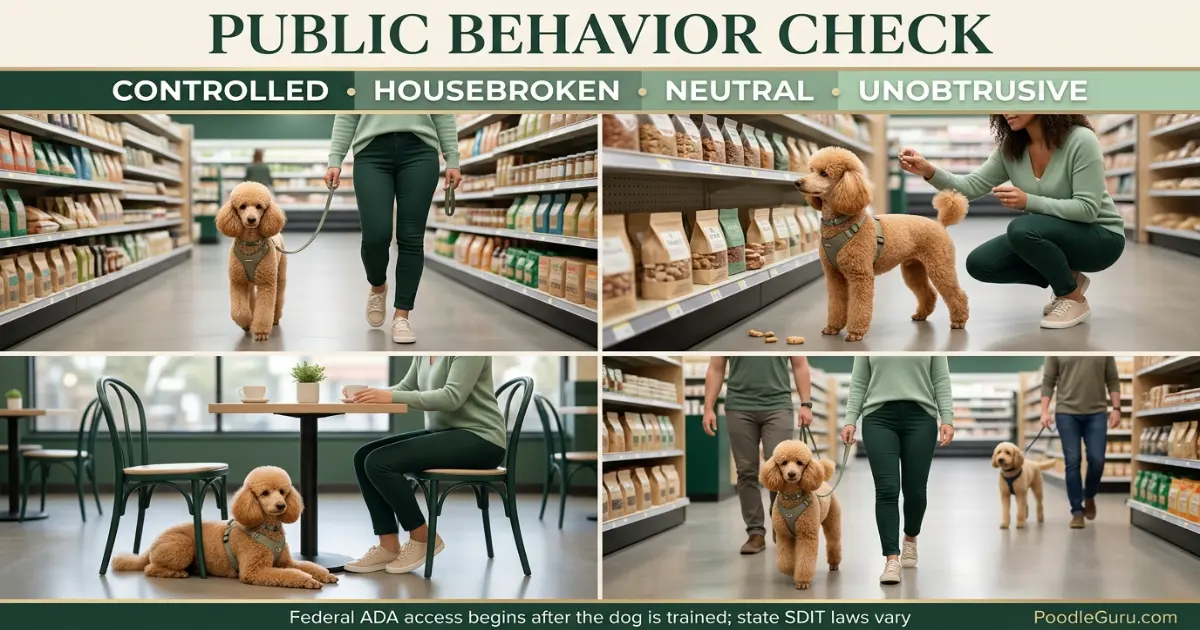
Poodle Service Dog Training for Public Behavior and SDIT Access
Poodle service dog training in public must follow the law that applies to the dog’s current training status. The federal ADA does not give a service dog in training the same public-access status as a trained service dog. Some states extend access to trainers or disabled owner-trainers, often with conditions. Check the current state law and ask permission when the law does not grant access.
Start in homes, training facilities, outdoor areas and pet-friendly businesses. Do not use a vest to pressure a non-pet-friendly business into admitting an untrained dog. Once the dog is legally working as a service animal, it still must remain under control and housebroken.
- Walk on a loose leash without blocking aisles or wrapping around people.
- Ignore food, merchandise, strangers and other animals unless a task requires otherwise.
- Settle quietly beside or beneath the handler without invading another person’s space.
- Use designated toilet areas and maintain reliable house training.
- Recover from ordinary noises without prolonged fear, barking or escape attempts.
- Respond to handler control without repeated physical correction.
- Leave promptly when the dog is ill, overwhelmed, disruptive or unable to work safely.
A business may ask a handler to remove a service dog that is out of control when the handler does not take effective action, or a dog that is not housebroken. The person should generally be allowed to continue receiving goods or services without the animal.
The Assistance Dogs International Public Access Certification Test is a respected program benchmark for ADI graduate teams, but it is not a federal legal certification and ADI does not simply test or certify any privately trained dog on request. CGC and Urban CGC can be useful foundation checks, but AKC states that passing them does not make a dog a service dog.
Medical Alert Tasks Need Specialist Training and Backup Systems
Some dogs can learn scent-based alerts to particular physiological changes, but not every dog has the ability and no internet protocol can guarantee accuracy. Seizure response—taking action after a seizure begins—is different from predicting a seizure before it happens.
Use a trainer with verifiable scent-detection or medical-alert experience, a safe sample-handling protocol and objective records. Track false alerts, missed events, environmental variables and whether the dog is responding to intentional or accidental cues from the handler.
Never rely on the dog as the only system for insulin decisions, allergens, seizures, cardiac events or another life-threatening condition. Continue prescribed monitors, medication, emergency plans and human support. A dog’s task can add help; it should not replace medical care.
Mobility Tasks and Physical Safety
Standard Poodles can be useful for non-weight-bearing mobility-related tasks such as retrieving objects, carrying lightweight items, opening light accessible doors, pressing buttons or bringing a mobility aid. Pulling or body-weight support creates greater orthopedic and harness risk.
Do not teach bracing, counterbalance, wheelchair pulling or fall-arrest work from a general web article. Obtain an orthopedic assessment, task analysis and harness fitting from qualified veterinary and assistance-dog professionals. Avoid arbitrary formulas such as allowing a fixed percentage of the dog’s body weight; safe force depends on structure, gait, health, equipment, direction and repetition.
A service dog should never replace an appropriate cane, walker, wheelchair or human assistance when the task would place unsafe load on the dog.
Grooming and Daily Care for a Working Poodle
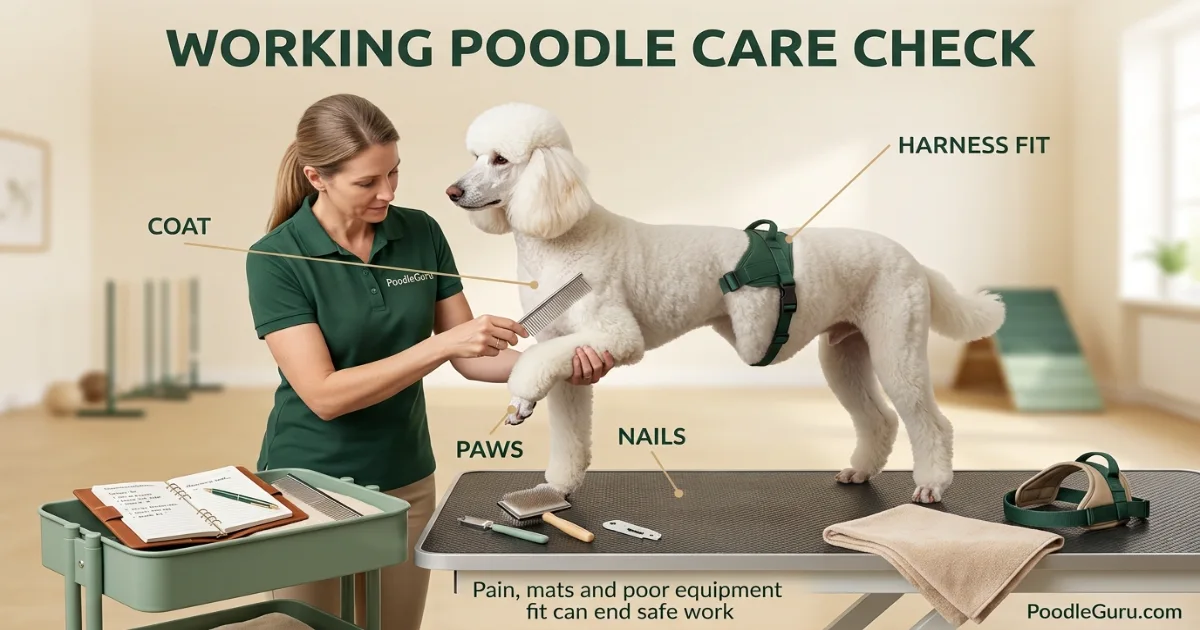
Daily comfort is part of responsible Poodle service dog training. A matted or painful Poodle cannot work comfortably. Choose a practical clip that supports cleanliness and reduces daily coat burden. Grooming frequency depends on coat length, activity, equipment and the individual coat, but many working Poodles need professional care approximately every four to eight weeks plus consistent brushing and comb checks at home.
Check friction areas beneath the harness, behind the ears, under the arms and between toes. Keep nails short enough for stable traction and inspect pads after long public days. A vest or harness should not cover damp coat, tight mats, sores or heat irritation.
Use the live Poodle grooming-cost guide to plan recurring appointments and the Poodle grooming schedule for age-appropriate maintenance.
When to Pause or Wash Out a Service-Dog Candidate
“Washout” means the dog is released from service training or moved to a different role. It is not a moral failure. Ethical training protects the handler and the dog from a partnership that is unsafe or chronically stressful.
- Repeated aggression, threatening behavior or inability to remain safely controlled
- Persistent fear, panic, shutdown or inability to recover from ordinary environments
- Chronic pain, orthopedic disease or another health condition incompatible with the task
- Severe distraction or prey drive that does not improve with humane training
- Inability to settle or work without constant management
- A task that physically exceeds the dog’s size or structure
- Training that is damaging the handler’s health, finances or ability to meet the dog’s needs
Possible outcomes include living as an at-home task dog, becoming a well-trained pet, moving to a sport or therapy role if appropriate, or being responsibly rehomed. A qualified professional can help make the decision without hiding stress behind obedience.
Training Pathways, Time and Budget
There is no universal completion guarantee or reliable national price for Poodle service dog training. Cost depends on whether the dog comes from a program, is owner-trained with coaching, requires private lessons, develops health or behavior problems, or washes out and must be replaced.
Accredited Program
May provide a trained dog and team instruction. Eligibility, tasks, geography, fees, fundraising and wait times differ by organization.
Owner-Training With Coaching
Permitted under the ADA for disabled handlers. Budget for candidate evaluation, regular professional lessons, veterinary care, public-skills coaching and task expertise.
Hybrid or Personal-Dog Program
Some organizations consider a handler’s existing dog; many do not. ADI organizations do not simply administer a one-time test to certify any private team.
Build a budget for the possibility that the first candidate will not graduate. Include acquisition, health testing, routine veterinary care, training, equipment, grooming, travel, insurance or emergency savings and the cost of maintaining the dog after retirement.
Search the Assistance Dogs International program directory for accredited organizations and verify any independent trainer’s credentials, methods, references, task experience and written policies.
Owner Action Plan: First Steps This Week
Write One Task Statement
Describe the disability-related problem, exact dog action and measurable outcome in one paragraph.
Book Veterinary and Behavior Assessments
Share the intended tasks so health, orthopedic and temperament suitability can be evaluated realistically.
Check State SDIT Law
Confirm where a dog in training may legally practice and what trainer or handler conditions apply.
Interview Reward-Based Trainers
Ask about service tasks, public-access law, washout decisions, medical-alert limitations and aversive-tool policy.
Start Foundation Records
Track training location, duration, task success, stress signs, recovery, health changes and the next small criterion.
Frequently Asked Questions
Can any Poodle be trained as a service dog?
No. Any breed or size can legally qualify, but the individual Poodle must have appropriate health, temperament, task ability and public control. Some dogs are better suited to at-home tasks or pet life.
Can a Toy Poodle be a public service dog?
Yes. The ADA recognizes any breed and any size. A Toy Poodle must still perform disability-related work, remain controlled and be protected from crowd and floor-level injury risks. It cannot safely perform weight-bearing mobility tasks.
Can I train my own Poodle service dog?
Yes. The ADA does not require professional training. Professional coaching is strongly recommended for candidate evaluation, public behavior, complex tasks, scent work, mobility equipment and washout decisions.
Does a service Poodle need certification or registration?
No federal ADA certification or registry is required. Online IDs do not create service-dog status. Other settings such as air travel, housing or employment may have separate forms or accommodation processes.
Does a service dog need to wear a vest?
No. The ADA does not require a vest, patch or special harness. Equipment should be chosen for communication, comfort and task function rather than as proof of legal status.
Can I take a service dog in training into any store?
Not under the federal ADA solely because it is in training. State or local law may provide access, and pet-friendly businesses may allow practice. Check the current law and obtain permission where required.
Is the Canine Good Citizen test required?
No. CGC can be a helpful manners benchmark, but AKC states that passing CGC or Urban CGC does not make a dog a service dog or emotional support animal.
Is an ADI public access test legally required?
No. ADI testing is a respected standard used within accredited assistance-dog programs, not a federal ADA requirement or a public one-time certification service for every privately trained team.
Can a Standard Poodle provide mobility support?
A Standard may perform retrieval, button pressing and other non-weight-bearing tasks. Bracing, counterbalance, pulling and body-weight support require individualized veterinary, task and harness assessment and may be unsafe for a particular dog.
What is the difference between a psychiatric service dog and an emotional support animal?
A psychiatric service dog is trained to take a specific action directly related to a disability. An emotional support animal provides comfort through presence and does not receive general ADA public-access rights on that basis alone.
How long does Poodle service dog training take?
Poodle service dog training has no guaranteed timeline. Development, prior training, task complexity, public reliability, health and setbacks determine progress. Many teams train for well over a year, but readiness should be measured by behavior and welfare rather than a deadline.
Official and Professional Sources
These sources were used to correct the legal, public-access, training-method and Poodle health claims in this guide.
- ADA.gov: Service Animals
- U.S. Department of Justice: Service Animal FAQs
- U.S. Department of Justice: ADA Service Animal Requirements
- Assistance Dogs International: Summary of Standards
- Assistance Dogs International: Travel and Public Access
- American Kennel Club: CGC Does Not Create Service-Dog Status
- American Veterinary Society of Animal Behavior: Humane Training
- Poodle Club of America: Recommended Health Testing
Poodle Service Dog Training: Key Takeaways
- Poodle service dog training can produce a legally qualifying service dog of any Poodle size when the dog is trained for disability-related work or tasks.
- Certification, online registration, a vest, professional training and a doctor’s note are not federal public-access requirements.
- The federal ADA does not cover service dogs in training; state and local laws may provide broader access.
- Select the individual Poodle for stable temperament, recovery, health, settle ability and safe task match.
- Use reward-based training and avoid aversive tools that can damage welfare and reliability.
- Teach a measurable disability-mitigating action before adding difficult environments.
- Public reliability means control, house training, neutrality and unobtrusive behavior—not simply wearing equipment.
- Medical alerts require backup systems, and physical-assistance tasks require professional health and equipment assessment.
- Washout or retirement protects the dog and handler when health, fear, aggression or chronic stress makes the work unsuitable.
Next step: write one precise disability-task statement and take it—along with the dog’s health and behavior history—to a veterinarian and reward-based service-dog professional before purchasing equipment or practicing in restricted public spaces.