This article contains affiliate links. PoodleGuru may earn a small commission if you purchase through our links, at no extra cost to you.
Sheepadoodle (Old English Sheepdog Poodle Mix): Complete Guide
The Sheepadoodle is a smart, shaggy Old English Sheepdog Poodle mix with a loyal personality, a demanding coat, and serious exercise needs. This guide explains the real size, temperament, grooming, health, training, and buyer details owners should understand before committing.
Quick Answer
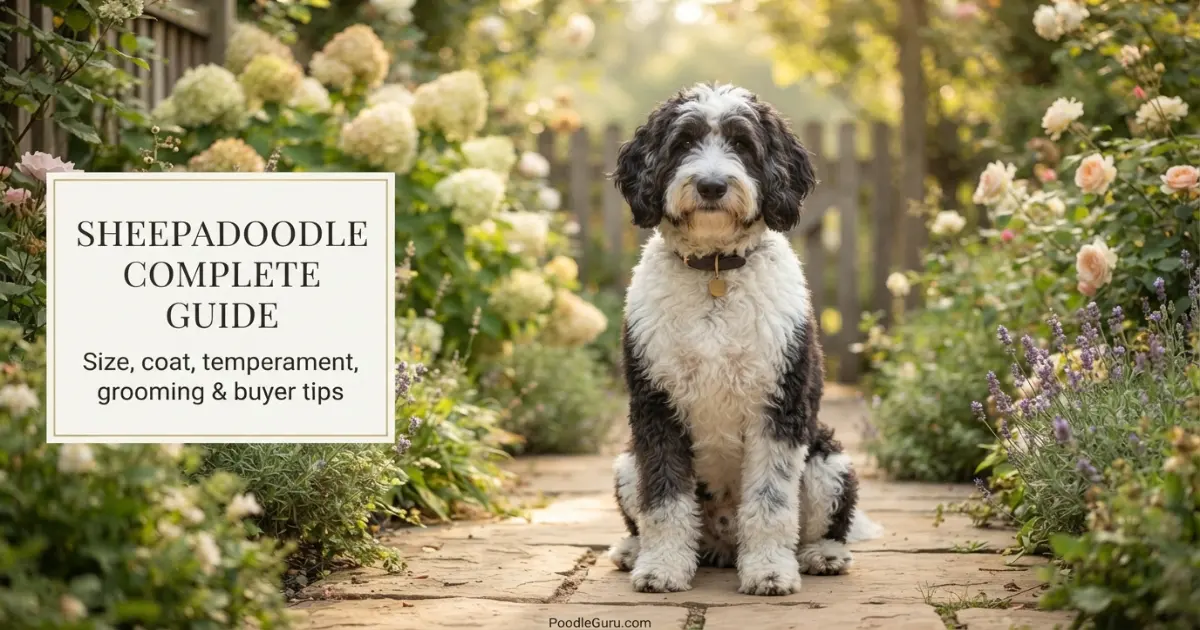
A sheepadoodle is a cross between an Old English Sheepdog and a Standard Poodle. Most weigh 50–80 lbs, stand 18–24 inches tall, and carry a wavy or curly low-shedding coat. They’re known for high intelligence, a playful temperament, and significant grooming demands. The sheepadoodle suits active households ready for daily exercise, consistent training, and professional grooming every 6–8 weeks. This isn’t a low-maintenance dog — but for the right owner, it’s an exceptional companion.
What Is a Sheepadoodle?
A sheepadoodle is a hybrid dog breed produced by crossing an Old English Sheepdog with a Standard Poodle. For poodle owners, this means you’re getting a dog that inherits traits from two intelligent, high-energy working breeds — neither of which is naturally inclined to lounge around all day. The most important thing to understand is that the sheepadoodle isn’t a standardized breed with predictable traits. Every litter varies, sometimes dramatically. Two sheepadoodle puppies from the same litter can have completely different coat types, temperaments, and adult sizes.
The cross emerged in the broader doodle trend of the 1990s and 2000s, driven by demand for low-shedding dogs with the Old English Sheepdog’s gentle, comedic personality and the Poodle’s sharp intelligence and lower-shedding Poodle-type coat. The AKC recognizes Poodles in Toy, Miniature, and Standard varieties, but most Sheepadoodles are bred from Standard Poodles or larger multi-generation lines — meaning buyers should expect a medium-to-large dog unless the breeder can show parent sizes and prior litter records.
Because sheepadoodles are crossbreeds rather than purebreds, they aren’t recognized by the AKC. That doesn’t make them lesser dogs. It does mean you can’t rely on a breed standard to predict what you’ll get. At PoodleGuru, we evaluate crossbreeds by looking at both parent breeds and identifying the range of realistic outcomes — not the idealized version you’ll see on social media.
Important
The sheepadoodle is a crossbreed, not a purebred. There is no breed standard. Coat type, adult size, and temperament can vary significantly even within a single litter. Responsible breeders prioritize health testing on both parent breeds over cosmetic traits.
Appearance & Size
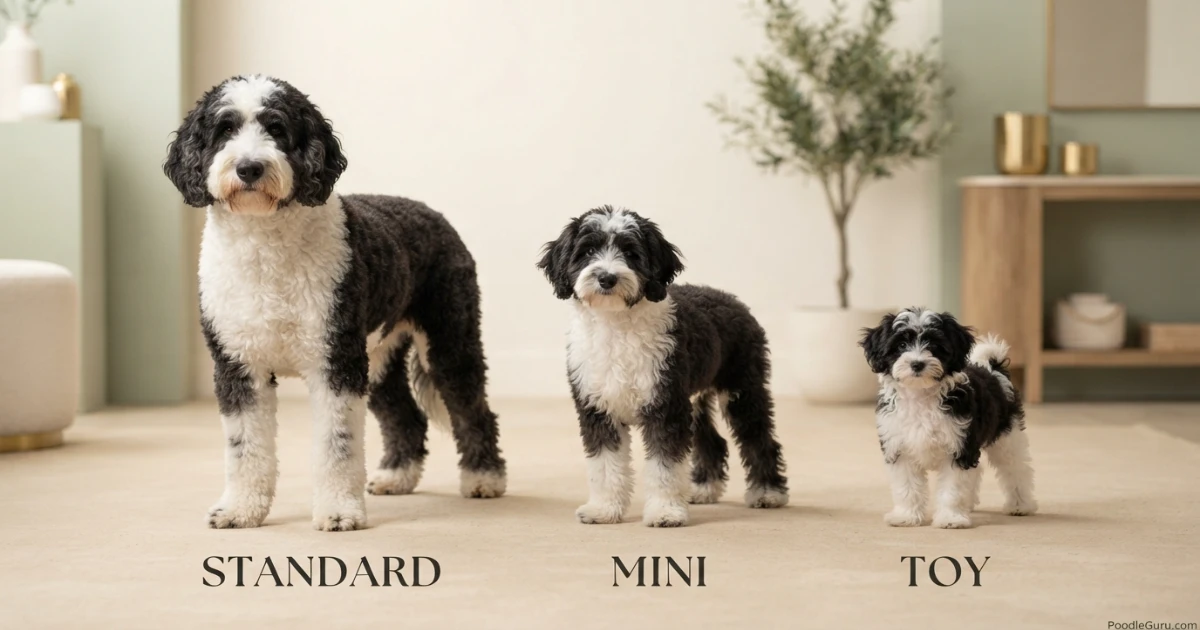
Sheepadoodles are large dogs with a shaggy, often black-and-white coat that softens as they mature. Most have the Old English Sheepdog’s distinctive colour blocking — white bodies with black or grey markings on the head, ears, and rump — paired with the Poodle’s longer muzzle and more refined bone structure. But you’ll also see solid-coloured, tri-coloured, and phantom-patterned dogs depending on the Poodle parent’s genetics.
Standard
50–80 lbs
18–24 inches at shoulder
Most common size
Standard Poodle × OES
Mini (Uncommon)
25–45 lbs
15–20 inches at shoulder
Miniature Poodle × OES
Rare, harder to find
Toy (Extremely Rare)
15–25 lbs
Under 15 inches
Toy Poodle × small OES
Very few breeders
Standard sheepadoodles reach their full height by 12–14 months but continue filling out until roughly age two. A common buyer mistake is underestimating just how substantial these dogs become. A 75-lb sheepadoodle with a full coat takes up real space — on your sofa, in your car, and across your grooming table.
Coat Types: Wavy vs Curly
Sheepadoodle coats fall into two broad categories. Wavy coats (sometimes called “fleece” coats) are the most desirable for pet homes — soft, shaggy, and easier to maintain between grooms. Curly coats lean closer to the Poodle side, are tighter in texture, and demand more frequent brushing to prevent matting. A small percentage of sheepadoodles inherit a straighter, higher-shedding coat closer to the Old English Sheepdog’s natural texture. This is unpredictable in first-generation crosses and one reason experienced buyers ask to see both parent dogs before committing.
Temperament & Personality
Sheepadoodles inherit a fascinating personality blend. From the Old English Sheepdog side, they get a playful, sometimes goofy demeanour and a strong attachment to their people. From the Poodle side, they get sharp intelligence, quick learning ability, and a sensitivity that makes harsh training methods backfire. The result is a dog that’s affectionate, perceptive, and occasionally mischievous — especially when bored.
Owners often notice these dogs shadow their people from room to room. Separation anxiety can develop quickly if early alone-time training isn’t prioritized. This isn’t a breed you can leave alone for 10-hour workdays without consequence. Destructive chewing, excessive barking, and house-soiling are common complaints from under-stimulated sheepadoodles.
Owner Insight
Sheepadoodles tend to be vocal. The Old English Sheepdog’s herding-dog bark combines with the Poodle’s alertness to produce a dog that announces visitors, squirrels, delivery trucks, and suspicious leaves. Early training can manage this, but don’t expect a silent dog. If you live in an apartment or have noise-sensitive neighbours, factor this in honestly.
With children, well-socialized sheepadoodles are generally patient and gentle — though their size and enthusiasm mean they can accidentally knock over toddlers during play. With other dogs, they’re typically social when properly introduced. With cats, results vary. The herding instinct can manifest as chasing, which some cats tolerate and others find deeply stressful.
The PoodleGuru Sheepadoodle Match Framework
At PoodleGuru, we evaluate whether a crossbreed fits your life using five measurable categories. This isn’t about whether sheepadoodles are “good dogs” — they are. It’s about whether a sheepadoodle is good for you, specifically, right now. Run through each category honestly before contacting breeders.
Space Reality Check
Do you have at least 800–1,000 square feet of living space plus access to a securely fenced yard or daily off-leash area? A 70-lb sheepadoodle in a 500-sq-ft apartment is a recipe for frustration — for both of you.
Grooming Budget Test
Can you commit $80–$150 every 6–8 weeks for professional grooming, plus daily at-home brushing? If the answer is “maybe,” the sheepadoodle isn’t your dog. Coat neglect leads to matting, skin infections, and expensive vet bills.
Energy Match
Do you currently walk 45–60 minutes daily and have time for active play? Sheepadoodles need more than a quick stroll. They thrive with running, fetch, swimming, or structured dog sports. A tired sheepadoodle is a well-behaved sheepadoodle.
Health Preparedness
Have you researched the major health conditions in both parent breeds? You need a rainy-day fund of at least $2,000–$5,000 for unexpected veterinary costs. Hip dysplasia, bloat, and eye conditions all appear in this cross.
Breeder Quality Screen
Will you commit to buying only from a breeder who provides OFA hip scores, eye clearances, and genetic testing on both parents? Skip this step and you’re gambling — sometimes expensively. More on this in the buyer section below.
Score yourself honestly. If you answered “no” or “maybe” to more than one category, consider whether a lower-maintenance poodle cross — or a smaller purebred poodle — might be a better fit for this season of life.
Health Considerations
Sheepadoodles are generally healthy dogs with a typical lifespan of 10–14 years. But hybrid vigour — the idea that crossbreeds are automatically healthier than purebreds — is an oversimplification. When both parent breeds share a predisposition to the same condition, the risk doesn’t disappear. It can compound.
| Health Condition | Risk Level | What Owners Should Watch For | Screening Available? |
|---|---|---|---|
| Hip Dysplasia | Moderate to High | Stiffness, reluctance to jump, bunny-hopping gait | Yes — OFA hip radiographs |
| Gastric Dilatation-Volvulus (Bloat) | Moderate | Distended abdomen, unproductive retching, restlessness | No — preventive management only |
| Progressive Retinal Atrophy (PRA) | Low to Moderate | Night blindness progressing to daytime vision loss | Yes — DNA test available |
| Hypothyroidism | Moderate | Weight gain, lethargy, coat changes, skin issues | Yes — blood panel |
| Ear Infections | Moderate to High | Head shaking, odour, redness, discharge | No — preventive cleaning helps |
| Elbow Dysplasia | Low to Moderate | Front-limb lameness, stiffness after rest | Yes — OFA elbow radiographs |
Veterinary guidance generally recommends that both parent dogs have current OFA hip and elbow clearances, a recent eye exam by a board-certified veterinary ophthalmologist, and breed-relevant DNA screening before breeding. Ask to see documentation. A breeder who hesitates or offers excuses is a red flag.
When to Call a Vet
Contact your veterinarian promptly if your sheepadoodle shows signs of bloat (distended belly, pacing, failed vomiting attempts), sudden lameness, significant vision changes, or unexplained weight gain with coat deterioration. Bloat is a life-threatening emergency — do not wait and see.
Grooming & Coat Care
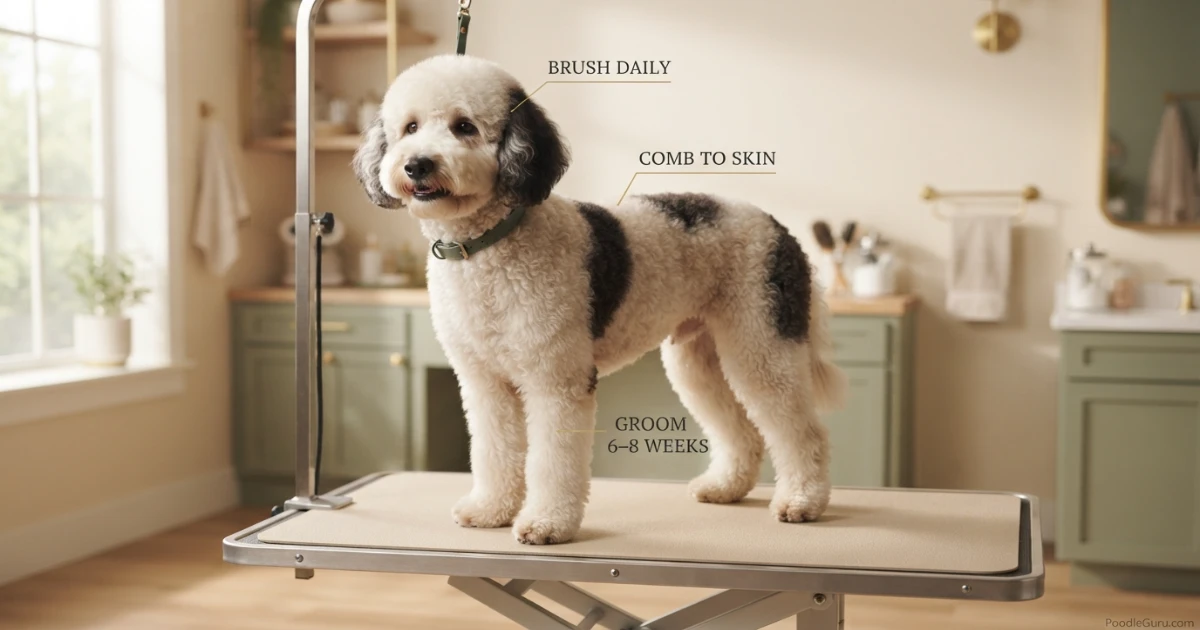
If there’s one thing that surprises new sheepadoodle owners, it’s the grooming commitment. This isn’t a brush-once-a-week dog. The dense, continuously growing coat demands daily attention and professional grooming every 6–8 weeks — more frequently if you keep the coat long.
Daily Maintenance Routine
Professional groomers commonly watch for matting behind the ears, under the collar, in the armpits, and along the hindquarters — these are high-friction zones where tangles form fastest. Use a slicker brush followed by a metal comb down to the skin. Surface brushing that only touches the top layer leaves mats forming underneath.
Bathing every 3–4 weeks is typical, though individual dogs vary. Use a gentle dog-formulated shampoo — never human products, which disrupt skin pH. Ear cleaning should happen weekly. Sheepadoodles with heavy, floppy ears are prone to moisture buildup and infections, especially after swimming or bathing.
When to Ask a Professional Groomer
If you notice mats tight against the skin, a strong odour despite bathing, or ears that look red and inflamed, book a professional groomer appointment. Attempting to cut out severe mats at home with scissors is dangerous — owners accidentally cut skin more often than you’d think. A groomer can assess whether a shorter reset cut is the kindest option.
Exercise & Training Needs
Sheepadoodles need 60–90 minutes of daily physical activity plus mental stimulation. A bored sheepadoodle is a creative problem-solver — and not in a good way. Digging, counter-surfing, shoe destruction, and demand barking are all signs your dog isn’t getting enough engagement.
Training should start early and stay positive. These dogs are sensitive to tone. Harsh corrections shut them down. Short, game-based training sessions work beautifully. They excel in rally, agility, and scent work — all outlets that engage both body and brain. Socialization during the critical 8–16 week window is non-negotiable. Expose your puppy to different people, dogs, surfaces, sounds, and environments in controlled, positive ways.
For owners who can provide this level of engagement, the payoff is significant. A well-exercised, well-trained sheepadoodle is calm indoors, reliable off-leash, and a joy to live with. Skip the work and you’ll wonder why you ever thought this breed was a good idea.
Sheepadoodle vs Other Doodle Breeds
If you’re considering a sheepadoodle, you’re probably also looking at Goldendoodles, Labradoodles, and Bernedoodles. Here’s how they compare across the traits that matter most in daily ownership — built as a uniquely structured reference you won’t find assembled this way elsewhere.
| Trait | Sheepadoodle | Goldendoodle | Labradoodle | Bernedoodle |
|---|---|---|---|---|
| Typical Weight | 50–80 lbs | 50–75 lbs | 50–80 lbs | 55–90 lbs |
| Coat Type | Wavy or curly, black/white common | Wavy or curly, cream/gold/red | Wavy or curly, cream/chocolate/black | Wavy or curly, tri-colour common |
| Shedding Level | Low to moderate | Low to moderate | Low to moderate | Low to moderate |
| Energy Level | High | Moderate to high | High to very high | Moderate |
| Trainability | High (sensitive) | High (eager to please) | Very high (food-driven) | Moderate to high (stubborn streak) |
| Grooming Demand | High | High | Moderate to high | High |
| Stranger-Friendly | Moderate (reserved at first) | High (very social) | High (outgoing) | Moderate (aloof initially) |
| Apartment Suitable | No | With enough exercise | Rarely | Better than most large doodles |
| Lifespan | 10–14 years | 10–14 years | 10–14 years | 9–13 years |
The sheepadoodle stands out for its distinctive black-and-white coat pattern and a slightly more reserved personality with strangers compared to the exuberantly social Goldendoodle. If you want a dog that’s friendly but not indiscriminately so — and you’re prepared for the grooming — the sheepadoodle earns its place on your shortlist.
Buyer Guide & 2026 Pricing
In 2026, a well-bred sheepadoodle puppy from a health-testing breeder typically costs $2,500–$4,500. Prices at the lower end of that range are common in regions with more breeders. Prices above $4,500 usually reflect rare coat colours, mini sizes, or breeders with exceptional health-testing pedigrees — not necessarily better dogs.
What Affects Sheepadoodle Price
- Health testing investment: Breeders who complete OFA hips, elbows, eyes, and DNA panels charge more — and they should. This testing costs them $500–$1,500 per breeding dog.
- Generation: F1 (first-generation) puppies are typically less expensive than F1b (backcross to Poodle) or multigenerational puppies, which offer more coat predictability.
- Coat colour: Rare colours like merle, phantom, or solid red-brown command premium pricing — sometimes double the base rate.
- Size: Mini and toy sheepadoodles are rarer and consistently priced $500–$1,500 higher than standards.
- Geography: Urban coastal markets (California, Northeast) run $1,000+ higher than rural Midwest or Southern breeders.
Buyer Red Flags
Walk away from any breeder who won’t show you OFA clearances, refuses to let you meet at least one parent dog, has multiple litters available year-round, or pushes you to commit without an application process. Puppies sold through pet stores or broker websites almost always come from high-volume commercial breeders — no matter what the listing says. A responsible breeder asks you questions, not just the other way around.
Common Mistakes & Myths
Myth: “They’re Hypoallergenic”
No dog is truly hypoallergenic. Many Sheepadoodles shed less than heavy shedders, but allergy responses vary by individual dog, coat type, grooming routine, and the person with allergies. Spend time with adult sheepadoodles before committing if allergies are a concern.
Myth: “Hybrid Vigour Means No Health Problems”
Crossing two breeds doesn’t cancel out shared genetic risks. Both parent breeds can carry hip dysplasia, eye disorders, and thyroid issues. Health testing matters more than the “hybrid” label.
Mistake: Underestimating Grooming Costs
Professional grooming every 6–8 weeks at $80–$150 per session adds up to $600–$1,300 annually. Add quality brushes, shampoos, and ear cleaners, and the yearly grooming investment often exceeds $1,000. Budget accordingly.
Mistake: Buying Based on Colour Alone
Choosing a puppy because it’s a rare merle or phantom pattern — while ignoring temperament and health clearances — is a fast track to heartbreak. Coat colour fades and changes. Temperament lasts 10–14 years.
Myth: “They’re Easy, Laid-Back Dogs”
Sheepadoodles can be calm indoors — but only after their exercise needs are met. An under-exercised sheepadoodle is restless, destructive, and vocal. This is an active breed cross, not a couch ornament.
Mistake: Skipping Early Socialization
The critical socialization window closes around 16 weeks. Sheepadoodles who miss early exposure to varied people, dogs, and environments often develop fearfulness or reactivity that’s harder to undo later.
Owner Action Plan: Before You Bring a Sheepadoodle Home
Use this checklist in the weeks before your puppy arrives. It turns good intentions into actual preparation.
Book a Vet Wellness Visit
Schedule your puppy’s first exam within 72 hours of pickup. Establish a baseline, review the breeder’s health records, and start your vaccination and deworming schedule.
Find a Professional Groomer
Book an introductory grooming appointment now. Good groomers book weeks out. Aim for a gentle puppy introduction session around 12–14 weeks, even if no cutting is needed.
Puppy-Proof Your Home
Secure electrical cords, remove toxic plants, install baby gates, and set up a crate in a quiet corner. Sheepadoodle puppies explore with their mouths — assume everything at floor level is a chew toy.
Stock Essential Supplies
Slicker brush, metal comb, nail clippers, ear cleaner, enzymatic cleaner for accidents, a sturdy crate, and high-quality large-breed puppy food. Skip retractable leashes — a 6-foot fixed leash gives better control.
Line Up Training Support
Enrol in a positive-reinforcement puppy class starting at 10–12 weeks. Group classes double as controlled socialization. A private trainer is worth considering if you’re a first-time large-dog owner.
Frequently Asked Questions About Sheepadoodles
Are Sheepadoodles good family dogs?
Yes — when properly socialized and exercised. Sheepadoodles are affectionate, patient, and playful with children. Their size means supervision around toddlers is essential. They thrive in active households where someone is home for a good portion of the day.
Do Sheepadoodles shed?
Many sheepadoodles are lower-shedding than heavy double-coated breeds, but they are not zero-shedding. Wavy and curly coat types trap loose hair rather than releasing it into the environment — which is why daily brushing is so important. A small percentage with straighter coats shed noticeably more.
How big do Sheepadoodles get?
Standard sheepadoodles reach 50–80 lbs and stand 18–24 inches at the shoulder. Mini sheepadoodles (from Miniature Poodle crosses) range from 25–45 lbs. Full adult size is typically reached by 12–14 months, with filling out continuing through age two.
How much does a Sheepadoodle cost in 2026?
Expect to pay $2,500–$4,500 from a reputable health-testing breeder. Mini and toy sizes, rare coat colours, and multigenerational lines sit at the higher end. Avoid puppies priced under $1,500 — this typically signals skipped health testing.
Are Sheepadoodles easy to train?
Yes — they’re intelligent, eager learners. But they’re also sensitive. Positive reinforcement works beautifully. Harsh methods erode trust quickly. Consistency matters more than intensity. Short, engaging sessions beat long, repetitive drills every time.
What health problems do Sheepadoodles have?
Hip dysplasia, bloat, progressive retinal atrophy, hypothyroidism, and ear infections are the most commonly seen conditions. Responsible breeding with full health clearances significantly reduces — but doesn’t eliminate — these risks.
How often should I groom my Sheepadoodle?
Daily brushing at home, professional grooming every 6–8 weeks, and weekly ear cleaning. Bathing every 3–4 weeks is typical. If you can’t commit to this schedule, choose a lower-maintenance breed or keep the coat clipped short year-round.
Is a Sheepadoodle right for first-time dog owners?
It depends on commitment, not experience. A first-time owner who’s researched thoroughly, budgeted for grooming, and committed to daily exercise and training can absolutely succeed. But this is not an easy starter dog — the grooming and energy demands are substantial.
Key Takeaways: Is the Sheepadoodle Right for You?
- The sheepadoodle is an Old English Sheepdog–Standard Poodle cross weighing 50–80 lbs with a low-shedding wavy or curly coat.
- Professional grooming every 6–8 weeks and daily at-home brushing are non-negotiable — annual grooming costs typically exceed $1,000.
- These dogs need 60–90 minutes of daily exercise plus mental stimulation to stay calm and well-behaved indoors.
- Health-tested puppies from responsible breeders cost $2,500–$4,500 in 2026 — prices below $1,500 are a red flag.
- The PoodleGuru Sheepadoodle Match Framework evaluates space, grooming commitment, energy match, health preparedness, and breeder quality before buying.
- Sheepadoodles suit active households with time for training, socialization, and companionship — they do not thrive when left alone for long workdays.
Best next step: If you scored well on the Match Framework above, start researching breeders who provide full OFA clearances, schedule visits with adult sheepadoodles to confirm temperament compatibility, and line up your groomer and puppy class before bringing a puppy home. For more foundational poodle knowledge, revisit our Complete Poodle Grooming Guide.