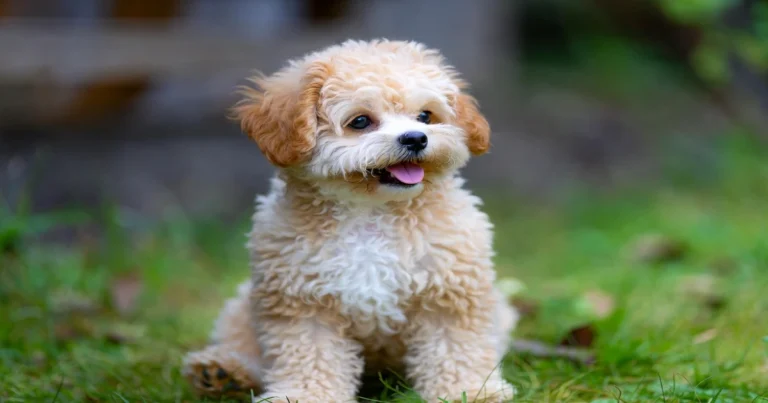
Poodle vs Schnauzer: Temperament & Grooming Compared
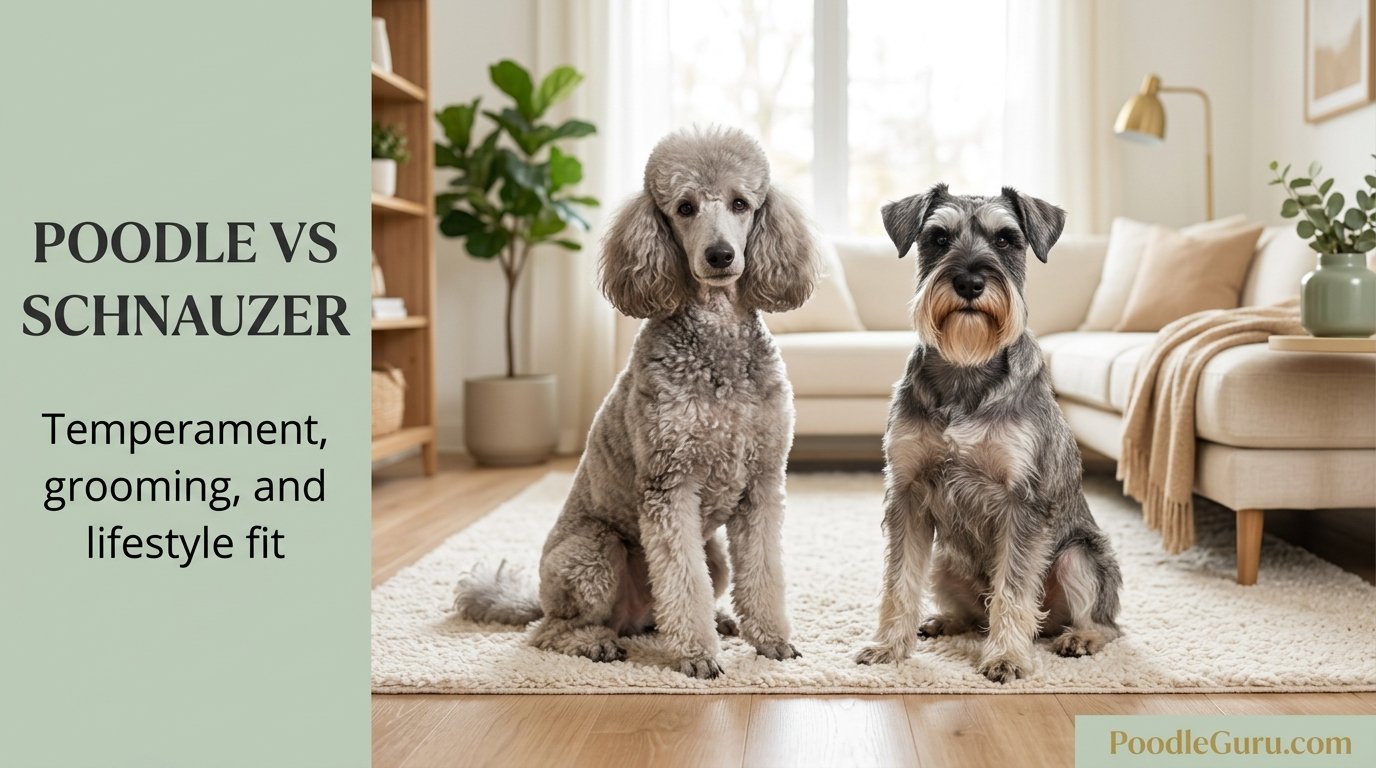
Poodle vs Schnauzer is a close match on intelligence and low shedding, but the daily ownership experience feels very different. One is a curly-coated genius with a flair for performance. The other is a wiry-coated workaholic with a built-in beard and eyebrows. Both are fiercely smart. Both need serious grooming. But under the surface, they differ in ways that will define your routine, training style, noise level, and long-term costs.
Quick Answer
If you want a sensitive, velcro-like companion who thrives on mental work and has a predictable single coat, choose the Poodle. If you prefer a scrappier, more independent guardian with a rugged wiry coat and a slightly more stubborn streak, the Schnauzer might be your match. Both need serious grooming. Neither is a low-effort dog — but the type of effort differs enormously. The Poodle demands regular clipping and detangling, while the Schnauzer requires hand-stripping or strategic clipping to maintain its trademark harsh coat.
In This Guide
- Quick Facts at a Glance
- What Is a Poodle?
- What Is a Schnauzer?
- The PoodleGuru 5-Point Companion Match Method
- Head-to-Head Comparison Table
- Coat & Grooming: The Real Difference
- Temperament & Lifestyle Match
- Health & Longevity
- Cost Comparison (2026)
- Common Buyer Mistakes & Red Flags
- Which Breed Fits Your Life?
- FAQs
- Final Summary & Key Takeaways
Quick Facts at a Glance
🐩 Poodle
Origin: Germany/France. Standardized breed with a documented history as water retrievers. AKC-recognized in three sizes: Toy, Miniature, and Standard.
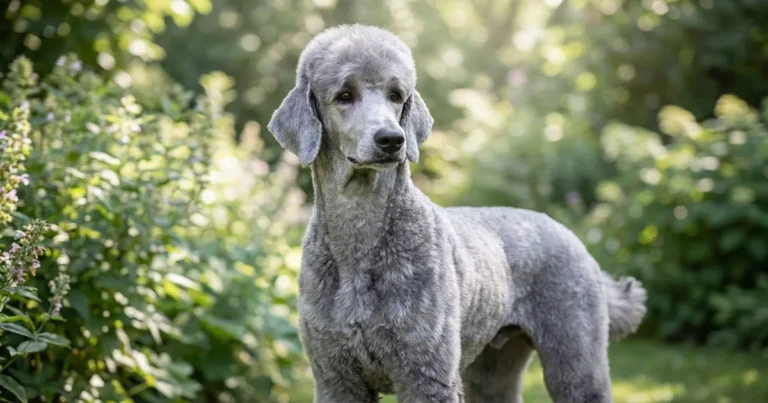
Coat: Single-coated, dense curls. Low-shedding but requires frequent professional clipping.
Core Temperament: Highly intelligent, sensitive, people-oriented, eager to please.
Lifespan: 10–18 years, depending on size.
🐕 Schnauzer
Origin: Germany. Bred as a versatile farm dog: ratter, guardian, and companion. AKC-recognized across Miniature, Standard, and Giant types.
Coat: Double-coated, wiry topcoat with a soft undercoat. Low-shedding but requires hand-stripping to maintain correct texture.
Core Temperament: Bold, alert, independent, playful, with strong guarding instincts.
Lifespan: 12–15 years, varying by size.
⚡ The Core Trade-Off
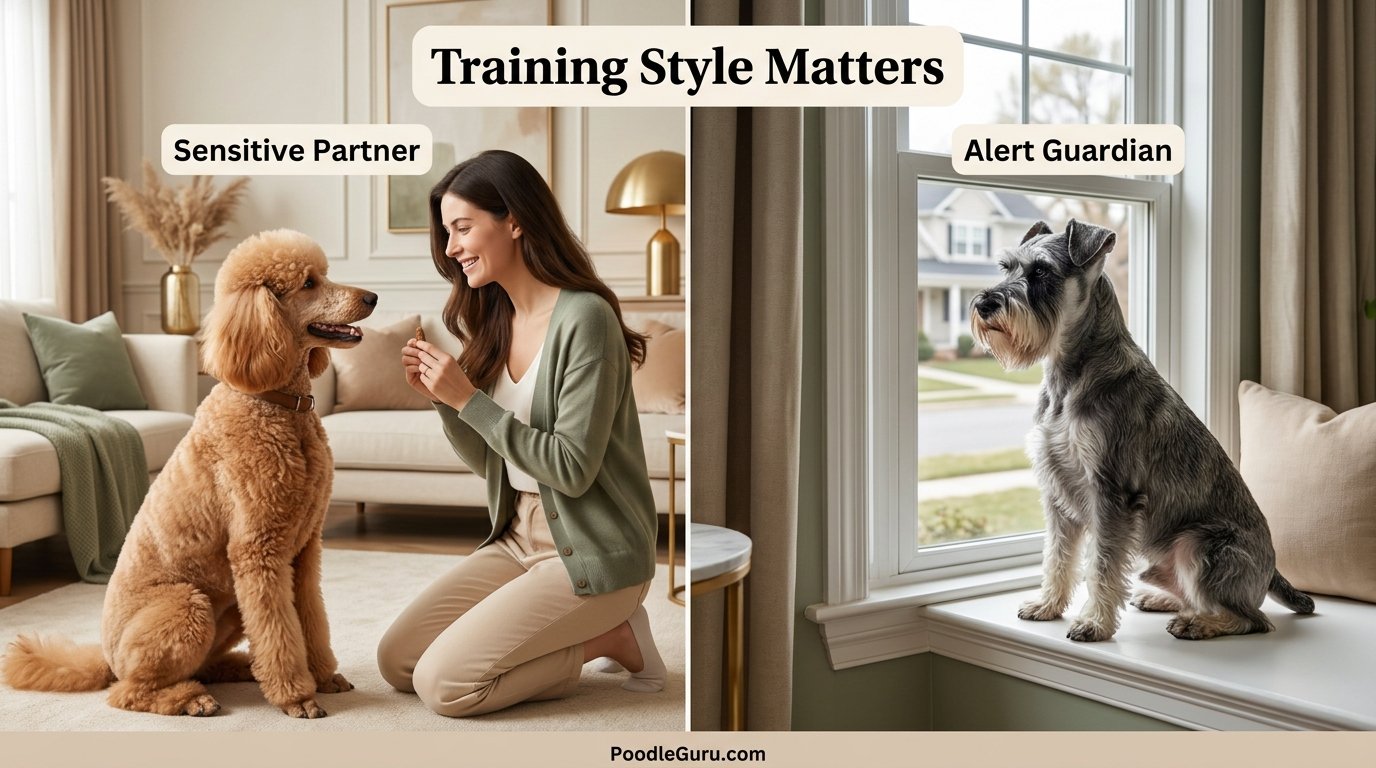
With a Poodle, you get a sensitive intellectual who wants to be your shadow. With a Schnauzer, you get a rugged, independent thinker who will guard your house but might question your commands. The Poodle aims to be your partner. The Schnauzer aims to be your equal. Your choice hinges on whether you want a dog who feels your emotions or one who watches for threats.
What Is a Poodle?
A Poodle is a purebred dog celebrated for its exceptional intelligence and athletic build. Originating as a water retriever, the breed is built for endurance and sharp thinking. For owners, this means living with a dog that rarely misses a pattern, thrives on complex training, and wants to be involved in everything you do.
The breed comes in multiple distinct sizes—Toy, Miniature, and Standard—which the AKC Poodle breed information recognizes formally. This gives you the rare ability to choose a Poodle that literally fits your living space while retaining core traits. The most important thing to understand is that Poodles are emotionally sensitive. Harsh corrections don’t just bounce off them; they can cause lasting wariness. Poodles don’t need a firm hand. They need a fair, consistent, and gentle guide.
At PoodleGuru, our complete Poodle size chart details the precise differences between these sizes so you can match a Poodle to your home’s physical and logistical constraints.
What Is a Schnauzer?
The Schnauzer is a German breed named for its distinctive muzzle (the word “Schnauze” means snout). Bred as an all-purpose farm dog, the Schnauzer’s job description included hunting vermin, herding livestock, and guarding the property. For owners, this creates a dog who is naturally vigilant, often vocal, and surprisingly playful—but rarely clingy.
Schnauzers also come in three sizes—Miniature, Standard, and Giant—each with slightly different energy profiles, though all share the breed’s trademark wiry coat, arched eyebrows, and bristly beard. The most important thing to understand is that Schnauzers have a high prey drive and a built-in suspicion of strangers that Poodles often lack. They aren’t aggressive without reason, but they will alert you and won’t back down easily. A Schnauzer isn’t just a companion; it’s a devoted and sometimes stubborn guardian.
The PoodleGuru 5-Point Companion Match Method
At PoodleGuru, we evaluate breed suitability using a five-factor framework designed to cut through generalizations. This method helps you weigh the Poodle vs Schnauzer decision against your real personality and lifestyle—not just a breed brochure.
Sensitivity Scale
How much do you value a dog’s emotional attunement? Poodles are finely tuned instruments; they read your mood like a book. Schnauzers are more resilient and less likely to be rattled by a chaotic household or a stern “no.” If you need a dog who mirrors your emotions, the Poodle wins. If you need a dog who stays steady in a busy, loud environment, the Schnauzer has an edge.
Guardian Instinct
Do you want a watchdog who will alert to every delivery? Schnauzers have a deeply ingrained guarding instinct—they watch the window and bark. Poodles will often bark at a knock on the door too, but they’re generally more social with strangers once introduced. If a strong protective streak matters to you, the Schnauzer fills that role more naturally.
Biddability vs. Independence
Poodles were bred to work closely with humans and generally want to get it right. Schnauzers were bred to work independently and might decide they have a better idea. Poodles are easier to train for precision work. Schnauzers learn fast but bore easily and can be stubborn. If you want a competitive obedience star, pick a Poodle.
Social Battery
Poodles often form intense bonds with one or two people and can be aloof with outsiders. Schnauzers tend to be more “party animal” with their family but can be outright suspicious of strangers. Both need early socialization, but the Poodle’s aloofness is often polite indifference, whereas the Schnauzer’s suspicion can escalate to reactivity if not managed.
Grooming Texture
This isn’t about frequency—it’s about texture and technique. Poodle coats are clipped with clippers; it’s a sculptural process. Schnauzer coats are traditionally hand-stripped (pulling out dead hair) to preserve the harsh, weather-resistant wire texture. Clipping a Schnauzer softens the coat and fades the color. If you can’t commit to hand-stripping or don’t mind a soft, faded coat, you need to know that going in.
Expert Insight
Most buyer regret between these two breeds comes from underestimating the Schnauzer’s independence or the Poodle’s sensitivity. Neither is a “Labrador in a different coat.” They are distinct working breeds with distinct emotional needs. Align those needs with your household rhythm, and either can be extraordinary.
Head-to-Head Comparison: Poodle vs Schnauzer
| Attribute | Purebred Poodle | Purebred Schnauzer |
|---|---|---|
| Breed Group | Non-Sporting for Standard/Miniature; Toy Group for Toy Poodle (AKC) | Working (Standard/Giant), Terrier (Miniature) |
| Size Options | Toy, Miniature, Standard | Miniature, Standard, Giant |
| Coat Type | Single coat, dense curly | Double coat, harsh wiry topcoat, soft undercoat |
| Shedding Level | Very Low | Very Low |
| Grooming Method | Clipping every 4–6 weeks | Hand-stripping or clipping every 6–8 weeks |
| Temperament Core | Intelligent, sensitive, eager to please | Bold, alert, independent, protective |
| Trainability | Exceptional; thrives on positive reinforcement | High but stubborn; needs creative motivation |
| Watchdog Ability | Moderate; will alert but generally social | Very High; natural guardian, often territorial |
| Exercise Needs | High mental + Moderate physical | High physical + Moderate mental |
| Common Health Risks | Bloat, Addison’s, Hip Dysplasia, SA | Pancreatitis, Bladder Stones, Comedone Syndrome |
| Lifespan | 10–18 years | 12–15 years |
| Puppy Price Range (2026) | $1,500–$4,000+ | $1,800–$3,500+ |
This table is built specifically for PoodleGuru, combining temperament traits, grooming techniques, and health predispositions in a way that standard size charts don’t capture. It prioritizes the daily reality of living with these breeds.
Coat & Grooming: The Real Difference
Coat care is the single biggest practical distinction between living with a Poodle and a Schnauzer. Both are celebrated as “hypoallergenic” or low-shedding breeds, but the upkeep is worlds apart.
The Poodle Coat: Sculpting in 6-Week Cycles
Poodles have a single coat of dense, curly hair. It’s less like fur and more like a continuous-growing fleece. For owners, this means the coat must be brushed thoroughly and trimmed or clipped on a consistent 4-to-6-week schedule. There’s no shedding season—just constant, steady growth. Without consistent brushing and professional clipping, Poodles mat painfully. The mats start close to the skin, trapping moisture and pulling tight.
Professional groomers commonly recommend a slicker brush and a long-toothed metal comb for Poodles, working in sections to ensure you reach the skin. The upside is that the Poodle’s coat is a blank canvas; you can choose any clip style from a sporty “kennel cut” to a continental trim. You can learn more about mastering this routine in our complete Poodle grooming guide.
The Schnauzer Coat: A Stripping Problem
Schnauzers possess a double coat: a harsh, wiry outer coat and a soft undercoat. In a perfect world, this coat is hand-stripped—dead outer hairs are plucked out by the root, allowing new, harsh wires to grow in. This preserves the coat’s natural weather resistance and rich pigment. But hand-stripping is a dying art, and it’s expensive.
Most modern pet Schnauzers are clippered. It’s faster and cheaper. But clippering cuts the wire hairs and soft undercoat indiscriminately, causing the coat to lose its harsh texture and fade to a lighter, softer gray. You’ll hear breeders say a clipped Schnauzer is “ruined” in coat quality. If you plan to show a Schnauzer, stripping is mandatory. If you want a pet, clippering is standard—but you must accept the soft, fluffy texture and color change. Veterinary guidance generally recommends Schnauzer owners pay special attention to the beard; it traps food and moisture and needs daily wiping to prevent bacterial buildup.
Grooming Reality Check
A Poodle requires a consistent, predictable grooming bill and schedule—like a haircut. A Schnauzer presents a philosophical choice: pay more for hand-stripping to preserve the breed’s signature harsh coat, or clip for convenience and live with a softer, lighter version of the dog you bought. There is no right answer, but you must pick one.
Temperament & Lifestyle Match
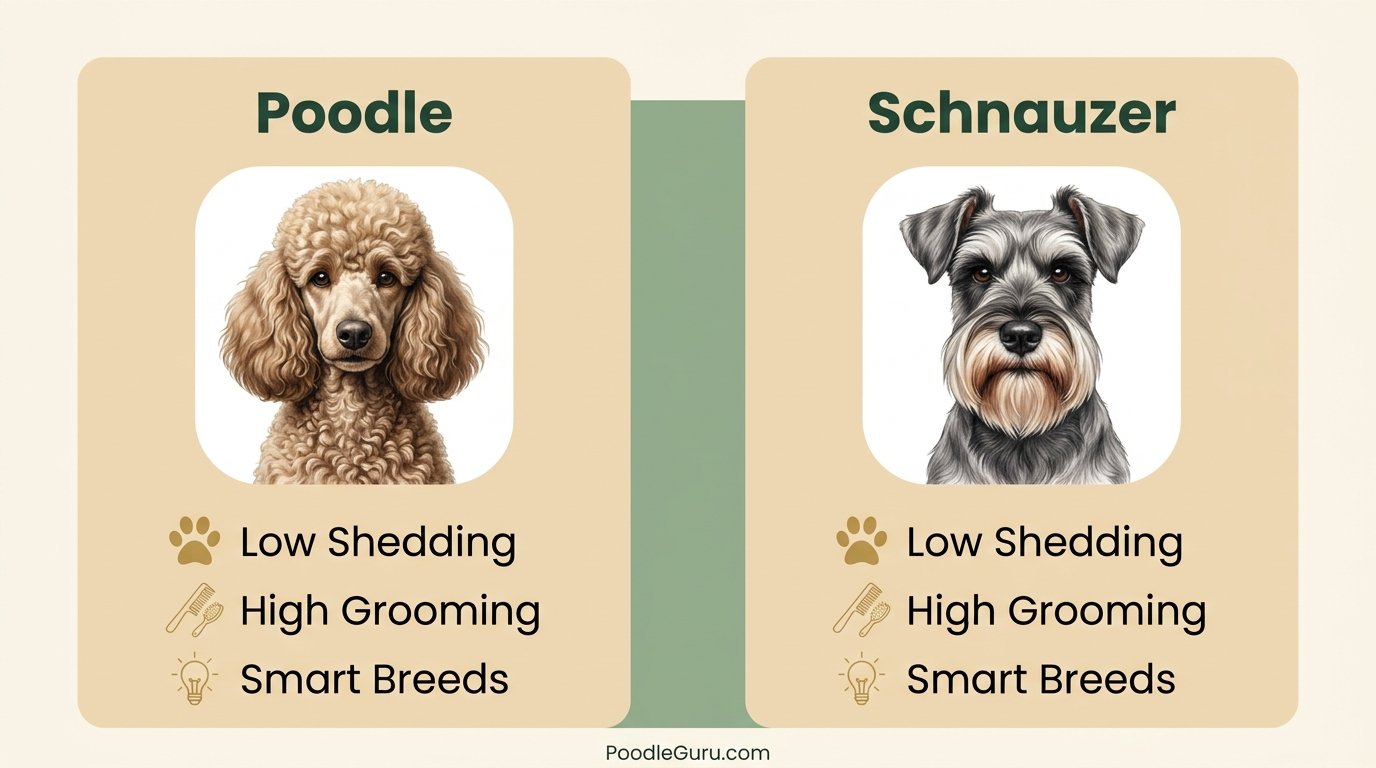
You can manage shedding and grooming with money. Temperament you live with every minute. The Poodle and Schnauzer diverge sharply here.
The Poodle: The Intellectual Partner
Poodles are intuitive. They are often described as “human-like” in their emotional intelligence. They thrive on cooperation and can become deeply anxious in environments filled with tension or anger. A Poodle doesn’t just want to do the job; it wants to do it with you. This makes them exceptional candidates for advanced obedience, therapy work, and agility. However, it also makes them prone to separation anxiety. A bored or lonely Poodle is a destructive whirlwind. Owners often notice their Poodle memorizes routines without formal training—they just watch and learn.
The Schnauzer: The Spirited Guardian
Schnauzers are not “biddable” in the same way. They were bred to kill rats on their own, chase livestock, and alert to intruders—decisions that required initiative, not permission. A Schnauzer loves its family fiercely but rarely obsesses over pleasing them. It wants the ball thrown, but it might play keep-away. It hears the command, but it might weigh whether it’s worth obeying.
This creates a dog with huge personality and enormous entertainment value—but it requires an owner with a sense of humor and a commitment to motivational training. Harsh methods don’t work; they just solidify stubbornness. In practice, a Schnauzer is often a much better “gatekeeper” than a Poodle, naturally patrolling the house and using its imposing voice.
Owner Tip: The Bark Factor
Both breeds can be vocal, but the Schnauzer’s bark is often deeper and more rapid-fire. It is a working terrier/guard dog’s primary tool. If you have shared walls or noise-sensitive neighbors, factor this in. Training can moderate it, but you won’t silence the guardian instinct entirely.
Health & Longevity
Both breeds are generally healthy with good breeding, but they carry different risk profiles that every buyer should know.
Poodles, particularly Standards, carry a risk for Gastric Dilatation-Volvulus (bloat), Addison’s disease, and Sebaceous Adenitis (SA)—a hereditary skin condition affecting the hair follicles. Miniature and Toy Poodles have their own predispositions, including luxating patellas and certain eye issues like Progressive Retinal Atrophy (PRA).
Schnauzers—especially Miniatures—are often watched closely for lipid-related pancreatitis risk, fatty-meal sensitivity, and calcium oxalate bladder stones. The Miniature Schnauzer specifically is associated with Schnauzer Comedone Syndrome, a condition causing distinctive blackheads along the back. Standard and Giant Schnauzers can also share large-breed concerns such as bloat and hip dysplasia with their larger Poodle counterparts.
For a deeper dive into breed-specific conditions, resources like VCA Animal Hospitals provide detailed medical overviews. At PoodleGuru, our guide to Poodle lifespan and long-term health covers aging across all three sizes.
When to Consult a Vet
This article discusses breed tendencies, not individual diagnoses. If you’re evaluating a puppy, have the breeder’s health testing results reviewed by your veterinarian. A breeder who screens for hips, eyes, and genetic markers for your specific breed and size—and can show results through resources like the OFA CHIC breed screening database—is worth their weight in gold for either a Poodle or a Schnauzer.
Cost Comparison: What You’ll Pay in 2026
Premium purebred puppies from health-tested parents command premium prices, and exact numbers vary by region, breeder reputation, health testing, size, and demand. There’s no getting around it: a “bargain” puppy often costs thousands more in the long run.
2026 Price Guide
Purebred Poodle puppy (well-bred planning range): $1,500–$4,000+. Rare colors like red or silver can push prices higher. Toy Poodles often sit at the top of this range due to demand and small litter sizes.
Purebred Schnauzer puppy (well-bred planning range): $1,800–$3,500+. Miniatures and Giants often vary significantly in price. Salt-and-pepper is common; solid black or white can be pricier.
Annual Grooming Costs: Budget $800–$1,500 per year for a Poodle (clipping every 4–6 weeks) and $900–$1,800 per year for a hand-stripped Schnauzer. A clipped Schnauzer matches Poodle costs. These numbers assume professional care; DIY is cheaper but requires skill.
What’s actually worth paying for: Health testing. A breeder who shows you OFA certifications for hips and patellas, plus current eye screening results recorded through OFA/CAER where applicable, is worth the price difference between a reputable breeder and a backyard one.
Common Buyer Mistakes & Red Flags
These two breeds look very different, but buyers still find ways to get confused—or get duped.
| Mistake | Why It Happens | How to Avoid It |
|---|---|---|
| Assuming “hypoallergenic” means no grooming | Marketing terms focus on shedding, not matting | Both breeds require professional-level grooming. The Poodle mats to the skin; the Schnauzer’s undercoat can compact into a painful pelt if ignored. |
| Thinking a Schnauzer is just a “Poodle with a beard” | Both are smart, non-shedding, and medium-sized | The Schnauzer’s terrier/working drive is fundamentally different from the Poodle’s retriever drive. Expect more independence, prey drive, and stubbornness. |
| Buying a “Toy Poodle” who is actually a tiny Schnauzer | Puppies with very short trims can look similar to untrained eyes | Check the paperwork. A Schnauzer’s ears are naturally button-shaped; Poodle ears are lobular and hang closer. The snout length also differs. |
| Ignoring the Schnauzer’s voice | Underestimating guardian breeds | Schnauzers use their bark. A lot. Apartment dwellers should think twice. Training from day one is non-negotiable to keep it manageable. |
Buyer Red-Flag Checklist
Walk away if the breeder: won’t show you health clearances for both parents, dismisses coat care as “easy,” sells multiple breeds, claims their “tiny teacup” Schnauzers or “royal” Poodles are rare, or can’t explain the difference between hand-stripping and clipping. Good breeders are nerds about their breed—they want you to know exactly what you’re getting.
Which Breed Actually Fits Your Life?
After laying out the coats, the costs, and the character, the decision often comes down to a few simple scenarios.
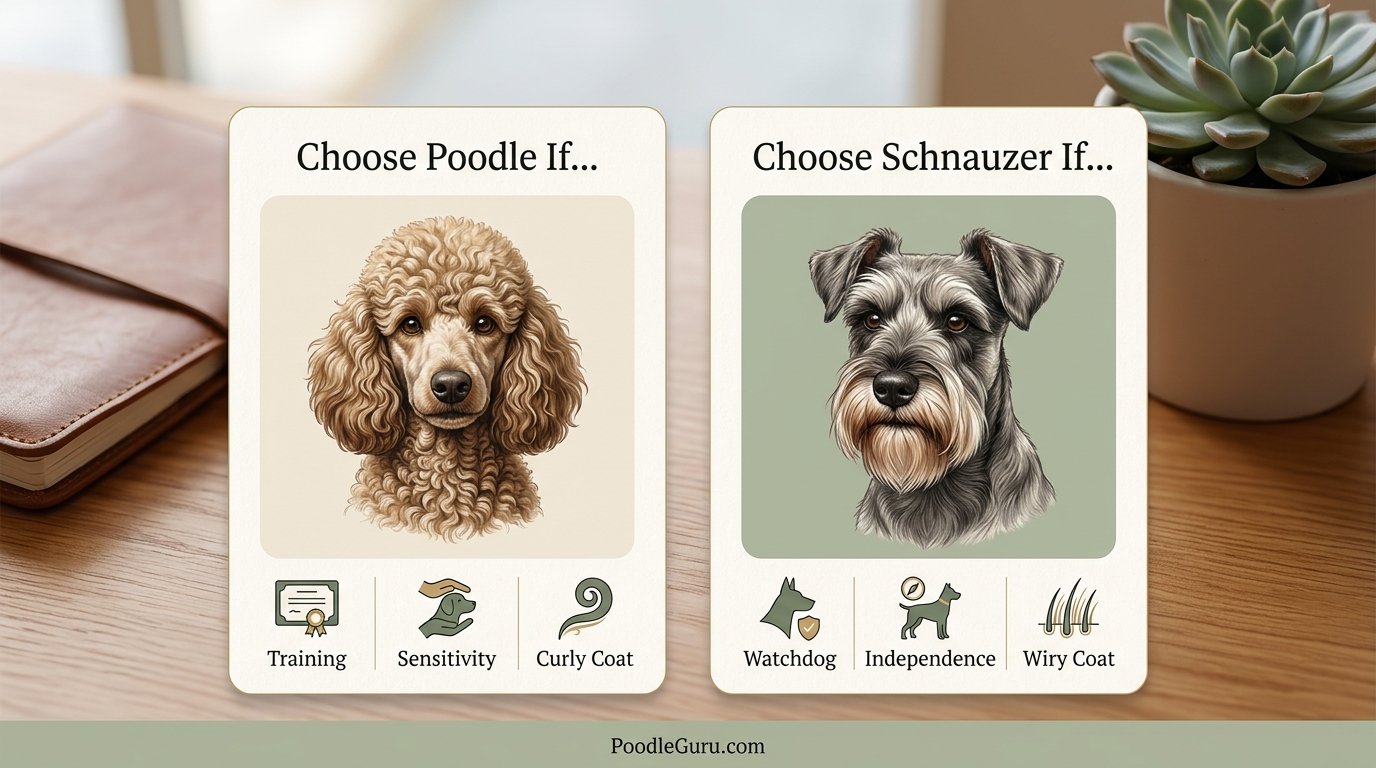
Choose a Poodle If…
You want a dog who lives to work with you. You love the soft, curly texture and don’t mind a 6-week salon schedule. You prefer a dog who is sensitive to your moods and generally welcoming to guests. You want to compete in dog sports where precision matters.
Choose a Schnauzer If…
You want a tough, hardy dog with a sense of humor. You don’t mind a dog who questions your authority occasionally. You appreciate the crisp, wiry coat texture and are willing to learn about stripping or accept the softened clipped version. You value an alert watchdog presence in your home.
Keep Looking If…
You’re hoping for a dog that requires minimal grooming—neither fits that bill. You want a silent dog—the Schnauzer is likely to disappoint. You want a guard dog who doesn’t need socialization—any intelligent breed can become reactive without it.
Frequently Asked Questions
Are Poodles or Schnauzers better for allergies?
Both are considered low-shedding, making them popular for allergy sufferers. Poodles have a single coat that traps dander effectively. Schnauzers shed very little but still produce dander, and their wiry hair can trap outdoor allergens. No dog is 100% hypoallergenic, but both breeds are generally excellent options for sensitive owners.
Which is easier to train, a Poodle or a Schnauzer?
Poodles are famously easier to train. They are highly biddable and live to please their handlers. Schnauzers are equally intelligent but much more independent. They learn commands quickly but often choose when to obey. Training a Schnauzer requires patience, creativity, and a good sense of humor.
Do Schnauzers shed as little as Poodles?
Yes, Standard and Miniature Schnauzers are minimal shedders thanks to their wiry double coat. You will find very little hair on your furniture. However, the grooming maintenance to prevent matting in the undercoat is just as intensive as managing a Poodle’s curls.
Are Poodles good watchdogs like Schnauzers?
Poodles will generally alert you to a knock at the door, but Schnauzers are natural guardians. A Schnauzer is far more likely to patrol the property and bark at potential threats. Poodles tend to be warmer with strangers once introduced, whereas Schnauzers remain reserved or suspicious.
Which needs more grooming, a Poodle or a Schnauzer?
They require roughly the same frequency of professional attention (every 4–8 weeks). Poodles need clipping and dematting. Schnauzers require hand-stripping to preserve the coat texture, or clipping which softens the coat. The daily upkeep for a Poodle often involves more brushing to prevent matting, while a Schnauzer needs beard cleaning plus regular ear checks and cleaning.
Which is better with kids, Poodle or Schnauzer?
It depends on the home’s energy. Standard Poodles are often very gentle and patient with calm, respectful children. Schnauzers, particularly Miniatures, can be less tolerant of rough handling and may nip if provoked. Standard and Giant Schnauzers are sturdier but can be boisterous. Early socialization is key for both breeds.
Which breed is healthier?
Both have specific health predispositions. Standard Poodles deserve extra attention for bloat, Addison’s, and sebaceous adenitis, while Miniature Schnauzers are often watched closely for lipid issues, pancreatitis risk, bladder stones, and comedone syndrome. Overall, both are generally healthy breeds when sourced from reputable breeders who perform comprehensive genetic and orthopedic testing. The breeder’s practices matter more than the breed label for individual health.
Can Schnauzers be left alone longer than Poodles?
Generally, yes. Schnauzers are more independent and less prone to severe separation anxiety than Poodles. Poodles often bond very intensely and can be emotionally reliant on their owners. While no dog should be left alone for extreme hours, a well-trained Schnauzer is often more self-sufficient than a Poodle.
Final Summary: Poodle vs Schnauzer
The Poodle vs Schnauzer choice is a clash of companion styles. The Poodle offers a sensitive, eager-to-please partnership wrapped in a curly, low-shedding coat that requires clipping. The Schnauzer offers a bold, independent, and protective friendship wrapped in a wiry, low-shedding coat that may require stripping or strategic clipping.
Poodles are often better for owners wanting predictability, sensitivity, and trainability. Schnauzers are often better for owners who appreciate a dog with a mind of its own, a strong voice, and a protective streak.
Key Takeaways
- Poodles have a single curly coat requiring clipping every 4–6 weeks; Schnauzers have a wiry double coat that traditionally requires hand-stripping to maintain its harsh texture.
- Poodles are highly sensitive and biddable, excelling in obedience and emotional attunement; Schnauzers are independent and bold, functioning as natural guardians.
- Both breeds are low-shedding, but neither is low-maintenance—expect similar grooming costs but very different grooming techniques.
- Schnauzers are generally more vocal and protective than Poodles, making them excellent watchdogs but challenging for noise-sensitive homes.
- Well-bred Poodles cost $1,500–$4,000+ and Schnauzers $1,800–$3,500+ in 2026, with lifetime grooming costs typically exceeding the purchase price.
- The most critical factor for either breed is finding a breeder who prioritizes health testing and temperament over color trends or convenience.