Why Does My Poodle Hump Things? Mounting Behavior Explained
Your poodle grabs a pillow, a visitor’s leg, or a favorite stuffed toy — and you’re mortified. Mounting behavior in poodles is rarely about what owners assume. Understanding the real triggers is the difference between solving the behavior and accidentally making it worse.

Poodle Humping Behavior: Quick Answer
Poodle humping behavior is most often driven by overexcitement, overarousal, or stress relief — not dominance or sexual drive. An intact male may hump due to hormones, but neutered males and female poodles hump for entirely different reasons. The behavior is a normal (if awkward) canine communication signal. The key to addressing it is identifying the specific trigger, not punishing the act.
Most Common Trigger
Overexcitement and overarousal — not dominance — drive the majority of poodle mounting episodes at home.
Not Gender-Specific
Both male and female poodles mount. Spayed females and neutered males exhibit the behavior regularly.
Highly Redirectable
With consistent calm interruption and replacement activities, mounting frequency can drop dramatically in weeks.
What Mounting Behavior Actually Means in Poodles
Mounting — also called humping — is a normal canine behavior that involves a dog clasping and thrusting against an object, another dog, or a person. In poodles, it’s frequently misread. Owners tend to see it and think one of three things: dominance, sexual motivation, or a “bad habit.” The reality is more layered.
Mounting is a displacement behavior in many contexts. A displacement behavior is something a dog does when caught between two conflicting impulses — excitement and uncertainty, for example. It’s the canine equivalent of a person pacing during a tense phone call. The act releases tension and brings the nervous system back toward baseline. That’s why it can look compulsive: it works, temporarily.
Poodles are a high-intelligence, high-sensitivity breed. They notice everything. A doorbell, a new guest, a change in routine, a too-long day without exercise — any of these can push a poodle past their arousal threshold. Mounting becomes the pressure-release valve. The most important thing to understand is that your poodle is not being “bad” or “dominant.” They’re communicating that something in their environment has exceeded their capacity to cope calmly.
The Real Triggers: Excitement, Stress, and Overarousal
The word “arousal” in canine behavior doesn’t mean sexual arousal. It means a state of heightened alertness and energy — the dog’s engine is revving too high. Mounting is one way that engine vents pressure. The triggers fall into several predictable categories.
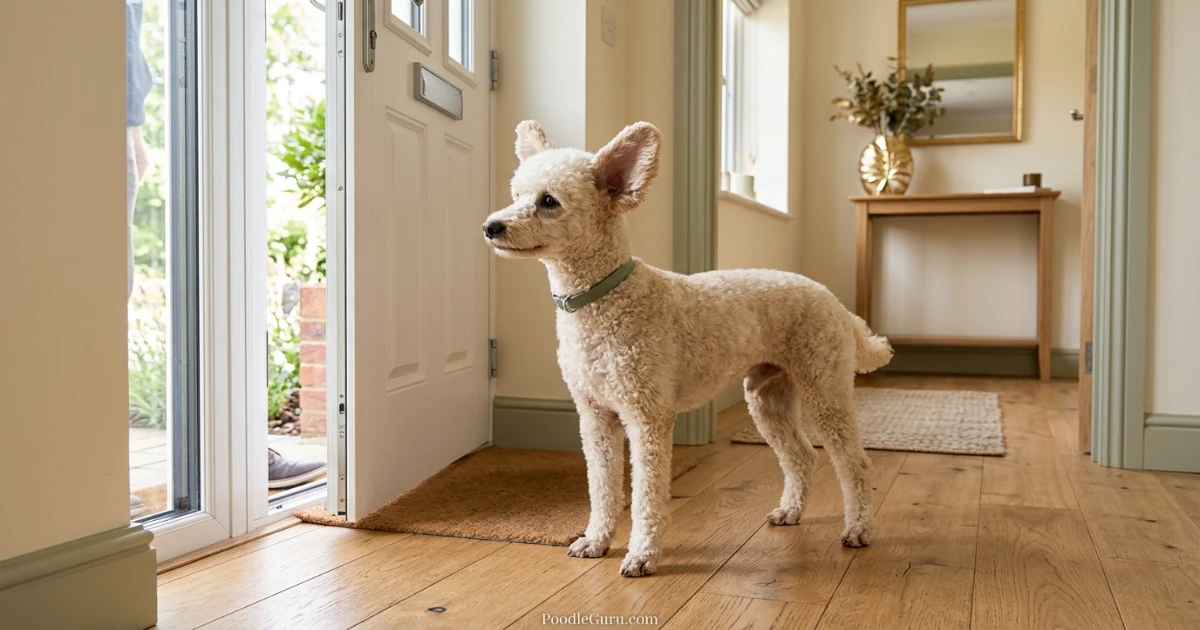
Social excitement is the most common trigger in poodles. When guests arrive, when another dog enters the room, or when play escalates past a certain intensity, mounting can appear almost reflexively. It’s not a calculated move. It’s a nervous system overflow. Some poodles mount the air in front of them, not even making contact with anything — the clearest sign that this is about internal state, not external target.
Stress displacement produces a similar-looking behavior but for opposite reasons. A poodle who is anxious about a new environment, a loud noise, or tension in the household may mount a pillow or toy repetitively. The repetition is soothing. It’s a self-regulation strategy, not a misbehavior.
Compulsive patterning can develop when mounting has been inadvertently reinforced. If a poodle mounts when bored and the owner reacts with attention — even negative attention like scolding — the behavior can become a learned attention-seeking strategy. Poodles are smart. They figure out what gets a reaction.
| Trigger Category | What It Looks Like | Common Poodle Scenario | Redirection Difficulty |
|---|---|---|---|
| Social Overexcitement | Mounting during greetings, play, or visitor arrival | Humping a guest’s leg within seconds of entry | Moderate — responds well to preemptive redirection |
| Stress Displacement | Mounting objects when environment is chaotic or unpredictable | Humping a bed after a tense household argument or during thunderstorms | High — requires addressing underlying anxiety first |
| Compulsive / Attention-Seeking | Mounting whenever owner is distracted or on the phone | Humping a cushion precisely when you sit down to work | Moderate — extinction requires zero reaction from owner |
| Play Escalation | Mounting other dogs during high-arousal chase or tug | Humping a playmate after 10 minutes of roughhousing at the park | Low — brief play interruption usually sufficient |
Male vs. Female Poodle Mounting: What Differs
Owners are often surprised to learn that female poodles mount just as much as males. The behavior is not sex-exclusive. What differs are the typical motivation patterns and the role of hormones.
Intact male poodles may mount more frequently due to circulating testosterone. A male who has not been neutered may direct mounting toward female dogs in heat, or toward objects that carry their scent. But even in intact males, the majority of household mounting is still arousal- or excitement-driven, not purely sexual. The distinction matters because neutering alone rarely solves mounting if the behavior has become a learned pattern.
Female poodles — both spayed and intact — mount for the same displacement and excitement reasons males do. Some intact females mount more during certain phases of their heat cycle due to hormonal fluctuations. Spayed females typically show no hormonally driven pattern, but they still mount during periods of high excitement or stress. A female poodle humping a favorite toy after a long day alone is displaying classic displacement behavior, not anything unusual.
Important: Neutering Is Not a Behavioral Cure-All
Veterinary behavior guidance generally notes that while neutering can reduce hormonally driven mounting in intact males, it does not resolve mounting rooted in excitement, stress, or learned patterns. If your poodle has been mounting for months, the behavior has likely become habit-based — and habit-based behaviors require training intervention, not surgery.
How Age and Hormones Shape Mounting Behavior
Mounting shows up differently across life stages. Knowing what’s typical for your poodle’s age helps you gauge whether the behavior is developmentally normal or worth a closer look.
Puppyhood (8 weeks–6 months): Mounting often appears early, even in very young puppies. At this stage, it’s almost never sexual — it’s exploratory and play-related. Puppies mount littermates, toys, and human hands because they’re testing motor patterns and social responses. Most puppies outgrow early mounting without intervention, as long as it’s not inadvertently rewarded with laughter or excited attention.
Adolescence (6–18 months): Hormones enter the picture for intact dogs. Mounting frequency may increase, and the behavior may become more directed — toward specific dogs, objects, or people. This is also the peak window for overarousal-related mounting, as adolescent poodles have adult energy but immature impulse control. Consistent, calm redirection during this phase prevents the behavior from hardening into a lifelong pattern.
Adulthood (18 months–7 years): In spayed and neutered adults, mounting should be occasional and clearly linked to identifiable triggers — a visitor arriving, an unusually exciting play session, a stressful event. If mounting is daily or seems random, it’s worth investigating underlying causes, including chronic stress or insufficient mental stimulation. For more on keeping a poodle mentally engaged, our complete poodle training guide covers enrichment strategies in detail.
Senior years (8+ years): New or increased mounting in a senior poodle deserves more attention. It can signal cognitive decline, discomfort (mounting as a pain displacement behavior), or urinary tract issues that create odd sensations. A senior poodle who suddenly starts mounting after years of not doing so should see a veterinarian to rule out medical causes.

Owner Mistakes That Make Humping Worse
Most owners respond to mounting with some combination of yelling, pushing the dog off, or nervously laughing it away. These reactions feel natural, but they can accidentally reinforce the exact behavior you want to stop. Poodles read attention as currency. Even negative attention is attention.
| Mistake | Why It Backfires | What to Do Instead |
|---|---|---|
| Yelling or scolding during mounting | Adds excitement and attention to an already overaroused dog; can increase the behavior | Interrupt calmly with a neutral cue, then redirect to a settled activity |
| Physically pushing the dog off | Can feel like play contact to the dog; may escalate mouthing or wrestling | Use a lightweight drag line to guide the dog away without physical confrontation |
| Laughing or giving affection during mounting | Directly rewards the behavior; the dog learns humping gets positive attention | Withdraw all attention immediately — turn away, stand up, leave the room briefly |
| Punishing the dog after the fact | Dogs don’t connect delayed punishment to the earlier act; creates fear without learning | Only interrupt in the moment; never punish retroactively |
The PoodleGuru Redirect-and-Replace Method
At PoodleGuru, we approach mounting behavior as a communication signal that needs redirection — not suppression. Punishing a displacement behavior doesn’t resolve the underlying arousal; it just removes one outlet and may push the dog toward a different (sometimes worse) displacement behavior. The goal is to teach your poodle a more acceptable way to regulate their nervous system.
Interrupt Neutrally
The moment mounting begins, use a calm interrupter — a gentle “oops” or “easy” — not an angry shout. Your tone matters more than the word. You’re aiming for “let’s do something else,” not “you’re in trouble.”
Redirect to a Settling Activity
Immediately offer a calming replacement: a stuffed Kong, a chew toy, a “find it” scatter of kibble on the floor, or a short training sequence of sits and downs. The activity should engage the mouth or brain in a settling way — sniffing and chewing are naturally calming for dogs.
Manage the Environment Proactively
Identify the specific trigger that preceded the mounting. If it’s guest arrivals, give your poodle a stuffed Kong in another room before the doorbell rings. If it’s post-play overarousal, build a two-minute calm-down break into every play session. Prevention is more effective than interruption.
Increase Baseline Calm
Mounting is often a symptom of chronic low-grade overarousal. More sniffy walks, more chew time, and more predictable routines reduce the baseline arousal that makes mounting likely. A tired, mentally satisfied poodle mounts far less than an under-stimulated one.
Owner Quick Checklist: Reducing Mounting in 7 Days
- Remove the most commonly mounted object (pillow, toy) from free access for one week — break the pattern first.
- Add one extra 15-minute sniff walk or chew session daily — lower baseline arousal.
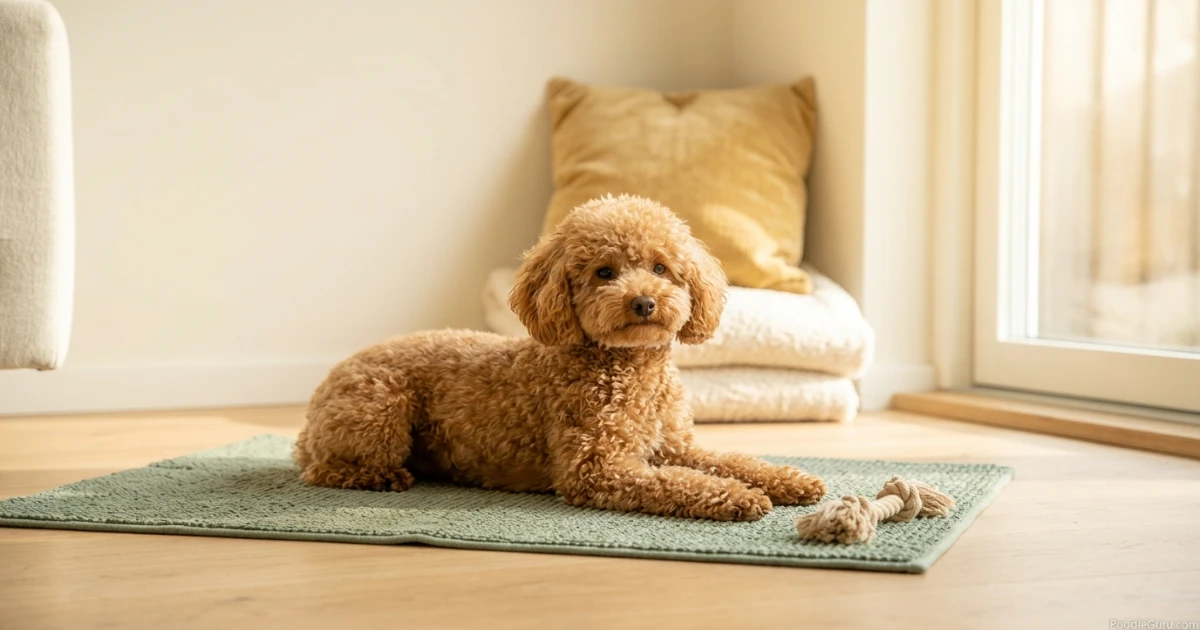
- Practice “go to mat” or “settle” training for 5 minutes, twice daily — build an alternative self-regulation skill.
- Zero reaction to mounting: stand up, turn away, leave the room for 30 seconds.
- Track episodes in a notes app: time, trigger, and target — patterns will emerge within days.
When Mounting Signals a Deeper Problem
Mounting is almost always behavioral, but there are a few situations where a veterinary visit is the right next step. Medical issues can produce sensations that trigger mounting or compulsive humping, and ruling those out prevents wasted training effort.
A urinary tract infection can cause irritation that leads to increased mounting or licking in the genital area. Skin allergies or irritations in the groin or belly can produce similar displacement mounting. In senior dogs, cognitive decline sometimes manifests as repetitive behaviors — mounting, circling, or pacing — that weren’t present before. And in rare cases, neurological conditions can produce compulsive mounting that doesn’t respond to behavioral intervention.
Ask Your Vet If…
- Mounting starts suddenly in a previously non-mounting adult or senior poodle.
- The behavior is accompanied by excessive licking of the genital area, frequent urination, or signs of discomfort.
- Mounting has become so frequent it interferes with eating, sleeping, or normal daily activities.
- Your poodle seems unable to stop even when you attempt to redirect — this can indicate a compulsive disorder.
For deeper reading, the ASPCA guide to mounting and masturbation in dogs explains why dogs may mount people, objects, and other animals. The AKC overview of dog humping and mounting also notes that sudden or excessive mounting can sometimes point to irritation, infection, or another medical issue.
What Experienced Poodle Owners Understand That New Owners Miss
Long-time poodle owners tend to develop a different relationship with mounting behavior. Not because they ignore it — but because they stop personalizing it. A poodle mounting a pillow isn’t defying you. A poodle humping a guest’s leg isn’t trying to embarrass you. These are projections that make the behavior feel bigger and more loaded than it actually is.
Poodles are emotionally sensitive dogs. They absorb household tension, mirror excitement levels, and respond to unpredictability with displacement behaviors. When experienced owners see mounting, they don’t think “bad dog.” They think: “What’s too much right now? What does my poodle need less of — or more of?” That reframe changes everything about how the behavior is handled.
If your poodle is also showing other signs of stress or reactivity beyond mounting, our poodle temperament guide explores the full picture of poodle personality and emotional needs.
Frequently Asked Questions
Is it normal for my female poodle to hump things?
Yes. Female poodles mount for the same reasons males do — excitement, stress displacement, and play escalation. Spaying reduces hormonally influenced mounting but does not eliminate the behavior when it’s rooted in arousal or habit.
Will neutering stop my male poodle from humping?
Neutering can reduce mounting directly driven by testosterone, but most household mounting is excitement- or stress-based, not hormonal. If the behavior has been practiced for months, it’s likely a learned habit that requires training redirection regardless of neuter status.
Why does my poodle only hump one specific pillow?
That pillow has become a conditioned trigger. The poodle mounted it once, found the act regulating, and the object became a learned target. Removing the pillow temporarily while teaching alternative calming behaviors usually breaks the pattern.
Should I punish my poodle for humping guests?
No. Punishment adds excitement and attention to an already overaroused dog and can increase the behavior. Instead, manage the environment proactively — give your poodle a calming activity before guests arrive and interrupt mounting neutrally with redirection.
Why does my poodle hump after playing with other dogs?
Play escalates arousal levels. Mounting at the end of a play session is a common arousal-release behavior. Brief play breaks every few minutes help keep arousal below the threshold where mounting occurs.
Can anxiety cause poodle humping behavior?
Yes. Mounting is a well-documented displacement behavior in dogs — a self-soothing action performed during stress or conflict. If mounting increases during thunderstorms, household tension, or routine changes, anxiety is a likely driver.
How long does it take to reduce mounting with training?
With consistent neutral interruption and redirection, most owners see a meaningful reduction in mounting frequency within two to three weeks. The key is consistency: every family member must respond the same way every time.
When should I see a vet about my poodle’s mounting?
See a vet if mounting starts suddenly in a previously non-mounting adult or senior, is accompanied by excessive genital licking or urination changes, or has become so frequent it interferes with normal eating, sleeping, or daily activities.
Key Takeaways: Understanding Poodle Humping Behavior
- Poodle humping behavior is most often a displacement response to overexcitement, stress, or overarousal — not dominance or purely sexual drive.
- Both male and female poodles mount; neutering helps only when the behavior is directly hormone-driven, not when it’s a learned habit.
- The PoodleGuru Redirect-and-Replace Method prioritizes calm interruption and replacement activities over punishment, which can backfire.
- Attention — even negative attention like scolding — can reinforce mounting in poodles; zero-reaction withdrawal is more effective.
- New or escalating mounting in senior poodles warrants a veterinary evaluation to rule out medical causes, including cognitive decline or discomfort.
- Track episodes by trigger, time, and target — patterns become visible within days and guide your management strategy.