Poodle Deaf Symptoms: Causes, Signs & Living With a Deaf Poodle
Deafness in poodles can be present from birth or creep in quietly with age. But noticing the first poodle deaf symptoms early, understanding what’s behind them, and adapting your home can make all the difference to your dog’s quality of life — and your bond.
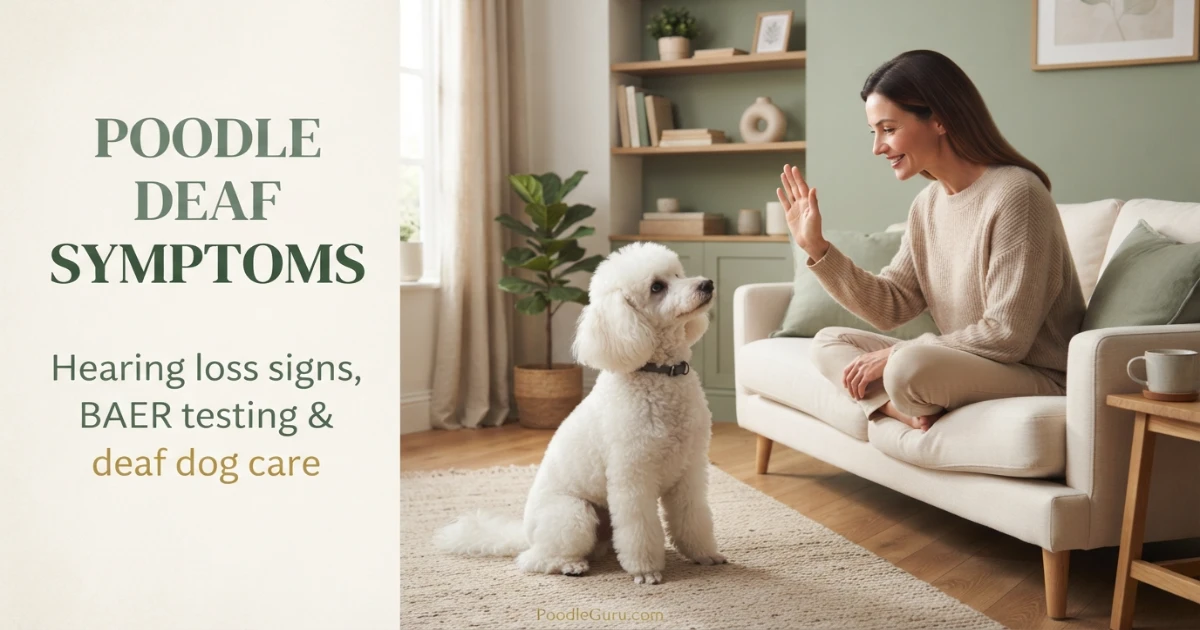
Quick Answer: What Are Poodle Deaf Symptoms?
Poodle deaf symptoms include a lack of response to familiar sounds — like the doorbell, a squeaky toy, or their name called from another room. Deaf puppies may not wake when littermates stir, and older poodles may sleep through sounds that once startled them. Because poodles are attentive and visually aware, early hearing loss can be easy to miss. The most telling sign is when a dog that once greeted you at the door no longer notices your arrival until they see you. A veterinary ear exam and, when needed, BAER testing are the safest way to confirm what is happening.
In This Guide
- Understanding Deafness in Poodles
- Types of Deafness: Congenital vs. Acquired
- Causes of Deafness in Poodles
- Spotting Poodle Deaf Symptoms at Every Age
- The PoodleGuru Deafness Adaptation Framework
- How to Test Your Poodle’s Hearing at Home
- Living With a Deaf Poodle: Practical Adjustments
- Training a Deaf Poodle: Hand Signals & Vibrations
- When to Consult a Veterinarian or Specialist
- Common Myths About Deaf Poodles
- FAQs
More Common Than Many Think
Congenital deafness is uncommon in poodles, but age-related hearing loss becomes more likely in senior dogs. Early detection matters for safety, training, and quality of life.
Two Main Types
Conductive deafness involves the outer or middle ear and can sometimes be treated. Sensorineural deafness involves the inner ear or auditory nerve and is usually permanent.
Deaf Poodles Live Full Lives
With visual cues, vibration signals, and a few environmental tweaks, a deaf poodle can learn, play, and bond just as deeply as a hearing dog.
Understanding Deafness in Poodles
Deafness is the partial or complete inability to hear in one or both ears. For poodle owners, this means recognizing that hearing loss may be present at birth, develop gradually during adulthood, or appear suddenly after infection, medication exposure, trauma, or aging. The most important thing to understand is that deafness isn’t a reflection of intelligence or temperament — deaf poodles are just as bright and trainable as their hearing counterparts.
Veterinary hearing experts describe deafness as either conductive (a mechanical blockage in the outer or middle ear) or sensorineural (damage to the inner ear or auditory nerve). Conductive cases can sometimes be reversed with treatment. Sensorineural loss is generally permanent. VCA Animal Hospitals explains that canine deafness can be present from birth or acquired later, and early recognition helps owners adapt more smoothly.
Types of Deafness: Congenital vs. Acquired
Not all hearing loss looks the same. The table below breaks down the key differences every poodle owner should know.
| Feature | Congenital Deafness | Acquired Deafness |
|---|---|---|
| When it appears | Present at birth or within first few weeks of life | Develops later — from a few months old to senior years |
| Typical cause in poodles | Genetic or developmental inner-ear changes; pigment-associated deafness is recognized in some dog breeds, but coat color alone cannot diagnose hearing status | Chronic ear infections, ototoxic medications, noise trauma, or aging (presbycusis) |
| Reversibility | Usually permanent when the inner ear or auditory pathway did not develop normally | Sometimes reversible if the underlying condition (e.g., infection) is treated early; age-related loss is permanent |
| Common poodle associations | Uncommon in poodles overall; any suspected puppy deafness should be confirmed with BAER testing | Frequent ear infections in any poodle size; senior poodles may develop age-related hearing decline |
| Diagnostic tool | Brainstem Auditory Evoked Response (BAER) test — detects electrical activity in the auditory pathway | Veterinary ear exam, history, and BAER testing when hearing loss needs confirmation |
Causes of Deafness in Poodles
Several distinct factors can reduce a poodle’s hearing. Some are treatable when caught early; others are congenital or age-related and may be permanent. Here are the most common pathways:
- Congenital or pigment-associated deafness: In dogs, congenital deafness can be linked with inner-ear development and pigment-associated genetics in some breeds. In poodles it is considered uncommon, and coat color alone cannot confirm risk — BAER testing is needed when puppy deafness is suspected.
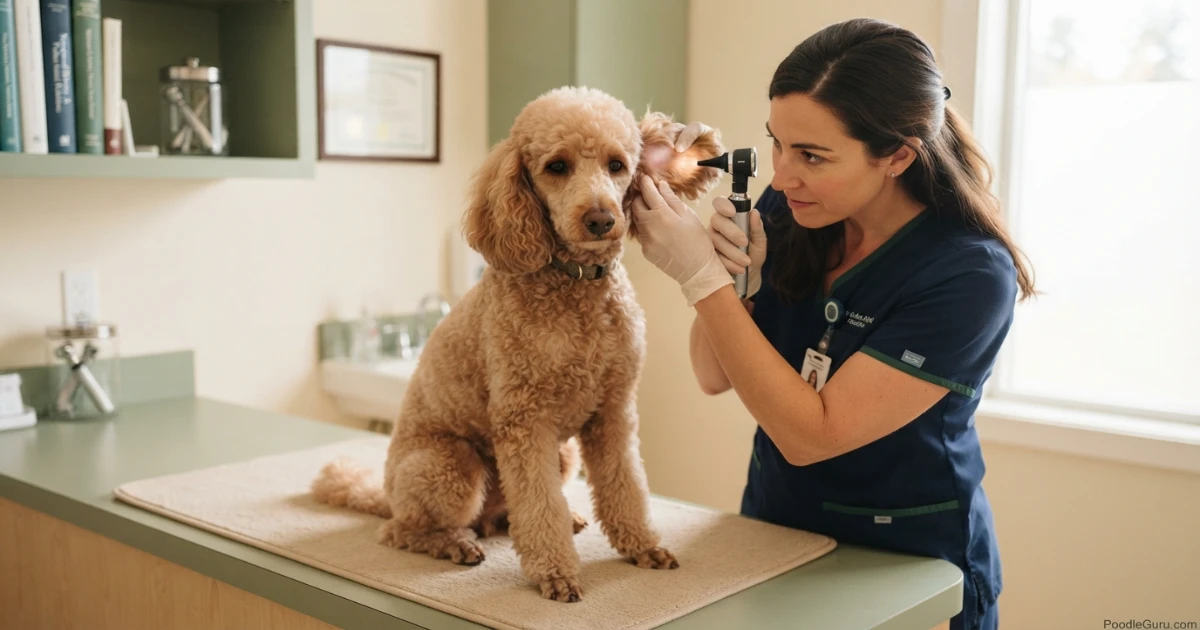
- Chronic otitis externa: Poodles’ narrow, hairy ear canals trap moisture and wax. Repeated infections can thicken the ear lining and eventually damage the eardrum and middle ear bones, causing conductive deafness.
- Ototoxic medications: Certain antibiotics (aminoglycosides), some ear cleaning solutions, and chemotherapy drugs can damage the cochlea. Always confirm ear medication safety with your vet, especially if your poodle already has reduced hearing.
- Noise trauma: A single extremely loud event — such as a gunshot close to the ear or a firework explosion nearby — can contribute to permanent sensorineural hearing loss.
- Presbycusis (age-related hearing loss): Just like humans, senior poodles slowly lose the ability to hear high frequencies first. This is a common cause of hearing decline in senior poodles.
Spotting Poodle Deaf Symptoms at Every Age
Poodle deaf symptoms change depending on when the hearing loss begins. Here’s what to watch for across life stages.
Puppy (8 weeks–6 months)
Deaf puppies don’t startle at loud noises. They may sleep through feeding time while littermates rush to the bowl. They often play roughly because they miss the yelps that signal “too hard.” A deaf puppy usually relies heavily on visual contact and may seem unusually clingy — not out of anxiety, but because they track you by sight.
Adult (1–7 years)
Acquired deafness in adulthood often begins subtly. Your poodle might stop reacting to the squeak of a toy, ignore a recall command from another room, or fail to notice the doorbell. Because poodles are so visually focused, they compensate well, and you might mistake the change for stubbornness. Watch for a pattern: the same dog that once responded instantly now only comes when they can see you.
Senior (8+ years)
Age-related hearing decline is gradual. High-frequency sounds — the jingle of keys, a bird chirping — fade first. Your senior poodle may sleep more deeply and be harder to rouse. Increased barking or vocalizing sometimes appears when they can no longer monitor sounds in the house. They might startle more easily when touched unexpectedly, so always approach within their line of sight. PetMD covers hearing loss in dogs and notes that many owners first notice the change when their dog no longer responds to a favorite treat bag crinkle.

The PoodleGuru Deafness Adaptation Framework
At PoodleGuru, we’ve developed a simple four-step method to help owners move from suspicion to confidence when deafness is diagnosed. It’s called the ACAE Framework: Assess, Communicate, Adapt, Enrich.
Assess
Document the specific poodle deaf symptoms you’re seeing. Note which sounds are missed, when the behavior started, and whether it’s getting worse. Share this log with your veterinarian to decide if a BAER test or ear exam is needed.
Communicate
Replace verbal cues with consistent hand signals. Teach a “look at me” signal as the foundation for all future communication. Pair signals with gentle floor vibrations (a stomp they can feel) to get attention without startling them.
Adapt
Make the environment predictable. Keep furniture layouts stable. Use baby gates instead of calling them back. Attach a small bell to your deaf poodle’s collar so you can locate them indoors. Establish a routine for entering and leaving the house so they always know where you are.
Enrich
Deaf dogs rely on scent and sight for stimulation. Offer puzzle toys, scent trails, and window perches. A deaf poodle’s world can be just as rich as a hearing dog’s when you lean into their other senses.
How to Test Your Poodle’s Hearing at Home
You can do simple observations before heading to the vet. These steps do not diagnose deafness, but they can help you document patterns and decide whether a veterinary ear exam or BAER test is needed.
Observe Everyday Sound Responses
Stand behind your poodle when they are calm and not looking at you. Use a normal household sound such as a treat bag, keys, or a food bag crinkle. Note whether they turn an ear, glance back, or ignore the sound. Repeat at different distances, but avoid creating floor vibration, shadows, or air movement that could cue them visually or physically.
Tool: Your usual treat bag or a set of keys.
Perform a Controlled Sound Test
Wait until your poodle is resting quietly but not deeply asleep. From several feet behind them, make a moderate sound that will not frighten them, such as a normal clap or treat-bag crinkle. If they repeatedly show no reaction across different sounds and settings, document it and schedule a vet exam. Remember not to create a breeze, shadow, or floor vibration that they might feel; true sound detection is what you’re screening.
Outcome: Repeated lack of response suggests hearing loss is possible and should be checked professionally.
Consult a Veterinarian for BAER Testing
If home tests indicate a problem, schedule a BAER (Brainstem Auditory Evoked Response) test. This non-invasive procedure measures electrical activity in the ear and hearing pathway and can confirm whether each ear detects sound. Your vet or specialist will combine BAER results with an ear exam and history to understand the likely cause. It’s the gold standard, especially for puppies suspected of congenital deafness.
Next step: Ask your vet for a referral to a veterinary neurologist, veterinary specialist, or teaching hospital that offers BAER testing.
Living With a Deaf Poodle: Practical Adjustments
Once deafness is confirmed, small changes create a safe, happy world. Here’s what to prioritize.
- Leash safety is non-negotiable. A deaf dog can’t hear cars, bicycles, or recall commands. Use a secure harness and a bright “I am deaf” tag on the collar or leash.
- Visual door signals. Train your poodle to watch for a flashlight beam or a porch light flash as a signal to come inside. A stomp on the deck can also work if they’re nearby.
- Wake gently. Always approach from the front. Place your hand softly on their shoulder or back, avoiding sudden touches that cause defensive startles.
- Use vibration collars thoughtfully. These are not shock collars; they buzz gently like a phone. A quick buzz can serve as a “come” or “look at me” cue when your poodle is across the yard. Introduce with positive reinforcement — treat, buzz, treat — so the vibration predicts good things.
A complete overview of breed health challenges, including sensory changes in seniors, is available in our Poodle Health Issues guide.
Training a Deaf Poodle: Hand Signals & Vibrations
Deaf poodles can learn beautifully with clear visual cues and positive reinforcement. The key is consistency. Choose distinct hand signals for sit, stay, come, down, and “good dog.” A thumbs-up works well as a marker signal, replacing the clicker. To get attention from across the room, stomp your foot twice (they’ll feel the vibration) or flash the lights quickly. Always reward with a smile, a treat, and a soft touch so they connect the signal with joy.
If you’re working with a deaf puppy, begin shaping these signals as early as you would with a hearing pup. The same gentle, positive approach applies. Need guidance on puppy foundations? Our Poodle Puppy Training Guide can help you build a strong start.

When to Consult a Veterinarian or Specialist
Not every hearing change requires an emergency visit, but some scenarios do call for prompt professional input.
Contact your vet if:
- You notice a sudden loss of hearing, especially if accompanied by head shaking, ear odor, or balance issues.
- Your puppy never reacts to loud sounds by 4–5 weeks of age.
- Your poodle’s ears appear red, swollen, or have dark discharge — these could indicate an infection that may cause temporary conductive deafness.
- Hearing loss occurs after starting a new medication or ear cleaner.
A veterinarian can examine for infection, wax buildup, eardrum problems, or medication-related concerns. A veterinary neurologist or specialist can perform BAER testing when the degree of hearing loss needs confirmation.
Common Myths About Deaf Poodles
Myth: Deaf poodles can’t be trained.
Reality: They learn brilliantly with visual cues, hand signals, and vibration prompts. Many can enjoy obedience, enrichment, and sport-style activities with safe visual communication.
Myth: All white poodles are deaf.
Reality: Pigment-associated deafness exists in dogs, but coat color alone does not diagnose hearing status. Many white poodles hear normally, and any concern should be confirmed with appropriate testing.
Myth: Deafness always means a lower quality of life.
Reality: With owner awareness and small home adaptations, deaf poodles enjoy rich, engaged lives. They simply experience the world through eyes, nose, and vibration.
Myth: You can cure deafness with medication or surgery.
Reality: Conductive hearing loss from infection, wax, or blockage may improve with veterinary treatment. Sensorineural deafness is usually permanent, so management focuses on safety, communication, and quality of life.
Frequently Asked Questions
Can poodles be born deaf?
Yes. Congenital deafness can occur in dogs, including poodles, but it is uncommon in the breed overall. Pigment-associated deafness is recognized in some breeds, but coat color alone cannot confirm hearing status. BAER testing is the best way to check a puppy suspected of being deaf.
At what age do poodles start losing their hearing?
Age-related hearing loss can begin in the senior years, often around 9–10 years old, though signs may not be obvious until later. High-frequency sounds fade first. Dogs with a history of chronic ear infections may lose hearing earlier.
What does the BAER test involve for poodles?
The Brainstem Auditory Evoked Response (BAER) test places tiny electrodes on the scalp to measure the brain’s response to clicking sounds. It is generally quick and non-invasive and can show whether each ear responds to sound. Puppies can often be tested from around six weeks of age, depending on the testing center.
Can ear infections cause permanent deafness in poodles?
Yes, severe or recurrent ear infections can contribute to lasting hearing problems if they damage the ear canal, eardrum, or middle ear. Some infection-related conductive hearing loss improves with prompt veterinary treatment, but not every case is reversible.
Are vibration collars safe for training deaf poodles?
A vibration-only collar can be useful for some deaf poodles when introduced gently with positive reinforcement. It should never deliver shock. Start by pairing a soft vibration with treats so the sensation predicts something good, then use it as a “look at me” cue in safe settings.
How do I keep my deaf poodle safe outdoors?
Always use a secure harness and leash. Consider a brightly colored vest or collar tag that says “I am deaf.” In the yard, ensure fencing is secure and that your poodle can see you before you open a gate. A long training line can provide freedom without risk.
Will my deaf poodle still bark?
Many deaf poodles bark — sometimes more than hearing dogs because they can’t modulate volume. They may also bark less, relying on visual cues instead. Every dog is different, and training can help shape appropriate vocal behavior.
Key Takeaways: Poodle Deafness & Next Steps
Deafness doesn’t define your poodle — it’s simply a shift in how you communicate and connect.
- Poodle deaf symptoms include ignoring familiar sounds, sleeping through loud noises, and only responding when visual contact is made.
- Deafness can be congenital (present at birth) or acquired later from ear infections, medications, noise trauma, or aging.
- A BAER test is the definitive way to diagnose and measure hearing loss; at-home sound tests are useful screening tools but not conclusive.
- The PoodleGuru ACAE Framework — Assess, Communicate, Adapt, Enrich — provides a clear path from diagnosis to thriving.
- Hand signals, vibration-only cues when appropriate, and consistent routines allow deaf poodles to learn and live fully.
- Prompt treatment of ear infections can prevent some forms of acquired deafness; routine ear care is a powerful preventive tool.
If you suspect your poodle is losing hearing, start by documenting the symptoms and scheduling a veterinary ear exam. A clear diagnosis is the foundation for every positive adaptation that follows.