Why Is My Poodle Marking Indoors? Understanding & Stopping Territorial Urination
There’s a specific kind of frustration reserved for the poodle owner who knows their dog is perfectly house-trained, yet keeps finding small puddles on furniture legs, doorways, and new objects. This isn’t a potty-training relapse. It’s marking — and it has its own set of rules. The good news is poodles respond to a clear, methodical plan once you understand what’s actually driving the behavior.
Quick Answer
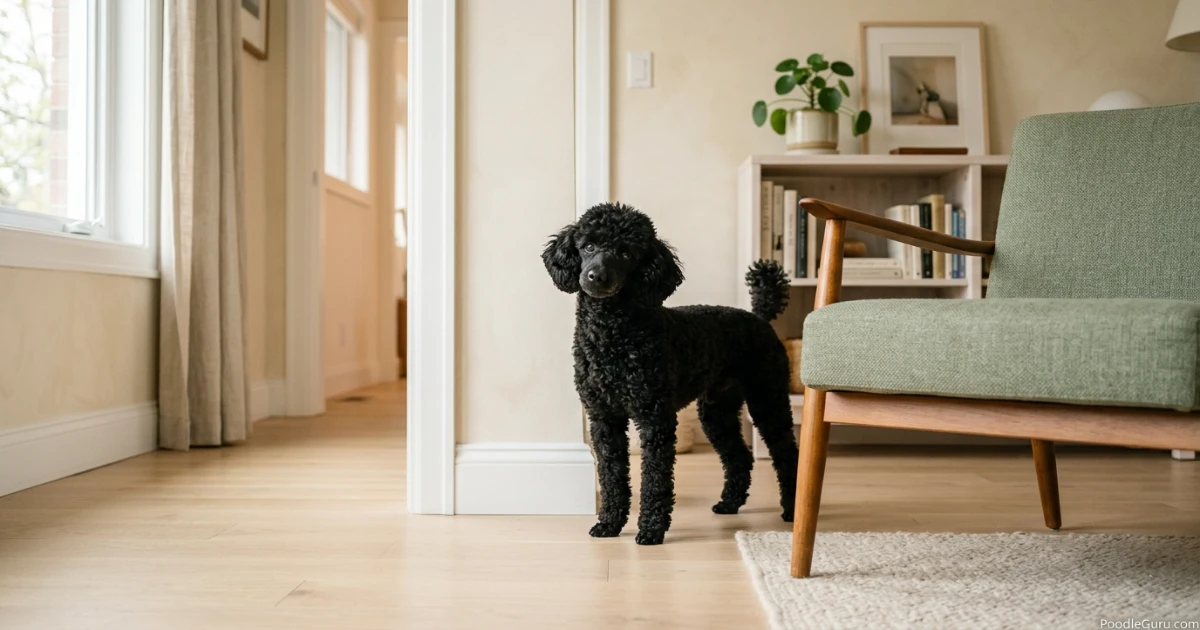
Indoor marking in poodles is rarely about incomplete house-training. It’s a communication behavior triggered by hormones, social competition, anxiety, or environmental change. Intact males are the most frequent markers, but spayed females and neutered males can mark too — especially in multi-pet homes or during routine disruptions. The solution sequence that works best is: veterinary check to rule out infection, thorough enzymatic cleanup of every marked spot, reducing social triggers, and rewarding outdoor elimination with high-value reinforcement.
What Is Urine Marking? A Clear Definition
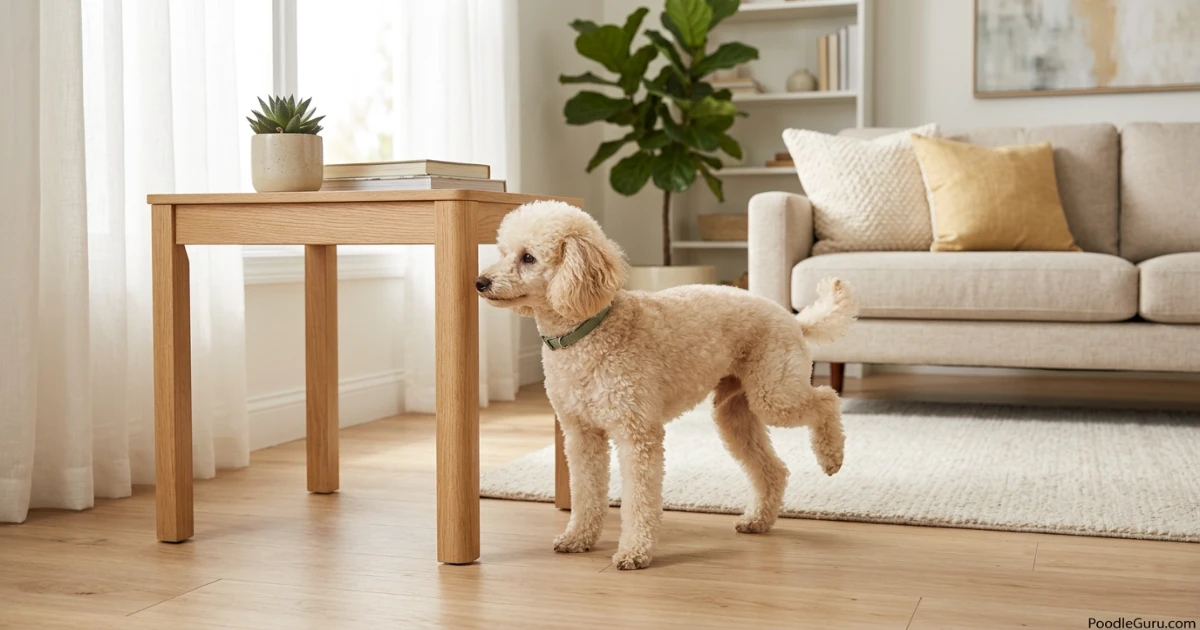
Urine marking is a territorial communication behavior where a dog deposits small amounts of urine on vertical surfaces — furniture, walls, doorframes, new objects, or spots where other animals have been. For poodle owners, this means a behavior that looks deliberate, often occurs in specific locations, and persists even when the dog clearly knows outdoor elimination is expected.
The most important thing to understand is that marking and house-soiling are not the same problem. A marking poodle isn’t confused about where to pee. They’re responding to a social or environmental trigger that says “leave a message here.” Punishing it as if it were a potty-training failure misses the point entirely and can make the behavior worse by increasing anxiety — the very thing that often drives marking in sensitive poodles.
Quick Facts About Poodle Marking Indoors
Males Mark Most
Intact male poodles account for the majority of marking cases. Testosterone drives the impulse. Neutering reduces marking in roughly 50–60% of males, but it’s not a guaranteed fix — especially if the habit is well-established.
Females Mark Too
Spayed and intact female poodles can mark, particularly before or during heat cycles, or in response to social stress. It’s less common but by no means rare.
Multi-Pet Homes Amplify It
Poodles living with other dogs — or even cats — mark more. The presence of another animal’s scent creates a perceived need to re-establish territory.
Marking vs. House-Soiling: The Critical Difference
Treating marking like a potty accident is the single most common mistake poodle owners make. The two look different, feel different, and require different solutions. This table helps you tell them apart before you choose your approach.
| Characteristic | Urine Marking | House-Soiling (Incomplete Training) |
|---|---|---|
| Volume of urine | Small amounts, often just a few drops | Full bladder release, large puddle |
| Location | Vertical surfaces, new objects, doorways, other pets’ areas | Floor, rugs, hidden corners, near doors |
| Dog’s posture | Standing, often lifting leg, sniffing then marking | Squatting, may look uncomfortable or urgent |
| Triggers | New person, new pet, delivery boxes, visitor’s belongings | Long intervals without a potty break, excitement, fear |
| Timing | Often soon after a walk where they already eliminated | After drinking, waking, or extended indoor time |
| Response to scolding | May increase due to anxiety, or become sneakier | May learn to hide the behavior but not understand why |
If your poodle’s pattern matches the left column, you’re dealing with marking. Move forward with that framework. If it matches the right column, revisit house-training fundamentals before assuming it’s territorial.
Why Poodles Mark Indoors: 5 Root Causes
Marking is a symptom. The poodle isn’t trying to be defiant or dirty — they’re responding to a trigger that feels real to them. These are the five categories that cover almost every indoor marking case in poodles.
1. Hormonal Drive
Testosterone is the most powerful biological driver of marking. Intact male poodles mark to advertise their presence and assess reproductive competition. The behavior often escalates around 6–12 months of age as hormone levels surge. Even after neutering, learned marking habits can persist if they’ve been rehearsed for months. Female poodles approaching or in heat may also mark — this is a signaling behavior, not a training lapse.
2. Social Competition
This is the most underestimated trigger in poodle households. A poodle who has lived peacefully for years may start marking the day a new dog, cat, or even a frequent canine visitor enters the home. The poodle isn’t being “bad.” From their perspective, the social map just changed, and scent-marking is how dogs update territory claims. Multi-poodle homes see this most often. Even tension between resident dogs — subtle to humans, obvious to dogs — can trigger a marking cycle.
3. Anxiety & Environmental Stress
Poodles are sensitive dogs. Routine disruptions, construction noise, a new baby, a change in work schedules, or a recent move can all produce low-grade anxiety that expresses as marking. The dog is self-soothing by depositing familiar scent in a space that suddenly feels uncertain. This is common in rescue poodles during the first weeks of rehoming. Punishment here is especially counterproductive — it confirms the dog’s sense that the environment is unsafe.
4. Visitor & Object Triggers
Delivery boxes, grocery bags, a guest’s shoes or luggage — these carry foreign scents. For a territorial poodle, these objects represent an intrusion. Marking them is a quick, instinctive response. You’ll often notice this pattern during the holidays or after a party, when many unfamiliar scents enter the home at once.
5. Reinforced Habit Loop
Once marking has occurred in a spot, the residual odor — undetectable to humans even after standard cleaning — signals “this is a marking zone” to the dog. Without enzymatic breakdown, the scent persists and pulls the poodle back to the same location repeatedly. What started as a one-off response to a trigger becomes a self-perpetuating cycle.
Medical Conditions That Mimic Marking
Before you invest weeks in a behavioral plan, rule out physical causes. Several common poodle health issues can look exactly like marking but require veterinary treatment, not training. The VCA Animal Hospitals guide to urinary issues covers the diagnostic basics in useful detail.
Ask Your Vet About These Conditions
- Urinary tract infection (UTI): Causes urgency and frequency. A poodle with a UTI may dribble small amounts in multiple spots — easily mistaken for marking. Often accompanied by licking at the genitals or visible discomfort.
- Bladder stones or crystals: Irritation mimics marking behavior. More common in Miniature and Toy Poodles. Requires imaging to diagnose.
- Kidney disease or diabetes: Increased urine production means the bladder fills faster. The dog may genuinely struggle to hold it between walks.
- Cognitive decline: Senior poodles — typically over 10 years — can develop canine cognitive dysfunction, which sometimes presents as forgetting house-training or standing and urinating without awareness.
- Hormonal-responsive incontinence: Spayed females, particularly as they age, can develop urethral sphincter weakness that leaks small amounts of urine, especially when resting.
A urinalysis and basic blood panel are usually sufficient to rule out the medical suspects. If everything comes back clear, you can proceed with confidence that the problem is behavioral.
The PoodleGuru Marking Solution Method
At PoodleGuru, we evaluate indoor marking through a five-step framework that moves from foundation to advanced intervention. Each step builds on the one before. Skipping ahead — like jumping to a belly band without cleaning first — almost guarantees the behavior returns.
Get a Clean Medical Slate
Schedule a veterinary exam with urinalysis. Tell your vet specifically that your poodle is depositing small amounts on vertical surfaces. This distinction matters for diagnosis. A clean bill of health lets you pursue behavioral work without doubt. If a UTI or other condition is found, treating it may resolve the “marking” entirely.
Erase Every Trace
Use an enzymatic cleaner — Nature’s Miracle, Rocco & Roxie, or a veterinary-grade product — on every marked surface. Not the area around it. The exact spot. Soak porous surfaces. This step fails when owners use vinegar, standard cleaners, or steam (heat can bind proteins, locking odor in). You are eliminating the scent signal that calls your poodle back.
Manage the Environment Relentlessly
For 2–3 weeks, deny unsupervised access to previously marked rooms. Close doors. Use baby gates. Confine your poodle to spaces where they have never marked when you can’t actively supervise. A belly band (for males) is a humane management tool during this phase — it breaks the rehearsal cycle without punishment. Change it promptly if it gets damp.
Reward Outdoor Marking in the Right Spot
This step surprises owners, but it’s powerful. Take your poodle to a designated marking area outside — a specific tree, post, or bush — and reward leg-lifting there with a high-value treat and calm praise. You are not suppressing the instinct; you are redirecting it to an approved location. The indoor marking drive drops when the outdoor outlet is consistently reinforced.
Reduce Social Triggers
If marking started when a new pet arrived, manage their shared space carefully. Feed them separately. Provide separate resting areas. Use pheromone diffusers (Adaptil) near marking hotspots. In multi-poodle homes, ensure each dog has their own bed, bowl, and attention from you — competition for resources fuels marking. Managing poodle anxiety is often the hidden key to breaking the cycle.
Enzymatic Cleanup: Why It’s Non-Negotiable
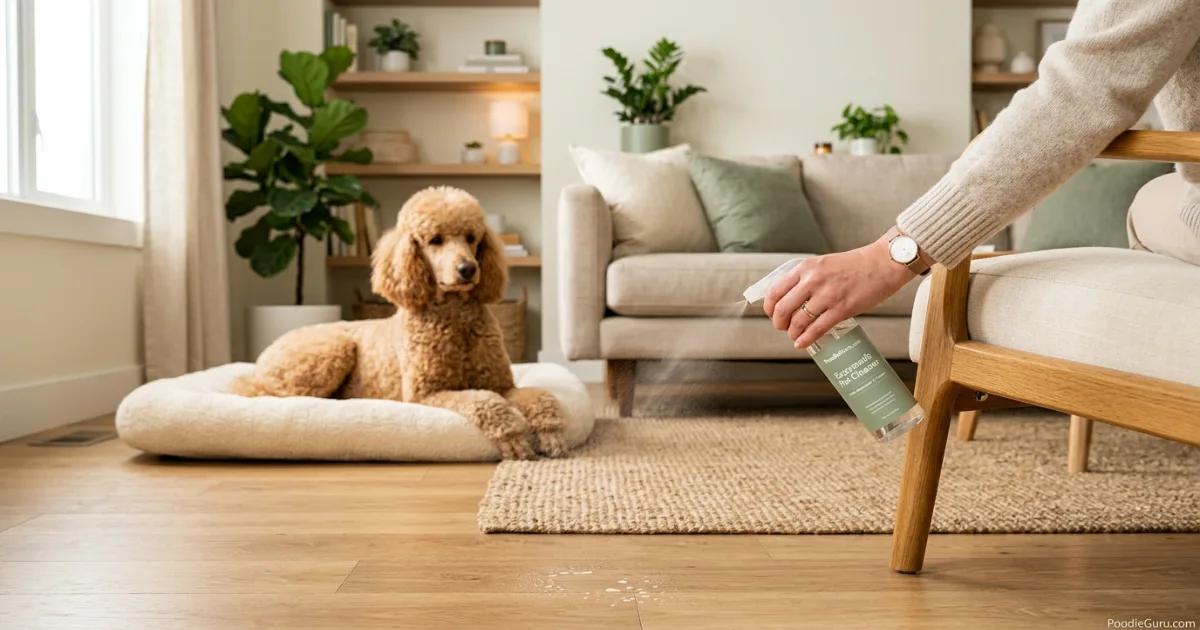
Standard household cleaners don’t cut it. Ammonia-based products can actually make the problem worse — they smell similar to urine breakdown compounds and can trigger remarking. Soap and water remove what you can see, but the proteins that a dog’s nose detects remain. Enzymatic cleaners use bacteria or enzyme cultures to digest those proteins at a molecular level. This is the only way to truly erase the scent signal.
Apply the cleaner liberally. Let it air-dry — don’t blot it up early. For deep penetration into carpet padding or wood grain, you may need to repeat the treatment. On hard floors, check that urine hasn’t seeped under baseboards. A UV blacklight flashlight can reveal old marking spots you didn’t know existed. Finding and treating every one is tedious, but skipping even a single location leaves the door open for the habit to return.
4 Mistakes That Make Indoor Marking Worse
1. Punishing or Rubbing Their Nose in It
This is never effective and with a sensitive poodle, it’s actively harmful. It raises anxiety and damages trust. A fearful poodle may stop marking in front of you but continue when you’re gone — you lose the opportunity to redirect.
2. Using Household Cleaners Instead of Enzymatic Products
Ammonia-based cleaners can chemically resemble urine breakdown odor. Your poodle smells “urine signal” and marks again to cover it. You’re accidentally cueing the behavior you’re trying to stop.
3. Restricting Water
Limiting water access to reduce urine volume is dangerous and doesn’t stop the marking impulse. It can cause dehydration, urinary concentration problems, and medical issues that then mimic marking. Always provide fresh water.
4. Assuming Neutering Will Fix Everything
Neutering reduces marking in many males, but the success rate drops the longer the habit has been practiced. If a male poodle has been marking for two years, surgery alone may only reduce the frequency by 40–50%. It’s part of the solution, not the whole solution.
When to Call a Veterinary Behaviorist
If you’ve completed the full PoodleGuru method — medical workup, enzymatic cleanup, management, outdoor redirection — for six consistent weeks with no improvement, it’s time to escalate. A veterinary behaviorist can assess for underlying anxiety disorders and, where appropriate, prescribe anti-anxiety medication that reduces the compulsive drive to mark. This is not a failure. Some poodles’ neurochemistry makes the behavior extremely resistant to environmental change alone. Combining medication with the behavior plan often produces the breakthrough.
Frequently Asked Questions
Will neutering stop my male poodle from marking indoors?
Neutering reduces marking in 50–60% of male dogs, but results vary. The earlier it’s done relative to when marking started, the better the outcome. A dog marking for years will likely need behavioral work alongside the surgery.
Can female poodles mark territory?
Yes. Female marking is less common but happens — especially during heat cycles, with hormonal changes, or in response to social stress. Spayed females can still mark if the behavior has been reinforced or triggered by environmental changes.
Why is my poodle suddenly marking after years of being clean?
Sudden onset marking in a previously reliable adult poodle points to one of three things: a new trigger in the home (pet, person, object), an underlying medical issue like a UTI, or a change in routine causing anxiety. Start with the vet.
Do belly bands work for indoor marking?
Belly bands are an effective management tool — they prevent urine from reaching surfaces and break the rehearsal cycle. They are not a standalone solution. They work best paired with enzymatic cleanup and redirection training, not as a permanent fix.
How do I clean marked spots so my poodle won’t return to them?
Use an enzymatic cleaner designed for pet urine. Soak the area thoroughly and let it air-dry completely. For porous surfaces, you may need two applications. Avoid steam cleaners and ammonia-based products, which can lock in or mimic urine scent.
Can anxiety medication help with marking?
For poodles whose marking is driven by significant anxiety, medication prescribed by a veterinary behaviorist can reduce the compulsive drive. It’s not a first-line solution, but it’s a legitimate option when thorough behavioral and environmental changes haven’t been enough.
Key Takeaways
- Indoor urine marking is a territorial or anxiety-driven behavior distinct from house-soiling — small volumes on vertical surfaces, not full bladder releases on the floor.
- Intact male poodles mark most, but spayed females and neutered males can mark too, especially in multi-pet homes or during environmental changes.
- A veterinary check with urinalysis should always be the first step — UTIs, bladder stones, and metabolic conditions can mimic marking precisely.
- The PoodleGuru method works in sequence: medical clearance, enzymatic cleanup of every marked spot, management to prevent rehearsal, outdoor redirection, and trigger reduction.
- Punishment makes marking worse in sensitive poodles by raising anxiety — management and positive redirection get faster, lasting results.
- If six consistent weeks of the full behavioral plan produce no improvement, a veterinary behaviorist consult is the right next step.
Your poodle isn’t being spiteful or dirty. They’re responding to a signal — hormonal, social, or environmental — that feels urgent to them. Once you decode the trigger and apply a clear, step-by-step plan, most poodles stop marking within weeks. Start with the vet. Get obsessive about cleanup. And show your poodle exactly where marking is welcome — that’s the fastest path back to a clean, calm home.