Poodle Sports: The Definitive Guide to Every Dog Sport a Poodle Can Excel In
Poodles are among the most versatile canine athletes in the world. They compete and win in agility, obedience, dock diving, rally, hunt tests, scent work, and protection sports — often at the very highest levels. If you are wondering which poodle sports match your dog’s personality, the answer depends on their size, drive, and your training style, but most poodles can do remarkable things across a dozen different disciplines. The real question is not “can my poodle do a sport,” but “which one first?”
There is a quiet secret in the dog sport world that poodle people have known for decades. Beneath the continental clip and beneath the reputation as a fancy companion dog lives a driven, agile, astonishingly intelligent athlete. Poodle sports are not a niche curiosity; they are a legitimate pathway to a richer life with your dog. Whether you live with a pocket-sized Toy or a leggy Standard, your poodle carries the genetic blueprint of a water retriever and a trick dog rolled into one. The sports you can explore together are far more varied than most owners realize.
This guide is built for the owner who senses their poodle needs more than a daily walk — and for the future owner who wants to know what these dogs are truly capable of. We will move through the entire landscape of poodle sports, from the obvious choices to the ones that surprise even longtime breed enthusiasts. No fluff. No recycled generic dog-sport list. Just real, structured insight into what your poodle can do, what to watch for, and where the pitfalls sit.
Quick Facts: Poodles in Dog Sports
Why Poodles Deserve a Reputation Reset in Sport
Too many people still think of poodle sports as an afterthought. They imagine a prancing show cut and assume the dog underneath is soft. That assumption collapses the moment you watch a Standard Poodle launch off a dock, swim 35 feet, and climb out shaking with joy. Or the moment a Miniature Poodle clears a jump chute with the same precision as a Border Collie. The breed’s history tells the real story: these are retrievers first, athletes by design, and show dogs only by human preference.
The misunderstanding begins with grooming. Because poodles are presented in elaborate clips at conformation shows, the public conflates aesthetics with ability. Breeders and longtime owners know better. The tightly structured body, the powerful hindquarters, the webbed feet, the dense coat that insulates in cold water — all of it points toward a working dog that has simply been redirected into companion life. Poodle sports are not a stretch for the breed; they are a return to form.
What most buyers get wrong: They choose a poodle for the hypoallergenic coat and the elegant look, then feel surprised when the dog needs a job. Poodles do not outgrow their drive. A bored poodle will invent its own sport — usually involving counter-surfing, escaping, or reorganizing your trash. Real poodle sports channel that intelligence before it becomes destructive.
The Breed’s Athletic Architecture
Before diving into the list of sports, it helps to understand what you are working with physically. Poodles are square-proportioned dogs with a level topline, deep chest, and well-sprung ribs. Their shoulder layback and rear angulation are balanced — they are not as extreme as a sighthound, nor as heavy as a mastiff. This means they accelerate well, turn tightly, and sustain moderate speed without tiring quickly.
The coat is dense and curly, which serves as insulation and mild protection in rough cover, but it can also trap heat. In warm-weather sports, owners need to manage coat length strategically. The webbed feet — a feature many owners overlook — give poodles an edge in water sports. They do not paddle inefficiently; they push water with purpose.
Size variation plays an enormous role. A Toy Poodle and a Standard Poodle share the same breed standard but not the same athletic constraints. Standards cover ground faster. Toys and Miniatures often exhibit quicker twitch responses, which can be an advantage in sports demanding sharp direction changes. When mapping out poodle sports for your dog, size is not a limitation as much as a steering factor.
Poodle Sports: The Complete Discipline-by-Discipline Guide
1. Agility — The Poodle’s Playground
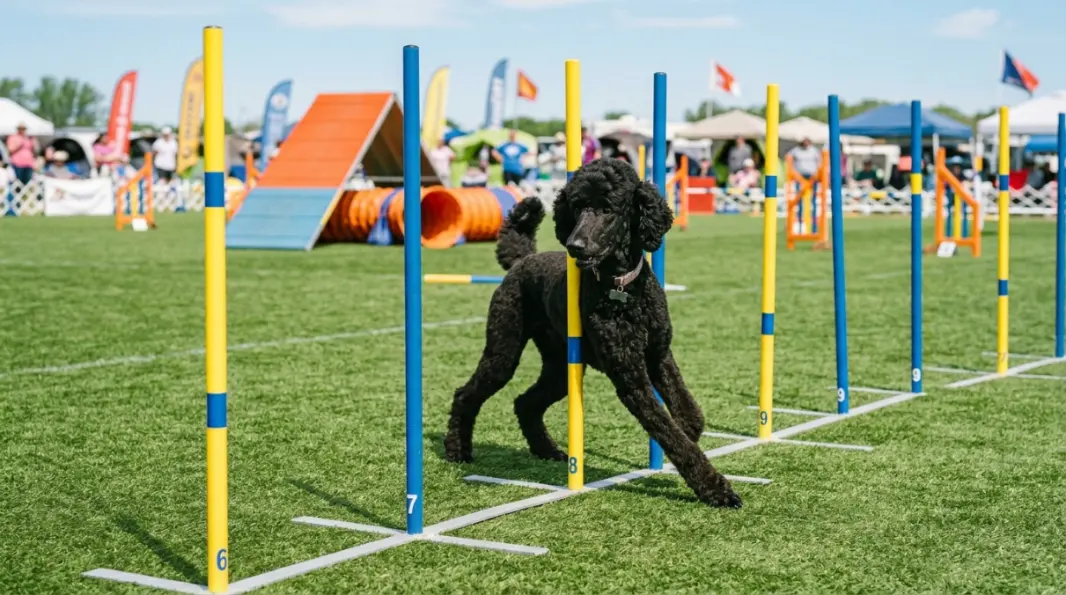
Agility is the sport most people picture when they think of high-energy dogs. Poodles are consistently competitive at every level. The Standard Poodle’s long stride chews up ground between obstacles, while their body awareness allows them to bend through tunnels and over A-frames without the crashing you sometimes see in larger, less coordinated breeds. Miniature Poodles are whip-smart on course and often post faster yards-per-second times than many herding breeds in the same height class. Toy Poodles compete in AKC’s Preferred class and can be surprisingly fierce competitors.
What makes poodles special in agility: Their willingness to work at a distance, combined with handler focus. A well-trained poodle reads subtle body cues that other breeds miss. The downside? Poodles can be too clever. If your timing is sloppy, a poodle will learn the wrong pattern instantly and offer it back to you with confidence.
Getting started: Foundation classes that emphasize flatwork and body awareness are non-negotiable. Avoid jumping full height until growth plates close — especially in Standards, which mature slower. Budget for quality equipment or class fees, and treat early training as relationship building, not competition prep.
2. Rally Obedience — Precision with Personality
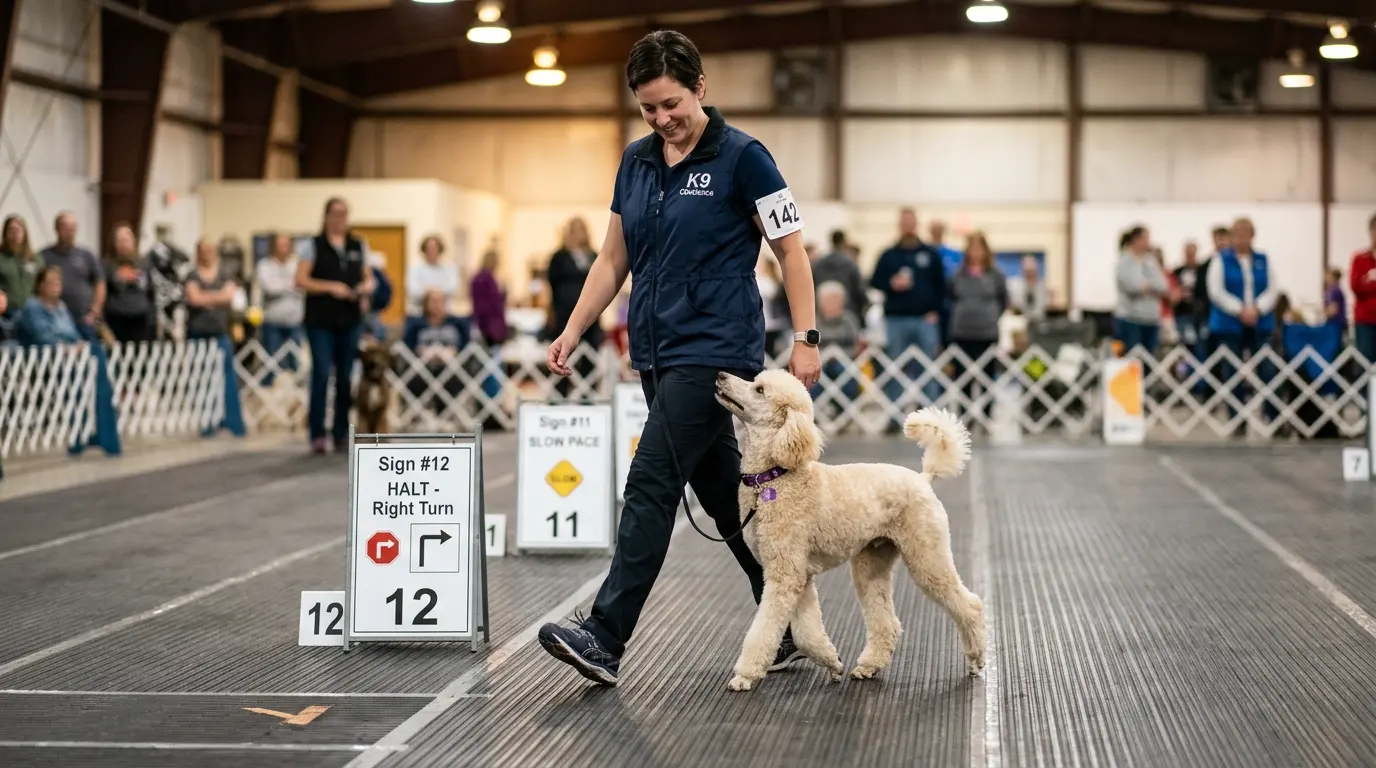
Rally sits in the sweet spot between formal obedience and playful teamwork. The dog and handler move through a course of stations, each with a sign indicating an exercise. Poodles thrive here because rally rewards engagement and attitude, not robotic precision. Toys and Miniatures often dominate the higher-level rally classes, where tight pivots and fast sits feel almost effortless.
The sport is accessible to older poodles, puppies still building confidence, and handlers who want a lower-impact option. It is also one of the best entry points into poodle sports for first-time competitors. The learning curve is gentle, but the depth is real.
3. Obedience — The Classic Test of Partnership
Traditional competitive obedience demands sustained focus, precise heeling, clean retrieves, and rock-solid stays. Poodles have won the AKC National Obedience Championship. They are one of a handful of breeds that genuinely enjoy the precision work. The retrieve — flat, high jump, and directed — taps directly into the breed’s historical retrieving instinct. Many poodles retrieve with a soft, confident mouth that requires almost no force-fetch training.
Owners should be aware that poodles can become ring-wise. They know the difference between practice and trial. If you are not mindful, you may create a dog that performs brilliantly in training and then decides to freelance in the ring. The fix is proofing — lots of it — and learning to read your dog’s emotional state on trial day.
4. Dock Diving — Pure, Joyful, and Shockingly Natural
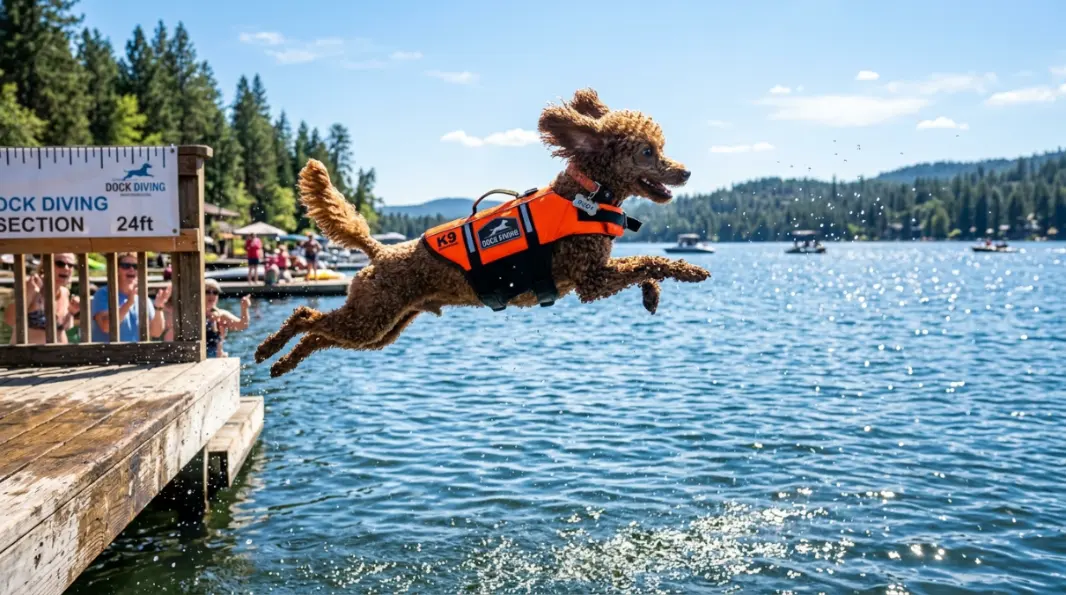
If you want to see a poodle explode with happiness, find a dock diving facility. This sport measures either distance jumped or height grabbed from a suspended bumper. Poodles — especially Standards — take to it with startling speed. The retrieve drive kicks in, the water retrieves awaken something ancient, and suddenly your impeccably groomed companion is airborne, ears streaming, landing with a splash that drenches the front row.
Dock diving is low-impact enough for most healthy adult poodles, but build up gradually. Watch for shoulder strain in dogs that launch repeatedly with poor form. The sport is also forgiving for older poodles who can still swim strongly but may not want to jump from a height — many facilities allow ramp entries.
5. Flyball — Speed, Teamwork, and Loud Chaos
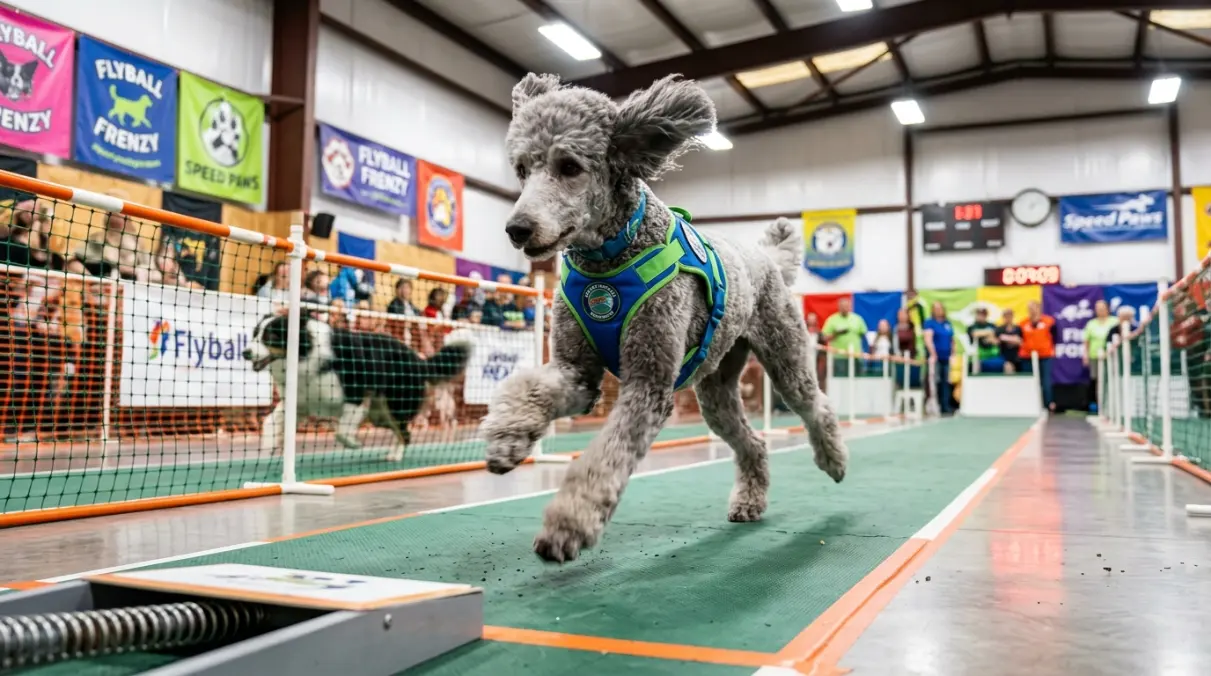
Flyball is a relay race with hurdles and a spring-loaded box that launches a tennis ball. Poodles are solid flyball competitors. They may not surpass the raw speed of a purpose-bred Border Collie mix, but clean ball grabs and reliable box turns win heats. Miniatures often compete at excellent heights, and their compact build allows efficient strides between jumps.
The chaotic, noisy environment of a flyball tournament can overstimulate some poodles. Socialization to the sound of barking, the echo of the building, and the proximity of strange dogs is essential. For the right poodle, though, flyball is pure adrenaline and social bonding with the team.
6. Scent Work / Nose Work — The Underrated Poodle Superpower
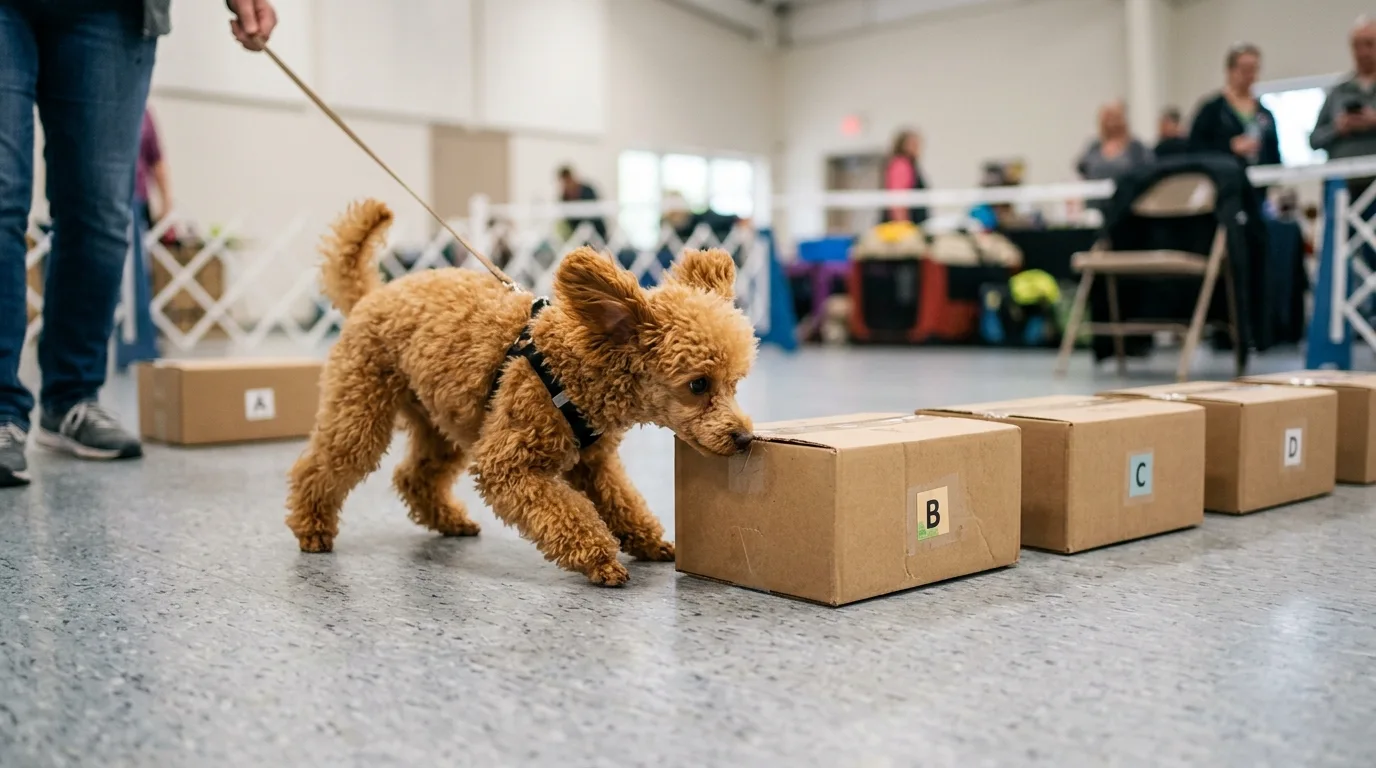
Scent work mimics the detection work of professional K9s. The dog searches for a target odor — usually birch, anise, clove, or cypress — hidden in containers, interiors, exteriors, or vehicles. Poodles excel here for a simple reason: they are methodical searchers with exceptional noses and a work ethic that doesn’t quit.
Many owners overlook scent work because it looks slow compared to agility. But for poodles that are aging, recovering from injury, or simply less interested in high-impact sports, nose work is a revelation. It tires the brain deeply, builds confidence in shy dogs, and can be practiced anywhere. Standards and Miniatures are both strong in this discipline, and Toys often surprise handlers with their focus.
7. Barn Hunt — A Small-Game Instinct That Never Left
Barn Hunt tests a dog’s ability to find rats (safely enclosed in protective tubes) hidden in a course of hay bales. Poodles, despite their elegant image, often have a strong small-prey drive. The sport relies on instinct more than training, which means you can enter a total novice poodle and watch it light up. The tight spaces and elevated climbs also reward athleticism. Toys and Miniatures are the natural size fit, but Standards can compete in the higher divisions.
8. Lure Coursing and Fast CAT — The Chase Instinct
Poodles are not sighthounds, but the Coursing Ability Test (CAT) and Fast CAT events are open to all breeds. Many poodles chase the lure with surprising enthusiasm. Fast CAT is a straight 100-yard dash with a radar gun. Standards can post times that surprise people who think of poodles as fluffy lap dogs. The sport is a pure adrenaline outlet with almost no training required — just a healthy dog and a desire to run.
An important caution: Poodles are not built with the suspension gallop of a Greyhound. Hard stops and sharp turns on uneven ground can lead to soft-tissue injuries. Choose events carefully, condition your dog, and know when to retire for the day.
9. Hunt Tests and Retriever Work — Returning to Roots
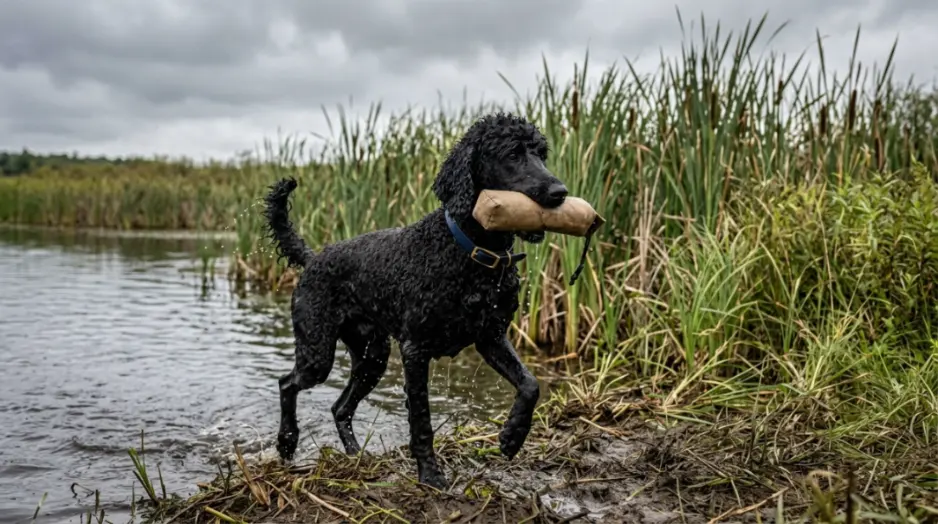
This is where the poodle’s history becomes undeniable. The breed was developed to retrieve waterfowl from cold water. Today, dedicated poodle handlers compete in AKC Retriever Hunting Tests and the Poodle Club of America’s working certificate program. Poodles mark falls, take hand signals, and deliver birds to hand with the same dedication as Labradors and Goldens, though often with a different working style — more upright, with a deliberate, thinking approach.
Finding a trainer who understands poodles is crucial. Traditional retriever training relies heavily on repetition and pressure, which can backfire with a sensitive poodle. The best hunt trainers adapt their methods, using more shaping and less force. The result is a poodle that works happily, not shut down.
Misidentification happens constantly: Hunt test judges and fellow handlers sometimes do a double-take when a poodle steps to the line. Expect curiosity, and be prepared to answer the same question a hundred times: “Is that a poodle?” The sport is slowly changing, and poodles are part of that shift.
10. Disc Dog — Catching Air and Hearts
Disc dog competitions involve distance throws, accuracy catches, and freestyle routines set to music. Poodles, especially lighter-built Standards, can be phenomenal disc dogs. Their leaping ability and soft mouth serve them well. The sport requires significant conditioning and careful attention to landing mechanics. Avoid repetitive high-impact landings on hard surfaces. Grass is non-negotiable.
11. Protection Sports (Mondioring, IPO, PSA) — The Conversation Few Expect
This is the most controversial entry on the list, and it deserves nuance. Poodles are not traditional protection dogs, but there is a growing community of poodle handlers in Mondioring and IPO (formerly Schutzhund). Mondioring, in particular, values versatility and control under environmental pressure — qualities a well-bred Standard Poodle can possess in abundance.
This is not a sport for every poodle. It requires a specific temperament: clear-headed, confident without being sharp, and deeply bonded to the handler. The training is intense and must be guided by an experienced helper. Poorly applied bite work can ruin a poodle’s trust and stability. But for the right dog and the right owner, protection sports reveal a side of the breed that is breathtakingly capable.
12. Trick Dog — The Gateway Sport
Trick Dog titling through AKC or Do More With Your Dog is the most accessible entry point for any poodle owner. No equipment, no special facility — just a dog, a treat pouch, and a willingness to play. Poodles almost seem designed for trick training. They learn chains of behaviors quickly, generalize well, and perform with theatrical flair. Toys, Miniatures, and Standards all earn advanced trick titles with ease. Many handlers start here and discover a passion for performance that leads them into the more structured sports above.
Comparing the Top Poodle Sports at a Glance
| Sport | Best Size Fit | Impact Level | Training Time | Cost to Start | Poodle Edge |
|---|---|---|---|---|---|
| Agility | All sizes | High | Moderate-High | $$$ | Quick learning, handler focus |
| Rally | All sizes | Low | Moderate | $$ | Attitude and precision |
| Obedience | All sizes | Low | High | $$ | Natural retrieve, intelligence |
| Dock Diving | Mini/Standard | Moderate | Low | $$ | Water drive, webbed feet |
| Scent Work | All sizes | Very Low | Moderate | $ | Methodical searching |
| Flyball | Mini/Standard | High | Moderate | $$$ | Clean box turn, team focus |
| Hunt Tests | Standard | Low-Moderate | High | $$$ | Bred for retrieving |
| Trick Dog | All sizes | Very Low | Low | $ | Fast learning, playfulness |
How to Choose the Right Poodle Sport for Your Dog
Matching a poodle to a sport is rarely about what the dog “can” do. The breed can do almost everything. It is about the intersection of your lifestyle, your dog’s individual temperament, your budget, and the community you want to be part of.
For the high-drive Standard Poodle who lives to retrieve and doesn’t mind pressure, hunt tests, dock diving, and agility form a powerful trifecta. For the thoughtful, slower-moving Miniature who loves to sniff, scent work and rally often feel like the dog was born for them. For the Toy Poodle with a theatrical streak, trick dog and rally offer endless creative satisfaction. There is no hierarchy of sports; there is only fit.
One of the biggest mistakes owners make is projecting their own sport ambitions onto a dog that doesn’t enjoy the work. A poodle that shuts down in the agility ring is not a failure. It may simply be a nose work dog waiting for the right outlet. Pay attention to what your dog offers you naturally. That is usually the signpost.
1. Start foundations, not equipment. Flatwork, attention games, and body awareness build the athlete before the sport demands it.
2. Condition beyond the sport itself. Core strength, proprioception, and cardio conditioning prevent the injuries that end careers early.
3. Find a poodle-positive trainer. A trainer who thinks poodles are “soft” or “stubborn” will not bring out your dog’s best. Look for someone who sees sensitivity as a strength.
4. Keep the coat practical. A continental clip is beautiful. It is also impractical for most sports. A short, even cut — often called a sporting clip or kennel clip — keeps the dog cool and reduces maintenance.
5. Respect the heat. Poodles can overheat faster than short-coated breeds. Train early in the morning during summer, bring cool water, and watch for signs of exhaustion.
What Buyers and New Owners Consistently Get Wrong About Poodle Sports
The gap between expectation and reality looms large in poodle sports, especially for first-time poodle owners. Here are the patterns that repeat themselves in training classes and online forums.
They underestimate the drive. A poodle purchased as a calm companion turns out to need a part-time job. The owner feels overwhelmed, the dog becomes restless, and nobody is happy. The fix is simple: recognize before you buy that poodles are working dogs in companion-dog clothing. If you do not plan to provide structured outlets, consider a breed with lower exercise needs.
They assume size limits capability. Toy Poodle owners sometimes feel their dog is “too small” for real sports. This is nonsense. Toys title in scent work, rally, and trick dog at the highest levels. The sport community is increasingly inclusive of small dogs, and the joy of watching a Toy Poodle nail a complicated rally course is profound.
They conflate show grooming with sporting ability. The same poodle that glides around a conformation ring in a show clip can swim, jump, and retrieve. The coat can be shaved down. The dog is the same underneath. Some buyers reject poodles for sports because they have only seen the pom-pom version. They are rejecting a fiction.
They think “intelligence” means “easy.” Poodle intelligence makes training faster but also more nuanced. A poodle will notice every inconsistency, exploit every loophole, and sometimes outsmart the handler. Training a poodle requires clarity, fairness, and a sense of humor. If you want a dog that simply repeats behaviors without thinking, a poodle will frustrate you.
Coat Care for the Sporting Poodle
This section matters more than most guides admit. The poodle’s coat is both a superpower and a maintenance burden. For active dogs, the coat traps burrs, mud, and moisture. If left unbrushed, it mats quickly and can cause skin problems that sideline a dog from training.
The most practical approach for sporting poodles is a short, uniform clip — sometimes called a retriever clip, kennel clip, or sporting clip. The body is taken down to a half-inch or less, with slightly more length left on the topknot and tail if desired. The face and feet are shaved clean, which reduces the mess from water and mud. This clip requires maintenance every four to six weeks, but it keeps the dog comfortable and reduces the grooming bottleneck that stops many owners from training consistently.
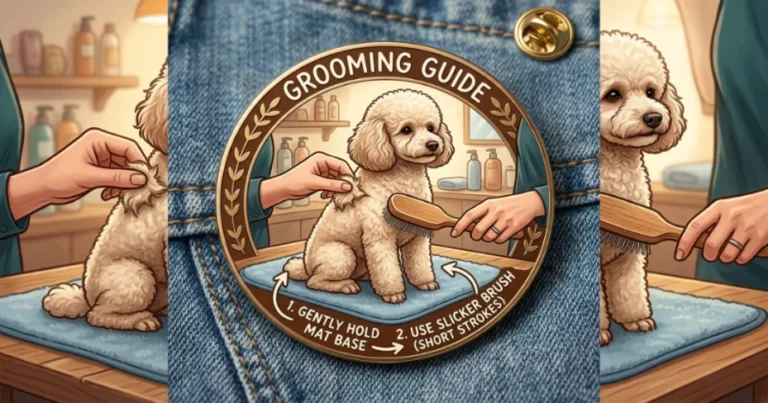
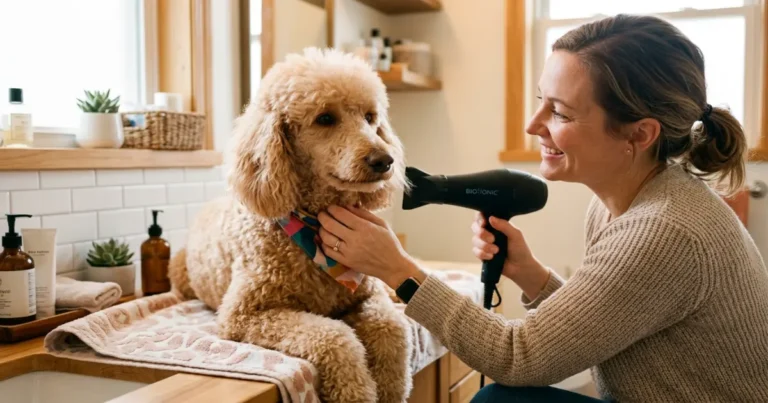
After swimming, rinse the coat with fresh water to remove chlorine or lake debris. Check between paw pads for gravel and foxtails. A leave-in conditioning spray makes brushing easier throughout the week. Grooming is not separate from your sport; it is part of your sport prep.
Health Considerations for the Canine Athlete Poodle
Every sport places specific demands on the body, and poodles are not immune to the injuries and conditions that affect active dogs. Responsible owners screen for breed-relevant issues and manage workload sensibly.
Hips and elbows: Standards should be screened through OFA or PennHIP before beginning high-impact sports. Hip dysplasia exists in the breed, and undiagnosed joint laxity can turn into a lifelong problem if training ignores the risk. Miniatures and Toys are less prone but not exempt.
Patellar luxation: This is a concern primarily in Toys and Miniatures. A luxating patella can cause intermittent lameness and may be aggravated by repeated jumping. Before enrolling a small poodle in agility or flyball, have a veterinarian evaluate the knees.
Eye health: Poodles are on the list of breeds affected by progressive retinal atrophy (PRA) and cataracts. Annual eye exams by a veterinary ophthalmologist are recommended, especially for dogs working in sports that require sharp distance vision.
Bloat (GDV): Standards are a deep-chested breed, which means they are at higher risk for gastric dilatation-volvulus. Never feed a large meal immediately before or after intense exercise. Learn the early warning signs, because bloat moves fast and can be fatal within hours.
Recovery days: Sports dogs need rest built into their schedule. A poodle that trains hard five days a week is likely under-recovered. Rest days allow soft tissue to repair, cortisol levels to drop, and the dog’s enthusiasm to recharge. Under-rested poodles become flat, irritable, or injury-prone.
Getting Started: Your First 90 Days in Any Poodle Sport
Regardless of which poodle sports interest you, the first three months follow a similar path. The goal is not a title — it is building a working partnership and identifying whether the sport genuinely fits your dog.
Month 1: Focus on relationship and foundations. Practice attention heeling, engagement games, and impulse control exercises. Visit the training venue without the dog to absorb the environment. Talk to experienced handlers about the real time and money commitment.
Month 2: Start formal classes. Keep sessions short — 10 to 15 minutes of focused work, followed by decompression. Poodles learn fast, which means they also burn out fast if you drill. Quit before the quality drops.
Month 3: Evaluate honestly. Is your dog excited to work? Are you excited to train? Does the sport community feel welcoming? If the answers are positive, consider entering a fun match or run-through. If something feels off, pivot to a different sport. There is no shame in changing course.
2026 Price Guide: What Poodle Sports Actually Cost
Weekly group classes: $25–$45 per session, depending on location and sport. Agility and flyball classes trend higher.
Private coaching: $65–$120 per hour. Worth it for targeted problem-solving or handling refinement.
Trial entry fees: $25–$35 per run. A weekend trial with multiple runs can total $150–$250.
Equipment (starter): $100–$400. A good agility starter kit (tunnel, jumps) runs higher. Scent work kits start around $50.
Travel and lodging: Easily the largest hidden cost. Serious competitors budget thousands annually for regional and national events.
Veterinary sports medicine: Plan for $300–$600 annually for wellness checks, chiropractic, or physical therapy, especially for high-impact sports.
Is the Investment Worth It?
Financially, no dog sport pays for itself. That is not the point. The return is measured in a dog that sleeps contentedly, a bond built through shared challenge, and a community of people who understand why you get up at 5 a.m. to stand in a field with a plastic bumper. For poodle owners, the sports journey often transforms the relationship entirely. The dog that was once a well-groomed pet becomes a partner with purpose. That is worth more than any ribbon.
Frequently Asked Questions About Poodle Sports
What is the best sport for a Standard Poodle?
Standard Poodles typically excel in agility, dock diving, hunt tests, and scent work. The best fit depends on your dog’s drive — high-energy Standards often love agility and dock diving, while more methodical individuals shine in scent work and rally. Many Standards compete in multiple sports simultaneously.
Can Toy Poodles compete in dog sports?
Absolutely. Toy Poodles regularly compete and title in rally obedience, scent work, trick dog, and barn hunt. Their small size is an advantage in tight spaces. Some Toys also participate in agility with modified jump heights. Do not underestimate a Toy Poodle’s athleticism.
Are poodles good at protection sports like Mondioring?
A small but growing number of Standard Poodles compete successfully in Mondioring and IPO. This requires a very specific temperament — confident, clear-headed, and stable under pressure. Protection sports are not suitable for most poodles and demand expert training from an early age. Serious mistakes in bite work can permanently damage a dog’s trust.
How do I keep my poodle’s coat manageable for sports?
The sporting clip or kennel clip — a short, uniform length over the body with shaved face and feet — is the most practical solution. It reduces matting, dries faster after swimming, and makes post-training cleanup much easier. Plan to groom every 4–6 weeks and brush weekly.
At what age can I start my poodle in dog sports?
Foundation training — flatwork, attention games, recall, and body awareness — can start in puppyhood. Avoid high-impact activities like full-height jumping and repetitive weave poles until growth plates close, typically around 12–18 months for Standards and slightly earlier for smaller varieties. Scent work and trick training have no such restrictions and are excellent early outlets.
Do poodles need a lot of exercise before starting sports?
Poodles benefit from a baseline fitness level, but sport-specific conditioning is more important than raw mileage. Core strength, hind-end awareness, and cardiovascular conditioning should be built progressively. A fit poodle entering a sport is less likely to be injured than an unconditioned one.
What health screenings are important for a sporting poodle?
Hip and elbow evaluations (OFA or PennHIP) for Standards, patella checks for Toys and Miniatures, annual eye exams, and a baseline cardiac evaluation are all wise investments. Screening identifies risks before training stress turns a predisposition into an injury.
Can a poodle compete in multiple sports at once?
Yes, and many do. A poodle might chase a rally title in the morning, run agility in the afternoon, and earn trick dog ribbons in the evening. The key is managing the dog’s physical and mental workload so that enthusiasm stays high and the body stays sound.
Poodle sports are not a side note — they are the clearest expression of what this breed was built to do. From agility courses to open water retrieves, from scent detection to precision rally courses, poodles bring intelligence, work ethic, and joy to every discipline they enter. The most common mistake owners make is underestimating their poodle’s potential. The second-most common mistake is waiting too long to explore it. Choose a sport that fits your dog’s size and temperament, find a supportive community, keep the coat short and the training positive, and you will discover a partnership that goes far deeper than pet ownership. That is the real prize.