Poodle Therapy Dog Certification Process Explained
Poodles have the intelligence, empathy, and trainability that therapy work demands. But certification isn’t automatic—it requires careful preparation, honest temperament assessment, and knowing exactly which path fits your dog. Here’s the complete process, stripped of confusion.
Important distinction: Therapy dog registration is for invited volunteer visits. It does not make a poodle a service dog, emotional support animal, or public-access dog. Always confirm the latest rules directly with your chosen therapy dog organization and the facility you plan to visit.
Quick Answer
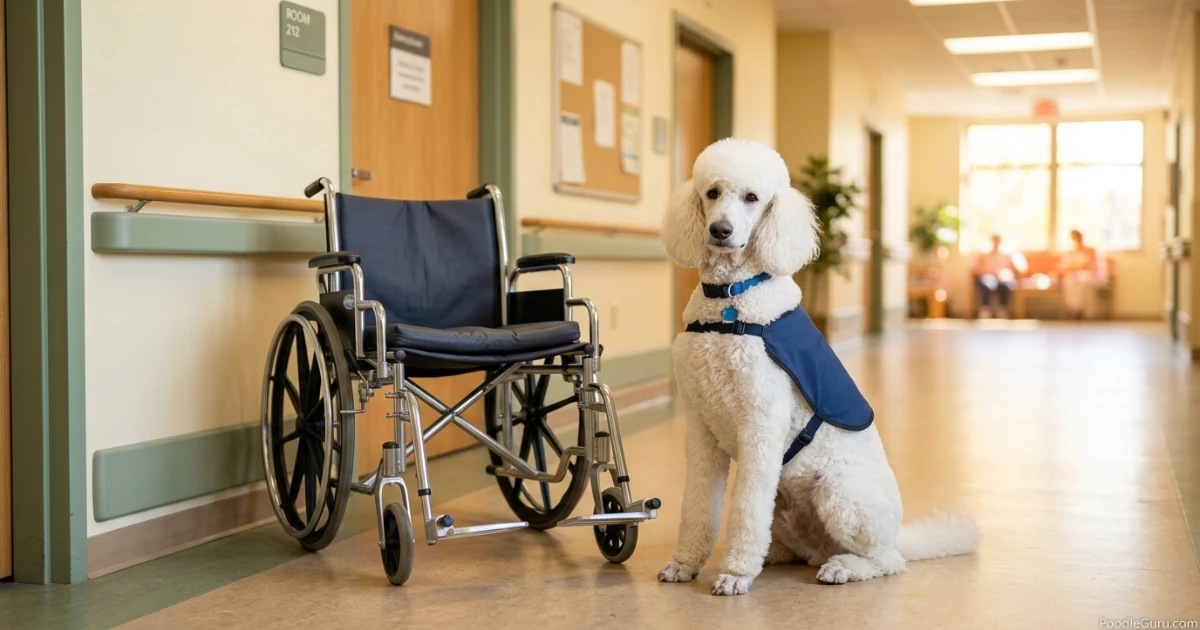
Poodle therapy dog certification or registration requires passing a hands-on evaluation through a recognized organization such as Pet Partners, Alliance of Therapy Dogs, or Therapy Dogs International. Your poodle must demonstrate calm greetings, comfort with strangers and medical equipment, solid basic obedience, gentle handling tolerance, and the ability to recover quickly from startling situations. The process typically includes handler education or rules review, veterinary health screening, paperwork, and an in-person or supervised team assessment. Many well-prepared poodles can be ready within 3–6 months of focused training, but the timeline depends on temperament, socialization history, and the organization you choose.
In This Guide
- What Therapy Dog Certification Actually Means
- Why Poodles Excel—And Where They Struggle
- Therapy Dog vs. Service Dog: Critical Differences
- Major Certification Organizations Compared
- Prerequisites: What Your Poodle Needs Before Applying
- The PoodleGuru Therapy Readiness Checklist
- What Happens During the Evaluation
- Owner Mistakes That Delay or Derail Certification
- FAQs
What Therapy Dog Certification Actually Means
Therapy dog certification is a credentialing process that verifies a dog has the temperament, training, and health status to provide comfort and affection in settings like hospitals, schools, nursing homes, and disaster relief sites. For poodle owners, this means your dog’s natural people-orientation gets channeled into structured, safe volunteer work.
The most important thing to understand is that certification does not grant public access rights. A certified therapy dog is not a service dog. Under the ADA service animal guidance, a service animal is a dog trained to perform work or tasks directly related to a person’s disability; animals whose role is comfort, therapy, or companionship are not service animals under the ADA. Therapy poodles are invited into facilities by the facility itself—that’s the fundamental legal and practical distinction.
— Consistent with guidelines from the American Kennel Club’s therapy dog certification overview
Volunteer Role
Therapy dogs visit facilities by invitation only. There is no legal public access right—unlike service dogs under the ADA.
Minimum Age
Most organizations require the dog to be at least 1 year old at evaluation time. Puppies cannot be certified, regardless of temperament.
All Sizes Eligible
Toys, Miniatures, and Standards can all certify. Size determines which settings suit them best—not whether they qualify.
Why Poodles Excel—And Where They Struggle
Poodles bring remarkable strengths to therapy work. They read human emotion with unusual precision. Their history as close-working companions means they’re wired to check in with their handler constantly. They tend to be gentle-mouthed, which matters when taking treats from fragile hands.
But poodles also have breed-specific challenges that owners must address honestly before pursuing certification. High sensitivity means a poodle who hasn’t been carefully socialized may find chaotic environments overwhelming rather than rewarding. Some poodles—particularly from lines selected for sharpness or alertness—may be too environmentally aware to settle in busy settings.
At PoodleGuru, we evaluate therapy readiness by looking at three poodle-specific traits: recovery speed after a startle, willingness to approach unfamiliar people with relaxed body language, and the ability to disengage from the handler and engage with a stranger on cue. A poodle who scores well on all three has strong therapy potential.
Therapy Dog vs. Service Dog: Critical Differences
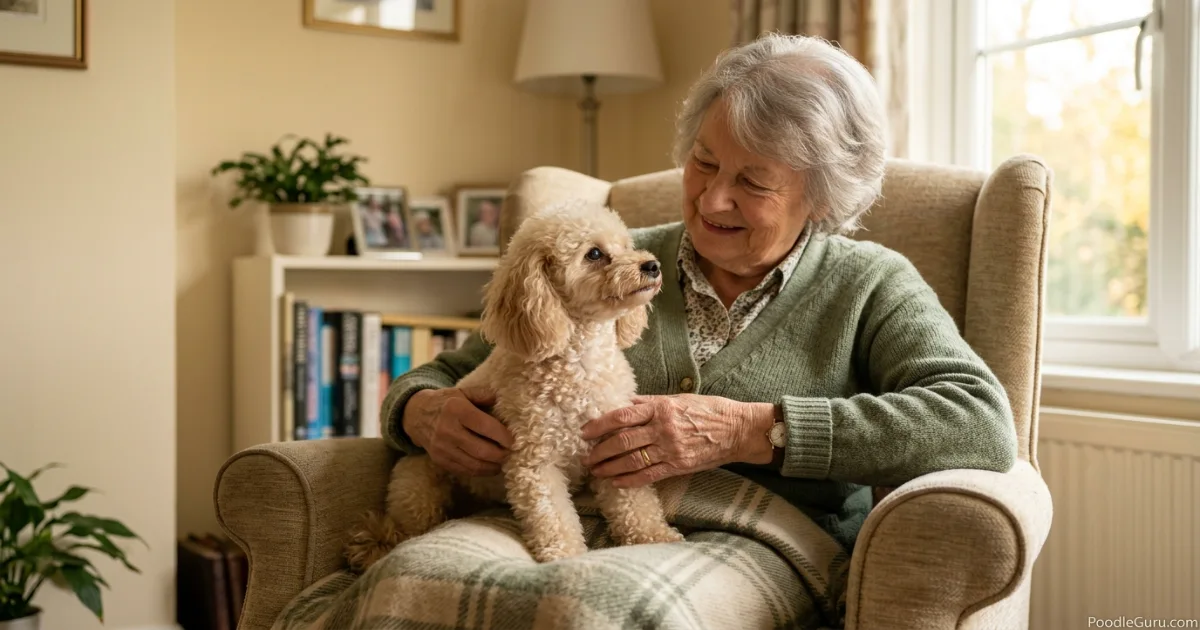
Confusing these two roles is the single most common misunderstanding new owners bring to the certification process. Getting clear on the distinction will save you months of misdirected training.
| Factor | Therapy Dog | Service Dog |
|---|---|---|
| Legal status | No federal public access rights; invited by facilities | ADA-protected public access when trained to perform disability-related work or tasks |
| Purpose | Provides comfort to many people in therapeutic settings | Performs disability-specific tasks for one handler |
| Training focus | Temperament, gentle interaction, basic obedience | Task training, public access skills, advanced obedience |
| Who benefits | Patients, students, facility residents | A single person with a diagnosed disability |
| Certification | Through therapy dog organizations (Pet Partners, ATD, TDI) | No ADA certification requirement; must be task-trained and under handler control |
| Typical poodle | Social, calm, seeks human contact | Task-focused, handler-oriented, bombproof in public |
Major Certification Organizations Compared
Not all therapy dog certifications carry equal recognition. Facilities typically expect registration through a known national organization with clear standards and liability insurance coverage. Here are the organizations most poodle owners work with in 2026.
| Organization | Evaluation Style | Insurance Included? | Best For |
|---|---|---|---|
| Pet Partners | Handler education, animal health screening, and a simulated team evaluation | Included after accepted registration | Handlers who want a structured, widely recognized healthcare-visit path |
| Alliance of Therapy Dogs (ATD) | Handling Assessment plus 3–4 supervised observations with a Tester/Observer | Included for active registered teams | Poodles who perform better in real settings than formal test-only environments |
| Therapy Dogs International (TDI) | Formal skills-and-temperament test with published test items | Check current member policy | Handlers who prefer a direct, test-based certification route |
| Bright & Beautiful Therapy Dogs | Evaluation focused on temperament, manners, and gentle interaction | Check current member policy | Smaller settings; often a good fit for Toy and Miniature Poodles |
Each organization publishes its evaluation criteria publicly. Download the checklist from your chosen organization before you start training. Train to the test, not to vague notions of “being good.”
Prerequisites: What Your Poodle Needs Before Applying
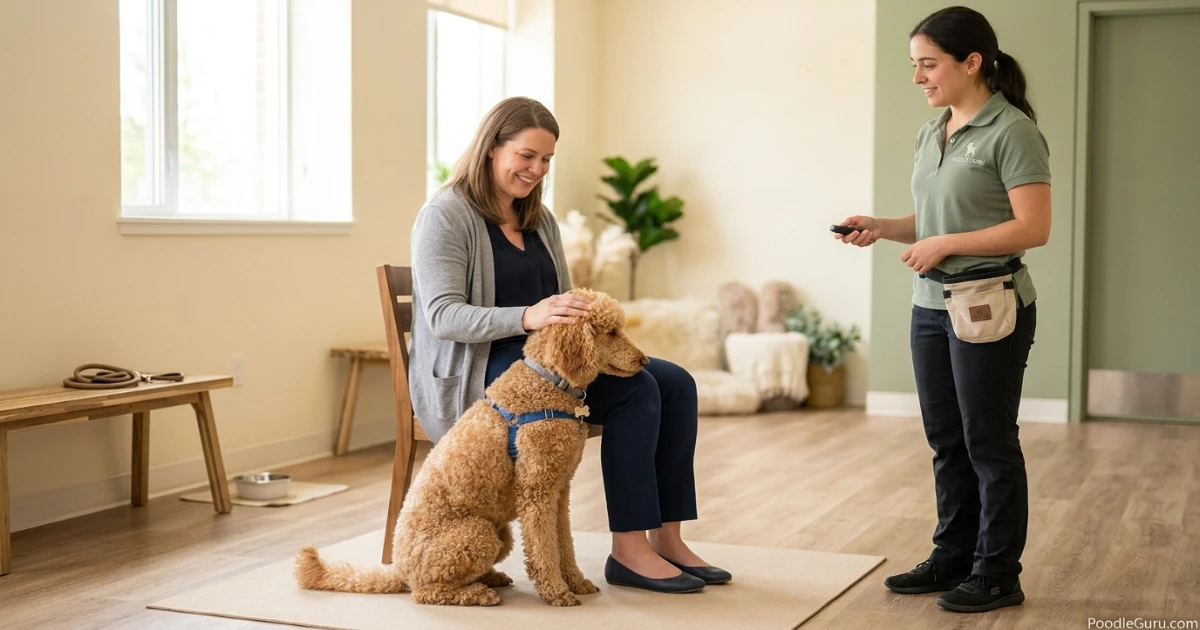
Walking into an evaluation unprepared is the fastest route to frustration. Most organizations require the same foundational pieces. Get these in place first.
🐾 Solid Basic Obedience
Sit, down, stay, come, loose-leash walking, and leave-it must be reliable around distractions. Not perfect—but reliable. Evaluators are watching for responsiveness, not robotic precision.
🐾 Veterinary Health Screening
Current legally required vaccines, organization-required health paperwork, and a veterinary statement confirming your poodle is healthy enough for therapy visits. Pet Partners uses an official Animal Health Screening form, while Alliance of Therapy Dogs requires dogs to be current on locally required vaccines and have a negative fecal test every 12 months. Check your chosen organization before scheduling an evaluation.
🐾 Handler Education
Pet Partners requires an online handler course before evaluation. Other organizations strongly recommend it. You need to understand infection control, reading canine stress signals, and facility etiquette—not just dog training.
The PoodleGuru Therapy Readiness Checklist
At PoodleGuru, we evaluate a poodle’s therapy readiness across five dimensions that go deeper than the standard evaluation score sheet. This checklist helps you spot gaps before the evaluator does.
Stranger Engagement
Does your poodle approach unfamiliar people with relaxed, wagging body language—not jumping, not barking, not shrinking back? Evaluators will test this with people of different ages, appearances, and mobility aids.
Startle Recovery
How fast does your poodle bounce back after a sudden noise or clumsy petting? Three seconds or less is ideal. Longer than ten seconds, and chaotic environments will be genuinely stressful for them.
Medical Equipment Comfort
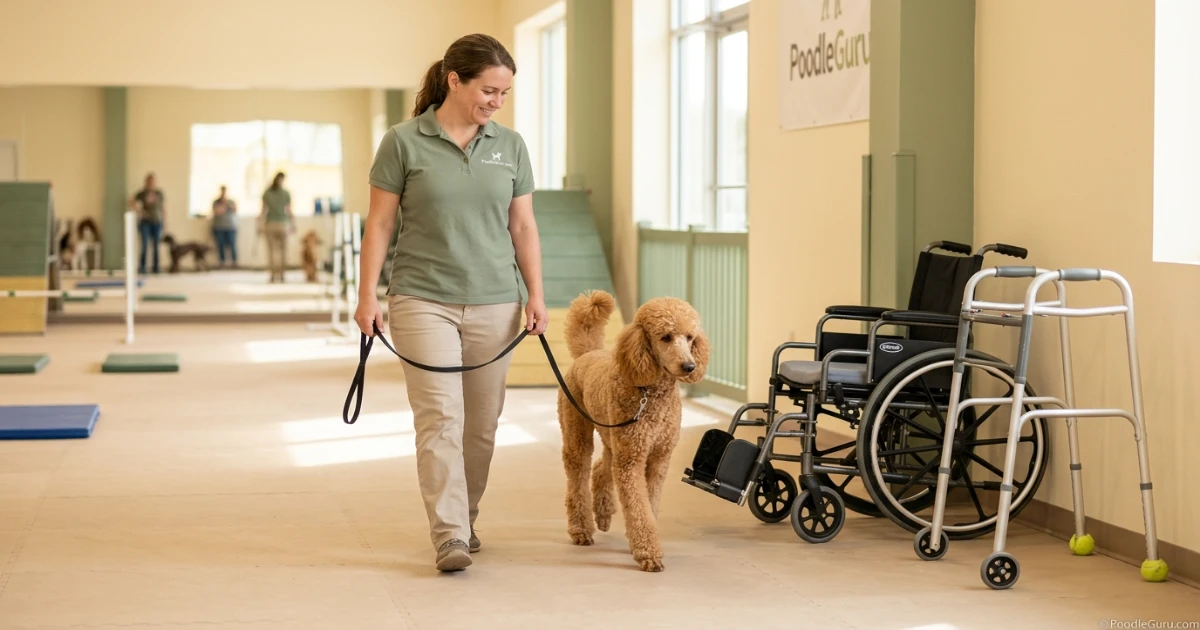
Crutches, wheelchairs, IV poles, walkers. Your poodle doesn’t need to ignore them—they need to coexist without fear. Evaluators often roll equipment nearby or drop items during the test.
Food Refusal Under Pressure
Your poodle must take treats gently and also leave dropped medication or food on command. A “leave-it” around scattered pills on the floor is a common evaluation item in healthcare-focused certifications.
Emotional Regulation
Can your poodle settle on a mat for 10 minutes in a novel environment? Therapy visits involve waiting—hallways, elevators, reception areas. A dog who can’t down-regulate between interactions will burn out fast.
What Happens During the Evaluation
A structured evaluation often runs around 30–45 minutes, while observation-based organizations may require multiple supervised visits and simulates the range of experiences your poodle will encounter during real visits. Knowing the structure removes the mystery—and the nerves.
Expect a greeter at the door to check your paperwork and observe your poodle’s entry. Then you’ll move through stations: a greeting with a neutral stranger, a “crowded” hallway pass, a medical equipment area, a “clumsy petting” simulation where someone touches your poodle awkwardly, and a group interaction with multiple people. Throughout, the evaluator watches your dog’s body language more than their obedience precision. A poodle who sits crookedly but wags softly will outscore a rigidly obedient dog with whale eye and tucked tail. The evaluation ends with a short separation—someone holds your poodle’s leash while you step briefly out of sight.

Owner Mistakes That Delay or Derail Certification
Most poodles who fail evaluations don’t fail because they’re unsuitable. They fail because their handler made preventable errors in preparation or on test day.
| Mistake | What Happens | How to Fix It |
|---|---|---|
| Rushing to evaluate before the dog is ready | Poodle freezes, shuts down, or shows stress signals; evaluator must stop the test | Practice the skills in at least 5 novel environments before scheduling. Record your sessions and review body language honestly |
| Over-managing the leash during greetings | Tight leash signals tension to the dog; poodle reads handler anxiety and becomes guarded | Practice loose-leash greetings separately from other skills. The leash should form a J-shape during interactions |
| Correcting the dog during evaluation | Verbally reprimanding or leash-popping a poodle mid-evaluation is often an automatic disqualification | If your poodle makes an error, redirect calmly or simply reset. Evaluators assess recovery, not perfection |
| Choosing the wrong organization for the dog’s style | A poodle who thrives in real settings may struggle with a formal test format; conversely, an anxious dog may need the predictability of a structured eval | Read evaluation descriptions carefully. ATD’s observation-based model suits some poodles better than Pet Partners’ structured skills test |
Frequently Asked Questions
How old does my poodle need to be for therapy dog certification?
Most organizations require dogs to be at least 1 year old at the time of evaluation. Some set the minimum at 18 months. This ensures emotional maturity and a full socialization history. Puppies, no matter how well-behaved, cannot be certified.
Can a Toy Poodle become a certified therapy dog?
Yes. Toy Poodles can and do certify. They’re often ideal for lap-based visits in nursing homes, hospice, and reading programs where their small size is an advantage. The evaluation standards are identical regardless of size. The key is ensuring your Toy Poodle has been socialized to not feel threatened by being picked up or handled by strangers.
How much does therapy dog certification cost?
Expect to budget roughly $150–$300 in 2026 for a typical registration path, depending on organization and local evaluator costs. Pet Partners lists an $80 online handler training fee, a typical $15–$30 team evaluation fee, and a $95 first-time registration fee; other organizations use different fee structures. Training class costs are separate and vary widely by region.
Can a poodle with anxiety become a therapy dog?
Generally, no. A dog who experiences significant anxiety in novel environments will find therapy work stressful, not fulfilling. The evaluation is designed to screen for this. If your poodle shows consistent stress signals in new places—panting, tucking, yawning excessively—therapy work may not be the right fit, and that’s okay.
Is therapy dog certification the same as an emotional support animal?
No. Therapy dogs are trained and evaluated to visit facilities. Emotional support animals (ESAs) provide comfort through their presence in the owner’s home and have limited housing-related protections. ESAs require no specific training or evaluation and do not have public access rights.
How long does poodle therapy dog certification last?
Registration is typically valid for 2 years. To renew, you’ll usually need an updated veterinary health screening and a re-evaluation or logged visit hours. Each organization sets its own renewal requirements, so check your certifying body’s policy before expiration.
What if my poodle fails the evaluation?
Most organizations allow re-evaluation after a waiting period—typically 4–8 weeks. Use the evaluator’s feedback as a training roadmap. Many poodles pass on the second attempt after focused work on the specific items flagged. A failure is diagnostic information, not a permanent verdict.

Key Takeaways
Poodle therapy dog certification is a structured, achievable process—for the right dog and the right handler. Here’s what to remember as you move forward.
- Therapy dog certification verifies temperament and training for volunteer facility visits—it does not grant public access rights like service dog status does.
- Poodles of all sizes can certify, but honest temperament assessment matters more than wishful thinking about your dog’s potential.
- The PoodleGuru Therapy Readiness Checklist evaluates five dimensions: stranger engagement, startle recovery, medical equipment comfort, food refusal, and emotional regulation.
- Choose your certification organization based on evaluation style—structured testing (Pet Partners) or observation-based (ATD)—not just name recognition.
- Most evaluation failures come from handler mistakes—rushing the timeline, tight-leash handling, or correcting the dog mid-test—not from unsuitable dogs.
- A failed evaluation is information, not rejection. Use the feedback, train the gaps, and reapply.