Do Poodles Like Water? Swimming Benefits, Risks & Getting Started
They were bred as water retrievers, but that heritage does not mean every poodle paddles on instinct — or that water is risk-free. Here is what every owner should know before the first splash.
Do Poodles Like Water? Quick Answer
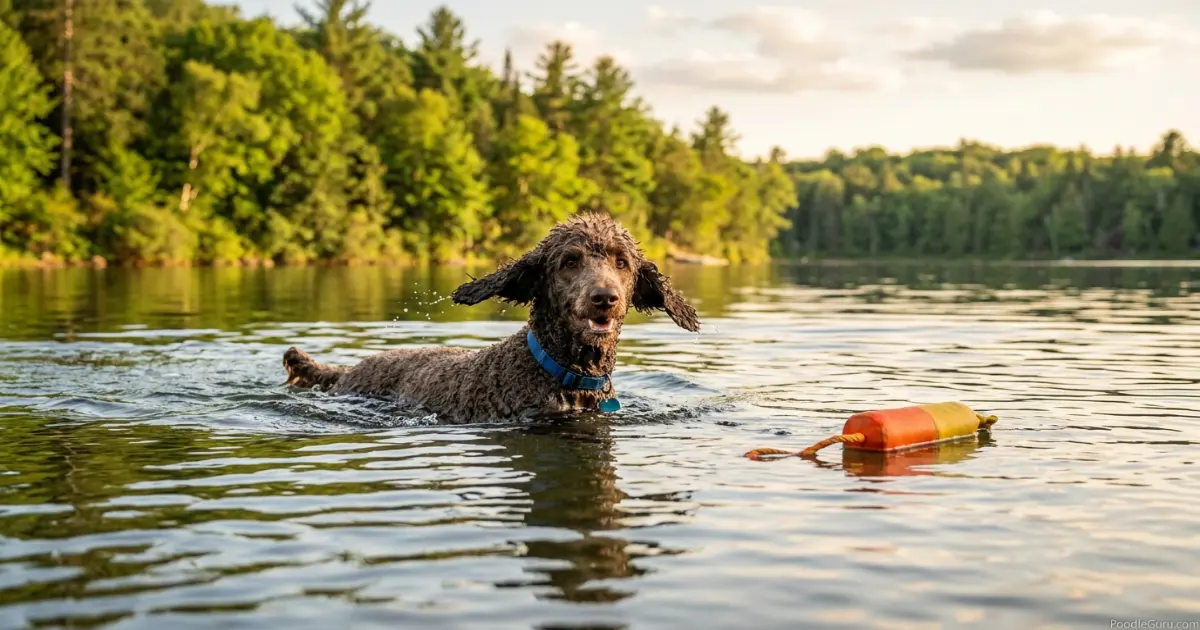
Most poodles genuinely enjoy water and swimming once properly introduced. Their breed history as water retrievers means many take to it naturally. But “most” is not “all,” and “naturally” is not “instantly.” A poodle’s individual personality, early experiences, and the way water is introduced matter far more than breed genetics. With the right approach, even a hesitant poodle can learn to swim confidently. Rush it, and you risk creating a fear that lasts a lifetime.
Quick Facts at a Glance
🧬 Bred for Water
Poodles were originally developed as water retrievers, and the name is commonly linked to the German word “pudeln,” meaning to splash in water.
🏊 Natural Swimmers
Many poodles have strong paddling instincts, but confidence varies widely by individual dog, age, temperament, and early exposure.
💪 Low-Impact Exercise
Swimming provides full-body conditioning with minimal joint stress, making it useful for active poodles and for carefully managed fitness routines.
🦻 Ear Risk
Moisture trapped in hairy poodle ear canals is a common trigger for ear irritation and infection risk, especially when ears are not dried properly.
🧥 Coat Management
Wet poodle hair can tangle quickly. A thorough rinse, dry, and brush-out after swimming helps prevent painful mats and skin irritation.
🦺 Safety First
Even strong swimmers need supervision. A canine life jacket is recommended for poodles in open water, especially lakes, rivers, boats, and beaches.
The Water Retriever Heritage Most Owners Forget
Before poodles became associated with French elegance and show rings, they were working dogs used for water retrieving. Their job was practical: enter cold water, retrieve waterfowl, and return it to a hunter’s hand. The famous poodle clip, which now looks decorative to many people, had a working purpose. Hunters clipped parts of the coat to reduce drag while leaving protective hair over important areas such as the chest and joints.
That history explains why the AKC breed standard describes poodles as active, proud, very smart dogs with the structure of capable athletic companions. Many poodles have the physical tools that help in water, including a strong body, good stamina, and feet that can paddle efficiently. The question is not only whether the breed can swim. The better question is whether your individual poodle has been given the right introduction to unlock that confidence safely.
Why Most Poodles Love Water Once They Try It
Poodle swimming enthusiasm is not just genetics. Three practical factors make water genuinely enjoyable for many poodles in ways that ordinary exercise may not match.
🌡️ Cooling Effect
A dense poodle coat can feel warm during active play. On hot days, safe water play can provide full-body cooling and relief when shade alone is not enough.
🧩 Mental Engagement
Water is sensory-rich in the way poodles often enjoy. Splashes, ripples, floating toys, and changing textures give a curious dog more to process than a flat walk.
🤝 Shared Activity
Poodles bond through shared experience. When you wade, guide, reward, and cheer, your poodle is not just swimming — your poodle is doing something with you.
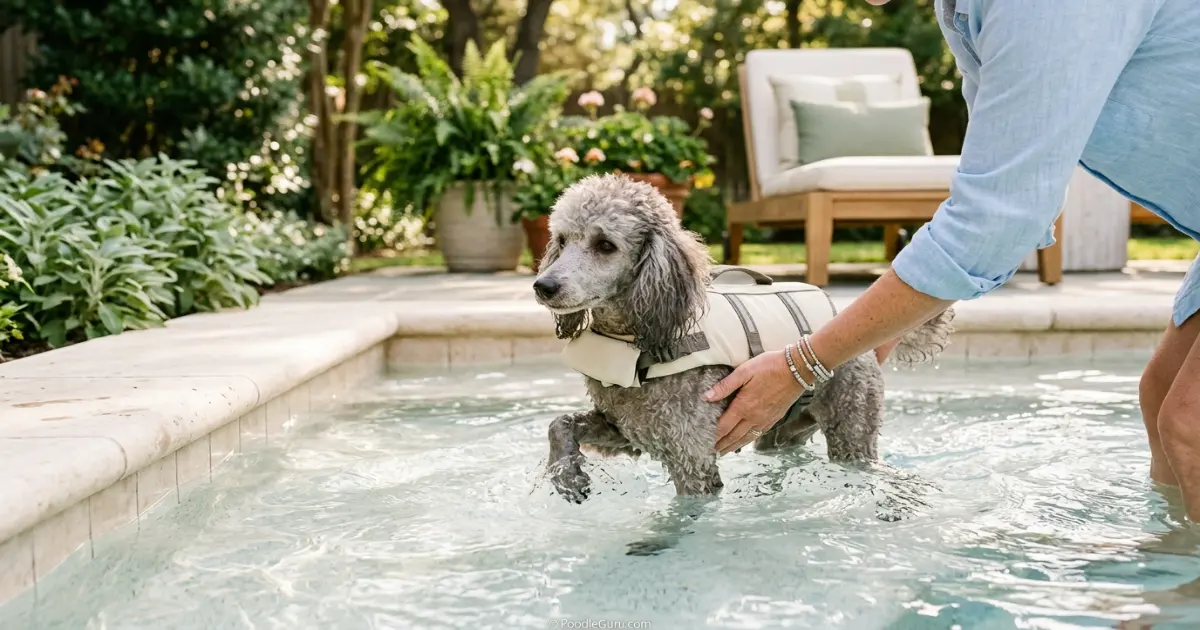
When a Poodle Does Not Like Water — and Why
Not every poodle is a natural swimmer. Some are indifferent. A few are genuinely afraid. When that happens, there is usually a reason — and it is rarely “the dog is just stubborn.”
| Cause | What It Looks Like | What to Do |
|---|---|---|
| Negative First Experience | Panic at water’s edge, trembling when wet, or avoidance of shallow water and puddles | Reset fully. Start with positive exposure to water sounds, damp surfaces, and shallow wading before deeper attempts. Never force. |
| Lack of Early Exposure | Curiosity mixed with hesitation, watching other dogs swim but refusing to enter | Use gradual desensitization. Let the dog observe from a distance. A calm swimming dog can help if your poodle is comfortable around that dog. |
| Physical Discomfort | Short swims, quick exits, excessive shaking, pawing at ears, or reluctance after previous swims | Check for ear irritation, skin issues, or joint pain. A poodle who links water with discomfort will not volunteer for it. |
| Sensory Overwhelm | Freezing at the shoreline, dilated pupils, heavy panting, or refusal to step forward | Break the experience into smaller pieces: damp towel, sprinkler, an inch of water, then shallow wading. |
| Individual Preference | No fear, but no interest either, even after a positive introduction | Accept it. Some poodles simply prefer land activities. Water should be enrichment, not a battle. |
The Benefits of Swimming for Poodles
Swimming is often called one of the best low-impact exercises for dogs. For poodles, the benefits can be especially useful when sessions are supervised and matched to the dog’s size, age, and fitness level.
🦴 Joint-Friendly Conditioning
Poodles can be prone to certain joint concerns, including luxating patellas in smaller sizes and hip problems in some Standards. Swimming helps build strength with less impact than hard running.
❤️ Cardiovascular Health
Water resistance turns every paddle stroke into gentle resistance training. A short swim can provide meaningful cardio without the same pavement impact as a long walk.
🧠 Mental Exhaustion
Swimming requires coordination, balance, and sensory processing. A safe 15–20 minute session can leave many poodles mentally satisfied and calmer afterward.
Hidden Risks Every Owner Should Know Before the First Swim
Swimming can be wonderful, but it should never be treated as risk-free. These risks are not reasons to avoid water. They are reasons to approach water with preparation, supervision, and a prevention plan.
| Risk | Why Poodles Are Vulnerable | Prevention |
|---|---|---|
| Ear Irritation or Infection | Hairy ear canals may trap moisture, creating a warm environment where irritation can develop | Dry ears after every swim. Use a veterinary-approved drying solution if your vet recommends it. Watch for head-shaking, odor, redness, or discharge. |
| Coat Matting | Wet curly hair can tangle, tighten, and trap moisture against the skin | Rinse with fresh water after swimming. Towel-dry, brush, and dry the coat to the skin instead of letting it stay damp for hours. |
| Water Intoxication | Dogs who bite at splashes or retrieve repeatedly may swallow too much water during play | Limit long retrieve sessions. Watch for lethargy, bloating, vomiting, weakness, or loss of coordination. Treat suspected water intoxication as an emergency. |
| Cold Water Risk | A soaked single-layer coat offers limited warmth, especially in cold water | Check water temperature. Keep cold-water sessions short. Stop immediately if your poodle shivers, slows down, or tries to leave. |
| Blue-Green Algae | Toxic algae in stagnant freshwater can be extremely dangerous if a dog drinks or contacts contaminated water | Never let a poodle swim in water with visible green scum, foul odor, dead fish, or posted warnings. When in doubt, stay out. |
| Exhaustion or Drowning | Excited poodles may keep retrieving past the point of fatigue | Always supervise. Use a life jacket in open water. End sessions before your dog shows fatigue, frantic paddling, or repeated attempts to return to shore. |
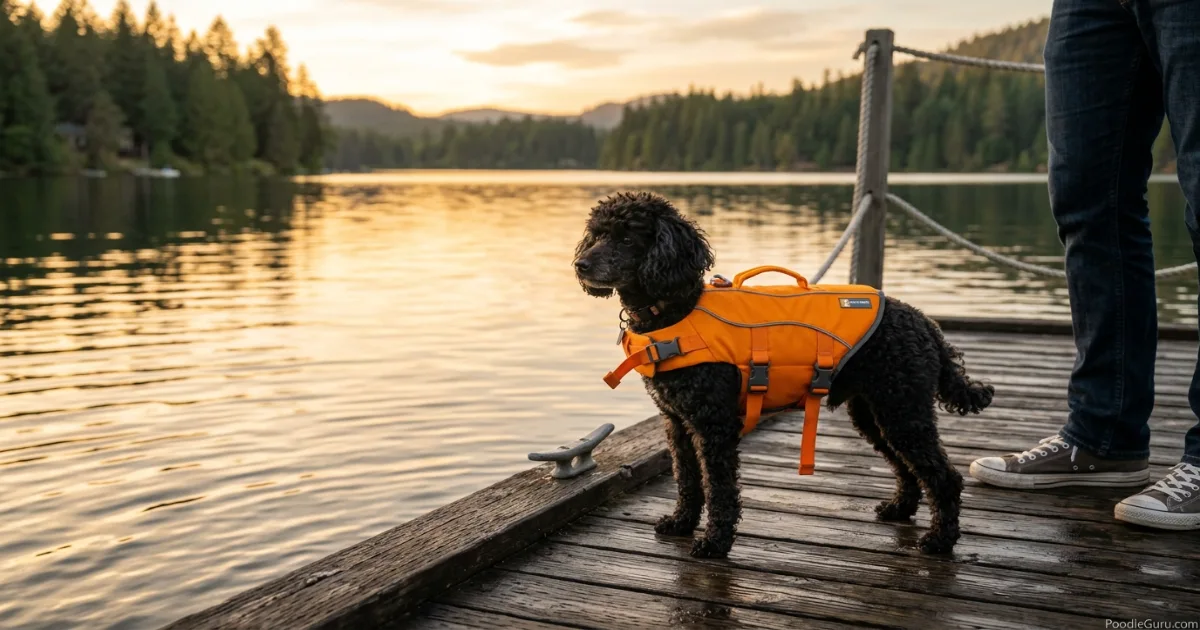
The PoodleGuru Water Introduction Plan: 5 Steps to a Confident Swimmer
At PoodleGuru, we approach water introduction the same way we approach poodle training: respect the dog’s intelligence, protect their sensitivity, and never rush. This 5-step plan works for puppies and adults alike. The timeline changes by dog, but the principles stay the same.
Land First: Gear Familiarization
Put the life jacket on at home. Let your poodle wear it during meals and play for short sessions over 3–5 days. The jacket should feel normal before it ever touches water.
Shallow Wading: Paws Only
Find a spot with a gradual entry and no drop-offs. Walk in yourself first. Let your poodle follow at its own pace into ankle-deep water. No pulling, dragging, or carrying into the water.
Chest-Deep Support: The Trust Builder
When your poodle willingly walks into chest-deep water, slide your hand under the belly just behind the ribs. Support without lifting. Let the dog feel buoyancy with a safety net.
First Paddle: Short and Sweet
With the life jacket on and your hand nearby, let the dog paddle 5–10 feet toward you or a floating toy. Celebrate warmly, then stop while the experience is still positive.
Build Distance Gradually Over Weeks
Add distance slowly across multiple sessions. A relaxed tail and steady breathing usually mean your poodle is coping well. Frantic paddling, a dropped tail, or repeated turns toward shore mean the session should end.
Post-Swim Coat Care: The Routine That Prevents Problems
Getting a poodle wet is the easy part. What you do after swimming determines whether water stays a positive experience or becomes a source of mats, itchy skin, or ear problems.
🚿 Step 1: Fresh Water Rinse
Lake water, pool chlorine, salt water, and sand should be rinsed off. A clean fresh-water rinse helps reduce skin irritation and removes debris before it becomes trapped in the coat.
👂 Step 2: Ear Drying
Use a veterinary-approved ear drying solution only if recommended for your dog. Gently dry the outer ear with a soft cotton ball or towel. Never push cotton swabs deep into the ear canal.
🧥 Step 3: Thorough Drying
Towel-dry well, then use a force dryer or cool blow-dryer while brushing through the coat. The goal is not show-ring perfection. The goal is a coat that is dry to the skin.
Frequently Asked Questions
Do poodles naturally know how to swim?
Most poodles have a natural paddling instinct and will move their legs in a swimming motion when placed in water. But instinct is not the same as skill. A poodle who has never been in water may paddle frantically, tire quickly, or panic. Natural ability needs a calm introduction to become confident, efficient swimming.
Do Toy Poodles like water as much as Standards?
Size does not determine water enthusiasm. Individual personality and early experiences matter more. Some Toy Poodles are fearless swimmers, and some Standards avoid water. The practical difference is stamina and temperature tolerance. Toy Poodles lose body heat faster and tire more quickly, so sessions should be shorter.
Can poodles swim in chlorinated pools?
Yes, with precautions. Chlorine can irritate poodle skin and eyes with repeated exposure. Always rinse your poodle thoroughly with fresh water after pool swimming. Limit sessions, prevent pool-water drinking, and make sure your dog knows how to exit safely.
How do I teach a poodle who is afraid of water?
Start far from deep water. Use a kiddie pool with an inch of water, a sprinkler on low, or a wet towel to walk on. Reward voluntary interaction. Never pull, carry, or throw a fearful poodle into water. Progress at the dog’s pace, even if that means weeks of dry-land exposure before the first paw gets wet.
Do poodles need a life jacket for swimming?
In open water such as lakes, rivers, beaches, and boating areas, a life jacket is strongly recommended for poodles regardless of swimming ability. Currents, drop-offs, sudden fatigue, and distance from shore can change quickly. In pools with easy exits and close supervision, a life jacket is especially useful during the learning phase.
How often can I take my poodle swimming?
In warm weather with proper post-swim care, 2–3 times per week is sustainable for many healthy poodles. Daily swimming may be fine for some dogs if coat drying and ear care are meticulous. Watch for ear irritation, skin dryness, fatigue, or reluctance, and adjust the routine if needed.
Can puppies swim? What age is safe to start?
Puppies can begin shallow-water introduction around 8–10 weeks in warm, calm water with full supervision. Focus on positive exposure, not distance. Keep sessions very short and avoid stagnant or questionable water sources until vaccinations are complete. Ask your veterinarian about local waterborne risks before natural-water swimming.
Final Summary: Water Is in Their Blood — Safety Is in Your Hands
Do poodles like water? For many poodles, the answer is yes when water is introduced with patience, safety, and positive experiences. Their breed heritage makes swimming a natural fit for many dogs, and their bodies and minds can benefit from water-based exercise.
But loving water is not the same as being safe in water. Ear problems, coat matting, water intoxication, cold-water stress, and exhaustion are real risks that owners can reduce with preparation and post-swim care.
Key Takeaways
- Poodles were developed as water retrievers, which explains why many poodles enjoy swimming and water play.
- Most poodles like water when properly introduced, but individual personality and early experience matter more than breed history alone.
- Swimming gives poodles low-impact exercise, cardiovascular work, and valuable mental enrichment.
- The biggest preventable risks include trapped ear moisture, coat matting, swallowing too much water, cold-water stress, and fatigue.
- The PoodleGuru Water Introduction Plan uses five steps: gear familiarization, shallow wading, supported buoyancy, first short paddle, and gradual distance building.
- Post-swim care is essential: fresh-water rinse, careful ear drying, brushing, and drying the coat to the skin.
Best next step: If your poodle has not swum yet, start with life jacket familiarization on dry land. If your poodle already swims, audit your post-swim routine against the checklist above. For the grooming foundation that makes water activities sustainable, explore our Complete Poodle Grooming Guide next.