Bordoodle (Border Collie Poodle Mix): The Complete Owner’s Guide
A brilliant, athletic cross that blends two of the smartest dog breeds on the planet — the Bordoodle demands more than a casual owner. This 2026 guide lays out exactly what that commitment looks like, from daily mental stimulation to the reality of that high-maintenance coat.
Quick Answer: What Is a Bordoodle?
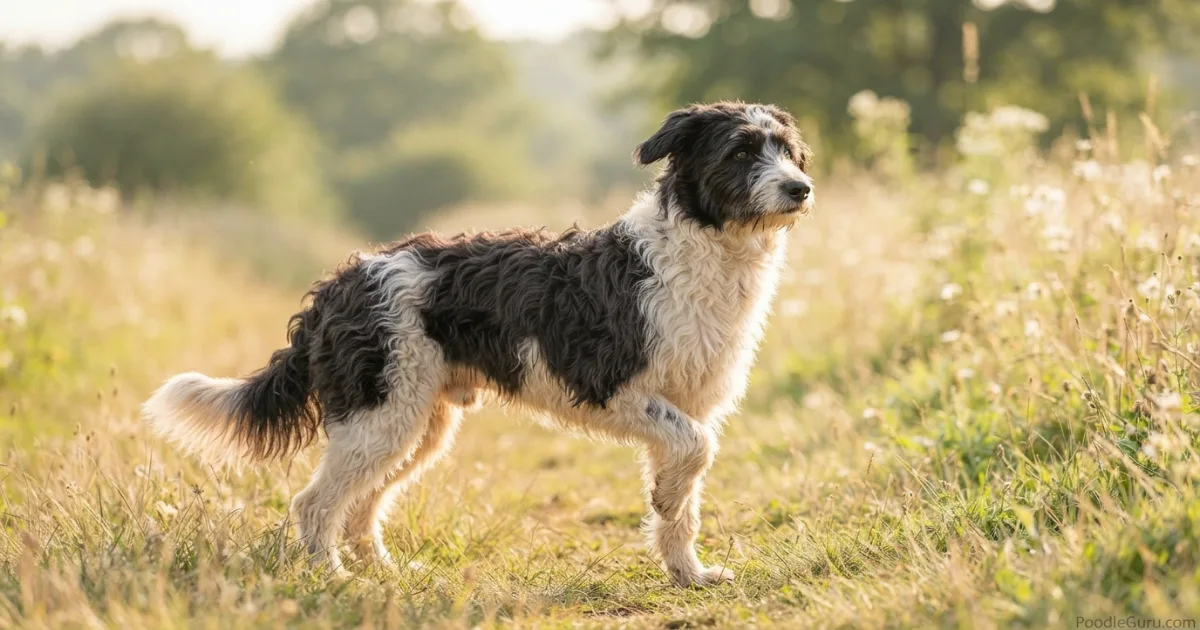
A Bordoodle is a designer hybrid dog produced by crossing a Border Collie with a Poodle, most often a Standard or Miniature Poodle. Adults typically weigh 30–60 pounds and stand 18–22 inches tall. This mix is prized for its exceptional intelligence, work ethic, and often lower-shedding coat — but that brain needs a job, and an under-stimulated Bordoodle will invent its own, usually destructive, occupations. Expect a dog that learns commands in minutes and demands you keep up.
What Is a Bordoodle?
A Bordoodle is a first-generation cross between a purebred Border Collie and a purebred Poodle. For poodle owners, this means you’re adding the Border Collie’s legendary herding instincts and endurance to the Poodle’s quick wit and low-shedding, allergy-conscious coat potential. The most important thing to understand is that the Bordoodle is not simply a curly-coated Border Collie — it’s a high-octane blend of two working breeds, and the intensity level often surprises even experienced dog owners.
The Bordoodle emerged as part of the wider designer-dog movement, gaining traction in the early 2000s alongside other Poodle crosses. Like all hybrids, individual puppies can favor either parent in appearance and temperament. Responsible breeders focus on health testing both parent breeds — a non-negotiable when you’re dealing with two lines that carry distinct inherited conditions. The AKC Border Collie breed standard describes a dog bred for stamina and control; the AKC Poodle standard emphasizes elegance and intelligence. Your Bordoodle will land somewhere on that spectrum.
Size Range
30–60 lbs, 18–22 inches at the shoulder. Standard Poodle crosses produce larger Bordoodles; Miniature Poodle crosses yield a more compact 25–40 lb dog.
Coat Type
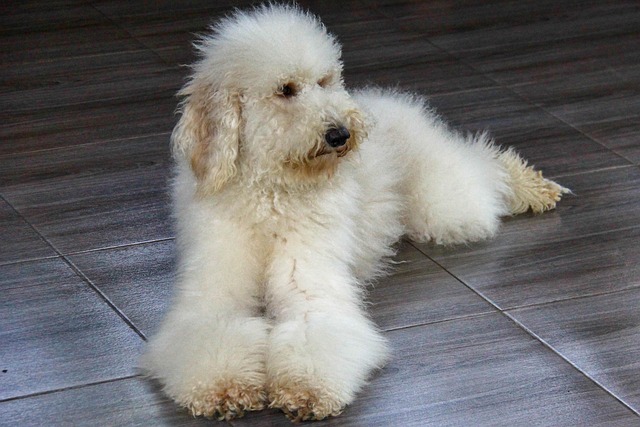
Wavy to curly, medium-long. Shedding varies from low to moderate. The coat is rarely fully non-shedding — it requires consistent grooming.
Lifespan
12–15 years. Well-bred individuals from health-tested parents regularly reach the upper end of this range.
Best Suited For
Active singles, couples, or families with older children who can provide at least 90 minutes of daily physical and mental exercise. Not for sedentary homes.
Energy Level
High to very high. Bordoodles need purposeful activity — running, agility, advanced obedience, or herding games — not just a walk around the block.
Trainability
Extremely high, but paired with sensitivity. They excel with positive reinforcement and shut down under harsh corrections. Boredom leads to problem behaviors quickly.
Bordoodle Appearance & Size: A Study in Variety
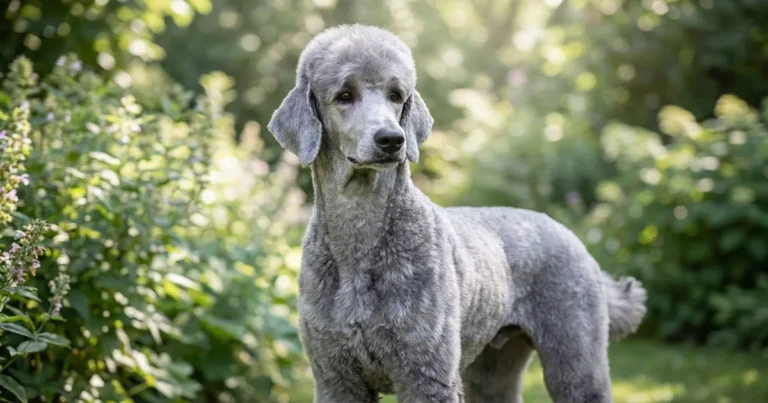
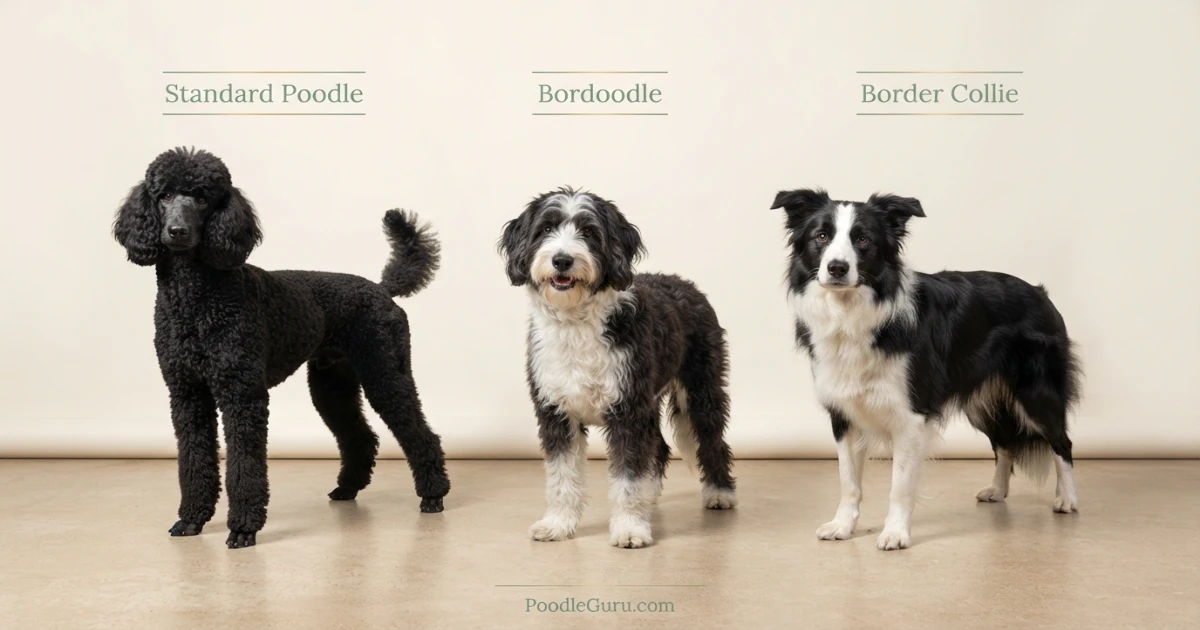
Bordoodle looks can vary dramatically. The Poodle parent’s size — Standard versus Miniature — is the single biggest factor. A Standard Poodle cross typically yields a leggy, athletic dog of 45–60 pounds. A Miniature Poodle cross produces a smaller, more compact dog under 40 pounds. Within the same litter, some puppies will inherit the Border Collie’s broader skull and moderate stop, while others show the Poodle’s finer bone and longer muzzle.
Coat color is equally unpredictable. Black-and-white is common, mimicking the classic Border Collie pattern, but solid black, cream, apricot, red, sable, and merle also appear. The Poodle’s fading gene means puppy coat color isn’t permanent. A dark chocolate puppy may lighten to café-au-lait by age two. If color matters to you, ask to see adult siblings from previous litters — that’s your most honest preview.
Bordoodle Temperament: Brilliant, Driven, and Sensitive
The Bordoodle’s mind is its defining feature. These dogs notice everything. They learn routines after a single repetition, anticipate your next move, and remember exactly where you keep the treats. That intellectual horsepower, however, comes with a catch: they’re emotionally soft. A harsh tone, an impatient correction, or inconsistent rules can erode trust faster than with many other breeds.
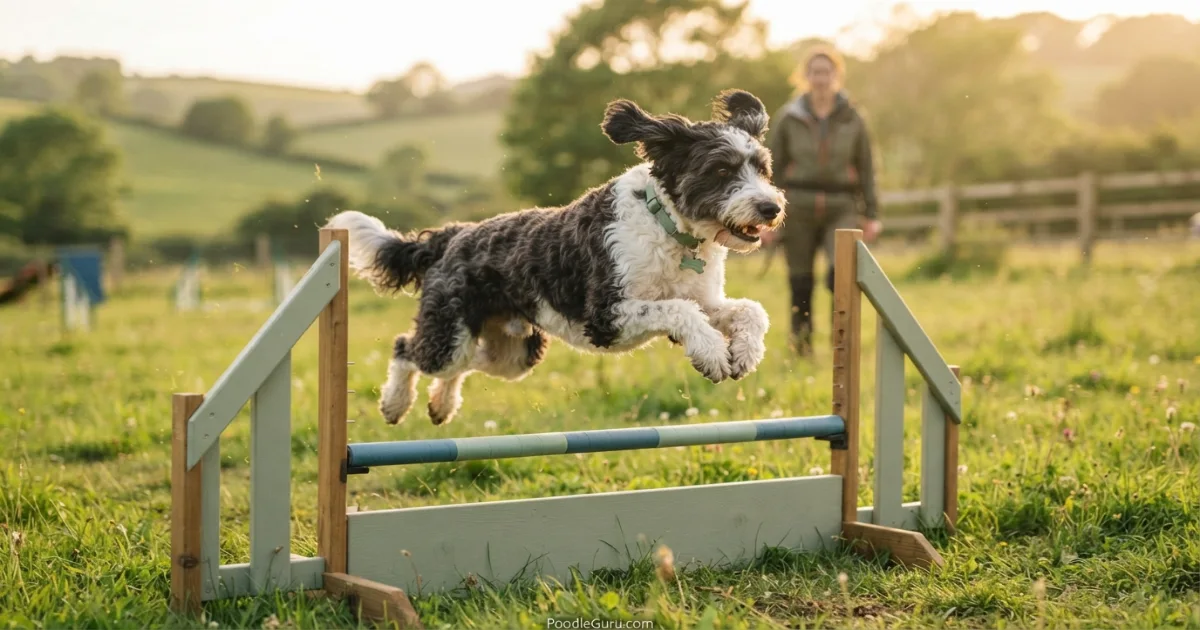
Herding instincts run deep. Bordoodles may circle children, nudge ankles, or stare intently at moving objects — these are hardwired behaviors, not quirks to punish. Channeling that drive into structured activities (agility, flyball, treibball) keeps the dog fulfilled and your household sane. Without an outlet, that same intensity turns into pacing, barking, and obsessive shadow-chasing.
Owners often notice that Bordoodles bond tightly with their people but can be reserved with strangers. Early and ongoing socialization is non-negotiable. A Bordoodle raised in isolation becomes a dog that’s anxious, reactive, and difficult to manage in public. The goal isn’t to create a social butterfly — it’s to build a dog that can remain calm and focused around unfamiliar people and dogs.
Expert Insight: The “Border Collie Stare”
The Border Collie’s signature crouch-and-stare behavior often appears in Bordoodles. This isn’t aggression — it’s a herding behavior. However, around small children or other pets, it can be misinterpreted and may escalate into chasing. Professional trainers recommend redirecting the stare into a structured “watch me” command before it fixates on an inappropriate target.
Bordoodle vs. Poodle vs. Border Collie: A Trait-by-Trait Breakdown
This table isn’t just for curiosity — it’s a decision-making tool. Understanding exactly how the Bordoodle compares to its parent breeds reveals what you’re signing up for:
| Trait | Bordoodle | Standard Poodle | Border Collie |
|---|---|---|---|
| Weight | 30–60 lbs | 40–70 lbs (Standard) | 30–55 lbs |
| Coat Type | Wavy to curly, medium-long | Dense, curly single coat | Double coat, medium-length, straight or wavy |
| Shedding | Low to moderate | Very low | Moderate to heavy |
| Grooming Frequency | Every 4–6 weeks professional groom; brushing 3–4x/week | Every 4–6 weeks; daily brushing ideal | Weekly brushing; heavier during shedding seasons |
| Trainability | Very high — learns fast, needs mental challenges | Very high — eager to please | Extremely high — but requires a job |
| Energy Level | High to very high | High | Very high |
| Exercise Needs | 90+ min daily, plus mental work | 60+ min daily | 90–120+ min daily |
| Herding Instinct | Often present — may herd people/pets | Minimal | Very strong |
| Stranger Response | Reserved, may be aloof | Alert, may bark | Wary, can be sensitive |
| Lifespan | 12–15 years | 12–15 years | 12–15 years |
The Bordoodle pulls from the Poodle’s trainability and the Border Collie’s endurance. That’s a powerful combination — and a massive daily responsibility. If you’re looking for a dog that’s happy with a 20-minute stroll, this table should redirect you elsewhere.
The PoodleGuru 4-Point Bordoodle Match Assessment
At PoodleGuru, we evaluate high-energy designer mixes through a lens of honest suitability, not just aesthetic appeal. Use this framework to decide whether a Bordoodle genuinely fits your life — before you contact a breeder.
Assess Your Activity Reality
Write down exactly how much active, engaged time you can offer daily — not your ideal, but your actual. Bordoodles need a minimum of 90 minutes of physical exercise plus dedicated brain work (puzzle toys, training, scent games). If your schedule can’t absorb that, this dog will suffer.
Outcome: A clear yes/no based on your weekly routine, not your aspirations.
Evaluate Herding Tolerance
Bordoodles often herd by circling, staring, and nipping at heels. If you have young children, elderly family members, or cats, ask yourself honestly: can you manage and redirect this behavior without frustration? Herding isn’t a training flaw, but it requires consistent redirection.
Outcome: A household compatibility check — herding dogs and fragile household members require careful management.
Calculate True Grooming Commitment
Wavy Bordoodle coats mat quickly at friction points. Between professional grooms every 4–6 weeks, you’ll need to brush thoroughly 3–4 times per week using a slicker brush and metal comb. Factor in the cost: $80–$120 per groom session, plus quality tools.
Outcome: A realistic grooming budget — time and money — not a fantasy of a wash-and-wear dog.
Verify Breeder Health Transparency
Both parent breeds carry distinct hereditary risks. Demand OFA or PennHIP hip scores, a CERF eye exam, and DNA testing for Collie eye anomaly (CEA) and progressive retinal atrophy (PRA). If the breeder hesitates or offers only “vet-checked” assurances, you’re looking at a puppy-mill front.
Outcome: A filtered list of breeders who meet baseline health testing standards — protecting you from devastating vet bills later.
Bordoodle Health & Lifespan: What Responsible Breeding Prevents
A Bordoodle’s 12–15 year lifespan depends heavily on the health clearances behind it. Hybrid vigor offers some protection, but it’s not a shield. A puppy from untested parents can inherit the worst of both worlds. Veterinary guidance generally recommends screening for these conditions in Bordoodle lines:
- Hip dysplasia — prevalent in both Standard Poodles and Border Collies. OFA or PennHIP evaluation of both parents is non-negotiable.
- Progressive retinal atrophy (PRA) — inherited blindness. DNA testing identifies carriers; two carriers should never be bred.
- Collie eye anomaly (CEA) — a congenital condition from the Border Collie side that can cause vision impairment. Reputable breeders test for it.
- Epilepsy — idiopathic epilepsy appears in both parent breeds. There’s no genetic test, but a breeder who discloses any seizure history in the line is acting responsibly.
- Exercise-induced collapse (EIC) — more commonly associated with retrievers, but Border Collies can also carry the gene. Testing is available and should be considered.
When to Call Your Vet
Contact your veterinarian if your Bordoodle shows sudden lameness, unexplained collapse during exercise, persistent eye changes (cloudiness, redness, squinting), or seizure activity. These are not wait-and-see symptoms in a working-breed cross.
Grooming & Coat Care: The Price of That Soft Wave
Bordoodle coats are deceptive. They look effortlessly tousled — until you find a mat the size of a walnut behind the ear. Professional groomers commonly warn that Bordoodle coats mat just as readily as Poodle coats, especially where the collar rubs, in the armpits, and along the hindquarters. A consistent home routine is the only way to prevent painful pelting that requires a full shave-down.
Book professional grooming every 4–6 weeks. Between appointments, a line-brushing technique with a slicker brush followed by a greyhound comb will reach the skin and prevent hidden mats. Pay special attention after swimming or rainy walks — moisture tightens existing tangles into solid knots. If you hear the comb scraping, stop. Work the mat apart with your fingers or leave it for the groomer; pulling through it hurts the dog and damages the coat.
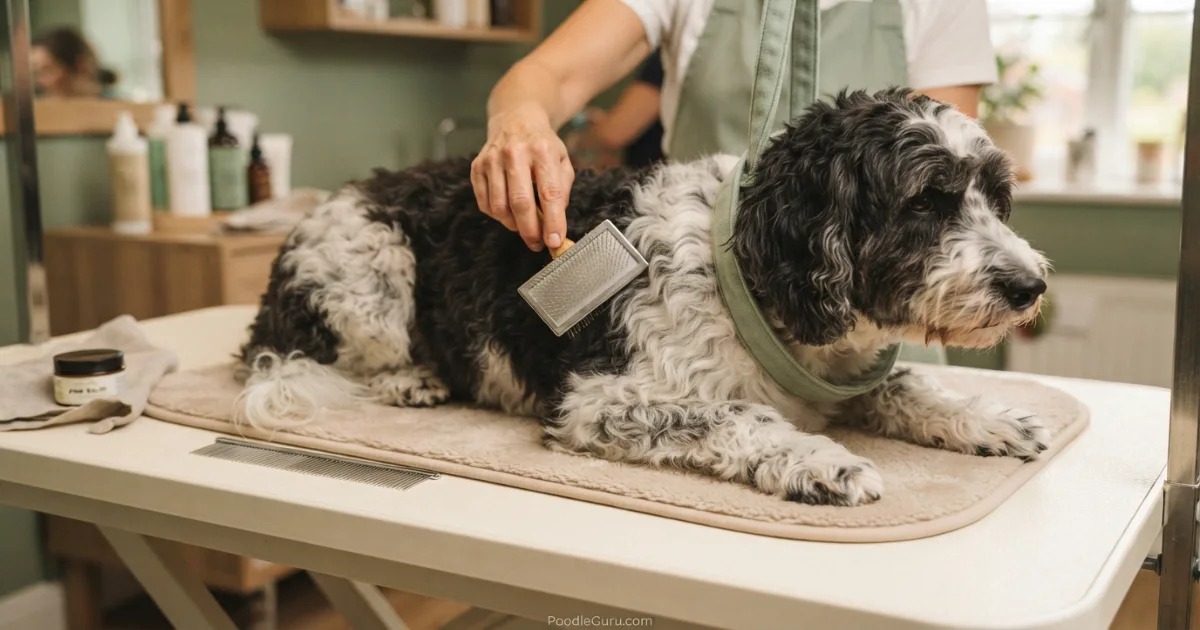
Ear care is equally critical, especially in Bordoodles with drop ears inherited from the Border Collie side. Clean ears weekly with a vet-approved solution, and check for odor or discharge. Any head-shaking or pawing at the ears warrants a vet visit — ear infections can take hold quickly in moist, hairy ear canals. For a complete grooming routine breakdown that applies directly to Poodle-mix coats, see our Complete Poodle Grooming Guide.
Training & Mental Stimulation: A Job, Not Just a Lesson
Training a Bordoodle is rarely about teaching the command — they’ll master “sit,” “down,” and “stay” in a single session. The challenge is keeping that brilliant mind engaged over a lifetime. These dogs need progressive training: once they’ve nailed basic obedience, move to trick training, agility foundations, scent work, or advanced recall in distracting environments. If you stop at the basics, they’ll find their own curriculum — and you won’t like it.
Positive reinforcement is the only methodology that preserves the Bordoodle’s trust. Clicker training, in particular, harnesses their natural precision. Avoid punishment-based methods entirely. A Bordoodle subjected to harsh corrections often develops anxiety-based reactivity that’s far harder to undo than the original behavior. Early socialization must expose the puppy to varied environments, surfaces, sounds, and calm unfamiliar dogs before 16 weeks. A well-socialized Bordoodle grows into a confident, adaptable companion; a poorly socialized one becomes a project dog that’s afraid of strangers, traffic, and vet offices.
Mental stimulation isn’t optional — it’s as essential as food. Rotate puzzle toys, play hide-and-seek with treats, teach the names of toys, or set up a simple backyard agility course. A tired Bordoodle is a happy Bordoodle; a bored one will dismantle your couch cushion by cushion.
Finding a Responsible Bordoodle Breeder
Because Bordoodles aren’t a recognized AKC breed, there’s no central breed club to enforce standards. That leaves the burden of vetting entirely on you. Here’s how to separate a committed breeder from a profit-driven operation:
| Green Flag | Red Flag |
|---|---|
| Both parent dogs are available to meet or view via live video | Breeder won’t show you one or both parents — “they’re at a friend’s house” is a classic excuse |
| Full OFA/PennHIP, CERF, and DNA health clearances for both parents | “Vet-checked” is the only health claim; no actual documentation exists |
| Breeder asks detailed questions about your lifestyle, exercise plan, and training experience | Breeder only asks about payment method and pickup date |
| Puppies raised indoors with early neurological stimulation and exposure to household sounds | Puppies kept in outdoor kennels or barns with limited human interaction |
| Transparent about which Poodle size (Standard vs. Miniature) was used and why | Vague or misleading about parent size; uses “teacup” or “royal” sizing language |
| Written health guarantee and a contract that includes a return-to-breeder clause | No contract, or a contract that waives all health responsibility after sale |
Remember: a responsible breeder will interview you as thoroughly as you interview them. If the conversation feels transactional, walk away. The right Bordoodle puppy is worth waiting for.
Bordoodle Price Guide (2026)
In 2026, a responsibly bred Bordoodle from fully health-tested parents costs between $1,800 and $3,500. Miniature Poodle crosses sometimes fall at the lower end of that range, while Standard Poodle crosses with exceptional working lineage or rare coat colors push toward the upper end.
What Affects Bordoodle Pricing
- Parent health clearances — comprehensive OFA, CERF, and DNA panels add real cost. This is not where you want to save money.
- Poodle parent size — Standard Poodle crosses often produce larger litters and higher-demand puppies, influencing price modestly.
- Coat color and pattern — Merle, red, and striking tri-color patterns can increase price by $300–$700, despite having no health advantage.
- Breeder location and reputation — established breeders in high-cost regions charge more, but their health guarantees and support are often worth it.
Avoid any Bordoodle priced under $1,000. At that level, you’re nearly always looking at a puppy-mill or backyard-bred dog without health testing. The upfront savings vanish the moment you face a hip dysplasia diagnosis or a dog with severe behavioral issues rooted in poor early socialization.
Is a Bordoodle Right for You?
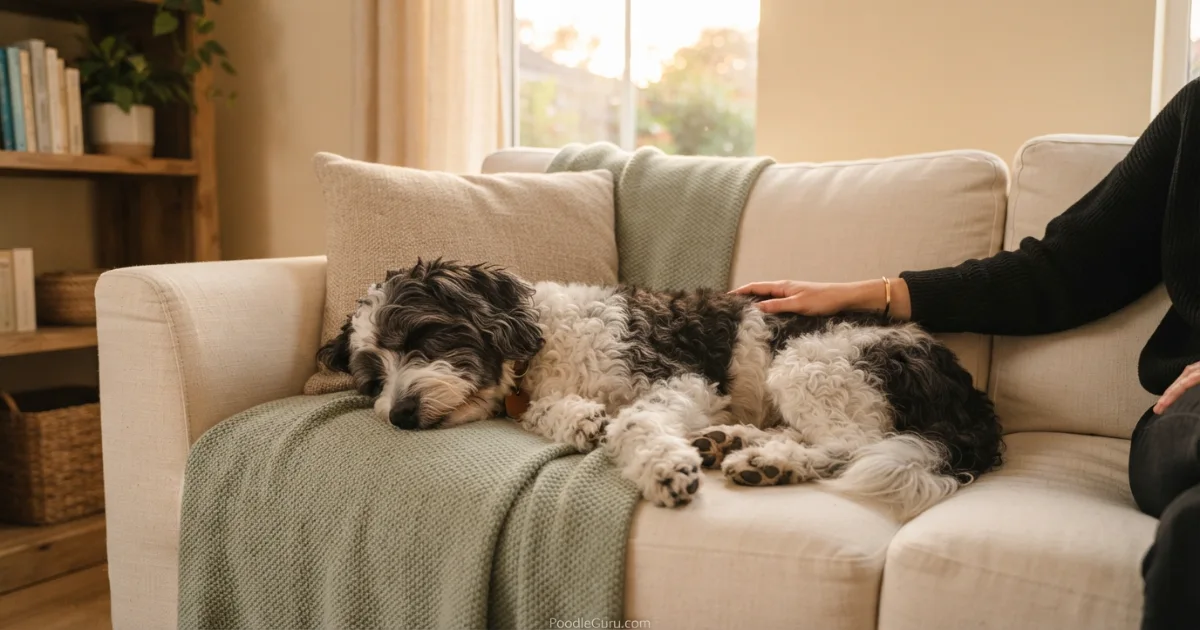
The Bordoodle is not a dog for everyone. It’s a dog for the committed, active person who sees training as a hobby and exercise as a daily ritual. Answering honestly here prevents a mismatch that hurts both you and the dog.
A Bordoodle may be right for you if: you enjoy daily outdoor adventures, you’re fascinated by advanced training, you have a flexible schedule or work from home, and you view grooming as a necessary bonding routine rather than a chore.
A Bordoodle is probably not right for you if: your ideal dog is a couch companion with minimal exercise needs, you’re away from home for 8+ hours daily, you have very young children who could be unnerved by herding behavior, or you’re looking for a low-maintenance, low-cost pet.
Frequently Asked Questions About Bordoodles
Are Bordoodles hypoallergenic?
No dog is fully hypoallergenic. Bordoodles with a tighter, Poodle-like curl shed very little dander and may suit mild allergy sufferers. However, coat type varies, and someone with severe allergies should spend time with the specific adult dog before committing.
Do Bordoodles bark a lot?
Bordoodles are alert and vocal, a trait inherited from both parent breeds. They’ll bark at visitors, passing dogs, and unexpected sounds. Early training and providing sufficient mental exercise significantly reduce demand barking, but a completely silent Bordoodle is unlikely.
Are Bordoodles good with children?
Bordoodles can be excellent with older, respectful children who understand how to interact with a sensitive, high-energy dog. Their herding instincts may lead them to nip at running toddlers, so supervision and training are essential in homes with young kids.
How much exercise does a Bordoodle really need?
Plan for a minimum of 90 minutes of active exercise daily, plus dedicated mental stimulation. This means off-leash running, structured fetch, agility, or long hikes — not just a short neighborhood walk. Without it, destructive behaviors surface quickly.
Do Bordoodles shed?
Shedding varies from very low (tight curls) to moderate (wavy coat resembling a Border Collie). Most fall in the low-to-moderate range. If you’re seeking a reliably non-shedding dog, a multi-generational Australian Labradoodle with predictable coat genetics may be a better fit.
Are Bordoodles easy to train?
They learn commands incredibly fast — often in one or two repetitions. The challenge is maintaining engagement and preventing boredom. Training must be progressive, positive, and mentally stimulating. They’re not “easy” in the sense of a low-maintenance, always-obedient dog.
What’s the difference between a Bordoodle and an Aussiedoodle?
Both are Poodle crosses with herding breeds, but an Aussiedoodle uses an Australian Shepherd instead of a Border Collie. Aussiedoodles tend to be slightly stockier and may have a more protective streak. Bordoodles lean more toward the intense, stare-driven working style of the Border Collie.

Final Summary: Key Takeaways for Bordoodle Buyers & Owners
The Bordoodle is a stunning, whip-smart companion — for the right owner. Before you commit, carry these non-negotiable points forward:
- A Bordoodle is a Border Collie-Poodle cross weighing 30–60 lbs, with a 12–15 year lifespan, requiring at least 90 minutes of daily exercise plus mental stimulation to prevent destructive behaviors.
- Coat type varies from wavy to curly; shedding is low to moderate, and professional grooming every 4–6 weeks combined with home brushing 3–4 times per week is mandatory for coat health.
- The PoodleGuru 4-Point Bordoodle Match Assessment forces an honest evaluation of your activity level, herding tolerance, grooming commitment, and breeder vetting standards before you buy.
- Responsible breeders provide OFA/PennHIP, CERF, and DNA clearances for both parents; expect to pay $1,800–$3,500 in 2026 for a well-bred Bordoodle from health-tested lines.
- Herding instincts, sensitivity to harsh training, and intense social needs make this breed a poor fit for sedentary homes, first-time owners seeking low maintenance, or households with very young children.
- Mental engagement — trick training, puzzle toys, scent work, agility — is not a bonus; it’s a daily requirement as critical as food and water.
Next step: Revisit the 4-Point Match Assessment above. If you can honestly answer “yes” to each point, you’re ready to start contacting breeders who meet the health-testing standards outlined here. Your future Bordoodle’s well-being begins with the choices you make today.