This article contains affiliate links. PoodleGuru may earn a small commission if you purchase through our links, at no extra cost to you.
Corgipoo (Corgi Poodle Mix): The Complete Guide for 2026
The Corgipoo pairs a Poodle’s cleverness with a Corgi’s bold, herding spirit — but that unique body shape can bring structural risks many buyers overlook. Here’s what you need to know before you commit.
Quick Answer
A Corgipoo is a designer cross between a Pembroke Welsh Corgi (or occasionally a Cardigan) and a Toy or Miniature Poodle. Most adults weigh 12–28 lbs and stand 10–12 inches tall. Their coat ranges from wavy to curly; shedding is usually moderate. Temperament is bright, playful, and often more stubborn than a pure Poodle. The biggest ownership challenge — and the one that catches people off guard — is the long-backed, short-legged frame many Corgipoos inherit from the Corgi, which can increase spinal risk, including intervertebral disc disease (IVDD).
What Is a Corgipoo?
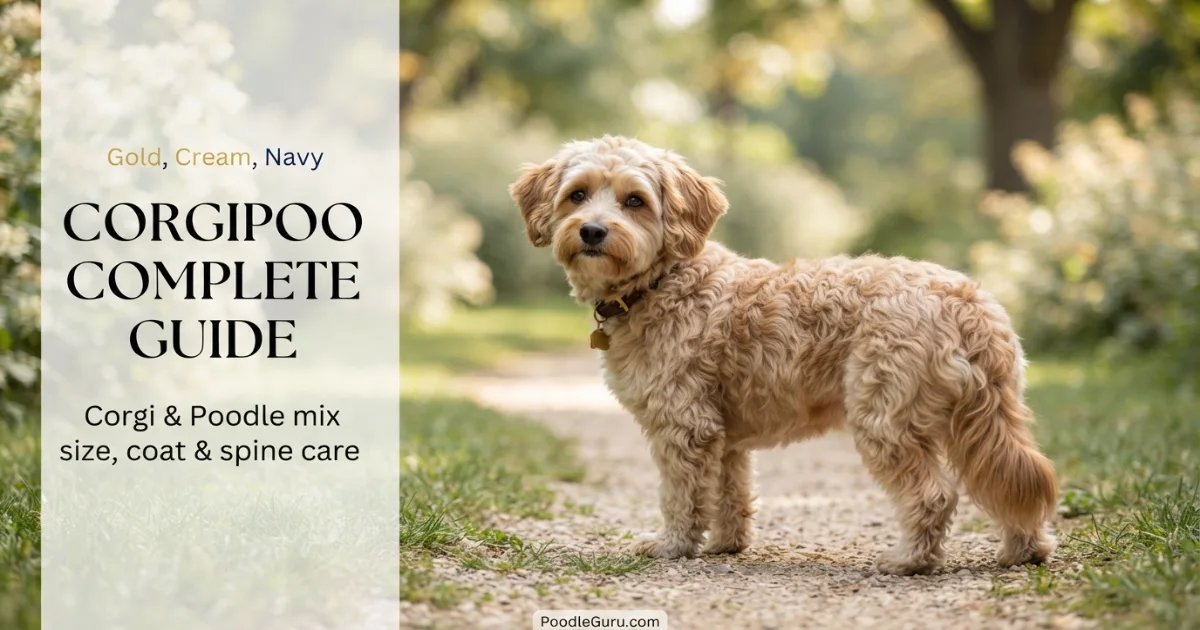
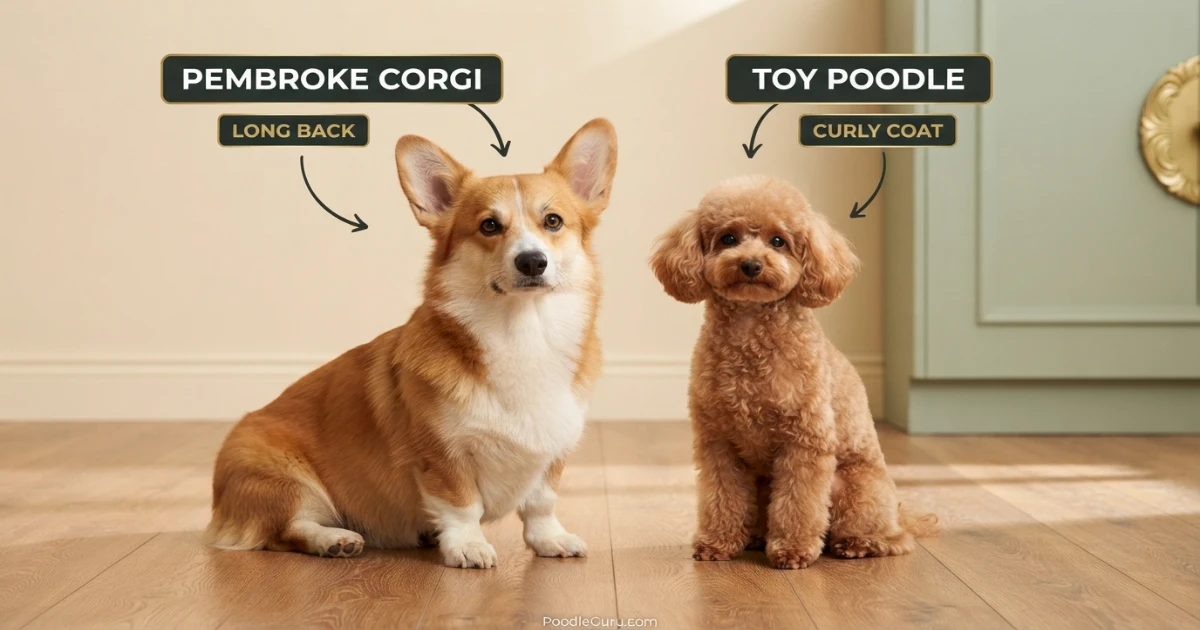
A Corgipoo is a hybrid dog produced by crossing a purebred Corgi — most commonly the Pembroke Welsh Corgi — with a purebred Poodle, typically a Toy or Miniature Poodle. The goal is a small, intelligent companion with a Poodle’s low-shedding coat and a Corgi’s spirited personality.
For poodle owners, this means expecting a dog with sharper herding instincts than a typical Poodle, combined with the chondrodysplastic build that gives Corgis their short legs and long back. The most important thing to understand is that the Corgipoo’s skeletal structure — while adorable — can introduce spinal vulnerabilities that are less central in standard-legged Poodles. Weight management, safe handling, and breeder selection become everything.
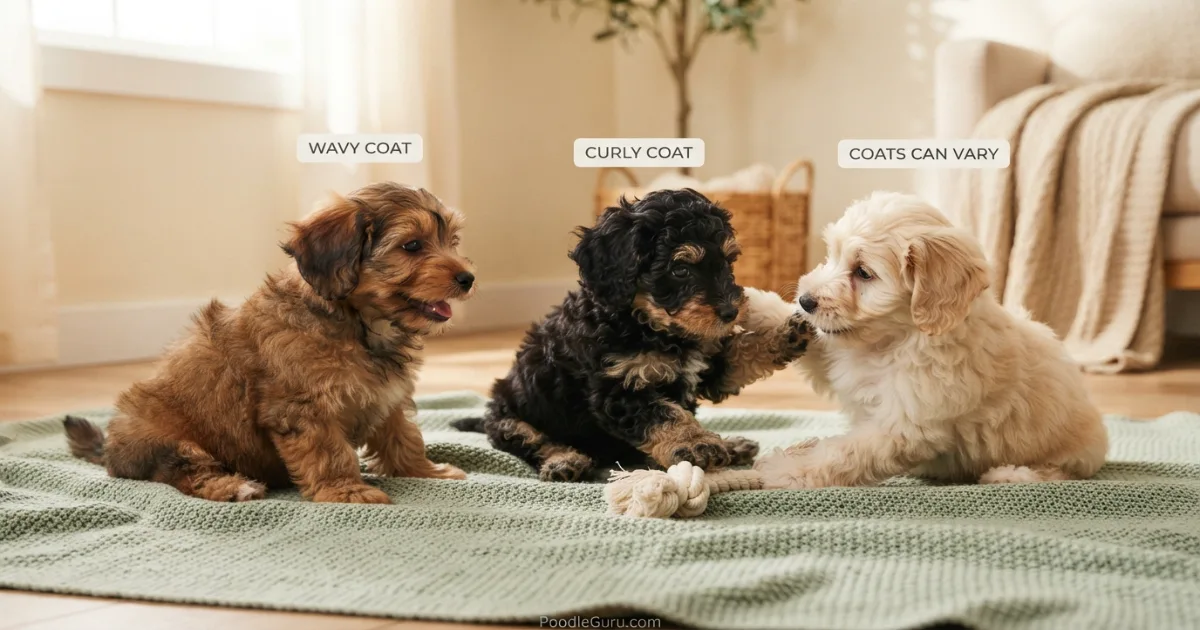
As with any mixed breed, puppies can pull heavily from either parent. You might get a curly, low-shedding coat or a dense, shedding double coat. You might get the Poodle’s eager-to-please nature or the Corgi’s independent, “what’s in it for me?” attitude. That variability makes every Corgipoo a bit of a surprise.
Quick Facts at a Glance
Size
10–12 inches tall
Weight
12–28 lbs (varies widely)
Coat
Wavy, curly, or double coat; low to heavy shedding possible
Lifespan
12–15 years with proper care
Temperament
Smart, playful, alert, sometimes stubborn
Energy Level
Moderate — needs daily walks and mental work
Temperament & Personality: Bold, Bright, and Sometimes Bossy
The Corgipoo personality is a lively cocktail: the Poodle’s sharp mind mixed with the Corgi’s independent, herding nature. Many owners describe them as big dogs in small bodies. They’re confident, often comical, and form intense bonds with their people.
This mix can be more stubborn than a pure Poodle. Corgis were bred to move cattle — independently making decisions — so your Corgipoo may question commands before obeying. Training needs to be consistent, positive, and filled with micro-sessions. They pick up tricks quickly but can also learn to game the system if you’re not careful.
Herding behaviors — nipping at heels, circling, or barking when people move quickly — can surface, especially with young children. Early redirection is a must. A well-socialized Corgipoo is wonderful with older kids and other dogs. They’re alert watchdogs, but not yappy without reason. Expect a dog that wants to be part of every conversation and activity.
Size & Appearance: The Long-Backed Truth
The Corgipoo’s body is unmistakably Corgi-influenced: a long back, deep chest, and short, sturdy legs. The head shape varies; many have a slightly foxy face with erect or semi-erect ears, though floppy Poodle-like ears can also appear. The tail is usually long, sometimes carried jauntily over the back.
Weight swings wildly depending on which parent size was used. A Toy Poodle cross may land around 12–18 lbs, while a Miniature Poodle cross can hit 20–28 lbs. Height at the shoulder rarely exceeds 12 inches, but body length can stretch to 18 inches or more. That length-to-height ratio is what puts the spine at risk.
Coat colors include red, sable, fawn, black and tan, apricot, cream, and brindle. White markings on the chest, paws, and face are common, especially from the Corgi side.
Coat & Grooming Reality
The promise of a low-shedding or allergy-friendlier coat draws many people to the Corgipoo, but the truth is messier. The coat can land anywhere on a wide spectrum:
- Curly (Poodle-dominant): tight curls, sheds minimally. Needs brushing 3–4 times a week and professional grooming every 6–8 weeks.
- Wavy (blend): the most common result — moderate shedding, mats easily behind the ears and under the collar. Brush 2–3 times a week.
- Short, dense double coat (Corgi-dominant): heavy shedding, especially seasonally. The fluffy undercoat can mat if neglected. Expect fur on every surface.
Professional groomers see a lot of Corgipoos with painful mats because owners underestimated the upkeep. Never skip professional grooming if you have a curly or wavy coat. And for heavy shedders, invest in a good deshedding tool and a powerful vacuum. If allergies are a concern, spend time with the specific puppy before committing — there’s no guarantee.
Health: The Spinal Reality and Other Must-Know Concerns
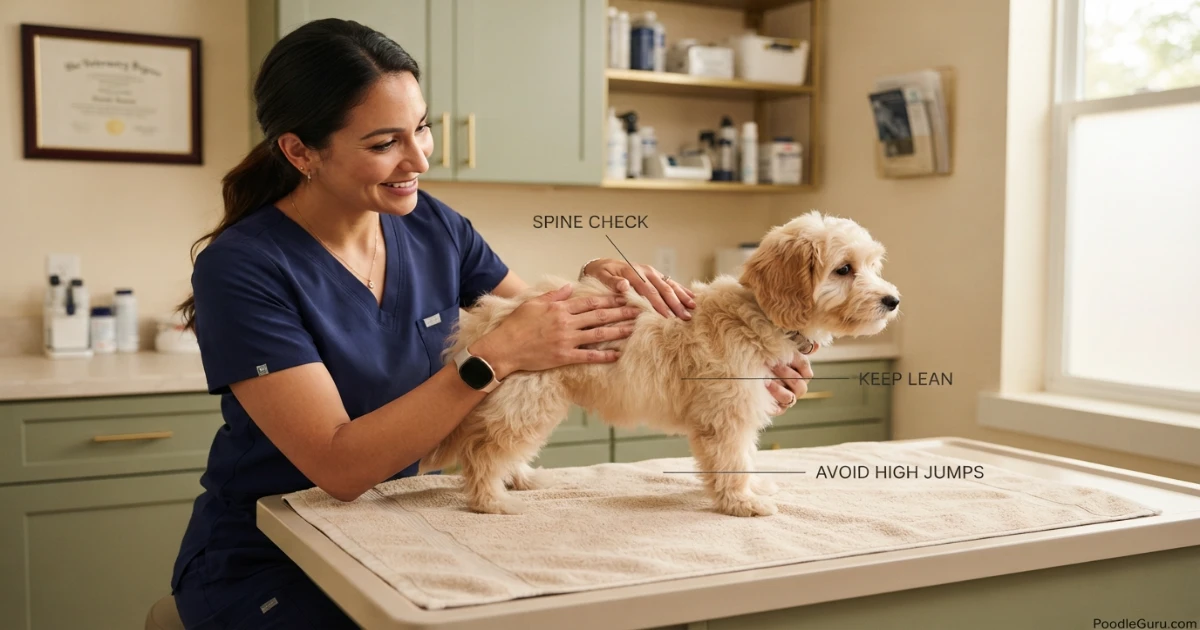
The single largest health consideration for many Corgipoos is the long-backed, short-legged body structure inherited from the Corgi side. This chondrodysplastic build can raise concern for intervertebral disc disease (IVDD), where discs between vertebrae bulge or rupture and may cause pain, nerve compression, weakness, or paralysis. VCA Animal Hospitals explains that IVDD signs vary with the location and severity of disc pressure, so sudden back pain, gait changes, or weakness should be treated seriously.
Beyond the spine, Corgipoos may inherit issues from both parents:
- Patellar luxation: slipping kneecaps, common in small dogs.
- Hip dysplasia: especially in heavier Corgipoos with Miniature Poodle lineage.
- Progressive retinal atrophy (PRA) and cataracts: both Corgis and Poodles can carry these eye conditions.
- Degenerative myelopathy (DM): a progressive spinal cord disease known in Corgis.
- Obesity: extra weight on that long spine is disastrous. You must keep a Corgipoo lean.
Ethical breeders screen for these problems. They won’t breed a Corgi with an excessively long back or a Poodle with unknown joint history. They’ll share OFA or PennHIP hip scores, patella evaluations, and eye clearances. If a breeder can’t produce those documents, you’re gambling with a five-figure spinal surgery down the road.
The AKC Pembroke Welsh Corgi breed standard describes the correct proportions, but even within standard, the back is long relative to the legs. Pair that with a Poodle, and structural risk management falls squarely on breeder choices.
5 Breeder Red Flags for Corgipoos
The designer dog market is flooded with breeders who prioritize cuteness over structural soundness. These are the non-negotiables that separate a responsible breeder from a risky one:
- No health testing for parent dogs. At minimum, demand OFA hips, elbows, patellas, and eye clearances (CAER) for both parents. Radiographic screening for IVDD is less standardized but a breeder who mentions structural evaluation earns trust.
- Extremely long backs or very stubby legs in the Corgi parent. The longer the back and the shorter the legs, the higher the IVDD risk. A moderate, balanced Corgi is healthier.
- Puppies constantly available. Quality breeders have waitlists, not a rotating stock of 8-week-olds.
- No return policy or health guarantee. A written contract should spell out what happens if the dog develops a genetic condition.
- Multiple designer crosses under one roof. A breeder producing Corgipoos, Cockapoos, and Sheepadoodles simultaneously is likely a commercial operation, not a specialist.
For more on vetting a breeder, our guide to questions every Poodle breeder should answer is just as useful for mixed breeds.
Corgipoo Price Guide (2026)
- Ethical breeder: $1,500 – $3,200 (health-tested parents, early socialization, limited registration)
- Pet store or broker: $2,800 – $5,000+ (often no health guarantees; high-pressure sales)
- Rescue or rehome: $250 – $600 (adoption fees; adults and seniors occasionally available through breed-specific rescues)
Rare coat colors — blue merle, brindle points, or “fluffy” coats — inflate the price dramatically. They don’t make the dog healthier. Pay for health testing and temperament, not a trendy color.
Training & Socialization: Harnessing the Herding Brain
Training a Corgipoo is a dance between the Poodle’s eagerness to learn and the Corgi’s independent streak. Short, reward-heavy sessions — 5–10 minutes, twice a day — outperform long drills. They’re food motivated, which is helpful, but their intelligence means they get bored with repetition. Switch up cues and add trick training to keep things fresh.
House training usually goes smoothly with consistency. Crate training is invaluable, not just for potty training but for giving your Corgipoo a safe place to settle. Without it, they can become velcro dogs who panic when you leave.
Herding behaviors like nipping at moving feet need immediate, calm redirection. Never punish a nip — simply stop moving and redirect to a toy. Early socialization, especially between 8–16 weeks, shapes a confident adult. Expose them to different people, surfaces, and gentle dogs. A poorly socialized Corgipoo can become fearful or reactive, so this is a priority, not an option.
Corgi vs. Poodle vs. Corgipoo: A Side-by-Side Look
| Trait | Pembroke Welsh Corgi | Toy/Mini Poodle | Corgipoo |
|---|---|---|---|
| Weight | 24–30 lbs | 4–15 lbs | 12–28 lbs |
| Body Structure | Long back, short legs (dwarf) | Square, proportional | Long back, short legs typical; varies |
| IVDD Risk | Moderate to High | Low | Moderate to High (inherited dwarfism) |
| Shedding | Heavy | Minimal | Low to Heavy depending on coat |
| Trainability | Independent, food-driven | Highly biddable | Smart, can be stubborn |
| Herding Instinct | High | Low | Moderate to High |
| Best For | Active, herding-savvy homes | Versatile, allergy-conscious owners | Engaged owners who can manage structure and energy |
This table highlights a blend of attributes you won’t find on generic listicles: the direct mapping of dwarf structure to IVDD risk, combined with herding instinct and coat variability. At PoodleGuru, we evaluate mixed breeds by first understanding the extremes of each parent, then mapping where a cross might land — and where the danger zones lie.
The PoodleGuru Corgipoo Structure Assessment Framework
When we evaluate whether a Corgipoo is built for a long, healthy life, we look at five structural and behavioral dimensions. Use this framework yourself when meeting a litter:
1. Spine Length-to-Leg Ratio
A moderately long back with legs that aren’t excessively short reduces IVDD load. Extremes in either direction raise red flags.
2. Body Condition & Weight
A visible waist and palpable ribs are non-negotiable. Even an extra pound torques that long spine.
3. Coat Type & Shedding
Curl pattern determines your grooming commitment and the allergen load in your home.
4. Parent Health Clearances
OFA hips, elbows, patellas, CAER eyes, and ideally spinal awareness — no exceptions.
5. Temperament Blend
Look for a puppy that is curious and handler-focused, not overly independent or fearful.
This is a PoodleGuru original framework, built to cut through breeder marketing and focus on what actually determines quality of life.
How to Evaluate a Corgipoo Breeder in 4 Steps
Verify Structural Health Testing
Ask for OFA or PennHIP certificates for both parents. A breeder who says “the vet said they’re healthy” without paperwork is not doing enough.
Assess the Corgi Parent’s Body Proportions
A healthy Corgi has a long back, but it shouldn’t look stretched to the extreme. Legs should be sturdy, not so short that the belly nearly touches the ground.
Meet the Mother Dog and Observe Temperament
The dam should be calm, comfortable with strangers, and not overly reactive. Her behavior is a strong predictor of puppy temperament.
Secure a Detailed Contract
The contract must include a health guarantee, return policy, and spay/neuter expectations. Verbal promises don’t count.
Frequently Asked Questions About Corgipoos
Are Corgipoos hypoallergenic?
No dog is completely hypoallergenic. Corgipoos with curlier Poodle-type coats may shed less, but there is no guarantee of a low-allergen dog. Spend time with the specific dog before committing if allergies are a concern.
How big do Corgipoos get?
Most Corgipoos weigh between 12 and 28 pounds and stand 10 to 12 inches tall. The size depends on whether the Poodle parent was Toy or Miniature, and the size of the Corgi parent.
Do Corgipoos shed a lot?
It depends entirely on the coat type. Those with a Corgi-like double coat shed heavily; wavy or curly coats shed much less. There’s no way to predict this in a young puppy, so be prepared for any outcome.
Are Corgipoos good with children?
Yes, when raised with them. However, their herding instinct may cause nipping at running kids, so supervision and training are essential. They do best with older, respectful children.
What health problems do Corgipoos have?
The greatest risk is intervertebral disc disease (IVDD) due to the long back and short legs. Patellar luxation, hip dysplasia, eye diseases, and obesity are also common. Health testing of parents reduces but never eliminates these risks.
How much exercise does a Corgipoo need?
About 45 minutes of daily walking plus mental stimulation. Limit high-impact jumping and frequent stair-climbing, especially while the dog is young and still developing, and ask your vet what level of activity is safest for your individual dog.
Do Corgipoos bark a lot?
They can be vocal, especially if bored or herding instincts kick in. Early training to reward quiet behavior and providing sufficient mental exercise help keep barking in check.
Key Takeaways: Corgipoo Ownership in 2026
- A Corgipoo is a Corgi-Poodle mix weighing 12–28 lbs with a long-backed, short-legged body that demands careful handling.
- Intervertebral disc disease (IVDD) is the #1 structural risk; avoid high jumps and keep the dog lean.
- Coat type varies wildly — curly (low shed) to double coat (heavy shed) — with no guarantee.
- Temperament is intelligent, alert, and affectionate but can include herding nipping and stubbornness.
- Expect to pay $1,500–$3,200 from an ethical breeder in 2026; higher prices rarely mean better health.
- Insist on documented OFA hip, patella, and eye clearances for both parents. No paperwork, no puppy.
- Use The PoodleGuru Corgipoo Structure Assessment Framework as your checklist when visiting a litter.