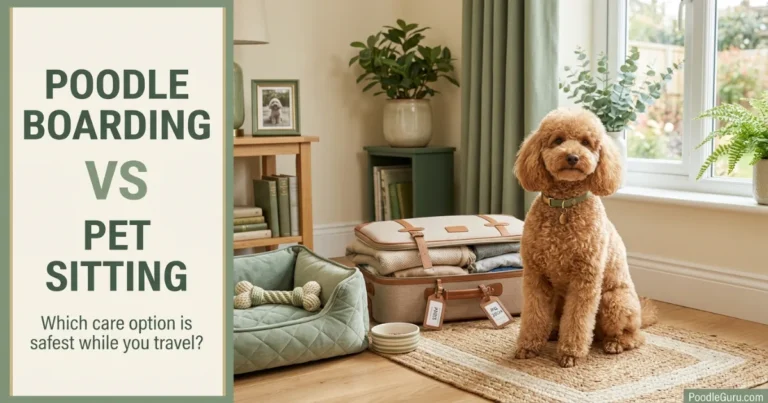
Working From Home With a Poodle: Routine, Training & Enrichment
Your poodle wants to be near you. That’s wonderful—until your laptop becomes a headrest. Use this practical routine to protect your focus while meeting your poodle’s needs for movement, mental work, connection, and rest.
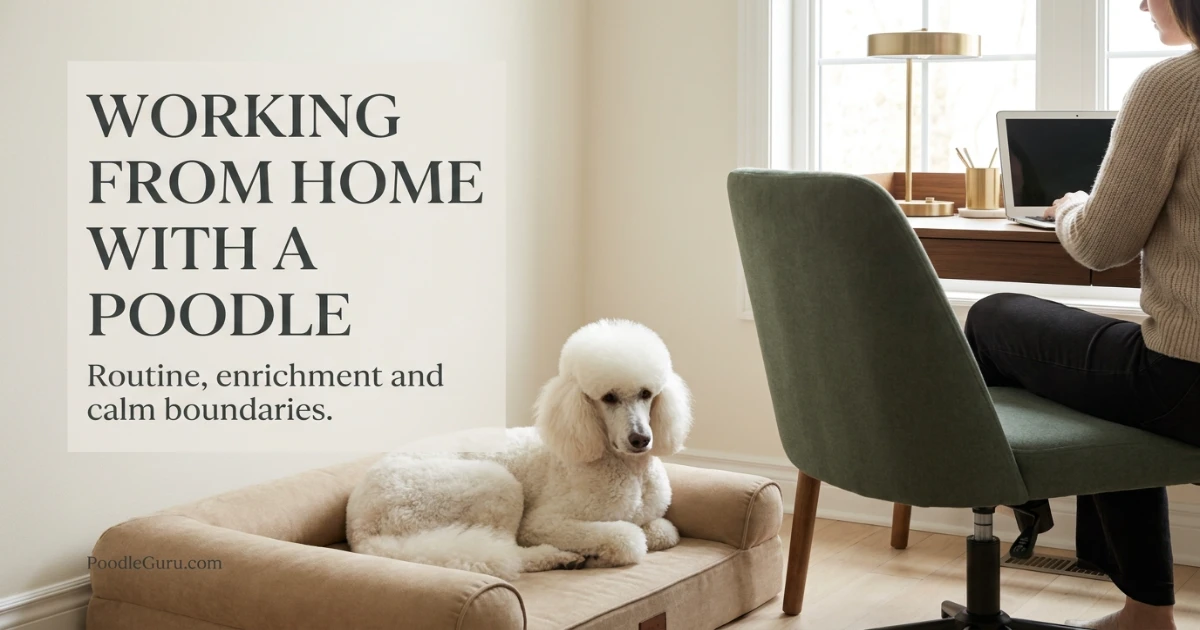
Quick Answer
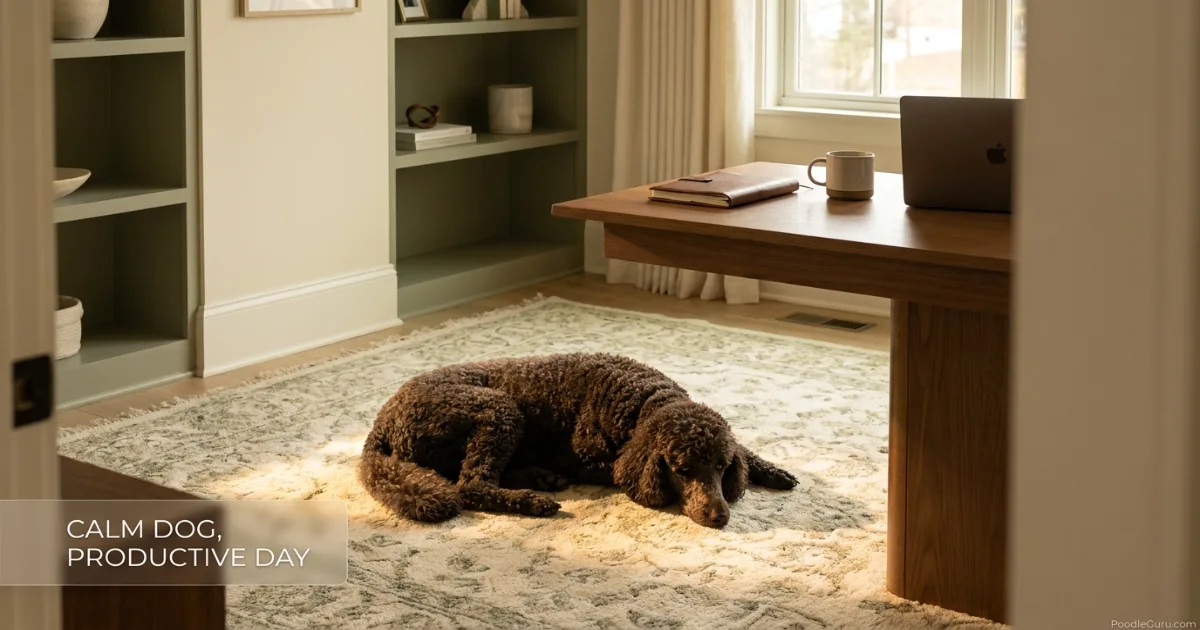
Working from home with a poodle means understanding that they don’t just want passive company—they want a role in your day. For poodle owners, this means creating a predictable routine that mixes focused work blocks with intentional engagement. The most important thing to understand is that poodles will create their own jobs if you don’t provide them, and those jobs often involve nudging your elbow during a video call.
In This Guide
- Why Poodles Need a Different WFH Strategy
- The PoodleGuru Work-From-Home Harmony Method
- Setting Up a Poodle-Proof Workspace
- The Daily Routine That Keeps a Poodle Calm
- Enrichment: The Secret to Uninterrupted Focus
- Common Mistakes That Disrupt Your Workday
- How to Handle Attention-Seeking and Barking
- FAQs
- Key Takeaways & Next Step
Why Poodles Need a Different WFH Strategy
Working from home with a poodle is not the same as simply coexisting. The AKC describes Poodles as extremely intelligent and easily trained, so they quickly notice routines, changes in attention, and patterns that earn a response. That is why generic “ignore them and they’ll settle” advice can fail. Poodles need clear information about when it is work time, when engagement is available, and what behavior earns reinforcement.
The AKC recommends building alone time gradually, beginning with brief periods in another room and slowly increasing distance and duration. That practice matters even when you work from home. A poodle who understands that a specific mat means “settle here” and that short separations are normal is less likely to depend on constant physical contact.
High Intelligence
Poodles need a clear “job” during your workday. Without one, they’ll assign themselves tasks like guarding the window or reorganizing your socks.
Velcro Tendency
Many poodles follow room to room. Teaching a solid “place” cue and rewarding independence keeps them content 6 feet away instead of on your keyboard.
Sensitive to Tone
A sharp “no” during a stressful meeting can wound a poodle’s confidence. Redirect with calm cues, and save frustration for after you mute.
The PoodleGuru Work-From-Home Harmony Method
At PoodleGuru, we’ve seen that a smooth work-from-home life with a poodle rests on three pillars: Predictability, Enrichment Before Boredom, and Kind Boundaries. Together, they form the PoodleGuru Work-From-Home Harmony Method—a framework you can implement starting tomorrow.
Predictability: Anchor the Day with a Cue
Start work at the same time every day, and use a consistent sound or action. For example, brew coffee then give a long-lasting chew. Your poodle learns that this sequence means “settle in.” Predictability dissolves anxiety.
Enrichment Before Boredom: Fill the Tank First
Never sit down to a 2-hour focus block with a restless poodle. Walk, train, or puzzle-feed for 15–20 minutes first. A mentally satisfied poodle will nap while you answer emails.
Kind Boundaries: The “Not Now” Cue
Teach a calm signal like “all done” and pair it with ignoring attention-seeking for 30 seconds before redirecting to a toy. Poodles respect fair rules; they rebel against inconsistency.
Setting Up a Poodle-Proof Workspace
Your home office can trigger a poodle’s curiosity—cords, paper, and lap-level keyboards are irresistible. Set up for success by removing temptations and adding a poodle zone.
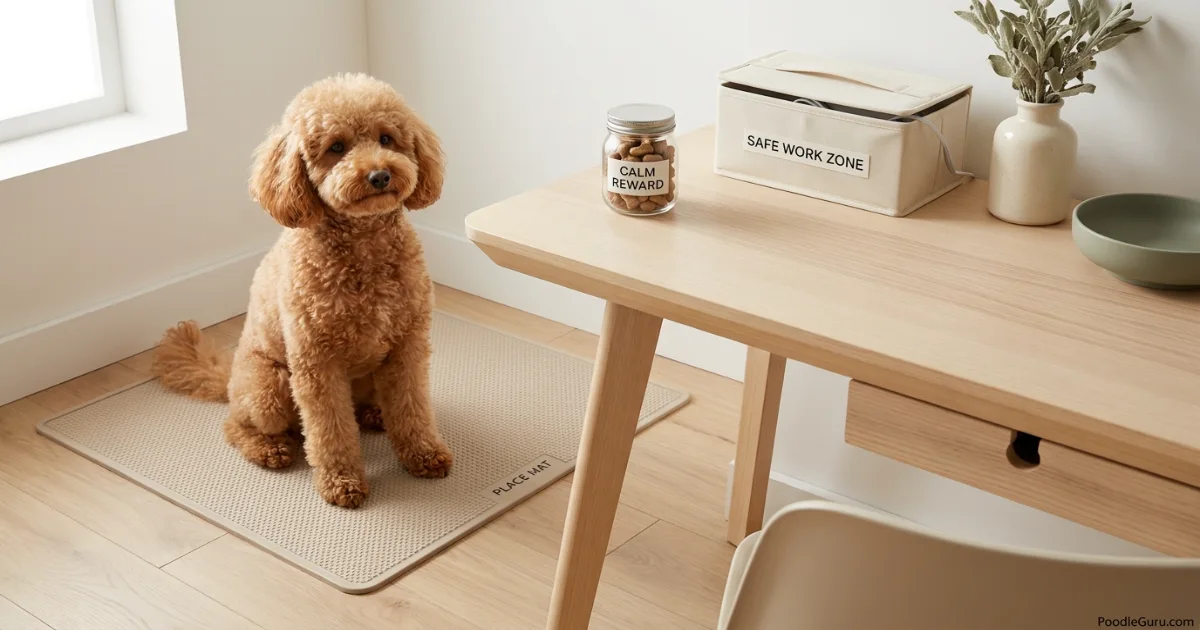
Keep a short, non-slip mat or bed within sight but not under your chair. Attach a chew toy or puzzle nearby. If your poodle is a persistent lap climber, place a second chair next to you with a soft cushion. Many poodles simply want to be at your level, not necessarily on top of you. Use cable protectors and a lidded trash can. Poodles are dexterous; they can open low drawers and unzip backpacks if bored.
Expert Insight: The “Place” Mat Resets Everything
A well-taught “place” command is worth more than any gadget. Practice for 5 minutes a day using high-value treats, building up duration. Soon, “place” becomes your poodle’s default during work. Pair it with a specific mat that only appears during work hours so the context is crystal clear.
The Daily Routine That Keeps a Poodle Calm
Routine is the silent language poodles rely on. This sample schedule fits an 8-hour workday with enough flexibility for size differences—a Toy Poodle’s legs might need shorter walks, a Standard’s bigger bladder a different rhythm—but the principles hold.
| Time | Activity | Poodle Benefit |
|---|---|---|
| 8:00 AM | Morning walk + 5-minute training burst | Burns energy, sets “work mode” expectation |
| 8:30 AM | Breakfast in a puzzle toy | Mental work extends calm into first block |
| 8:45 AM–12:00 PM | Deep work block with occasional “place” rewards | Poodle learns to self-settle; you check in with treats |
| 12:00 PM | Midday walk or backyard sniffari + quick play | Breaks up the day; resets focus for afternoon |
| 12:30 PM | Lunch (yours) + poodle gets a frozen Kong | Simultaneous quiet time |
| 1:00–4:30 PM | Afternoon work block with another puzzle/chew | Prevents 3 PM zoomies |
| 4:30 PM | End-of-work ritual: short walk, then “all done” cue | Marks transition; poodle knows workday is over |
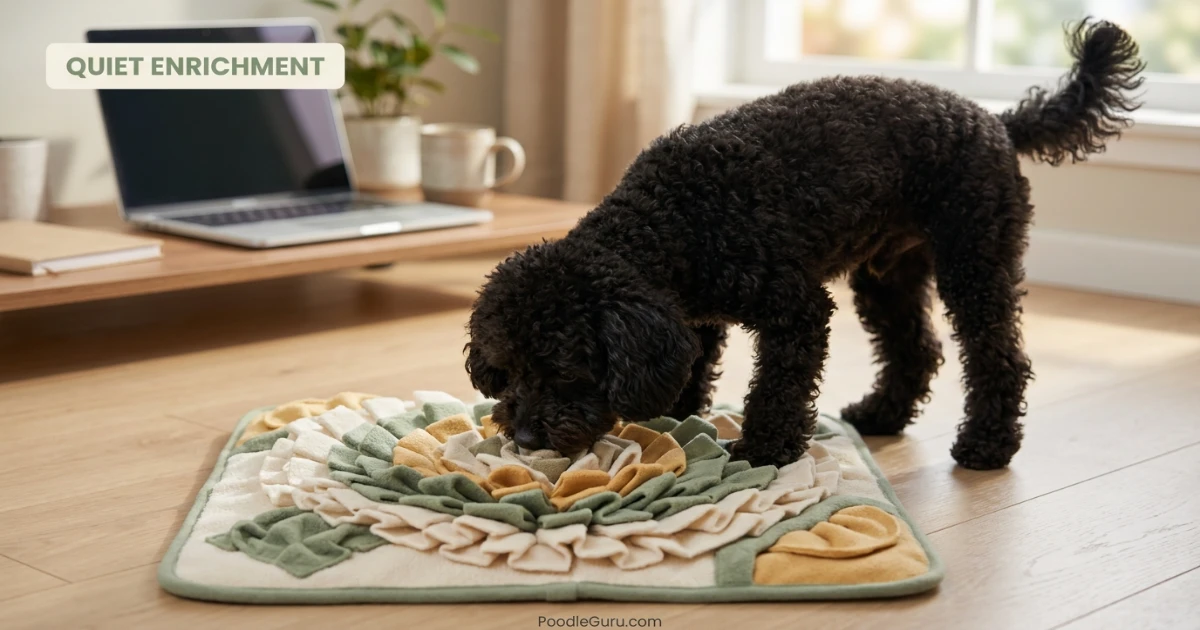
If you have calls scattered unpredictably, use a pre-call routine: 2 minutes of “find it” tosses into a snuffle mat. Your poodle will be nose-down when the meeting starts. Over time, they associate the mat’s appearance with “I get to sniff while they talk.”
Enrichment: The Secret to Uninterrupted Focus
Your poodle’s brain doesn’t have an off switch. But you can channel it. Rotate these three enrichment types throughout the week to keep them novel:
- Food puzzles: From simple treat-dispensing balls to DIY towel rolls. The 10 minutes of extraction buys you 30 minutes of post-meal rest.
- Chews and stuffed toys: Use a size-appropriate, veterinarian-approved chew or durable food-stuffable toy. Supervise every session, inspect items for damage, and remove pieces small enough to swallow.
- Scent games: Hide a few treats around the room while your poodle waits. Release them with “find it.” This indoor hunt tires a poodle out almost as much as a walk.
Swap one enrichment type per day to avoid habituation. If your poodle ignores a puzzle they once loved, it’s time to retire it for a week and rotate something else in. The foundational obedience commands you’ve taught also double as mental workouts: a 5-minute review of sits, stays, and spins during a break reinforces your bond and your expectations.
Common Mistakes That Disrupt Your Workday
Even seasoned poodle owners slip into these patterns. Identify and correct them to regain your focus.
| Mistake | Poodle Impact | Fix |
|---|---|---|
| Never leaving the house without your poodle | Fosters separation anxiety; can’t cope when you eventually go out | Practice micro-absences daily: step outside for 1 minute, return calmly |
| Rewarding nudges with attention | Poodle learns that pestering works; you get interrupted more | Ignore the nudge, then after 20 seconds of calm, invite them for a pet |
| Skipping morning exercise | A pent-up poodle will invent outlets, often vocalizing or destructive chewing | Even a 10-minute fetch before logging on makes a visible difference |
| Inconsistent rules between partners | Confusion; poodle tries different tactics with different people | Agree on one set of boundaries and enforce them equally |
| Using punishment during work hours | Poodle associates your work presence with negativity; trust erodes | Redirect; if frustrated, step away, take a breath, then re-engage calmly |
How to Handle Attention-Seeking and Barking
Your poodle will test the new boundaries. That’s intelligence, not defiance. When they bark at you during a call, resist the urge to talk back. Any verbal response—even “quiet!”—can be reinforcing. Instead, use a pre-planned interrupt: stand up, walk calmly to the treat drawer, ask for a sit, then reward on the mat. This breaks the barking loop without scolding.
If your poodle barks at delivery trucks or passersby, manage the environment first. Apply frosted window film at poodle eye-level. Use a white noise machine near the workspace. Then, teach a “thank you” protocol: mark the first bark with “yes,” toss a treat away from the window, and praise quiet. Over time, your poodle learns that a single alert is enough, and they come to you for the reward instead of escalating.
When to Worry About Stress
Persistent pacing, panting, or hiding during work hours isn’t just mischief—it can signal anxiety. If your poodle can’t settle despite a solid routine, consult your vet. A professional can rule out pain and discuss anti-anxiety supports. The ASPCA’s separation anxiety resources are a good starting point.
Frequently Asked Questions
How do I stop my poodle from jumping on my lap during video calls?
Teach a solid “off” and “place” cue. Before calls, tire them with a puzzle. If they do jump, stand up calmly, guide them to their mat, and reward heavily there. Improvement usually comes through calm, repeated practice and consistent rules.
My poodle whines when I’m on the phone. What helps?
Whining can be a bid for connection, frustration, or discomfort. Before a call, offer a safe food-stuffable toy or another supervised enrichment activity. If the whining is attention-seeking, avoid rewarding it accidentally and reinforce the first calm pause. Persistent or sudden whining deserves a veterinary check.
Is it okay to leave my poodle alone while I work from home?
Yes, and it’s essential. Even if you’re home, your poodle should practice being in a separate room for short periods. This prevents separation anxiety when you eventually return to an office. Start with 5-minute separations daily.
How much exercise does a poodle need before a workday?
Use 20–30 minutes of age-appropriate physical activity and mental work as a starting point before your first focus block, then adjust for your poodle’s size, age, health, and normal daily exercise needs. The goal is a settled dog—not an exhausted one.
What if my poodle barks at every delivery truck?
Block the visual trigger with window film. Use a white noise machine to dampen sounds. Teach a “thank you” protocol: mark the first bark, toss a treat away, and reward quiet. Management plus training reduces the habit.
Can I use a crate while working from home?
Yes, if introduced positively. A crate can be a peaceful retreat. Never use it as punishment. Place it in a quiet area with a chew, and your poodle may choose to nap there voluntarily during work hours.
My poodle follows me every time I move. How do I teach them to stay put?
Reward calm staying with small treats tossed to their mat. Practice brief departures: step away, return, reward for staying. Gradually increase distance. A poodle who trusts you’ll come back is less likely to shadow.
Key Takeaways: Working From Home With a Poodle
With a consistent routine, kind boundaries, and a well-fed brain, your poodle can become the calm, quiet office mate you didn’t know you needed. Use the PoodleGuru Work-From-Home Harmony Method to structure your days.
- Poodles thrive on predictability; anchor your workday with a consistent start ritual and a clear end cue.
- Fill your poodle’s enrichment tank before each deep work block—a 15-minute walk or puzzle session prevents restlessness.
- Teach a solid “place” command so your poodle has a job (relaxing on a mat) while you focus.
- Ignore attention-seeking nuzzles, then reward calm; poodles learn patterns quickly, so be consistent.
- Rotate three enrichment types—food puzzles, chews, scent games—to keep your poodle’s brain happily occupied.
- Practice micro-separations even when home to prevent separation anxiety if your work situation changes.
Next step: Try the morning routine from our sample schedule for one week. Notice which enrichment your poodle loves most, and stock up. Then reinforce “place” daily with our obedience training guide as your next read.