How to Socialize an Adult Rescue Poodle
Rescue poodles don’t come with a reset button. They arrive with a history — and your job isn’t to erase it, but to help them write a braver next chapter. Here’s what actually works.
Quick Answer
Socializing an adult rescue poodle means gradually building the dog’s confidence with new people, dogs, environments, and handling — without flooding or forcing.
Poodles are sensitive and emotionally intelligent; they read your energy and remember negative experiences deeply. Rushing the process damages trust. Expect steady progress over weeks and months, not days.
The most effective approach pairs desensitization with positive reinforcement, respects the dog’s threshold, and prioritizes safety and predictability above all. A well-socialized adult rescue poodle can become a calm, adaptable companion — but the timeline belongs to the dog, not the calendar.
Quick Facts: Socializing an Adult Rescue Poodle
Typical Timeline
Decompression takes 2–4 weeks. Visible confidence with new people often emerges after 4–12 weeks of consistent, positive exposure.
Key Poodle Traits
High intelligence, emotional sensitivity, strong bonding. A poodle who trusts you is half-socialized already.
Biggest Mistake
Forcing greetings and crowded spaces too soon. Flooding a sensitive dog creates a setback that can take months to undo.
When to Get Help
If the dog shows freezing, snapping, or extreme avoidance, involve a force-free behavior professional — sooner rather than later.
What Not to Use
Avoid prong collars, shock, and dominance-based methods. Poodles shut down or become defensive under confrontation.
Daily Practice
10–15 minutes of low-pressure exposure and reward-based exercises, 2–3 times a day. Consistency matters more than duration.
The Unique Challenge of an Adult Rescue Poodle
Socializing an adult poodle who came from a rescue or unknown background is fundamentally different from raising a puppy. The dog already carries a full emotional library — some chapters you’ll never read. Your job isn’t to overwrite that history. It’s to offer new, positive experiences that gradually outweigh the old ones.
Poodles notice everything. Their intelligence, bred for centuries of close partnership with humans, makes them exquisitely sensitive to environment and routine.
A rescue poodle who’s been neglected, rehomed, or undersocialized doesn’t just lack exposure — they may actively expect the world to be unpredictable or unsafe. That expectation shows up as hypervigilance, flinching, freezing, or barking.
It’s not stubbornness. It’s survival mode.
The rescue poodle’s attachment style also shapes the process. Many bond intensely to one person and then struggle with strangers.
That loyalty is a gift — but you’ll need to carefully teach the dog that other humans aren’t a threat to the relationship. It’s a balancing act.
Push too hard, and you confirm the dog’s fears. Go too slowly without a plan, and the world never gets bigger.
Why Poodles Need a Different Approach
Generic dog-socialization advice often falls flat with poodles. This breed was developed to work in close partnership with people, not to exist independently in a pack.
A rescue poodle who’s wary of other dogs isn’t necessarily “poorly socialized” — they may simply prefer human company, and that’s breed-typical.
Forcing dog-dog interactions when your poodle would rather check in with you creates unnecessary conflict.
Poodles also tend to be sensitive to handler emotion. If you’re anxious about an interaction, your poodle feels it and becomes more guarded.
Calm leadership — relaxed breathing, loose leash, quiet voice — does more for a poodle’s confidence than any treat ever could.
The best socialization sessions happen when you are genuinely relaxed. Fake calm doesn’t fool a poodle.
Because poodles are so intelligent, mental engagement during exposure is critical. A poodle who’s simply standing near a trigger while tense is rehearsing anxiety.
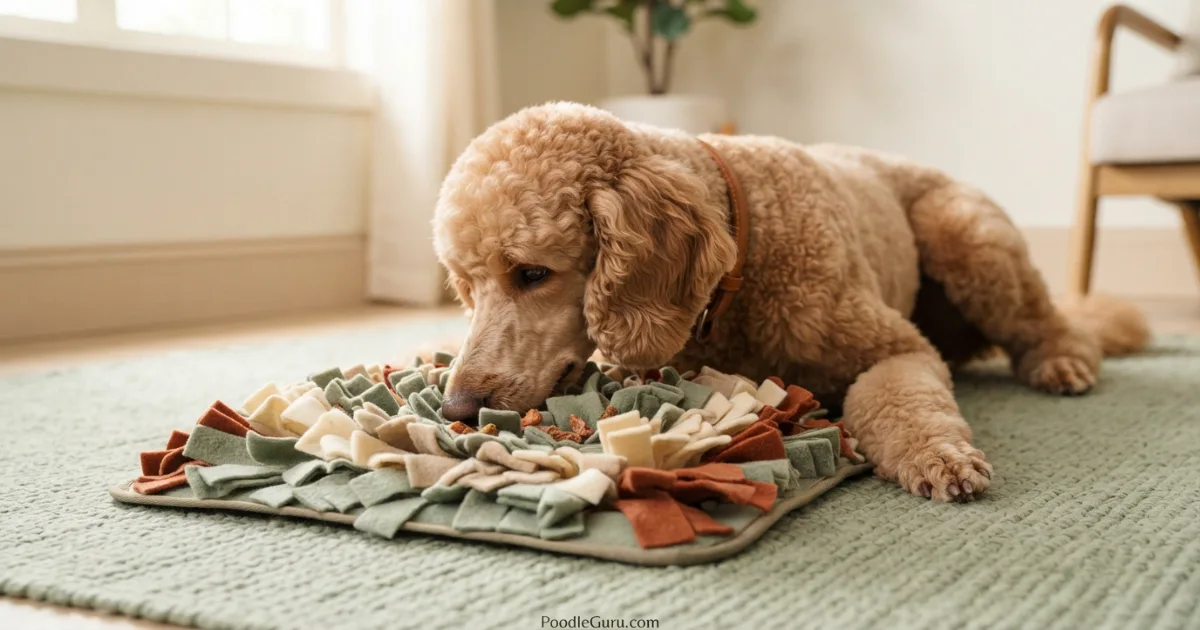
A poodle who’s doing a simple “touch” cue or sniffing a snuffle mat near a trigger is learning that triggers predict good things. The brain is occupied, and the body follows.
This is a core principle in the PoodleGuru method — and we’ll return to it.
For more on poodle temperament and why sensitivity is a feature, not a bug, see our poodle temperament guide.
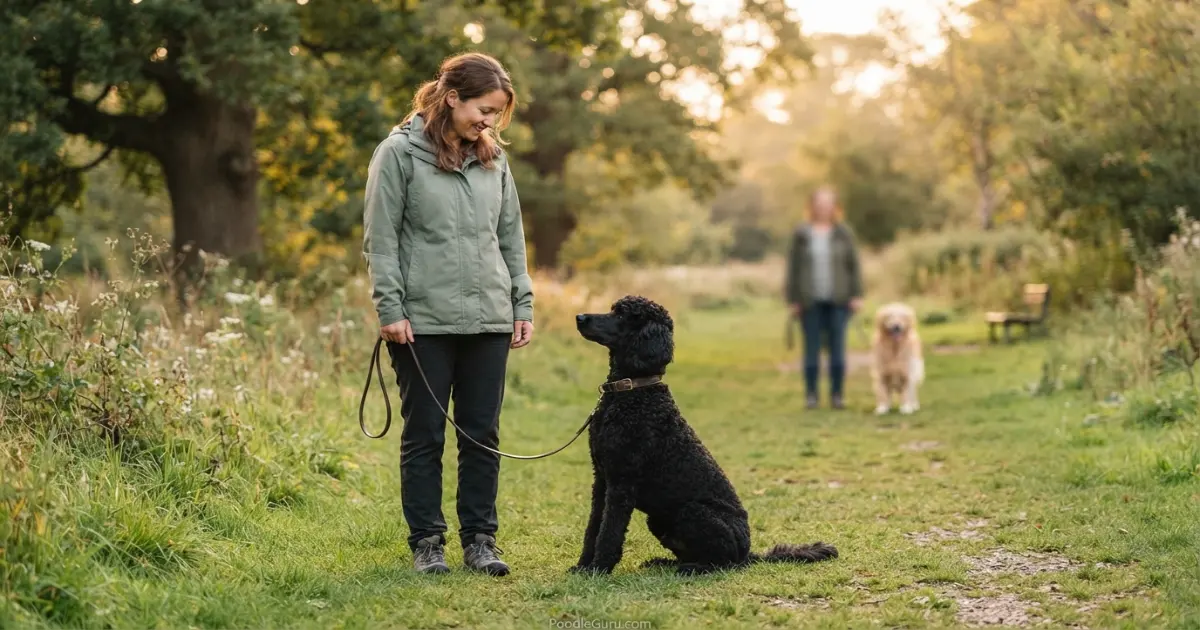
Puppy Socialization vs. Adult Rescue Socialization
If you’ve raised a poodle from puppyhood, the rescue experience can feel disorienting. The tools are similar, but the pace, expectations, and emotional landscape are completely different. Here’s how they compare:
| Aspect | Puppy Socialization | Adult Rescue Socialization |
|---|---|---|
| Primary Goal | Build positive first impressions of the world | Repair or replace existing negative associations |
| Emotional State | Generally curious and neutral | May carry fear, suspicion, or hypervigilance |
| Pace of Progress | Often rapid; developmental windows help | Slower; progress is nonlinear, with regressions common |
| Critical Skill | Broad exposure to many stimuli | Systematic desensitization near the dog’s threshold |
| Mistake Tolerance | Higher; puppies bounce back faster | Lower; a single frightening event can cause weeks of fallout |
| Bonding First? | Can socialize while bonding develops | Must establish deep trust before pushing comfort zones |
The adult rescue needs you to be their safe harbor first, their social director second. In poodle terms: earn the heart, then expand the circle.
The PoodleGuru Socialization Reset Method
At PoodleGuru, we evaluate and structure socialization for adult rescue poodles around four distinct phases. This isn’t a rigid schedule — it’s a compass.
Some dogs breeze through Phase 1 in a week. Others need a month. The poodle decides the tempo. This approach follows the same broad principle used in veterinary behavior work: gradual desensitization paired with positive associations.
Phase 1: Safety & Decompression
First 2–4 weeks. No introductions. No guests. No walks in busy areas. The dog’s only job is to learn that home is predictable and safe.
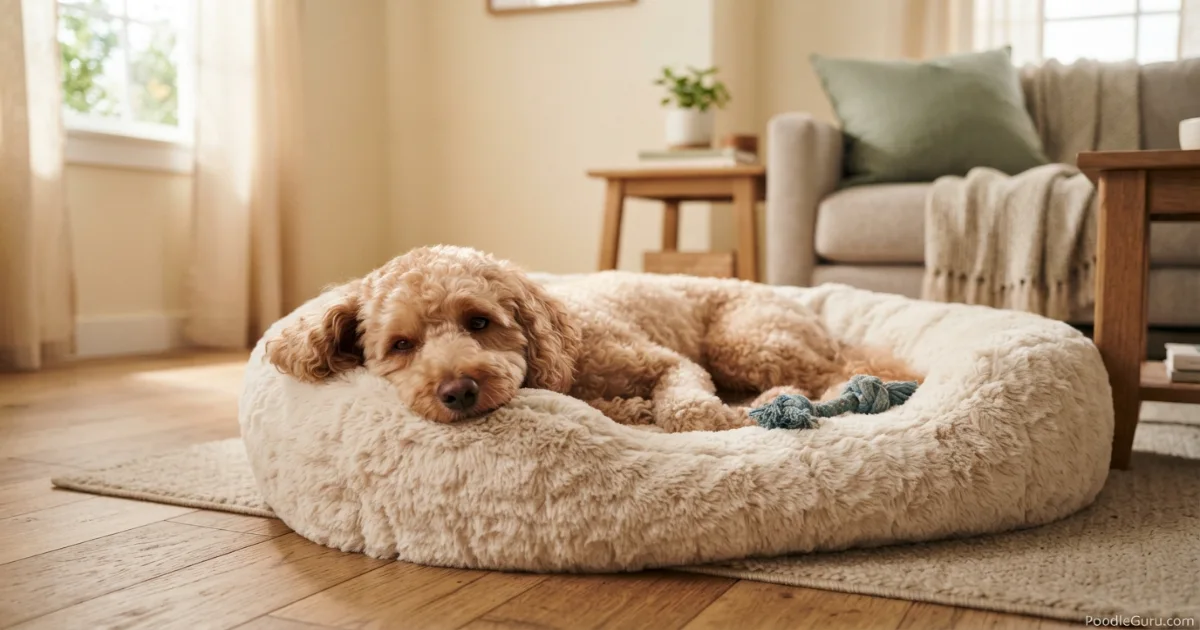
Feed at regular times, use soft voices, and allow the dog to retreat to a crate or quiet corner. You’re building the safe base that all future courage will spring from.
The visible outcome: the dog begins to sleep deeply, eat normally, and seek you out voluntarily.
Phase 2: Bonding & Baseline
Weeks 3–6. Introduce gentle handling, basic name recognition, and a few simple cues like “touch” or “find it.” Use food puzzles to build confidence.
Now you’re teaching the dog that interaction with you is rewarding and safe.
Outcome: the dog responds to their name, accepts light handling, and shows relaxed body language around you.
Phase 3: Controlled Exposure
Weeks 4–12. Begin low-intensity exposures. A single calm friend visits, sitting sideways and ignoring the dog initially. Short walks at quiet times let the dog observe the world from a distance.
Use the “Look at That” (LAT) game: mark and treat when the dog notices a trigger without reacting.
Outcome: the dog can remain relaxed near a new person or mild trigger with support.
Phase 4: Real-World Generalization
Months 3+. Gradually add complexity: polite on-leash greetings if the dog is ready, short café patios, calm group walks with trusted people. Always maintain an escape route. The dog should always feel they can leave a situation without being trapped. Outcome: the dog navigates everyday environments with manageable stress and recovers quickly from surprises.
Owner Action Plan: Your First 7 Days
Day 1–3: No training, no introductions. Quiet space, short potty breaks in a low-traffic area. Let the dog observe you from a distance.
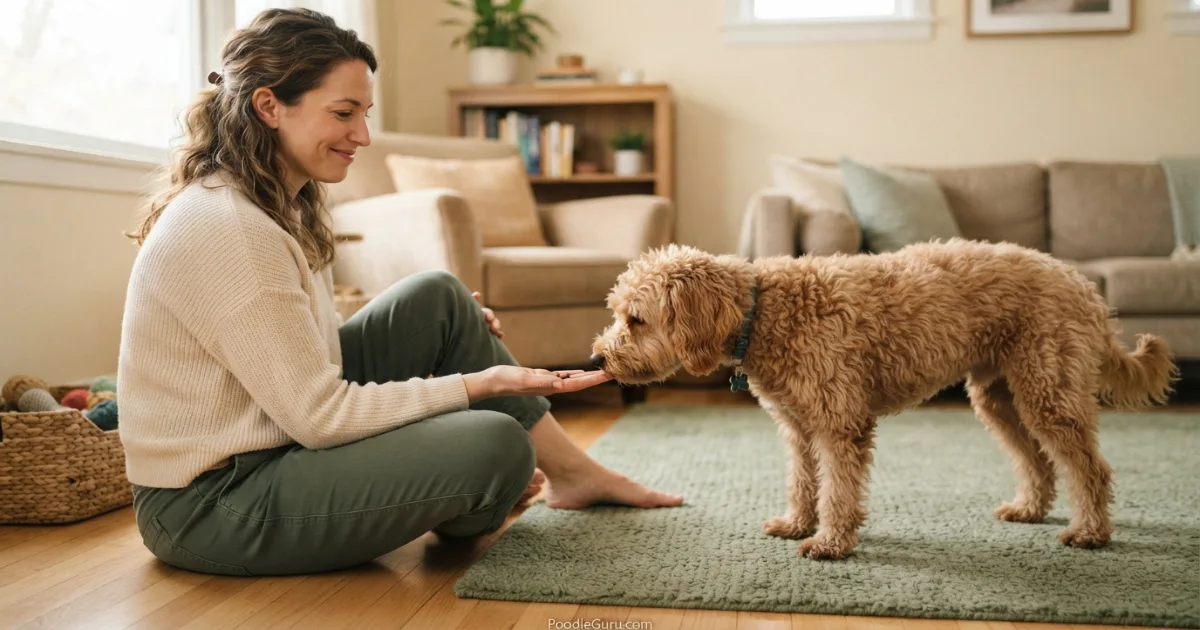
Day 4–7: Begin feeding by hand for a few kibbles. Sit on the floor and let the dog approach.
Introduce a soft mat or bed as a “place” cue without pressure. If the dog retreats, let them. Trust is built in the returning, not the approaching.
Common Mistakes That Set You Back
Well-meaning owners often derail progress without realizing it. The poodle’s sensitivity makes these missteps especially costly. Here are the most frequent mistakes — and what to do instead:
| Mistake | Why It Hurts | Do This Instead |
|---|---|---|
| Introducing too many new people at once | Overwhelms the dog; can trigger a fear freeze or defensive barking | One calm person at a time, sitting quietly, letting the dog initiate contact |
| Forcing the dog to “face their fear” | Flooding increases panic and erodes trust in you | Work below threshold where the dog notices the trigger but still takes treats |
| Using aversive tools or corrections | Poodles associate the punishment with the trigger, not their reaction; fear grows | Use positive reinforcement and redirection; manage the environment to prevent rehearsal |
| Neglecting mental exercise | An understimulated poodle fixates on triggers; boredom worsens reactivity | Daily puzzle toys, nose work, and short training sessions to tire the brain |
| Comparing to other dogs | Creates unrealistic expectations and frustration for the owner — the dog feels it | Track this poodle’s progress, not someone else’s timeline. Celebrate small wins |
| Skipping the decompression period | The dog never develops a baseline of safety; all socialization efforts become harder | Give at least two full weeks of quiet routine before introducing anything new |
When Progress Stalls
You’ll hit plateaus. A poodle who was improving week by week suddenly seems stuck — or worse, regresses.
That’s not failure. It’s information. Regression often means the dog’s stress bucket filled up from something you didn’t notice: a vet visit, a change in your work schedule, a noisy neighbor.
Poodles accumulate stress silently, then show it all at once.
When progress stalls, pause. Go back to Phase 2 activities for a week. Rebuild the safe base.
The worst thing you can do is push harder. It’s like trying to fill a cup that has a hole in the bottom — patch the hole first.
Often, a brief retreat to familiar, low-pressure routines restores momentum faster than any new training plan.
When to Consult a Force-Free Professional
Seek qualified help if your poodle shows freezing that lasts more than a few seconds, growling or snapping when approached, extreme avoidance in mildly novel situations, or aggression toward family members.
A certified behavior consultant who uses positive methods can assess the dog’s emotional state and design a tailored desensitization plan.
The investment protects your poodle’s quality of life — and your relationship. For general fear and anxiety signs in dogs, the VCA’s guide to fear and anxiety provides a helpful overview.
Realistic Milestones (Not Deadlines)
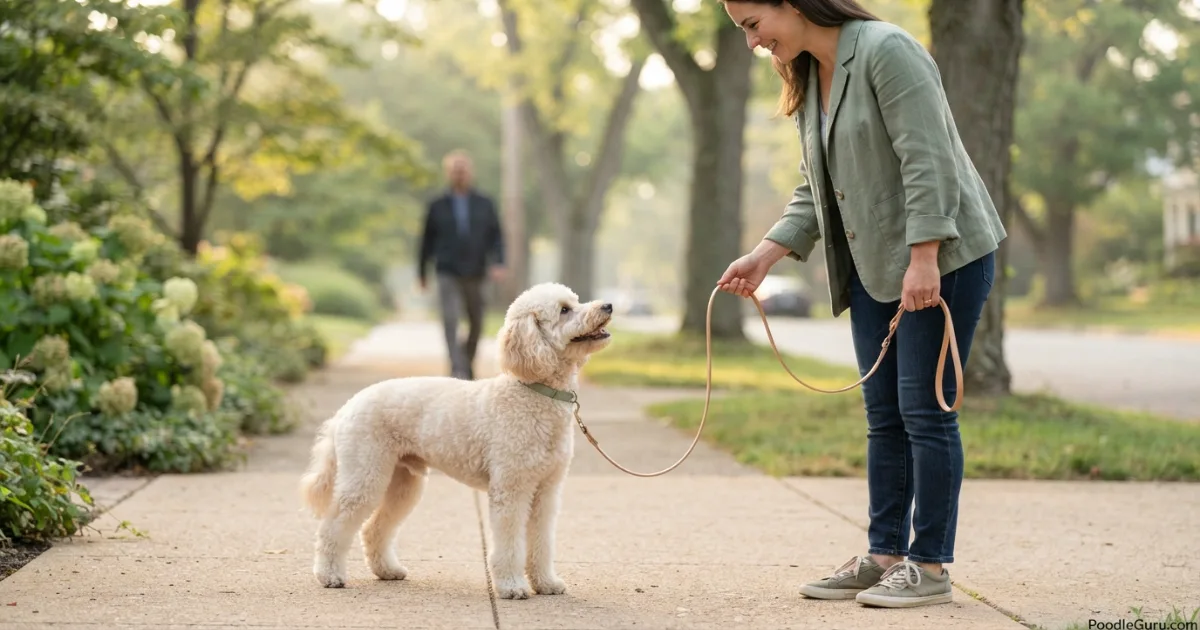
Progress with a rescue poodle is measured in moments, not milestones. But owners often ask for a rough map. Here’s what commonly unfolds when you follow a trust-first, force-free approach:
Week 2–4
Dog eats normally, sleeps through the night, approaches you for affection. Responds to name in quiet settings. Accepts gentle touch on chest and shoulders.
Month 2–3
Can settle calmly when a familiar guest visits. Walks comfortably in the neighborhood at quiet hours. Looks to you for guidance when mildly uncertain.
Month 4–6
Allows handling for basic grooming (brushing, paw touches). Greets calm strangers politely, though may still be reserved. Recovers from startles within seconds.
Month 6–12
Navigates moderately busy environments with support. May initiate friendly interactions with familiar dogs. Shows wider emotional range — playfulness, relaxation, curiosity.
These are not guarantees. Some poodles race ahead in one area and lag in another. A dog who’s comfortable at the vet might still bark at the mail carrier. That’s normal. Socialization is never truly finished — it’s a practice. What changes is your poodle’s capacity to return to calm after something goes wrong.
Frequently Asked Questions
How long does it take to socialize an adult rescue poodle?
Decompression takes about 2–4 weeks. Meaningful progress with new people and environments often appears within 4–12 weeks of consistent, low-pressure work. Full confidence can take six months to a year — and some dogs may always be reserved in certain situations. The timeline is individual.
My rescue poodle barks at strangers. Is that aggression?
Not necessarily. Barking at strangers often signals fear or uncertainty, not a desire to harm. Poodles are watchful by nature. With distance, treats, and calm introductions, many learn that guests predict good things. If the barking includes lunging or snapping, consult a force-free professional immediately.
Can I socialize my rescue poodle with other dogs?
Yes, but dog-dog socialization should come after the dog trusts you and has a solid recall or check-in behavior. Start with calm, known dogs in neutral spaces, on leash, at a distance. Parallel walking is better than nose-to-nose greetings. Watch for stiff body language and end sessions before the dog becomes overwhelmed.
What if my poodle was abused? Does that change the approach?
The principles stay the same: safety, choice, and positive associations — but you’ll need even more patience. Avoid any handling that mimics past trauma if you suspect triggers. Let the dog set the pace for touch and proximity. A certified behavior consultant experienced with trauma can help you map a safe desensitization plan.
Should I use treats, or will that spoil my dog?
Use high-value treats liberally during socialization. You’re not bribing — you’re building new emotional responses. For a poodle who’s uncertain, a piece of chicken when a stranger appears literally changes the brain’s association over time. Phase treats out gradually once the dog is consistently relaxed; they’re a tool, not a crutch.
How do I introduce grooming to a rescue poodle who’s afraid of being handled?
Break it into tiny steps. Start with a soft brush touching the floor near the dog while you feed treats. Then one stroke on the back, then treat.
Keep sessions under two minutes. Gradually increase duration and body areas over weeks.
Never restrain a panicking dog for grooming — that cements the fear. Our complete poodle grooming guide covers desensitization in more detail.
Is it ever too late to socialize an adult poodle?
No. An adult poodle’s brain remains plastic and capable of new learning. While the sensitive puppy socialization window has closed, adult dogs can still form positive associations and change their emotional responses. Progress may be slower, and some deep-seated fears may persist, but meaningful improvement is almost always possible with patience and the right methods.
Final Summary: Key Takeaways
Socializing an adult rescue poodle is a trust-building project, not a training command. Here’s what matters most:
- Adult rescue poodles need decompression and safety before any social exposure — 2–4 weeks of quiet routine is the non-negotiable foundation.
- Poodles are emotionally intelligent and sensitive; they learn best through positive reinforcement, gentle desensitization, and handler calmness.
- The PoodleGuru Socialization Reset Method moves through four phases: Safety, Bonding, Controlled Exposure, and Real-World Generalization.
- Common mistakes like flooding, forcing greetings, or using punishment can set socialization back by weeks or months.
- Progress is measured in small moments — a relaxed breath, a voluntary approach, a quicker recovery — not in a calendar deadline.
- When fear, freezing, or aggression appear, pause and consult a force-free professional; this protects both your dog’s wellbeing and your bond.
Next step: Build the mental enrichment habits that accelerate confidence. Explore our poodle training basics guide for positive techniques that strengthen your partnership.