Poodle Watchdog Instincts: 7 Honest Guard Dog Facts
The image of a guard dog is usually a big, stoic breed staring down a threat. A curly-coated poodle does not fit that picture — and that is exactly why this question surprises so many owners.
So, poodle watchdog instincts? They can be excellent watchdogs, but they have clear limits as true guard dogs. Here is what a poodle will actually do when someone approaches your door, and what they almost certainly will not do.
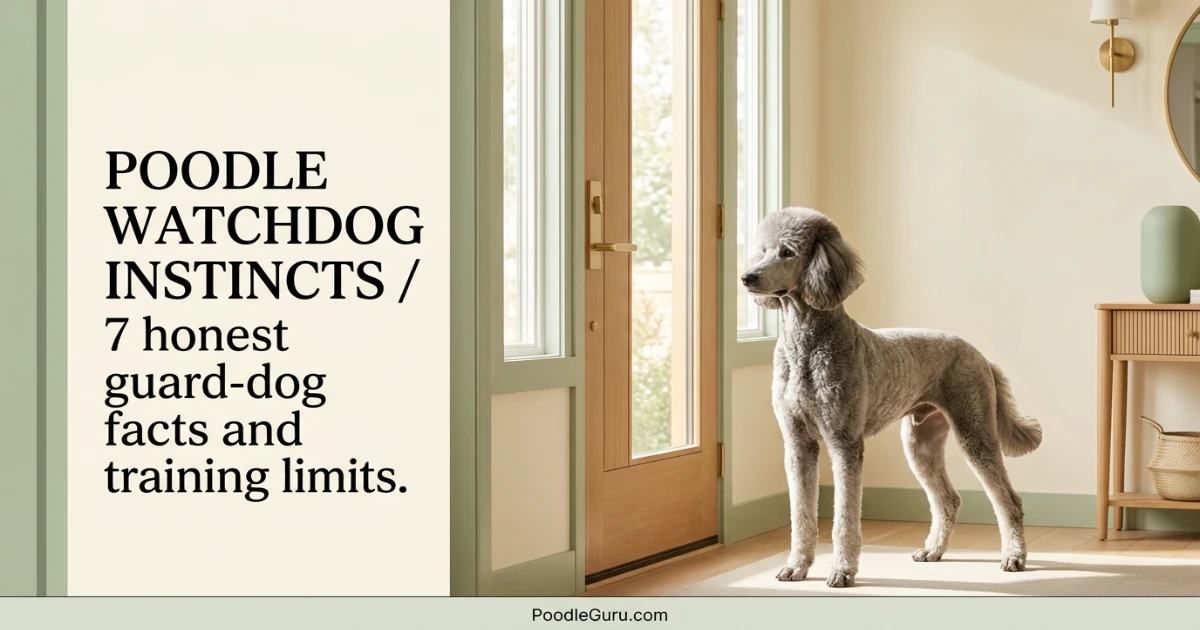
Are Poodles Good Guard Dogs? Quick Answer
Poodles are excellent watchdogs and mediocre guard dogs. They have sharp senses, strong territorial awareness, and a deep bark that sounds larger than they are. A well-socialized poodle will reliably alert you to someone at the door — and that is often enough deterrent. But expecting a poodle to physically engage an intruder misunderstands the breed. Their intelligence makes them discriminating: they assess situations rather than react blindly. For most households, that is a feature, not a flaw.
Watchdog vs. Guard Dog: The Key Difference
A watchdog is a dog that alerts you to something unusual — a sound, a presence, an approach. Their job is to notice and announce. A guard dog takes the next step: they deter through physical presence and may engage a threat directly.
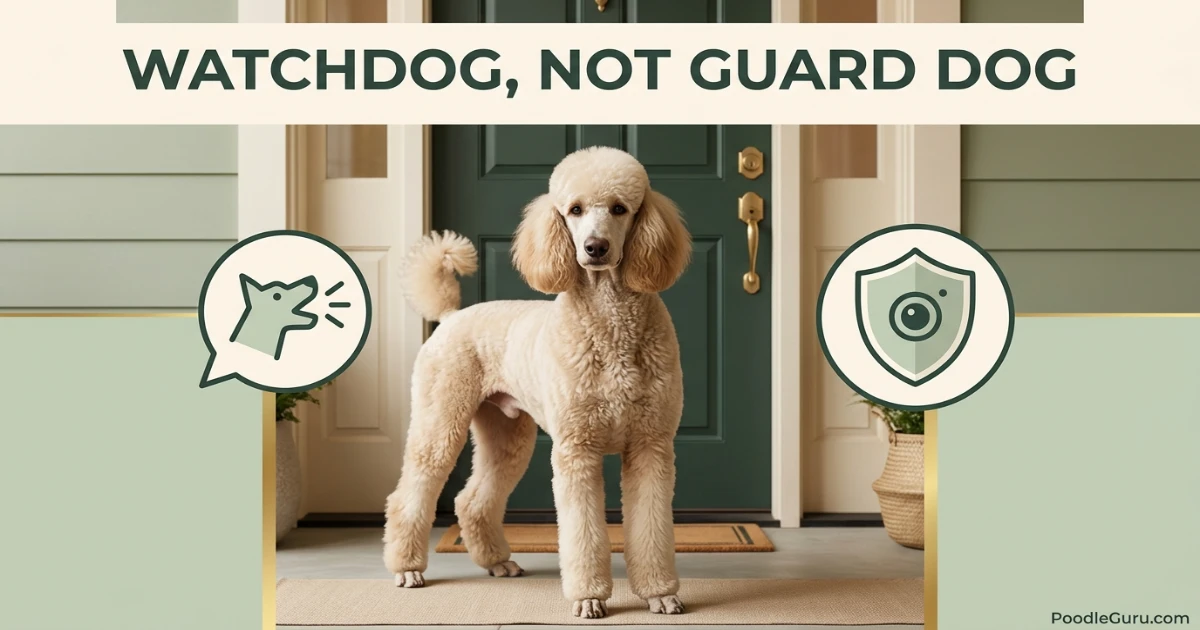
For poodle owners, this distinction is everything. Poodles are natural, sometimes exceptional, watchdogs. They are not natural guard dogs. The most important thing to understand is that a poodle who barks at the doorbell is not showing guard-dog potential — they are showing watchdog instinct, and that is the ceiling for almost every poodle in a typical home.
Confusing the two leads to unrealistic expectations. Owners who want a dog that will physically defend the property should look at breeds specifically developed for that work — German Shepherds, Rottweilers, Dobermans. Poodles were never selected for bite work or takedown courage. They were selected to notice, to retrieve, and to partner with humans. That partnership instinct is what makes them such reliable alert dogs. They want to tell you something is happening.
Poodle Watchdog Instincts: Quick Facts
They are Alert, Not Aggressive
Poodles rank high on environmental awareness. They notice changes — a new car in the driveway, footsteps on the porch — faster than many traditional guard breeds. What they do next is bark, not charge.
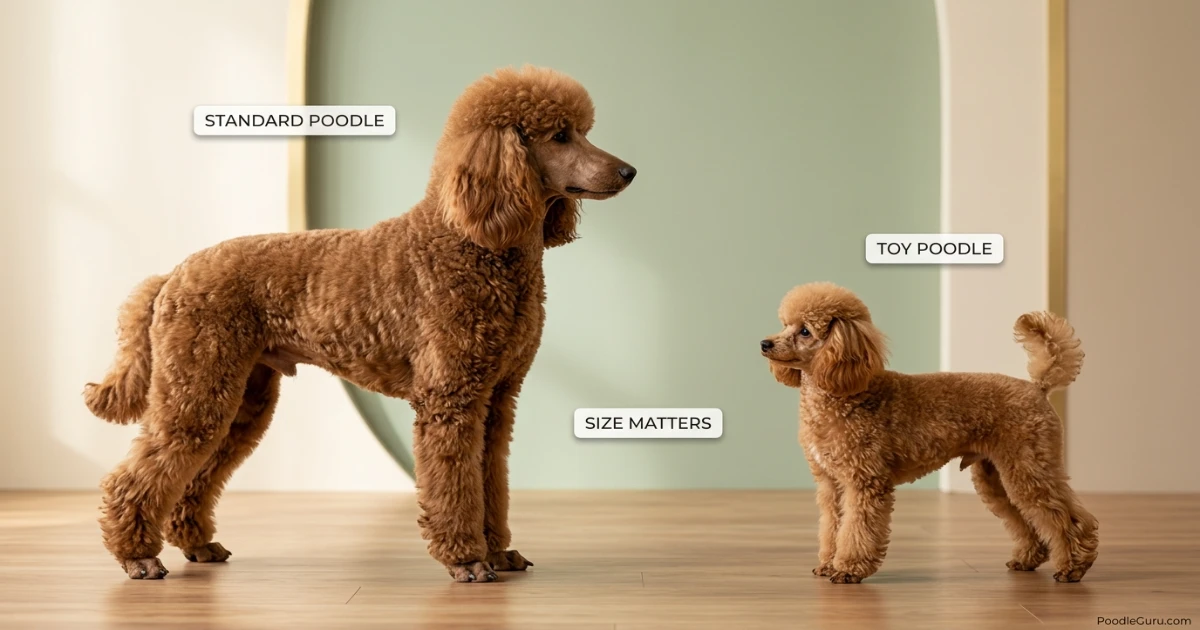
Size Dictates Deterrence
A Standard Poodle’s size and deep bark create real deterrent effect. Toy and Miniature Poodles alert reliably but do not intimidate anyone. Their value is purely as an early-warning system.
Socialization Shapes Everything
An under-socialized poodle becomes a fearful barker — not a protector. A well-socialized poodle learns to distinguish normal from suspicious and alerts appropriately. The difference is massive.
The Poodle’s Protective History: More Than a Show Dog
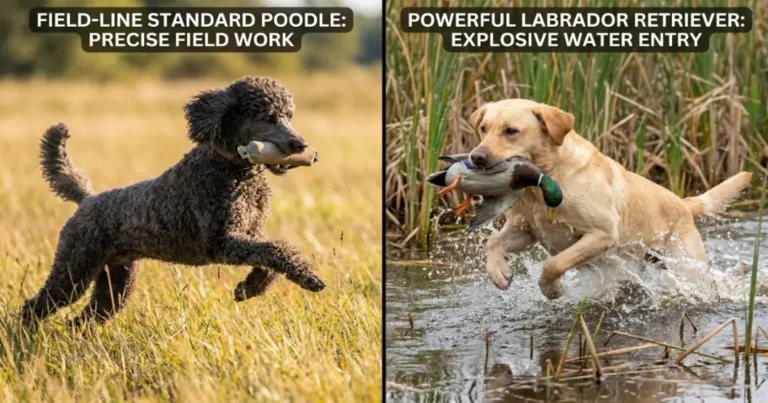
Most people know poodles as circus performers, show dogs, or companions. But the breed’s origins tell a tougher story. Poodles descended from European water retrievers — dogs that worked alongside hunters, plunged into cold water, and returned with game. That work required courage, independent judgment, and strong bonding with a handler.
The breed standard, as recognized by the AKC’s official poodle breed page, describes the poodle as “active, intelligent, and elegant” with a “proud carriage.” What the standard does not explicitly say — but what owners and breeders know — is that poodles carry a streak of territorial instinct that surprises people who only know the breed from grooming competitions. This is not aggression. It is proprietorship. A poodle knows what belongs to them: their space, their people, their routine.
The retrieving heritage matters here. A good retriever marks the fall, watches the environment, and works in partnership with the hunter. That same brain now watches the front window and works in partnership with you. The alertness is hardwired. The response is trainable.
Guard Ability by Poodle Size
Poodle size is not just a lifestyle preference. It directly determines what kind of protective presence your dog can offer. This comparison breaks down watchdog and deterrent capability across the three recognized sizes.
| Attribute | Toy Poodle (4–6 lbs) | Miniature Poodle (10–15 lbs) | Standard Poodle (40–70 lbs) |
|---|---|---|---|
| Watchdog alertness | Excellent — notices everything | Excellent — highly aware | Excellent — and intimidating bark |
| Physical deterrence | None | Minimal | Moderate to high |
| Bark depth | High-pitched yap | Medium, sharper tone | Deep, resonant, surprising |
| Likelihood to stand ground | Low — retreats behind owner | Moderate — may posture | Moderate to high — stands between owner and door |
| Physical engagement risk | Extremely low | Low | Low unless cornered |
| Best role | Pure early-warning alarm | Alert system + minor deterrent | Visual and vocal deterrent + alert system |
The takeaway is not that Standards are guard dogs and Toys are not. It is that every poodle size excels at the watchdog half of the equation. The guard half — physical deterrence — only becomes relevant at the Standard size, and even then, it is about presence, not action. A Standard Poodle standing silently at the door is more intimidating than most people expect. That’s often enough.
The Poodle Temperament for Protection Work
Poodles bring a unique set of traits to the protection conversation. They are not the fearless, fight-ready dogs of traditional guarding breeds. But they have other qualities that make them surprisingly effective at the detection and alert side of security.
The poodle’s intelligence is the headline trait, and it shapes everything. A poodle does not just react to a sound. They process it. Is that the neighbor’s car or an unfamiliar one? Is that the delivery person who comes every Tuesday or a stranger? This discrimination is valuable in a watchdog — it means fewer false alarms and more meaningful alerts. A dog that barks at everything teaches you to ignore them. A poodle that barks selectively teaches you to pay attention.
Their sensitivity cuts both ways. A poodle reads your emotional state constantly. If you are nervous, they are on higher alert. If you are relaxed, they settle faster. This makes them responsive watchdogs but also means they absorb household stress. A tense home produces a tense, hyper-vigilant poodle — not a better protector, just a more anxious one.
For a deeper understanding of how poodle temperament affects everyday behavior, our complete poodle temperament guide covers the full picture, from sensitivity to social intelligence.
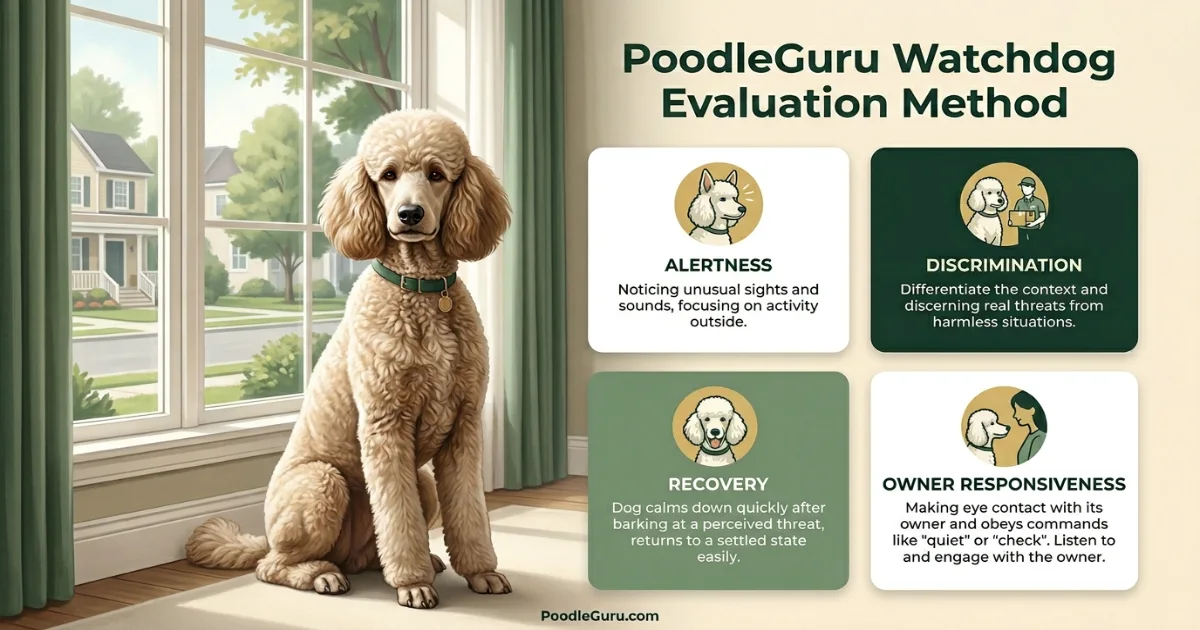
The PoodleGuru Watchdog Evaluation Method
At PoodleGuru, we evaluate a poodle’s protective potential across four dimensions. No single dimension tells the whole story. A poodle who scores high on alertness but low on discrimination is a nuisance barker, not a watchdog. The ideal is balance across all four.
Alertness
Does your poodle notice and respond to novel sounds or approaches? Score high if they consistently orient toward doors, windows, or unusual noises. Most poodles score high here by default — it is the strongest part of the breed’s watchdog profile.
Discrimination
Does your poodle differentiate between familiar and unfamiliar people? A dog who barks identically at your spouse and a stranger has low discrimination. A dog who pauses, assesses, then responds differently has high discrimination. This is where training makes the biggest impact.
Recovery
How quickly does your poodle settle after the trigger passes? A dog who barks for 20 minutes after the mail carrier leaves is not protecting — they are stuck in a reactive loop. Quick recovery signals emotional regulation, which is essential for a reliable watchdog.
Owner Responsiveness
When you acknowledge the alert and give a calm “thank you, I’ve got it,” does your poodle defer to you? This is the most important dimension. A watchdog’s job is to notify the decision-maker — you. A poodle who will not stand down when you take over is no longer a watchdog. They are a problem.
A strong watchdog scores high on alertness, moderate to high on discrimination, fast on recovery, and excellent on owner responsiveness. If your poodle scores low on recovery or responsiveness, the issue is not their protective instinct — it is impulse control or anxiety, and that is a training path, not a failure of the dog.
Training a Poodle for Watchdog Duties
You can shape and refine a poodle’s natural watchdog instincts. You cannot install guard-dog instincts that aren’t there. Training should focus on what poodles do well — alerting appropriately and deferring to you — rather than trying to make them something they are not.
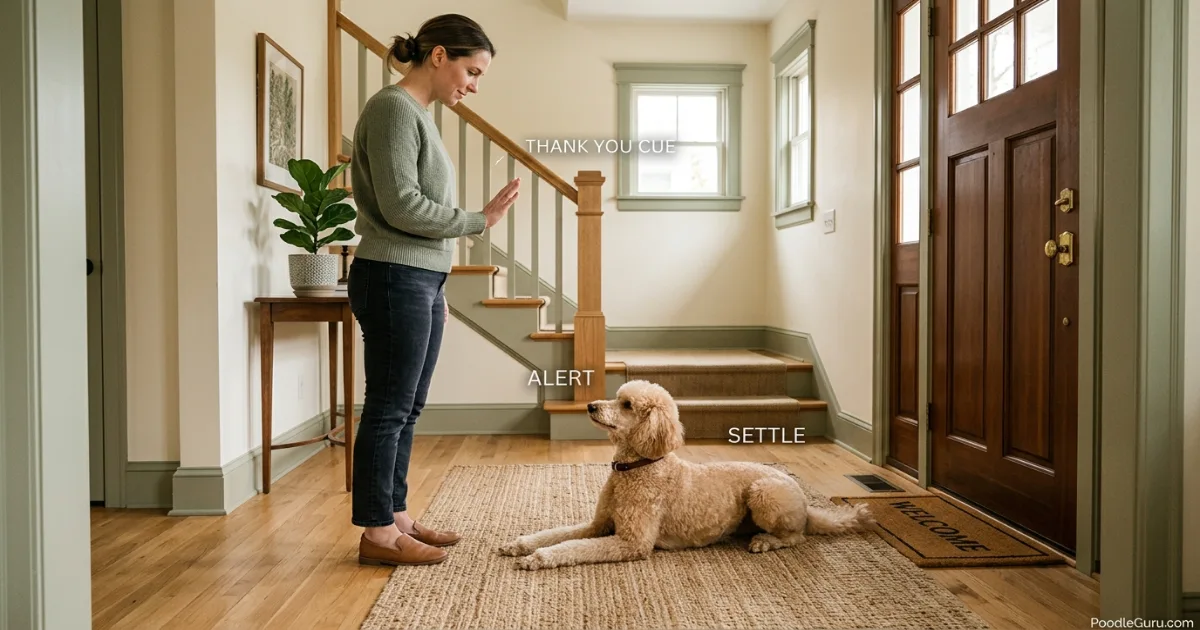
Teach an “Enough” or “Thank You” Cue
This is the single most valuable tool in a poodle watchdog owner’s kit. When your poodle barks at the door, you want to be able to say “thank you, I see it” and have them stop.
The training sequence is simple but takes consistency: when they alert, you go to the door, look, thank them calmly, and reward quiet. Over dozens of repetitions, they learn that the alert matters — and that your acknowledgment ends the job. The ASPCA’s guidance on managing barking behavior in dogs reinforces that positive interruption and redirection works far better than punishment for alert-barking breeds.
Socialize Broadly, Not Just Heavily
An under-socialized poodle fears everything unfamiliar and barks at everything. A well-socialized poodle has a large mental catalog of “normal” — and only flags what is genuinely outside it. Take your poodle to different environments, introduce them to varied people, and let them observe without forcing interaction. The goal is a dog who can assess, not a dog who reacts.
Do not Encourage Aggressive Posturing
Some owners think growling at the door or hackling up makes their poodle a better guard dog. It does not. It makes them a liability. A poodle who learns that aggressive displays get rewarded may escalate those displays when you are not around to control them. A calm, confident alert is more effective — and far safer — than a dog who looks like they might bite.
What Poodles Won’t Do: Honest Limitations
This is where the guard-dog fantasy meets reality. Poodles have hard limits that responsible owners need to accept. Pretending otherwise sets the dog up to fail and the owner up for disappointment — or worse, a dangerous situation.
A poodle will almost never physically engage an intruder. The breed lacks the fight-drive of true protection breeds. If someone enters your home despite the barking, most poodles will retreat, circle, or continue barking from a distance. They will not bite and hold. Expecting that from them is unfair and unsafe. If you need a dog for personal protection, you need a breed developed for that purpose and professionally trained — not a poodle with a loud bark.
Poodles are also too discriminating to be reliable “threat detectors” in the traditional sense. A well-socialized poodle may decide that a burglar is simply a new guest and greet them warmly — especially if the person acts calm and confident. The poodle’s intelligence works against them here. True guard breeds are supposed to be suspicious. Poodles are supposed to be smart. Smart enough, sometimes, to be fooled.
Finally, poodles feed off owner energy. A nervous owner produces a nervous poodle. A nervous poodle barks more but protects less effectively. The breed’s sensitivity means that in a genuinely threatening situation, many poodles will mirror their owner’s fear rather than override it with protective aggression. That’s not a design flaw. It is what makes them excellent companions. But it is a real limit on their guard-dog ability.
Owner Action Plan: Making the Most of Your Poodle’s Watchdog Instincts
- Train the “thank you” cue until it is automatic — this separates a useful watchdog from a nuisance barker.
- Socialize continuously, not just during puppyhood. A poodle who keeps meeting the world stays better at reading it.
- Use signage — a “Dog on Premises” sign amplifies your poodle’s deterrent effect without requiring anything from the dog.
- Reward calm assessment more than excited barking. The poodle who watches silently and only barks when something is genuinely off is the ideal.
- Accept the ceiling. Your poodle is an alarm system, not a security system. Pair them with actual home security measures for real protection.
Frequently Asked Questions
Will a poodle protect me if I’m attacked?
A poodle is more likely to bark, circle, and create commotion than physically engage. Some individual Standard Poodles may stand their ground or attempt to intervene, but this is not a breed-wide trait. Do not rely on a poodle for personal protection — rely on them for alerting and deterrence.
Are male or female poodles better watchdogs?
Both sexes are highly alert. Intact males tend to show more territorial marking and posturing behavior, which some owners mistake for protectiveness. Neutered males and females are equally capable watchdogs. Individual temperament matters far more than sex.
Can a Toy Poodle be a guard dog?
A Toy Poodle cannot physically deter anyone, but they are often exceptional watchdogs. Their small size makes them sensitive to sound and movement. Their bark is high-pitched but persistent. Think of them as a highly reliable alarm system that fits in a purse — not a guard.
Why does my poodle bark at every little sound?
Excessive alert barking usually stems from under-socialization, lack of discrimination training, or anxiety — not strong protective instinct. A poodle who barks at everything is not a better watchdog. They need training to learn what is worth alerting to and what is not.
Can I train my poodle to be more protective?
You can train better discrimination, faster recovery, and more reliable alerting. You cannot train genuine protection drive into a breed that wasn’t developed for it. Attempting to make a poodle aggressive often backfires — creating a fearful, unpredictable dog rather than a protector.
Are poodles used in any professional protection roles?
Poodles are not a common choice for police K-9, military, or personal protection roles where engagement is expected. They may be better suited to detection-style tasks where intelligence, trainability, and scent work matter more than physical confrontation.
Does a poodle’s haircut affect how intimidating they look?
A Standard Poodle in a clean, short clip (like a kennel or sporting cut) looks more athletic and imposing than one in a show coat. The continental clip reads as decorative to most people. If deterrent presence matters to you, choose a practical clip that shows the dog’s actual size and musculature.
Key Takeaways
- Poodles are natural, often exceptional, watchdogs — they notice and announce — but they are not guard dogs and should not be expected to physically engage threats.
- The breed’s intelligence and sensitivity produce discriminating alertness rather than blind reactivity, making them reliable without being nuisances when properly trained.
- Standard Poodles offer moderate to high visual and vocal deterrence due to their size and deep bark; Toy and Miniature Poodles function as early-warning alarms with little to no physical deterrence.
- The PoodleGuru Watchdog Evaluation Method measures four dimensions: alertness, discrimination, recovery speed, and owner responsiveness — balance across all four defines a reliable watchdog.
- Teaching a “thank you” or “enough” cue is the single most effective training tool for channeling a poodle’s watchdog instincts into useful, controllable behavior.
- If you need genuine physical protection, choose a breed developed for that work and professionally trained — pair your poodle’s alert system with actual home security measures for complete coverage.
Your poodle will tell you when something’s happening. That’s the gift of the breed. A deep bark in the dark, a sudden alertness at the window, a dog who knows their territory and their people — that is what poodles bring. It is not a guard dog’s ferocity, and it was never supposed to be. It is intelligence on watch. For most homes, that is exactly the right level of protection. Train the alert. Trust the bond. And let your poodle be what they actually are: the smartest early-warning system you’ll ever have.