Can Poodles Be Left Alone All Day? Safe Time Limits By Age
Poodles hate being away from their people — but modern life often demands it. The real question isn’t “can they survive” — it’s “how long can they be alone and still feel safe, calm, and connected?” This guide breaks down safe alone-time windows for every life stage, from puppy to senior, so you can build a routine that works for both of you.
Quick Answer
Most adult poodles can be left home alone for 4 to 6 hours comfortably, with a maximum of about 8 hours if you’ve built up gradually and provide a midday break. Puppies, however, need much shorter alone-time — roughly 1 hour per month of age up to 4–5 hours. Senior poodles may need more frequent bathroom breaks and comfort checks. Poodles are intensely social, so being left alone all day without preparation, enrichment, or a potty plan can quickly lead to separation anxiety, destructive behavior, or house soiling. The key is matching alone-time to your poodle’s age, temperament, and physical needs — not forcing them to fit a schedule that works for you alone.
⏱️ Puppy Limit
Poodle puppies under 6 months typically can’t hold their bladder or manage solitude beyond 2–4 hours. The rule of thumb: 1 hour per month of age.
💡 Mental Need
Poodles are brilliant. Without mental stimulation before being left, they’ll often fill the silence with barking, chewing, or escape attempts.
🧓 Senior Changes
Older poodles may need more frequent potty breaks, softer bedding, and shorter alone times as cognitive or mobility issues emerge.
What Does “Home Alone” Mean for a Poodle?
Leaving a poodle home alone means more than just exiting the house. For poodle owners, it means asking a deeply social, human-oriented dog to regulate their own emotions, bladder, and activity for an extended stretch without their primary attachment figure. The most important thing to understand is that a poodle’s tolerance for solitude is never just about “holding it” — it’s about emotional security, not just physical capacity.
Many poodles will physically survive an 8-hour workday. But survival isn’t the same as thriving. A poodle who spends those hours pacing, whining, or shut down in a corner is already in distress — even if they didn’t chew the doorframe. Alone-time quality matters as much as quantity.
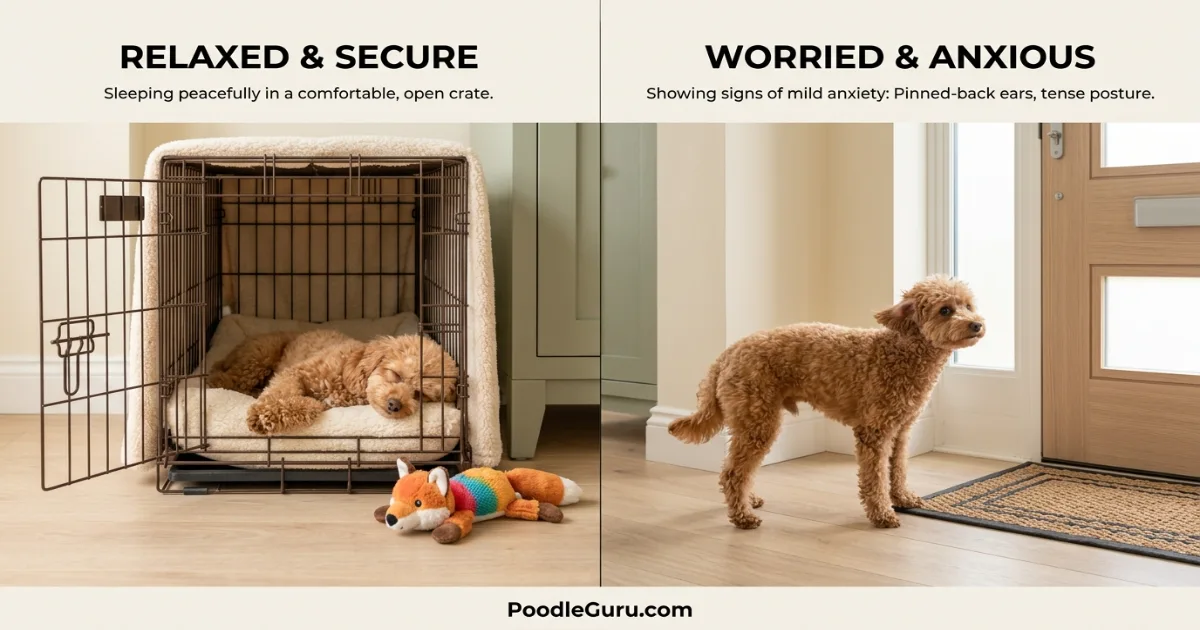
That’s why we measure safe alone-time not just by the clock, but by what the poodle does while you’re gone. A poodle who sleeps deeply, chews calmly, or watches the window peacefully is handling solitude well. A poodle who pants, paces, refuses food, or eliminates inside despite being house-trained is sending a clear signal that the duration is too long — or the emotional preparation isn’t sufficient.
Safe Alone-Time Limits By Age
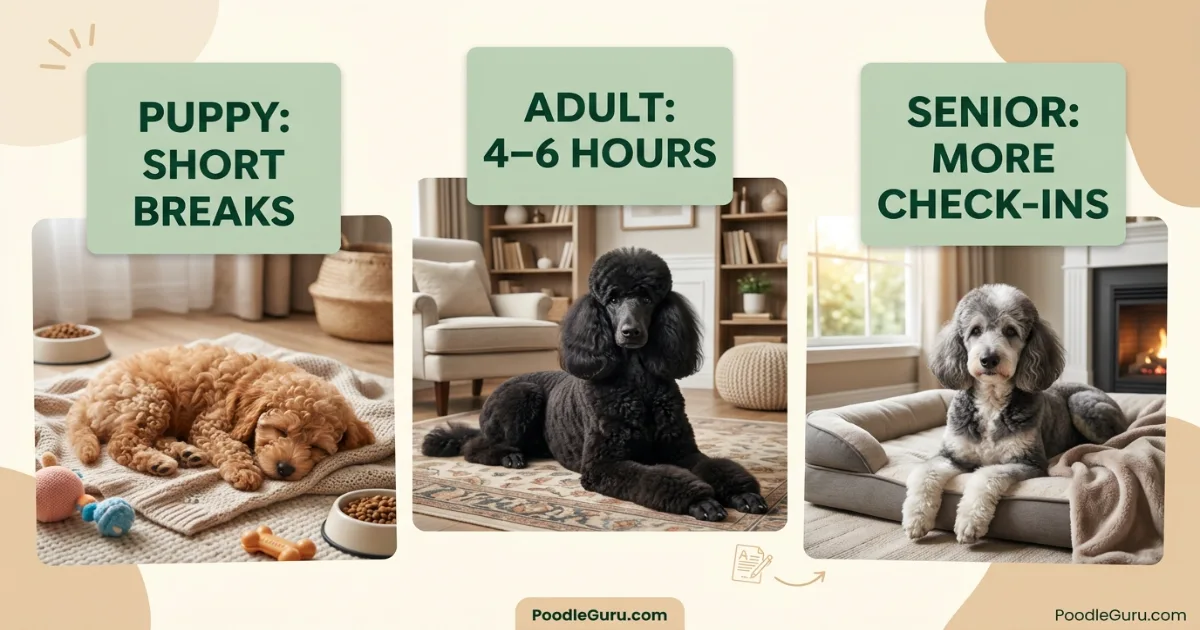
Alone-time capacity changes dramatically across a poodle’s life. Puppies need frequent human contact and bathroom breaks. Adults can handle a workday with the right setup. Seniors circle back to needing more check-ins. These are safe maximums for a poodle who has been gradually accustomed to being alone — not a starting point.
| Life Stage | Max Alone Time (Single Stretch) | Total Alone Time Per Day | Bathroom Break Needed | Special Considerations |
|---|---|---|---|---|
| 8–10 weeks | 1–2 hours | 2–3 hours total | Every 1–2 hours | Bladder control is minimal; loneliness can trigger fear periods. Crate training in short sessions only. |
| 3–5 months | 2–4 hours | 4–5 hours total | Every 2–3 hours | Socialization window still open — isolation can negatively impact confidence. |
| 6–12 months | 3–5 hours | 5–7 hours total | Every 3–4 hours | Adolescent poodles often test boundaries; mental enrichment before departure is critical. |
| 1–7 years (Adult) | 4–6 hours (up to 8 with midday break) | 8 hours total with break | Every 4–6 hours | Healthiest window for longer alone-time if physical and mental needs are met before and after. |
| 8+ years (Senior) | 3–5 hours | 6–7 hours total | Every 3–4 hours | Joint stiffness, reduced bladder control, and possible cognitive decline call for shorter durations and more comfort checks. |
These numbers assume a poodle who has been positively conditioned to alone time, has had exercise and a potty break beforehand, and has access to water and safe enrichment. A poodle left alone for the maximum should still have a midday visit — from a dog walker, a neighbor, or you — to break up the stretch.
The PoodleGuru Alone-Time Safety Framework
At PoodleGuru, we evaluate whether a poodle is ready for a given alone-time duration using four checks. If any check fails, the duration should be shortened or the preparation improved before trying again.
The PoodleGuru 4-Check Alone-Time Readiness Method
Use this quick assessment before leaving your poodle home alone — especially when you’re extending the usual duration.
Physical Needs Met
Your poodle has had a potty break within the last 30 minutes, fresh water is available, and the room temperature is comfortable. An overheated poodle in a thick coat will struggle regardless of emotional readiness.
Mental Tank Filled
Within the hour before departure, your poodle has had at least 15–20 minutes of sniffing, training, or puzzle activity. A mentally satisfied poodle is far more likely to sleep while you’re gone.
Environment Is Predictable
The alone-time space is safe, familiar, and free from triggers that might cause panic — like mail carriers banging on the door or construction noise. White noise or soft music can help.
Gradual Duration, Not Jumped
If your poodle is used to 2 hours alone, don’t suddenly leave for 6. Increase in small increments — 15 minutes, then 30, then an hour — always staying below the threshold where panic appears.
This framework isn’t about being perfect. It’s about being intentional. If you run through it and realize your poodle hasn’t had a walk yet today, that’s your sign to postpone the errand or arrange a quick enrichment session first.
Factors That Increase or Decrease Alone-Time Tolerance
Not all poodles of the same age handle solitude equally. These variables make a real difference.
| Factor | Increases Alone-Time Tolerance | Decreases Alone-Time Tolerance |
|---|---|---|
| Size | Standard Poodles often have more emotional resilience and a larger bladder | Toy and Miniature Poodles may feel more vulnerable and need more frequent potty breaks |
| Personality | Confident, curious, moderately independent temperament | Highly anxious, noise-sensitive, or velcro-temperament poodles |
| Early Socialization | Puppyhood exposure to short, positive alone-time experiences | Pandemic puppy or rescue with no prior alone-time practice |
| Pre-Departure Enrichment | A sniff walk, training session, or food puzzle within the previous hour | No exercise or mental engagement — just a rushed departure |
| Health | No underlying pain or medical conditions | UTIs, arthritis, cognitive decline, or GI issues that increase discomfort and urgency |
| Companionship | Another calm, well-adjusted dog may provide comfort (not guaranteed) | Being the only pet — but note: a second dog isn’t a substitute for human absence if anxiety is owner-specific |
Even within the same litter, you’ll see variation. One puppy might nap through 4 hours at 5 months old while another panics after 20 minutes. The breed’s general tendencies are a starting point — not a guarantee.
Common Mistakes Owners Make
Most poodle alone-time problems aren’t because the dog is “bad” — they’re because the setup is incomplete. These mistakes are fixable once you spot them.
⛔ Leaving Too Long, Too Soon
Jumping from 2 hours to a full workday without gradual training is the single most common cause of separation distress in poodles. Build duration slowly.
⛔ Skipping the Pre-Departure Routine
A poodle with a full bladder and pent-up energy will struggle. A quick walk, potty break, and mental game take 20 minutes and transform the alone-time experience.
⛔ Dramatic Hellos and Goodbyes
Elaborate farewells and over-the-top reunions teach your poodle that departures are a big emotional event. Calm, neutral transitions reduce anxiety.
⛔ Punishing “Accidents” Upon Return
If you come home to a mess and scold your poodle, they associate your return — not the act — with fear. This makes alone-time anxiety worse, not better.
How to Build Your Poodle’s Alone-Time Confidence
You can’t just hope your poodle learns to be okay alone. You have to teach it — with patience, predictability, and small wins.
Practice Micro-Absences
Step out the door for 5 seconds. Return calmly. Repeat until your poodle barely looks up. Then stretch to 30 seconds, 2 minutes, 10 minutes. Keep it boring. Reward calm settling, not frantic greetings.
Desensitize Departure Cues
Pick up your keys, put on your coat, and then sit down on the couch. Do this randomly until the sound of jingling keys no longer triggers a panic response. This breaks the predictive chain that fuels anxiety.
Create a Safe, Enriching Alone-Zone
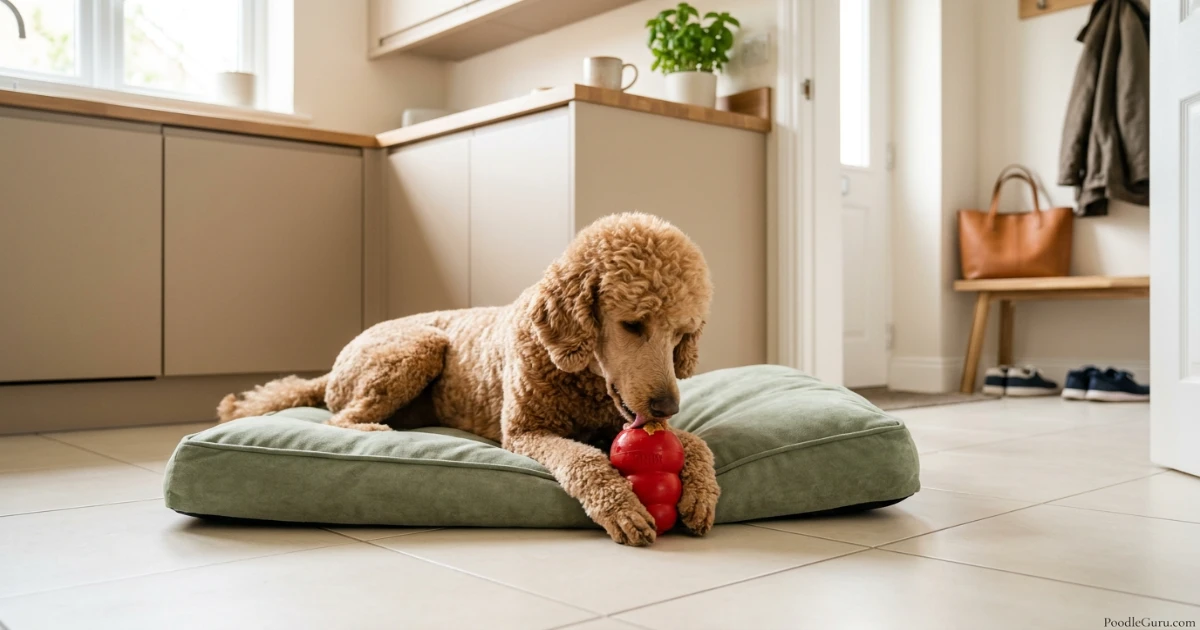
Designate a comfortable space — a crate with the door open, a puppy-proofed room, or a pen — where only good things happen. Stuffed Kongs, snuffle mats, long-lasting chews, and a comfy bed. This becomes the place your poodle chooses to rest, even when you’re home.
Use Technology for Reassurance
A pet camera lets you watch without intruding. If you see signs of distress (pacing, panting, vocalizing), you know the duration needs to be shortened and the training dialled back. A camera is a feedback tool — not a way to monitor failure.
This process takes weeks, not days. The ASPCA’s separation anxiety resources recommend keeping training sessions short, positive, and always ending before distress begins. Pushing too fast undoes progress.
When Being Home Alone Becomes a Problem
There’s a line between “I’d rather you were here” and “I’m in a panic.” It’s important to know where that line sits.
Signs of Separation Anxiety vs. Normal Disappointment
| Behavior | Normal Adjustment (Mild Discomfort) | Separation Anxiety / Distress |
|---|---|---|
| Vocalization | Brief whining for 1–2 minutes, then quiet | Persistent barking, howling, or crying for most of the absence |
| Destruction | None or mild shredding of a toy | Chewing doorframes, scratching at exits, self-injury |
| House Soiling | None if bladder capacity matches the duration | Urination or defecation despite being house-trained and having adequate potty breaks |
| Appetite | Eats treats or Kong eventually | Refuses all food until owner returns |
| Reunion | Happy but calms within a minute or two | Frantic, prolonged, unable to settle even after owner is home |
If your poodle consistently shows signs from the right column, a professional consultation is the next step. A certified separation anxiety trainer or a veterinary behaviorist can create a custom plan. In some cases, anti-anxiety medication prescribed by a vet can be a compassionate bridge while training takes hold.
🩺 Vet Check First
Sudden onset of alone-time distress in an adult poodle can sometimes be triggered by pain or illness. A vet exam can rule out medical causes before you invest in behavior modification.
If your schedule genuinely can’t change — for example, a full-time job with a commute — don’t beat yourself up. Instead, build a support system. A midday dog walker, a trusted neighbor, a quality dog daycare (one that understands poodle sensitivity), or a family member can break the day into manageable chunks. Many poodles do better with a midday visit than with 8 solid hours alone — and that small change often transforms the experience from distressing to doable.

Frequently Asked Questions
Can poodles be left alone for 8 hours a day?
An adult poodle can manage 8 hours with a midday potty break, enrichment, and gradual training — but not every poodle thrives on that schedule. If signs of distress appear, shorten the stretch or add a dog walker. Toy poodles often need more frequent breaks.
How long can a poodle puppy hold its bladder?
A general guideline is 1 hour per month of age. A 3-month-old puppy may hold it for about 3 hours max, but many need breaks every 2 hours. Overnight, some puppies can stretch longer while sleeping, but daytime alone-time should stay conservative.
What’s the best way to leave a poodle home alone without crying?
Start with micro-absences, desensitize departure cues like keys and coats, and always provide a high-value food puzzle right before you leave. The goal is for your poodle to associate your departure with a positive activity, not panic.
Do standard poodles handle alone-time better than toy poodles?
On average, yes. Standard Poodles often have more emotional resilience and larger bladders. Toy Poodles were bred as close companions and may feel more vulnerable alone. But individual temperament matters far more than size alone.
Should I use a crate when leaving my poodle home alone?
A crate can be a safe den if your poodle has been positively crate-trained and sees it as a restful place — not a prison. Never force a poodle into a crate if they show panic. A puppy-proofed room or exercise pen is often a better option for anxious dogs.
How do I know if my poodle is ready for longer alone-time?
Signs of readiness include: your poodle settles quickly after you leave, doesn’t vocalize excessively, eats treats left for them, and greets you calmly upon return. If you’re unsure, use a pet camera to observe for a few sessions before extending duration.
Is it cruel to leave a poodle alone while at work?
Not if their needs are met — a proper walk, mental stimulation, a comfortable environment, and a midday break. It becomes problematic when alone-time exceeds their emotional or physical capacity without support. Many poodles adapt well to a routine that includes quality time before and after work.
Key Takeaways: Leaving Your Poodle Home Alone
Poodles can learn to be alone — but they need your help to feel safe, not just your absence. The right approach transforms alone-time from a source of anxiety into a calm, predictable part of their day.
- Adult poodles can typically be left alone for 4–6 hours, with 8 hours possible if a midday break and proper preparation are provided.
- Puppies under 6 months need shorter durations (1 hour per month of age max) and more frequent human contact to prevent emotional and house-training setbacks.
- The PoodleGuru 4-Check Alone-Time Readiness Method — physical needs, mental tank, environment, gradual duration — helps you assess whether your poodle is set up for success.
- Alone-time tolerance varies by size, personality, health, and early experience — tailor expectations to your individual poodle, not just breed averages.
- Separation anxiety is not the same as mild disappointment; persistent distress signals need professional guidance and should not be ignored or punished.
- If your schedule can’t change, a midday dog walker, neighbor, or daycare can make a full workday possible without compromising your poodle’s well-being.