Poodle Show Grooming: How to Prepare for Conformation
Stepping into the conformation ring with a Poodle means entering a world where preparation is measured in months, not hours. The dogs you see floating across the ring — sculpted, balanced, impossibly elegant — are the result of careful planning, daily coat work, and a grooming routine that begins long before show day. This guide walks you through what that preparation actually looks like.
Quick Answer: What Does Poodle Show Grooming Involve?
Poodle show grooming is a multi-month process of coat growth, conditioning, banding, and precise scissoring — not a day-before touch-up. It involves growing specific coat sections to exact lengths, protecting that coat from damage through banding and wrapping, bathing and drying with techniques that maximize volume and texture, and hand-scissoring every surface into the balanced silhouette judges expect. For Poodle owners entering conformation, this means daily coat management, careful coat protection between shows, weekly maintenance routines, and a professional-grade toolkit. The most important thing to understand is that show grooming isn’t a service you purchase the morning of the show — it’s a lifestyle you commit to for the duration of your dog’s show career.
Quick Facts: Show Grooming Essentials
Coat Lead Time
Full show coat takes 6–12 months of dedicated growth depending on the dog’s age, genetics, and the clip style chosen.
Approved Show Clips
In AKC regular classes, Poodles 12 months or older must be shown in the Continental or English Saddle clip. Puppies under 12 months may use the Puppy clip.
Banding Frequency
Show coat in active growth is typically banded or wrapped weekly — sometimes more often — to prevent breakage and matting.
Bath Schedule
Many show handlers bathe show Poodles weekly during active prep. Dirty coat loses lift, while over-conditioned coat can become too soft to hold shape.
Scissoring Cycle
Show Poodles are scissored every 2–4 weeks for maintenance, with a final detailed scissor session in the days before each show.
Ring-Day Timing
Show-day grooming typically starts 2–3 hours before ring time — washing, drying, scissoring, and final product application.
What Judges Actually Look For
Before you pick up a brush, understand what you’re grooming toward. In Poodle conformation, the AKC breed standard describes the ideal Poodle in precise detail. Judges evaluate your dog against that standard — not against the other dogs in the ring. Grooming isn’t decoration. It’s the presentation layer that allows a judge to see your dog’s structure clearly.
AKC Clip Rule Note
For AKC conformation, the exact class matters. Poodles under 12 months may be shown in the Puppy clip. In regular classes, Poodles 12 months or older must be shown in the Continental or English Saddle clip. The Sporting clip is limited to Stud Dog, Brood Bitch, and non-competitive Parade of Champions situations. Always confirm the current rules for your registry and event before entering.
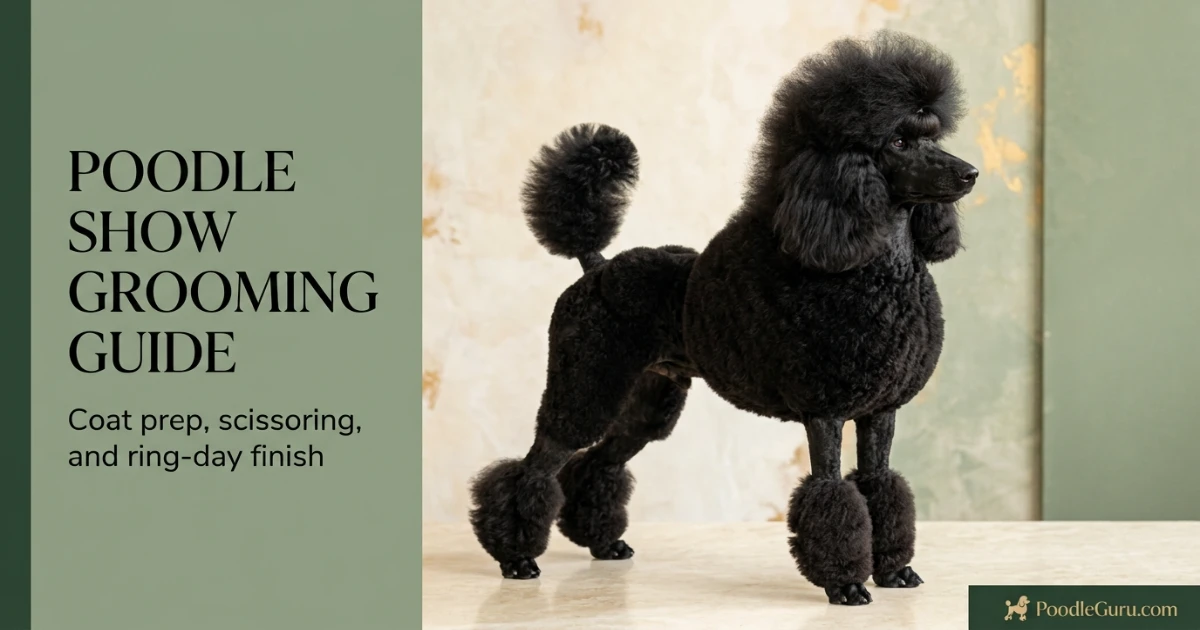
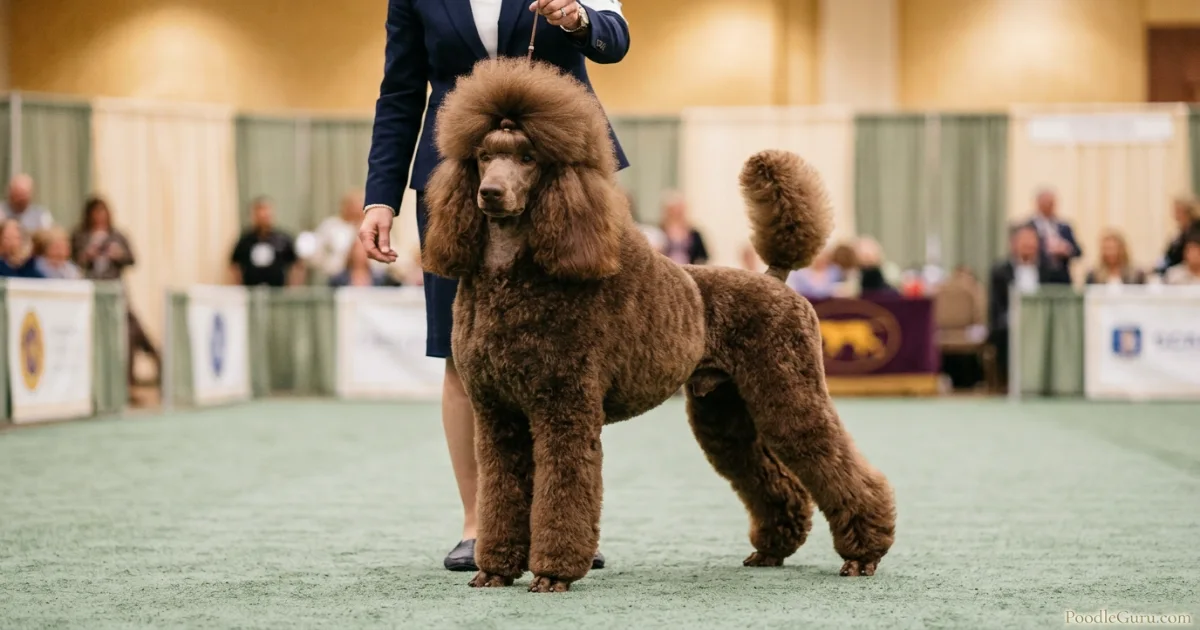
Judges are looking for a square silhouette with balanced angulation front and rear. The topline should be level when viewed from the side. The neck should flow smoothly into well-laid-back shoulders. The tail should be set high and carried up. Your grooming must reveal these structural elements — not disguise them. A poorly scissored dog can make a correctly built Poodle look unbalanced. A well-groomed dog can’t fix structural faults, but it can make correct structure visible.
In practice, this usually means the eye travels across the dog without catching on rough transitions, uneven planes, or patches where the coat density changes abruptly. The groomed surface should read as intentional from every angle.
Coat Growth: The Foundation of Show Grooming
Show grooming begins with coat — specifically, the months-long process of growing, protecting, and conditioning coat to the length and density that scissoring requires. You can’t sculpt what isn’t there.
For a Continental clip, the coat on the chest, front legs, bracelets, topknot, tail pompon, and optional hip rosettes must be grown to substantial length — often 4–8 inches depending on the dog’s size and the handler’s preference. The English Saddle clip requires similar volume in the front assembly but uses a different hindquarter pattern, with a short blanket of coat and clean shaved bands that must still read balanced from the side and rear. Coat that’s been clipped short for pet maintenance needs 6–12 months of dedicated growth to reach show length, and during that entire period, every inch of that coat must be protected from breakage.
Coat Quality and Genetics
Not every Poodle has show-quality coat texture. The breed standard calls for a naturally harsh, dense coat that stands off the body. Soft, cottony coats — common in some pet lines — won’t hold a sculpted shape the same way, no matter how skilled the grooming. If you’re considering showing, evaluate coat texture before committing to the show path.
Professional handlers and breeders commonly recommend that puppies destined for the show ring never have their coat fully clipped short. Instead, the coat is shaped and maintained from puppyhood to encourage the density and texture that show grooming demands. Starting with a blank-slate shave-down means starting over entirely.
Banding and Wrapping: Protecting the Coat
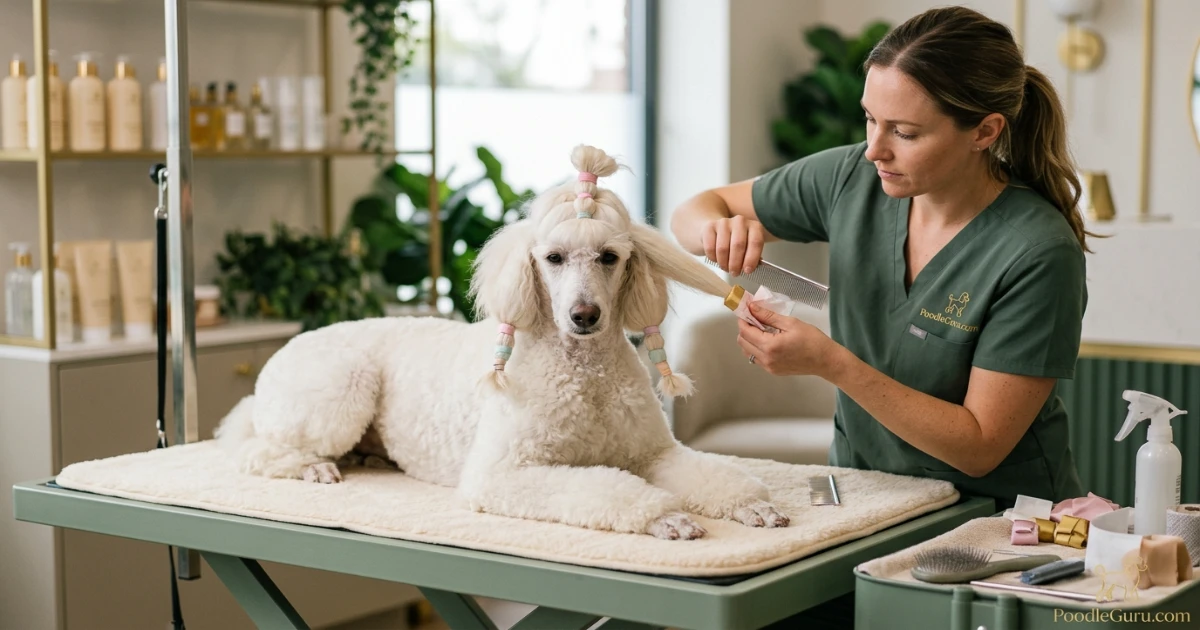
Long Poodle coat is fragile. It breaks from friction against bedding, floors, and the dog’s own movement. It mats from moisture, static, and contact. Banding and wrapping — the practice of sectioning coat into small bundles and protecting it with bands, paper, or fabric between grooming sessions — is how many show handlers preserve months of growth.
What Gets Banded
| Coat Section | Banding Method | Frequency | Notes |
|---|---|---|---|
| Topknot | Sectioned into multiple small ponytails, wrapped in paper | Weekly, more often if active | Keep bands loose at the base to avoid breakage — never tight against the skin |
| Ears | Wrapped flat or in a single protective sleeve | Weekly | Ears drag in food and water — wrapping is essential for coat protection |
| Neck and chest | Sectioned and banded in rows following the growth direction | Weekly | Keeps the jacket coat off the ground and prevents collar matting |
| Front legs | Banded in sections from shoulder to bracelet | Weekly | Prevents friction matting where legs meet the body |
| Hip rosettes | Sectioned and wrapped to protect shape | Weekly | Rosettes take the longest to grow — protection is non-negotiable |
| Tail | Wrapped in a single protective cover | Weekly | Tail coat drags and collects debris — wrap for cleanliness |
Professional groomers commonly note that banding is where new show owners fail first. It’s tedious. It takes practice. Done incorrectly — bands too tight, sections too large, wrapping left too long — it can damage the very coat it’s meant to protect. But without consistent between-show protection, long coat often breaks and mats before it ever reaches the ring intact.
Important Ring-Day Clarification
Protective banding and wrapping are maintenance practices used away from judging. Before entering the ring, follow your registry’s presentation rules carefully. In the AKC standard, elastic bands are specifically allowed for the topknot area, so do not assume every protective wrap used at home can remain in place for judging.
Show Bath Preparation
The show bath is fundamentally different from a pet bath. The goal isn’t just clean coat — it’s coat that’s volumized, textured, and prepared to accept product and hold a scissored shape for hours in the ring.
The Show Bath Process
Pre-Bath Brushing and Dematting
Before water touches the coat, every band comes out and the entire dog is line-brushed to the skin. Any tangles present before the bath will tighten irreversibly when wet. This step alone can take 30–60 minutes on a full show coat.
Clarifying and Volumizing Shampoo
Show handlers typically use a clarifying or volumizing shampoo formulated for harsh coats. The goal is to strip residue without stripping natural texture. Product buildup flattens the coat, so clarifying is essential — but over-clarifying creates static and brittleness.
Conditioning — Strategic, Not Generous
Conditioner is applied selectively — often only to the ends of long coat or to areas prone to dryness. The body and legs may receive minimal or no conditioner to preserve the coat’s ability to stand off the body. Too much conditioning creates a soft, limp finish that won’t hold shape.
High-Velocity Drying With Direction
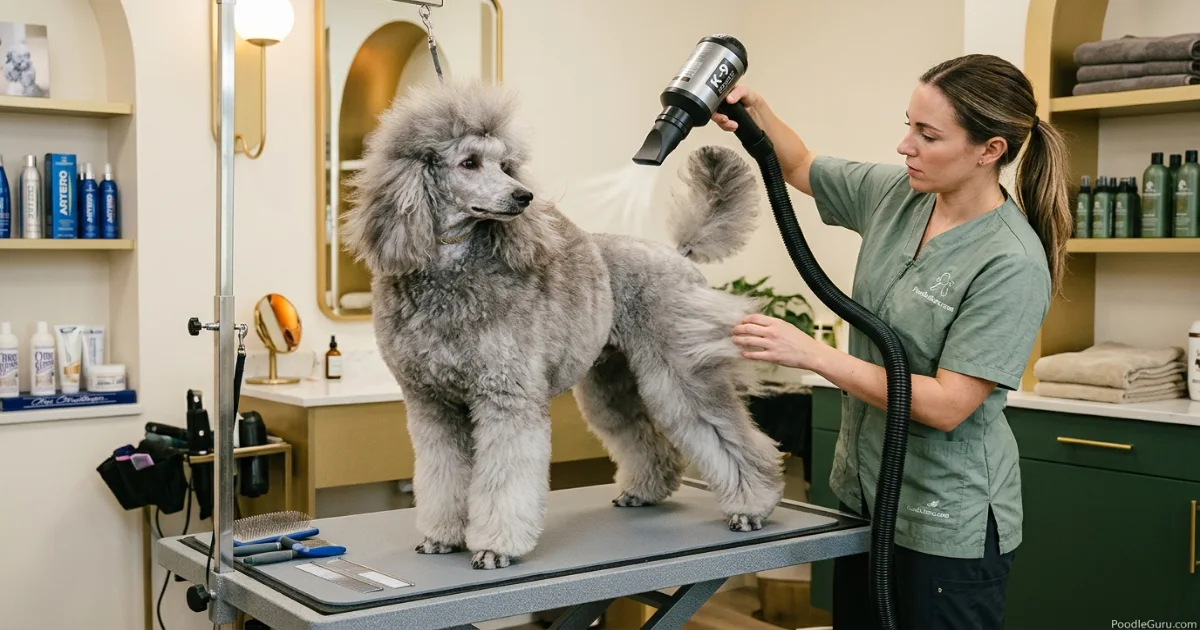
The coat is blown dry with a high-velocity dryer, working section by section. The direction of airflow matters — coat is dried upward and outward from the skin to create lift and volume. Flat drying creates flat coat. This is the single most technique-intensive step in the entire process.
Product Application for Texture and Hold
Volumizing sprays, texturizers, and light-hold grooming products are applied during the drying process, not just at the end. Product is worked through the coat while it’s warm and receptive, building volume layer by layer.
Scissoring the Show Silhouette
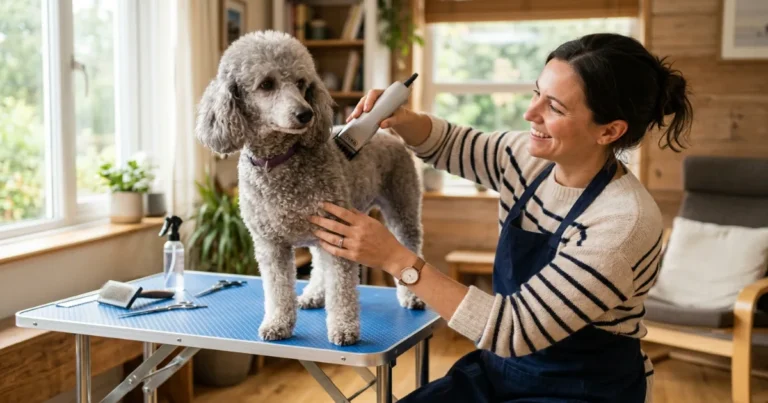
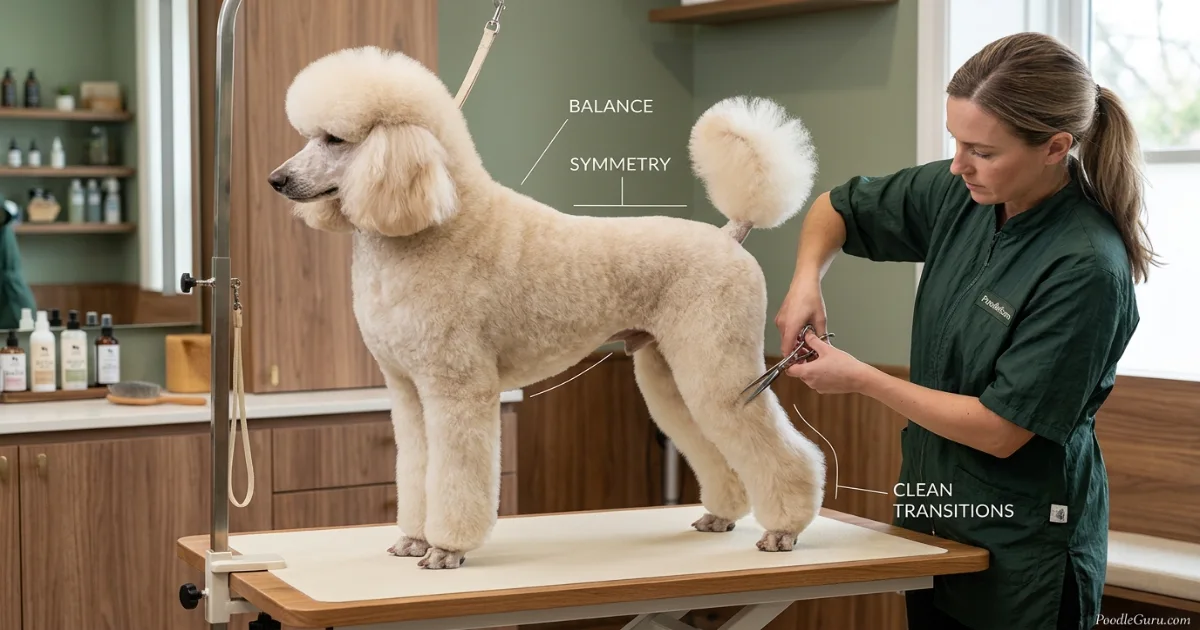
Scissoring is where technical skill meets artistic judgment. The best Poodle handlers spend years developing their eye for balance, proportion, and the smooth, flowing lines that judges reward. Scissoring is done in layers — rough shaping first, refinement over multiple sessions, and final detailing in the days before the show.
Key Scissoring Zones
| Zone | What the Judge Sees | Scissoring Goal |
|---|---|---|
| Topknot | The frame for the head and expression | Full, rounded, balanced — not top-heavy, not flat. Should complement the length of neck. |
| Neck and throat | The transition from head to shoulders | Clean throat with a smooth, flowing line into the chest. No harsh angles. |
| Chest and front jacket | The forward projection and substance | Full but proportional — should balance the hindquarter volume, not overwhelm it. |
| Front legs and bracelets | Vertical columns that define leg placement | Straight, even columns with defined but not exaggerated bracelets at the wrists. |
| Hip rosettes | The signature of the Continental clip | Round, balanced, placed symmetrically on each hip. Size proportional to the dog. |
| Back legs | Angulation and rear balance | Smooth from hip to hock with defined bracelets — mirroring the front leg proportions. |
Scissoring a show Poodle is not a one-session job. Most handlers do maintenance scissoring every 2–4 weeks, with a final detailed session 2–3 days before each show. The day before the show is typically reserved for touch-ups only — you want fresh lines, not a rushed overhaul.
Ring Day Finishing
Show morning is controlled chaos. The dog gets a final bath — often just a light wash with volumizing products — followed by targeted drying, scissoring touch-ups, and product application for hold and shine. Timing matters. If you finish too early, the coat settles. If you finish too late, you’re rushing into the ring with a damp dog.
Most experienced handlers start 2–3 hours before their ring time. The final 20 minutes are for the dog to relax, shake off any residual tension, and enter the ring fresh — not exhausted from hours on the table. The handler’s final job is to make the dog look effortless, even though nothing about the process was.
When to Call a Professional Handler
Show grooming at the competitive level often involves a professional handler who manages both presentation and conditioning. If you’re new to conformation, working with a handler — or at minimum, apprenticing with one — is the fastest way to learn what the ring actually demands. This guide describes the process; it doesn’t replace hands-on mentorship from someone who’s won in your breed and region.
The PoodleGuru Show Prep Timeline
At PoodleGuru, we map show preparation backward from ring time so nothing gets compressed or forgotten. This timeline assumes a dog in full show coat with ongoing maintenance — not a dog being grown out from scratch.
6+ Months Before the Show
Assess coat length and quality. If the dog needs more coat in specific zones, adjust banding and protection to prioritize growth. Address any skin or coat health issues with your veterinarian — show coat grows from healthy skin first.
4 Weeks Before
Major scissoring session to establish the silhouette. This is not the time to experiment with a new shape — stick with what you know works on your dog’s structure. Begin weekly baths with volumizing products if you aren’t already on that schedule.
1 Week Before
Maintenance scissoring to refine the shape. Check all banding and wrapping — replace anything worn or loose. Confirm your show kit is packed with all products, tools, backups, and ring essentials.
2–3 Days Before
Final detailed scissoring session. This is the shaping that will read in the ring. Focus on symmetry, clean transitions, and balanced proportions. After scissoring, band everything back up.
Show Morning
Light bath, targeted drying, touch-up scissoring, and finishing product. Allow the dog at least 20 minutes to relax and move around naturally before entering the ring. The coat should look alive, not shellacked.
Common Show Grooming Mistakes
Even experienced exhibitors make these errors. Knowing them in advance saves you the frustration of learning them ringside.
Over-Scissoring the Topknot
A topknot that’s too small makes the neck look long and the head look narrow. A topknot that’s too large unbalances the entire front assembly. The correct topknot complements your dog’s specific head and neck — it doesn’t match a photo of a different dog.
Rushing Coat Growth
You can’t hurry coat. Over-bathing, over-conditioning, and excessive product use won’t make coat grow faster — they’ll just damage what’s already there. Coat growth is a biological process. Feed it well, protect it carefully, and wait.
Using Too Much Product on Show Day
Stiff, crunchy coat reads as artificial. The judge should see a Poodle that looks touchable and alive — not a hairspray sculpture. Less product applied with better technique almost always looks better than more product applied heavily.
Neglecting the Feet and Face
Clean feet and a smooth, close-shaven face are the first things a judge sees up close. Stubble, uneven shaving, or poorly trimmed nails suggest carelessness — and that impression can color the entire evaluation.
Frequently Asked Questions
Which show clips are allowed for Poodles in AKC conformation?
In AKC regular classes, Poodles 12 months or older must be shown in the Continental clip or English Saddle clip. Poodles under 12 months may be shown in the Puppy clip. The Sporting clip is limited to Stud Dog, Brood Bitch, and non-competitive Parade of Champions situations, so always check the current rules before entering.
How long does it take to grow a full show coat on a Poodle?
Expect 6–12 months of dedicated coat growth from a short pet trim to full show length, depending on the dog’s age, genetics, and coat growth rate. Some dogs grow coat faster; others need the full year. Consistent banding and protection are essential throughout.
Can I show my Poodle without a professional handler?
Yes — owner-handlers compete successfully at all levels. However, professional handlers bring years of experience in presentation, ring strategy, and grooming technique. Most new exhibitors benefit from mentorship or co-handling arrangements before showing independently.
How often should a show Poodle be bathed?
Most show handlers bathe their Poodles every 5–7 days to maintain coat texture and volume. Coat that goes too long between baths loses its ability to stand off the body. Coat that’s bathed too frequently can become dry and brittle — balance is key.
What products do professional handlers use on show Poodles?
Professional handlers typically use volumizing shampoos, lightweight texturizers, and flexible-hold finishing sprays formulated for harsh coats. Product choice is highly individual — what works on one dog’s coat texture may not work on another’s. Most handlers test products extensively before show use.
Is show grooming hard on the dog?
Show grooming requires long periods of standing on a table and tolerance of bathing, drying, and scissoring. Dogs bred for the show ring are conditioned to this from puppyhood. A well-conditioned show Poodle accepts grooming as routine. Signs of stress or resistance should be addressed with training, not force.
What’s the difference between a pet groom and a show groom?
A show groom involves months of coat growth, protective banding, specialized products, precision hand-scissoring across every surface, and finishing techniques designed to hold shape under ring conditions. A pet groom prioritizes practicality and comfort. The difference in time, technique, and cost is substantial.
Key Takeaways: Poodle Show Grooming
Show grooming is a craft built on patience, consistency, and an honest understanding of your dog’s structure. It’s not something you master in a weekend — but every skill builds on the one before it.
- Poodle show grooming is a multi-month commitment involving coat growth, protective banding, weekly bathing, precise scissoring, and ring-day finishing — not a single pre-show appointment.
- In AKC regular classes, Poodles 12 months or older must be shown in the Continental or English Saddle clip; puppies under 12 months may be shown in the Puppy clip.
- Coat protection through banding and wrapping is the daily discipline that makes show-length coat possible — without it, long coat breaks and mats before it ever reaches the ring.
- Show bathing prioritizes volume and texture through clarifying shampoos, strategic conditioning, and high-velocity drying — the goal is coat that stands off the body and holds a sculpted shape.
- The PoodleGuru Show Prep Timeline maps preparation from six months out through show morning, so nothing gets compressed, skipped, or rushed at the last minute.
- Most successful exhibitors work with mentors, professional handlers, or breed mentors — this guide provides structure and context but cannot replace hands-on coaching from someone who knows your dog and your region’s competition.
Ready to start your show journey? Begin with our Complete Poodle Grooming Guide to build the foundational skills that show grooming depends on — and seek out a local Poodle club or mentor to take the next step in person.