Best Shampoo for Poodles (2026 Tested & Reviewed)
Poodle coats are not like other dog coats. They’re dense, curly, low-shedding, and surprisingly easy to damage with the wrong products. This guide cuts through the noise — no affiliate fluff, no generic rankings — just expert-backed picks tested on real poodle coats, with honest notes on what actually works and what to skip.
⚡ Quick Answer: Best Shampoo for Poodles
The best shampoos for poodles in 2026 are Burt’s Bees Hypoallergenic Shampoo (best overall for sensitive skin), Chris Christensen White on White (best for white and cream poodles), TropiClean Luxury 2-in-1 (best budget pick), and Isle of Dogs Coature No. 50 (best professional formula). Poodles need a pH-balanced, sulfate-free shampoo formulated for curly or single-layer coats — standard dog shampoos strip the natural oils that keep poodle curls defined and healthy. Bathing frequency should be every 3–4 weeks for most poodles.
Why Poodle Coats Demand a Different Shampoo
Most dogs have a double coat: a dense undercoat plus a topcoat of guard hairs that sheds regularly. Poodles don’t. Their single-layer, continuously-growing curly coat traps dead hair inside the curl pattern rather than shedding it outward. That’s what makes them low-dander and beloved by allergy-prone families — but it also means the coat builds up oils, debris, and product residue differently than a typical double-coated breed.
When you wash a poodle with a regular drugstore dog shampoo, you risk stripping the sebaceous oils that keep the curl structure intact. The result? Dry, frizzy, puffy coats that mat faster and look duller between grooming appointments. Over time, the repeated stripping affects the skin barrier too — leading to flakiness, itching, and in some dogs, recurring hot spots.
A well-chosen shampoo does three things simultaneously: it cleans effectively without stripping, it supports the curl pattern, and it keeps the skin’s pH balance stable. That’s a narrower target than most generic shampoo formulas aim for.
The good news? There are now genuinely excellent options at every price point. You don’t need to spend $40 per bottle — but you do need to know what to look for.

What to Look For (and What to Avoid)
The ingredient label tells you everything. Here’s what actually matters when you’re choosing the best shampoo for poodles — and what to steer clear of.
✅ Look For
pH-balanced (6.5–7.5) — matches canine skin’s natural range and prevents irritation.
Sulfate-free formula — avoids the harsh cleansing agents that strip protective oils.
Hydrolyzed proteins — strengthen the hair shaft from the outside in.
Oat or aloe base — soothes sensitive or reactive skin without sedating scent.
⚠️ Approach With Care
Heavy conditioning shampoos — can weigh down fine curls, especially on Toy Poodles.
Medicated formulas — use only when directed by a vet; overuse disrupts healthy skin flora.
Tea tree oil — effective in diluted forms, but toxic in concentration; check percentages.
High-fragrance formulas — synthetic fragrance is one of the top allergens for poodles.
❌ Avoid These
Human shampoo — your scalp’s pH is 4.5–5.5; dogs need 6.5–7.5; using human product causes chronic dryness.
Sodium lauryl sulfate (SLS) — strips aggressively; common in cheap formulas.
Artificial dyes — zero grooming benefit, moderate sensitization risk.
“2-in-1” conditioner for curly coats — fine on straight-coated breeds; can disrupt curl structure.
🔬 Expert Insight: pH Is the Most Underrated Factor
Veterinary dermatologists consistently cite pH mismatch as the most common cause of chronic itching and flaking in otherwise healthy dogs. A dog’s skin pH sits between 6.5 and 7.5 — more neutral than human skin. Many popular dog shampoos, especially budget-tier ones, are formulated closer to human pH ranges (around 5.0) because they’re cheaper to produce. Over weeks of bathing, this mismatch slowly degrades the skin barrier. Always check or ask the manufacturer about the pH range of any shampoo you’re considering.
Best Shampoo for Poodles in 2026 — Our Top Picks
Every pick below was evaluated against the same five criteria: ingredient safety, pH suitability for poodle skin, effect on curl definition, scent intensity (lower is better for sensitive dogs), and overall value. We didn’t include anything we wouldn’t use on our own dogs.
1. Burt’s Bees Hypoallergenic Shampoo Best Overall
This one earns its place at the top consistently. It’s sulfate-free, dye-free, fragrance-free, and formulated with a pH specifically matched to canine skin. The shea butter base provides light moisture without weighing down curl patterns, making it equally suitable for Toy Poodles with fine curls and Standard Poodles with denser coats. At under $10 for a 16 oz bottle, it’s also the most accessible professional-quality option on the market. Ideal for poodles with known sensitivities or skin conditions — and genuinely good for healthy coats too.
2. Chris Christensen White on White Best for Light Coats
If your poodle is white, cream, apricot, or silver, this is the shampoo groomers quietly recommend. The optical brightener technology removes the yellowing that accumulates on pale coats — particularly around the muzzle and paws — without bleach or harsh oxidizers. It rinses extremely clean, which matters on curly coats where residue hides easily. The professional-grade formula is concentrated, so a little goes a long way. This is not the cheapest option at around $18–$22 for 16 oz, but it genuinely outperforms every drugstore alternative on white and cream poodle coats.
3. Isle of Dogs Coature No. 50 Best Professional Formula
Developed originally for show dogs, Isle of Dogs No. 50 is built around volumizing and curl-enhancing properties rather than simple cleansing. The formula uses a combination of violet extract and silk proteins to define curl pattern while cleaning thoroughly — two things most shampoos don’t do together well. It performs noticeably better on dense, fully-grown poodle coats than on close clips. Professional groomers often keep this in rotation for clients whose dogs have a show or competition schedule. It sits at the higher end of the price range ($24–$30) but is concentrated enough to dilute 10:1, bringing the per-wash cost down significantly.
4. TropiClean Luxury 2-in-1 Papaya & Coconut Best Budget Pick
Budget picks for poodles are genuinely hard to find because most cheap formulas cut corners on pH or surfactant choice. TropiClean Luxury 2-in-1 is the exception. The coconut-derived cleansers are gentle, the conditioner component is light enough not to flatten curls, and the papaya enzyme provides mild deodorizing without synthetic fragrance. At $8–$11 for 20 oz, it delivers a performance level that most mid-range shampoos can’t match. The one caveat: the “2-in-1” label means some dogs with very thick or coarse coats may still benefit from a separate conditioner applied post-bath.
5. Veterinary Formula Clinical Care Antiseptic & Antifungal Best for Skin Issues
Not every poodle needs a medicated shampoo, but some do — particularly those with recurring yeast infections, hot spots, or seborrheic skin conditions. This formula uses benzethonium chloride and ketoconazole to address both bacterial and fungal concerns effectively. Use it as directed rather than as a regular maintenance shampoo; rotating it with a gentle everyday formula every other bath is the approach most veterinary dermatologists suggest. It’s not glamorous and the scent is clinical, but it works. Available at most pet retailers for around $12–$15.
2026 Poodle Shampoo Comparison Table
| Shampoo | Best For | pH Safe | Sulfate-Free | Coat Type | Price (16 oz) | Scent Level |
|---|---|---|---|---|---|---|
| Burt’s Bees Hypoallergenic | Sensitive skin, all coat types | ✅ Yes | ✅ Yes | All poodle sizes | ~$9 | None / fragrance-free |
| Chris Christensen White on White | White, cream, apricot, silver coats | ✅ Yes | ✅ Yes | Light-colored coats | ~$20 | Light / fresh |
| Isle of Dogs Coature No. 50 | Show coats, dense / full-grown curls | ✅ Yes | ✅ Yes | Standard / Moyen / longer coats | ~$26 | Moderate / floral |
| TropiClean Luxury 2-in-1 | Budget-conscious everyday bathing | ✅ Yes | ✅ Yes | All sizes | ~$10 | Moderate / tropical |
| Vet Formula Clinical Care | Yeast, bacteria, skin conditions | ✅ Yes | ⚠️ Partially | All sizes | ~$13 | Clinical / light |
How to Properly Bathe a Poodle (Step-by-Step)
Choosing the right shampoo is only half the equation. Technique matters more than most owners expect — particularly with poodles, where improper rinsing or drying is often what creates matting and frizz, not the shampoo itself. Here’s how professional groomers approach it:
Brush Before Bathing
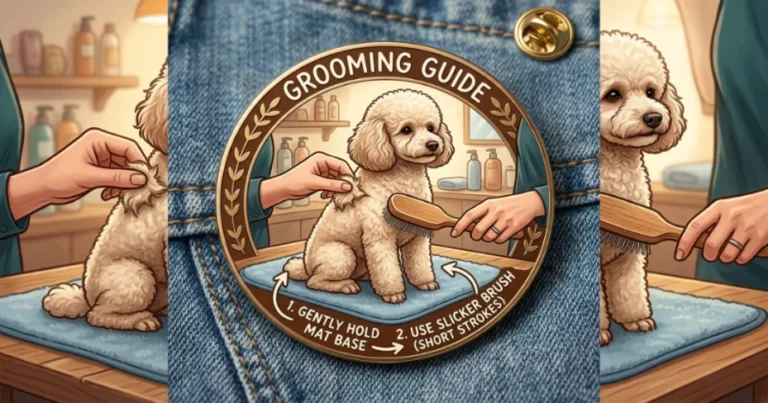
Always detangle before the bath, not after. Wet curls tighten mats significantly. Use a slicker brush followed by a metal comb to work through the full coat, especially behind the ears, under the armpits, and around the collar area — all high-friction zones where poodles mat first.
Dilute Your Shampoo
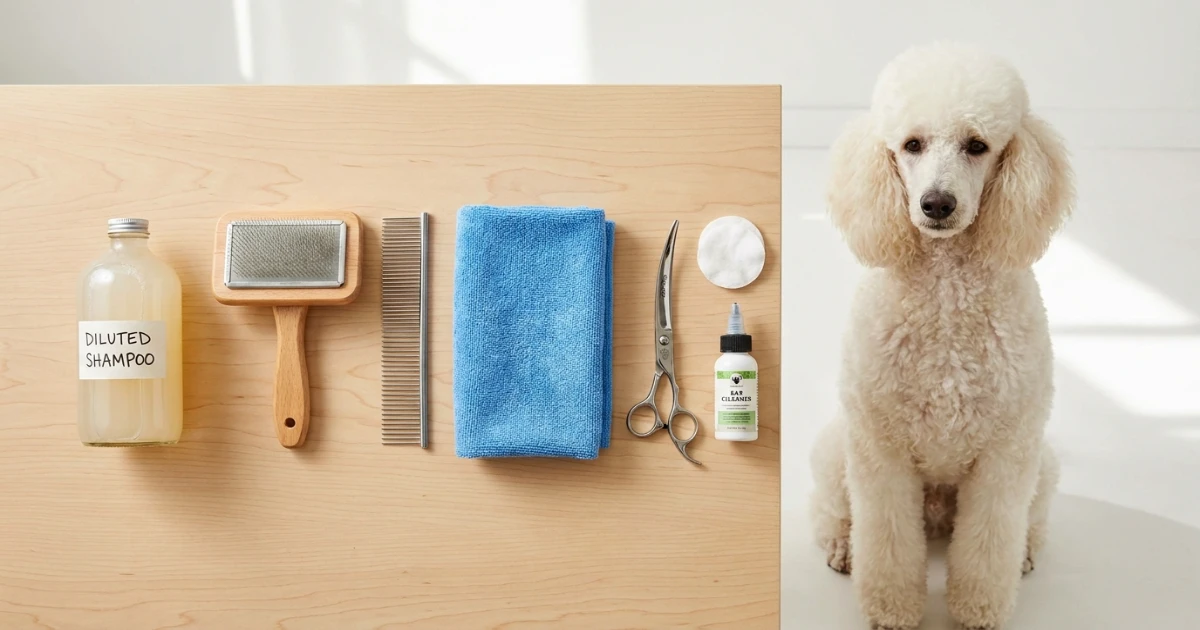
Most professional-grade poodle shampoos are designed to be diluted. A 4:1 (water to shampoo) ratio works for most formulas. Diluting ensures even coverage without over-saturating any one area and makes thorough rinsing far easier. Apply with a squirt bottle or dilution cup, not directly from the bottle.
Work Section by Section
Don’t just pour and scrub. Work the shampoo in straight, downward motions following the direction of hair growth — circular scrubbing aggravates the curl pattern and can create friction mats. Pay extra attention to the neck, chest, groin, and between the paws where dirt accumulates most.
Rinse Longer Than You Think Necessary
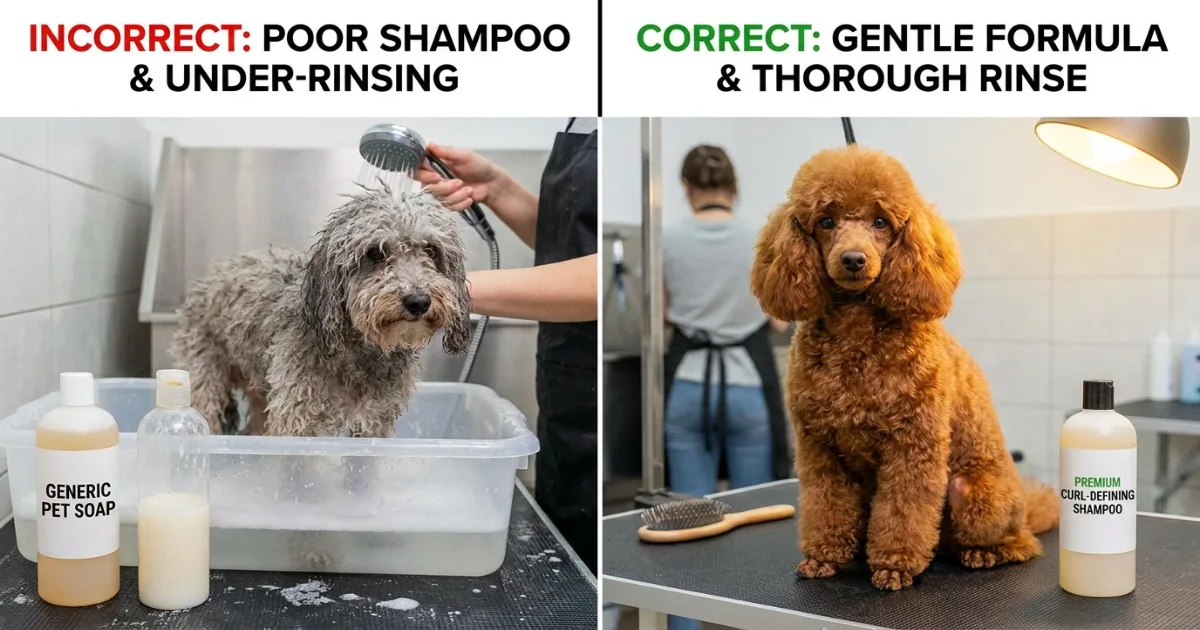
The single biggest technical error in poodle bathing is under-rinsing. Poodle curls trap shampoo residue easily, and leftover product causes the very dryness and flakiness owners often blame on the shampoo itself. Rinse for twice as long as the lather tells you to, especially around the neck and topline.
Condition When Needed
Not every bath needs a conditioner, but poodles with longer coat styles benefit from a lightweight leave-in or rinse-out conditioner after shampooing. Focus it on the mid-lengths and ends; avoid the skin surface on dogs prone to sebaceous buildup.
High-Velocity Dry, Then Fluff
Towel drying compresses curl patterns and creates mats. A high-velocity dryer straightens the coat as it dries, making brushing easier and reducing frizz. Brush simultaneously with a slicker brush while drying, working section by section. Finish with a metal comb to confirm there are no hidden mats before the coat sets fully.

What Most Poodle Owners Get Wrong About Shampoo
These are the patterns we see repeated constantly — across online forums, groomer consultations, and owner Q&As. None of them are obvious mistakes, which is why they persist.
Mistake 1: Bathing Too Frequently
Poodles don’t need weekly baths unless they’re actively dirty or have a skin condition that requires it. Over-bathing — even with a gentle shampoo — strips the sebum layer faster than it regenerates. Every 3 to 4 weeks is the standard recommendation for most poodles on a regular grooming schedule. If your poodle smells between baths, the issue is usually ear yeast, anal glands, or coat-trapped bacteria — none of which are solved by bathing more often.
Mistake 2: Using the Same Shampoo Year-Round
Poodle skin changes with the seasons. Many dogs experience dry, flaky skin during winter heating season and oilier, more reactive skin during humid summer months. Some owners find that rotating between a hydrating formula in winter and a clarifying formula in summer produces noticeably healthier coats over time. If your poodle’s skin seems perfect in spring but itchy in January, seasonal shampoo rotation is worth trying before assuming a dermatology issue.
Mistake 3: Assuming “Natural” or “Organic” Means Gentle
This is probably the most common misconception. Essential oils like eucalyptus, peppermint, and citrus — all natural, all popular — are actually among the most common sensitizers for dogs. “Natural” on a label doesn’t mean “safe for poodles.” Read the actual ingredient list. Gentle, well-formulated synthetic surfactants can be kinder to poodle skin than an aggressively “botanical” formula.
Mistake 4: Skipping Conditioner on Coats Over 2 Inches
Once a poodle’s coat grows past roughly 2 inches — the length typical in puppy clips and pet trims — the mid-lengths and ends start losing moisture faster than the skin can replace it. A rinse-out or leave-in conditioner becomes less optional and more necessary for maintaining a supple, mat-resistant coat. Many owners who complain about excessive matting are actually dealing with a moisture deficit, not a structural coat problem.
Mistake 5: Confusing Medicated Shampoo with a Long-Term Solution
Medicated shampoos address symptoms — bacterial overgrowth, yeast, seborrhea — but they don’t address the root cause. If your poodle needs a medicated shampoo more than occasionally, that’s a conversation for your veterinarian, not a reason to keep rotating medicated formulas indefinitely. Chronic skin issues in poodles often point to food sensitivities, environmental allergies, or thyroid function — all conditions that shampoo alone won’t resolve.
2026 Poodle Shampoo Price Guide
Poodle shampoo spans a surprisingly wide price range, and cost doesn’t always correspond to quality. Here’s what you’re actually paying for at each tier.
💰 What Your Budget Gets You in 2026
One note worth making: premium professional concentrates are often cheaper per wash than budget bottles, once you factor in dilution. A $26 bottle diluted at 8:1 will yield approximately the same number of baths as three $9 bottles. If you’re bathing a Standard Poodle monthly, the math favors the concentrate.
🐩 Pro Tips from Experienced Poodle Groomers
- Test on a small patch first — especially with any new formula. Apply behind one ear and check the skin 24 hours later before doing a full bath with an unfamiliar product.
- Don’t judge on first use — some shampoos require 2–3 baths before the coat adjusts, particularly if the previous product left buildup. A clarifying bath before switching formulas helps.
- Match shampoo to clip length — a tight puppy clip needs less conditioner and more cleansing power. A Continental or longer coat needs more moisture retention and less surfactant aggression.
- For poodles on a grooming schedule of every 6–8 weeks, the shampoo you use at home matters almost as much as what your groomer uses — coat condition between appointments is largely driven by the at-home bath.
- Ear drying matters too — poodles have narrow, hair-filled ear canals that trap moisture easily. Always follow a bath with gentle ear drying using a cotton ball and an appropriate ear-drying product to reduce yeast risk.
Frequently Asked Questions
What is the best shampoo for poodles with sensitive skin?
Burt’s Bees Hypoallergenic Dog Shampoo is the top pick for poodles with sensitive skin. It’s fragrance-free, dye-free, sulfate-free, and pH-balanced for canine skin (6.5–7.5). For poodles with diagnosed skin conditions, consult your vet before choosing — some sensitivities require medicated or prescription formulations rather than over-the-counter gentle shampoos.
How often should you bathe a poodle?
Every 3 to 4 weeks is the standard recommendation for most poodles on a regular grooming cycle. Bathing more frequently than every 2 weeks risks stripping the coat’s natural oils, even with gentle shampoo. Poodles that swim regularly or spend significant time outdoors may need more frequent baths, but should still use a moisturizing shampoo formula to compensate.
Can you use human shampoo on a poodle?
No. Human shampoo is formulated for scalp pH around 4.5–5.5, which is significantly more acidic than dog skin pH (6.5–7.5). Regular use of human shampoo on a poodle damages the skin barrier over time, causing dryness, flaking, and increased susceptibility to bacterial and yeast infections. Even “gentle” or “baby” human shampoo carries this risk.
What shampoo do professional groomers use on poodles?
Most professional groomers rotate between a clarifying shampoo and a moisturizing or coat-enhancing formula. Brands commonly used in professional settings include Chris Christensen, Isle of Dogs, Bio-Groom, and EarthBath. Many groomers also use shampoo concentrates diluted to 8:1 or 10:1 for cost efficiency and even coat coverage. The specific formula varies based on the dog’s coat color, condition, and clip style.
Is conditioner necessary for poodles after shampooing?
For poodles in short clips (under 2 inches), conditioner is optional. For poodles with longer coats, a lightweight rinse-out or leave-in conditioner becomes increasingly important for preventing moisture loss and matting in the mid-lengths. Heavy conditioners should be avoided on fine-textured Toy Poodle coats, where they can flatten curl definition significantly.
Why does my poodle smell bad after a bath?
Post-bath odor in poodles is almost always caused by one of three things: incomplete rinsing (shampoo residue ferments in the coat), inadequate drying (moisture trapped in dense curls or ear canals leads to bacterial and yeast growth), or an underlying issue like ear infection or anal gland impaction. If the smell returns within a day or two of bathing, drying technique and ear health are worth investigating before changing shampoos.
What’s the best shampoo for a white poodle?
Chris Christensen White on White is the standout choice for white, cream, and apricot poodles. It uses optical brighteners to lift yellowish staining — particularly around the muzzle and paws — without bleach. For maintenance between baths, a targeted whitening spray or dry shampoo applied to stained areas can extend the time between full baths while keeping the coat looking bright.
Final Summary: Choosing the Best Shampoo for Your Poodle
Poodles are not generic dogs, and their grooming needs reflect that. A coat that’s designed to grow continuously, trap rather than shed, and carry the fullest expression of careful breeding deserves a shampoo that was actually built for it.
- Choose sulfate-free, pH-balanced formulas designed specifically for canine skin (6.5–7.5 range)
- For most poodles, Burt’s Bees Hypoallergenic is the safest, most reliable everyday pick
- White and light-colored coats benefit significantly from Chris Christensen White on White
- Longer or show coats respond best to protein-enriched professional formulas like Isle of Dogs No. 50
- Bathing every 3–4 weeks is the right frequency for most pet poodles; more often strips protective oils
- Technique matters as much as product: dilute, rinse thoroughly, and dry properly
- Persistent skin issues aren’t a shampoo problem — they’re worth a veterinary conversation
Great coat health isn’t expensive. It’s consistent, informed, and specific to your dog. See our full poodle grooming guide to build a complete routine around these shampoo picks.