Poodle Microchipping: 7 Safety & Cost Tips Every Owner Should Know
A practical, owner-friendly guide to how microchips work, what the procedure feels like, how much it costs, and the registration mistakes that stop lost Poodles from getting home.
Quick Answer: Poodle microchipping is a fast, one-time identification procedure where a tiny RFID transponder is placed under the loose skin between your dog’s shoulder blades. The chip does not use GPS, does not need a battery, and does not show private contact details by itself. When a vet, shelter, or animal control team scans it, the scanner displays a unique chip number. That number must be connected to your current phone number and address in a pet recovery registry. For Toy, Miniature, and Standard Poodles, the chip is only truly useful when it is registered, updated, and checked during yearly vet visits.
If your Poodle slipped through a gate, bolted during fireworks, or was found without a collar, what would connect them back to you? A tag helps, but collars can break, fade, or be removed. A microchip stays with your dog. For a breed as clever and valuable as the Poodle, that permanent form of identification is not a luxury. It is a simple safety layer every owner should understand.
The important part is this: the chip is not magic. It only works when the number is linked to a current registry record. Many lost dogs are scanned, but the owner cannot be reached because the phone number is old, the chip was never registered, or the chip is still under a breeder’s name. This corrected guide focuses on the full system: chip, scanner, registry, yearly checks, and smart owner habits.
What Is Poodle Microchipping?
Poodle microchipping is the process of placing a tiny electronic transponder under your dog’s skin. Most pet microchips are about the size of a grain of rice. They carry a unique identification number, not a GPS signal and not your full personal profile.
When a compatible scanner passes over the chip area, the scanner activates the chip and displays that number. The person scanning then uses a registry lookup tool or the chip company’s database to find which registry may hold the owner record. That registry is what connects the number to your contact details.
For Poodle owners, this distinction matters. A microchip does not stop a dog from getting lost. It does not let you watch your dog on a map. It creates a permanent ID trail so a shelter, clinic, rescue, or animal control team can start the reunion process.
Why Poodle Microchipping Matters More Than Owners Realize
Poodles are bright, athletic, and often more curious than owners expect. Toy and Miniature Poodles can squeeze through small openings. Standard Poodles can jump, push, or open weak latches. Even a clingy Poodle may run when panic takes over during thunder, fireworks, traffic noise, or a household emergency.
The strongest argument for microchipping is reunion data. A national shelter study published in the Journal of the American Veterinary Medical Association found that microchipped dogs were returned to owners at a much higher rate than dogs without microchips. The same study also showed that incorrect or missing registration information was a major reason microchipped animals still failed to get home.
Owner truth
The chip is not the safety net by itself. The complete safety net is: a readable chip, a correct registry record, a backup emergency contact, and a yearly scan at your vet.
Microchip vs GPS Collar: Which One Does Your Poodle Need?
A GPS collar and a microchip solve different problems. A GPS collar helps you look for your Poodle while the collar is still on. A microchip helps prove identity and contact the owner if the collar is gone.
| Feature | Microchip | GPS Collar |
|---|---|---|
| Main purpose | Permanent identification | Live location tracking |
| Power source | No battery | Rechargeable battery |
| Can fall off? | No, it is under the skin | Yes, the collar can break or be removed |
| Shows location? | No | Yes, while charged and connected |
| Subscription | Usually no required monthly fee after registration | Often requires a monthly plan |
| Travel use | Often required for international pet travel | Not a substitute for travel identification |
The best setup is layered identification: a collar tag for quick neighborhood contact, a GPS collar for active searching, and a registered microchip for permanent proof of identity.
What Happens During a Poodle Microchipping Appointment?
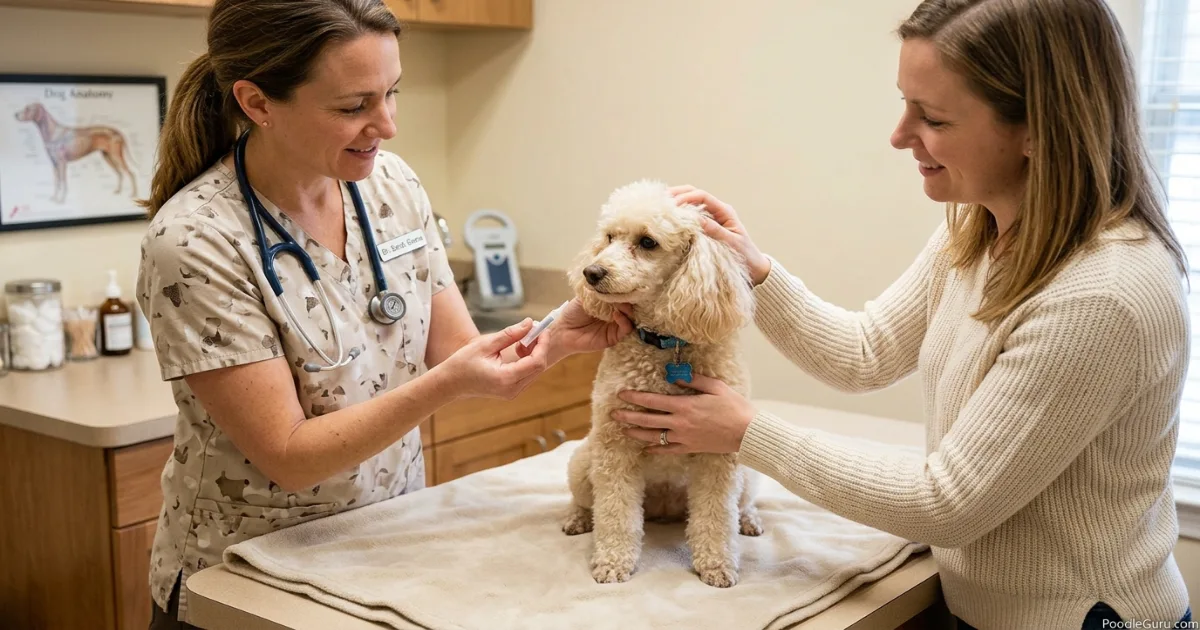
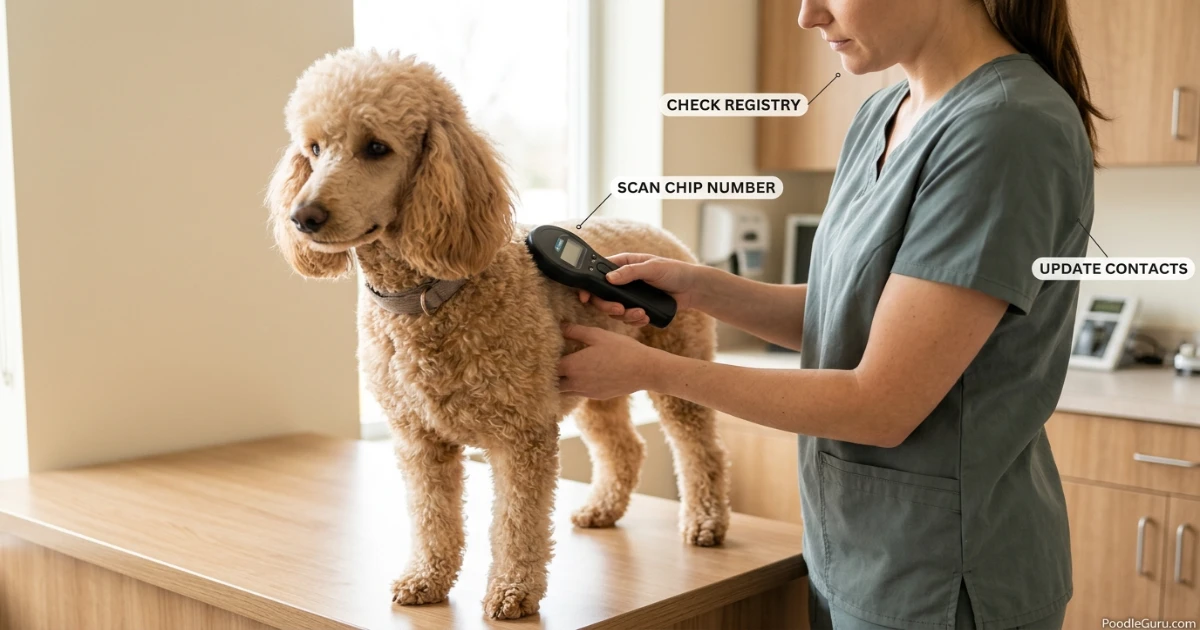
The procedure is usually simple. Your vet or trained professional scans first to make sure your Poodle does not already have a chip. Then the chip is placed with a sterile applicator under the loose skin between the shoulder blades. Most dogs react like they would to a quick injection: a brief flinch, then it is over.
Many owners choose to microchip during a spay, neuter, or dental procedure because the dog is already at the clinic, but anesthesia is not usually required just for microchipping. Tiny Toy Poodle puppies should still be assessed by a vet because body size, skin thickness, and comfort level matter.
For Toy Poodle puppies
Ask the vet whether your puppy is ready based on age, weight, and health. After the chip is placed, avoid rough play around the shoulder area for the rest of the day unless your vet says otherwise.
Poodle Microchipping Cost in 2026
In the United States, many owners pay around $25–$60 at a vet clinic. Low-cost shelter events may be cheaper, and some rescues include the chip in the adoption fee. Registration may be included, free, or offered as a paid upgrade depending on the registry.
Do not confuse registration with paid extras
You may see optional annual plans for lost-pet alerts, travel assistance, or premium services. Those extras are different from basic registry enrollment. Before paying a yearly fee, confirm whether your Poodle’s chip can remain searchable with a lifetime basic record.
The Registration Step That Makes or Breaks Everything
This is the part owners miss most often. A chip without current contact details is like a locked phone with no charger: it exists, but it may not help when you need it. Register your Poodle’s chip the same day it is implanted or transferred to you.
- Get the chip number. Ask your vet, breeder, shelter, or rescue for the exact microchip number and chip brand. Keep a photo of the paperwork.
- Find the right registry. Use the chip company’s instructions or the AAHA Universal Pet Microchip Lookup Tool to see which registries are linked to the chip.
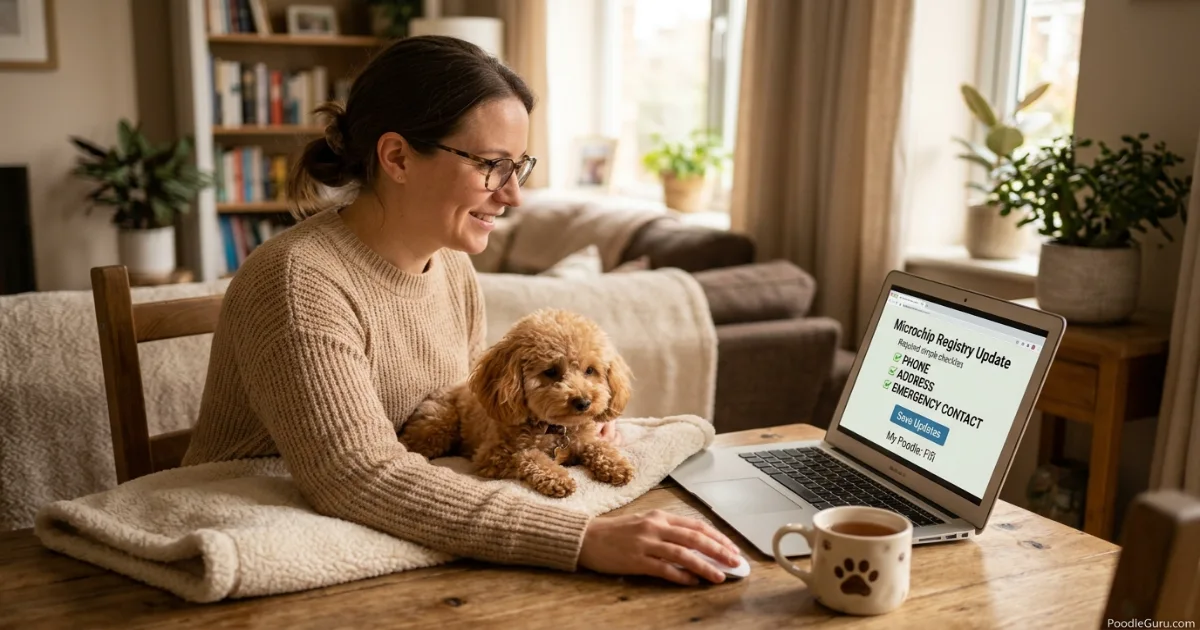
- Add complete contact details. Use your current phone number, email, address, emergency alternate contact, and vet clinic details if the registry allows it.
- Save confirmation. Keep the confirmation email, print a copy for your dog’s health folder, and store the chip number in your phone.
- Check it yearly. At every annual exam, ask your vet to scan the chip and confirm the number still matches your record.
Common Microchip Myths That Put Poodles at Risk
Myth 1: “My Poodle is indoors, so we do not need a chip.”
Indoor dogs still escape during emergencies, visitor mistakes, renovations, storms, delivery drop-offs, and open gates. Microchipping is not only for dogs that roam. It is for the day something unexpected happens.
Myth 2: “The chip tracks my dog’s location.”
No. A standard pet microchip cannot track your Poodle. It does not transmit live location, connect to satellites, or show movement history. It only provides an ID number when scanned close to the body.
Myth 3: “The scanner shows my address to anyone.”
The scanner displays the chip number. The owner details are held by a registry, and access depends on that registry’s process. This is why correct registration matters more than the chip alone.
Myth 4: “A collar tag is enough.”
A visible ID tag is excellent, but it is removable. A microchip is permanent. Use both. The tag helps a neighbor call quickly; the chip helps shelters and vets confirm ownership when the tag is missing.
Myth 5: “Microchips commonly cause serious health issues.”
Serious reactions are considered rare. The American Veterinary Medical Association notes that only a very small number of tumor cases have been associated with nearby microchips and that a causal effect has not been proven. As with any procedure, ask your vet if your Poodle has a bleeding disorder, skin infection, or unusual lump near the implant site.
Travel, Legal Requirements, and Poodle Microchipping
If you may travel internationally with your Poodle, ask your vet about an ISO-compliant 15-digit chip. Many destination countries require ISO 11784/11785 microchip identification, and some rules require the chip to be implanted before or on the same day as the rabies vaccination used for travel paperwork.
Rules vary by country and can change, so never rely on a blog post alone for a travel decision. Check the destination country’s official rules and your government’s pet travel guidance before booking flights.
UK law note
In the UK, dogs must be microchipped and registered by the time they are 8 weeks old. The keeper’s details must stay up to date on an approved database. Local rules outside the UK vary, so check your own region’s requirements.
Rescue Poodles and Breeder Puppies: Transfer the Chip Correctly
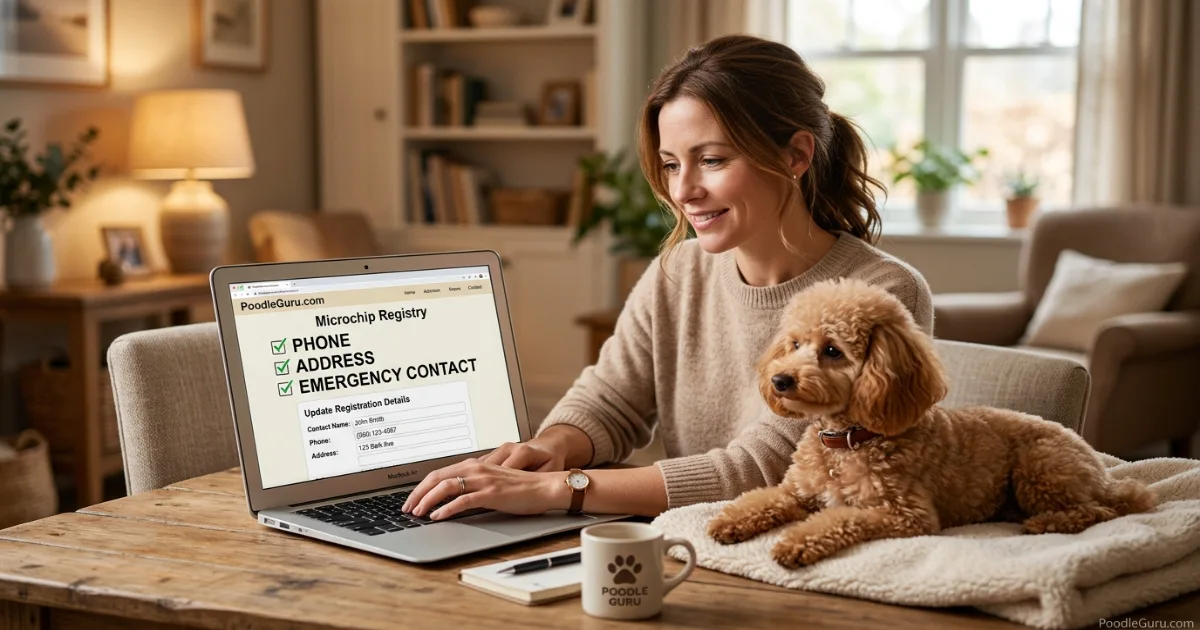
If you adopt a rescue Poodle, ask for the microchip number before you leave with the dog. Request transfer instructions, the registry name, and confirmation that the rescue has updated or released the record. If the dog’s previous owner is still listed, the registry may ask for adoption paperwork before changing the record.
If you buy a Poodle puppy from a breeder, ask whether the puppy is already chipped. Many responsible breeders microchip before placement. That is a good sign, but the chip must be transferred into your name. A chip that still points to the breeder may slow down a reunion if your dog is found far from home.
New owner checklist
- Scan the chip during your first vet visit.
- Confirm the chip number matches your paperwork.
- Transfer the registry into your name.
- Add a second contact who will answer the phone quickly.
- Keep your Poodle’s collar tag updated too.
The 2-Minute Yearly Microchip Check
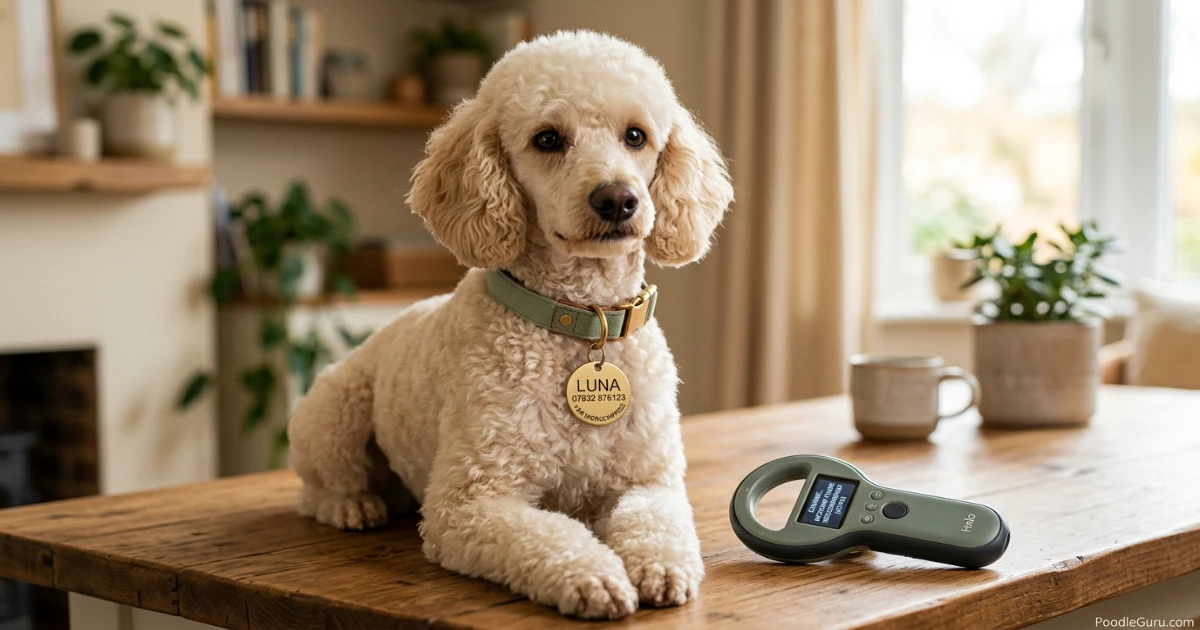
At your Poodle’s annual exam, ask your vet to scan the chip. This confirms three things: the chip still reads, the number matches your paperwork, and the chip has not migrated to an unexpected area. Migration is uncommon, but it can happen. A scan check keeps everyone confident.
After the vet visit, log in to the registry and verify your phone number, email, address, and emergency contact. This habit takes less time than ordering dog food online, and it may be the reason your Poodle gets home fast after an emergency.
Poodle Microchipping FAQs
Can I track my Poodle with a microchip?
Does a dog microchip need a battery?
Is microchipping safe for Toy Poodles?
What if my Poodle’s microchip moves?
What is the biggest microchipping mistake?
Is microchipping mandatory?
Can a Poodle have two microchips?
Should I still use a collar tag?
Final Takeaway
Poodle microchipping is one of the simplest safety decisions you can make. It is quick, usually affordable, and designed to last for your dog’s life. But the chip only does its job when the registration record is correct.
If your Poodle is not chipped, ask your vet about it at the next visit. If your Poodle already has a chip, check the registry today. A five-minute update now can save hours, days, or even years of heartbreak later.
Editorial Sources Checked
This guide was fact-checked against veterinary and official pet travel resources, including the JAVMA microchip shelter study, AAHA Microchip Registry Lookup Tool, AVMA microchipping FAQ, GOV.UK dog microchipping guidance, and USDA APHIS pet travel guidance.