TSA Pet Carrier Rules for Poodle Owners: Screening, Sizing & Airline Limits
TSA controls what happens at the airport security checkpoint, but your airline decides carrier dimensions, pet fees, cabin eligibility, route restrictions, and whether a larger Poodle can travel outside the cabin. This guide separates those rulebooks so you can prepare without relying on misleading “TSA-approved” marketing.
Quick Answer
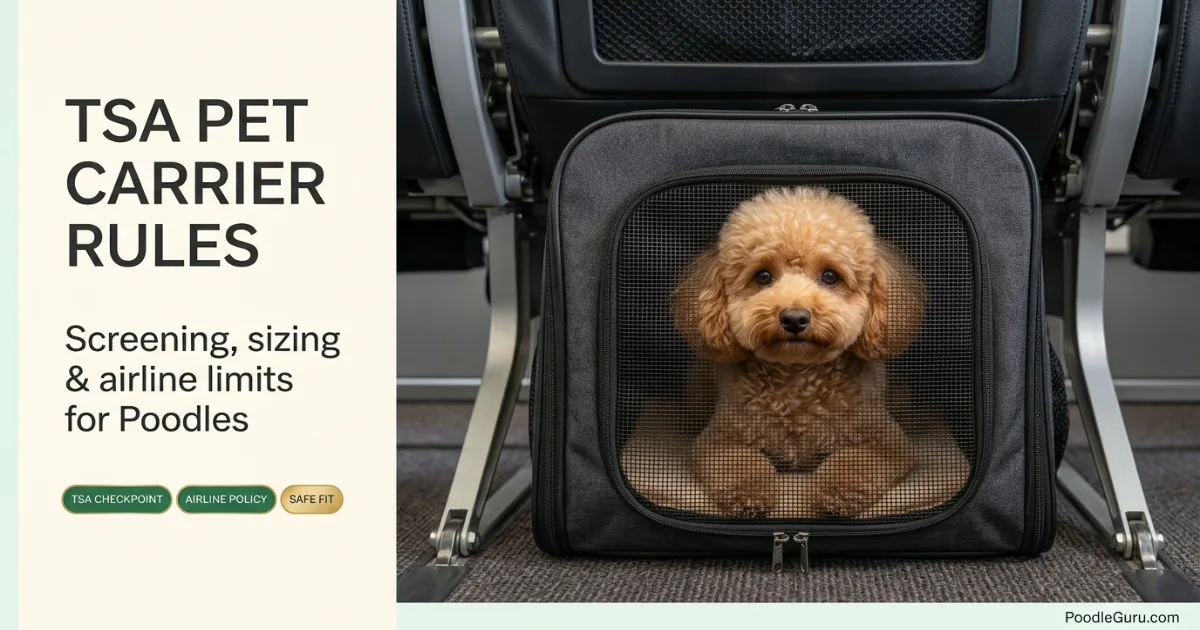
TSA pet carrier rules do not establish one nationwide carrier size. TSA manages security screening: you generally remove your Poodle from the carrier before screening, keep the dog under control, and send the empty carrier through the X-ray machine. Your airline—not TSA—sets the carrier’s dimensions, construction standards, route restrictions, fee, reservation process, and cabin-pet limit. A Toy Poodle and some small Miniature Poodles may qualify for cabin travel only when they can remain comfortably inside a closed carrier that fits fully under the assigned seat. Larger Miniatures and Standard Poodles usually cannot meet ordinary cabin-pet requirements; cargo, specialist animal transport, or ground travel may be alternatives only when the chosen company actually offers them.
In This Guide
- The Three Rulebooks You Must Check
- What TSA Actually Requires
- TSA Screening Step by Step
- Carrier Confidence Check
- Poodle Size and Cabin Eligibility
- Soft-Sided vs Hard-Sided Carriers
- Current Airline Examples
- Common Mistakes Owners Make
- Health and Travel-Day Safety
- Fees and Cost Planning
- Final Preflight Checklist
- Frequently Asked Questions
- Key Takeaways
The Three Rulebooks Every Poodle Owner Must Check
Many gate problems begin because owners use “TSA rules” as a catch-all phrase. Air travel with a dog is controlled by several organizations, and each answers a different question. Checking only one source leaves important gaps.
TSA Security
Explains how your Poodle and empty carrier pass through the U.S. airport security checkpoint. TSA does not publish one carrier dimension for every airline.
Operating Airline
Controls cabin eligibility, carrier dimensions, ventilation, fees, pet reservations, allowed seats, route limits, and cargo availability.
Destination Authorities
Control import forms, rabies rules, microchips, health certificates, quarantine, and other entry conditions for international or special-destination travel.
Always check the airline physically operating every segment. A ticket sold by one airline may include a flight operated by a partner with different pet rules. Connections can trigger multiple fees, documentation checks, aircraft sizes, and destination restrictions.
What TSA Pet Carrier Rules Actually Cover
TSA’s official guidance focuses on checkpoint security. Small pets may pass through the checkpoint, but travelers must first confirm that the airline accepts the animal. TSA advises bringing the pet to the checkpoint in a hand-held carrier, removing the animal before the carrier is screened, and maintaining control of the pet throughout the process.
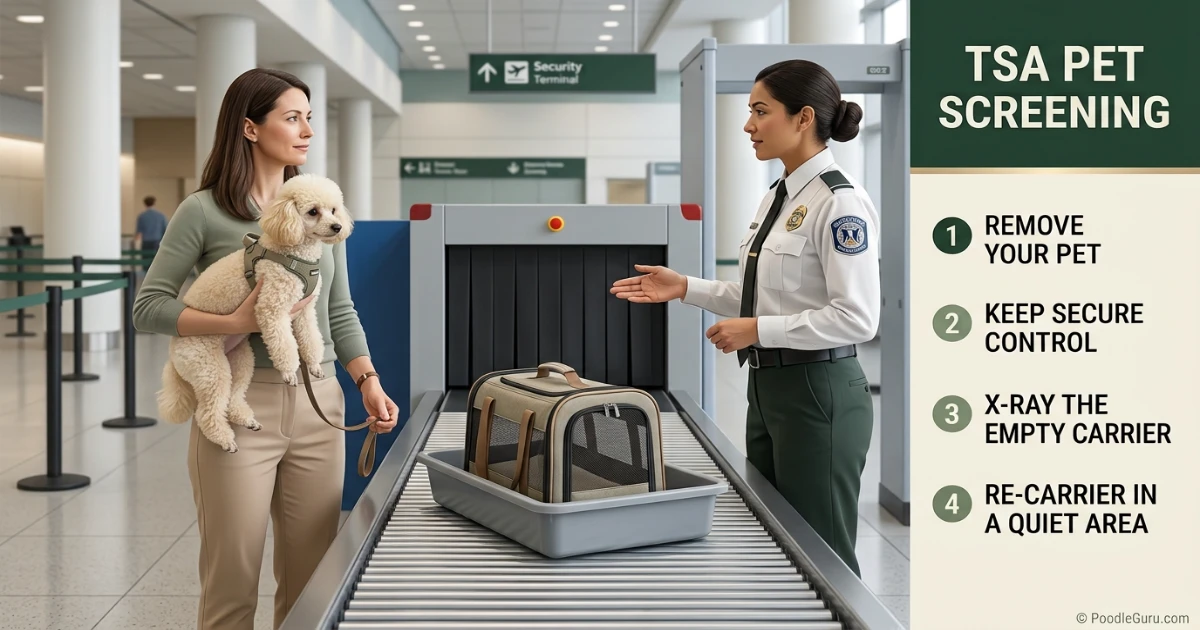
The empty carrier is placed on the conveyor for X-ray screening. Your Poodle must never enter the X-ray tunnel. You then carry the dog through the walk-through metal detector or follow the instructions given by the screening officer. The carrier may also receive a visual or physical inspection.
TSA does not promise that a particular soft carrier will fit an aircraft. It does not set your airline fee, determine whether your Poodle may remain in the cabin, or guarantee that a dog accepted on one route will be accepted on another. Those are airline and destination decisions.
What TSA Does Not Certify
TSA does not issue a universal “approved carrier” badge. Terms such as TSA approved, airline approved, or fits most airlines are not substitutes for reading the operating carrier’s current policy and confirming the actual aircraft and seat.
TSA Screening With a Poodle: Step by Step
Practice this sequence at home before travel day. The checkpoint is noisy and unfamiliar, and a rehearsed routine lowers the chance of an escape.
Approach With the Carrier Closed
Keep your Poodle secured inside the carrier while entering the checkpoint line. Use a properly fitted harness and short leash so control is ready when the carrier opens.
Tell the Officer You Have a Pet
Before opening the carrier, tell the Transportation Security Officer that you are traveling with a dog. Ask for private screening immediately if your Poodle may bolt, panic, or slip a harness.
Remove and Secure Your Poodle
Take the dog out only when instructed and maintain physical control. Carry the dog or walk through the detector as directed. Never place the dog on the baggage belt or inside the X-ray system.
Send the Empty Carrier Through X-Ray
Remove loose items that could fall out, then place the empty carrier on the belt. TSA may perform an additional visual or physical inspection if needed.
Re-Carrier in a Quiet Area
After screening, move away from the conveyor and crowd before returning your Poodle to the carrier. Check every zipper and tether point before continuing to the gate.
Quick Facts
No Universal TSA Size
TSA does not publish one carrier dimension. Airlines set under-seat limits, and the aircraft or seat may change the usable space.
Pet Comes Out at Security
The empty carrier is screened separately. Request private screening before opening it if your Poodle is an escape risk.
Cabin Fit Is Individual
Toy Poodles often qualify. Miniatures are case-by-case. Standard Poodles generally cannot meet ordinary under-seat pet-carrier rules.
The PoodleGuru Carrier Confidence Check
Use this four-part test before purchasing a carrier or booking a nonrefundable trip.
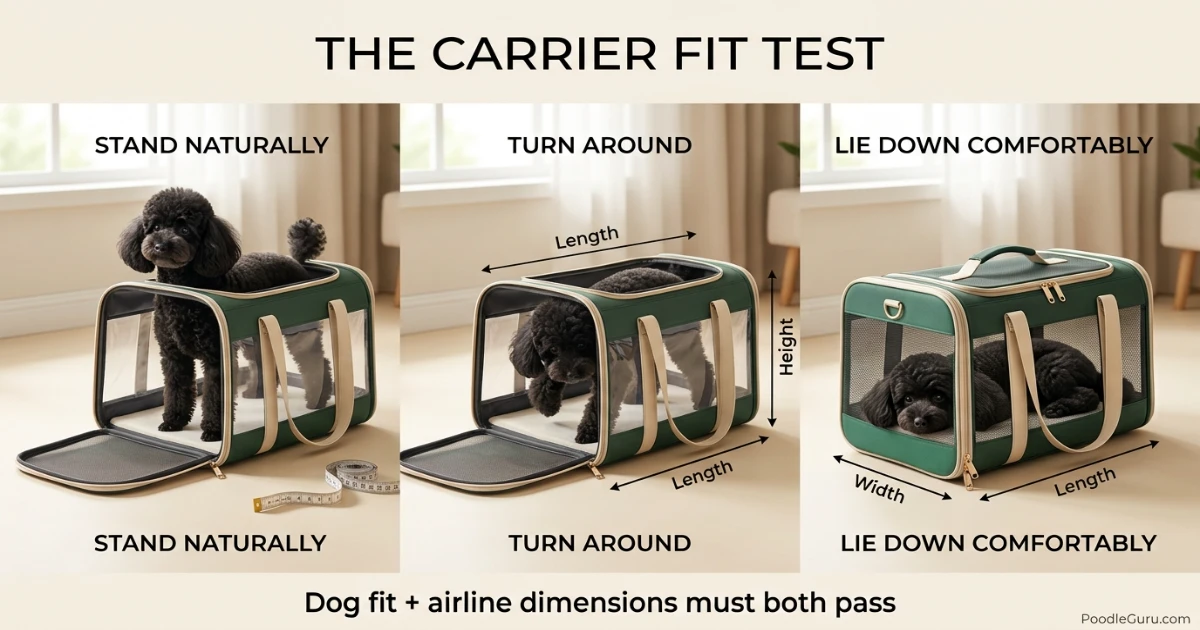
Measure the Individual Dog
Measure standing body length from nose to base of tail and natural standing height. Weight alone does not reveal whether a long-legged Miniature Poodle will fit.
Test Natural Movement
Inside the closed carrier, your Poodle should be able to stand naturally, turn without becoming wedged, and lie down with the head, paws, and tail contained.
Verify the Operating Airline
Check the live pet page for every operating carrier and aircraft. Confirm dimensions, seat restrictions, reservation availability, route rules, and fees.
Practice Before Travel
Build calm carrier duration, lifting, walking, waiting, and a rehearsal of the security-removal routine over two to four weeks.
Poodle Size and In-Cabin Eligibility
Poodle variety names are not airline categories. Airlines evaluate the individual animal, closed carrier, combined weight where applicable, route, aircraft, and seat. The dog’s proportions often matter more than a breed-average weight.
| Poodle Variety | Cabin-Pet Outlook | Main Limiting Factor | Responsible Planning |
|---|---|---|---|
| Toy Poodle | Often possible | Individual body length, carrier fit, route, and seat restrictions | Measure, test the closed carrier, and reserve pet space before buying nonrefundable travel. |
| Small Miniature Poodle | Sometimes possible | Height and leg length often matter more than body weight | Do not assume “small dog” is enough; test standing, turning, and lying-down room. |
| Larger Miniature Poodle | Often difficult or not possible | Under-seat height and usable internal space | Confirm alternatives before booking; never force the dog into an undersized carrier. |
| Standard Poodle | Ordinary cabin-pet travel is generally not realistic | The dog cannot fit in a closed carrier beneath a passenger seat | Research ground transport or a legitimate animal-transport service; airline cargo availability is not universal. |
Trained service dogs travel under a different U.S. Department of Transportation framework and are not ordinary cabin pets. Buying an extra passenger seat does not normally convert a large pet into a cabin-eligible animal.
For precise height context, use the Poodle size chart, then make the travel decision from your own dog’s measurements and the current airline policy.
Soft-Sided vs Hard-Sided Pet Carriers
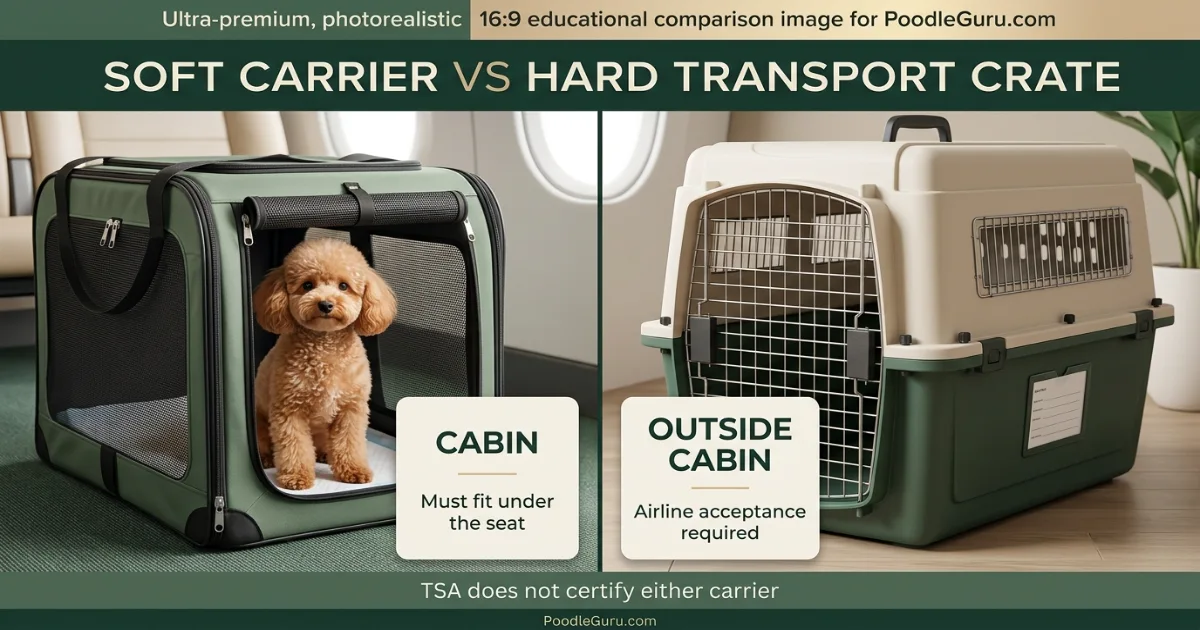
Neither style is universally “TSA approved.” Choose according to the operating airline, route, aircraft, and transport method.
| Feature | Soft-Sided Cabin Carrier | Hard-Sided Cabin Carrier | Hard Transport Crate |
|---|---|---|---|
| Typical use | Small pet in the passenger cabin | Small pet when exact under-seat space permits | Air cargo or specialist transport when accepted |
| Fit behavior | Can flex slightly, but should not crush inward | Rigid exterior must fit exact dimensions | Must meet airline and applicable live-animal container rules |
| Ventilation | Usually broad mesh panels | Fixed vents and door openings | Design and openings must remain compliant during handling |
| Main caution | Weak mesh, failed zippers, or collapsed roof | Less forgiveness when under-seat space is tight | “IATA compliant” is not a permanent universal approval; the airline must accept the crate and animal |
Expandable panels may provide extra room in an approved waiting area, but they do not increase the dimensions allowed beneath the seat. Confirm when the airline permits expansion.
Airline Policies Matter More Than a Generic Carrier Label
The examples below were checked on official airline pages on 2026. They demonstrate why one universal dimension is unsafe. Recheck the live policy before every trip because aircraft, routes, fees, and restrictions can change.
| Airline | Published Cabin-Carrier Example | Current Planning Note |
|---|---|---|
| American Airlines | Soft-sided recommendation: 18 × 11 × 11 in. Hard-sided limits differ between mainline and American Eagle aircraft. | Carry-on pet fee is listed as $150 per kennel for eligible routes. The dog must fit comfortably in the closed carrier beneath the seat. |
| Delta Air Lines | Delta recommends a soft carrier up to 18 × 11 × 11 in for many aircraft, while stating actual maximums depend on the aircraft. | Domestic U.S./Canada/Puerto Rico/U.S. Virgin Islands fee is listed as $150 each way for tickets issued on or after April 8, 2025. |
| United Airlines | Published maximums include 18 × 11 × 11 in for soft-sided carriers and 17.5 × 12 × 9 in for hard-sided carriers. | Confirm route, aircraft, fee, reservation availability, and seat restrictions directly before booking. |
These are examples, not a universal standard or product recommendation. Dimensions are shown length × width × height.
Larger Poodles Need a Separate Plan
Some airlines accept animals through cargo services, some restrict checked pets to military or government travelers, and others do not carry ordinary pets outside the cabin. Do not write “all Standard Poodles must fly cargo” as if cargo is universally available. Confirm the exact airline, route, season, crate, and health requirements—or choose ground transport.
Common Mistakes Owners Make
| Mistake | Why It Fails | Better Approach |
|---|---|---|
| Calling airline dimensions “TSA rules” | TSA controls screening, while the operating airline controls cabin-carrier limits | Check TSA for the checkpoint and the airline for the carrier, fee, seat, and route. |
| Buying by weight rating alone | Height, body length, and leg length determine real fit | Test stand, turn, and lie-down room inside the actual closed carrier. |
| Trusting “airline approved” marketing | The phrase is not a universal regulatory certification | Compare exact exterior dimensions with the live airline policy and aircraft. |
| Opening the carrier in a crowded checkpoint without a plan | A frightened Poodle can slip a collar or bolt | Use a tested harness and request private screening before opening the carrier. |
| Assuming a large dog can always travel in cargo | Many airlines or routes do not offer ordinary pet cargo | Confirm transport availability before booking or use qualified ground transport. |
| Trying a sedative for the first time on travel day | Sedatives can create health risk and may violate airline policy | Discuss anxiety and any medication with a veterinarian well before the trip. |
Poodle Health and Travel-Day Safety
Schedule a veterinary discussion before flying if your Poodle has heart disease, respiratory concerns, seizures, severe anxiety, recent surgery, chronic illness, pregnancy, advanced age, or any condition affected by stress and temperature.
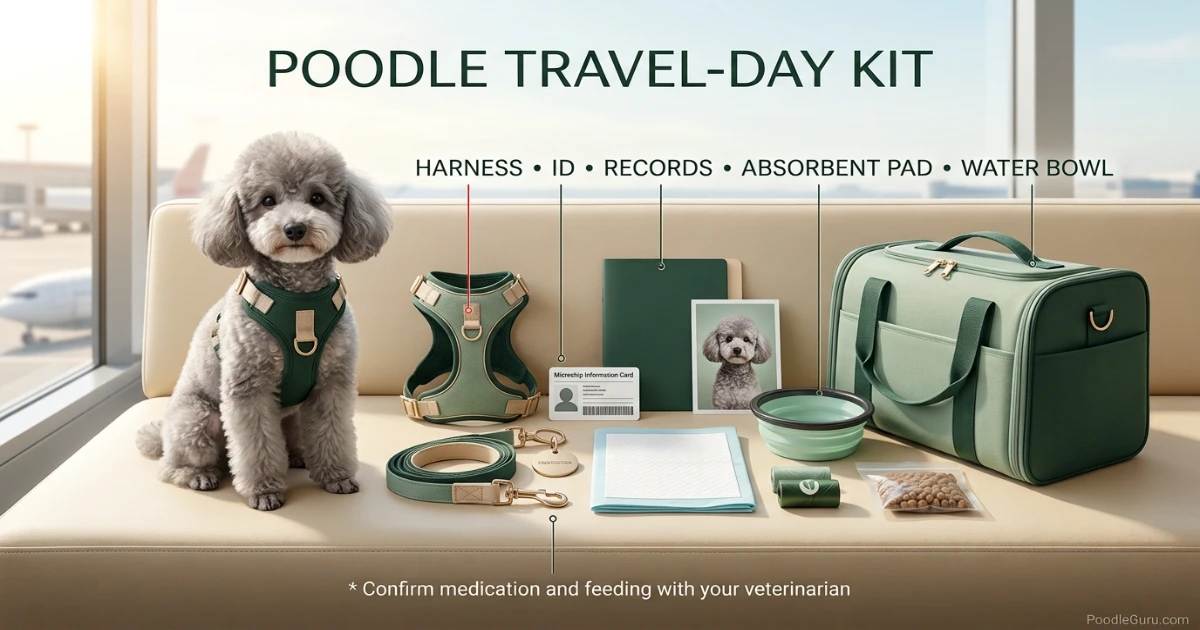
- Avoid unapproved sedation: AVMA travel guidance warns that tranquilizers and sedatives can increase heart or respiratory risk and may not be accepted by airlines. Use medication only through a veterinarian and confirm airline policy.
- Plan feeding individually: Ask your veterinarian and airline when to feed and offer water. Avoid a major diet change immediately before travel.
- Use a secure harness: The checkpoint requires removal from the carrier. Confirm that your Poodle cannot reverse out of the harness.
- Carry identification: Keep a recent photo, microchip details, rabies documentation, and destination contacts accessible.
- Use absorbent bedding: Choose a thin pad that stays flat and does not block ventilation or remove excessive headroom.
- Hydrate without soaking the carrier: Carry a collapsible bowl for approved relief breaks. Test any airline-permitted container before travel because leaks can soak bedding.
- Prefer simpler itineraries: A direct flight reduces transfers, waiting, and handling.
- Map relief areas: Locate pet-relief stations before arriving, especially when a connection is unavoidable.
Fees and Cost Planning
Budget Beyond the Carrier
Carrier price is only one part of the trip. Official airline fees and route rules can change, so avoid publishing a single “average fee” as if it applies everywhere.
- Current examples: American lists a $150 carry-on pet fee per kennel on eligible routes. Delta lists $150 each way for specified domestic-region tickets issued on or after April 8, 2025.
- Connections: Long stopovers, partner airlines, or separate tickets may create additional fees or prevent pet acceptance.
- Veterinary documents: Health certificates, vaccinations, microchips, laboratory tests, and import permits may add substantial cost.
- Larger-dog transport: Cargo or specialist ground transport is priced separately and may cost far more than a cabin-pet fee.
Recheck the live policy before payment and again shortly before departure.
The PoodleGuru Final Preflight Checklist
- I checked TSA’s current screening instructions.
- I read the operating airline’s live pet policy for every segment.
- My pet reservation is confirmed; I did not assume a passenger ticket reserves pet space.
- I verified carrier dimensions for the aircraft and seat, including connection aircraft.
- My Poodle can stand naturally, turn, and lie comfortably inside the closed carrier.
- The carrier fits fully beneath the seat without excessive collapse.
- I am not seated in a prohibited bulkhead, exit-row, flat-bed, or no-stowage seat.
- The harness is escape-resistant and tested at home.
- I know how to request private TSA screening before opening the carrier.
- The dog has practiced confinement, lifting, walking, and quiet waiting.
- Identification, microchip registration, and travel documents are current.
- I confirmed medication, feeding, and health questions with a veterinarian.
- I located pet-relief areas and built extra check-in time into the schedule.
- I rechecked airline and destination rules shortly before departure.
Frequently Asked Questions
What size pet carrier does TSA allow?
TSA does not publish one universal cabin-carrier dimension. The operating airline sets the maximum exterior size based on aircraft and under-seat space. TSA controls the security-screening procedure.
Is there an official TSA-approved pet carrier?
No universal TSA certification guarantees acceptance. Match the carrier to the operating airline, aircraft, route, and the individual dog’s comfortable fit.
Does my Poodle stay inside the carrier during TSA screening?
Generally, no. TSA instructs travelers to remove the pet before the empty carrier enters the X-ray machine. You carry or walk the controlled dog through screening as directed. Request private screening before opening the carrier when escape is a concern.
Can a Toy Poodle fly under an airplane seat?
Many Toy Poodles can qualify, but breed name and weight do not guarantee acceptance. The individual dog must fit comfortably in a closed carrier that meets the airline’s current limit, and pet space must be reserved.
Can a Miniature Poodle fly in the cabin?
Some small Miniature Poodles can; many taller Miniatures cannot. Measure body length and standing height, test the carrier, and confirm airline and aircraft limits.
Can a Standard Poodle fly in the passenger cabin as a pet?
An ordinary Standard Poodle pet generally cannot fit in the closed under-seat carrier required for cabin pets. Service-dog rules are separate. Ground or airline cargo options must be confirmed individually because not every carrier offers them.
Can I buy an extra seat for a large Poodle?
Buying a seat usually does not exempt an ordinary pet from the airline’s closed under-seat carrier requirement. Check the operating airline directly.
Should I sedate my Poodle for a flight?
Do not give a sedative or tranquilizer without veterinary direction and airline confirmation. Veterinary guidance notes possible heart and respiratory risks, and some airlines refuse sedated animals.
How early should I start carrier training?
Begin at least two to four weeks before travel when possible, progressing from open-carrier exploration to calm closed-door sessions, lifting, movement, waiting, and security-handling rehearsal.
Do airline pet rules apply to service dogs?
No. Trained service dogs are governed by a separate U.S. Department of Transportation framework. Emotional-support animals are not automatically treated as service animals.
Official Sources Checked
These sources support the rule distinctions and safety corrections in this guide. Always use the live versions for your own trip.
- Transportation Security Administration: Traveling With Pets
- TSA: Taking a Pet Through the Security Checkpoint
- U.S. Department of Transportation: Flying With a Pet
- American Airlines: Pets
- Delta Air Lines: Pet Travel
- United Airlines: Traveling With Pets
- IATA: Traveling With Pets
- American Veterinary Medical Association: Traveling With Your Pet
Key Takeaways: TSA Pet Carrier Rules
- TSA controls checkpoint screening; the operating airline controls carrier dimensions, fees, cabin eligibility, and pet reservations.
- Remove your Poodle before the empty carrier enters X-ray, keep secure control, and request private screening before opening the carrier when escape is a concern.
- No “TSA-approved” marketing label replaces checking the operating airline, aircraft, route, and seat.
- A Toy and some small Miniature Poodles may qualify only when dog fit and under-seat carrier fit both pass.
- Larger Miniatures and Standard Poodles should never be squeezed into undersized carriers; alternative transport must be confirmed because cargo service is not universal.
- Start carrier training weeks before travel and confirm medication, feeding, and health concerns with a veterinarian.
- International trips and Hawaii add destination, import, and documentation rules beyond TSA and airline policy.
Today’s action: measure your Poodle, identify the operating aircraft, and save the airline’s live pet-policy page with your reservation. Those three steps prevent most avoidable airport surprises.