Poodle Trick Training: 10 Fun Tricks to Teach Your Dog
Poodles learn quickly, notice tiny changes in your cues, and thrive on purposeful mental work. This reward-based guide shows you how to teach 10 fun tricks safely—from a first hand target to retrieving toys by name—whether you live with a Toy, Miniature, or Standard Poodle.
Quick Answer
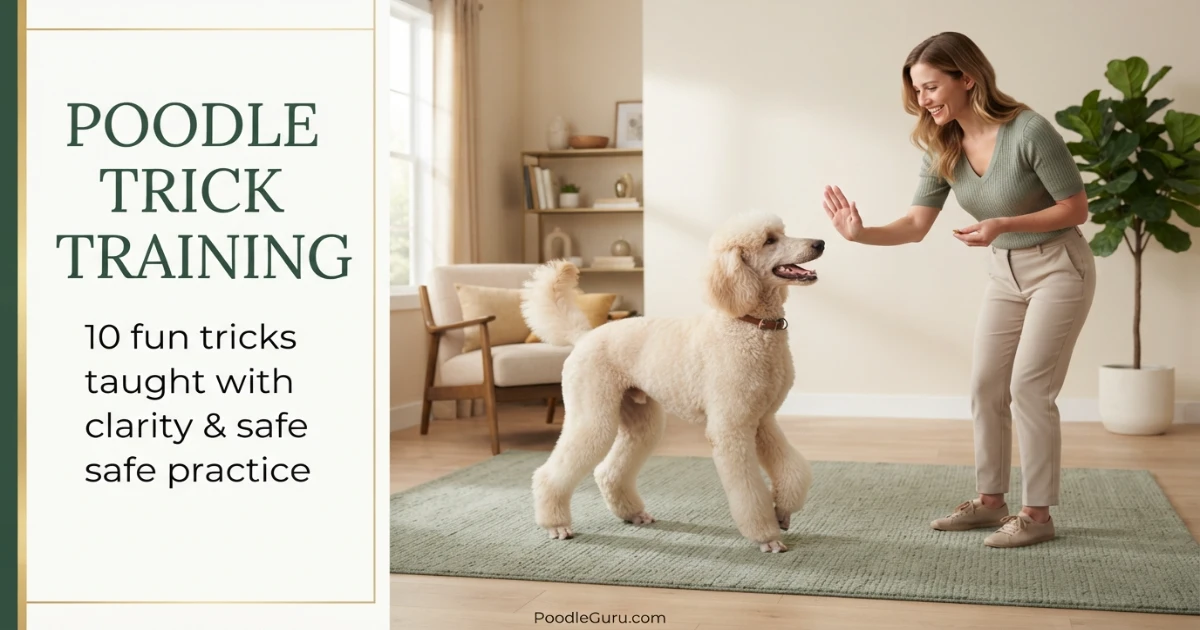
Poodle trick training uses reward-based shaping, luring, capturing, and clear markers to teach enjoyable behaviors such as spin, hand target, tidy up, bow, and retrieve by name. Start with a marker and a simple foundation skill, practise for 2–10 minutes depending on age and attention, and reward small steps rather than waiting for the finished trick. Many poodles begin offering a simple action within a few short sessions, but fluency in new rooms and around distractions takes deliberate practice.
In This Guide
- Quick Facts
- Why Poodles Excel at Trick Training
- The PoodleGuru Trick Training Framework
- Foundation Skills to Build First
- Safety and Size Adjustments
- 10 Fun Tricks to Teach Your Poodle
- 7-Day Poodle Trick Training Starter Plan
- Trick Difficulty & Prerequisites Table
- Common Mistakes Owners Make
- What Owners Usually Misunderstand
- Equipment That Helps
- When to Seek Professional Help
- Frequently Asked Questions
- Key Takeaways
Quick Facts
Exceptional Trainability
Poodles are widely recognized as highly trainable working dogs. They tend to notice patterns quickly, but individual learning speed still depends on age, motivation, prior experience, environment, and the clarity of your teaching.
Best Starting Age
Reward-based foundations can begin when a puppy comes home, often around 8 weeks. Keep early lessons playful, protect growing joints, and focus on name response, hand targets, settling, and handling rather than flashy physical tricks.
Session Length
Use 2–5 minute sessions for young puppies and about 5–10 minutes for many adolescents and adults. Stop while your dog is still engaged; several tiny wins are more useful than one long drilling session.
Why Poodles Excel at Trick Training
Poodles often enjoy trick training because it combines movement, problem-solving, social interaction, and a predictable way to earn reinforcement.
The breed developed as an athletic water retriever and working partner. That history helps explain the poodle’s handler awareness, quick pattern recognition, retrieving interest, and willingness to repeat tasks that lead to a clear outcome.
A poodle who learns tricks is doing more than performing. The dog is observing your posture, distinguishing cues, controlling movement, and learning how to try again after an error. That mental work can complement walks, sniffing, play, and rest, but it should not replace age-appropriate physical exercise.
The American Kennel Club’s Poodle profile describes the breed as active, proud, and very smart. Across all three sizes, good results still come from clear criteria, suitable rewards, and practice in more than one environment.
Evidence-Based Training Principle
The American Veterinary Society of Animal Behavior recommends reward-based methods for dog training and behavior work. For trick training, that means arranging the environment for success, marking the behavior you want, rewarding it, and avoiding physical or psychological punishment.
The PoodleGuru Trick Training Framework
At PoodleGuru, we evaluate every trick-training approach through a four-part method designed specifically for poodle temperament and learning style. Use this framework before introducing any new trick.
Engage the Mind First
Begin with a brief orientation game: name response, eye contact, or one easy hand target. This helps your poodle switch from wandering or play into a predictable training routine without demanding prolonged focus.
Shape, Lure, or Capture—Never Force
Reward small approximations toward the final behavior. For a spin, that may begin with a head turn, then a quarter turn, then a full circle. Fade food lures gradually and never push, pull, or hold your dog in position.
Add the Cue After the Pattern Is Clear
Say the verbal cue immediately before the behavior only after your dog is predictably following the hand signal or setup. This prevents the word from becoming background noise and gives the cue a clear meaning.
Generalize in Small Steps
Practise on different safe surfaces and in several low-distraction locations before adding visitors, outdoor sounds, or distance. Lower your criteria whenever the environment becomes harder.
Foundation Skills to Build First
Before teaching a trick chain, establish a few communication skills. These become the tools you use to guide position, mark success, pause, and restart without physically moving the dog.
- Name recognition and eye contact: Your poodle should orient toward you when you say her name. This is the gateway to all cued behavior.
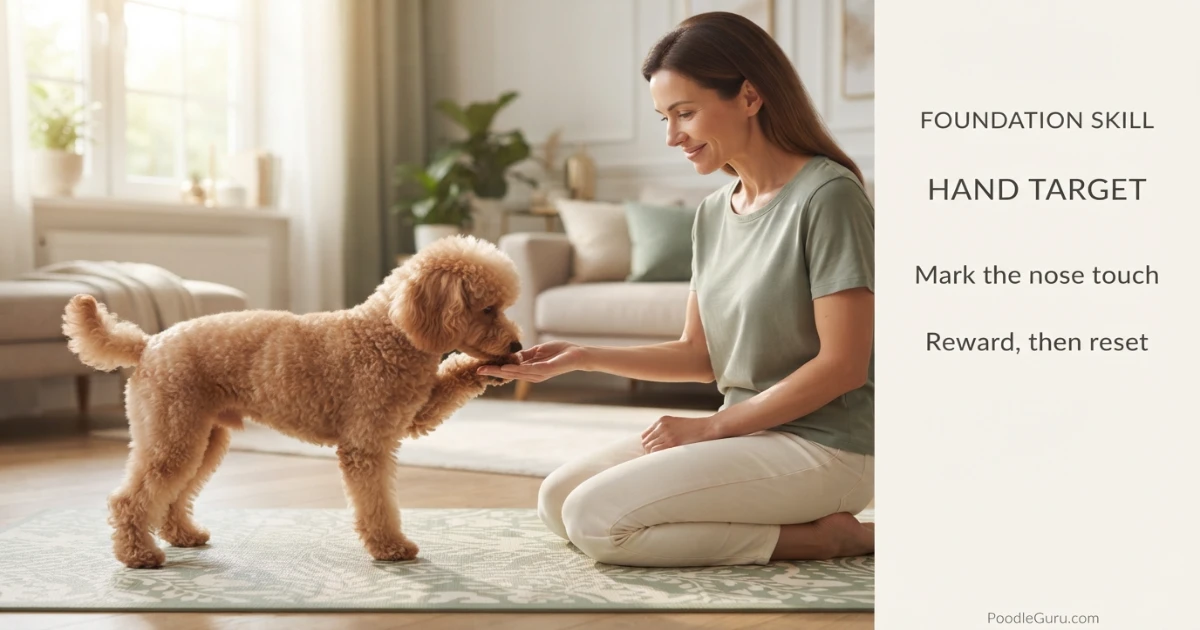
- Hand target (touch): Teach your dog to bump her nose to your open palm. This becomes a reset button, a positioning tool, and a confidence builder rolled into one.
- Sit and stay with duration: Impulse control matters. A poodle who can hold a sit for 15 seconds has the self-regulation needed for more complex trick chains.
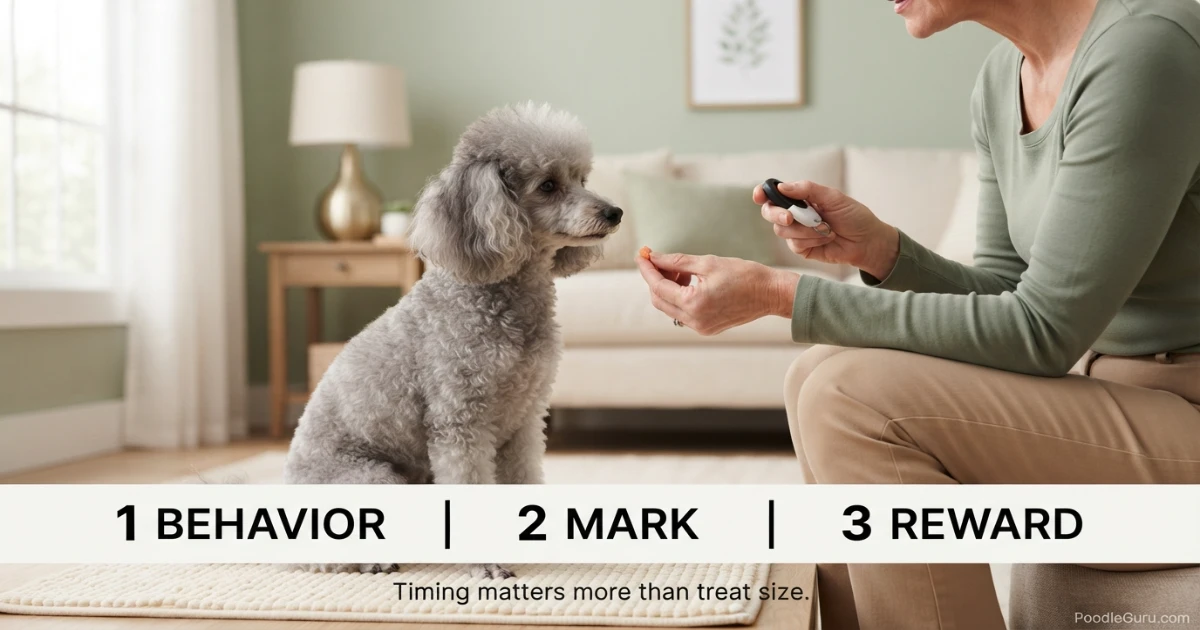
- Marker word or clicker understanding: Whether you use “yes” or a clicker, your poodle must understand that the marker predicts a reward. Charge the marker before anything else.
Some dogs understand these basics in a few days; others need longer. Build reliability gradually and keep the reward history strong. A clean foundation prevents frustration when you later combine several actions.
Safety and Size Adjustments Before You Train
The same teaching principle can work for Toy, Miniature, and Standard Poodles, but the movement should be adapted to the individual dog. Body size alone does not decide whether a trick is safe; age, footing, confidence, joint health, and repetition matter more.
Toy Poodle
Use tiny rewards, low props, and secure footing. Avoid lifting the dog into position or asking for jumps from furniture. Keep people’s feet and knees out of the dog’s path during leg-weaving games.
Miniature Poodle
Miniatures are agile, but speed can create sloppy turns. Use wide spins, one or two repetitions at a time, and a mat large enough for the complete movement.
Standard Poodle
Allow extra turning space and choose props that will not collapse or slide. Keep hoop work low until the dog understands the path, and avoid repetitive impact with growing puppies.
Stop the Session When You See:
- Repeated slipping, stumbling, reluctance to sit or lie down, or an uneven gait
- Turning away, leaving, freezing, tucked posture, persistent lip licking, or refusal of normally valued food
- Frustrated grabbing, frantic offering of behaviors, barking at the handler, or difficulty settling between repetitions
Give your dog a break and simplify the task. Sudden pain, limping, weakness, or a major behavior change deserves veterinary attention rather than more training.
10 Fun Tricks to Teach Your Poodle
The list moves from simple single actions to multi-step chains. Choose the easiest movement your dog can perform comfortably, and advance only when the previous step is clear in a quiet room.
1. Spin (Beginner)
Hold a tiny reward close enough for your poodle to follow without jumping, then guide a wide circle. Mark and reward a quarter turn at first, then build toward one full rotation. Fade the food lure to a hand signal before adding the word “spin.” Practise both directions and keep repetitions low.
2. High Five (Beginner)
Ask for a sit, present a closed hand at a comfortable height, and mark any voluntary paw lift. Gradually reinforce a higher paw, then offer your open palm as the target. Do not grab or pull the paw; some dogs prefer a nose-target trick instead.
3. Play Dead / Bang (Intermediate)
Begin from a comfortable down. Guide the nose gently toward one shoulder and reward a small weight shift, then a relaxed side position. Skip this trick if your dog resists lying down, appears stiff, or has back, hip, or shoulder discomfort.
4. Weave Through Legs (Intermediate)
Stand with enough space for your dog to pass without bumping your knees. Use a hand target or food lure to guide one path through your legs, reward, then reset. Build the figure-eight slowly; speed comes after accuracy and confidence.
5. Tidy Up Toys (Intermediate)
Teach pick up and release separately. Place one easy toy beside a low, stable basket, mark the pickup, then reward releases over the basket. Move the toy farther away only after each piece is reliable, and combine the steps from last to first.
6. Bow (Intermediate)
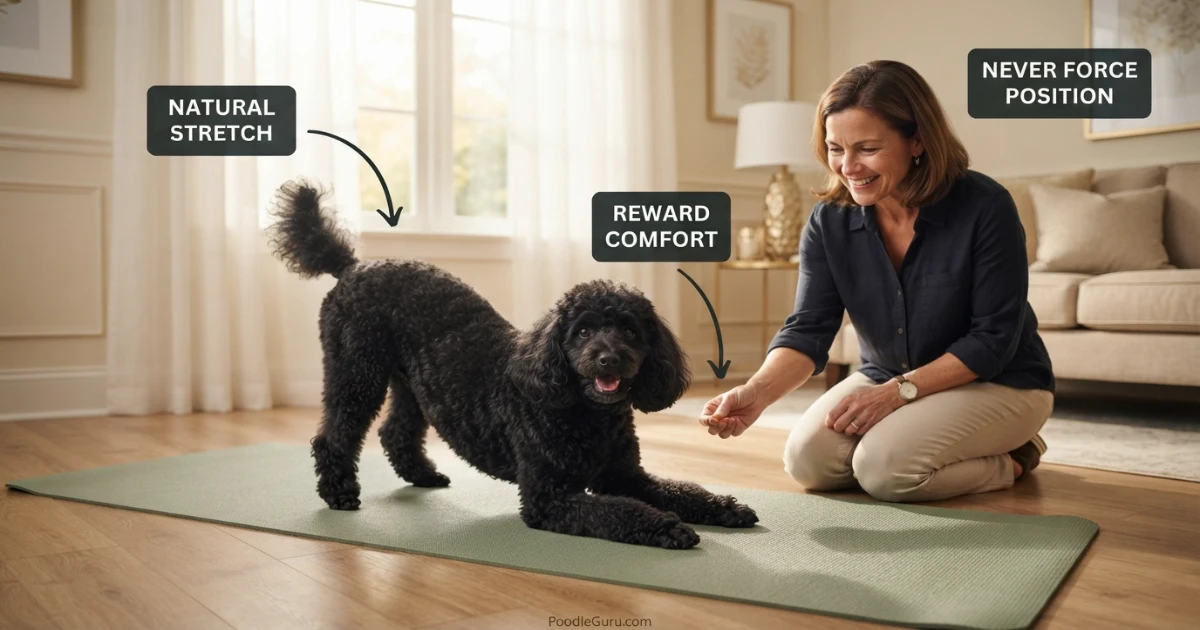
Capture a natural stretch or lure the nose slightly downward from a stand while rewarding bent elbows and a raised rear. Never press the shoulders or hold the dog in the posture. One comfortable bow is enough for a repetition.
7. Back Up (Intermediate)
Use a hallway, a low barrier, or a front-foot target to help your poodle discover one backward step without walking into the dog. Mark the first shift of weight, then gradually build distance. Maintain enough space for a Standard Poodle’s full body.
8. Legs / Peekaboo (Intermediate)
Guide your poodle behind you and reward the dog for standing or sitting between your legs with the head facing forward. Build duration before adding movement. This position should feel voluntary; release immediately if the dog appears trapped or uneasy.
9. Jump Through a Hoop (Advanced)
Begin with a lightweight hoop standing on the floor and reward walking through it. Raise it only a little after the path is confident and only for a physically mature, comfortable dog. Avoid repetitive jumping with puppies, seniors, or dogs with joint, back, or mobility concerns.
10. Retrieve by Name (Advanced)
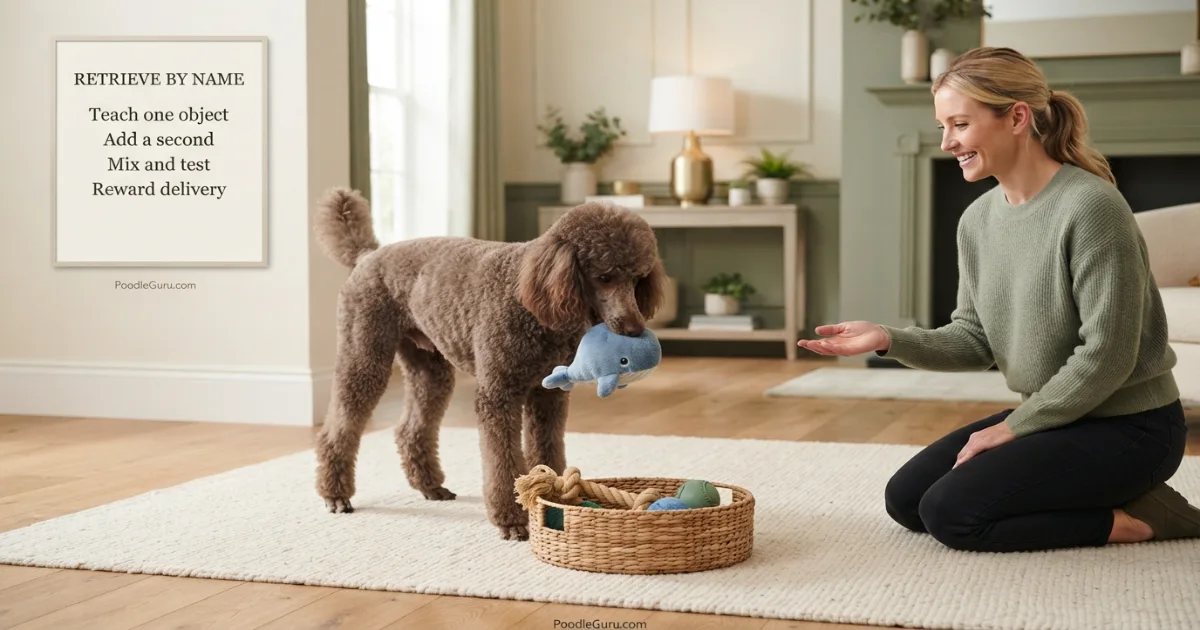
Teach one object name at a time. Reward looking at, touching, picking up, and delivering that object. Once two items have separate names, place them well apart and ask for one. Gradually reduce the distance between objects as discrimination improves.
7-Day Poodle Trick Training Starter Plan
This first week is about communication, not performance. Repeat a day when your poodle needs more time, and keep each session short enough that the dog would happily do one more repetition.
Build the Marker
Say “yes” or click, then deliver a tiny reward. Repeat 10–15 calm times so the sound predicts reinforcement.
Teach Hand Target
Present an open palm close to the nose. Mark the touch, reward, and move your hand only a few inches at first.
Shape a Quarter Spin
Use a hand target or lure to guide a small head-and-shoulder turn. Reward before asking for a complete circle.
Complete One Wide Spin
Join the small turns into a full, unhurried circle on non-slip footing. Practise both directions.
Fade the Food Lure
Make the same hand motion with an empty hand, then reward from the other hand after the turn.
Add the Verbal Cue
Say “spin” once, pause briefly, then give the familiar hand signal. Reward the successful response.
Practise Somewhere New
Move to another quiet room and lower your expectations. Reward an easier version before rebuilding the full trick.
Trick Difficulty & Prerequisites Table
Use this table to choose your starting point and understand what each trick demands from your dog — and from you.
| Trick | Difficulty | Prerequisite Skills | Avg. Sessions to Learn | Safety / Best Fit |
|---|---|---|---|---|
| Spin | Beginner | Lure following, marker understanding | 3–5 | All sizes; wide turns, low repetitions |
| High Five | Beginner | Sit, paw awareness | 4–6 | All sizes; never pull the paw |
| Play Dead | Intermediate | Down, stay, body handling comfort | 7–12 | Comfortable dogs only; skip with stiffness |
| Weave Through Legs | Intermediate | Lure following, body awareness | 6–10 | All sizes with adequate handler space |
| Tidy Up Toys | Intermediate | Take it, drop it, targeting | 10–20 | All sizes; use safe, easy-to-carry toys |
| Bow | Intermediate | Stand, body awareness | 4–7 | Adult dogs comfortable in a natural stretch |
| Back Up | Intermediate | Body awareness, spatial confidence | 5–8 | All sizes; clear space behind the dog |
| Legs / Peekaboo | Intermediate | Hand target, proximity comfort | 5–10 | All sizes; dog must be comfortable with proximity |
| Jump Through Hoop | Advanced | Confident jumping, sound joints | 8–15 | Physically mature, sound dogs; start at floor level |
| Retrieve by Name | Advanced | Retrieve, object discrimination | 15–25 | All sizes; choose safely sized objects |
Important: Session numbers are planning estimates, not promises. A behavior is not fully learned when it works once in the kitchen; it becomes reliable through successful practice across different rooms, surfaces, handler positions, and distraction levels.
Common Mistakes Owners Make
Even experienced dog owners slip into patterns that slow down trick training. Poodles, because they’re so sensitive to handler emotion, amplify both good technique and bad habits.
Repeating Cues Without Response
Repeating “spin, spin, spin” teaches the dog that the first cue does not matter. Give the cue once. If there is no response, pause, reduce the difficulty, and help with the familiar hand signal. Two unsuccessful attempts usually mean the setup needs to become easier.
Training When Frustrated
Your posture, pace, and tone change when you become frustrated. End with an easy behavior or scatter a few rewards, then stop. Returning later protects the dog’s confidence and prevents both of you from rehearsing a tense pattern.
Skipping Foundation Work
Complex tricks become much easier when the dog understands a marker, can follow a hand target, and can pause between repetitions. Without those skills, the handler often relies on larger lures or physical guidance, which makes fading help harder.
Using Punishment or Force
Leash corrections, intimidation, electronic collars, and physically pushing a dog into position are unnecessary for trick work and can damage welfare and trust. Follow the AVSAB recommendation for reward-based training: prevent errors where possible, reinforce the behavior you want, and change the setup when the dog struggles.
What Owners Usually Misunderstand
Some beliefs about poodle trick training get repeated so often they start to sound like facts. They aren’t.
Myth: “Smart dogs train themselves.”
Fast learning still requires clear feedback and consistent household rules. Without an outlet, a clever poodle may practise self-rewarding behaviors such as counter surfing, barking for access, or opening unsecured doors.
Myth: “If my poodle doesn’t get it quickly, she’s stubborn.”
A dog who hesitates may be unsure, distracted, uncomfortable, or insufficiently reinforced. Before calling the behavior stubbornness, make the step smaller and check whether the dog can physically perform it comfortably.
Myth: “Tricks are just for showing off.”
Tricks can build confidence, body awareness, cooperative communication, and useful life skills. They complement—not replace—walks, sniffing, play, social contact, and rest.
Equipment That Helps (And What You Don’t Need)
A quiet space, safe footing, and rewards your poodle values matter more than expensive gear. Start with what supports clear timing and comfortable movement.
What’s Worth Having
- Small, dog-safe rewards: Use pea-sized pieces or part of the daily food allowance when that is motivating. Keep rewards tiny, account for them in daily intake, and avoid ingredients your veterinarian has told you to restrict.
- A treat pouch or easy-access container: Fast delivery helps you reward the correct moment without breaking the flow of the lesson.
- A clicker or clear verbal marker: Dogs can learn more than one marker, but beginners should use one consistently within a session. Timing and predictable reward delivery matter more than whether the marker is a click or a word.
- A large non-slip mat: Secure footing is especially important for spins, bows, backward steps, and senior dogs. The mat must be large enough for the whole movement.
What You Can Skip
- Prong, choke, or electronic collars—AVSAB recommends reward-based methods rather than aversive tools
- Tiny unstable props, slippery hoops, or furniture jumps that create unnecessary fall and impact risk
- A large collection of novelty equipment before your dog understands markers, targets, and release cues
When to Seek Professional Help
Trick training should feel safe and voluntary. Bring in qualified help when the problem involves fear, pain, aggression, resource guarding, or a pattern you cannot resolve by simplifying the task.
Contact a Qualified Professional If:
- Your poodle repeatedly leaves, freezes, hides, growls, guards rewards, or becomes increasingly distressed during sessions
- A previously easy movement becomes difficult, uneven, painful, or suddenly avoided
- Your dog bites, snaps, or shows escalating aggression around handling, toys, food, or frustration
- You cannot identify a safe reinforcement plan for fear, reactivity, or another serious behavior concern
- Training is harming the relationship or you feel tempted to use force, intimidation, or aversive equipment
For basic teaching mechanics, look for a reward-based trainer who can explain criteria, reinforcement, and error prevention. For sudden behavior change or suspected pain, start with a veterinarian. For significant fear or aggression, ask your veterinarian about an appropriately qualified behavior professional.
Frequently Asked Questions
What is the easiest trick to teach a poodle first?
A hand target or a wide, slow spin is often an easy starting point. Hand targeting is especially useful because it teaches the dog to follow a clear target without physical handling and can later support positioning, recall, cooperative care, and more complex tricks.
How long should a poodle trick training session last?
Use about 2 to 5 minutes for young puppies and roughly 5 to 10 minutes for many adolescent and adult poodles. The best session ends while the dog is still engaged. Several short sessions usually produce clearer learning than one long session.
Can senior poodles still learn new tricks?
Yes. Senior poodles can learn throughout life, but choose movements that fit their comfort and mobility. Nose targets, chin rests, object names, scent games, and simple stationary behaviors are often easier than repeated spins, bows, weaving, or jumping. Ask your veterinarian about new physical limits if stiffness or pain is present.
Why does my poodle know a trick at home but ignore it elsewhere?
Dogs do not automatically apply a learned behavior to every environment. A new room changes the floor, smells, sounds, distance, and distractions. Begin with an easier version of the trick, use stronger reinforcement, and rebuild one variable at a time.
What treats work best for poodle trick training?
Use tiny, soft, dog-safe rewards that your individual poodle values and can swallow quickly. Part of the daily food allowance may work in easy settings, while more distracting environments may require a higher-value option. Keep portions small and account for rewards in daily intake.
Should I use a clicker or verbal marker for poodle trick training?
Either can work. A clicker is consistent and precise, while a verbal marker is always available. Dogs can learn multiple markers, but use one clearly and consistently while teaching a new skill, then deliver the reward promptly.
Does poodle size change which tricks are safe?
Size matters less than age, footing, body condition, confidence, and joint health. Toy Poodles need low, stable props and protection from accidental impact. Standards need more turning space. Growing puppies, stiff seniors, and dogs with orthopedic concerns should avoid repetitive jumping and tight turns.
Can I train multiple tricks at the same time?
Yes, as long as the cues and setups are distinct and your dog is not becoming confused or frustrated. Many owners teach one primary new trick while maintaining one or two familiar behaviors. When progress slows, reduce the number of new criteria and simplify.
Key Takeaways for Poodle Trick Training
- Reward-based poodle trick training works best when the behavior is broken into small, achievable steps.
- Build a marker, hand target, and calm reset before attempting multi-step tricks.
- Use 2–5 minute puppy sessions and roughly 5–10 minute sessions for many adults, ending before attention drops.
- Train on non-slip footing and adapt turns, stretches, props, and impact to the dog’s age, size, confidence, and joint health.
- Add the verbal cue after the movement pattern is predictable, then practise in several low-distraction locations.
- Stop and seek appropriate help when you see pain, sudden movement changes, fear, aggression, guarding, or escalating distress.
Start today with one marker session and five easy hand targets. When your poodle finishes eager for another repetition, you have chosen the right difficulty.