This article contains affiliate links. PoodleGuru may earn a small commission if you purchase through our links, at no extra cost to you.
Best Dental Chews for Poodles: Safe, Effective Options
The best dental chews for poodles are safe, size-matched, pliable, and evidence-backed — not just treats shaped like toothbrushes. Poodles have famously charming smiles and famously vulnerable teeth. Dental chews can help between professional cleanings, but the wrong chew does nothing useful, the wrong size becomes a choking hazard, and the wrong hardness can crack a tooth. This guide sorts the effective from the dangerous, sized for every poodle from Toy to Standard.
Quick Answer: Best Dental Chews for Poodles
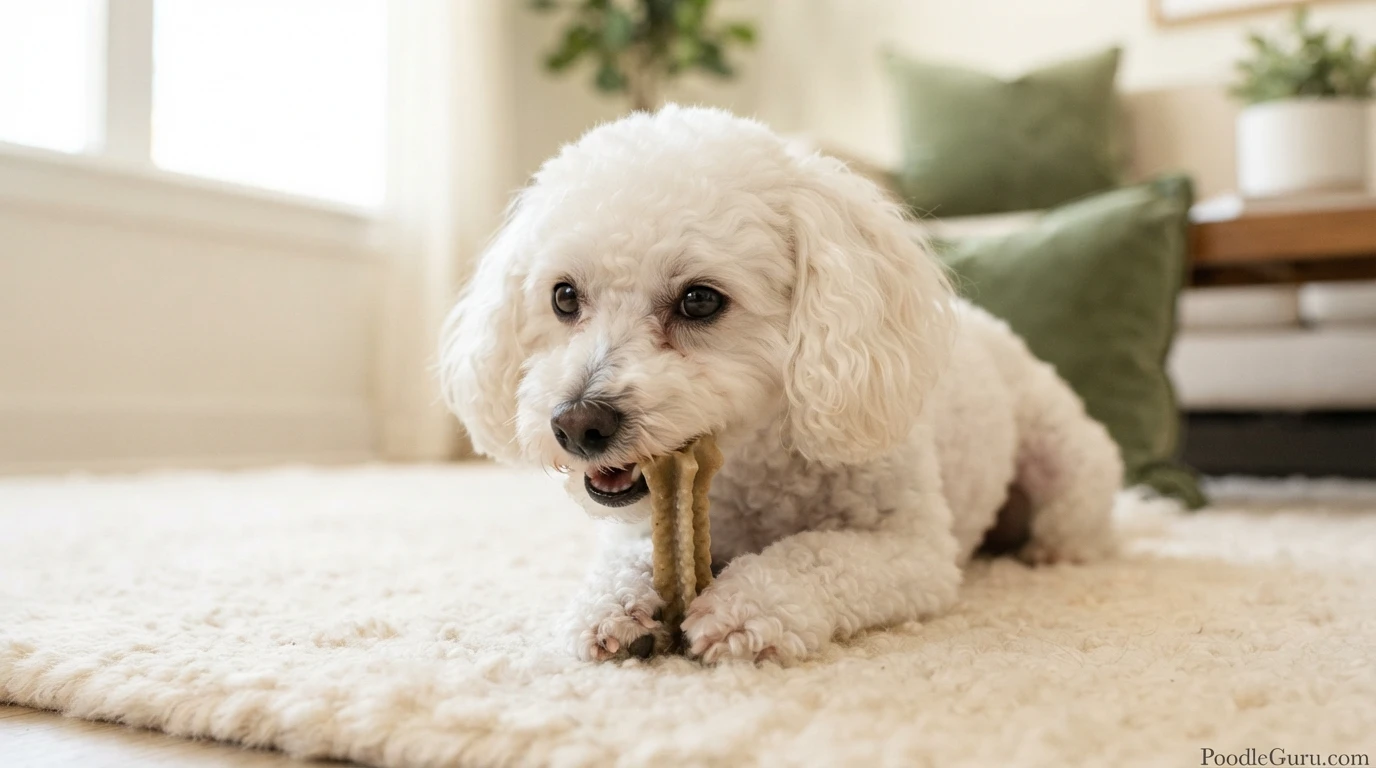
The best dental chews for poodles combine mechanical abrasion, a shape that encourages chewing on the back molars, and a formulation firm enough to clean but not so hard that it risks tooth fracture. For poodles, the Veterinary Oral Health Council seal is the most useful shortcut because VOHC-awarded products have submitted clinical evidence for plaque or tartar control. Size the chew to your poodle’s weight category, supervise every session, and limit dental chews to the amount recommended on the product label. A dental chew is a supplement to brushing, not a replacement.
Why Poodles Need Dental Chews More Than Most Dogs
Poodles have a mouth problem. Their narrow jaws, crowded teeth, and predisposition to periodontal disease create a perfect environment for plaque to harden into tartar. Toy and Miniature Poodles are especially vulnerable — their teeth are the same size as a Standard’s, packed into a much smaller jaw. The result is tight interdental spaces that trap debris and breed bacteria.
A dental chew is a targeted tool that scrapes the tooth surface during prolonged chewing — something that a crunchy biscuit swallowed in three seconds doesn’t do. For poodle owners, the most important thing to understand is that not all chews marketed as “dental” actually reduce plaque. Many are just treats shaped like toothbrushes. The difference between a functional dental chew and a dental-themed cookie is the difference between prevention and placebo.
The VCA Animal Hospitals resource on canine dental disease explains how plaque can progress into periodontal damage when oral care is neglected. For poodles, especially Toy and Miniature Poodles with crowded mouths, problems can appear earlier than owners expect. Dental chews are one piece of the prevention puzzle, alongside tooth brushing, routine mouth checks, and professional veterinary cleanings.
Best Dental Chews for Poodles: Quick Facts
Best Seal
The VOHC seal means the product has passed controlled trials for plaque or tartar reduction. Look for it first.
Chew Time
An effective dental chew takes 5–15 minutes for a poodle to consume. Faster than that, and no meaningful abrasion occurs.
Frequency
One dental chew per day is the standard recommendation. More doesn’t help and adds unnecessary calories.
Hardness Rule
If you can’t indent the chew with your thumbnail, it’s too hard for poodle teeth and risks slab fractures.
Supervision
Never leave a poodle unsupervised with a dental chew. Choking and obstruction are real risks even with appropriate products.
Calorie Count
Dental chews can add 30–80 calories each. Adjust meal portions accordingly, especially for Toy and Miniature Poodles.
How Dental Chews Actually Work
The mechanism is simpler than the marketing suggests. A dental chew works through mechanical abrasion — the physical scraping of the tooth surface as the poodle chews. The chew must be firm enough to create friction against enamel but pliable enough to avoid fracturing the tooth. It must also be large enough that the dog uses its back molars, where most tartar accumulates.
Some chews add chemical agents — enzymes, polyphosphates, or chlorhexidine — that inhibit bacterial growth or bind calcium in saliva to slow tartar formation. These can enhance the mechanical effect but don’t replace it. A chemically treated chew that’s swallowed whole does nothing for the teeth. The physical action of chewing is the non-negotiable part.
What Owners Usually Misunderstand
A dental chew is not a substitute for brushing. Brushing removes plaque from all tooth surfaces, including the inner faces and gumline where chews can’t reach. A chew cleans primarily the chewing surfaces of the molars. Think of it this way: brushing is flossing and brushing combined. A dental chew is chewing sugar-free gum after lunch. Helpful, but not a complete dental care plan.
The VOHC Seal: What It Means and Why It Matters
The Veterinary Oral Health Council authorizes its seal for products intended to help retard plaque or tartar when used as directed. VOHC does not test products itself; it reviews submitted clinical data against its standards before awarding the seal. For poodle owners standing in a pet store aisle surrounded by competing claims, the VOHC seal is the most reliable shortcut to a product with evidence behind it.
Products carrying the VOHC seal for plaque control have evidence for reducing plaque accumulation. Products carrying it for tartar, also called calculus, have evidence for slowing the mineralization of plaque into the hard deposits that require professional scaling to remove. Some products carry both claims. Those are usually the strongest evidence-backed non-prescription options to consider.
The PoodleGuru Chew Safety Check
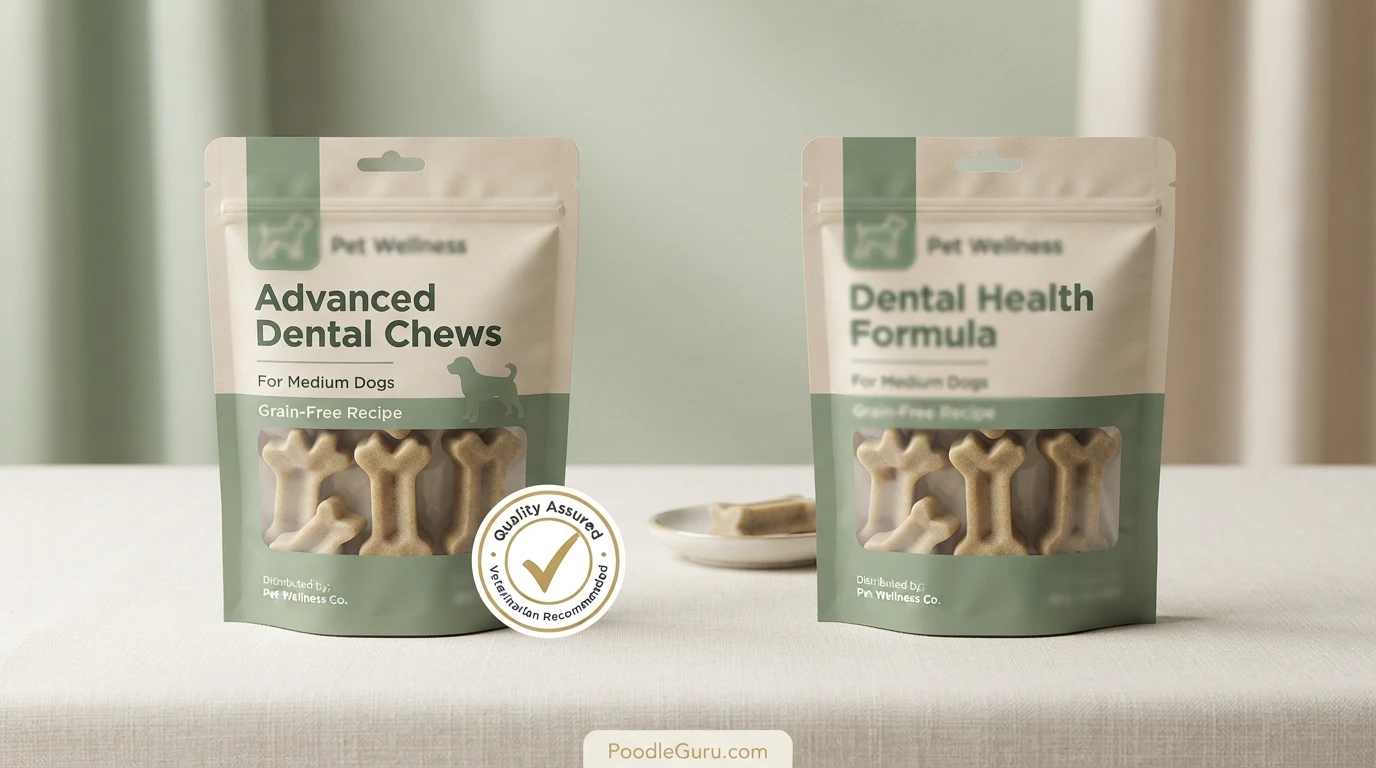
At PoodleGuru, we evaluate dental chews through a safety-first lens before we ever consider the dental claims. A chew that technically reduces plaque but poses a choking risk to a Toy Poodle isn’t a good product for a Toy Poodle — it’s a hazard with good marketing. Here’s our framework for evaluating any chew before it goes into your poodle’s mouth.
Four-Step Safety Evaluation
The Thumbnail Test
Press your thumbnail firmly into the chew. If you can make a visible indent, the chew is pliable enough for poodle teeth. If you can’t leave a mark, it’s too hard — risk of slab fracture. Outcome: A chew that flexes, not one that breaks teeth.
The Size Test
The chew should be larger than your poodle’s mouth so it can’t be swallowed whole. A Toy Poodle needs a small but not tiny chew — roughly the size of a thumb. A Standard Poodle needs a chew roughly the size of a small sausage. When in doubt, size up. Outcome: Zero risk of the entire chew being swallowed in one gulp.
The Ingredient Scan
Read the ingredient list before the marketing copy. Avoid artificial colors, BHA/BHT preservatives, unnamed “animal digest,” and excessive sugars. A short, recognizable ingredient list — rice flour, vegetable glycerin, gelatin, natural flavor — is what you want. Outcome: A product you’d recognize as food, not a chemistry experiment.
The Supervision Protocol
Watch your poodle chew. If the dog tries to swallow a large piece, take it away. If the chew splinters instead of wearing down evenly, discard the rest. A dental chew is a supervised event, not a leave-it-in-the-crate activity. Outcome: A safe chewing session, every time.
Best Dental Chews by Poodle Size (2026 Criteria)
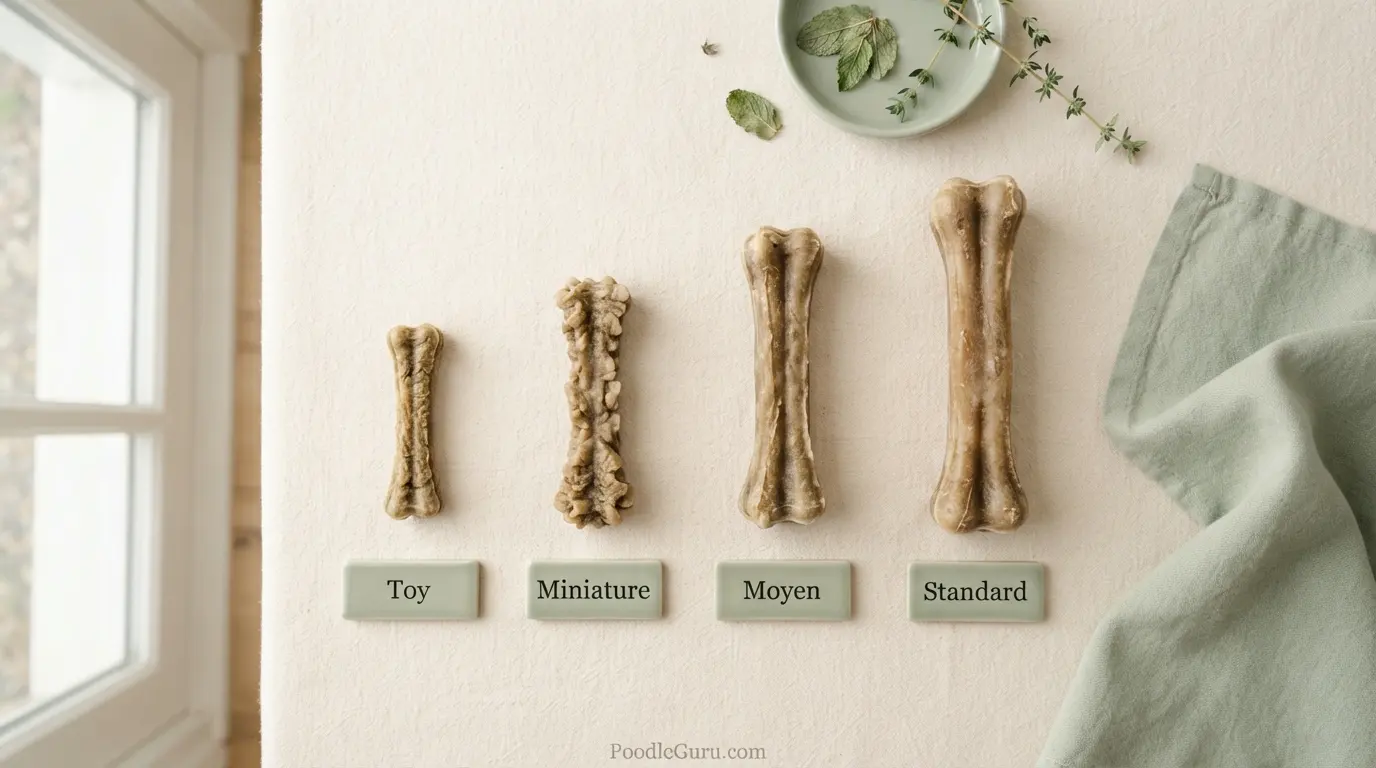
The right dental chew for a Toy Poodle could choke a Standard. The right one for a Standard could crack a Toy’s teeth. Product selection must be size-specific. Here are the recommended criteria and categories, organized by poodle size, based on the evaluation framework above.
| Poodle Size | Recommended Chew Type | What to Look For | Examples of Appropriate Products | Approximate Daily Cost |
|---|---|---|---|---|
| Toy Poodle (4–6 lbs) | Extra-small enzymatic chews, small dental sticks formulated for tiny dogs | VOHC seal, pliable texture, roughly thumb-sized, easily digestible base | Greenies Teenie size, Virbac C.E.T. VeggieDent small chews, Oravet small chews | $0.50–$1.00 |
| Miniature Poodle (10–15 lbs) | Small-to-medium dental chews with textured surfaces | VOHC seal, ridged or grooved design for increased abrasion, medium pliability | Greenies Petite size, Purina DentaLife small/medium, Whimzees small | $0.70–$1.40 |
| Moyen/Medium (20–35 lbs) | Medium dental chews with enzymatic coating | VOHC seal, enzymatic formula for added chemical plaque control, size roughly of a large carrot | Greenies Regular size, Virbac C.E.T. medium, OraVet medium | $1.00–$1.80 |
| Standard Poodle (45–70 lbs) | Large dental chews with significant chewing resistance | VOHC seal, substantial size requiring 10–15 minutes of chewing, highly digestible base | Greenies Large size, Purina DentaLife large, Whimzees large | $1.20–$2.00 |
Why Digestibility Matters for Poodles
Poodles can have sensitive stomachs, and some dental chews pass through poorly digested — or worse, cause obstructions. Products with a base of highly digestible wheat gluten, rice flour, or gelatin tend to break down more completely than those using rawhide or compressed vegetable fiber. If your poodle has a history of pancreatitis, avoid high-fat chews and check the calorie content. A dental chew shouldn’t trigger a veterinary visit.
Ingredients to Avoid in Dental Chews
Some ingredients in dental chews range from useless to actively harmful. Here’s what to scan for — and skip — when reading labels.
| Ingredient | Why Avoid It | What to Look For Instead |
|---|---|---|
| Rawhide | Indigestible, swells in the stomach, and is a well-documented choking and obstruction hazard — especially for small poodles. | Highly digestible vegetable-based or gelatin-based chews. If you want a long-lasting chew, consider a dental-specific rubber toy instead. |
| Artificial Colors (Red 40, Yellow 5, etc.) | Unnecessary in pet food. Some dogs show sensitivity or allergic reactions. They’re there to appeal to you, not your dog. | Products with natural color only — or no added color at all. The chew doesn’t need to be green to clean teeth. |
| BHA / BHT (preservatives) | Controversial synthetic preservatives that many owners prefer to avoid when cleaner alternatives are available. | Products preserved with mixed tocopherols, vitamin C, or rosemary extract. |
| Unspecified “Animal Digest” or “Meat By-Products” | Vague sourcing makes it impossible to know what your poodle is actually eating. Quality dental chews specify their protein sources. | Chews with named ingredients: chicken meal, beef gelatin, pork liver — things you can picture. |
| Added Sugars (corn syrup, sucrose, dextrose) | Feeding sugar to a dog with dental concerns is counterproductive. Sugar feeds oral bacteria and adds empty calories. | Glycerin provides sweetness without feeding oral bacteria the same way. It’s the standard base in quality dental chews. |
Mistakes That Make Dental Chews Dangerous
A dental chew is only as safe as the way it’s used. These are the errors that turn a beneficial product into an emergency.
Size Mismatch Is the Most Common Error
The number-one dental chew mistake is giving a Toy Poodle a chew sized for a Miniature, or a Miniature a chew sized for a Standard. A chew that’s too small can be swallowed whole and cause choking or gastrointestinal obstruction. A chew that’s too large can cause jaw strain or, in some cases, the poodle gives up and gets zero dental benefit. Match the product to your dog’s actual weight — not the size you think they are.
When to Call a Vet
Contact your veterinarian immediately if your poodle shows any of these signs after consuming a dental chew: repeated gagging or retching, distress or restlessness, vomiting, refusal to eat, lethargy, abdominal discomfort, or straining to defecate without producing stool. These can indicate an esophageal or intestinal obstruction — a medical emergency. Dental chews that break into large chunks are the biggest concern. This is why supervision is not optional.
Frequently Asked Questions
Do dental chews actually work for dogs?
Yes — when they carry the VOHC seal and are used correctly. Products with this seal have demonstrated measurable plaque or tartar reduction in controlled trials. Without the seal, there’s no guarantee the chew does anything for dental health beyond freshening breath temporarily.
How often should I give my poodle a dental chew?
Use the amount recommended on the product label; for many dental chews, that is one chew per day. Daily use maintains the mechanical cleaning benefit, while extra chews mainly add calories. Adjust meal portions to account for the chew’s calories, especially for Toy and Miniature Poodles.
Can dental chews replace brushing my poodle’s teeth?
No. Dental chews clean primarily the chewing surfaces of the molars. Brushing reaches all tooth surfaces, including the gumline and inner faces where periodontal disease often starts. A chew is a useful supplement to brushing — not a substitute. Both belong in a complete dental care routine.
What dental chews are safe for Toy Poodles?
Toy Poodles need extra-small, highly digestible chews that pass the thumbnail test and can’t be swallowed whole. Products labeled for dogs under 10 pounds are the starting point. Greenies Teenie size, Virbac C.E.T. VeggieDent small, and similar VOHC-approved extra-small options are appropriate when sized correctly.
Are Greenies safe for poodles?
Greenies are safe for poodles when the correct size is chosen and the dog is supervised while chewing. The product’s high digestibility reduces obstruction risk compared to rawhide. Size errors are the main cause of Greenies-related problems — a Teenie given to a Standard is a choking hazard. Match the product to your poodle’s weight category exactly.
Why are antlers and bones bad for poodle teeth?
Antlers, weight-bearing bones, and nylon bones are harder than tooth enamel. When a poodle bites down on a surface harder than its teeth, the result is often a slab fracture — a vertical crack that exposes the pulp and requires extraction or root canal. The thumbnail test is the rule. If you can’t indent it, don’t give it.
What should I do if my poodle swallows a dental chew whole?
Monitor closely for the next 24–48 hours. Watch for vomiting, gagging, refusal to eat, lethargy, or straining to defecate. If any of these appear, contact your veterinarian immediately. Most high-quality dental chews are designed to be digestible and pass without incident — but obstruction is always possible. When in doubt, call the vet.
Key Takeaways
A well-chosen dental chew, given daily and sized correctly, is one of the most practical tools a poodle owner has for reducing plaque between veterinary cleanings. Here’s what to remember:
- Look for the VOHC seal first. It’s the only reliable shortcut to a dental chew proven to reduce plaque or tartar in controlled clinical trials — everything else is marketing until proven otherwise.
- Match the chew size to your poodle’s actual weight category. A Toy Poodle (4–6 lbs) needs an extra-small chew. A Standard Poodle (45–70 lbs) needs a large one. Size errors are the leading cause of choking and obstruction incidents.
- Apply the thumbnail test: if you can’t indent the chew with your thumbnail, it’s too hard for poodle teeth. Slab fractures from antlers, bones, and nylon chews are painful, expensive, and entirely preventable.
- Supervise every chewing session. A dental chew is an active event, not a crate-time distraction. Check your poodle’s mouth afterward for stuck fragments. Ten seconds of prevention beats an emergency vet visit.
- One chew per day is enough. Adjust meal portions to account for the 30–80 calories most dental chews add. A dental chew should support health, not contribute to weight gain or pancreatitis risk.
- Dental chews supplement brushing — they don’t replace it. Brushing reaches every tooth surface. Chews clean primarily the chewing surfaces of the molars. Both belong in a complete poodle dental care routine.
A poodle’s smile is one of its best features. Keeping it healthy takes more than hoping — it takes the right products, the right size, and the right daily habits. Choose carefully, supervise consistently, and let your vet’s dental exams confirm what you’re building at home.