Poodle Whining: 7 Causes & How to Stop It Humanely
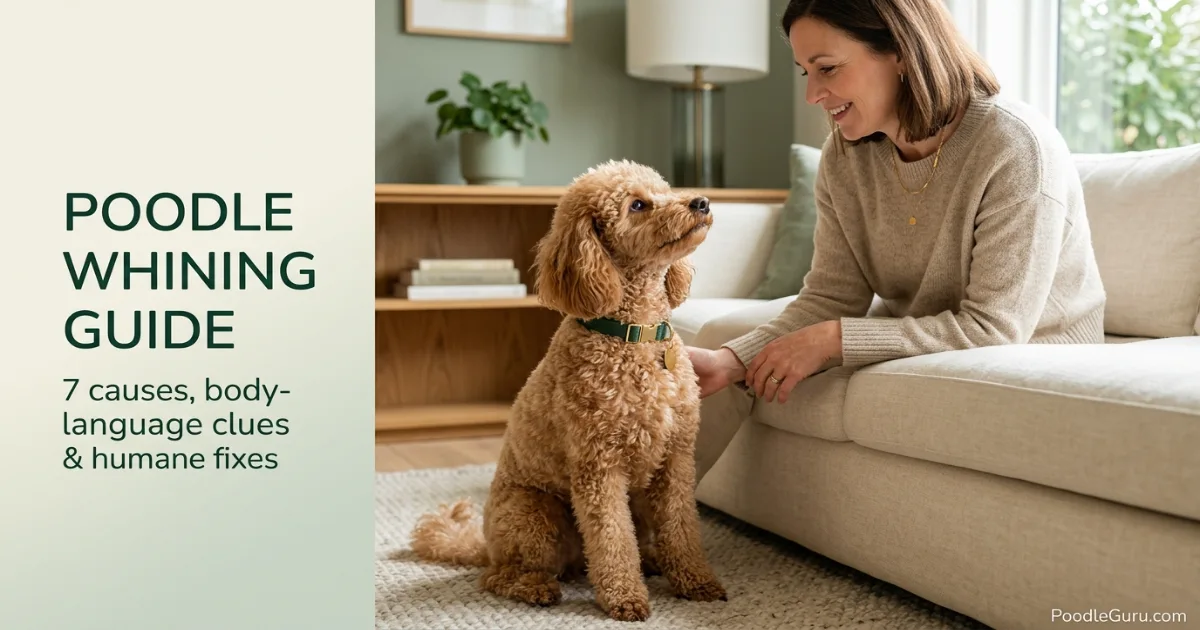
Poodles talk. Poodle whining often happens when they’re excited, bored, anxious, or uncomfortable. But when the whining becomes constant, it stops feeling like communication and starts feeling like a problem. This guide helps you understand what your poodle is really saying — and how to respond in a way that lowers the volume without damaging trust.
Quick Answer: What Poodle Whining Usually Means
Most poodle whining is a normal communication tool. Your poodle may whine because they need something (a potty break, food, or attention), feel anxious or overstimulated, are in pain, or simply want to engage with you. The key is to identify the trigger behind the whine. If your poodle suddenly starts whining excessively without an obvious reason, or the whine is accompanied by lethargy, appetite changes, or limping, a veterinary check is the right first step. For behavioral whining, the solution usually lies in meeting unmet needs and teaching a calm replacement behavior.
🗣️ Natural Talkers
Poodles are vocal by nature. Whining, sighing, and soft grumbles are part of their expressive repertoire — much more than in many other breeds.
🧠 Emotional Sponges
Poodles read human emotions extremely well. If you’re stressed, your poodle may whine in response to that tension, even without a direct trigger.
⚠️ Pain Signal
Sudden, persistent whining — especially at rest or when touched — can be an early sign of discomfort. Always rule out medical causes first.
What Is Poodle Whining?
Poodle whining is a high-pitched, often nasal vocalization that dogs use to communicate internal states — need, anticipation, frustration, or distress. For poodle owners, it’s the sound of a dog who’s deeply engaged with their environment and not shy about expressing it. The most important thing to understand is that whining is not misbehavior; it’s information.
Poodles whine in a variety of tones and rhythms. A short, rising whimper at the door means something very different from a low, continuous whine while lying down. Learning your own dog’s whining “dialects” takes patience, but it’s the single most effective way to address the behavior at its root — rather than silencing it without solving anything.
Unlike barking or howling, whining often signals a closer emotional bond. Puppies whine to their mothers. Adult dogs whine to the humans they trust. In poodles, that trust is deep and constant. So when the whining ramps up, it’s almost always worth asking: “What has changed, and what is my poodle trying to tell me?”
Why Poodles Whine More Than Other Breeds
If you’ve owned a poodle, you already know: they’re not a quiet breed. But the whining isn’t a flaw — it’s a direct result of what makes poodles so wonderful.
Bred for Close Partnership
Poodles were developed as water retrievers and companion dogs who worked closely with humans all day. That means they’re genetically wired to check in, communicate, and seek direction. A poodle who whines is often simply doing what centuries of breeding encouraged: staying connected. The AKC describes poodles as “exceptionally smart and active,” and that intelligence demands mental and emotional outlets.
Extreme Sensitivity
Poodles absorb human emotions like sponges. If there’s tension at home, if your routine shifts unexpectedly, if you’re feeling unwell — your poodle may whine more. They’re not being dramatic. They’re responding to a change in their emotional environment. Many owners notice that poodle whining peaks during stressful periods: moving house, a new baby, the loss of a family member.
High Need for Mental Engagement
Boredom whining is rampant in under-stimulated poodles. These are dogs who need puzzles, training, sniff walks, and interaction. Without enough enrichment, whining becomes one of the few tools they have to break the monotony.
The AKC breed standard for poodles emphasizes their “intelligent and active” nature — qualities that make them incredible companions, but also demanding ones. Meeting those demands reduces whining naturally.
Common Causes of Poodle Whining
Poodle whining rarely has a single cause. Most of the time, multiple layers are at play. Here are the most frequent drivers and how they typically show up in poodles.
Attention-Seeking Whining
Your poodle drops a toy at your feet and whines. You’re working at your desk and a soft, insistent whimper starts from under the chair. This is social whining — a bid for eye contact, touch, play, or interaction. It’s not manipulative in a human sense, but it is learned. If whining got your attention before, your poodle remembers.
Anxiety and Fear
Separation anxiety is common in poodles, and whining is often the first sign. You’ll see it paired with pacing, panting, drooling, or destructive behavior when left alone. Fear-based whining — during thunderstorms, fireworks, or vet visits — is high-pitched and accompanied by trembling, hiding, or clinginess. The ASPCA’s guide to separation anxiety highlights that early intervention and gradual desensitization are far more effective than punishment.
Boredom and Under-Stimulation
A poodle who spends hours alone with nothing to do will whine. It’s a release valve. The fix isn’t to scold — it’s to add sniff walks, food puzzles, trick training, or interactive play before the whining starts.
Pain or Medical Discomfort
Whining that appears suddenly, especially in a normally quiet dog, should prompt a veterinary visit. Dental pain, arthritis, digestive upset, ear infections — all can trigger vocalization. Senior poodles may whine more due to joint stiffness or cognitive decline. If your poodle whines when touched in a specific area, don’t wait.
Excitement and Anticipation
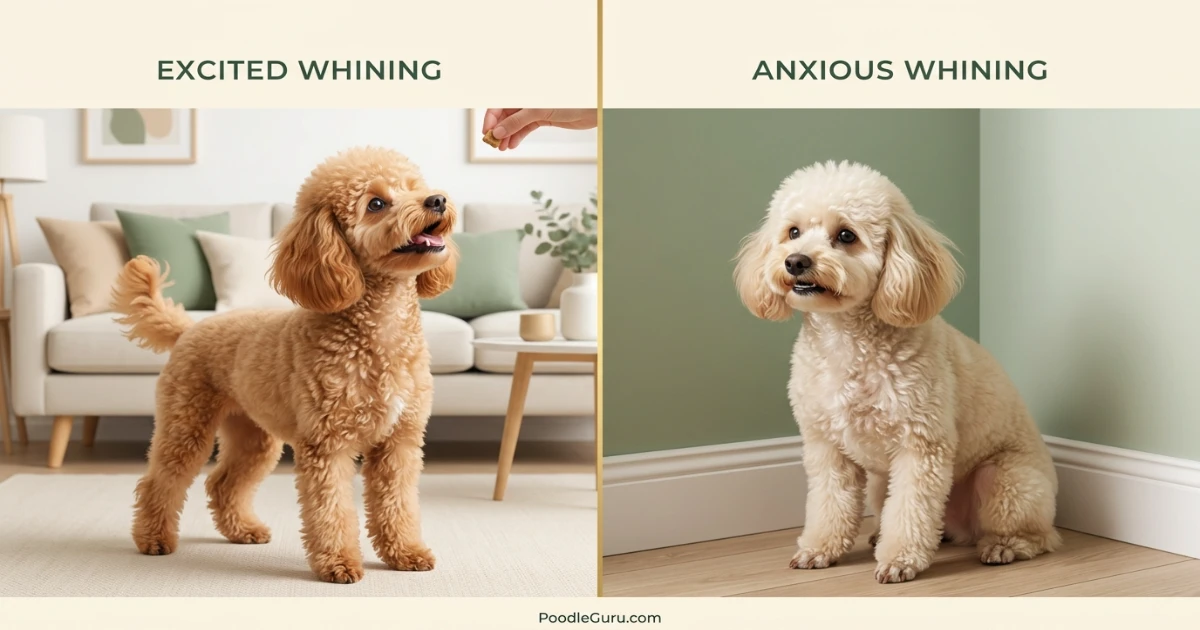
The leash comes out. The food bowl clinks. Someone you love walks through the door. Excitement whining is high-energy, often paired with spinning, tail wagging, and play bows. It’s normal, but it can become excessive if your poodle never learns to self-regulate during exciting moments.
Age-Related Changes
Senior poodles may whine due to canine cognitive dysfunction (dog dementia), hearing loss, or vision decline. The world becomes confusing, and whining becomes a way to seek reassurance. It’s heartbreaking, but knowing the cause helps you respond with compassion rather than frustration.
The PoodleGuru Whine Decoder Method
At PoodleGuru, we approach poodle whining by reading three layers: sound, body, and context. This method helps you move from “stop whining!” to “I know what you need.” It’s not a diagnostic tool, but it gives you a repeatable way to assess almost any whining episode.
The PoodleGuru Whine Decoder: 3-Layer Observation
Use this framework whenever your poodle whines. Go through all three layers before deciding how to respond.
Layer 1: Sound Quality
What to notice: Is the whine high-pitched and urgent, or low and rhythmic? Is it continuous or intermittent? The pitch and pattern often hint at the intensity of the feeling behind it.
Example: A sharp, repeated whine at the door signals urgency (bathroom need). A soft, droning whine while resting may signal mild discomfort or unease.
Layer 2: Body Language
What to notice: Ears, tail, posture, eyes, and muscle tension. A whine with a wagging tail and relaxed body is very different from a whine with tucked tail and whale eye.
Example: Play bow + whine = playful invitation. Cowering + whine = fear or anxiety.
Layer 3: Context and Timing
What to notice: What happened right before the whining started? Time of day, location, presence of people or other pets, recent changes in routine.
Example: Whining at 5pm every day before dinner = anticipation. Whining only when you pick up car keys = separation anxiety cue.
Combine all three layers, and you’ll almost always have a clear working hypothesis. That hypothesis guides your response — meet the need, address the anxiety, or rule out medical causes. And if the picture stays unclear, a short video recording of the whining episode is invaluable for your vet or behaviorist.
Quick-Reference Whine Decoder Table
| Whine Type | Sound | Common Body Language | Likely Cause | Best Initial Response |
|---|---|---|---|---|
| Excitement Whine | High-pitched, short bursts, often with panting | Wagging tail, play bow, spinning, bright eyes | Anticipation of walk, food, or greeting | Wait for a moment of quiet, then reward calmness before giving what they want |
| Anxiety Whine | Repetitive, high-pitched, sometimes trembling | Ears back, tail tucked, pacing, hiding, lip licking | Separation anxiety, noise fear, stress | Remove stressor if possible; otherwise comfort calmly and consult a behaviorist |
| Attention Whine | Soft, insistent, directed at you | Eye contact, pawing, toy in mouth, leaning | Desire for play, petting, or interaction | Acknowledge briefly, then redirect to a toy or cue a calm settle |
| Pain Whine | Sharp yelp or low, continuous moaning | Guarding a body part, stiffness, reluctance to move | Injury, arthritis, dental pain | Veterinary exam as soon as possible |
| Boredom Whine | Low, rhythmic, can become monotonous | Lying down with head on paws, sighing, aimless wandering | Lack of mental or physical stimulation | Provide an enrichment activity before the whining starts |
| Senior Whine | Soft, often at night or in new spaces | Disorientation, circling, seeming lost | Cognitive decline, vision or hearing loss | Vet check for CCD; maintain predictable routine and night lights |
Mistakes That Make Whining Worse
Well-meaning owners often accidentally reinforce the very whining they want to stop. Poodles, being brilliant pattern-detectors, learn fast. Here’s what backfires and why.
⛔ Common Owner Mistakes
- Yelling or scolding the whine. It might stop the noise momentarily, but it adds anxiety. A poodle who’s anxious will often whine more, not less, over time. Punishment also damages trust.
- Giving in immediately every time. If whining brings you running, your poodle learns that whining works. The behavior gets stronger.
- Ignoring a new whining pattern completely. Sudden, persistent whining can be a medical red flag. Ignoring it because “we don’t reward whining” can delay critical treatment.
- Using anti-bark collars or citronella spray. These punish the symptom, not the cause. In sensitive poodles, they often create fear and worsen the underlying anxiety.
- Expecting silence without providing alternatives. A poodle who whines from boredom needs an acceptable outlet — not just a command to be quiet.
How to Stop Poodle Whining Humanely
The most effective approach to reducing poodle whining is not to suppress it, but to make it unnecessary. That means meeting your dog’s needs so the whining loses its function — and teaching a calm behavior that earns rewards more reliably than whining ever did.
For Attention Whining
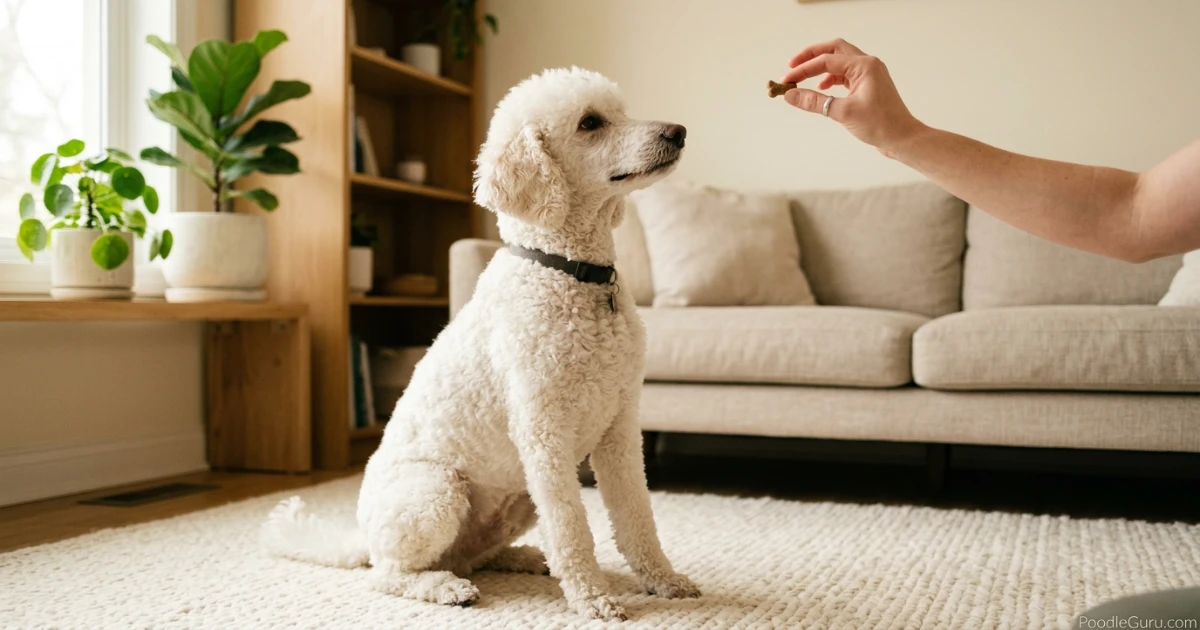
Don’t ignore your poodle entirely — that can increase frustration. Instead, briefly acknowledge them with a soft word, then redirect. Ask for a simple behavior like “sit” or “go to your mat,” and reward that calm action with the attention they sought. Over time, your poodle learns that quiet, polite behavior gets you to engage — whining does not.
For Anxiety Whining
Comfort is not the enemy. If your poodle whines from fear, you won’t reinforce the fear by providing calm presence. What you want to avoid is frantic, high-energy soothing that validates panic. Instead, sit quietly, offer gentle touch if your poodle seeks it, and work on long-term desensitization under the guidance of a force-free trainer or veterinary behaviorist. For severe separation anxiety, medication can be a compassionate and effective part of a treatment plan — discuss it with your vet.
For Boredom Whining
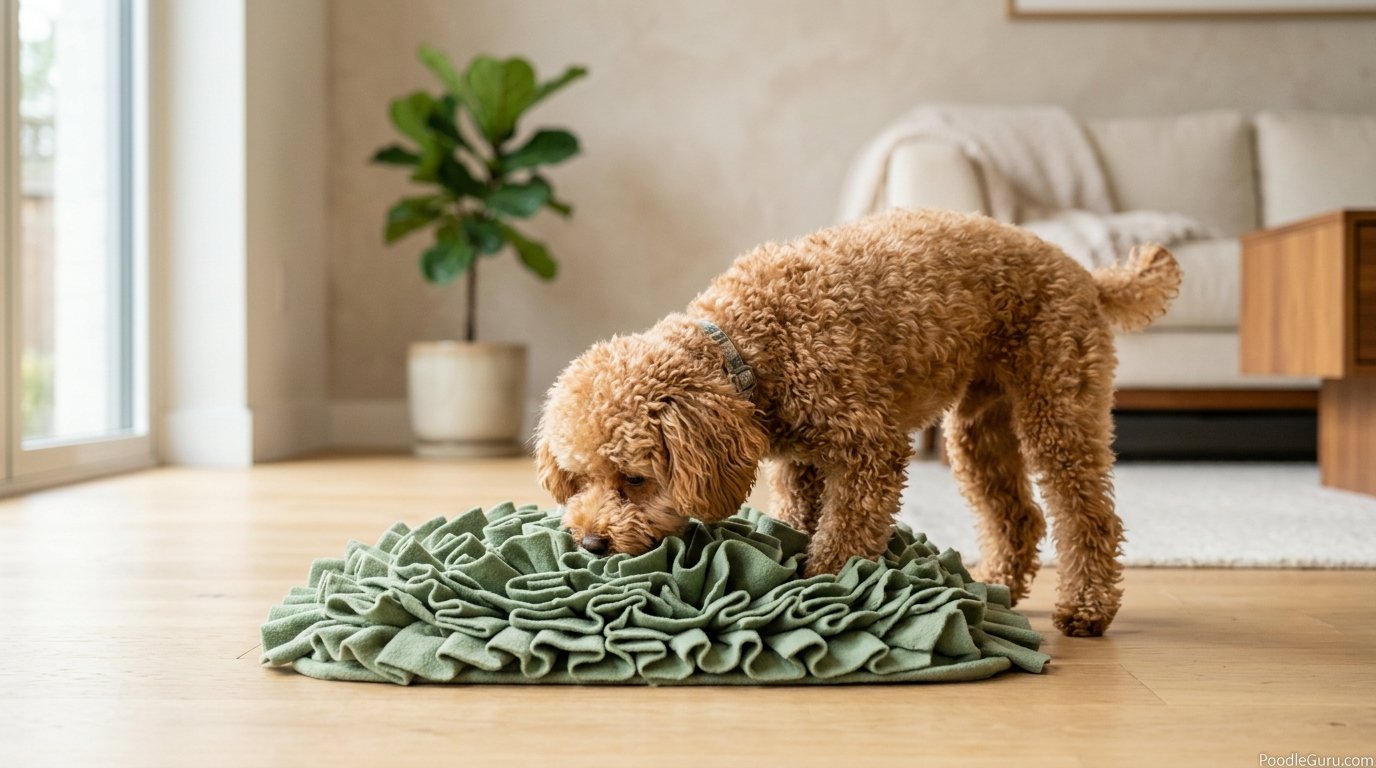
Boost daily enrichment. Replace a plain food bowl with puzzle toys. Add a midday sniff walk or a short training session. Rotate toys to keep them novel. A poodle with a full brain has far less reason to whine. Even five minutes of nose work can settle a restless poodle for hours.
Teach a “Quiet” Cue the Kind Way
Wait for a natural pause in the whining. Immediately mark “yes” and give a high-value treat. Repeat. Once your poodle offers pauses reliably, add the word “quiet” just before you think they’ll stop. This teaches that silence earns rewards — without any force or intimidation.
If you need step-by-step guidance on building calm behaviors, read the PoodleGuru training guide next.
When to Call a Vet or Behaviorist
Not all whining can be solved at home. Some situations need professional eyes and ears.
Veterinary Check First
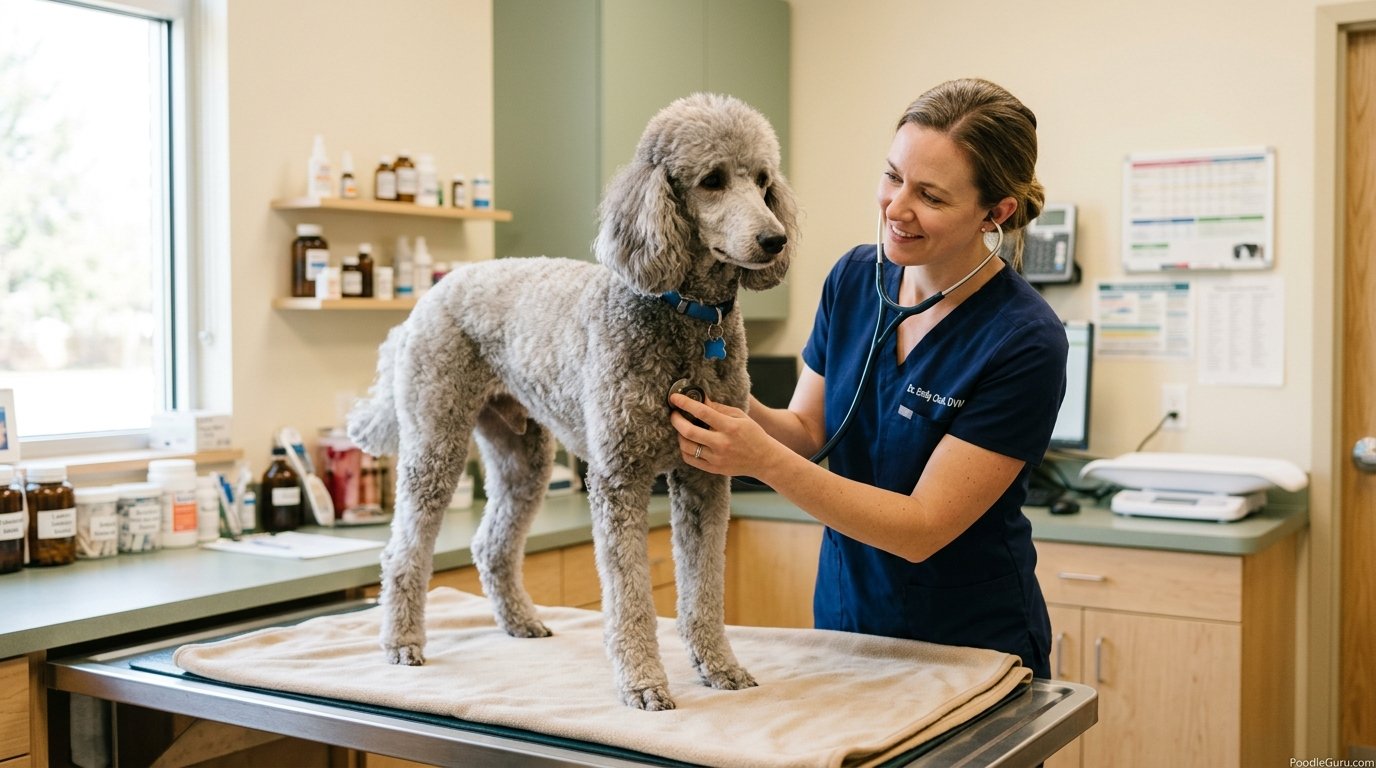
Any new, sudden, or escalating whining deserves a full veterinary exam — especially if it’s accompanied by changes in appetite, thirst, mobility, or bathroom habits. Blood work, joint assessment, or dental evaluation may uncover a hidden source of pain. Senior poodles benefit from a cognitive function assessment if whining seems disoriented or cyclical, especially at night.
🩺 When to Call the Vet
- Whining when touched in a specific area
- Whining at rest that interrupts sleep
- Whining paired with limping, shaking, or vomiting
- Night-time whining that appears suddenly in an older dog
When to Consult a Behavior Professional
If medical causes are ruled out and the whining is severe, persistent, or destructive, a certified separation anxiety trainer or a veterinary behaviorist can be transformative. Look for credentials like CDBC, CAAB, or a veterinarian with a behavior residency. The right professional will give you a customized plan that doesn’t rely on punishment — and they’ll support you through the process.
Frequently Asked Questions
Why does my poodle whine when I leave the room?
This is a classic sign of isolation distress or early separation anxiety. Poodles bond intensely with their people, and even brief separations can trigger whining. Start with very short absences where you return before the whining begins, and reward calm moments. For persistent cases, consult a separation anxiety specialist.
Is poodle whining a sign of pain?
It can be. Whining that appears suddenly, occurs at rest, or happens when a specific body part is touched often signals discomfort. A veterinary exam is the only way to confidently rule pain in or out. Don’t assume it’s behavioral without checking.
Can I train my poodle to stop whining without punishment?
Absolutely. The most effective approach is to identify why the whining happens, meet that need proactively, and reinforce quiet behavior with rewards. Teaching a “quiet” cue and offering engaging alternatives reduces whining far more reliably than corrections ever will.
Why does my poodle whine in the car?
Car whining usually comes from excitement, anxiety, or motion discomfort. Excitement whining is high-pitched and paired with alert body language. Anxiety whining often comes with panting, trembling, or lip licking. Short, positive practice trips with high-value treats can help both.
Do poodle puppies whine more than adults?
Yes. Puppies whine naturally to communicate needs to their mother — and they transfer that behavior to their human family. With consistent, kind training and the confidence that comes with maturity, most poodles whine less as adults. Excessive puppy whining that persists beyond the first few weeks at home may need a structured routine and more proactive potty breaks.
Why is my senior poodle whining at night?
Nighttime whining in older poodles often points to cognitive dysfunction (canine dementia), arthritis pain, hearing or vision loss, or a need to eliminate more frequently. A vet check can identify treatable causes. Predictable bedtime routines, night lights, and orthopedic bedding often bring significant relief.
Does whining mean my poodle is unhappy?
Not necessarily. Poodles whine for many reasons — joy, anticipation, and simple communication included. The context and your dog’s overall body language tell the true story. A poodle who whines with a wagging tail during a walk is probably very happy. A poodle who whines while hiding is not.
Key Takeaways: Poodle Whining at a Glance
Whining is your poodle’s way of sharing what’s happening inside. Listening well and responding thoughtfully builds trust — and usually quiets the behavior naturally. Here’s what to remember:
- Poodle whining is a normal, communicative behavior, not a character flaw — poodles are naturally more vocal and emotionally expressive than many breeds.
- The PoodleGuru Whine Decoder (sound + body language + context) helps owners identify the root cause instead of reacting to the noise alone.
- Common triggers include attention-seeking, anxiety, boredom, excitement, pain, and age-related cognitive changes — each requires a different response.
- Punishment and scolding often worsen whining by adding fear or anxiety; humane training focuses on meeting needs and teaching calm alternatives.
- Any sudden, persistent, or pain-associated whining warrants a veterinary exam before behavioral training begins.
- With the right mix of enrichment, predictable routine, and kind training, most poodle whining can be reduced to a level that feels manageable — and even endearing.