Poodle Eating Grass: 7 Real Reasons & Warning Signs
Poodle eating grass can look strange at first — your elegant dog suddenly grazing like a tiny sheep. In most cases, it is normal canine behavior, but the pattern, timing, vomiting, appetite, and lawn safety tell you whether to relax, redirect, or call your veterinarian.
Quick Answer
In the vast majority of cases, poodle eating grass is completely normal canine behavior. It’s rarely a sign of illness, and most grass-eating poodles are healthy, well-fed dogs acting on instinct, curiosity, or mild digestive self-regulation. The behavior only becomes concerning when it’s sudden, excessive, paired with repeated vomiting, or accompanied by lethargy and appetite loss. For most poodle owners, the right response is calm observation — not panic.
What Grass Eating Actually Means in Poodles
Grass eating is a behavior that spans nearly all dog breeds, and poodles are no exception. Toy, Miniature, Moyen, and Standard poodles all do it. The behavior is so widespread that veterinary researchers consider it a normal part of the canine behavioral repertoire — not a pathology.
For poodle owners specifically, this matters because poodles are an observant, sensitive breed. They notice things. They form habits. And their owners tend to be equally observant — which means a poodle grazing in the yard gets noticed more than a laid-back Labrador doing the same thing.
The most important thing to understand is this: grass eating alone, without other symptoms, is not evidence that your poodle is sick, nutritionally deficient, or psychologically distressed. It’s a behavior with multiple possible explanations — most of them harmless.
Quick Facts: Poodle Eating Grass at a Glance
How Common Is It?
Extremely common. Most poodle owners will witness grass eating at some point. It’s a normal canine behavior observed across all poodle sizes.
Is It Dangerous?
Rarely. The main risks come from chemically treated lawns, toxic plants mixed with grass, or grass awns that can lodge in the throat or digestive tract.
Does It Mean My Poodle Is Sick?
Usually not. Most grass-eating poodles are perfectly healthy. A sudden increase combined with other symptoms warrants attention, but grass eating alone is not diagnostic of illness.
Will It Make My Poodle Vomit?
Sometimes, but less often than owners expect. The link between grass eating and vomiting is weaker than conventional wisdom suggests.
Should I Stop It?
In most cases, occasional grazing on untreated grass doesn’t need intervention. Constant, obsessive, or risky grass eating does require management.
Do Puppies Do It More?
Yes. Poodle puppies explore the world with their mouths, and grass is no exception. The behavior often decreases with age but may persist as a habit.
The Most Common Reasons Your Poodle Eats Grass
There’s no single answer that fits every poodle. The behavior sits at the intersection of instinct, digestive physiology, and individual habit. Below are the most widely recognized explanations, organized by what veterinary guidance and behavioral observation tell us.
| Reason | What It Looks Like | What Poodle Owners Should Know |
|---|---|---|
| Ancestral Instinct | Casual, unhurried grazing with no signs of distress before or after | Wild canids consume plant matter as part of their natural diet. This instinct persists in domestic dogs, including poodles. It’s not a flaw — it’s evolution. |
| Digestive Self-Regulation | Eating grass and then vomiting within minutes, or eating grass when stomach seems unsettled | Some dogs appear to use grass to induce vomiting when they feel nauseous. But this is less common than owners assume. Many poodles eat grass and never vomit. |
| Boredom or Habit | Repetitive grazing in the same area, especially when alone in the yard | Poodles are intelligent dogs. An under-stimulated poodle finds ways to occupy itself. Grass eating can become a self-reinforcing habit if there’s nothing more interesting to do. |
| Dietary Fiber Interest | Seeking out specific types of grass or plant material | Some dogs may crave the texture or roughage that grass provides. This doesn’t necessarily mean the diet is deficient — it may simply reflect a preference for variety. |
| Attention-Seeking | Glancing at the owner while grazing, or starting the behavior when the owner is watching | Poodles are highly attuned to human reactions. If grass eating reliably gets your attention — even negative attention — a clever poodle may learn to repeat the behavior. |
| Sensory Exploration | Sniffing, mouthing, and sampling grass during walks or new environments | Poodles experience the world partly through their mouths. Young poodles and puppies are especially mouth-oriented explorers. |
Expert Insight
Veterinary guidance generally recommends evaluating grass eating as part of your poodle’s overall behavior picture — not as an isolated symptom. A poodle who eats grass occasionally, maintains normal energy and appetite, and shows no digestive distress is almost certainly fine. The behavior becomes clinically relevant only when it’s paired with other concerning signs.

Normal Grass Eating vs. Concerning Grass Eating
This is the distinction most poodle owners need help making. The table below gives you a practical framework for deciding whether your poodle’s grass eating falls into the “watch and relax” category or the “take action” category.
| Characteristic | Normal Grass Eating | Concerning Grass Eating |
|---|---|---|
| Frequency | Occasional — once every few days or less | Sudden increase to multiple times daily |
| Duration | Brief — a few nibbles, then moves on | Prolonged — obsessively grazing for minutes at a time |
| Vomiting | Rare or absent | Repeated vomiting, especially with bile or blood |
| Energy Level | Normal — playful, alert, responsive | Lethargic, withdrawn, or unusually quiet |
| Appetite | Normal — eats meals willingly | Refusing food or showing reduced interest in meals |
| Stool Quality | Normal — formed, consistent | Diarrhea, constipation, or visible grass in stool repeatedly |
| Behavioral Context | Relaxed, casual grazing | Frantic, urgent, or compulsive eating |
If your poodle’s grass eating maps entirely to the left column, you can breathe easy. If you’re seeing one or more signs from the right column — especially in combination — it’s time to pay closer attention and consider a vet visit.
When Poodle Grass Eating Becomes a Warning Sign
Grass eating shifts from “interesting quirk” to “potential problem” when it’s part of a larger pattern. Here’s what that pattern looks like:
- Grass eating plus repeated vomiting. Occasional vomiting after grass is one thing. Vomiting multiple times in a day, especially if it contains yellow bile or blood, is another entirely.
- Grass eating plus appetite loss. A poodle who skips meals and turns to grass instead may be experiencing nausea, gastrointestinal discomfort, or a systemic issue.
- Grass eating plus lethargy. Poodles are generally alert and engaged dogs. A poodle who grazes listlessly and shows no interest in normal activities needs veterinary assessment.
- Frantic or compulsive grass eating. If your poodle seems desperate to eat grass — pulling toward it, gulping it urgently, unable to be redirected — this may signal acute nausea or abdominal pain.
- Grass eating on treated lawns. Pesticides, herbicides, and fertilizers can be toxic. If your poodle eats grass in a public park, a neighbor’s yard, or any area where chemicals may have been applied, the risk profile changes immediately.
When to Call a Vet
Contact your veterinarian if your poodle shows any combination of these signs: sudden excessive grass eating, repeated vomiting, diarrhea lasting more than 24 hours, refusal to eat for more than one meal, visible abdominal discomfort (pacing, whining, stretching), or any ingestion of grass from a chemically treated area. Early intervention is always safer than waiting.

The PoodleGuru Grass Eating Evaluation Method
At PoodleGuru, we evaluate grass eating using a simple 3-step framework that any owner can apply in real time. This method prioritizes calm observation over reactive intervention — because the wrong response can turn a harmless behavior into a source of anxiety for both you and your poodle.
Observe the Context
Before reacting, note exactly what’s happening. Is your poodle casually nibbling or urgently gulping? Is the grass treated or untreated? What was your poodle doing right before the grazing started — playing, resting, or already seeming unsettled? Write down or mentally note the time of day, the setting, and what happened immediately before and after. Context is everything.
Assess the Pattern
A single episode means very little. A pattern over several days means more. Track frequency: once daily, multiple times daily, or occasional? Track outcomes: vomiting or no vomiting? Track appetite and energy: normal or changed? Use the Normal vs. Concerning table above as your reference. The key question is whether the behavior is stable or escalating.
Take Measured Action
If the pattern is normal (occasional, no vomiting, normal appetite and energy): do nothing except ensure your poodle only has access to untreated grass. If the pattern is mixed (more frequent but no other symptoms): increase supervision, add enrichment activities, and monitor for one week. If the pattern is concerning (frequent, vomiting, appetite loss, lethargy): schedule a veterinary evaluation and describe what you’ve observed — your notes from Steps 1 and 2 will help your vet immensely.
How to Respond When Your Poodle Eats Grass
Your reaction shapes your poodle’s behavior more than you might realize. Here’s what to do — and what to avoid — in the moment:
Do This
- Stay calm. Reacting with alarm can create anxiety in a sensitive poodle. A tense owner makes a tense dog.
- Redirect gently. Call your poodle’s name, offer a high-value treat, or initiate a brief play session. The goal is interruption, not punishment.
- Check the environment. Make sure the grass hasn’t been treated with chemicals and doesn’t contain toxic plants or sharp seed awns.
- Note the episode. A quick mental note about when and how it happened builds a useful record if patterns develop.
Avoid This
- Don’t punish. Scolding, leash-jerking, or yelling will not stop the underlying behavior. It will only damage trust and may increase anxiety-driven grazing.
- Don’t chase. Running after your poodle to pull grass from its mouth can turn the behavior into an exciting game — exactly the opposite of what you want.
- Don’t ignore escalation. If the behavior is becoming more frequent or intense, wishful thinking isn’t a strategy. Track it and, if needed, call your vet.
What Poodle Owners Usually Misunderstand About Grass Eating
Several persistent myths surround this topic. Clearing them up saves unnecessary worry and prevents misguided interventions.
Myth: Grass eating always means an upset stomach. Reality: Most grass-eating dogs show no signs of gastrointestinal distress before or after. The VCA Animal Hospitals notes that fewer than 25% of dogs regularly vomit after eating grass, and many dogs graze with no ill effects whatsoever.
Myth: Poodles eat grass because their diet is missing something. Reality: Well-nourished dogs on complete, balanced diets eat grass too. While a very small number of dogs may seek roughage due to low dietary fiber, most grass-eating poodles are not nutritionally deficient. Switching foods without veterinary guidance is more likely to cause digestive upset than to solve grass eating.
Myth: Stopping grass eating requires a training intervention. Reality: For most occasional grazers, no intervention is needed at all. For habitual grazers, the solution is usually environmental enrichment — not obedience training. A mentally engaged poodle is less likely to graze out of boredom.
Myth: Only sick or anxious dogs eat grass. Reality: Many completely healthy, well-adjusted poodles enjoy the occasional grass snack. It’s a normal behavior, not a symptom.
How to Reduce Excessive Grass Eating in Poodles
If your poodle’s grass eating crosses into “too frequent” territory but there are no concerning symptoms, try these owner-led adjustments before escalating to a veterinary visit:
Increase Mental Stimulation
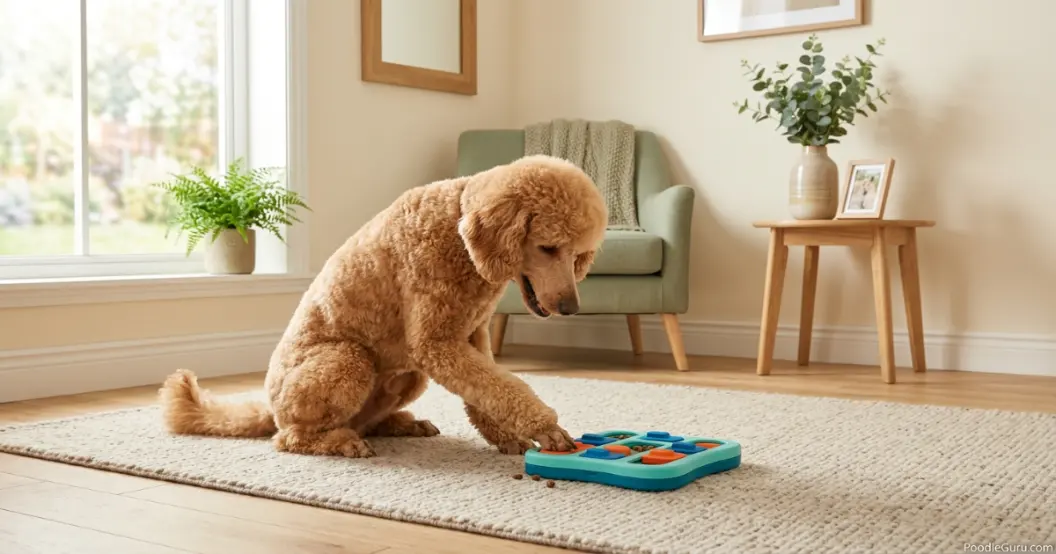
Poodles are among the most intelligent dog breeds. A bored poodle invents its own activities — and grazing can become one of them. Puzzle feeders, scent games, short training sessions, and rotating toy selections give your poodle’s brain something better to do than nibble the lawn.
Add Dietary Roughage Thoughtfully
Some poodles genuinely enjoy fibrous textures. You can offer safe alternatives: a few steamed green beans, a small piece of carrot, or vet-approved dog-safe vegetables. These provide satisfying crunch without the risks of lawn grass. Always introduce new foods gradually and in moderation.
Supervise Yard Time Differently
If your poodle grazes when left alone in the yard, change the pattern. Stay outside together and engage your dog in a quick game of fetch or a brief training drill. Breaking the solitary-grazing loop with positive interaction often reduces the behavior naturally.
Owner Tip
Some poodle owners find that offering a small, fibrous snack before yard time — like a few carrot sticks or a chew that occupies the mouth — reduces grass eating during outdoor sessions. It’s not a guaranteed fix, but it’s a simple, low-risk strategy worth trying.
When to Make the Veterinary Call
Most grass eating doesn’t require a vet visit. But certain combinations of signs do. Here’s a practical decision guide:
- Call your vet today if your poodle has eaten grass from a lawn you know or suspect was chemically treated, even if no symptoms are present yet.
- Schedule a visit if grass eating has increased sharply over 3–5 days and is accompanied by vomiting, diarrhea, appetite loss, or lethargy.
- Seek emergency care if your poodle shows signs of bloat (unproductive retching, distended abdomen, restlessness, pacing, excessive drooling), has ingested a toxic plant along with grass, or is vomiting repeatedly with blood or dark material.
Poodles, particularly Standard Poodles, have a higher risk profile for bloat (gastric dilatation-volvulus) than some other breeds. If your poodle is eating grass frantically and showing any bloat symptoms, do not wait — go to the nearest emergency veterinary hospital immediately. The AKC breed profile for poodles highlights the importance of understanding breed-specific health considerations, including bloat awareness, as part of responsible ownership.

Frequently Asked Questions
Is it normal for my poodle to eat grass every day?
Daily grass eating can be normal if it’s brief, casual, and not paired with vomiting or other symptoms. However, if daily grazing is a new behavior or has intensified recently, it’s worth tracking with the PoodleGuru Evaluation Method. A sudden shift from occasional to daily grazing deserves attention — especially in adult or senior poodles.
Will eating grass make my poodle vomit?
Not necessarily. While some dogs vomit after eating grass, veterinary observation suggests fewer than a quarter of grass-eating episodes result in vomiting. Many poodles eat grass casually and digest it without any visible reaction. If your poodle vomits every time it eats grass, that pattern warrants a veterinary check.
Should I stop my poodle from eating grass?
For occasional grazing on untreated, safe grass, there’s no urgent need to intervene. If the grass may be chemically treated, if your poodle eats it obsessively, or if the behavior is paired with digestive symptoms, then gentle redirection and environmental management are appropriate first steps.
Can grass eating be a sign of nutritional deficiency in poodles?
It’s possible but uncommon. Most grass-eating poodles are on nutritionally complete diets and are not deficient. If you’re concerned about your poodle’s diet, consult your veterinarian before making changes. Switching foods without guidance can create digestive issues that make the behavior worse, not better.
Is grass treated with pesticides dangerous for my poodle?
Yes. Pesticides, herbicides, and fertilizers can be toxic to dogs. If your poodle has eaten grass from a treated lawn, note the product if possible and call your veterinarian or a pet poison helpline. Even if no symptoms appear immediately, some chemicals cause delayed effects that require prompt medical attention.
Why does my poodle eat grass only in the morning?
Morning grass eating often relates to an empty stomach after the overnight fast. Some dogs nibble grass when stomach acids build up before breakfast. If the behavior is brief and your poodle eats breakfast normally afterward, it’s usually harmless. Offering a small bedtime snack can sometimes reduce morning grazing.
Do poodle puppies eat grass more than adult poodles?
Yes, generally. Puppies explore the world through their mouths, and grass is a novel texture worth investigating. Most puppies reduce mouth-exploration behaviors as they mature, though some carry the grass-eating habit into adulthood. Supervise puppy grass eating carefully — young digestive systems are more sensitive, and puppies are less selective about what they put in their mouths.
Key Takeaways: Poodle Grass Eating
Grass eating is one of those behaviors that looks alarming but is usually harmless. Here’s what to remember:
- Grass eating is a normal canine behavior observed across all poodle sizes — Toy, Miniature, Moyen, and Standard — and is rarely a sign of illness when it occurs in isolation.
- The behavior has multiple explanations: ancestral instinct, digestive self-regulation, boredom, sensory exploration, dietary fiber interest, and attention-seeking are the most common drivers in poodles.
- Fewer than 25% of grass-eating episodes result in vomiting, and most grass-eating poodles are healthy, well-nourished dogs acting on normal impulses.
- Concerning patterns include sudden escalation, repeated vomiting, appetite loss, lethargy, frantic or compulsive grazing, and any grass eating from chemically treated lawns.
- The PoodleGuru Grass Eating Evaluation Method — Observe the Context, Assess the Pattern, Take Measured Action — gives owners a practical, calm framework for deciding whether to watch, manage, or seek veterinary care.
- Mental enrichment, supervised yard time, and offering safe fibrous alternatives are the most effective owner-level strategies for reducing excessive grass eating in poodles.
- Standard Poodles carry an elevated risk for bloat (GDV). Frantic grass eating combined with unproductive retching, a distended abdomen, or restlessness requires immediate emergency veterinary attention.
Next step: Explore the Complete Poodle Health Guide to build a proactive wellness routine for your poodle.