Are Poodles Easy to Potty Train? 7 Proven Tips for New Owners
Are poodles easy to potty train? Yes — with one important condition: smart puppies still need a clear routine. This guide walks new owners through size-specific timelines, a proven step-by-step routine, crate training, accident prevention, and the common traps that delay success.

Quick Answer
Yes, poodles are generally easy to potty train. Their high intelligence and eagerness to please make them quick learners. But “easy” doesn’t mean automatic. Success depends on a strict schedule, early crate introduction, and understanding size‑specific differences — a Toy Poodle’s bladder isn’t the same as a Standard’s.
Ranked among the easiest
Breeders and trainers often place poodles in the top 10 easiest dogs to housebreak. Their desire to keep their living space clean is strong.
Smaller size = shorter hold times
Toy Poodles can only hold their bladder for about 2‑3 hours at 8 weeks. Standards may stretch to 3‑4 hours at the same age.
Puppy pads can delay progress
Over‑reliance on indoor pads often confuses a poodle who naturally wants to go outside. Use them as a temporary tool, not a long‑term solution.
Why Poodles Are Considered Easy to Housebreak
Three poodle traits work in your favor during potty training. First, this breed has a natural den instinct — they don’t like to soil where they sleep. Second, poodles are incredibly food‑motivated and praise‑driven, which means a small treat right after a correct potty goes a long way. Third, they read patterns faster than most dogs. If you take your puppy out the same door, to the same spot, at the same times, a poodle will often start sitting by that door within a week.
But intelligence cuts both ways. A smart poodle will also learn bad habits just as quickly if you’re inconsistent. If they learn that crying in the crate gets them out, or that pottying on the rug only sometimes gets a reaction, they’ll game the system. The key is crystal‑clear communication from day one. The AKC’s potty training fundamentals underscore that consistency, not strictness, is what builds reliable habits.
Toy vs Miniature vs Standard: Potty Training Speed Compared
Size plays a bigger role than you might think. A smaller bladder means more frequent trips outside, and that can make or break your perception of “easy.”
| Factor | Toy Poodle | Miniature Poodle | Standard Poodle |
|---|---|---|---|
| Bladder capacity (adult) | Smallest; may need to go every 3‑4 hours | Moderate; 4‑6 hours | Larger; can often hold 6‑8 hours overnight |
| Typical fully trained age | 5‑7 months (can be longer) | 4‑6 months | 4‑5 months |
| Biggest challenge | Tiny bladder and fast metabolism; accidents are small but frequent | Alert barking and excitement can trigger sudden urges | Large area to cover; puppy may not signal clearly from another room |
| Best potty spot strategy | Indoor turf box or frequent outdoor access | Structured outdoor schedule | Outdoor yard or walk routine |
| Owner mistake to avoid | Carrying everywhere — prevents learning to signal | Assuming smaller size means less need for structure | Expecting full overnight control too early |
The PoodleGuru Potty Training Success System
At PoodleGuru, we break potty training into three layers. Master these and you’ll move past the “are poodles easy to potty train” question and into real, predictable results.
Schedule precision
Puppies need potty breaks after waking, eating, drinking, playing, and every 30‑60 minutes otherwise. Set a timer. A written log of potty times helps you spot patterns.
Location consistency
Always take your poodle to the same outdoor spot. The scent triggers the urge to go. Pair the spot with a command like “go potty” and reward immediately — treat, then play.
Supervision & confinement
Your poodle is either in your sight, in a crate, or tethered to you. No unsupervised roaming. This prevents accidents and builds the habit of holding it until the right place.
Step‑by‑Step Routine: From 8 Weeks to Fully Housebroken
A predictable week‑by‑week plan removes guesswork. Adjust based on your individual poodle, but stick to the structure.
Week 1: The Foundation (8‑9 weeks)
Take your puppy out every hour on the hour during the day, plus after every nap, meal, and play session. Carry them to the spot to avoid mid‑route accidents. Use a high‑value treat the moment they finish. No free roaming.
Week 2: Stretch the Intervals
Gradually extend to every 90 minutes when accidents are rare. Keep night trips short and boring — no play. By the end of this week, many puppies start heading toward the door.
Week 3‑4: Adding a Signal
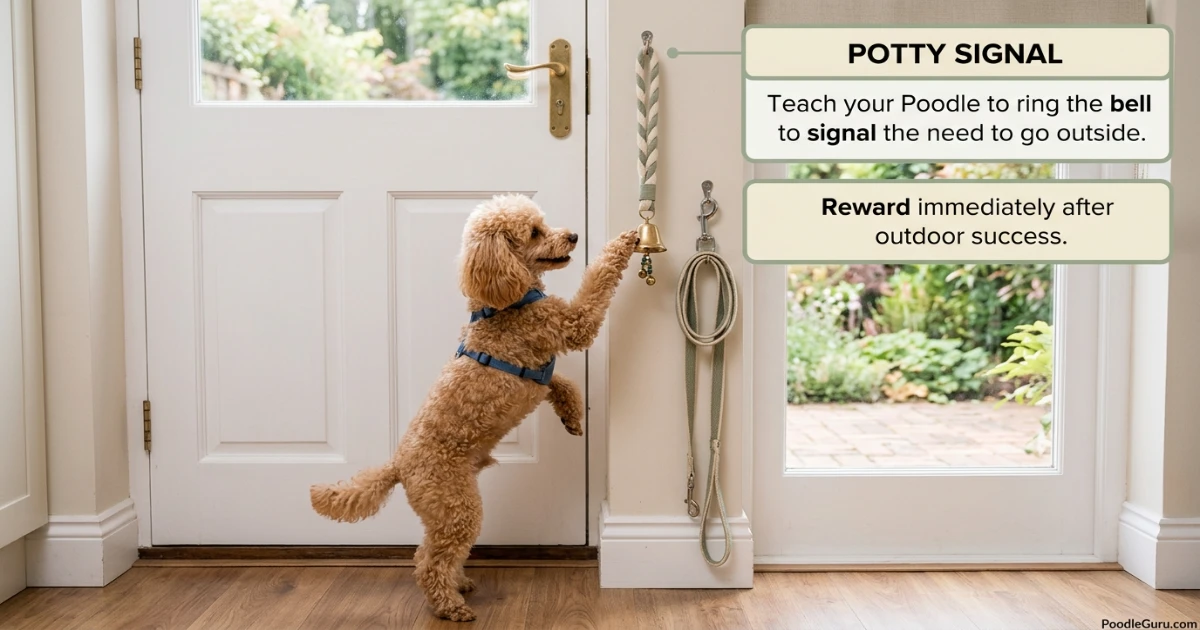
Hang a bell on the door and ring it with your puppy’s paw every time you go out. Reward. Soon they’ll ring it on their own. This phase often brings rapid improvement.
Week 5 and Beyond: Maintenance
By now your poodle may be reliable at home during the day. Continue the routine for at least 2 more weeks without accidents before you loosen the schedule. Nighttime control usually comes last, especially for Toys.
Crate Training: The Backbone of Fast Housebreaking
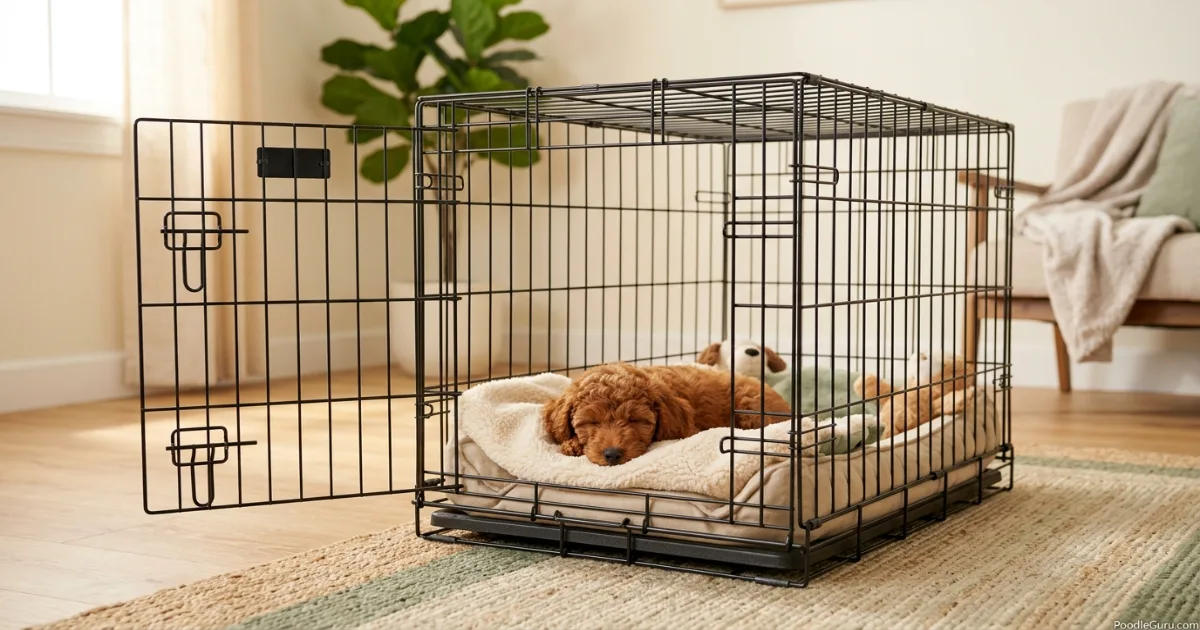
A crate, properly used, isn’t a cage — it’s a poodle’s personal den. Dogs avoid soiling their den, so a correctly sized crate teaches bladder control naturally. The crate should be just large enough to stand, turn around, and lie down. If it’s too big, your poodle may use one end as a bathroom.
Introduce the crate with meals, treats, and short sessions while you’re home. Never use it as punishment. At night, place the crate next to your bed. A young puppy will wake you when they need to go. That’s a good thing — it builds communication. For tips on balancing crate training with overall poodle puppy training milestones, see our full timeline guide.
Expert Insight: Overnight Strategy
Remove water 2 hours before bedtime. Take the puppy out right before you sleep. Expect at least one middle‑of‑the‑night trip until 12‑14 weeks. This temporary effort pays off in long‑term reliability.
6 Mistakes That Slow Poodle Housebreaking
Even with a smart dog, small errors can extend the process by months. Here are the most common ones, and exactly how to fix them.
Punishing accidents
Rubbing a poodle’s nose in it or yelling doesn’t teach where to go — it teaches them to hide from you when they need to potty. If you catch them in the act, clap gently to interrupt, then immediately take them outside and reward heavily when they finish in the right spot.
Giving too much freedom too soon
Allowing a puppy unsupervised access to the whole house before they’re reliable is a setup for hidden accidents. Gate off one or two rooms and expand access only after 3‑4 weeks of zero mistakes.
Inconsistent schedule
Poodles thrive on routine. If you take them out at 7 AM on Monday, 9 AM on Tuesday, and skip the post‑nap trip on Wednesday, they can’t build a reliable internal clock. Stick to the same times every day.
Using potty pads as a permanent fix
Pads teach that going inside is acceptable. Transition off pads as soon as your puppy is vaccinated and can safely go outside. If you must use them temporarily, move them closer to the door each day.
Not cleaning accidents with an enzymatic cleaner
Regular household cleaners don’t fully remove the scent. A poodle’s sensitive nose will still smell it and be drawn back to the same spot. Use an enzyme‑based cleaner specifically for pet messes.
Ignoring subtle signals
Circling, sniffing the floor, or suddenly walking away from play are urgent signs. Miss them a few times and your puppy stops trying to tell you. The bell method helps, but you still need to watch for the quiet cues.
Setbacks, Regressions, and When to Reset
Regressions happen. A 5‑month‑old Miniature who seemed perfect may suddenly have accidents again. Common causes include teething, a change in routine, or a stressful event like a vet visit. Don’t panic — and don’t abandon the system. Instead, go back to the basics for one week: more frequent trips out, tethering, and logging every success. Most regressions resolve quickly with that reset. If accidents increase sharply with no obvious trigger, a vet check is wise to rule out a urinary tract infection.
When Potty Accidents Signal a Health Issue
Not every accident is a training failure. Poodles, especially females, can be prone to urinary tract infections that cause sudden urgency. Other health conditions like bladder stones, diabetes, or kidney issues can also lead to frequent urination. If your previously reliable poodle suddenly has multiple accidents, strains to urinate, or licks their genitals excessively, see your vet promptly. Always rule out a medical cause before assuming it’s behavioral. The VCA’s overview of UTIs in dogs is a helpful resource for understanding symptoms.
What First‑Time Poodle Owners Should Know Before They Start
If you’re bringing home a poodle puppy, your potty training mindset matters just as much as the method. Here’s what separates smooth experiences from frustrating ones.
Buyer/Adopter Checklist
Before your puppy arrives, have a crate, enzymatic cleaner, high‑value treats, a leash, and a designated potty spot ready. Know who will take the 3 AM shift. Plan the first week as a team.
Choose a breeder who starts early
Responsible breeders often introduce a potty area in the whelping box as early as 4 weeks. Puppies from breeders who begin this process often housebreak faster. Ask about it when you visit.
Realistic expectations
Even the fastest poodle won’t be 100% reliable before 4‑5 months. Toy poodles may take longer. Expect accidents, and measure progress in weeks, not days.
Frequently Asked Questions
Are poodles really easier to potty train than other dogs?
Yes, on average. Their intelligence and strong desire to please give them an edge. But the owner’s consistency is still the deciding factor. A poodle isn’t magically housebroken; they just learn routines faster when the routine is clear.
At what age is a poodle fully potty trained?
Most poodles reach reliable daytime control by 4‑5 months, with full nighttime control often by 6 months. Toy Poodles may need until 7 months because of smaller bladder capacity.
Should I use puppy pads for a Toy Poodle?
Puppy pads can work as a short‑term bridge, especially in apartments. Transition off them as soon as your puppy can go outside safely. Otherwise, you risk teaching your Toy that indoors is an acceptable bathroom.
How long can a poodle puppy hold its bladder?
A general rule: one hour per month of age plus one. An 8‑week‑old Standard may hold it for about 3 hours; a Toy of the same age might only manage 2. Nighttime can be slightly longer but never push it.
Why does my poodle have accidents when excited?
Excitement urination is common in young puppies, especially submissive ones. It’s not a housebreaking failure. Greet calmly, avoid hovering, and take them out before exciting events. They usually outgrow it.
Can an adult rescue poodle be potty trained?
Absolutely. Adult poodles can learn new routines with the same schedule‑based approach. A rescue may need an initial “reset” period of strict crate and schedule for 2‑3 weeks to build new habits.
What if my poodle refuses to go outside in the rain?
Many poodles dislike wet weather. Teach a rain routine: use an umbrella, a covered area, or a potty tray on a covered porch. Reward heavily for going in the rain. With consistency, reluctance usually fades.
Key Takeaways
- Poodles are generally easy to potty train due to high intelligence, eagerness to please, and natural den‑keeping instincts.
- Smaller sizes require more frequent outings — a Toy Poodle can only hold its bladder 2‑3 hours at 8 weeks, while a Standard can manage 3‑4.
- The PoodleGuru Potty Training Success System relies on schedule precision, location consistency, and constant supervision or crate training.
- Crate training accelerates the process by leveraging the poodle’s instinct not to soil their sleeping area; use it positively, never as punishment.
- Regressions are normal around teething or routine changes; resetting to a strict schedule for one week usually solves them.
- Always rule out a urinary tract infection or other health issue if a previously reliable poodle suddenly starts having frequent accidents indoors.
Start today with a written schedule and a timer. Within a few weeks, you’ll likely be asking a different question: “Why didn’t I try this earlier?”