Poodle Eye Discharge: Normal vs Problem Signs Every Owner Should Know
Quick Answer: Some Poodle eye discharge is totally normal — a clear, watery tear overflow that leaves a faint dampness. But yellow, green, or thick mucus, a sudden increase in tearing, redness, squinting, or odor all point to a problem that needs a vet. For a breed with prominent eyes and sensitive skin, learning the difference between benign tear staining and infection is essential. The rule of thumb: clear and minimal is fine; colored, goopy, or uncomfortable is not.
Poodle owners tend to notice eyes. They’re expressive, dark, and framed by that iconic curly coat — and when something goes wrong, it shows. A little crust in the corner after a nap doesn’t alarm anyone, but the shift from occasional wetness to constant, sticky, or oddly colored Poodle eye discharge can happen gradually enough to be missed. And Poodles, being stoic, won’t always tell you they’re hurting.
This guide walks you through the fine line between a healthy, tearing eye and one that needs medical attention. You’ll learn what causes discharge in the first place, how to read the color and consistency, how to safely clean the area, and when to stop home treatment and call a veterinarian. Because your Poodle’s vision — and comfort — depend on you catching the subtle signs before they become serious.
Small dark crusts at inner corner (dried tears)
No odor, rubbing, or redness
More wiping than usual
Occasional squinting in bright light
Thick, sticky mucus that returns quickly
Eye held shut, pawing at face, swelling
Why Poodles Are Prone to Eye Discharge in the First Place
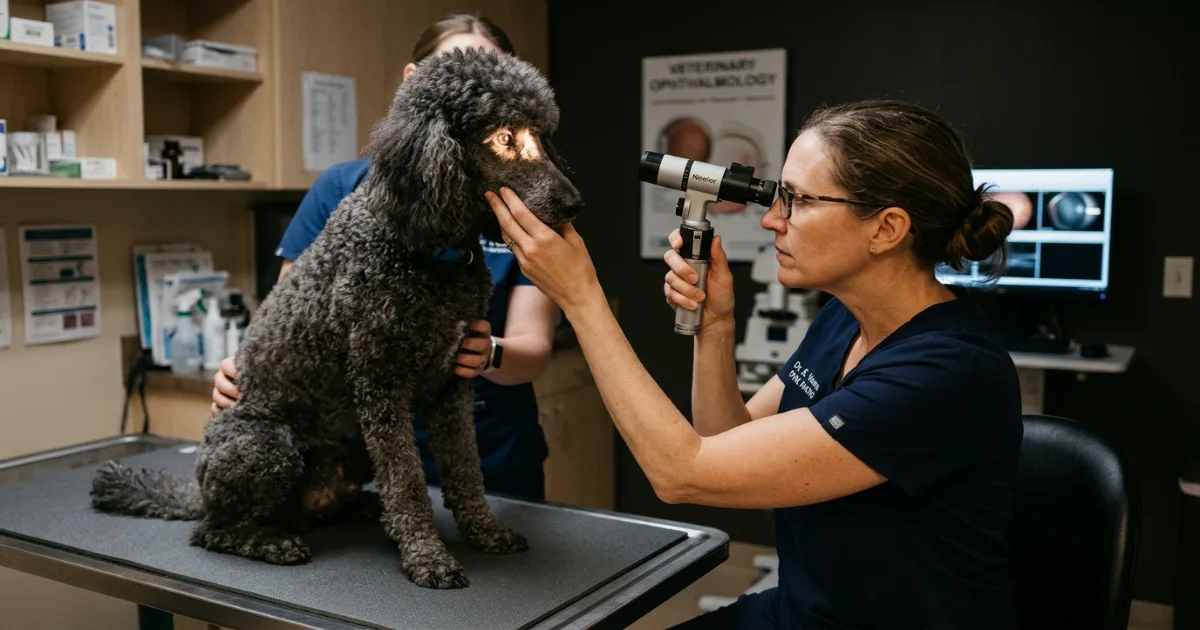
Poodles weren’t designed by nature to have those deep-set, forward-facing eyes and the heavy topknot that falls over them. The breed’s facial structure — particularly in Toy and Miniature Poodles with rounder skulls and shallower eye sockets — makes their eyes more exposed and more prone to irritation. Add hair that can rub the cornea, and you have a recipe for chronic tearing.
Tear production itself is a protective mechanism. The eye constantly produces tears to lubricate the surface, flush away debris, and maintain a healthy cornea. Those tears drain through tiny openings called puncta in the inner corner of the eyelids, then travel down the nasolacrimal duct into the nose. In many Poodles, that duct is narrow, partially blocked, or even absent from birth — a condition called imperforate punctum. When tears can’t drain properly, they spill over the lid margin and cascade down the face. That overflow is what owners see as discharge.
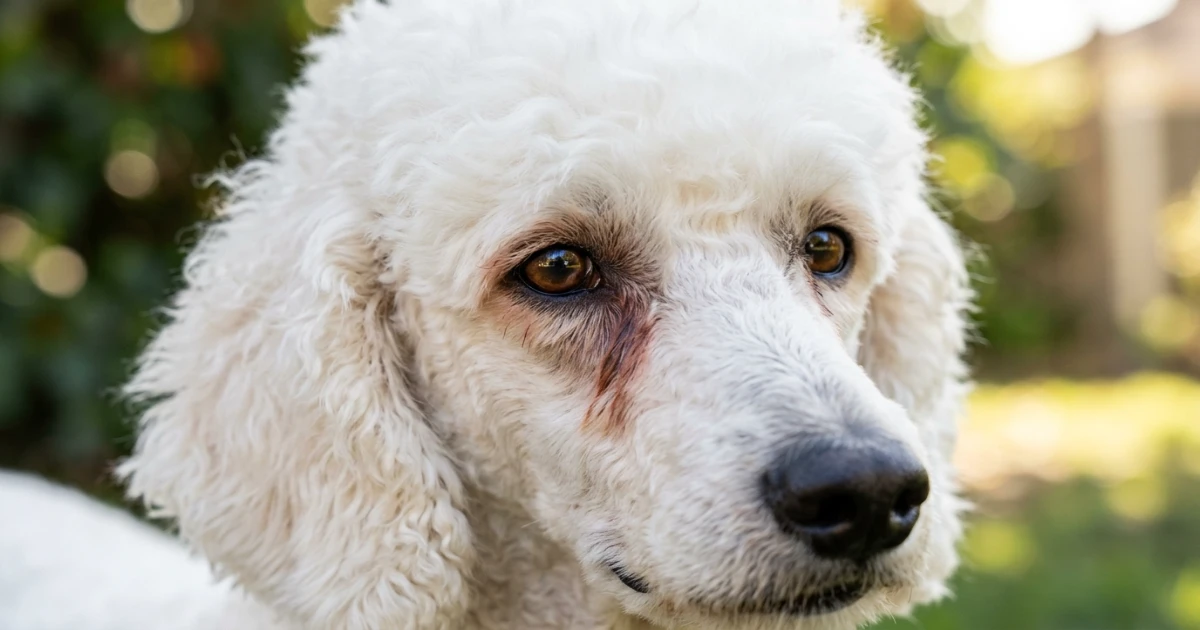
Compounding this, the hair around Poodle eyes wicks moisture outward, holding it against the skin. The result is not just wet fur but reddish-brown staining from porphyrins — iron-containing molecules found in tears and saliva. That staining is cosmetic, not a sign of infection, but it’s often the first thing owners notice and worry about. Learning to distinguish staining from true discharge is half the battle.
🐩 Expert Insight: “I see Poodles of all sizes with tear staining, and the most common question is ‘Is it infected?’ In most cases, no — it’s a drainage issue combined with the normal pigments in tears. But if the eye itself looks red, the dog is squinting, or the discharge changes from watery to thick, that’s a problem I want to examine.” — Dr. Catherine Voss, DVM, DACVO, veterinary ophthalmologist
Normal Poodle Eye Discharge: What Healthy Looks Like
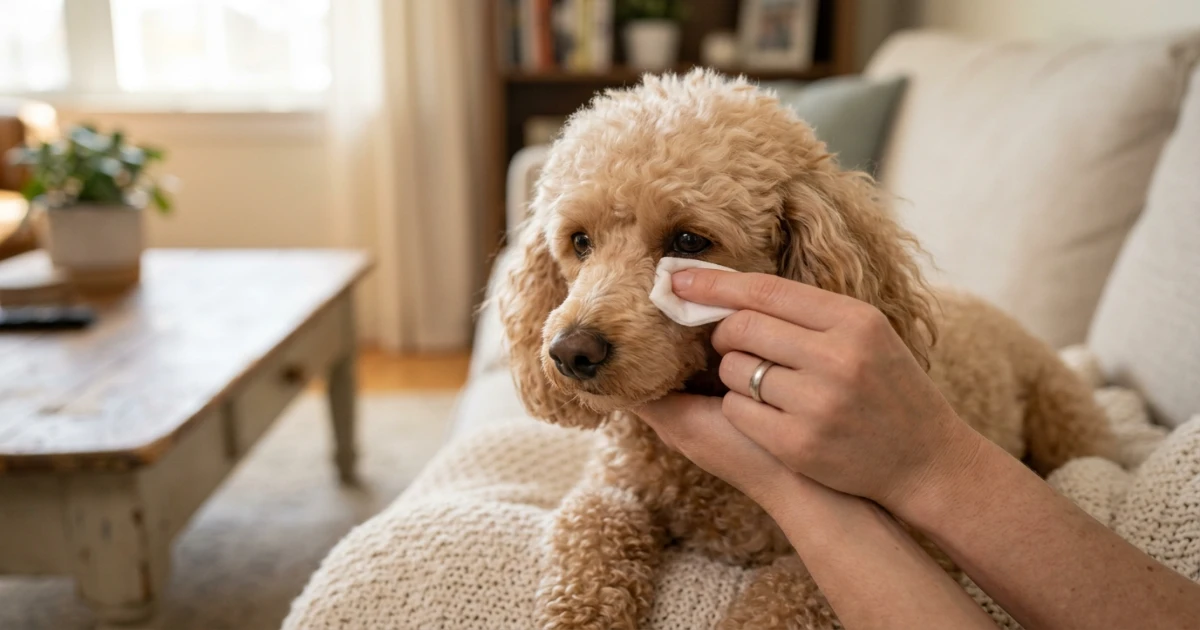
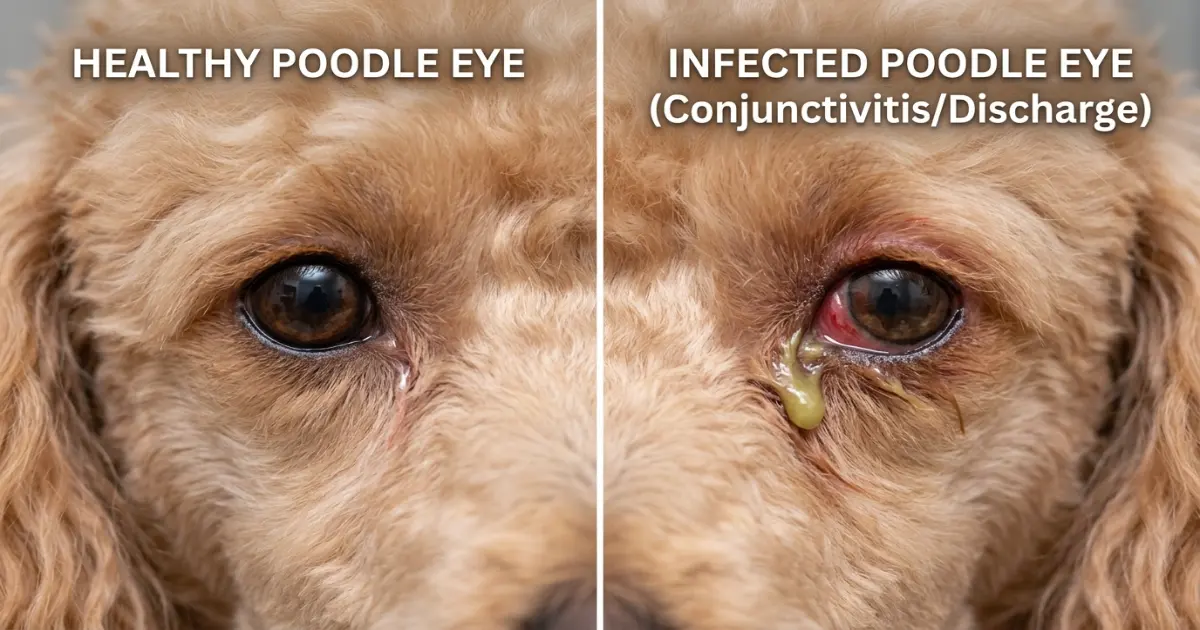
Healthy Poodle eyes produce a thin, clear tear film that keeps the cornea moist. You may notice a slight wetness at the inner corner of the eye, especially after sleep, when tears have accumulated without blinking. As these tears dry, they form a small, dark brown or slightly grayish crust — a completely normal finding that can be wiped away gently with a soft, damp cloth.
The quantity of normal tearing varies from dog to dog. Some Poodles have eyes that stream slightly whenever there’s a breeze or dust, while others stay remarkably dry. Both are typically fine as long as the eye itself stays white and quiet, the dog doesn’t rub at it, and the discharge remains clear. The variation depends on anatomy: the size of the tear duct opening, the depth of the eye socket, and even the tightness of the eyelid margins.
One normal anomaly that frightens many new owners is the occasional glob of clear, gel-like mucus in the corner of the eye — especially after a walk outside. This is just a bit of tear film mixed with environmental dust and debris. If it’s infrequent and wipes away with no residual redness, it’s nothing to lose sleep over.
Problem Signs: When Poodle Eye Discharge Means Something’s Wrong
The alarm bells should ring when the discharge changes color, consistency, or causes discomfort. Here is how to decode what you see:
Yellow or green discharge almost always indicates infection. The color comes from white blood cells fighting bacteria or, less commonly, a fungal organism. This is conjunctivitis, keratitis, or an infected corneal ulcer — all require veterinary evaluation, and corneal ulcers are emergencies that can lead to perforation within hours. Do not wait and see if it clears.
Thick, white, stringy mucus that keeps reappearing may signal dry eye (keratoconjunctivitis sicca). In this condition, the tear glands don’t produce enough of the watery component of tears, so the eye overproduces thick, lubricating mucus to compensate. Left untreated, dry eye causes chronic pain and corneal scarring. A simple Schirmer tear test at the vet’s office diagnoses it in minutes.
Blood-tinged discharge is rarer but serious — possible trauma, a foreign body, a bleeding tumor of the eyelid margin, or severe inflammation. Immediate veterinary attention is non-negotiable.
Clear but excessive tearing of sudden onset can mean a scratched cornea, an ingrown eyelash (distichiasis), a foreign body like a grass seed under the lid, or the start of an allergic reaction. If the eye is held partially closed or the third eyelid is visible, see a vet the same day.
| Discharge Type | Possible Causes | When to See a Vet |
|---|---|---|
| Clear, watery, minimal | Normal tearing; mild irritant | Not needed if eye is comfortable |
| Clear but excessive and sudden | Corneal scratch, foreign body, allergy | Within 24 hours, sooner if squinting |
| White or cloudy mucus | Dry eye (KCS), mild allergy | Schedule a visit within a few days |
| Yellow or green, thick | Bacterial or fungal infection | Same-day appointment recommended |
| Bloody or rust-colored liquid | Trauma, tumor, severe inflammation | Emergency vet visit immediately |
Common Eye Conditions in Poodles That Cause Discharge
While any dog can get an eye infection, Poodles are overrepresented for several specific conditions that produce abnormal discharge:
Imperforate punctum and nasolacrimal duct obstruction — mentioned earlier — is especially common in Toy and Miniature Poodles. The duct simply doesn’t open properly into the nose, so tears have nowhere to go. Surgical correction is possible but not always necessary if the overflow is mild and the skin stays healthy.
Entropion is a rolling inward of the eyelid margin, causing eyelashes to rub against the cornea. It’s less common in Poodles than in some breeds but does occur, particularly in Standards with looser facial skin. The constant rubbing produces reflex tearing and, over time, corneal damage. Surgical correction is straightforward and curative.
Distichiasis — extra eyelashes growing from the oil glands along the lid margin — is frequently seen in all Poodle sizes. These fine hairs can be surprisingly irritating, causing chronic tearing, squinting, and eventually corneal ulcers. Treatment ranges from lubricating drops to cryotherapy or electrolysis to remove the offending lashes.
Cataracts don’t directly cause discharge, but a Poodle with advanced cataracts may develop secondary lens-induced uveitis, which can present with red eyes, cloudiness, and increased tearing. Poodles are genetically predisposed to cataracts; regular eye exams catch them early.
How to Safely Clean Poodle Eye Discharge at Home
Daily wiping prevents the buildup of crusts and reduces staining, but it must be done gently. The skin around a Poodle’s eyes is thin and easily irritated. Follow these steps:
Step 1: Gather your supplies
A soft, lint-free cloth or cotton round, warm water, and a separate dry cloth. No soaps, no hydrogen peroxide, no alcohol-based wipes near the eyes. If you use a commercial eye-cleaning solution, choose one labeled safe for ophthalmic use.
Step 2: Soften any crusts
Hold a warm, damp cloth against the crusty area for 10–20 seconds without rubbing. This loosens the dried discharge so it slides off instead of scraping the skin. Never pick at crusts with your fingernail — it hurts and can create microtears that invite infection.
Step 3: Wipe outward and away
Using gentle pressure, wipe from the inner corner of the eye outward. Never wipe back toward the nose, which can drag debris into the tear duct opening. Use a fresh section of cloth for each eye to avoid cross-contamination.
Step 4: Dry thoroughly
Moisture lingering in the skin folds under the eye creates a breeding ground for yeast and bacteria. Pat dry, then run a clean finger through the hair to lift it away from the skin so air can circulate.
🛁 Pro Tips for Daily Eye Care
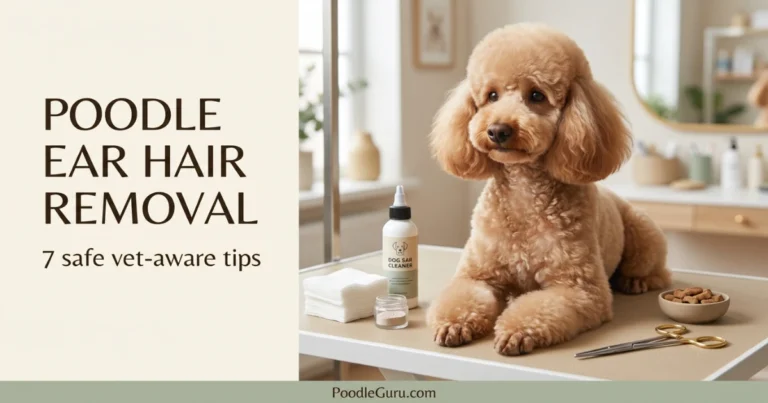
- Keep the hair around the eyes trimmed short. Ask your groomer for a “clean face” or keep the inner corner area clipped yourself with blunt-tipped scissors.
- Use filtered water on the cloth. Some Poodles react to tap water minerals, which can worsen staining.
- Don’t over-wipe. Twice daily is plenty. Over-cleaning strips natural oils and can cause irritation that mimics infection.
- Feed from stainless steel or ceramic bowls. Plastic bowls harbor bacteria and can cause contact dermatitis around the mouth and eyes.
What Owners Often Misunderstand About Poodle Eye Discharge
Misconceptions about eye discharge lead to delayed treatment or unnecessary panic. Here are the ones that show up regularly in Poodle owner forums and vet waiting rooms:
“Red-brown tear stains mean infection.” They usually don’t. The reddish color is porphyrin, a natural pigment in tears that oxidizes when exposed to light and air. It’s the same pigment that gives saliva its reddish-brown cast on light-colored fur. If the eye is white and comfortable, staining alone is a cosmetic concern, not a medical one.
“Crusts in the corner every morning mean there’s a problem.” Morning crusts — small, dark, and easily wiped away — are dried tears that accumulated during sleep, when the dog wasn’t blinking. They’re the canine equivalent of “sleep” in your own eyes. The difference between normal and abnormal is volume and ease of removal.
“I can clean the eyes with the same wipes I use for paws.” Do not. Paw wipes often contain antiseptics, fragrances, or alcohol that will sting and inflame the ocular surface. Only use products specifically labeled as eye-safe.
“Vaccinations cause eye discharge, so I’ll skip them.” This is a dangerous leap. While a transient mild increase in tearing can occur during a vaccine reaction, skipping core vaccines to avoid a minor possibility invites far worse — like distemper, which can cause severe ocular disease including blindness. The connection is vastly overstated.
🧬 The Tear Stain Gene Connection: Tear staining intensity has a genetic component. Some Poodle lines produce more porphyrin or have narrower tear ducts. You cannot train or supplement this away entirely. Managing it is about hygiene and, in some cases, accepting it as a cosmetic quirk of an otherwise healthy, beloved dog.
When to Stop Home Care and See a Veterinarian
It’s easy to convince yourself that one more day of wiping might clear things up. But certain signs demand professional eyes — literally. Take your Poodle to the vet promptly, not eventually, if you notice any of the following:
- Yellow, green, or blood-tinged discharge that persists beyond a single wiping
- Redness of the white part of the eye or the inner eyelid
- Squinting, excessive blinking, or holding the eye closed
- Visible cloudiness or a bluish haze on the corneal surface
- Swelling of the eyelids or the tissue around the eye
- Pawing or rubbing at the eye persistently
- Sudden vision loss or bumping into objects
Eye issues can escalate quickly. A simple scratch can become an infected ulcer in under 24 hours. Poodles, especially Standards, can develop acute glaucoma — a painful, vision-threatening pressure spike — that needs emergency treatment. Trust your gut: if something looks wrong, it probably is.
Frequently Asked Questions
Why does my Poodle have watery eye discharge every morning?
A small amount of clear, watery discharge in the morning is normal. Tears pool overnight because the dog isn’t blinking. If the discharge is clear, wipes away easily, and there’s no redness or squinting, it’s just “sleep” for dogs. Persistent thick or colored morning discharge is another story — then a vet visit is wise.
Can I use human eye drops for my Poodle’s eye discharge?
No, unless specifically prescribed or recommended by a veterinarian. Human drops can contain vasoconstrictors, preservatives, or active ingredients toxic to dogs. Even “natural tears” can worsen certain conditions. Always get a veterinary-approved product.
What’s the best way to remove tear stains on a white Poodle?
Daily gentle cleansing with warm water and a soft cloth, keeping facial hair trimmed short, and using stainless steel food bowls help. There are veterinary-approved tear stain supplements that work for some dogs. Avoid unregulated bleaching products — they can burn the skin and damage the eye.
Does diet affect Poodle eye discharge?
Yes, but indirectly. Food allergies can cause facial inflammation that leads to secondary eye tearing. Some dogs produce more porphyin when eating certain proteins or additives. A high-quality, limited-ingredient diet can sometimes reduce tear staining, but it won’t fix a blocked tear duct or an anatomical issue.
How do I know if my Poodle’s eye discharge is from an allergy or an infection?
Allergy-related discharge tends to be clear and watery, often accompanied by itching, sneezing, or skin issues. Infection usually produces colored, thicker discharge and localized eye redness. A vet can stain the cornea and examine the eye to tell the difference definitively.
Are Toy Poodles more likely to have eye discharge problems than Standards?
Toy and Miniature Poodles have proportionally rounder skulls and shallower eye sockets, which makes their eyes more prominent and their tear drainage anatomy more likely to be compromised. So yes, they are slightly more prone to tear overflow and staining, but Standards are not immune.
Can eye discharge in a Poodle puppy be a sign of something serious?
Absolutely. Puppies can be born with imperforate puncta, congenital cataracts, or juvenile cellulitis (puppy strangles), all of which can present with discharge. Any puppy eye discharge beyond a faint clear tear should be evaluated early, before it affects vision development.
How can I prevent Poodle eye discharge problems?
While you can’t change anatomy, you can reduce irritants: keep facial hair trimmed, rinse eyes with a veterinarian-approved solution after dusty walks, feed a high-quality diet, use hypoallergenic bedding, and schedule annual veterinary eye exams. Early intervention is your strongest prevention tool.
📋 Summary: Poodle eye discharge sits on a spectrum from harmless tear overflow to urgent infection. Normal discharge is clear and minimal; problem discharge is colored, thick, or causes discomfort. Know your dog’s baseline, establish a gentle daily cleaning routine, and don’t let tear staining fool you into missing real inflammation. Trust the eye itself — white, bright, and comfortable equals healthy. Anything less is worth a professional look. With a little vigilance and the right care, your Poodle’s beautiful, expressive eyes will stay clear and comfortable for years to come.