Poodle Teeth Brushing: The Complete Routine and Best Products for a Lifetime of Clean Teeth
Poodle teeth brushing should be a daily habit, using a soft-bristled brush or finger brush and a dog-specific enzymatic toothpaste — never human toothpaste. Poodles, especially Toys and Miniatures, are genetically prone to tartar buildup, gum disease, and early tooth loss. The best routine mixes daily mechanical brushing, annual veterinary dental exams, and a smart selection of VOHC-accepted dental chews or water additives. Starting when your poodle is a puppy and keeping sessions positive transforms a chore into a lifelong bonding ritual that protects not just the mouth, but the heart, kidneys, and overall health.
You brush your own teeth every morning and night without thinking. Yet when it comes to your poodle, it’s easy to let dental care slide into “I’ll get to it next week.” Then next week becomes next month, and suddenly the vet is pointing at Grade 3 tartar and quoting a four-figure cleaning under anesthesia. Poodle mouths are no different from ours in one critical way: what happens at the gumline doesn’t stay there. Bacteria from periodontal disease slip into the bloodstream and can damage the heart valves, liver, and kidneys. That’s not a scare tactic — it’s well-documented veterinary science.
This guide is the one-stop resource for poodle teeth brushing done right. You’ll learn why poodles are especially vulnerable, how to build a realistic routine that sticks, which products actually work, and the mistakes that even devoted owners make. By the end, you’ll have a complete, breed-specific plan that turns dental care from a guilt-trigger into a simple, satisfying part of your poodle’s daily rhythm.
Daily Brushing Gold Standard
Veterinary dentists recommend brushing every 24 hours to disrupt plaque before it hardens into tartar.
Poodle Dental Risk
Small poodle sizes have crowded teeth and thin enamel, accelerating decay and periodontal pockets.
Starts in Puppyhood
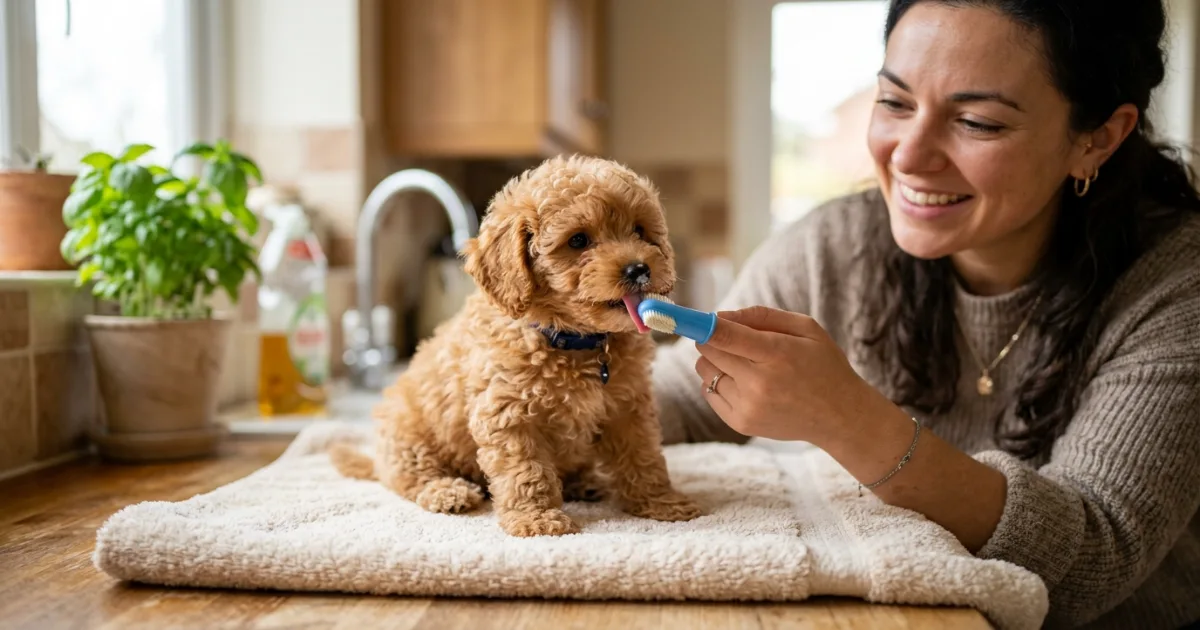
Introduce gentle mouth handling by 8–10 weeks; your poodle learns brushing is normal, not a threat.
Anesthesia-Free Warning
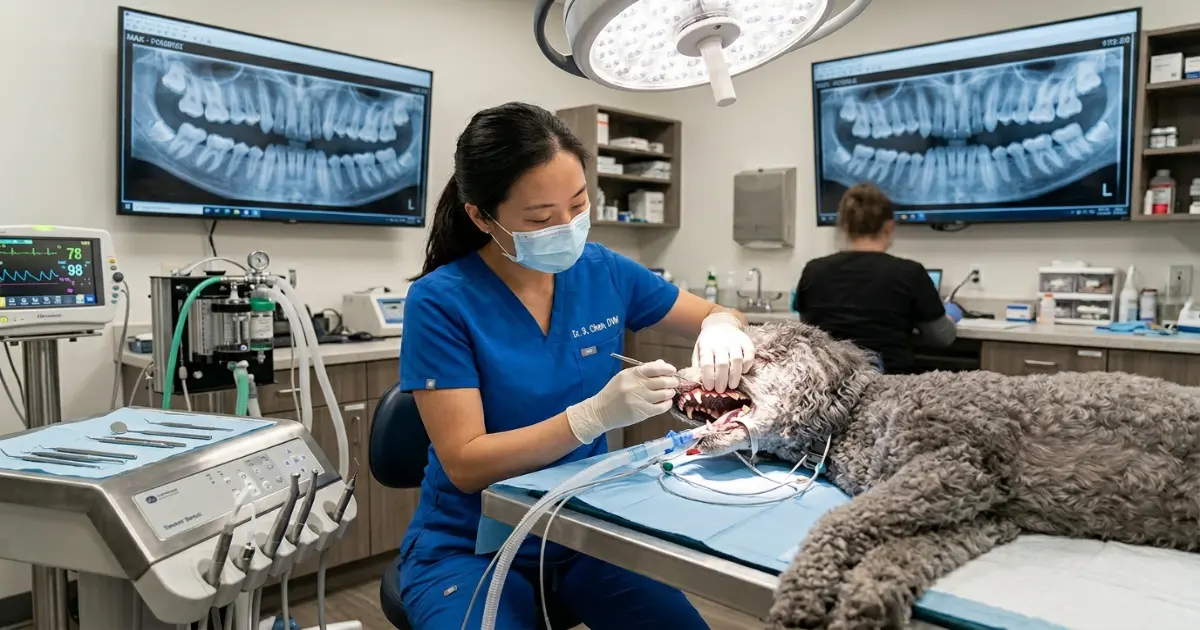
Non-anesthetic dental cleanings are cosmetic only — they miss subgingival disease and are not a substitute for veterinary care.
Why Poodle Teeth Brushing Matters More Than You Think
Poodles of every size share a single-layer coat and an elegant muzzle, but inside that muzzle is a potential minefield. Toy and Miniature Poodles, in particular, have the same 42 adult teeth as a Standard Poodle crammed into a much smaller jaw. The result is dental crowding — teeth overlap, creating tight, hard-to-clean pockets where food and bacteria stagnate. Even in Standard Poodles, the breed’s predisposition to a narrower lower jaw can lead to malocclusion and retained baby teeth, which trap plaque.
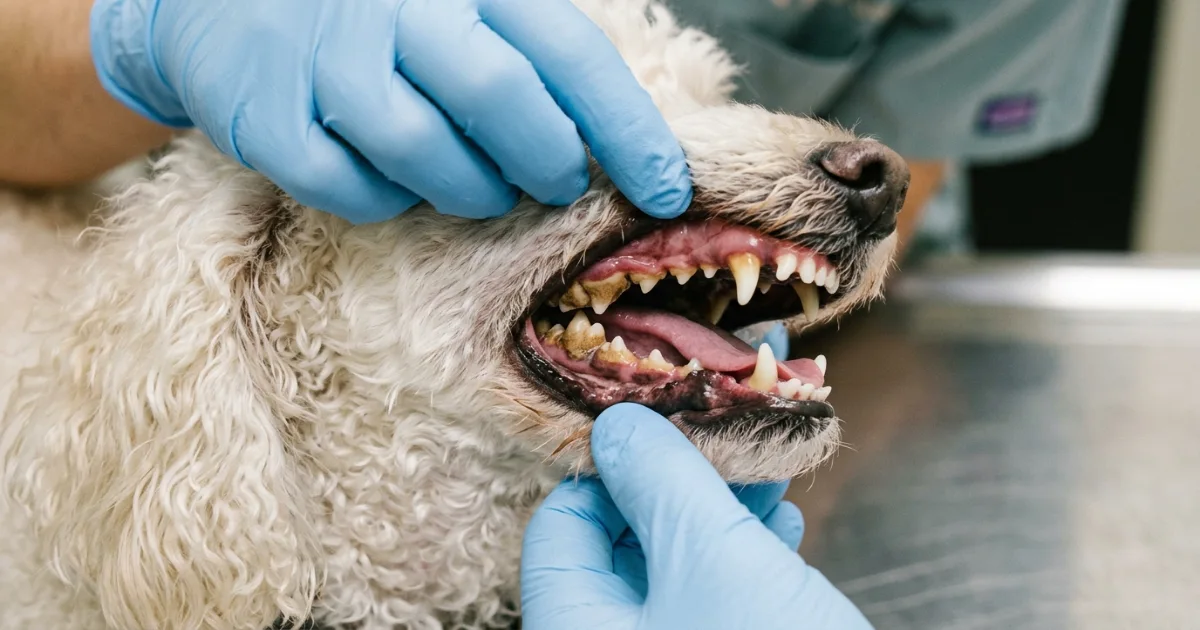
Without poodle teeth brushing, this plaque mineralizes into tartar within 24 to 48 hours. Tartar then pushes under the gumline, causing gingivitis, periodontitis, and eventually the destruction of the ligament and bone that hold teeth in place. The infection doesn’t stay local. Bacteria enter the bloodstream and settle on heart valves or filter through the kidneys, silently stealing years from your dog’s life. A study from Banfield Pet Hospital showed that small-breed dogs — including Toy and Miniature Poodles — are five times more likely to develop periodontal disease than larger breeds. The good news: daily brushing can prevent most of it.
The Perfect Poodle Teeth Brushing Routine: Step by Step
Consistency beats intensity. A gentle 30-second session every day is far better than a deep, stressful scrub once a week. Here is the routine, customized for a poodle’s mouth and temperament.
Step 1: Gather Your Tools
You need a dog-specific toothbrush (more on types shortly), an enzymatic dog toothpaste in a poodle-safe flavor like poultry or malt, and a soft cloth or gauze square for the first few weeks if your dog is touch-sensitive. Keep a high-value treat — like tiny cubes of boiled chicken — within reach.
Step 2: Desensitization Phase (Puppies and Adult Newbies)
If your poodle has never had a brush in their mouth, spend a full week just handling the muzzle. Lift the lip, run your finger along the outer gum line, and reward lavishly. Then introduce the toothpaste on your finger. Let them lick it off. Progress to rubbing the paste along the outer teeth with your finger, using a back-and-forth motion. Only then introduce the brush.
Step 3: The Brushing Technique
Apply a pea-sized amount of enzymatic toothpaste to the bristles. Gently pull the lip back and angle the brush at 45 degrees toward the gumline — exactly how you’d brush your own teeth. Focus on the outer surfaces of the upper and lower teeth, especially the back molars and canines, where tartar accumulates fastest. Use small circular motions. Aim for 5–10 seconds per quadrant. The inner surfaces (tongue side) receive natural cleaning from the tongue, so prioritize the cheek-facing sides.
Step 4: Positive Reinforcement Closure
End every session with enthusiastic praise and the promised treat. The goal is for your poodle to associate the brush with something wonderful. Even if you only manage a few teeth today, finish on a high note. Tomorrow you’ll get more.
Frequency Reality Check
The gold standard is daily. Realistically, many owners achieve 5–6 days per week. If you can only manage three, supplement with VOHC-approved dental chews and a water additive. But know that mechanical brushing is irreplaceable: it physically scrapes away the biofilm that chemical products alone cannot fully dissolve.
The Best Products for Poodle Teeth Brushing
The market is loud, but these are the products that actually make a difference for poodles.
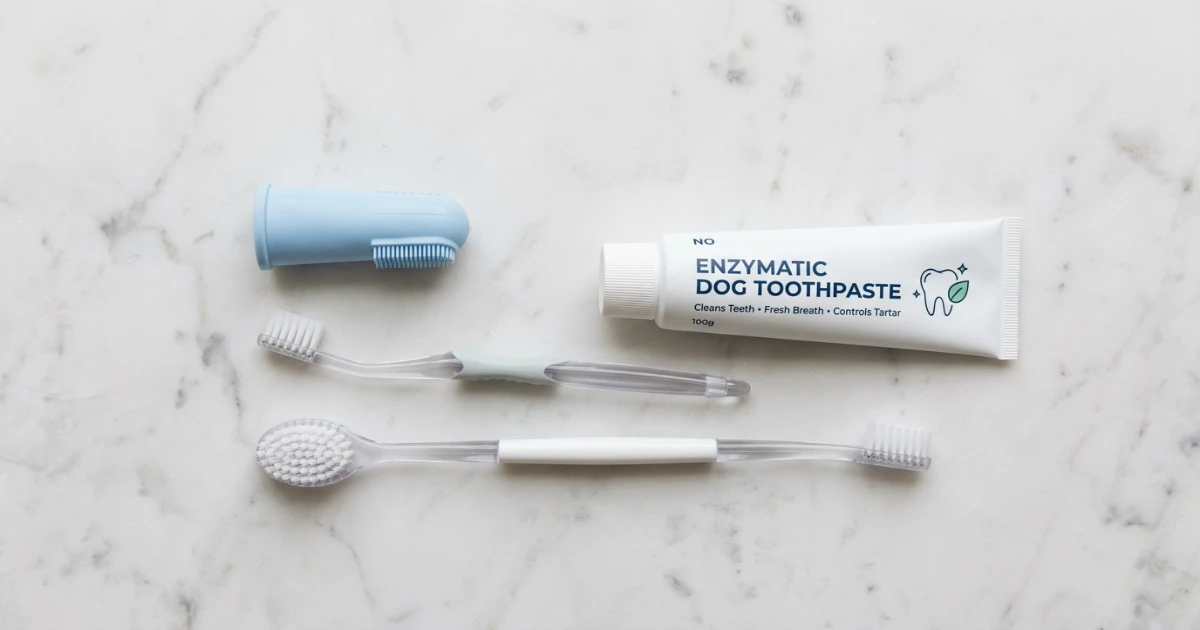
| Product Type | What to Look For | Pros | Cons | Poodle-Specific Fit |
|---|---|---|---|---|
| Dog Toothpaste | Enzymatic (glucose oxidase + lactoperoxidase), poultry or vanilla-mint flavor, VOHC seal | Chemically breaks down plaque; safe to swallow; dogs love the taste | Enzymatic action needs contact time; useless without brushing | Excellent for all poodle sizes; choose poultry flavor for picky eaters |
| Finger Brushes | Soft silicone, textured nubs, fits snugly | Gentle introduction; great for Toy/Miniature small mouths | Cannot reach deep molars easily; risk of getting bitten if dog clamps down | Ideal for Toy Poodles under 8 lbs; start here then graduate |
| Handled Toothbrush (Small Head) | Ultra-soft bristles, angled neck, small brush head | Better reach for back teeth; more precise cleaning | Requires more acceptance; may be too big for tiny mouths | Perfect for Miniature and Standard Poodles; use a puppy-size head |
| Dental Wipes | Textured, pre-moistened with enzymatic solution | Great for quick touch-ups or travel; no paste needed | Less effective mechanical action than bristles | Useful second step after brushing for the gumline; not a replacement |
| Water Additives | Approved by VOHC, xylitol-free, zinc gluconate or chlorhexidine base | Easy daily add-in; reduces plaque bacteria in saliva | Does nothing for existing tartar; some dogs refuse the taste | Great supplement for poodles that hate handling; always pair with brushing |
| Dental Chews & Treats | VOHC-accepted, appropriately sized, enzymatic coating | Mechanical scraping and enzymatic boost; dogs view as reward | Caloric; can cause GI upset if overfed; not a substitute for brushing | Choose a size suited to your poodle’s weight; use once daily maximum |
Never, under any circumstances, use human toothpaste for poodle teeth brushing. Human toothpaste contains fluoride and sometimes xylitol, both of which are toxic to dogs even in tiny amounts. Foaming agents can also cause gastric distress. Dog toothpaste is formulated to be safe when swallowed, which is critical because your poodle can’t rinse and spit.
What Owners Get Wrong About Poodle Teeth Brushing (and Dental Care)
Even well-meaning owners slip into these common traps. Recognizing them can save your poodle’s teeth.
1. Brushing only the front teeth. The canines and incisors are easiest to reach, but the premolars and molars in the back bear the brunt of chewing and collect the most debris. If you only brush what you can see, you’re missing the trouble spots.
2. Assuming dry kibble “cleans” the teeth. Most kibble shatters on contact rather than scraping plaque. Unless it’s a specifically formulated dental diet with a large, fibrous texture (and the VOHC seal), regular kibble does little.
3. Skipping anesthesia for a proper dental cleaning. “Anesthesia-free” cleanings offered by some groomers or pet stores scrape visible tartar but cannot assess or treat under the gumline — exactly where the disease lies. A complete veterinary oral health assessment and treatment (COHAT) under anesthesia, with full-mouth dental radiographs, is the only way to properly address periodontal disease.
4. Stopping when the breath smells better. Fresh breath is a side benefit, not the goal. Plaque can be present even when the mouth doesn’t smell. Only a vet exam can confirm whether the disease is controlled.
Professional Dental Care: When Your Poodle Needs More Than a Brush
Even with perfect poodle teeth brushing, most dogs need a professional veterinary dental cleaning by age 2 or 3. Signs that a cleaning is overdue include persistent bad breath, red or bleeding gums, visible brown tartar on the molars, drooling, dropping food, or pawing at the mouth. Dental radiographs under anesthesia often reveal painful problems hidden beneath the gums — root abscesses, bone loss, or retained tooth roots — that a visual check alone cannot catch.
Modern veterinary anesthesia for poodles is extremely safe when proper pre-anesthetic bloodwork and monitoring are performed, even for Toy Poodles. The benefits of a clean, infection-free mouth far outweigh the minimal anesthetic risk. Expect to budget $600–$1,200 for a comprehensive cleaning, depending on your location and whether extractions are needed. Many pet insurance plans cover dental cleanings if a history of home care is documented.
2026 Cost Snapshot: Poodle Dental Care
Professional Cleaning: $600 – $1,200
Includes anesthesia, full-mouth radiographs, scaling, polishing, and fluoride treatment. Extractions additional. At-home supplies (toothpaste, brush, chews) average $30–$45/month.
How to Build a Lifelong Habit: Practical Owner Insight
You don’t need to be perfect to be effective. Here is how to make poodle teeth brushing something you actually do, not just intend to do.
- Anchor it to a routine. Brush right after your morning coffee or right before you brush your own teeth at night. Habit stacking is powerful.
- Keep supplies visible. Store the brush and toothpaste near your dog’s feeding station or your own bathroom sink. If it stays hidden in a cabinet, it’s out of mind.
- Use a calendar sticker chart. Mark each day you brush. Seeing a streak motivates you — and your vet will appreciate the record.
- Rotate flavors. Poodles are intelligent and may bore of the same taste. Switching between poultry, beef, and malt keeps interest high.
- Involve the whole household. When everyone knows the technique, brushing doesn’t fall apart when one person is away.
1. For reluctant poodles, try the “lick and touch” game. Let them lick paste off the brush while you touch the teeth for one second. Gradually extend duration. 2. Young puppies: freeze a damp washcloth. The cold soothes teething gums and gets them used to mouth handling. 3. Never force. A traumatic session can undo weeks of positive conditioning. Stop and try later with higher-value rewards. 4. Brush in front of a mirror. It helps you see the back teeth and ensures proper angle.
Frequently Asked Questions About Poodle Teeth Brushing
How often should I brush my poodle’s teeth really?
What toothpaste is safe for poodles?
Can I use a human toothbrush on my poodle?
My toy poodle hates the brush. What should I do?
Are dental chews enough instead of brushing?
At what age should I start brushing my poodle puppy’s teeth?
Do poodles need professional dental cleanings even if I brush daily?
How can I tell if my poodle has dental pain?
Healthy Mouth, Longer Life: The Final Word on Poodle Teeth Brushing
Poodle teeth brushing isn’t just about a pretty smile or avoiding bad breath. It’s a frontline defense against a silent, systemic disease that can steal years from your dog. Poodles, with their genetically compact mouths and sensitive systems, benefit more than most breeds from a consistent, gentle home dental routine. The products are simple: a soft brush, a tube of enzymatic paste, and a willingness to spend two minutes a day on prevention. The payoff is a poodle that eats comfortably, plays without mouth pain, and keeps those teeth well into their senior years. Start today, even if it’s imperfect. Every brush stroke counts.