Rottle (Rottweiler Poodle Mix): Complete Owner’s Guide
A powerful, intelligent cross that pairs the Rottweiler’s steady confidence with the Poodle’s sharp mind — the Rottle is not a casual pet. This 2026 guide examines the temperament, care demands, and breeder warning signs every serious buyer needs to know.
Quick Answer: What Is a Rottle?
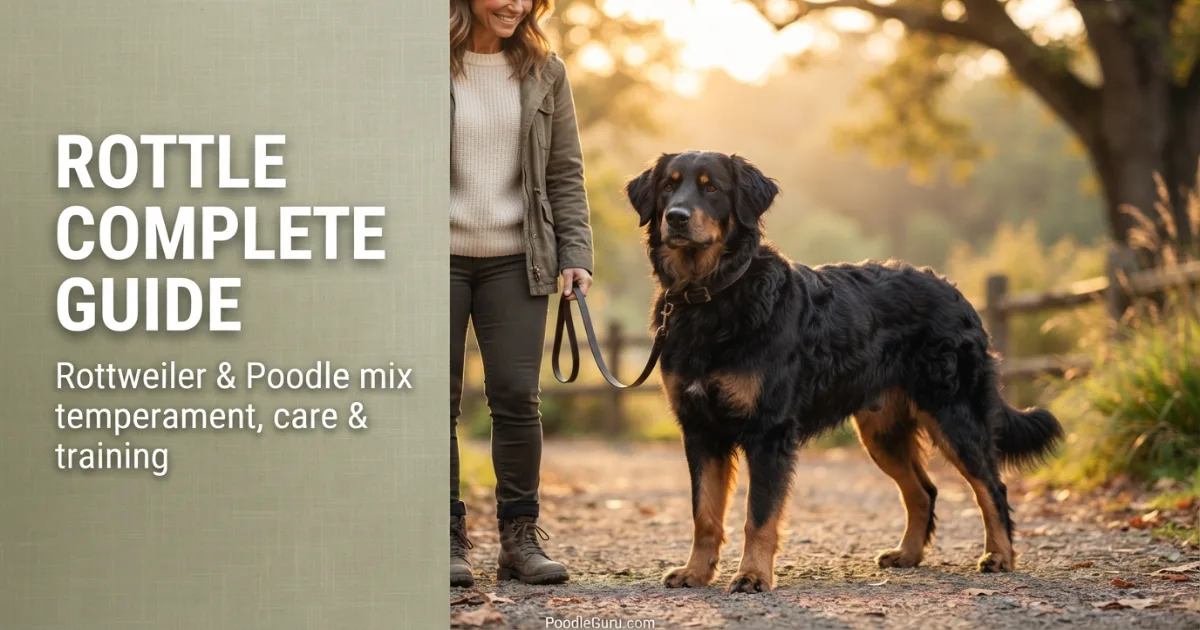
A Rottle is a designer hybrid produced by crossing a Rottweiler with a Poodle, almost always a Standard Poodle. Adult dogs typically weigh 60–90 pounds and stand 22–27 inches tall. This mix is sought after for combining the Rottweiler’s loyal, protective nature with the Poodle’s intelligence and lower-shedding coat. The most important thing to understand is that the Rottle is not a curly-coated Rottweiler — it’s a powerful, high-drive companion with working-breed influence that demands experienced, confident handling and early, sustained socialization to become a stable family member.
What Is a Rottle? The Rottweiler-Poodle Cross Explained
A Rottle is a first-generation hybrid dog that blends the purebred Rottweiler, a German working breed originally used for herding and guarding, with the Standard Poodle, a water retriever prized for its intellect and lower-shedding coat potential. For poodle owners, this means you’re adding significant size, strength, and a pronounced protective instinct to the Poodle’s existing smarts. The most important thing to understand is that a Rottle will likely inherit the Rottweiler’s natural wariness of strangers — this is usually not the same kind of instantly outgoing dog as many retriever mixes, and it requires early and consistent training to prevent over-guarding.
The Rottle remains one of the less common Doodle-style mixes, partly because breeding a large, powerful dog responsibly takes serious commitment. Reputable breeders focus on tempering the Rottweiler’s intensity with the Poodle’s biddability, but every puppy lands differently on that spectrum. The AKC Rottweiler breed standard describes a calm, confident, and courageous dog, while the AKC Poodle standard emphasizes intelligence and elegance. Your Rottle will be shaped by both — and by the training you provide.
Size Range
60–90 lbs, 22–27 inches at the shoulder. Males often reach the upper end; females tend to be slightly smaller and lighter.
Coat Type
Wavy to curly, medium-length, often black with tan markings. Shedding ranges from low to moderate — never fully non-shedding.
Lifespan
10–13 years on average. Well-bred individuals from health-tested parents can reach the upper end with proper care.
Best Suited For
Experienced owners with large-dog handling skills. Active singles, couples, or families with older children who can provide structured exercise and training.
Energy Level
Moderate to high. A Rottle needs at least 60–90 minutes of daily exercise plus brain work. Without it, restlessness and destructive behavior appear quickly.
Protective Instinct
High. A Rottle will naturally guard its home and family. This trait must be channeled through training — it should never be encouraged to escalate.
Rottle Appearance & Size: A Powerful, Athletic Build
Rottles are substantial dogs. The Standard Poodle contributes height and a slightly leggier frame, while the Rottweiler brings depth of chest, a broad skull, and a naturally muscular build. Most Rottles inherit the Rottweiler’s iconic black-and-tan markings, though the tan points may be muted by the Poodle’s fading gene. Solid black, phantom, and occasional sable patterns also appear.
A Rottle’s coat rarely resembles a pure Poodle’s tight curls. It more often falls in loose waves or soft curls that lie flat along the body. The face may show the Rottweiler’s broader muzzle or the Poodle’s longer, more refined snout. A puppy with a longer muzzle and looser flews (lips) will generally breathe more easily and drool less — a practical consideration for indoor living.
Owners should expect a dog with real physical presence. This is not a breed for apartment living unless you have ample outdoor space and a dedicated exercise schedule. Even then, many landlords and insurance companies have restrictions on dogs resembling Rottweilers, something worth checking before you commit.
Rottle Temperament: Loyal, Protective, and Thinking Two Steps Ahead
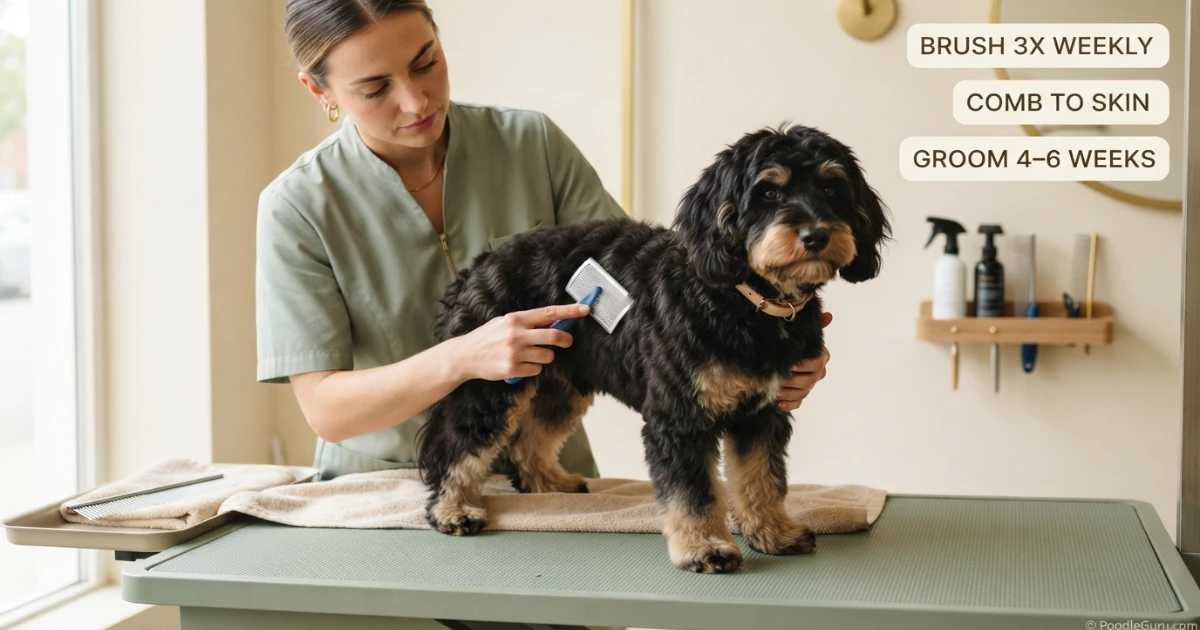
The Rottle’s mind works overtime. It watches strangers, reads your mood, and forms opinions quickly. This is a dog that will position itself between you and a newcomer without being asked — not out of aggression, but out of a deeply ingrained guardian instinct. That loyalty is extraordinary, but it carries an obligation: you must teach your Rottle when guarding is appropriate and when it’s not.
With its own family, a well-socialized Rottle is affectionate, steady, and often surprisingly gentle. They tend to be less needy than some Doodle varieties — they’ll accept affection on their own terms rather than demanding constant touch. However, they don’t tolerate isolation well. A Rottle left alone in a backyard for hours without human interaction can develop anxiety and become destructive or overly territorial.
The protective streak is the trait most owners underestimate. It’s not something to “train out” — it’s a core breed characteristic. The goal is to shape it into confident discernment. A Rottle that’s been properly socialized will assess a situation, look to you for cues, and respond accordingly. One that hasn’t will default to suspicion, which in a dog this size is a real safety concern.
Expert Insight: The Guarding Threshold
Rottles often hit a developmental phase around 12–18 months where protective behavior intensifies. This is when many inexperienced owners feel their dog is “suddenly aggressive.” In reality, the dog is maturing into its guarding instincts. Professional trainers recommend ramping up structured socialization and impulse-control work during this period. If your Rottle begins to growl or posture at strangers without provocation, seek a qualified qualified positive-reinforcement trainer immediately — the behavior won’t resolve on its own.
Rottle vs. Rottweiler vs. Standard Poodle: A Trait Comparison
This table clarifies what you gain — and what you need to manage — with the Rottle cross compared to its purebred parents.
| Trait | Rottle | Rottweiler | Standard Poodle |
|---|---|---|---|
| Weight | 60–90 lbs | 80–135 lbs | 40–70 lbs |
| Coat Type | Wavy to curly, medium-length | Short, dense double coat | Dense, curly single coat |
| Shedding | Low to moderate | Moderate to heavy | Very low |
| Grooming Frequency | Every 4–6 weeks; brushing 3x/week | Weekly brushing; seasonal shedding | Every 4–6 weeks; daily brushing ideal |
| Trainability | High — intelligent, responds to confident handling | High — but requires firm, fair leadership | Very high — eager to please |
| Protective Instinct | High — natural guardian | Very high — bred for protection | Moderate — alert, may bark |
| Energy Level | Moderate to high | Moderate | High |
| Exercise Needs | 60–90 min daily, plus mental work | 60+ min daily | 60+ min daily |
| Stranger Response | Wary, protective — needs socialization | Aloof, watchful — naturally reserved | Alert, may bark, warms up |
| Lifespan | 10–13 years | 8–10 years | 12–15 years |
The Rottle softens the Rottweiler’s heaviest traits — shedding, some of the bulk, and the shorter lifespan — while adding the Poodle’s brain and coat character. But it also brings a guardian temperament that must be managed, not ignored.
The PoodleGuru Rottle Owner Readiness Check
At PoodleGuru, we believe that powerful crosses need powerful preparation. Use this four-step assessment before you even start looking at puppy listings.
Assess Your Guardian-Dog Experience
Have you owned a large, protective breed before? If not, are you committed to working with a professional trainer from day one? A Rottle’s guarding instinct doesn’t wait — it develops whether you’re ready or not. Honest self-assessment here prevents rehoming later.
Outcome: A clear yes/no based on your handling history and willingness to seek professional guidance.
Evaluate Your Living Situation
Do you rent? Many rental properties and insurance companies have breed restrictions that include Rottweilers and dogs that resemble them. Check your lease and your homeowner’s policy before falling in love with a Rottle puppy. A fenced yard is strongly recommended, not optional.
Outcome: Verification that your housing and insurance can accommodate this breed without future conflict.
Calculate True Grooming Costs
A Rottle’s wavy-to-curly coat needs professional grooming every 4–6 weeks at $90–$130 per session, plus quality home tools. Between grooms, brush thoroughly 3 times per week with a slicker brush and metal comb. Mats form quickly behind the ears and under the collar — neglect leads to painful shaving.
Outcome: A realistic budget and time commitment for coat maintenance, not a surprise later.
Demand Full Health Clearances
A responsible Rottle breeder tests both parent dogs for hip dysplasia (OFA or PennHIP), elbow dysplasia, cardiac health, and eye conditions (CAER). Rottweiler parents should also have JLPP (juvenile laryngeal paralysis and polyneuropathy) DNA testing. If the breeder offers only “vet-checked,” you’re in the wrong place.
Outcome: A filtered list of breeders who meet baseline health standards — protecting your future dog from preventable suffering.
Rottle Health & Lifespan: The Role of Responsible Breeding
A Rottle’s expected lifespan of 10–13 years depends heavily on the health screening performed on both parents. Hybrid vigor can offer some protection, but it doesn’t erase the risks that both Rottweilers and Standard Poodles carry. Veterinary guidance generally recommends watching for these conditions in Rottles:
- Hip and elbow dysplasia — common in large breeds. Both parent dogs should have passing OFA or PennHIP scores. Hip dysplasia is a painful, degenerative condition that can require expensive surgery.
- Bloat (Gastric Dilatation-Volvulus) — deep-chested dogs like Rottweilers and Standard Poodles are at risk. Feed multiple small meals, avoid exercise right after eating, and learn the early signs (restlessness, unproductive retching, distended abdomen).
- Cardiac issues — both parent breeds can develop heart conditions, including dilated cardiomyopathy (DCM) in Rottweilers and mitral valve disease in aging Poodles. Annual cardiac exams are recommended.
- JLPP — a recessive neurological condition in Rottweilers. A DNA test identifies carriers; two carriers should never be bred together.
- Eye conditions — progressive retinal atrophy (PRA) and cataracts appear in both breeds. CAER eye exams on breeding dogs are non-negotiable.
When to Call Your Vet
Contact your veterinarian immediately if your Rottle shows sudden abdominal swelling with retching (possible bloat), unexplained limping or stiffness, collapsing episodes, or any sudden change in behavior or appetite. Large, deep-chested dogs can deteriorate quickly with emergencies like GDV, so prompt veterinary guidance matters.
Grooming & Coat Care: More Work Than It Looks
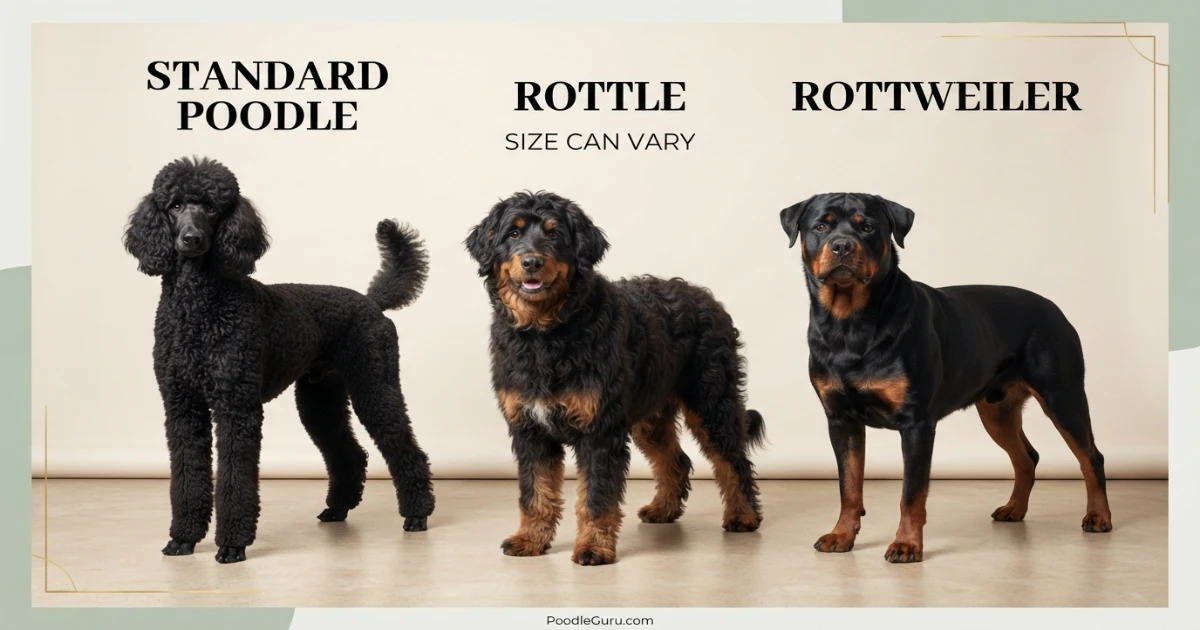
The Rottle’s coat is one of its major selling points — but it’s also a daily responsibility. That wavy, soft-looking fur mats quickly at friction points: behind the ears, under the collar, in the armpits, and around the tail base. Professional groomers commonly recommend a full groom every 4–6 weeks, with a thorough brush-out 3 times per week at home using a slicker brush followed by a metal comb. If you can hear the comb scraping against a mat, stop. Work it apart with your fingers or have a professional handle it; pulling through hurts the dog and damages the coat.
Ear care is critical, especially if your Rottle inherits drop ears from the Poodle side. Clean ears weekly with a vet-approved solution, and check for redness or odor. Any head-shaking or pawing at the ears signals a potential infection — don’t wait to see the vet. For a complete grooming routine that applies directly to Rottle coat care, see our Complete Poodle Grooming Guide.
Training & Socialization: The Foundation of a Stable Rottle
Training a Rottle isn’t about teaching tricks — it’s about building a communication system that keeps everyone safe. These dogs learn fast, but they’re also independent thinkers. A Rottweiler’s influence can make them less eager to please than a pure Poodle; they’ll assess whether a command makes sense before complying. That means you need to be consistent, confident, and fair — never harsh.
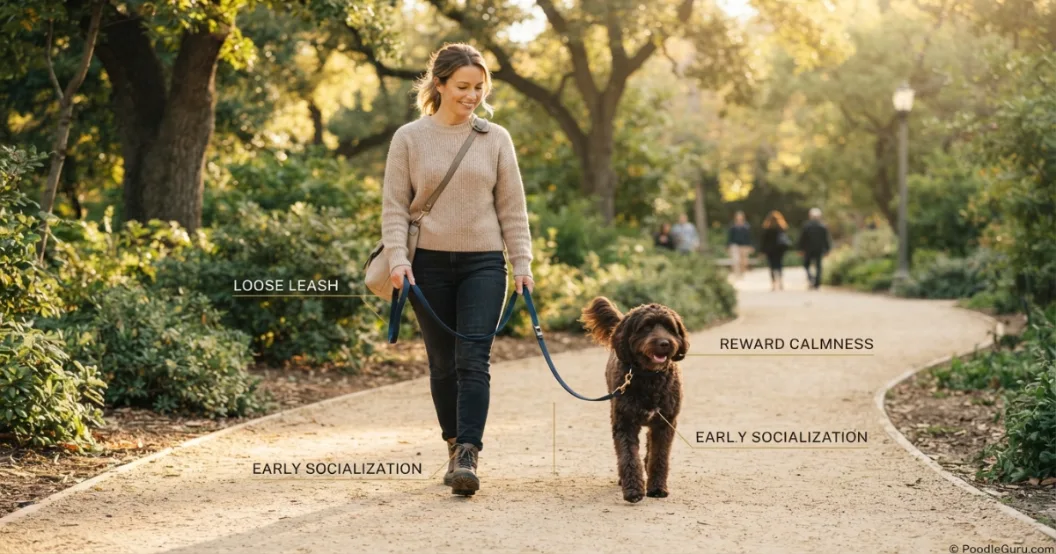
Positive reinforcement works, but it must be paired with clear boundaries. A Rottle that learns it can ignore a recall or push past you at the door is a Rottle that’s making its own rules. Early socialization is absolutely critical. Between 8 and 16 weeks, expose your puppy to a wide variety of calm people, vaccinated dogs, different surfaces, sounds, and handling. The goal is to build a dog that observes the world with confidence, not suspicion.
Enrolling in puppy kindergarten followed by an obedience class specifically for large breeds is strongly recommended. Even experienced owners benefit from the neutral environment and professional feedback. A Rottle that misses this early foundation may become reactive or hard to manage as an adult — and at this size, that can become a serious safety issue. If you see guarding behavior escalating (stiffening, growling at strangers without cause), consult a qualified positive-reinforcement behavior professional immediately. Don’t wait for a bite to happen.
Finding a Responsible Rottle Breeder
Rottles aren’t an AKC-recognized breed, so there’s no breed club to enforce standards. The burden of vetting falls entirely on you. Here’s what distinguishes a dedicated breeder from a profit-driven operation:
| Green Flag | Red Flag |
|---|---|
| Both parent dogs are available to meet or view via live video | Breeder won’t show you one or both parents; provides only photos |
| Full OFA/PennHIP, CAER, cardiac, and JLPP test results for both parents | “Vet-checked” is the only health claim; no actual certificates exist |
| Breeder asks detailed questions about your experience with large guardian breeds | Breeder focuses only on payment, pickup, and whether you have a yard |
| Puppies raised indoors with daily handling, exposure to household noises, and early socialization protocols | Puppies kept in kennels or garages with minimal human contact |
| Transparent about using a Standard Poodle and provides pedigree information for both sides | Vague about parent breeds; cannot explain why that pairing was chosen |
| Written contract includes a health guarantee, spay/neuter agreement, and a return-to-breeder clause for the dog’s lifetime | No contract, or a contract that waives all responsibility after sale |
A responsible Rottle breeder will interview you as thoroughly as you interview them. If the conversation feels rushed or transactional, that’s your signal to walk away.
Rottle Price Guide (2026)
In 2026, a responsibly bred Rottle from fully health-tested parents costs between $2,200 and $4,000. Puppies from exceptional working lines, those with rare coat colors (like solid red or blue), or from breeders with multi-year waitlists may exceed $4,000.
What Affects Rottle Pricing
- Parent health clearances — comprehensive OFA, cardiac, and JLPP testing is expensive. This is the single most important cost factor, and it’s worth every dollar.
- Rottweiler parent lineage — German or Serbian working lines with titled ancestors often increase price, as do dogs from lines screened for longevity.
- Coat color and markings — classic black-and-tan is common; solid colors or unusual patterns may command a premium. Color doesn’t affect health or temperament.
- Breeder location and support — established breeders who offer lifetime support and take back dogs at any age generally charge more, and they should.
Avoid any Rottle priced under $1,500. At that price, health testing has almost certainly been skipped. The initial savings disappear the first time you face a hip dysplasia diagnosis or a dog with temperament issues from poor breeding and early environment.
Is a Rottle Right for You?
This is not a dog for everyone. It’s a dog for someone who understands guardian breeds, welcomes the responsibility of early training, and has the space and schedule to match. Honesty here prevents a heartbreaking mismatch.
A Rottle may be right for you if: you have experience with large, protective dogs; you’re committed to ongoing training and socialization; you have a securely fenced yard and an active lifestyle; and you view grooming as a regular, budgeted routine.
A Rottle is probably not right for you if: you’re a first-time dog owner; you want a dog that greets every stranger with a wagging tail; you rent or have breed-restricted insurance; or you’re away from home for long hours without the ability to provide midday exercise and company.
Frequently Asked Questions About Rottles
Are Rottles aggressive?
A well-bred, properly socialized Rottle is not aggressive — it’s discerning. The breed’s natural protective instinct can look like aggression if it isn’t trained and managed. Early socialization, clear boundaries, and ongoing training are non-negotiable to ensure a Rottle becomes a stable, confident companion rather than a reactive guarder.
Do Rottles shed a lot?
Shedding varies from low to moderate. Rottles with a tighter Poodle curl shed very little, while those with a wavy coat closer to the Rottweiler side shed more. No Rottle is completely non-shedding. If you need a reliably low-shedding dog, spend time with the specific adult before committing.
Are Rottles good with children?
Rottles can be excellent with older, respectful children who understand how to interact with a large dog. However, their herding and guarding instincts may make them uncomfortable around chaotic, unpredictable movement. Supervision is always required with young children, and early socialization with kids is essential.
How much exercise does a Rottle need?
Plan for 60–90 minutes of daily physical exercise, plus dedicated mental stimulation. This includes brisk walks, off-leash running in secure areas, and brain games like puzzle toys or scent work. A bored Rottle will find its own activities — and you won’t like them.
Are Rottles easy to train?
They’re highly intelligent and learn commands quickly, but they’re not always eager to please in the way a pure Poodle might be. They require a confident, consistent handler who can provide fair leadership. Training should be positive, structured, and ongoing because a smart, powerful dog needs consistent communication throughout life.
Do Rottles have health problems?
Like all large breeds, they can be prone to hip and elbow dysplasia, bloat, and certain cardiac issues. Responsible breeders test both parents extensively. Purchasing from a breeder who provides full OFA, CAER, and cardiac clearances can reduce, but never completely eliminate, the risk of inherited conditions.
What’s the difference between a Rottle and a Labradoodle?
A Labradoodle is a Labrador Retriever-Poodle mix, generally producing a more outgoing, social dog with a lower guarding instinct. A Rottle (Rottweiler-Poodle) tends to be more protective, more reserved with strangers, and larger-boned. The two crosses suit very different owner profiles.
Final Summary: Key Takeaways for Rottle Buyers & Owners
The Rottle is a magnificent, capable cross — but it’s only as stable as the breeding, socialization, and training behind it. Before you move forward, hold onto these points:
- A Rottle is a Rottweiler-Standard Poodle cross weighing 60–90 lbs with a 10–13 year lifespan, requiring experienced handling and a commitment to early, ongoing socialization.
- Coat type ranges from wavy to curly, shedding low to moderate, with professional grooming every 4–6 weeks and home brushing 3 times per week essential for coat and skin health.
- The PoodleGuru Rottle Owner Readiness Check forces an honest evaluation of your guardian-breed experience, living situation, grooming budget, and breeder vetting standards before you buy.
- Responsible breeders provide full OFA/PennHIP, CAER, cardiac, and JLPP health clearances for both parents; in 2026, expect to pay $2,200–$4,000 for a well-bred Rottle from tested lines.
- Natural protective instincts, strong physical presence, and the need for confident leadership make this breed a poor fit for first-time owners, renters, or homes without large-dog experience.
- Training is not optional — it’s the foundation that determines whether your Rottle becomes a trustworthy family companion or a liability. Enroll in professional classes, socialize extensively, and never ignore early warning signs of over-guarding.
Next step: Revisit the Owner Readiness Check above. If you can answer each point with a confident “yes,” you’re ready to seek out breeders who meet the health-testing standards described in this guide. Your future Rottle’s stability begins with the choices you make today.