Pugapoo (Pug Poodle Mix): The Complete Guide for 2026
Everything you need to know before bringing home a Pugapoo — from real-world temperament and coat quirks to red-flag breeder practices that cost owners thousands.
Quick Answer
A Pugapoo is a designer cross between a Pug and a Poodle, usually a Miniature or Toy Poodle. Most weigh 10–20 pounds and stand 10–15 inches tall, though mixed-breed size is never guaranteed. Their coat is typically wavy or curly, low-shedding but not truly hypoallergenic. Temperament is affectionate, comical, and people-focused — great for companionship but not ideal for high-intensity exercise. The biggest health watchpoint is brachycephalic airway risk inherited from the Pug side. With careful breeder selection, healthy weight management, and regular veterinary care, many Pugapoos can live 12–15 years.
What Is a Pugapoo?
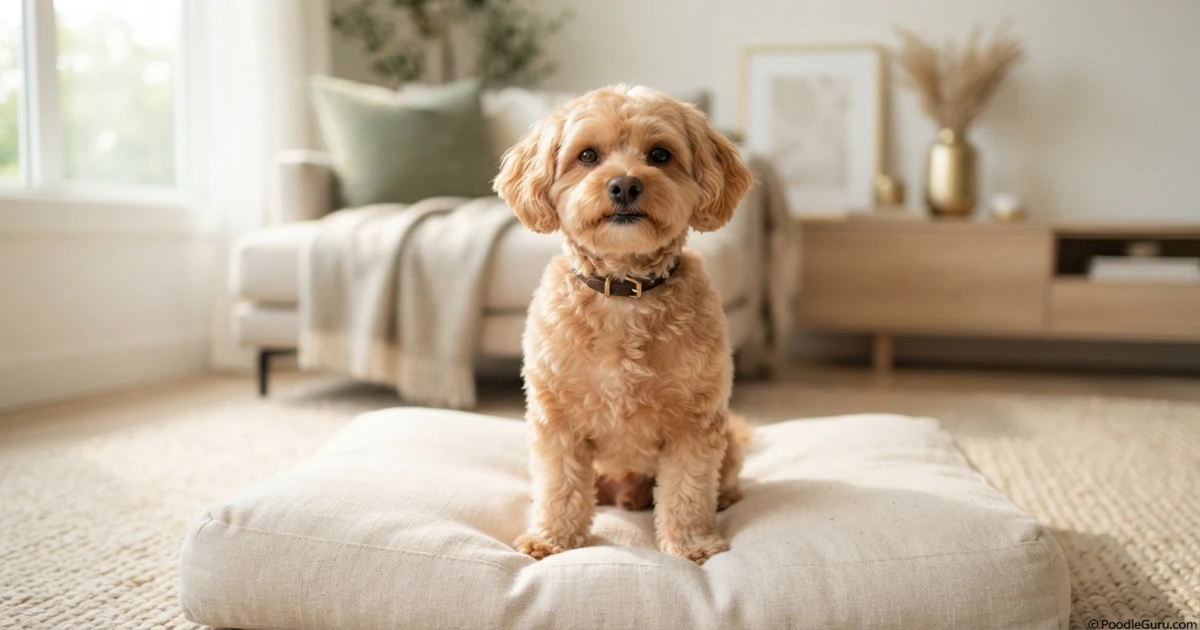
A Pugapoo is a hybrid dog produced by crossing a purebred Pug with a purebred Toy or Miniature Poodle. This cross falls into the “designer dog” category, first gaining popularity in the early 2000s as people looked for a smaller companion with a Pug’s charm and a Poodle-influenced coat.
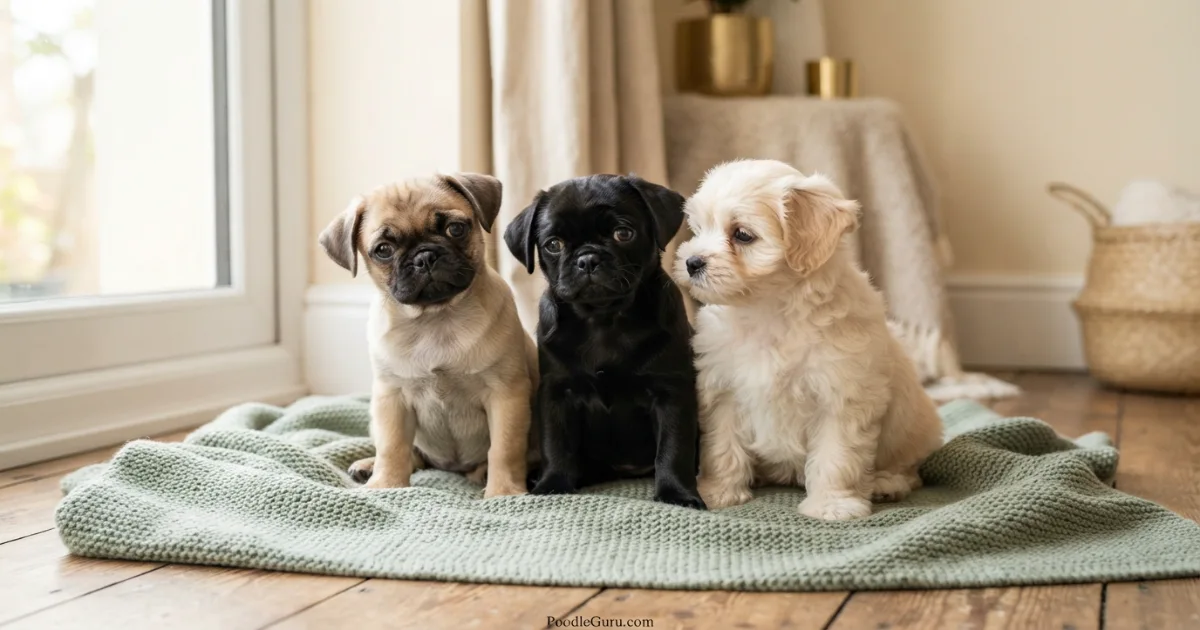
The goal is a sturdy little dog with a playful, clownish personality and a coat that may shed less than a typical Pug. But as with any mixed breed, puppies can inherit traits from either parent in unpredictable ways. You might get a curly Poodle coat or a shorter, denser Pug-like coat. You might get the Pug’s flat face or a slightly longer muzzle. That variability is the single most important thing to understand before falling in love with the idea of a Pugapoo.
For poodle enthusiasts considering a cross, the Pugapoo represents a different experience than a purebred Poodle. The mix tends to be less athletic, more heat-sensitive, and potentially more stubborn — but also deeply affectionate and famously funny.
Quick Facts at a Glance
Size
10–15 inches tall
Weight
10–20 lbs (some can reach 25 lbs)
Coat
Wavy or curly; low-to-moderate shedding
Lifespan
12–15 years with proper care
Temperament
Affectionate, clever, sometimes stubborn
Energy Level
Moderate — short walks, indoor play
Temperament & Personality: What Owners Should Actually Expect
The Pugapoo personality is a blend of the Pug’s comedic, people-pleasing nature and the Poodle’s intelligence. Most owners describe them as Velcro dogs — they want to be wherever you are, preferably on your lap.
They’re generally excellent with older children and other pets when socialized early. However, the Pug side can bring a touch of stubbornness. You’ll often see a dog that’s smart enough to learn commands quickly but also independent enough to decide when it’s worth obeying. Short, positive training sessions work best.
Be aware: the Pugapoo can be prone to separation anxiety. They bond intensely with their people and don’t do well left alone for long hours. If your household is empty most of the day, this may not be the ideal mix.
Compared to a purebred Poodle, expect less drive and more couch-potato energy. That said, they still need daily walks and mental stimulation. A bored Pugapoo can become noisy or destructive.
Size & Appearance: Not a One-Size-Fits-All Mix
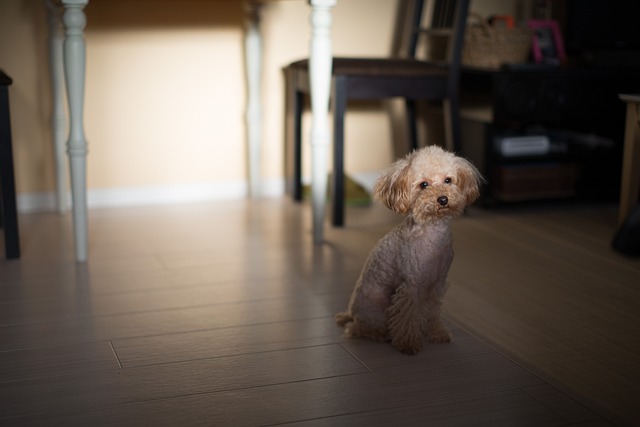
Because the Poodle parent can be Toy or Miniature, adult Pugapoos range considerably. Most fall between 10 and 15 inches at the shoulder and weigh 10–20 pounds, but it’s not unusual to see a larger Miniature Poodle cross tipping the scale at 22–25 pounds.
The body is typically compact and sturdy like a Pug’s, with legs slightly longer than a pure Pug’s. The tail may curl over the back or be carried high. Ears are usually floppy, and the muzzle length varies — the single most important factor for breathing health.
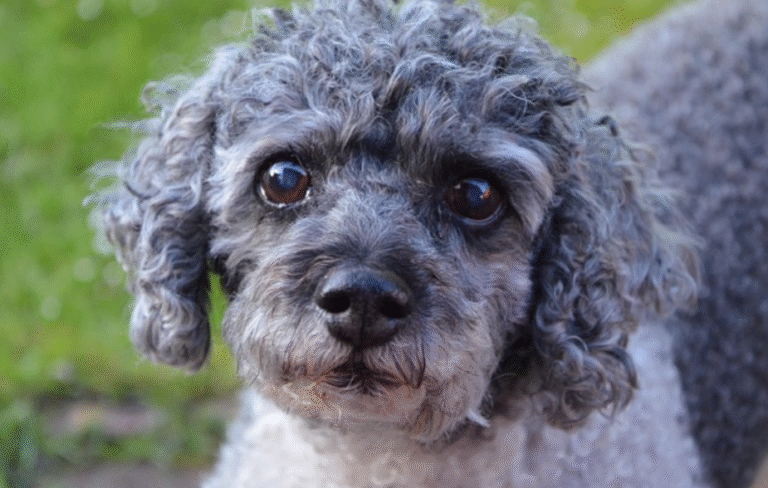
Coat colors include fawn, apricot, black, cream, silver, and brindle. Some puppies are born with a darker coat that fades to a lighter shade over the first two years, a common Poodle trait.
Coat & Grooming Reality
The coat is often the reason buyers choose a Pugapoo, but the reality is messier than the “hypoallergenic” marketing suggests. No dog is guaranteed allergy-safe, and dander, saliva, and individual sensitivity all matter. A Pugapoo’s coat can be:
- Curly (Poodle-dominant): tight curls, minimal shedding, requires daily brushing and professional grooming every 6–8 weeks.
- Wavy (mixed): the most common type — moderate shedding, mats easily behind the ears and under the collar. Brush 3–4 times a week.
- Short and dense (Pug-dominant): sheds heavily, much like a Pug. Minimal brushing needed, but you’ll find hair everywhere.
There’s no guarantee a Pugapoo won’t shed. If allergies are a serious concern, meet the specific puppy’s parents and spend time with the litter before committing. And never skip professional grooming — matting leads to skin infections fast.
Health: What You Must Know Before You Fall in Love
The Pugapoo faces a unique set of health concerns pulled from both parent breeds. The most serious is brachycephalic obstructive airway syndrome (BOAS), inherited from the Pug side. VCA Animal Hospitals explains that brachycephalic airway issues can include narrowed nostrils, elongated soft palate, and compromised cooling ability. Dogs with very short muzzles may snort, wheeze, overheat easily, or struggle during exercise.
A Pugapoo with a moderate muzzle and open nostrils is more likely to breathe comfortably than one with an extreme flat face. That is why muzzle length, nostril openness, heat tolerance, and quiet breathing at rest are the first things a savvy buyer discusses with a veterinarian or health-focused breeder. If the Pug parent has severe airway signs and the breeder dismisses them, the risk becomes harder to justify.
Other common issues include:
- Patellar luxation: slipping kneecaps, common in small breeds.
- Hip dysplasia: especially in larger Pugapoos.
- Eye problems: dry eye, entropion, and progressive retinal atrophy (PRA) appear in both parent breeds.
- Obesity: Pugapoos gain weight easily and quickly — joint stress follows.
- Skin fold dermatitis: if facial wrinkles are present, they need daily cleaning.
Responsible breeders screen for these conditions and share health clearances openly. If a breeder dismisses health testing or claims “hybrid vigor” eliminates all risks, walk away.
5 Red Flags That Scream “Avoid This Breeder”
Designer dogs attract both excellent breeders and opportunistic puppy mills. These warning signs separate the two:
- No health testing for parent dogs. Both Pugs and Poodles have known genetic conditions. Walk away if the breeder cannot show relevant health documentation, including patella, eye, and breed-appropriate orthopedic or genetic screening.
- Multiple designer crosses available at once. A breeder offering Pugapoos, Cockapoos, and Maltipoos simultaneously is likely a commercial operation, not a specialist.
- Puppies always available. Ethical breeders have waitlists, not a constant supply of 8-week-olds.
- Pressure to buy immediately. A good breeder wants to vet you as much as you vet them.
- No return policy or health guarantee in writing. Reputable breeders will take a dog back at any point if you can’t keep it.
For Poodle-specific buyer guidance, our list of questions to ask a Poodle breeder translates well to mixed breeds.
Pugapoo Price Guide (2026): What You’ll Actually Pay
- Ethical breeder: $1,500 – $3,200 (health-tested parents, limited registration, early socialization)
- Pet store or broker: $2,500 – $5,000+ (often no health guarantees; high-pressure sales)
- Rescue or rehome: $200 – $600 (adoption fees; adults and seniors often available)
What inflates the price: rare coat colors (like silver or blue), “teacup” sizing claims, and breeders who charge extra for “designer” labeling without adding any value. A higher price does not equal a healthier puppy.
Training & Socialization: Working With the Pugapoo Brain
Pugapoos are bright, but their attention span can be short. Training sessions of 5–10 minutes, twice daily, work far better than long drills. Use high-value treats (tiny pieces of chicken or cheese) and lots of praise.
House training can take a bit longer than with a pure Poodle. Consistency is everything. Crate training helps enormously and also gives a Pugapoo a safe den when they need quiet time.
Early socialization is non-negotiable. Expose your puppy to different people, gentle dogs, surfaces, and sounds between 8 and 16 weeks. A well-socialized Pugapoo is confident and adaptable; an under-socialized one can become fearful or snappy.
Pug vs. Poodle vs. Pugapoo: A Side-by-Side Look
| Trait | Pug | Toy/Mini Poodle | Pugapoo |
|---|---|---|---|
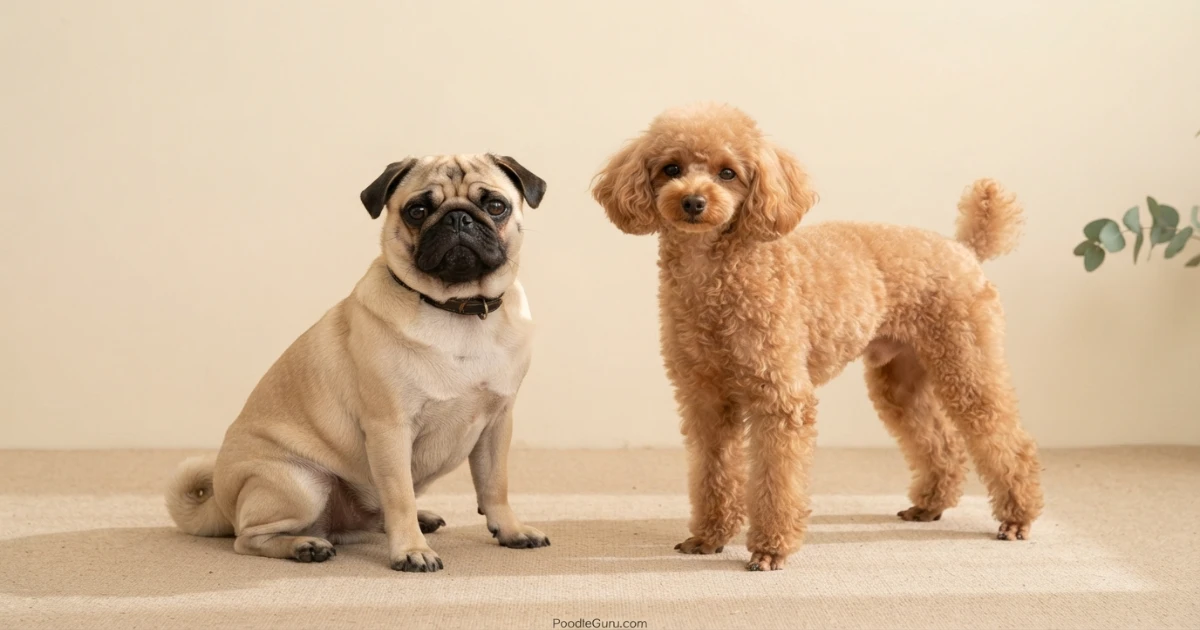
| Weight | 14–18 lbs | 4–15 lbs | 10–20 lbs |
| Shedding | Heavy | Minimal | Low to moderate (varies) |
| Exercise Needs | Low | Moderate to high | Moderate |
| Trainability | Can be stubborn | Highly trainable | Smart but easily distracted |
| Breathing Issues | Common (BOAS) | Rare | Risk depends on muzzle length |
| Grooming | Minimal | High | Moderate to high |
| Best For | Laid-back homes | Active, allergy-conscious owners | Companion-focused owners with moderate activity |
This unique combination of attributes — especially the BOAS risk gradation — is something you won’t find in most generic Pugapoo articles. At PoodleGuru, we evaluate mixed breeds by first understanding the extremes of each parent, then mapping where a cross might land.
The PoodleGuru Pugapoo Evaluation Framework
When we assess a Pugapoo for a prospective owner, we look at five dimensions — what we call the “Five-Point Design Check.” You can use this yourself when evaluating a litter or adult dog:
1. Muzzle & Breathing
The single most important factor. A longer muzzle dramatically improves quality of life.
2. Coat Type & Shedding
Curl pattern determines grooming commitment and allergen load.
3. Body Condition Score
Pugapoos hide weight gain well. Feel the ribs, don’t rely on sight.
4. Parent Health Clearances
OFA hips, patellas, eyes, and PRA DNA testing for both parents.
5. Temperament Stability
Observe the puppy’s response to novelty, handling, and brief separation.
This framework is a PoodleGuru original, created to bring clarity to a decision that’s too often driven by emotion alone.
How to Evaluate a Pugapoo Breeder in 4 Steps
Request Health Testing Documentation
Ask for relevant health-testing documentation for both parents: patella and eye clearances, PRA DNA results where appropriate, and orthopedic screening for larger lines. No documents, no puppy. This is the line that separates ethical breeders from everyone else.
Meet the Mother Dog On-Site
The dam should be calm, clean, and comfortable with strangers. Her temperament is a strong predictor of puppy behavior. If you can’t meet her, that’s a red flag.
Assess Muzzle Structure of Both Parents
Look at the length of the muzzle on both the Pug and the Poodle. A very flat-faced Pug parent, especially one with noisy breathing or narrow nostrils, increases concern for breathing trouble in puppies.
Get a Written Contract and Health Guarantee
The contract should spell out return policies, health guarantee terms, and spay/neuter expectations. If anything feels vague, ask for clarification.
Frequently Asked Questions About Pugapoos
Are Pugapoos hypoallergenic?
No dog is truly hypoallergenic. Pugapoos with curly Poodle coats may shed less, but there is no guarantee because allergens also come from saliva and dander. Spend time with the specific dog before committing if allergies are a concern.
Do Pugapoos bark a lot?
They can be alert barkers, but they’re not typically excessive. Proper training and mental stimulation reduce nuisance barking. A bored Pugapoo, however, will find ways to make noise.
How much exercise does a Pugapoo need?
About 30–45 minutes of daily walking plus playtime. Avoid vigorous exercise in hot weather — the Pug influence makes them prone to overheating.
Are Pugapoos good with kids?
Yes, when socialized early. They’re sturdy enough for gentle play but should be supervised with very young children who might handle them roughly.
What’s the difference between a Pugapoo and a Puggle?
A Puggle is a Pug-Beagle mix, while a Pugapoo is a Pug-Poodle mix. Puggles tend to shed more and have a stronger prey drive; Pugapoos are often lower-shedding and more people-focused.
Can Pugapoos be left alone?
Not for long periods. They’re prone to separation anxiety and do best in homes where someone is around most of the day. Crate training and gradual alone-time practice help.
Do Pugapoos have breathing problems?
Not all do, but the risk is real if the muzzle is very short. Choose a puppy with at least a moderate muzzle length, and watch for signs like noisy breathing or exercise intolerance.
Key Takeaways: Pugapoo Ownership in 2026
- A Pugapoo is a Pug-Poodle mix weighing 10–20 lbs with a low-to-moderate shedding coat.
- Temperament is affectionate, clever, and companion-focused — but separation anxiety is a real risk.
- Muzzle length is the #1 health predictor; choose a puppy with a visible nose and open nostrils.
- Grooming needs range from moderate (wavy coat) to high (curly coat); professional grooming is essential every 6–8 weeks.
- Reputable breeders provide documented health testing for both parent dogs — no exceptions.
- Expect to pay $1,500–$3,200 from an ethical breeder in 2026; higher prices don’t guarantee better health.
- This mix thrives in homes where someone is present most of the day and can commit to daily short walks and training.
Ready to take the next step? Use The PoodleGuru Evaluation Framework above as your personal checklist when you visit a breeder or rescue.